

Arkady Dvorkovich meets with President of Kazakhstan
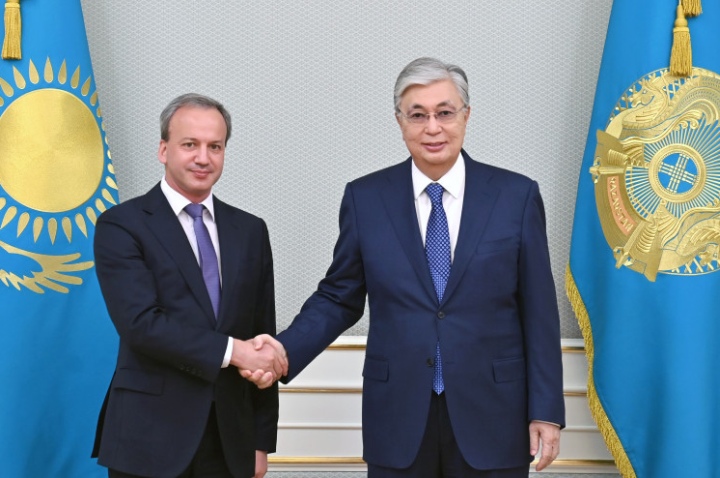
On September 29, FIDE President Arkady Dvorkovich met with President of Kazakhstan Kassym-Jomart Tokayev. Opening the conversation, Kassym-Jomart Tokayev congratulated Arkady Dvorkovich on his recent re-election as president of the International Chess Federation (FIDE). During the meeting Arkady Dvorkovich briefed the President of Kazakhstan about the FIDE Women’s Grand Prix Series, which brought together 12 strongest chess players of the world in Astana. Kassym-Jomart Tokayev noted that events of this level make a significant contribution to the development of chess sport in our country. “Chess is very popular in Kazakhstan, especially among children and young people. We have more than seven thousand chess clubs and classes, but we need to increase this number at least twofold. Now there are more than 200,000 people involved in chess. Kazakhstani chess players successfully perform at international competitions. We pay great attention to chess. A roadmap for the development of chess is in place and we are planning to launch a large project Chess in Schools” Tokayev said. In turn, Arkady Dvorkovich expressed his gratitude to Kassym-Jomart Tokayev for his personal support and promotion of chess in Kazakhstan, and also expressed FIDE’s readiness to share its successful international experience in introducing chess into the school curriculum. The participants of the meeting exchanged opinions on long-term cooperation between Kazakhstan and FIDE and discussed the prospects of holding major international tournaments in the country. Text and photos: akorda.kz/
2022 African Chess Championship: Bassem Amin and Shahenda Wafa claim titles
Egyptian players dominated the 2022 African Individual Chess Championship winning gold in both open and women’s sections. The competition took place in Lagos, the largest city in Nigeria, from September 18-27 and brought together 93 participants from 27 African countries. Both championships were 9-round Swiss tournaments with classical time control. FIDE President Arkady Dvorkovich opened the 2022 African Individual championship and made the first ceremonial move in the competition. The open event turned into an exciting race of two rating favourites and compatriots, GMs Bassem Amin (pictured below) and Ahmed Adly, who were in the lead from start to finish. Coming into the final round a half-point ahead of Amin, Aldy managed only a draw against Dante Beukes. His main competitor jumped on the opportunity and caught up with Aldy after defeating Kenny Solomon. Photo by Madelene Belinki Just like a year before, the two Egyptian GMs tied for first place with an excellent score of 8/9, but this time around, the tiebreaks (rating average of the opponents) favoured Bassem Amin, who won his sixth title of African champion. Another Egyptian GM, Hesham Abdelrahman, finished third. Final standings Open: 1 GM Amin Bassem EGY 2663 8 2 GM Adly Ahmed EGY 2578 8 3 GM Hesham Abdelrahman EGY 2374 7 4 IM Silva David ANG 2315 6 5 IM Rakotomaharo Fy Antenaina MAD 2492 6 6 IM Ortega Amarelle Mariano CPV 2474 6 7 IM Beukes Dante M NAM 2295 6 8 FM Adebayo Adegboyega Joel NGR 2267 6 9 Eyetonghan Denyefa Callistus NGR 2079 5½ 10 IM Okeke Isaac Chukwudalu NGR 2180 5½ In the women’s section, the top-seed Shahenda Wafa (pictured below) of Egypt lived up to the expectations and took gold after netting 7/9. The champion finished a half-point ahead of Charlize Van Zyl (South African Republic) and Bridget Michael (Nigeria), who scored critical final-round victories and tied for second place on 6.5/9. The silver medal goes to Charlize by dint of the higher rating average of her opponents. Photo by Lennart Ootes Final standings Women: 1 WGM Wafa Shahenda EGY 2110 7 2 WIM Van Zyl Charlize RSA 1710 6½ 3 Michael Bridget NGR 1800 6½ 4 WFM Luzia Pires ANG 1839 6 5 WCM Ampaire Shakira UGA 1657 5½ 6 Onoja Iyefu Joy NGR 1762 5½ 7 Paulo Jemima ANG 1886 5½ 8 Ofowino Toritsemuwa NGR 1857 5½ 9 WFM Oloruntola Oluwatobiloba NGR 1918 5½ 10 WFM Mbatha Constance ZAM 1613 5
Huge excitement in Astana WGP
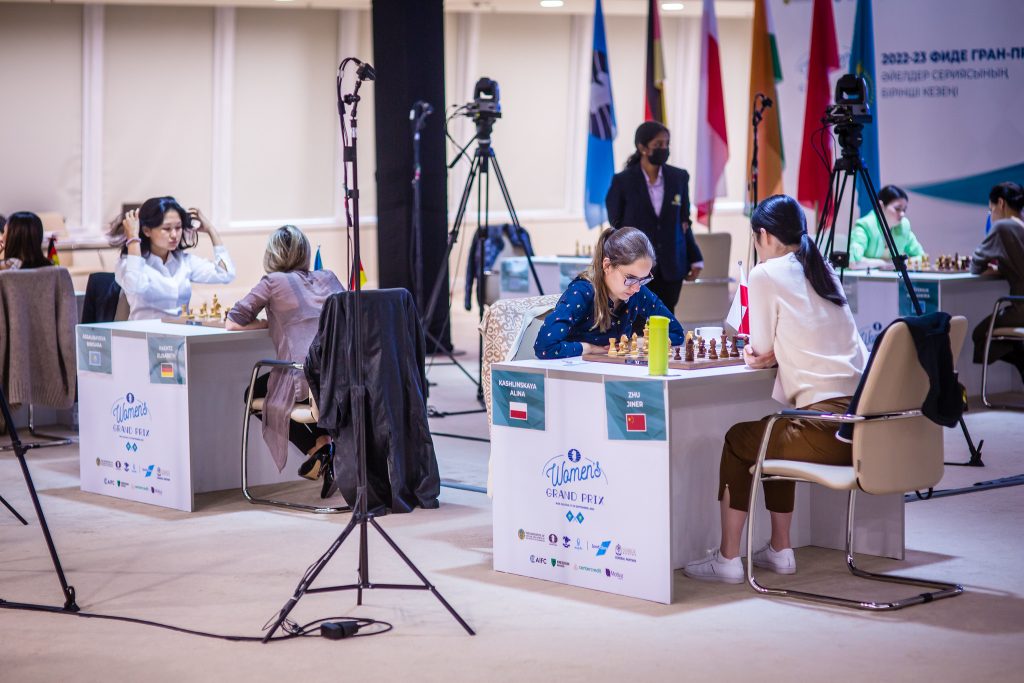
Kateryna Lagno leads the tournament with one round to go The tenth round of the Astana Women’s Grand Prix started off with two very quick draws by three-fold repetition. One of them seemed like an intelligent strategic decision by Kateryna Lagno in an effort to retain her top position in the standings and pile the pressure on her main rival, Aleksandra Goryachkina. With one round to go, Kateryna Lagno leads with 7½/10, Aleksandra Goryachkina is second with 7, and Zhu Jiner is third, sitting on 6 points. Tomorrow’s round will start at 1 pm instead of 3 pm and features several interesting match-ups. Kosteniuk vs Lagno and Vaishali vs Goryachkina will be the two main games of the day in the fight for clear first, while Zhu Jiner will be playing with White for second place and possibly a GM norm. Lagno, Kateryna — Abdumalik, Zhansaya (0.5-0.5) The round had practically just begun, and the first game ended in a draw. Playing with Black, Zhansaya Abdumalik, who already made a quick draw against Goryachkina yesterday, proposed the Zaitsev system in the closed Ruy Lopez. Half a point ahead of her rivals in the standings, Kateryna Lagno probably thought it was a good idea to go for a well-known theoretical move repetition, forcing a draw and extending her lead to a full point with a round to go. As a side note, the clocks showed 1:32,59 for Lagno and 1:34,18 for Abdumalik – players start with 1:30,30 with a 30-second increment. Shuvalova, Polina — Vaishali, Rameshbabu (0.5-0.5) The second game to finish in a draw was also a quick one. Saved by the bell and arriving just on time to the venue, Polina Shuvalova went for a side-line against Vaishali’s Sicilian Sveshnikov, which leads to a forced perpetual check for Black. Both players blitzed out their moves, which makes me think that they were content with the decision, making a draw in less than twenty moves. Goryachkina, Aleksandra — Kosteniuk, Alexandra (0.5-0.5) Undoubtedly the most important game of the round. Pressured from the start by Lagno’s draw, Goryachkina, who turns 24 today, needed a win to tie for first and go into the last round with options to win the tournament. According to my database, previous encounters between both of them produced a head-to-head record of 9-7 for Kosteniuk, although a few of the games were played when Goryachkina was still a junior. Nonetheless, Kosteniuk eliminated Goryachkina in the 2021 World Cup final last year, a huge result for her. Kosteniuk went for the very solid Slav Defence main line and, slightly surprised, Goryachkina spent 8 minutes and chose the side-line 12.e5 – there are several more popular options such as 12.Bf4 or 12.Rd1. The second key moment of the game occurred on the move fourteen when Goryachkina refrained from exchanging bishops on g6, weakening Black’s kingside. Kosteniuk seized her chance, exchanged most of the pieces on the c1 square and headed for an equal queen + knight ending in which both players agreed on a draw by three-fold repetition on the move thirty. Alexandra Kosteniuk gave us her thoughts on the game in a short interview. Kashlinskaya, Alina — Zhu, Jiner (0-1) Poland’s number one female player Alina Kashlinskaya started off the Grand Prix in great shape, but she has been struggling to find her form in the last few rounds. According to my database, she had played twice against Zhu Jiner previously, a draw in the Chinese Team Championship in 2017 and a loss last year in the 2021 Grand Swiss. In today’s game, by move transposition, the position resembled a classical isolated d-pawn structure. While Zhu Jiner was preparing to blockade the d5 square and finish her development, Kashlinskaya uncorked a seemingly promising bishop sacrifice, destroying the kingside of her opponent. She followed it up with a clean rook sacrifice that couldn’t be accepted because of mating threats. However, as Zhu Jiner explained in her post-game interview, she had it under control: although she was slightly worried, she didn’t think it was correct. The continuation of the game proved her point. With precise 17…Qf4! the Chinese player cold-bloodedly repelled White’s threats and forced Kashlinskaya’s resignation on move 24. Assaubayeva, Bibisara — Paehtz, Elisabeth (0-1) Although German’s number one female player hasn’t been in top form in Astana, she played a very nice positional game in the Carlsbad structure today with Black against Bibisara Assaubayeva. Her plan based on 26…b5 followed up by the kingside attack worked perfectly and netted her the full point in a key moment of the tournament. In her post-game interview, Paehtz reflected on her opponent’s playing style and experience when deciding her game strategy. She also discussed some of the issues that top women players have faced since the end of the pandemic. Tan Zhongyi — Wagner, Dinara (1-0) With her third win in the last four games, Tan Zhongyi made a huge step today to fight for fifth place in the tournament. Playing fast and confidently, she prevailed over Dinara Wagner in a masterfully played two bishops against a two-knight endgame. In fact, as FIDE’s General Director GM Emil Sutovsky shared on Twitter, the ending has a striking similarity to game 23 of the 1951 Botvinnik vs Bronstein World Championship Match. In her post-game interview, Tan Zhongyi discussed with Press Officer IM Michael Rahal her style of play and handling of the clock. Round 11 (final round) | Astana | 29.09.2022 Wagner, Dinara — Shuvalova, Polina Paehtz, Elisabeth — Tan, Zhongyi Zhu, Jiner — Assaubayeva, Bibisara Abdumalik, Zhansaya — Kashlinskaya, Alina Kosteniuk, Alexandra — Lagno, Kateryna Vaishali, Rameshbabu — Goryachkina, Aleksandra Text and interviews: IM Michael Rahal, FIDE Press Officer, Astana Photos: Anna Shtourman
FIDE’s statement on sexist remarks

During yesterday’s Women’s Grand Prix live broadcast, one of the announcers expressed some very embarrassing comments. Although we have great respect for Grandmaster Ilya Smirin as a chess player, the views he expressed on air are completely unacceptable, offensive, and do not represent any of the values that FIDE stands for. Therefore, we unreservedly apologise to all those who were offended. Additionally, GM Smirin will not continue as a FIDE commentator with immediate effect. FIDE not only strives to increase women’s representation in professional sports and official positions but also to change the perception of chess as purely a men’s world. Our community has to be a place where women feel safe and respected. Therefore, any action that carries disrespect, sexism or physical, verbal or emotional assault is unacceptable.
FIDE Chessable Academy resumes in October
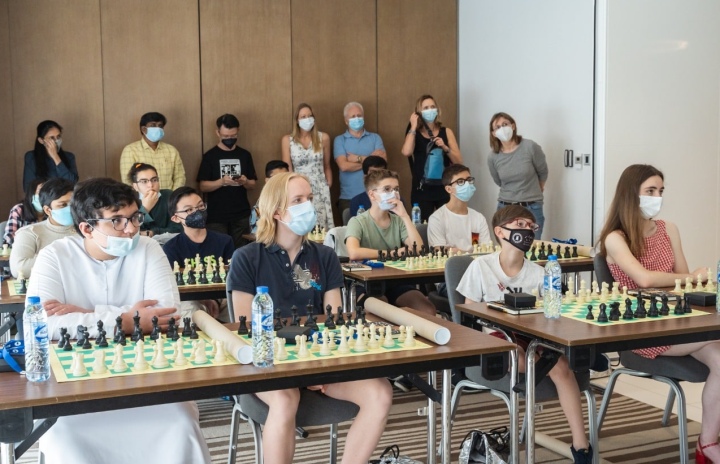
FIDE Chessable Academy will resume in October 2022 after taking a break for the FIDE World Chess Olympiad held in Chennai, India. This grassroots and young talent development program is now in its second year, with 336 students between the ages of 8 to 16 from 72 National Chess Federations returning for the final two months of lessons this year. Classes are conducted online on Chessable Classroom, every weekend, and each lesson is two hours where students are divided into ten groups in three time zones, New York, Berlin, and Moscow, and held in English, Spanish and Russian, accommodating all levels of students right up to Grandmaster level. Lecturers for this last semester in 2022 are leading trainers Ramesh RB, Igor Stohl, Alexey Kuzmin, Farrukh Amonatov, Melikset Khachiyan, Mikhail Kobalia, Alonso Zapata, Bernal Gonzales and Michael Oratovsky. The program is developed and administered by FIDE Trainers Commission with sponsorship from Chessable.
FIDE WGP: Kateryna Lagno takes the lead in Astana
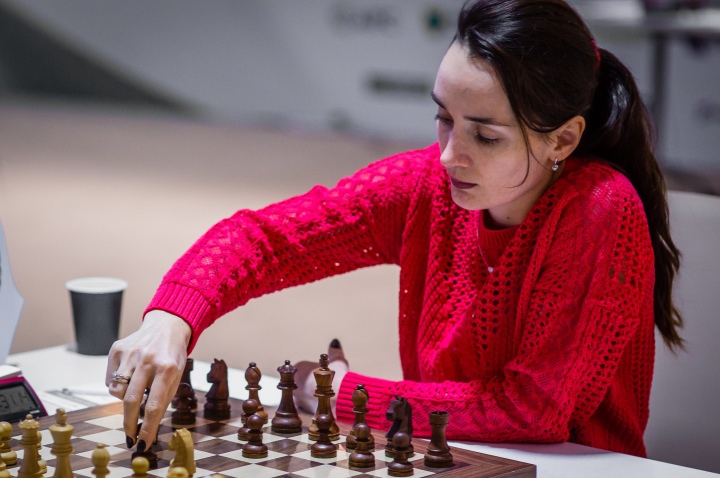
With two rounds to go, Kateryna Lagno is a half-point ahead of Aleksandra Goryachkina The Kazakhstan Chess Federation, in close collaboration with FIDE, is leaving no stone unturned in their desire to provide a clean and safe environment for the Women’s Grand Prix in Astana. One of the main concerns is guaranteeing that the players feel comfortable as soon as they arrive at the Astana Business Hub. The venue is spacious and well-lit, and players can access a special rest area with beverages, fruit and sweets. High-tech digital boards and clocks are being used for the games, and three different types of chairs are provided. With regard to anti-cheating, guarantees are solid. Among other measures, no spectators are allowed in the playing area, all participants are scanned before the game and randomly after the game, and there is a 15-minute delay on the live broadcast. Games will be won or lost, but from my point of view, both the hotel and the venue conditions are excellent. Abdumalik, Zhansaya — Goryachkina, Aleksandra (0.5-0.5) In the first game to finish, Zhansaya Abdumalik and Aleksandra Goryachkina repeated a well-known theoretical draw in the Ruy Lopez. Abdumalik scores half a point against the tournament leader while Goryachkina stays in the lead and saves energy for tomorrow’s important game against Kosteniuk As a side note, Aleksandra turns 24 tomorrow: a chance to celebrate with a quiet birthday dinner. However, this result did give Kateryna Lagno the chance to move into the sole lead if she defeated Zhu Jiner: stay tuned to find out! Tan, Zhongyi — Shuvalova, Polina (0-1) Although they have never faced each other in classical chess over the board, Tan Zhongyi defeated Polina Shuvalova by 17-10 in a gruelling 27-game match in the 2022 Women’s Speed Chess Championship. Shuvalova decided to repeat the Nimzo-Indian defence that she already used against Kashlinskaya in the fifth round, but Tan Zhongyi quickly deviated from the main line, going for a solid Ragozin exchange setup. Soon a d4-isolani position appeared on the board: active play for White’s pieces in exchange for the weak d4 isolated pawn. The crucial moment was when Tan Zhongyi invaded the seventh with her rook, which was a double-edged idea. Shuvalova tried to trap it, and in mutual time-trouble peppered with mutual errors, she managed to outplay her opponent and score her second win in a row. Polina was kind enough to give her insights into the game in an interview with FIDE Press Officer Michael Rahal. Wagner, Dinara — Assaubayeva, Bibisara (0.5-0.5) I could only locate two previous games between these two contenders: a win and a draw in favour of Wagner. With both players on 3.5/8, a win in this important game would catapult one of them to 50%. For today’s game, Assaubayeva, with Black, went for the popular Schallopp variation in the Slav defence: a new opening in this event. Possibly surprised by Wagner’s 10.0-0-0 (both 10.h3 and 10.g3 are far more common), Assaubayeva uncorked the unexpected novelty 10…a5!? And Wagner allowed the pawn to advance to a3, a thorn in the side of her castled king. After the exchange of queens, the game remained balanced for a while. Assuabayeva took advantage of Wagner’s deep time trouble to win a pawn, and even went into a rook ending with two extra pawns. But as they say, “All rook endings are drawn”, and today’s endgame wasn’t an exception. Paehtz, Elisabeth — Kashlinskaya, Alina (0.5-0.5) The German number one female player has generally had good results when facing Poland’s number one. According to the database, they have played classical games five times, with a four to one favourable score for Elisabeth. For the first time in this tournament, Kashlinskaya went for the Nimzo-Indian defence, against which Paehtz chose the popular Bd3-Nge2 setup. After the adventurous 8…e5!?, Paehtz spent 22 minutes evaluating the consequences of grabbing a pawn with 9.Bxf7+ and more than half an hour to calculate 12.Nf4, played back in 2010. It’s unclear whether the pawn sacrifice was preparation – you can argue that there is some compensation for Black – but at least Kashlinskaya was well ahead on the clock. Given her impending time trouble, Paehtz decided to return the extra pawn for an easier game, and after some more exchanges, a peaceful draw was agreed. Zhu Jiner — Lagno, Kateryna (0-1) In their first game face-to-face, Lagno went for the Four Knights Sicilian, which Elisabeth Paehtz has already used a couple of times in this tournament. Zhu Jiner chose the main line with White, but Lagno had prepared a reputable side-line (8…Bb7 instead of 8…Qc7). Zhu Jiner wasn’t caught by surprise. She blitzed out the best moves according to modern theory, momentarily sacrificing a pawn along the way. Lagno returned the pawn a few moves later, and the position remained equal. According to the computer, Zhu Jiner missed a huge chance with 25.a4! (instead of 25.Rc4) with the idea of 26.f5 and 27.Nxd7 in many variations. I also discussed these variations with Lagno before her interview, and she sensed that she might be in danger. However, Zhu Jiner wasn’t on her day and had a blackout. She went for a direct tactical attack but missed that after 28.exf6? she was losing the bishop on c5, which wasn’t hanging before. After losing two games in a row (against the two leaders), she still maintains her third place but is no longer a contender for the top spot in Astana. With this win, Lagno is the sole leader, half a point ahead of Aleksandra Goryachkina. But with two games to go, anything can happen, as she reminded us in her post-game interview. Kosteniuk, Alexandra — Vaishali, Rameshbabu (1-0) In spite of only having played one classical game (which ended in a draw), Kosteniuk and Vaishali clashed in one of the rounds of the 2020 Women’s Speed Chess Championship, which Kosteniuk won by 7-4. Against Vaishali’s Sicilian Defence, Kosteniuk went for the Rossolimo Attack and achieved a small edge in the opening. It’s
Winners crowned at FIDE World Cadet Championship
The FIDE World Cadet Chess Championship 2022 in the U8, U10 and U12 categories is in the books. In the final round, the participants, especially those contesting for medals, showed real fighting spirit. Not all the favourites made it to the podium, giving way to uprising lower-rated players. For example, in the Under 8 Open section, Indian Safin Safarullakhan (number 26 on the starting list) climbed as high as the third position in the final standings and took bronze. In the U8 Girls section, Lila Rzadkowska from Poland (19th on the starting list) also claimed bronze. On the other hand, in all other categories, the medals went to the top-10 rated participants. Final results in each category: U8 Open Llari Marc (FRA) Shogdzhiev Roman (FID) Safin Safarullakhan (IND) U10 Open Lacan Rus David (FRA) Smirnov Mark (KAZ) Liu Patrick (USA) U12 Open Uskov Artem (FID) Movahed Sina (IRI) Besou Hussain (GER) U8 Girls Charvi A (IND) Sivanandan Bodhana (ENG) Rzadkowska Lila (POL) U10 Girls Venskaya Nika (FID) Bassari Senem Gul (TUR) Siskou Evangelia (GRE) U12 Girls Shubhi Gupta (IND) Yousefian Maedeh (IRI) Goriachkina Oksana (FID) FIDE President Arkady Dvorkovich, who attended the final round, President of Georgian Chess Federation George Giorgadze and Akaki Iashvili, welcomed participants, coaches, guests and special guests at the closing ceremony as well as awarded winners. In his speech, Mr Iashvili mentioned that next year Batumi, Georgia, would host the World Cadet Rapid and Blitz Championships U8, 10 and 12, cementing the city’s status in the chess circuit. The winners were awarded diplomas, medals, cups, laptops and Apple devices. Photos : Mark Livshitz
Fifth Chess in Education Lecturer course announced

The International Chess Federation, together with its Chess in Education Commission (EDU) and “Chess” Scientific Research Institute (CSRI), is pleased to announce the 5th Chess in Education Lecturer course. The course will be held 28-30 October, in English, online 15:00-20:00 CET. The objectives of the course: To develop and enhance the skills of effective teaching of chess basics To enhance the ability of using active and interactive teaching methods To improve positive professional communication skills The target audience of the course is professionals with experience in chess and education. Duration and content: 3 days – 15 hours (including breaks) + Project. Day 1 Introduction (100 minutes); Fear – both teachers’ fear and your fear of exam! Teaching the chessboard. (130 minutes) Project assignment (10 minutes)
FIDE Statement on the Carlsen – Niemann polemic

Last week, World Champion Magnus Carlsen resigned in a game played in an online competition against GM Hans Niemann before making his move two. The week before, he left an over-the-board tournament after losing the game to the same Mr. Niemann. These were not FIDE events; however, as the world’s chess governing body, it is our duty to protect the integrity of the game and its image, and in view that the incident keeps escalating, we find it necessary to take a step forward. First of all, we strongly believe that the World Champion has a moral responsibility attached to his status, since he is viewed as a global ambassador of the game. His actions impact the reputation of his colleagues, sportive results, and eventually can be damaging to our game. We strongly believe that there were better ways to handle this situation. At the same time, we share his deep concerns about the damage that cheating brings to chess. FIDE has led the fight against cheating for many years, and we reiterate our zero-tolerance policy toward cheating in any form. Whether it is online or “over the board”, cheating remains cheating. We are strongly committed to this fight, and we have invested in forming a group of specialists to devise sophisticated preventive measures that already apply at top FIDE events. As we have already done before, FIDE calls for reinforcing the cooperation between major online platforms, private events and top players – most of whom have already expressed their will to join efforts with FIDE. FIDE is prepared to task its Fair Play commission with a thorough investigation of the incident, when the adequate initial proof is provided, and all parties involved disclose the information at their disposal. We are fully aware that, in some cases, uncertainty can harm players’ performance. It also can be damaging to a player’s reputation – that’s why we insist on the anti-cheating protocols to be followed. It is our hope that this whole situation could have a long-term positive effect, if tackled properly. We propose to launch a dedicated Panel, that would include representatives of the leading chess platforms, Grandmasters, anti-cheating experts and FIDE officers, in order to fight this risk and prevent it becomes a real plague. Arkady Dvorkovich FIDE President
FIDE WGP: Goryachkina and Lagno head-to-head in Astana
Five decisive results in the eighth round of the Women’s Grand Prix The amount of decisive results in this tournament is staggering. Not a round has gone by without at least two decisive outcomes; most rounds have between three and four, and today, no less than five of the six games finished with a winner. Compared to most of the top elite events, the drawing percentage is notoriously low, to a large extent based on the fighting spirit of the players: all of them good friends away from the board but fierce competitors when the games begin. All eyes were on two key games this afternoon. The clash between the two leaders, Aleksandra Goryachkina and Zhu Jiner and the game between Kateryna Lagno (also tied for first) and Elisabeth Paehtz. Goryachkina, Aleksandra — Zhu, Jiner (1-0) Undoubtably, the most important game of the round was the clash between the two leaders, who, by the way, had never faced each other over the board before. For this important game, Goryachkina, playing White, chose the English Opening and, more specifically, the Four Knights System, which Magnus Carlsen has recently brought into fashion. I’m not sure if Goryachkina was expecting this line today, although both players were blitzing out their first moves. A previous 2019 game between Carlsen and Caruana continued with the aggressive 11.0-0-0, but Goryachkina preferred the computer suggestion 11.Be2. Zhu Jiner went into the tank for 25 minutes, visibly surprised by the turn of events. Nevertheless, she kept her cool and calculated all the best moves, exchanging queens and going into a more or less equal ending. Goryachkina did have a strong passed pawn on d6 but also some weaknesses in her own position. The Chinese teenager prodigy kept the balance most of the game until she missed 24…Kf8 and then, more importantly erred with 25…Bd7, the losing move (25…Rf8 was still holding). Goryachkina invaded the seventh rank, exchanged a pair of rooks, and after she activated her king, the d6-pawn became the decisive factor. Certain decent endgame technique was required from Aleksandra, but the result was never in doubt. Goryachkina was kind enough to join us in the press room for a short interview. Lagno, Kateryna — Paehtz, Elisabeth (1-0) The first time Lagno and Paehtz faced each other was more than twenty years ago, in the 2001 Girls U18 European Team Championship. Since then, they have played many classical games, with an overwhelming 9-0 record for Kateryna Lagno, albeit with many draws as well in the mix. Leading the event with 5/7 and with co-leaders Goryachkina and Zhu Jiner playing each other, this game was a golden opportunity for Lagno to make a stand. In a Sicilian Rossolimo, Lagno seemed slightly surprised when she spent 20 minutes for the very well-known exchange 6.Nxd4. On her side, Paehtz took her own 20 minutes to calculate the consequences of 8.Qb3. Already on the move fifteen, both players were very low in time, which would explain some of inaccurate moves by both of them during the early middlegame stage. Eventually, Lagno won a central pawn and began to consolidate. Kateryna gradually piled up the pressure with her eyes set on her opponent’s kingside. With a well-timed 44.e6! breakthrough, she won her opponent’s queen and finished off the game effortlessly. In her postgame interview, Kateryna explained to us her opening play. Assaubayeva, Bibisara — Tan, Zhongyi (0-1) Standing on 50% in the standings, Bibisara Assaubayeva was eager to take advantage of the white pieces and go for the win against Tan Zhongyi, whose play has proven to be quite unstable in Astana. Although I couldn’t find any previous classical games between them in the database, I did notice a couple of rapid games. Both players blitzed out the opening, a theoretical line of the Exchange variation of the Queen’s Gambit Declined, in which White also exchanges queen’s on f6, creating a permanent weakness on Black’s kingside in the form of doubled isolated pawns. However, the theory has more or less proven that Black’s bishop pair offers more than enough compensation, and today’s game didn’t seem to change that assessment. Essentially playing with her increment, Tan Zhongyi improved on a 2018 Kramnik-Aleksandrov game with 16…Rh-g8, with a completely equal position. At a crucial moment, going for the win, Assaubayeva sacrificed a pawn on the kingside to penetrate with her rook. Observing her games during the last few rounds, it has become apparent that Bibisara is always looking for a challenge and never backs down. She is prepared to take a risk and go with her guts. However, on this occasion, maybe she burned her bridges. With more time on her clock, Tan Zhongyi prepared a devious rook sacrifice which Bibisara unexpectedly fell for. In her postgame interview, the Chinese representative explained at what point she saw the trap. Shuvalova, Polina — Kosteniuk, Alexandra (1-0) According to my database, Shuvalova has dominated Kosteniuk in classical games by a 3-1 margin. In yesterday’s postgame interview, Polina suggested that she would try to leave behind her disastrous start and regroup in the second part of the event. With White, Shuvalova went for the fashionable London system, grabbing a pawn on the opening and subsequently defending it in exchange for a weakened pawn structure and bishop pair for her opponent. Kosteniuk could have recuperated material with 8…Bxc5 followed by 9…Qa5+, but instead preferred 8…Qf6, which the computer condemns as being clearly worse. Trying to find some compensation for the pawn, Kosteniuk spent bags of time and around move 20 was already down to her last 25 minutes on the clock: things were looking good for Shuvalova, an extra pawn and much more thinking time. However, just when Kosteniuk was again very near to equality, Shuvalova went for her last chance to complicate the game – and it worked! Kosteniuk blundered 26…exf5? (the weird 26…gxf5 was correct, with equality) and after massive exchanges, Shuvalova found herself in a completely won rook ending