

Fifth Chess in Education Lecturer course announced

The International Chess Federation, together with its Chess in Education Commission (EDU) and “Chess” Scientific Research Institute (CSRI), is pleased to announce the 5th Chess in Education Lecturer course. The course will be held 28-30 October, in English, online 15:00-20:00 CET. The objectives of the course: To develop and enhance the skills of effective teaching of chess basics To enhance the ability of using active and interactive teaching methods To improve positive professional communication skills The target audience of the course is professionals with experience in chess and education. Duration and content: 3 days – 15 hours (including breaks) + Project. Day 1 Introduction (100 minutes); Fear – both teachers’ fear and your fear of exam! Teaching the chessboard. (130 minutes) Project assignment (10 minutes)
FIDE Statement on the Carlsen – Niemann polemic

Last week, World Champion Magnus Carlsen resigned in a game played in an online competition against GM Hans Niemann before making his move two. The week before, he left an over-the-board tournament after losing the game to the same Mr. Niemann. These were not FIDE events; however, as the world’s chess governing body, it is our duty to protect the integrity of the game and its image, and in view that the incident keeps escalating, we find it necessary to take a step forward. First of all, we strongly believe that the World Champion has a moral responsibility attached to his status, since he is viewed as a global ambassador of the game. His actions impact the reputation of his colleagues, sportive results, and eventually can be damaging to our game. We strongly believe that there were better ways to handle this situation. At the same time, we share his deep concerns about the damage that cheating brings to chess. FIDE has led the fight against cheating for many years, and we reiterate our zero-tolerance policy toward cheating in any form. Whether it is online or “over the board”, cheating remains cheating. We are strongly committed to this fight, and we have invested in forming a group of specialists to devise sophisticated preventive measures that already apply at top FIDE events. As we have already done before, FIDE calls for reinforcing the cooperation between major online platforms, private events and top players – most of whom have already expressed their will to join efforts with FIDE. FIDE is prepared to task its Fair Play commission with a thorough investigation of the incident, when the adequate initial proof is provided, and all parties involved disclose the information at their disposal. We are fully aware that, in some cases, uncertainty can harm players’ performance. It also can be damaging to a player’s reputation – that’s why we insist on the anti-cheating protocols to be followed. It is our hope that this whole situation could have a long-term positive effect, if tackled properly. We propose to launch a dedicated Panel, that would include representatives of the leading chess platforms, Grandmasters, anti-cheating experts and FIDE officers, in order to fight this risk and prevent it becomes a real plague. Arkady Dvorkovich FIDE President
FIDE WGP: Goryachkina and Lagno head-to-head in Astana
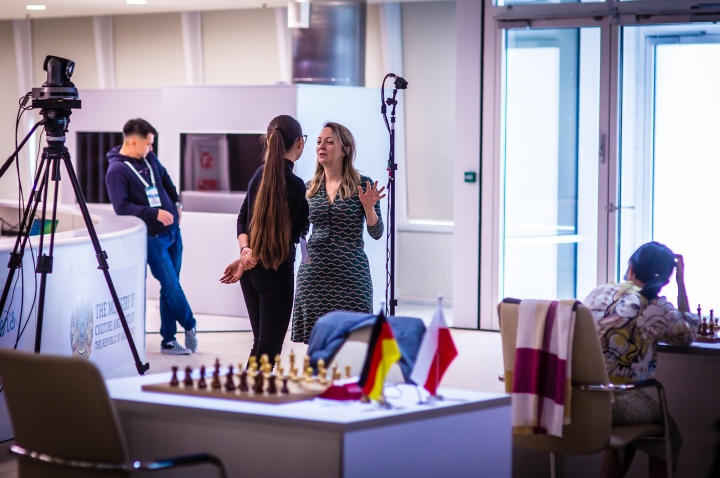
Five decisive results in the eighth round of the Women’s Grand Prix The amount of decisive results in this tournament is staggering. Not a round has gone by without at least two decisive outcomes; most rounds have between three and four, and today, no less than five of the six games finished with a winner. Compared to most of the top elite events, the drawing percentage is notoriously low, to a large extent based on the fighting spirit of the players: all of them good friends away from the board but fierce competitors when the games begin. All eyes were on two key games this afternoon. The clash between the two leaders, Aleksandra Goryachkina and Zhu Jiner and the game between Kateryna Lagno (also tied for first) and Elisabeth Paehtz. Goryachkina, Aleksandra — Zhu, Jiner (1-0) Undoubtably, the most important game of the round was the clash between the two leaders, who, by the way, had never faced each other over the board before. For this important game, Goryachkina, playing White, chose the English Opening and, more specifically, the Four Knights System, which Magnus Carlsen has recently brought into fashion. I’m not sure if Goryachkina was expecting this line today, although both players were blitzing out their first moves. A previous 2019 game between Carlsen and Caruana continued with the aggressive 11.0-0-0, but Goryachkina preferred the computer suggestion 11.Be2. Zhu Jiner went into the tank for 25 minutes, visibly surprised by the turn of events. Nevertheless, she kept her cool and calculated all the best moves, exchanging queens and going into a more or less equal ending. Goryachkina did have a strong passed pawn on d6 but also some weaknesses in her own position. The Chinese teenager prodigy kept the balance most of the game until she missed 24…Kf8 and then, more importantly erred with 25…Bd7, the losing move (25…Rf8 was still holding). Goryachkina invaded the seventh rank, exchanged a pair of rooks, and after she activated her king, the d6-pawn became the decisive factor. Certain decent endgame technique was required from Aleksandra, but the result was never in doubt. Goryachkina was kind enough to join us in the press room for a short interview. Lagno, Kateryna — Paehtz, Elisabeth (1-0) The first time Lagno and Paehtz faced each other was more than twenty years ago, in the 2001 Girls U18 European Team Championship. Since then, they have played many classical games, with an overwhelming 9-0 record for Kateryna Lagno, albeit with many draws as well in the mix. Leading the event with 5/7 and with co-leaders Goryachkina and Zhu Jiner playing each other, this game was a golden opportunity for Lagno to make a stand. In a Sicilian Rossolimo, Lagno seemed slightly surprised when she spent 20 minutes for the very well-known exchange 6.Nxd4. On her side, Paehtz took her own 20 minutes to calculate the consequences of 8.Qb3. Already on the move fifteen, both players were very low in time, which would explain some of inaccurate moves by both of them during the early middlegame stage. Eventually, Lagno won a central pawn and began to consolidate. Kateryna gradually piled up the pressure with her eyes set on her opponent’s kingside. With a well-timed 44.e6! breakthrough, she won her opponent’s queen and finished off the game effortlessly. In her postgame interview, Kateryna explained to us her opening play. Assaubayeva, Bibisara — Tan, Zhongyi (0-1) Standing on 50% in the standings, Bibisara Assaubayeva was eager to take advantage of the white pieces and go for the win against Tan Zhongyi, whose play has proven to be quite unstable in Astana. Although I couldn’t find any previous classical games between them in the database, I did notice a couple of rapid games. Both players blitzed out the opening, a theoretical line of the Exchange variation of the Queen’s Gambit Declined, in which White also exchanges queen’s on f6, creating a permanent weakness on Black’s kingside in the form of doubled isolated pawns. However, the theory has more or less proven that Black’s bishop pair offers more than enough compensation, and today’s game didn’t seem to change that assessment. Essentially playing with her increment, Tan Zhongyi improved on a 2018 Kramnik-Aleksandrov game with 16…Rh-g8, with a completely equal position. At a crucial moment, going for the win, Assaubayeva sacrificed a pawn on the kingside to penetrate with her rook. Observing her games during the last few rounds, it has become apparent that Bibisara is always looking for a challenge and never backs down. She is prepared to take a risk and go with her guts. However, on this occasion, maybe she burned her bridges. With more time on her clock, Tan Zhongyi prepared a devious rook sacrifice which Bibisara unexpectedly fell for. In her postgame interview, the Chinese representative explained at what point she saw the trap. Shuvalova, Polina — Kosteniuk, Alexandra (1-0) According to my database, Shuvalova has dominated Kosteniuk in classical games by a 3-1 margin. In yesterday’s postgame interview, Polina suggested that she would try to leave behind her disastrous start and regroup in the second part of the event. With White, Shuvalova went for the fashionable London system, grabbing a pawn on the opening and subsequently defending it in exchange for a weakened pawn structure and bishop pair for her opponent. Kosteniuk could have recuperated material with 8…Bxc5 followed by 9…Qa5+, but instead preferred 8…Qf6, which the computer condemns as being clearly worse. Trying to find some compensation for the pawn, Kosteniuk spent bags of time and around move 20 was already down to her last 25 minutes on the clock: things were looking good for Shuvalova, an extra pawn and much more thinking time. However, just when Kosteniuk was again very near to equality, Shuvalova went for her last chance to complicate the game – and it worked! Kosteniuk blundered 26…exf5? (the weird 26…gxf5 was correct, with equality) and after massive exchanges, Shuvalova found herself in a completely won rook ending
Free day of WCCC 2022 filled with chess activities
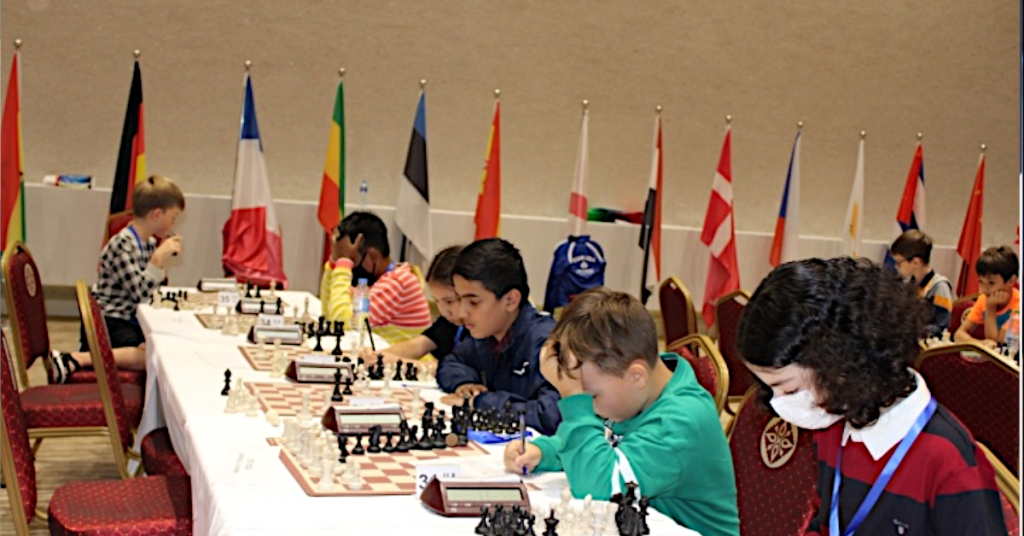
The free day of the FIDE World Cadet Chess Championships 2022 was packed with chess, with three interesting events on the menue: a solving competition, the 2022 Nesis Cup, and a friendly match between a ChessKid team and another comprised of kids from the Adjarian Chess Federation and Ukraine. 218 children from 39 federations took part in the solving competition, held in three age categories (under 8, 10 & 12). Each participant had 90 minutes to solve 8 positions (3 two-movers, 3 three-movers and 2 endgame studies). Each composition was rated on a five-point scale. The “Nesis Cup 2022”, a 9-round blitz tournament, was held for heads of delegations and accredited coaches. 59 players from 26 federations, including 11 GMs and 13 IMs, participated. Three players tied for the top position and in accordance with tiebreak variables GM Mikhail Kobalia took first place, GM Vladislav Kovalev came second and GM Davit Maghalashvili – third. Final stadings: https://chess-results.com/tnr677664.aspx?lan=1&art=1&rd=9&flag=30 A “ChessKid” team and a team comprised of kids from the Adjarian Chess Federation and Ukraine played two friendly games on a big chessboard. Team “Chesskid” prevailed but there were no losers in this competition. All participants were given presents after the match. WCCC Director Akaki Iashvili awarded the Ukrainian kids with iPads. This friendly event was the culmination of the free day. From the seventh round, the players will continue fighting for the prizes and glory in the main tournaments.
Magnus Carlsen wins Julius Baer Generation Cup

Magnus Carlsen became the Julius Baer Generation Cup champion after crushing the “Indian Iceman” Arjun Erigaisi in the final final. Norway’s world number 1 needed just two games to take the seventh leg of the Meltwater Champions Chess Tour, ending Erigaisi’s challenge 2-0. It is Carlsen’s fourth tournament win of the Tour season and extends his advantage at the top of the overall leaderboard. For 19-year-old Erigaisi, he can take huge credit for a stunning run to the final. International Master Jovanka Houska said: “Magnus in killer mode. He’s just relentless. He really is not stopping here. If we had any doubt Magnus would slip up, he has come in here today in absolute fighting mode. He is the beast.” Carlsen eve allowed himself a smile afterwards. “I’m very happy,” he said. “I played very much throughout this match ‘anti-young player chess’, in the sense I tried to play older, less theoretical lines that have some serious strategic complexity and it worked out very well. Going into the last match today, Carlsen already had one hand on the trophy having ended beaten Erigaisi, one of India’s brightest talents, 2.5-0.5 yesterday. Erigaisi, who has been so impressive throughout the event, simply folded again as Carlsen didn’t give him a chance. There are two more tournament left in the 2022 Meltwater Tour, one Regular in October and one Major in November, to decide the winner. Carlsen and Erigaisi are already qualified for the eight-player Major in San Francisco. For further comments contact: Leon Watson leon@championschesstour.com
FIDE WGP Astana: Kateryna Lagno joins the lead
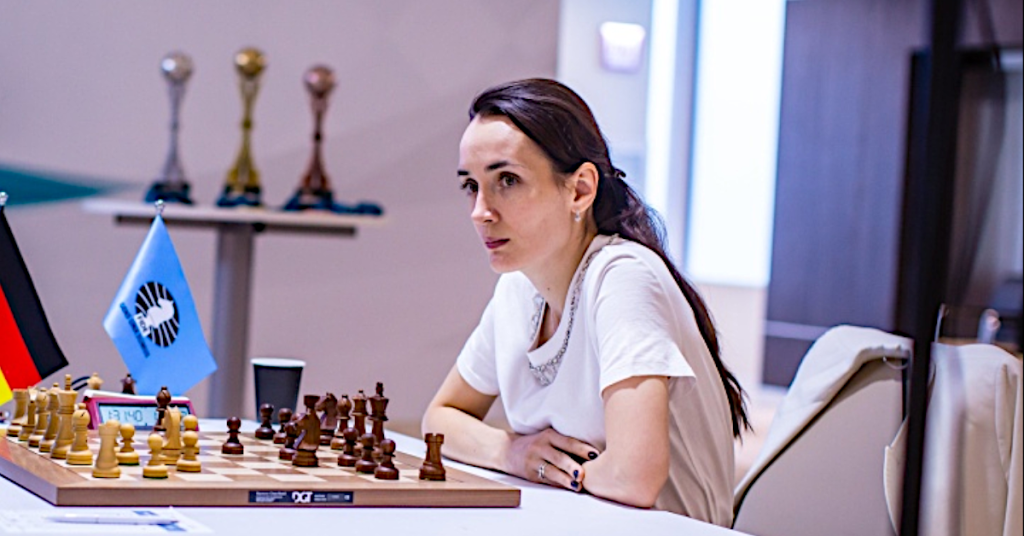
Three players tied for first in the Astana Women’s Grand Prix with four rounds to go. Grand Prix events are long and tiring. Eleven games plus travel essentially means two full weeks abroad, in addition to time allocated for training purposes. The free day at the halfway point of the event is very much appreciated by the players – and officials/volunteers – to recharge their batteries for the last rounds. Most of the players hang around the official hotel, relaxing, maybe watching a movie, or using the gym. Nonetheless, the tournament organizers happily provided a bus and a guide for a wonderful three-hour trip to visit the city’s highlights. Getting to know the city where you are playing is a must for most of us, and Astana doesn’t let you down. Back to today’s seventh round, the Minister of Culture and Sports of Kazakhstan, Dauren Abayev, made the ceremonial first move today in the games Abdumalik vs Kosteniuk and Assaubayeva vs Shuvalova. Zhu, Jiner — Vaishali, Rameshbabu (0.5-0.5) To date, Zhu Jiner and Vaishali had only faced each other once, in the Hou Yifan rapid play challenge in 2021, in which the Chinese wonder girl emerged victorious. In today’s game, Vaishali mixed it up and went for the Sveshnikov variation, diverting from the Accelerated Dragon she used successfully in the first round against Lagno. It quickly became clear that both players had prepared very well: they blitzed out their first twenty moves, following several games played by the mighty Ivanchuk, and eventually went for a forced mass piece simplification. An uneventful draw was agreed on move 31 in a completely equal rook ending. Vaishali spent less than 25 minutes for the full game: impressive opening preparation with Black. With this result, she remains on 50% in the middle of the standings while Zhu Jiner maintains her spot at the top. Abdumalik, Zhansaya — Kosteniuk, Alexandra (0-1) Dominating her opponent by 3-1 in classical games and also many rapid and blitz games, Alexandra Kosteniuk has always been a tough rival for Kazakhstan’s number one female player. In addition, Kosteniuk has been crushing with the Black pieces here in Astana, although her performances with White have been much less impressive. In the second game to finish, Abdumalik surprised her opponent with the rare 5.Re1 side-line in the Italian opening. I noticed in the playing hall that Kosteniuk took a moment before responding 5…Ng4 but then blitzed out her next moves: a piece sacrifice was in the making. Zhansaya was playing very fast: it was clear that she was in home preparation, but the position seemed quite dangerous for White. She won a pawn but had to weaken her kingside to hold it. In the commentary booth, GM Ilya Smirin believed that she had a very dangerous position. After 16…g6! White’s position was crumbling, and after 17.Qe1 Abdumalik was lost, although the alternatives were not much better. With the piece sacrifice 17…Nxg4, Kosteniuk opened the way for the rest of her pieces, and the game was essentially over. “In modern chess, to win with Black is quite an achievement,” Kosteniuk stated in her post-game interview. Tan, Zhongyi — Kashlinskaya, Alina (1-0) Today’s game was an important one for Poland’s number one female player. A win with Black against out-of-form Tan Zhongyi would catapult her to the head of the table. Kashlinskaya took advantage of the free day to refresh her knowledge of the Semi-Tarrasch variation of the Queen’s Gambit, which, according to my database, she had only played once against Goryachkina in 2013. Her opening decision definitely came as a surprise for Tan Zhongyi. Faced with a choice of variations, she opted for the solid 5.e3 and 6.a3 line and the game transposed into a variation of the Queen’s Gambit Accepted, which also isn’t a regular line in Alina’s repertoire. Black did get the bishop pair but fell behind in development. However, Tan Zhongyi couldn’t capitalize on her initiative, and, with a symmetrical pawn structure, the position fizzled out into an equal endgame. Just when the draw seemed to be the most logical result, Kashlinskaya misplayed her chances, and suddenly, her king was in danger: pawn sacrifices were needed to avoid a direct disaster, and Tan Zhongyi didn’t let her second chance go away. The Chinese GM shared her thoughts about the game in a short interview. Wagner, Dinara — Lagno, Kateryna (0-1) For the third time in the event, Dinara Wagner chose the Catalan Opening for today’s important game against Lagno. Well-prepared, Kateryna went for a new and very aggressive stonewall setup with Black, launching her kingside pawns against White’s castled king: Lagno was going all-out for the win from the get-go. 15…h4! might have been an improvement, but Black’s slow play on the queenside allowed Wagner to break open with 19.f3! and get back into the game. Once again, very low on time – Wagner’s plague in the tournament – she sacrificed a pawn for the attack, but her own king was also very weak. “My king was unsafe. If I missed one check, it could not be good. So, I tried to focus until the very end,” explained Lagno in her post-game interview. At some point, Wagner’s plan backfired, and Lagno was in the driving seat, bringing back the full point. With this important win with Black, Kateryna Lagno ties for first with Goryachkina and Zhu Jiner, with four rounds to go. Paehtz, Elisabeth — Goryachkina, Aleksandra (0.5-0.5) This match-up is a classic. They have been facing each other for the past ten years with a more or less equal record. But while Goryachkina is leading the tournament, Paehtz is in need of points: she is currently on -2. Things started off well for the top German female player: in an Exchange Slav, she developed a strong initiative on the kingside and Goryachkina was on the defence. But Aleksandra pulled herself together and gradually improved her position, to a point where she was even much better:
Fifth Chess in Education Lecturer course announced

The International Chess Federation, together with its Chess in Education Commission (EDU) and “Chess” Scientific Research Institute (CSRI), is pleased to announce the 5th Chess in Education Lecturer course. The course will be held 28-30 October, in English, online 15:00-20:00 CET. The objectives of the course: To develop and enhance the skills of effective teaching of chess basics To enhance the ability of using active and interactive teaching methods To improve positive professional communication skills The target audience of the course is professionals with experience in chess and education. Duration and content: 3 days – 15 hours (including breaks) + Project. Day 1 Introduction (100 minutes); Fear – both teachers’ fear and your fear of exam! Teaching the chessboard. (130 minutes) Project assignment (10 minutes) Day 2 Interdisciplinary chess & educational chess (10 minutes) Chessmen: values, moves and set-up (115 minutes) Check. Mate. Stalemate. (115 minutes) Day 3 Presentation of assignments (The projects are not presented. Participants need to send them by email). Problem-solving skills. Teaching playing skills (120 minutes) Effective teaching skills and Course summary (75 minutes) Exam (45 minutes) The cost of training is €75, which covers both access to materials and preparation, and the exam. Those who successfully pass the course will receive the title of Lead School Instructor (LSI). This is valid for three years, and it implies an administrative fee of €50. Those who gain this qualification (LSI) will be those, exclusively, who we appoint to the paid lectureships of the FIDE School Instructor seminars. FIDE Chess in Education Titles are awarded for life and can only be suspended or revoked by a decision of the FIDE Ethics & Disciplinary Commission or FIDE Council, while an EDU Licence is a certification by FIDE and EDU of current proficiency to teach at the indicated level of the awarded FIDE EDU title. Chess in Education Titles when awarded include a three (3) year licence. Renewal of the licence requires the completion of a renewal course. During the final six months of the validity of the licence, a title-holder may renew the licence for a further three year period to run from the end date of the current licence by following the normal procedure and paying the appropriate fees (currently €50). Here is the course description in more detail:https://cloud.fide.com/s/kY9Fs5pQ5D9gDS7 Applications for the course are open till October 26. If you want to apply, please fill in the registration form for “Preparation of Lecturers” and send it to edu.chairman@fide.com & copy to edu.senioradviser@fide.com. Your CV & Motivation letter should pay special attention to your relevant experience in “educational chess”, rather than “sport chess”. Please check this explanatory document if you are unsure about the difference between these two concepts: https://edu.fide.com/educational-chess-vs-sport-chess The course is limited to a maximum of 20 people (first come, first served). Applicants who cannot be given an assured place will be placed on the waiting list for the subsequent course.
FIDE WGP Astana: Kashlinskaya and Lagno close the gap
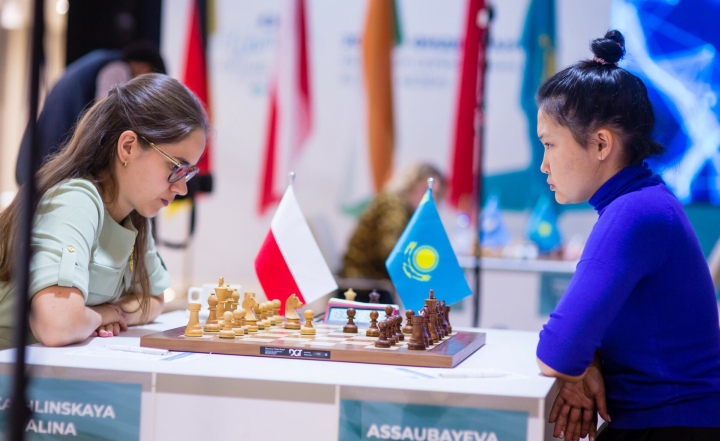
All the participants will enjoy tomorrow’s free day to visit Astana. The sixth round of the Astana Women’s Grand Prix proved to be one of the most exciting, with four decisive outcomes and two hard-fought draws. Tomorrow will be a well-deserved rest day, and play will resume on Sunday. After this afternoon’s results, Aleksandra Goryachkina and Zhu Jiner still lead the event with 4.5/6.0, but both Kateryna Lagno and Alina Kashlinskaya have closed the gap and are just behind on 4/6. Lagno, Kateryna – Tan Zhongyi (1-0) Excluding blitz and rapid games, Kateryna Lagno has had a slightly better head-to-head record 4.5-3.5 over Tan Zhongyi in classical games. However, in their last encounter, Tan Zhongyi eliminated Lagno from the 2021 Sochi World Cup in the fifth round, a mighty blow for the two times European champion. Eager to increase the score between them and maybe even get some payback for the Sochi elimination, Lagno went for the hyper-aggressive 8.g4 variation in the Sicilian Najdorf, which GM Esipenko recently used to defeat World Champion Magnus Carlsen. Lagno might have mixed up her move order in the opening (11.g5 preventing 11…Bh4+ is the computer’s suggestion) but in any case, reached a very nice middlegame position, with a rook on the seventh rank and, more importantly, Black’s queen in great danger of being trapped. Nevertheless, at the same time, Kateryna was very low on time – only 10 minutes left for the last 12 moves. Tan Zhongi tried her best, but she could not find a solution. In the end, she had to give up a piece in order to avoid losing her queen and finally threw in the towel on the move 39. With this win, Lagno advances to +2 and greatly positions herself for the event’s second half. She joined us at the press center to give us her thoughts on the game. Kosteniuk, Alexandra – Zhu Jiner (0.5-0.5) Previously, Kosteniuk and Zhu Jiner had only played one classical game in the 2021 Grand Swiss. In that encounter, Alexandra opened with 1.d4 and scored a nice victory in the Nimzo-Indian Defence. Today, in an attempt to defeat and catch up with one of the co-leaders, Kosteniuk decided upon 1.e4. Zhu Jiner repeated her favourite Najdorf Sicilian, and a typical positional middlegame position emerged: the battle revolved around the all-important d5 square. The position remained more or less balanced, and after mass exchanges, both players tried to squeeze a marginal edge from a bishop plus three pawns ending. After 48 moves, a draw was agreed. Goryachkina, Aleksandra – Wagner, Dinara (0.5-0.5) Although Aleksandra Goryachkina and Dinara Wagner had already faced each other more than ten times in blitz and rapid games, they hadn’t played each other with classical time control. Playing with White, it was clear before the game that Goryachkina was going to try to make the best of this opportunity, going into the rest day leading the event. Wagner went for the Nimzo-Indian defence but chose to play the side-line 7…h6, instead of the more popular 7…c5 and especially 7…dxc4. Both players came very well-prepared for this game: Wagner mentioned in previous interviews that she needed to speed up her opening play to avoid time trouble later on. After twenty moves, it already became clear that Wagner had equalised. It even seemed that she might have the upper hand in the position. However, with spot-on defence, Goryachkina forced a well-known theoretical drawn rook endgame, which finished in the Philidor theoretical drawn position. “My sister and her boyfriend will join me tomorrow. They have come to support me,” said Dinara in her post-game interview. Shuvalova, Polina – Abdumalik, Zhansaya (0-1) In this first classical chess encounter between these two players (previously only three rapid and blitz games), Shuvalova opened with 1.e4 and chose the Rossolimo variation against Abdumalik’s Sicilian defence. By advancing her centre pawns, Shuvalova obtained a lot of space for her pieces but perilously opened up the long h1-a8 diagonal for Black’s light-squared bishop. On move 20, Abdumalik sacrificed a pawn for the initiative. It seemed that Shuvalova had everything under control but at the crucial moment miscalculated 26.Ng5? h5! and suddenly, she was two pieces down for a rook and still facing unsurmountable problems. Abdumalik stepped up the pace, and soon her opponent was in huge trouble, facing two Black bishops, spearheading Zhansaya’s pressure. Things were going great up and until fateful move 41: instead of 41…Nxc3, 41…Bb5! was the way to go. After that Shuvalova’s drawing chances increased but it was still an uphill battle for her: the two bishops are a powerful force on the open board. Abdumalik brought home the game on move 56, scoring her first win in the tournament. She shared her thoughts on the game in a short post-game interview. Vaishali, Rameshbabu – Paehtz, Elisabeth (1-0) Although Elisabeth Paehtz has been around for many years, I wasn’t able to find any previous encounters against her opponent today, Vaishali – not even in official blitz or rapid events. With both players standing on -1 (2/5), a win today would be a crucial step to recover 50% going into the rest day. In a Sicilian Four Knights variation, Vaishali went for one of the most complicated lines, demonstrating once again excellent opening preparation. But Paehtz was ready for the complications. She blitzed out her first twenty moves and then sprang upon her opponent a novelty 20…Qc7, in an attempt to improve Caruana’s play in his 2021 game against Najer. After the exchange of the queens, White seemed to be slightly better in the endgame but once again under time pressure: less than 10 minutes for the last 15 moves to the time control. Once they passed the time control, Vaishali converted a slightly better – albeit very tricky – rook ending into a full point. The happy winner gave her insights into the game in a short interview. Kashlinskaya, Alina – Assaubayeva, Bibisara (1-0) There is no doubt here that Alina Kashlinskaya has been playing the longest games
Astana WGP: Goryachkina and Zhu Jiner extend their lead

“At some point, you really start to appreciate the journey more than the result.” – Alexandra Kostenuk The FIDE Women’s Grand Prix began in 2009-2011 as a series of six chess tournaments exclusively for women, forming part of the qualification cycle for the 2011 Women’s World Chess Championship. Subsequent Women’s Grand Prix series were held in 2011-2012 and 2013-2014. Chinese star GM Hou Yifan, currently number one on the FIDE Women’s rating list, emerged as the overall winner of all three of these Grand Prix: an outstanding performance. By withdrawing after the first tournament, Hou Yifan paved the way for her compatriot GM Ju Wenjun to win the 2015-2016 Grand Prix, overtaking Humpy Koneru in the final event. The fifth edition of the Women’s Grand Prix, consisting of four events during 2019-2021, was dominated by GM Aleksandra Goryachkina, who will definitely be looking to repeat her success this year. After the first five rounds, Goryachkina leads the event with one full point over the rest of the field. However, she is not alone. Zhu Jiner, a mostly unknown Chinese youth, is also performing wonderfully, tied for first with 4/5. Paehtz, Elisabeth – Kosteniuk, Alexandra (0-1) Elisabeth and Alexandra have a huge playing history together and, from what I gather at the start of the rounds, seem to be on very good terms. In my database, I have computed no less than seventy games (under different time controls): the first of them in the 1994 European Under 10 Girls Championship. Quite unbelievable! If we consider their results in classical chess, Kosteniuk has won most of their recent encounters, totalling 11.5-8.5 but, notwithstanding, definitely a tough match-up. For today’s game, Paehtz chose a rare side-line ( 8.Bd2) in the Closed d3 Ruy Lopez Opening, trying to surprise her opponent, but Kosteniuk came very well-prepared and equalised effortlessly. The game remained more or less balanced for the first thirty moves. Just when the game seemed to be heading towards a draw, although Kosteniuk did have a small edge, fate struck for Germany’s number one women player: she blundered a back-rank mate and had to resign. Although in the middle of a roller-coaster event, Alexandra was kind enough to drop in to the press centre and share her thoughts with FIDE Press Officer IM Michael Rahal. You can watch the interview here. Assaubayeva, Bibisara – Lagno, Kateryna (0.5-0.5) Lagno and Assaubayeva have battled it out in many blitz and rapid games over the past few years but had only faced each other in classical chess in the 2021 FIDE World Cup, where Lagno eliminated her opponent by 2.5-1.5. Kazakh number two women player opted for 1.d4 this afternoon and Lagno chose the Tarrasch variation in the Queen’s Gambit declined. As she mentioned later on, she thought that her opponent didn’t really know what to do. After twenty moves the position was about equal: a typical middlegame with an isolated d-pawn for Black but with opposite-coloured bishops to go with the heavy pieces. As Lagno recalled in the post-game interview, she clearly had in mind one of the famous Karpov-Kasparov games, in which the pawn structure and piece distribution was analogous – Karpov won that game with White. Zhu, Jiner – Abdumalik, Zhansaya (1-0) Zhu Jiner and Zhansaya Abdumalik have never faced each other in classical chess; in fact, they had only played two rapid games before. For today’s encounter, Abdumalik chose the popular Sicilian Sveshnikov, a double-edged weapon, in search of sharp play with the black pieces. Zhu Jiner played cautiously, following Caruana’s 7.Nd5 main line, used in the World Championship match against Carlsen. Abdumalik launched an attack with her pawns on the kingside, while Zhu Jiner corresponded on the queenside. It’s always hard to speculate where a certain player might have made a fatal mistake, but in her post-game interview Zhu Jiner mentions 27…Bg3+? – instead 27…Bxe1 is much better – as the moment where Abdumalik loses track, reaching a lost position. With this victory, Zhu Jiner leads the event with 4/5 tied with Goryachkina. Wagner, Dinara – Vaishali, Rameshbabu (0.5-0.5) Based on the Mega Chess Database, Wagner and Vaishali have only faced each other on one occasion before, namely in the 2016 World Under20 Girls Championship. On that occasion Vaishali emerged victorious. Of course, that was many years ago and it has rained a lot since then. Wagner is definitely on a roll in the last couple of games and today it didn’t seem that she was thinking of slowing down. Playing with Black, Vaishali made some inaccuracies in the Catalan Opening and soon found herself a pawn down with meagre compensation. Both 20.Nxf7 and 20.0-0 were probably better options for Wagner, whose advantage slowly dwindled to a point where the computer was already indicating equality: White did have an extra pawn, but a weak king and too many weaknesses. A draw was soon agreed. Tan, Zhongyi – Goryachkina, Aleksandra (0-1) The Chinese player has traditionally been a tough opponent for Goryachkina: 3-2 for Tan Zhongyi in classical games. However, Goryachkina did defeat her in the 2019 Women’s Candidates Tournament, which allowed her to fight for the 2020 World Championship against her compatriot, GM Ju Wenjun. In this afternoon’s game, Goryachkina repeated the same Slav variation that brought her success in the third round against Kashlinskaya. Tan Zhongyi might have missed a chance to press with 24.Rad1 instead of 24.b6 but all in all the game was equal for the most part. Just when the game seemed to be heading for a draw, Tan Zhongyi miscalculated a pawn breakthrough in the ending and was suddenly worse, close to losing. Goryachkina’s killer instinct did the rest, and she finishes the day tied for first place in the lead with Zhu Jiner. Here you can watch an interview with Aleksandra Goryachkina (in Russian with English subs) Kashlinskaya, Alina – Shuvalova, Polina (1-0) In past encounters, and obviously excluding blitz and rapid games, Shuvalova had edged out Kashkinkaya in classical chess by a very narrow 3.5-2.5 margin, although funnily
World Cadets Championships are halfway through

FIDE World Cadets Chess Championships (Open and Girls under 8, 10, 12) are halfway through in Batumi, Georgia. Six out of 11 rounds have been played, and 750+ participants, coaches, and parents are enjoying a free day. Roman Shogdzhiev is the sole leader in the Open U8 with 6 points out of 6. His rating is 1715, which is his peak so far, and he already gains 34.8 points in this tournament and shows a 2127 rating performance. A few months ago, Aaron Reeve Mendes from Canada became the FIDE World School Chess Champion in Panama. Now he’s the rating-favourite of the Open U10 and is leading on par with Gorkem Unsal from Turkey (#24 in the starting list). Both managed to win five games and draw one; a big group of participants is trailing them by half a point. The sole leader in the Open U12 section, Dinh Nho Kiet (pictured above), with maximum points so far, seems very well prepared, even though he hasn’t played a single rated game for a year before April 2022. After that, he increased his rating in almost all tournaments. Compatriots, but representatives of different federations, India and England, Charvi A and Sivanandan Bodhana drew between each other and continue leading in Girls U8. Girls U10 also has two leaders, Nika Venskaya and Evangelia Siskou. Nika Venskaya (pictured above) is progressing very rapidly. She participated in two open tournaments in August and gained 186.4 rating points! So, we can’t say that her leading in this tournament is unexpected. Second leader Evangelia Siskou, despite her young age, participated in the national team championship and famous traditional Kavala open this summer. It was probably part of the preparation to fight for the medals! Girls U12 is the only age category where three players are leading. Indian Shubhi Gupta, Elnaz Kaliakhmet from Kazakhstan, and a representative of the host country, Georgian Mgeladze Kesaria. They haven’t played against each other yet; right after free day, there will be the first battle among the leaders. Shubhi’s father Pradeep Gupta told us a little about his daughter and her chess path: “Shubhi started to play chess as a hobby at home and joined the chess club at Indirapuram Public School when she was in the first grade. In her first inter-school competition, she secured third place. With time, chess became her passion, and she started participating in state and national championships. In 2021, during the pandemic, she participated in the world and Asian level online championships and clinched silver in the Asian and Western Asian School Championships. This year, she bagged gold in U12 and bronze in U16 National Chess Championships. She also participated in OTB Western Asian Youth Chess Championship in June 2022 in the Maldives and secured three silver medals.” “This is her first time participating in OTB World Cadet Chess Championship, and we are enjoying the event and Batumi,” continues Pradeep. “She liked the sea view from her room and the view of the valley on the other side.” Shubhi is trained by her coach Prasanjit Dutta and spends almost 5-6 hours daily on chess. She has the dream of becoming a Grandmaster in the next two years and following her passion for playing chess professionally. And here is the portrait of the co-leader in Girls U8, Charvi A. She became interested in chess when she was around five years old. First, she played with her daycare friends and later started training with IM Shivananda BS. FIDE World Cadet Championships is her first major tournament over the board. Last year she participated in World and Asian Online Championships. Currently, she is training with WGM Aartie Ramaswamy and IM Shivananda and practices chess every day for 5 hours! Despite being so young, Charvi A has already won many titles, even in the elder age categories. Her best results: National Champion among girls U8 anU10 in 2022; 4th place in the Indian School Championship in the open section; Gold medalist of the Indian School Championship U7 in 2021; Individual silver and team gold medalist of Asian School Championship in 2021; Individual silver and team gold medalist of western Asian Championship U8 in 2021; Winner of Karnataka state open rapid tournament U15 in 2022. Her parents told us that her ambition is to become the World Champion, and she is enjoying her stay here in Batumi since it is her first tournament outside India. Reporting by Sofio Gvetadze Photos by Sopio Nikoladze Official website of the tournament: https://wccc2022.fide.com/