

Lviv and Berlin to play charity match

On Friday, September 23, the Ukrainian city of Lviv and the German capital Berlin will play a charity match. The one-day competition will bring together some of the most famous personalities of German and Ukrainian chess without them meeting directly, as it will be held in a hybrid format. Grandmaster Niclas Huschenbeth will lead the Berlin team, while Volodymyr Vetoshko will be his counterpart on the Ukrainian side. Ukrainian-born Angelika Valkova will host the match and stream it live on her Twitch channel, supported by German IM Georgios Souleidis aka “The Big Greek”. The start time is 16:45 Berlin time. The lineups: Berlin Niclas Huschenbeth (GM, 2572) Steve Berger (IM, 2451) Alexander Lagunow (IM, 2360) Clemens Rietze (FM, 2360) Lviv Volodymyr Vetoshko (GM, 2450) Oleg Romanishin (GM, 2414) Mikhail Kazakov (GM, 2400) Margeir Petursson (GM, 2447) This match is dedicated to supporting UNICEF’s “Help for Children from Ukraine” fundraising campaign. “We have chosen this organization because its work is very close to our hearts. Both we and UNICEF are happy about your support because really every contribution helps!” write the organizers on the landing page of the match, www.hybrid-chess.de. The link to the donations page:https://www.betterplace.org/de/fundraising-events/42762-chess-for-ukraine-wir-spielen-du-spendest
FIDE WGP Astana: Goryachkina leads after three rounds
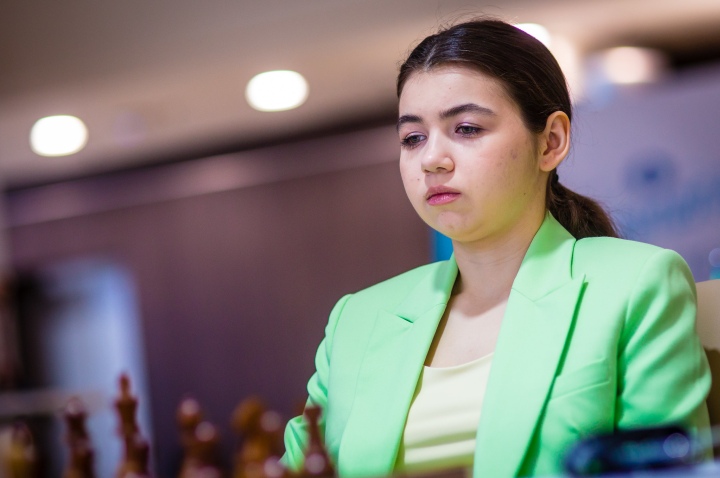
Three decisive outcomes in the third round of the Women’s Grand Prix. Time trouble is a serious problem for chess players. Understanding how to balance thinking enough to avoid mistakes during the game, with not thinking too much and getting into time trouble is a talent in itself. This afternoon, none less than four of the games were essentially decided between moves thirty and forty, when players are on the low spectrum of the time distribution. Those who shine in these situations will definitely be the ones leading the tournament in the final rounds. Lagno, Kateryna — Shuvalova, Polina (1-0) With both players on 50%, expectations for this game were high. Lagno went for the 8.a4 Anti-Marshall line, used by Nepomniachtchi in the 2021 World Championship against Magnus Carlsen. However, Shuvalova came well prepared and essentially blitzed out her first 15 moves. Nonetheless, Lagno was performing at the highest level, albeit spending a lot of time on the clock – after move 17, she only had thirty minutes left to reach the time control. Shuvalova seemed to be doing well but, at some point, lost track, and ended up exchanging her centre d5-pawn for her opponent’s h3 pawn, weakening somewhat the castled king of the former two-times European Women’s Champion but allowing Lagno to enjoy huge central superiority. Lagno pressed on with strength, connecting three pawns on the fifth rank. Although her technique wasn’t perfect, the win was always there. Her thoughts and analysis of the key moments can be listened to in the following video. Kashlinskaya, Alina — Goryachkina, Aleksandra (0-1) Undoubtedly, one of the main match-ups of the round, the clash between tournament co-leaders Kashlinskaya and Goryachkina was the longest game of the day. Goryachkina selected the Slav from her repertoire, choosing the so-called Soultanbeieff Variation, 5…e6 instead of the more popular 5…Bf5. After a few moves, the position transposed into the popular Panov Attack setup, a tempo down for Black but with White having committed her pawn to a4 (instead of the usual a3). Goryachkina played the novelty 12…a5 and promptly secured the d5 square for her knight, blockading White’s isolated pawn. Meanwhile, Kashlinskaya swung her rook over to the kingside signalling an attack. Goryachkina kept her head above water, exchanged a couple of pieces and pushed back the attack, reaching a queen + knight ending, slightly better for Black due to Kashlinskaya’s isolated d-pawn, but with huge drawing chances. However, in a mutual time trouble, just before the time control, Kashlinskaya blundered her knight (38.Qh4??). Although Goryachkina probably took more time than necessary to convert, she finally notched up her second win in the tournament and now is the sole leader of the event. Assaubayeva, Bibisara — Vaishali, Rameshbabu (0.5-0.5) In the game between two of the best young female players in the world, Vaishali, playing with Black, opted for the aggressive Grunfeld Defense, one of her two main weapons against 1.d4. Confident after her win yesterday, Assaubayeva chose a solid side-line – Vaishali is well-known for her attacking style. Wasting no time at all, Vaishali stepped away from the theoretical continuation and rapidly sacrificed a pawn for the initiative. Unfazed, the current female World Blitz champion began to exchange pieces: she wanted to convert the extra pawn in the ending. Low on time, Vaishali kept pressuring. With both players under their last five minutes, Assaubayeva won a piece for a pawn in a tactical muddle, but Vaishali kept fighting, banking on her passed a-pawn on the seventh rank to keep the balance. Although both players were unsure of the situation, a draw was finally agreed on move 36. The Indian star gave us her thoughts in a short post-game interview, in which she also gave us some insight on how she recovers from tough defeats. Tan, Zhongyi — Kosteniuk, Alexandra (0-1) Eager to recover from yesterday’s loss and get back to 50% as fast as possible, Kosteniuk went for the always dangerous Marshall Attack in the Ruy Lopez, choosing the 11…Bb7 side-line. After a well-timed …c5 pawn break, she achieved active play and superior development for the pawn. However, Tan Zhongzhi defended successfully and around move 25, Black’s compensations compensation was already diminishing. But when everything was looking good for Tan Zhongyi she faltered in her calculations: computer analysis suggests that 29.g3 is superior to 29.Re1, after which Kosteniuk recuperated the pawn and equalised. Just when the game looked to be heading for the draw – Tan Zhongyi could have exchanged queens with equality on move 39 – the former Chinese World Champion blundered with 40.Bxc4, and immediately fell into a very dangerous situation. Sensing her opportunity, Kosteniuk changed gears and went for the kill, combining her two bishops to launch a decisive attack on her opponent’s king. “My opponent overestimated her chances, and that landed her into big trouble” said Alexandra Kosteniuk in her postgame interview. Wagner, Dinara — Abdumalik, Zhansaya (0.5-0.5) After two defeats in a row, Wagner, playing with the White pieces, wanted to deliver a strong performance today. The Catalan was her opening of choice, which soon transposed into a Stonewall structure. For many moves, they followed a 2021 game between GM’s Baryshpolets and Swiercz, which ended well for White. They also managed their time very well: by move 20 both had more than 40 minutes left on the clock – a welcoming sight for Wagner, who has suffered tremendous time trouble issues in the first two rounds. After the exchange of queens, the game seemed to be heading for a draw, but Wagner was once again very low on time, in a still very complex ending. Kazakhstan’s best female player took advantage of Wagner’s inaccuracies and pushed her a-pawn to promotion. However, after overcoming a match-ball (44…Kf7 instead of 44…Kg7 was winning for Black), Wagner was able to hold a rook vs knight ending to a draw. Visibly relieved, she was kind enough to pop into the press centre for a quick interview. Paehtz, Elisabeth — Zhu, Jiner (0.5-0.5) A very solid game ending in an uneventful
FIDE WGP: Tactics and time trouble in Astana
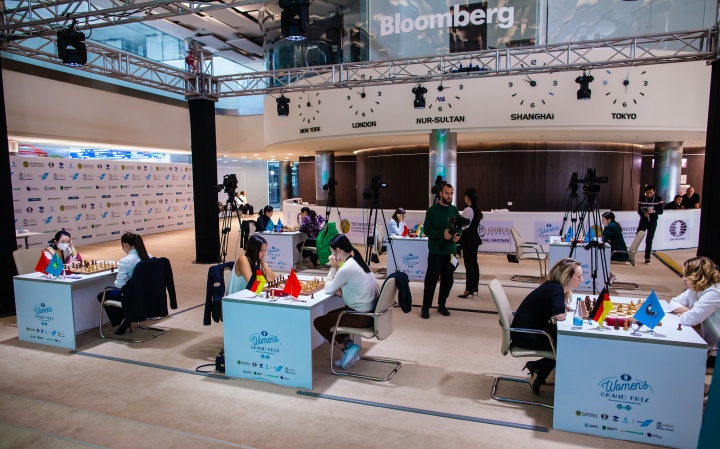
“I hope that my husband was not watching today!” – Alina Kashlinskaya. “Today was a bloody round” were GM Ilya Smirin’s first words to me when we left the venue this evening. None less than four out of the six games of the round had a decisive result: a huge percentage for this type of event. But the official commentator’s considerations had more to do with the ups and downs experienced during the games. Time-trouble, stranded centre kings, sudden attacks followed by counterattacks, rejected three-fold draw repetitions … All in an afternoon’s work! As I mentioned in yesterday’s report, the format and structure of the Women’s Grand Prix, in addition to the no-nonsense fighting approach of all the players, will undoubtedly give way to many more exciting rounds. Aleksandra Goryachkina vs Kateryna Lagno (0.5-0.5) Lagno tried to surprise her opponent with the Sicilian defence instead of her usual 1.e4 e5. However, Goryachkina was well prepared with the Alapin side-line variation, achieving a small advantage in the opening. Lagno smartly bailed out into a slightly worse ending which she was able to hold to a draw after a small inaccuracy by her opponent. With this result, Goryachkina keeps the lead in the event with 1.5/2.0, although three other players have caught up with her. The two-time European champion and World Blitz and Rapid champion Kateryna Lagno was kind enough to share her thoughts with us in a short postgame video. Zhu Jiner vs Dinara Wagner (1-0) After defeating Hou Yifan a few days ago in the Chinese League, a lot of attention is being focused on the performance of the world’s top under-20 female player, Zhu Jiner. And she certainly didn’t disappoint today! Her opponent, German WGM Dinara Wagner, went for the Sicilian Defence and Zhu Jiner brought her preparation to the table: the dangerous Prins variation. The line seemed to catch Wagner by surprise as, once again, she spent a lot of time navigating her way through the complications, while the Chinese player was practically blitzing out her preparation. In deep time trouble, Wagner was unable to hold a slightly worse position and eventually had to succumb to Zhu Jiner’s fine tactical play. “I am very happy with my win, but the tournament is long and complicated, so I am just trying to play my best and enjoy the event” was Zhu Jiner’s state of mind in the post-game interview. Alexandra Kosteniuk vs Bibisara Assaubayeva (0-1) Top Kazakh female player Bibisara Assaubayeva joins the lead with today’s win over former World Champion Alexandra Kosteniuk. “It’s a very important win for me because I don’t have a good score against her,” said Assaubayeva after the game. Nonetheless, after the opening, it was Kosteniuk who enjoyed a sizeable advantage. She caught her opponent with her opening preparation (Bibisara hadn’t analysed the 10.Nd5 line in the classical Sicilian Najdorf ) and eventually won a pawn. However, Assaubayeva kept her cool, defended with success and spotted a move repetition which should have led to a draw. With both players low in tome heading towards move 40, Kosteniuk decided to force matters and push for the win but fell into a devious tactical trap that Assaubayeva had prepared: After 34….Qc7! hits the queen and also h2, the point being that 35.Qg3 loses to the fantastic 35…Qb6+! mating. The current female World Blitz champion took us through the game in her post-game interview. Zhansaya Abdumalik vs Tan Zhongyi (0.5-0.5)Although this game ended in a draw, it was certainly one of the most complicated of the six. With White, Abdumalik went for an enterprising line of the Scotch opening, leaving her king in the centre and developing her kingside rook via h3, playing for the attack. According to computer analysis, both players missed one or two chances to secure an advantage at different stages of the game. Finally, after a very complex middlegame battle, Abdumalik won a pawn, but her opponent, former World Champion Tan Zhongyi, enjoyed a great deal of positional compensation, more than enough to force a three-fold repetition. Vaishali R vs Alina Kashlinskaya (0-1) For most of the audience in the auditorium, following the games live with local commentary by GM Murtas Kazhgaleyev, definitely the most exciting game of the round. “I agree, it was a crazy game. I hope that my husband (GM Radosław Wojtaszek) was not watching it because he has to play in the Magnus online tournament today!” a very happy Kashlinskaya explained in her post-game interview. In a trending Italian Opening, Kashlinskaya mixed up her opening preparation and went for an extremely dangerous pawn advance in front of her castled king. Vaishali quickly took advantage, sacrificed a piece – which Alina didn’t accept – and forced her opponent’s king out into the open. However, a piece sacrifice was needed to finish off the job, and Vaishali faltered. Instead of 20.f3? played in the game computer analysis suggests the idea of 20.gxf7 followed by 21.Qxg4, sacrificing the knight on d2. As played, Black coordinated his pieces and fully employed the power of her e-pawn to score a full point. Polina Shuvalova vs Elisabeth Paehtz (1-0) After defeating her compatriot Wagner yesterday in a King’s Indian, Paehtz repeated Black this afternoon against Shuvalova. The opening was a success: on move 15 she had secured a strong knight on the e5 in the Sicilian defence and had equalised comfortably. She even enjoyed a slight time advantage on the clock. However, Shuvalova defended tenaciously, avoiding direct threats and complicating the position as much as possible. Just before move 40, with both players in deep time trouble, Paehtz blundered a double attack (39.Qc1!) and was forced to resign after 39…Ra2 40.Qc8+ Kf7 (40…Rf8 41.Qxe6+) facing 41.Qe8#. Standings after Round 2 Round three pairings are out, featuring the clash between co-leaders Alina Kashlinskaya and Aleksandra Goryachkina. Round 3 | Astana | 20.09.2022 Lagno, Kateryna — Shuvalova, PolinaKashlinskaya, Alina — Goryachkina, AleksandraAssaubayeva, Bibisara — Vaishali, RameshbabuTan, Zhongyi — Kosteniuk, AlexandraWagner, Dinara — Abdumalik, ZhansayaPaehtz, Elisabeth — Zhu, Jiner Text: IM Michael Rahal, FIDE Press Officer, Astana Photo: Anna Shtourman
FIDE WGP Astana: Goryachkina and Paehtz lead the dance
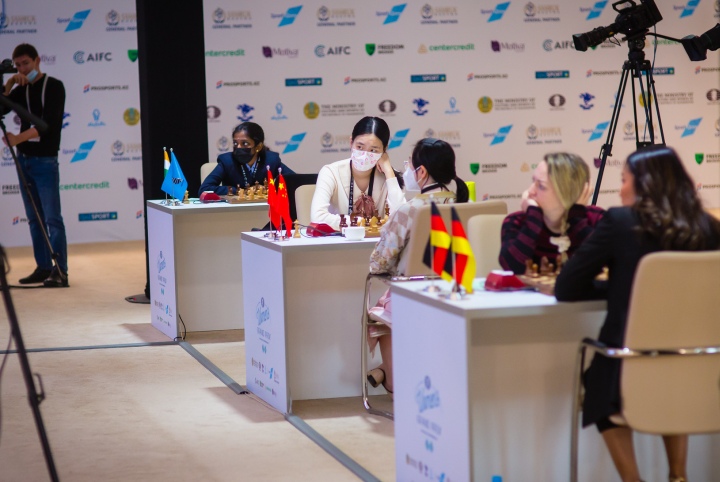
Only two players score the win in the first round of the Astana Women’s Grand Prix The first round of the first leg of the 2022-2023 Women’s Grand Prix kicked off this afternoon in Astana. Undoubtedly, a very special day in the history of the ninth largest country in the world since the name change of the capital – Astana for Nur-Sultan – was legally confirmed. Definitely, a fitting moment for the commencement of an elite chess event. International Arbiter Abd Hamid Bin Abd Majid initiated the clocks punctually at three o’clock in the afternoon, and after the customary handshakes and pre-game smiles, the twelve sat down to battle it out. Only a few minutes earlier, the ceremonial first move was made on the Assaubayeva vs Abdumalik board. Azamat Imashev, Deputy Director of the Republican Sports Development Directorate, advanced the e-pawn to e4; Kazakh’s bright hope quickly returned the pawn to its original square to avoid giving any clues to her opponent and promptly opened with 1.d4. This event features a new security measure: the 15-minute delay. Although the games begin at the official starting time, the move broadcast and video footage are synchronously “delayed” for fifteen minutes. Although this does pose a technical challenge for the organizing team, the measure generates a better sense of security for the players at a time when the chess world is especially sensitive to these unfortunate issues. Another special regulation, much appreciated by chess fans all over the world, is the 30-move rule. Notwithstanding the fact that women’s events are traditionally extremely hard-fought, the regulations of the tournament expressly forbid draw agreements before Black’s 30th has been played on the board, with the exception of draw repetition or statement. Adding to this the 90-minute for 40 moves plus 30 extra minutes time control, exciting games are to be expected. Kateryna Lagno vs Vaishali R (0.5-0.5) The first game to finish ended in a three-fold move repetition after 32 moves. The young Indian played a solid Accelerated Dragon Sicilian with Black and equalised comfortably in the opening. After trading most of the pieces, Lagno tried to take advantage of the open d-file but to no avail. A good result for Vaishali, who kindly joined the Press Officer for a short post-game interview, in which, amongst other things, she explained the reason behind arriving late for the opening ceremony. Bibisara Assaubayeva vs Zhansaya Abdumalik (0.5-0.5) The battle between the two top Kazakh women players also ended in a draw, but play was fast and furious. Assaubayeva, with White, went for a topical pawn sacrifice which allowed her to develop a very dangerous initiative. In fact, if she had gone for the promising piece sacrifice with 17.Nxf7, Abdumalik might have been in serious trouble. “I was lucky” was Abdumalik’s feeling after the game – in her short interview, she also discussed what it’s like to face her compatriot in the first game of the event. Tan Zhongyi vs Zhu Jiner (0.5-0.5) The third game to finish was an uneventful draw between the two Chinese representatives. Zhu Jiner has arrived in Astana with added confidence after her stunning win against Hou Yifan a few days ago in the Chinese Higher League. Her choice of opening this afternoon, the Nimzo-Indian defence, proved a tough nut to crack for her opponent, Tan Zhongyi, who actually played her first official game in many months. The position remained more or less balanced for most of the game, and a draw was agreed on move forty-two. Aleksandra Goryachkina vs Polina Shuvalova (1-0) Seed number one, and winner of the previous Women’s Grand Prix Aleksandra Goryachkina, surprised her opponent in the opening with a sharp variation of the Scotch Gambit with white pieces. Although it seemed that Polina Shuvalova was close to equalising, White’s kingside initiative began to grow, and after 25.f4 was already looking very dangerous. Playing the Black pieces, Shuvalova bailed out into an ending down a pawn and even seemed to be doing well with her d-passer, but the former World Cup finalist evaluated it much deeper. After Goryachkina’s doubling rooks on the seventh rank, Shuvalova was forced to resign: mate on g7 was unavoidable. This fine win allows Goryachkina to grab the lead from the get-go. Dinara Wagner vs Elisabeth Paehtz (0-1) The second win of the afternoon came shortly afterwards. Leading black pieces, Germany’s number one women player for the past twenty years, Elisabeth Paehtz, was fortunate enough to get her opening preparation on the board. In a secondary line of the King’s Indian, Paehtz swapped off her two bishops for Wagner’s two knights in exchange for some devious pressure on White’s e-pawn. The practical gambit paid off. Wagner spent a huge amount of time trying to consolidate her space advantage and very soon was down to her last few minutes. In deep time trouble, Wagner was unable to defend a direct attack on her castled king and had to resign shortly after reaching the 40-move time control. Visibly pleased with her performance, Paehtz kindly shared her views in her post-game interview, in which she also revealed how she deals with the pressure of playing with her Olympiad teammates and the status of her pending GM title. Alina Kashlinskaya vs Alexandra Kosteniuk (0.5-0.5) The last game to finish was a testament to the fighting spirit of the participants. Nursing a small positional advantage from the middlegame with White, Poland’s number one female player Kashlinskaya pressed all the way in an attempt to prove that the bishop pair would be able to defeat her opponent’s bishop plus knight in an ending with an equal number of pawns. Although Kosteniuk expressed the feeling that at some point she might have been losing, she certainly defended her slightly worse position skilfully, notching up a well-deserved draw on the move 89. Tomorrow’s round two pairings feature some very interesting match-ups. Special attention should be focused on the top two seed’s face-off between Goryachkina and Lagno. Round 2 | Nur-Sultan | 19.09.2022 Shuvalova, Polina — Paehtz, ElisabethZhu, Jiner —
Women’s Grand Prix 2022-2023 officially opened
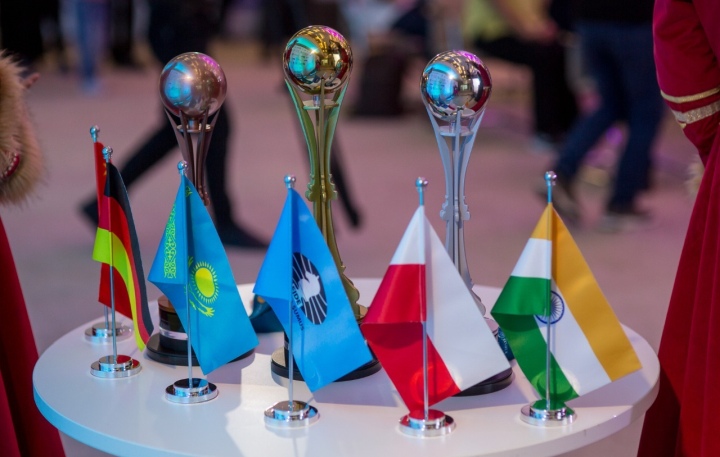
The opening ceremony of the 2022-2023 Kazakhstan leg of the Women’s Grand Prix was held this evening at the Astana International Financial Centre. Pending the President’s discretion, the capital Nur-Sultan will very soon be renamed back to Astana after yesterday’s Parliament session endorsed the draft law on the constitutional amendment. Side by side in the front row with the authorities, arbiters and other officials, eleven of the twelve players – India’s Vaishali hadn’t arrived at the time – enjoyed a series of traditional dances and musical performances that enlivened the 30-minute evening ceremony. The Minister of Culture and Sports of Kazakhstan, Dauren Abayev, welcomed all the participants to the Nur-Sultan Gran Prix and thanked FIDE for the opportunity to organize the tournament with the two best Kazakh players. Berik Balgabayev, an adviser to the FIDE president, read a welcoming letter from Arkady Dvorkovich himself. “It’s not the first time that Kazakhstan has become the host of top chess tournaments, and I am fully confident that the Grand Prix will be held at the highest level and will be the force of continuation of chess traditions in the region”. The President of the Kazakhstan Chess Federation, Galim Khusainov, expressed his gratitude to all the members of the event, with special thanks to the Ministry of Culture and Sports for their ongoing support. He also manifested that one of the aims was to showcase their national traditions and customs. Finally, the chief arbiter of the event, IA Hamid Bin Abd Majid, took the stage with one of the most applauded sentences of the night. “It’s a great honour for me to be here. It seems quite appropriate for Nur-Sultan to be the host – Minister, you have a really beautiful city!” After the inauguration, the organizing team met up with the players to go over the rules and regulations and answer any relevant questions in preparation for the first round, which will start on September 18th at 3 pm. As per rules, players of the same federation will face each. There is no doubt that the clash between the two Kazakh players, Bibisara Assaubayeva and Zhansaya Abdumalik, will be one of the highlights of the day. Another very interesting game will be the encounter between the two Chinese players: Zhu Jiner defeated the world’s number one women player Hou Yifan a few days ago in the Chinese League. Round 1 pairings: Goryachkina Aleksandra 2579 (FID) – Shuvalova Polina 2510 (FID)Lagno Kateryna 2547 (FID) – Vaishali R 2449 (IND)Kashlinskaya Alina 2491 (POL) – Kosteniuk Alexandra 2521 (FID)Assaubayeva Bibisara 2443 (KAZ) – Abdumalik Zhansaya 2503 (KAZ)Tan Zhongyi 2525 (CHN) – Zhu Jiner 2464 (CHN)Wagner Dinara 2358 (GER) – Paehtz Elisabeth 2477 (GER) Text: IM Michael Rahal, FIDE Press Officer, Astana Photo: Anna Shtourman
Fabiano Caruana wins 2022 Champions Showdown: Chess 9LX

Fabiano Caruana was crowned the winner of the 2022 Champions Showdown: Chess 9LX after defeating Alireza Firouzja in Armageddon during their rapid playoff match. The victory capped off an incredible day for Caruana, who won his final three games in regulation to finish with 6.5/9 and catch Firouzja to force a playoff tiebreaker. For Firouzja, it was a mildly disappointing conclusion but, nevertheless, a stellar result to end his campaign in Saint Louis, where he won the Saint Louis Rapid & Blitz, Sinquefield Cup, and overall Grand Chess Tour. Sharing third place were Ian Nepomniachtchi and Shakhriyar Mamedyarov, who both ended on 6.0/8, while 13th World Champion Garry Kasparov could not turn his luck around–despite several promising positions throughout the event, he eventually finished with 0.5/9. Kasparov: “I think there were very high expectations after my performance last year here, but last year I did some chess. This year when I arrived here, I just realized that I didn’t play chess, over the board, for a year. And obviously the latest events in Europe, and all the war in Ukraine consumed my energy and attention. Some games here made me feel really good but, of course, I wanted to do better.” ROUND 7 Round 7 – Starting Position Going into the round, all eyes were on Firouzja and Mamedyarov, who entered the day as co-leaders. Firouzja built up a decisive advantage against Svidler by grabbing material early on and getting away with it, but could not sort through the complications after a desperate rook sacrifice by Svidler, and in massive time trouble settled for a draw by repetition. In Mamedyarov’s case, after squandering a huge advantage to end up in a drawn knight vs. bishop endgame against Dominguez, he managed to pose just enough problems to induce a game-losing blunder and take the sole lead. 81…Be6? was the losing mistake, as after 82.c7! Black could no longer prevent Ne7, followed by promoting the c-pawn. Mamedyarov led after seven rounds but just ran out of steam at the end. | Photo Courtesy of Saint Louis Chess Club, Lennart Ootes ROUND 9 Round 8 – Starting Position The penultimate round saw the standings flip as Mamedyarov’s four-game winning streak was snapped by Svidler, who took advantage of a blunder to win an exchange, while Firouzja beat Aronian with Black to overtake the sole lead. This meant that going into the last round, Firouzja would have a half-point lead ahead of Mamedyarov, Nepomniachtchi, and Caruana, who had just won his second game of the day, defeating Nakamura. After 27…f3, Firouzja’s kingside pawns were simply too strong. | 0-1, 43 moves Firouzja won literally everything in Saint Louis, taking home well over $300,000 in prize money. | Photo Courtesy of Saint Louis Chess Club, Lennart Ootes ROUND 9 Round 9 – Starting Position The final round saw lots of drama as three players (Mamedyarov, Nepomniachtchi, Caruana) were all chasing Firouzja, who had White against Nakamura. At first, Firouzja was in a bit of trouble out of the opening but managed to stabilize and eventually push a bit in the endgame, which was ultimately drawn. Neither Mamedyarov nor Nepomniactchi were able to win their games, but Caruana continued his excellent form with a win over So, catching up to Firouzja and forcing a rapid playoff. After 35.Be5, Caruana’s powerful dark-squared bishop and passed pawn on g7 secured a decisive advantage. | 1-0, 46 moves An insane comeback day for Caruana, who entered the day thinking he had no chances. | Photo Courtesy of Saint Louis Chess Club, Lennart Ootes PLAYOFF The playoff featured Caruana and Firouzja battling it out in a 2 game, 10+2 match, playing the same randomized starting position with both colours. The first game saw Firouzja much worse as White out of the opening, but a later knight sacrifice blew the game wide open. A wild time scramble then ensued, with Caruana emerging as the winner after Firouzja blundered into a direct mate: 37…Ba3+ forced resignation, as 38.Kb3 would walk into either …Qb5# or …a4# In the second game, Firouzja stroke back, forcing an Armageddon, after Caruana accidentally got his queen stuck behind enemy lines: After 13…c4, White’s queen was simply stuck on the queenside, with no way to get back. | 0-1, 31 moves Winning the Armageddon toss was Caruana, who chose to play White in the final game, receiving 5 minutes against 4 minutes along with draw odds for Firouzja. At first, it seemed like Firouzja would hold without any issues after forcing an equal endgame, but a mistake allowed Caruana to snag an extra pawn thanks to a knight fork. With two knights each, Firouzja still had serious drawing chances if he managed to exchange off all the pawns, but one last pawn was all Caruana needed to convert the advantage, as he finished the game with a nice zugzwang: After 62.Nf6!, Black was in zugzwang and had to resign. “Even though it was a total mess of a playoff, and it was super difficult, and honestly I was very lucky in the Armageddon, and also in the first game, still I feel very happy,” said Caruana in the post-game interview. The final handshake. | Photo Courtesy of Saint Louis Chess Club, Lennart Ootes Text: IM Kostya Kavutskiy Dates & Location: September 14 – September 16, 2022Saint Louis Chess Club Livestream:USChessChamps.ComYouTube: @STLChessClub | Twitch.tv: @STLChessClub Web: uschesschamps.com | Twitter: @STLChessClubInstagram: @STLChessClub | Facebook: @STLChessClub#ChampionsShowdown #Chess9LX #STLChessClub Press Contact:Rebecca Buffingtonrbuffington@saintlouischessclub.org Photo Credits:Photos and appropriate credits available on Flickr Saint Louis Chess Club | Building Champions4657 Maryland Avenue, Saint Louis, MO 63108 | (314) 361.CHESS (2437)
Winners crowned at World Youth U14, U16, and U18 Championships
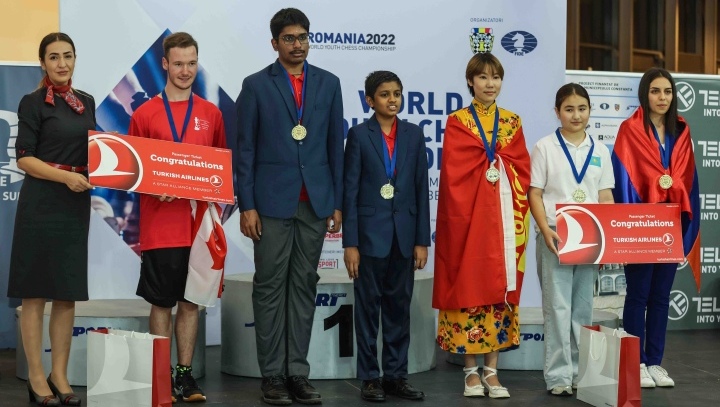
The curtain fell on the World Youth Chess Championship 2022 in Mamaia, Romania. After 11 days of chess battles among 620 participants, we got new world champions, young heroes for whom this step may be a turning point in future professional chess careers. WIM Mariam Mkrtchyan (ARM, Girls-U18), who achieved an unprecedented score of 11/11, was deservedly in the spotlight. Mariam convincingly won gold in her category with two rounds to spare. At the closing ceremony, in addition to speeches by officials and sponsor representatives, the organizers also prepared an interesting cultural and artistic program. After that, trophies, medals, certificates and gift packages were awarded to the three top finishers in all categories by representatives of FIDE, organizers, sponsors and arbiters. National chess federations also competed for the titles in the team standings. The first place trophy went to India with two golds, Kazakhstan came second with one gold, one silver, and one bronze, Armenia with one gold medal is third, thanks to the best performance by Mariam Mkrtchyan in the Girls-U18 category. Here are all the winners: OPEN-U14 (138 participants) 1. Ilamparthi A R (IND) 9.5 points 2. FM Seemann Jakub (POL) 9 points 3. IM Ansat Aldiyar (KAZ) 8.5 points Girls-U14 (96 participants) 1. WCM Nurgaliyeva Zarina (KAZ) 9 points 2. Peglau Charis (GER) 8.5 points 3. WFM Shvedova Alexandra (FID) 8.5 points OPEN-U16 (111 participants) 1. IM Pranav Anand (IND) 9 points 2. Lutsko Artem (UKR) 8.5 points 3. FM Droin Augustin (FRA) 8.5 points Girls-U16 (87 participants) 1. WFM Munkhzul Davaakhuu (MGL) 8.5 points 2. WCM Nguyen Hong Nhung (VIE) 8.5 points 3. FM Van Foreest Machteld (NED) 8.5 points OPEN-U18 (109 participants) 1. IM Rodrigue-Lemieux Shawn (CAN) 9 points 2. FM Nogerbek Kazybek (KAZ) 8 points 3. FM Fromm Marius (GER) 8 points Girls-U18 (79 participants) 1. WIM Mkrtchyan Mariam (ARM) 11 points 2. WFM Allahverdiyeva Ayan (AZE) 8.5 points 3. WFM Wikar Martyna (POL) 8 points Photo: Mark Livshitz Official website: worldyouth2022.com/
Champions Showdown Chess 9LX: Day 2 Recap

Shakhriyar Mamedyarov surged ahead today in the Champions Showdown, winning all three of his games to finish tied for first with Alireza Firouzja, both on 4.5/6. Yesterday’s leader Ian Nepomniachtchi slipped to third place with 4.0/6, while former World Champion Garry Kasparov was unfortunately once again shut out from scoring any points. ROUND 4 Round 4 – Starting Position Continuing his run from yesterday, Nepomniachtchi managed to trick Caruana in a drawn knight endgame to move to 4/4, while Nakamura outplayed Dominguez to reach a winning rook and knight against rook and bishop ending. Final position of Nepomniachtchi – Caruana, Black resigned as White’s a-pawn is simply unstoppable. In the ‘clash of generations’, Kasparov sacrificed an exchange and established a strong knight on e6, but patient play by Firouzja allowed him to first trade off White’s rook, and then the knight, before overtaking the initiative and winning the game. And in another turnaround, the game between So and Mamedyarov ended abruptly as in a winning position So blundered into a brutal tactical counter: After 32.Rd3 it looked like Black’s queen was trapped, but the powerful response 32…Ne3!-+ forced resignation from White, who was now losing at least an exchange. Firouzja & Kasparov discuss their game after the fact. | Photo Courtesy of Saint Louis Chess Club, Lennart Ootes ROUND 5 Round 5 – Starting Position The crucial match-up of the round took place between Firouzja and Nepomniachtchi, who quickly exchanged everything, resulting in an equal double-rook endgame. Things looked quite drawish until Nepomniachtchi suddenly got his king stuck on the back rank, and Firouzja used his active king to win the endgame. After 44.Re6, Black resigned as the king is completely cut off, with no way to stop the c-pawn. Mamedyarov and Nakamura also picked up their second straight wins, defeating Kasparov and Svidler respectively. In Mamedyarov’s case, the task was simpler, as Kasparov spent too much time in the opening phase and ended up flagging in a difficult middlegame. In the meantime Nakamura out-developed Svidler and used a textbook rook sacrifice to decimate the enemy king: After 24.Rxh6! it was all over–in case of 24…gxh6 25.Rxh6 Black can’t avoid heavy material losses. A nice comeback for Nakamura, who scored 2.5/3 in today’s games. | Photo Courtesy of Saint Louis Chess Club, Crystal Fuller ROUND 6 Round 6 – Starting Position Nepomniachtchi’s run came to a full halt in his Round 6 game against Mamedyarov, after the latter found a nice zwischenzug to strand White’s king in the center of the board. Nepo tried to survive as long as he could, but the result was never in doubt, and the game finished with a nice underpromotion by Mamedyarov, as he scored his third straight win. 25…e1=N+! was the stylish finale in Nepomniachtchi – Mamedyarov. The players had a lot of fun analyzing today’s positions. | Photo Courtesy of Saint Louis Chess Club, Lennart Ootes Meanwhile, Firouzja had excellent chances to win against Dominguez and take the sole lead, but missed a narrow path to win in the rook endgame, and Dominguez managed to hold the draw. Firouzja is tied for the lead heading into tomorrow’s final rounds. Will he be able to win his third straight super-tournament? | Photo Courtesy of Saint Louis Chess Club, Lennart Ootes The 2022 Champions Showdown: Chess 9LX continues Friday, September 16, starting at 1:50 PM CT. Tune in to watch WGM Anastasiya Karlovich, GM Yasser Seirawan, & GM Cristian Chirila provide live commentary on uschesschamps.com and on the Saint Louis Chess Club’s YouTube and Twitch.tv channels. Text: IM Kostya Kavutskiy Dates & Location: September 14 – September 16, 2022Saint Louis Chess Club Livestream:USChessChamps.ComYouTube: @STLChessClub | Twitch.tv: @STLChessClub Web: uschesschamps.com | Twitter: @STLChessClubInstagram: @STLChessClub | Facebook: @STLChessClub#ChampionsShowdown #Chess9LX #STLChessClub Press Contact:Rebecca Buffingtonrbuffington@saintlouischessclub.org Photo Credits:Photos and appropriate credits available on Flickr Saint Louis Chess Club | Building Champions4657 Maryland Avenue, Saint Louis, MO 63108 | (314) 361.CHESS (2437)
FIDE World Cadet Chess Championships kick off in Batumi, Georgia
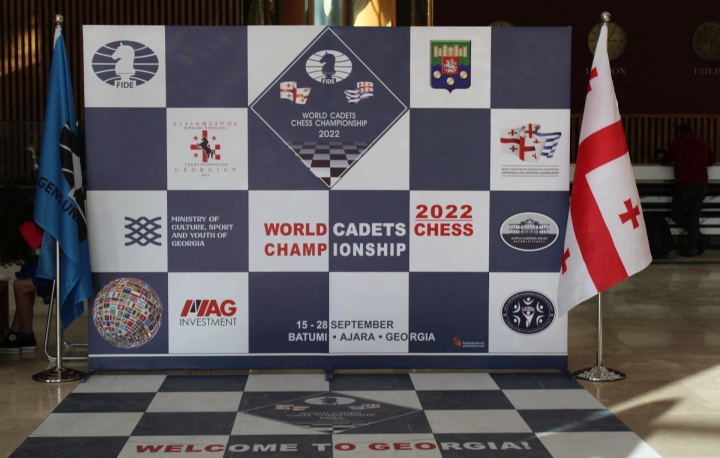
The FIDE World Cadet Chess Championships U8, U10 and U12 open and girls (six tournaments in total) kicked off in Georgia, in a popular black sea resort city of Batumi. The Championships, 11-round Swiss tournaments, stretch from September 15th to September 28th. 752 participants from 70 federations are ready to battle for the titles in this prestigious competition. The beautiful playing venues are ready to host the participants. The Open section is held in Hotel Euphoria while the girls are competing in hotel Legend. The highest rated players in the event are Artem Uskov (U12 open section), rated 2377, and Diana Preobrazhenskaya (U12 Girls section), with the rating of 1994. The U12 Open section boasts the highest number of participants – 157 players registered in this tournament. Before the start of the tournaments, the arbiter’s meeting was held in hotel Euphoria, with the technical meeting scheduled right before the first round. The solving compositions championships are set for a free day, September 22nd. All the rounds start at 15:00 except for the final one which will begin at 11:00. Regulations for the FIDE World Cadets Chess Championships 2022 You can find all the information related to the FIDE World Cadets Chess Championships 2022 on the official website of the tournament wccc2022.fide.com.
Second Intercontinental Online Chess Championship for Prisoners: Registration deadline approaches
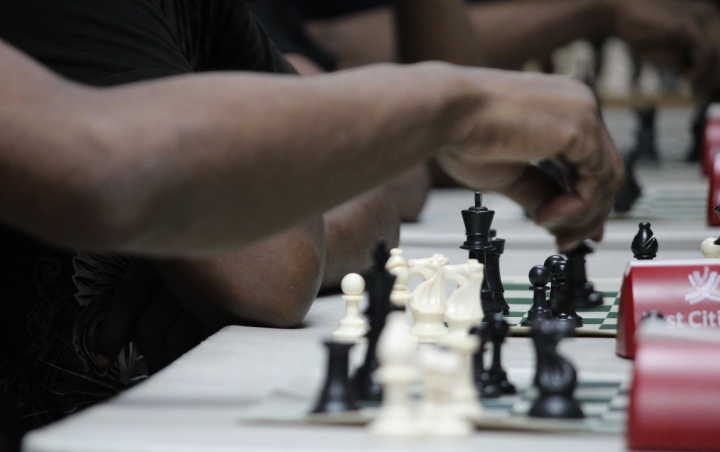
58 teams representing 32 countries have already registered for the second Intercontinental Online Chess Championship for Prisoners, scheduled for October 13-14, 2022, on the International Day of Education in Prison. Correctional facilities for male, female and youth inmates from Argentina, Armenia, Australia, Bosnia and Herzegovina, Bulgaria, Canada, Colombia, Croatia, Czech Republic, Ecuador, El Salvador, England, Georgia, Germany, India, Italy, Kyrgyzstan, Latvia, Mexico, Mongolia, the Netherlands, North Macedonia, Norway, the Philippines, Portugal, Serbia, Slovenia, South Sudan, Spain, Trinidad and Tobago, Turks and Caicos Islands and the USA field their teams made of amateur chess players for whom the game became not just a hobby but strong motivation to change for the better. In some prisons teaching inmates to play chess has been done for many years, in others, the first Intercontinental tournament for prisoners held by FIDE, jointly with Cook County (Chicago) Sheriff’s office in October 2021, gave an impetus to bring chess classes to correctional facilities. The Argentina chess federation (FADA) started its cooperation with SENAF (National Secretariat for Children, Adolescents and Family) in 2021, bringing chess classes to prisons and correctional institutions for children under 18 years of age. Currently, the initiative is implemented in 20 schools for troubled youth throughout the country. “We have noticed that the behaviour of prisoners changed. Sometimes instead of solving their problems and conflicts through violence, they decide to have a game of chess to resolve a dispute,” says Hector Flori, General Coordinator of the project, FADA Secretary. “With a view to this tournament, a national qualifying event was held on September 14, and the winners will receive, in addition to the weekly formal classes of the project, a special training by the teachers of the school of high performance of FADA. It is a great challenge for us to play in this event again.” In addition to the tournament itself, the live broadcast of the championship will include many guests – ambassadors of Chess in Prisons initiatives from different countries, chess teachers for inmates and at-risk communities, ex-convicts whose lives changed after being introduced to chess. One of them is Simosakhe Ngwane from South Africa, an ex-prisoner who learned to play chess while in jail. He came back to normal life and became a role model for many at-risk children in his country. “I hope the program expands into schools as well because that’s where our kids start making mistakes. Even myself. If I’ve learned how to play chess in school, I wouldn’t have made some mistakes in my life,” he says. To make his dream to help youngsters come true, Ngwane organized chess classes for kids in his hometown Molweni. Even though sometimes there are not enough chess boards, clocks and tables for students, the number of kind who want to start playing chess keeps growing. “Crime is easy when you are young. That’s the reality. You don’t think of consequences until it’s too late. Playing chess develops a positive attitude. The simple rule of chess “Touch is a move” brings discipline and calmness. It teaches you to wait, to think, and to prepare before you make a decision,” Ngwane adds. The registration for the second Intercontinental Online Chess Championship for Prisoners is open until September 21, 2022. Participation is free of charge. Tournament regulations (pdf) Registration form