

Winners crowned at 44th Chennai Chess Olympiad
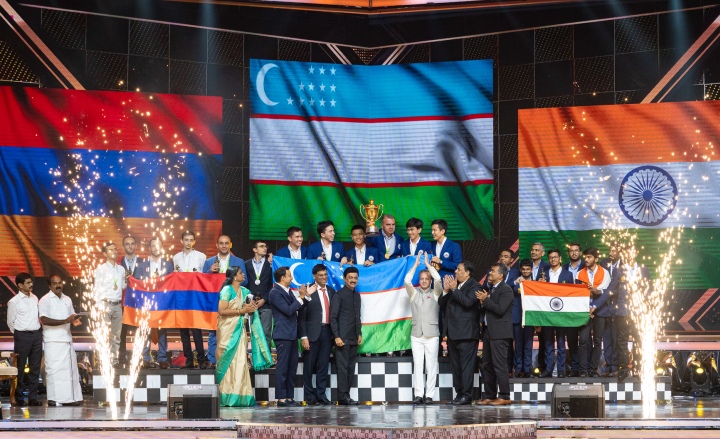
FIDE president Arkady Dvorkovich hands over the Olympic flag to the president of the Hungarian Chess Federation The closing ceremony for the 44th Chennai Chess Olympiad took place at the Jawaharlal Nehru Stadium yesterday evening, with the presence of Tamil Nadu Chief Minister M.K Stalin along with FIDE president Arkady Dvorkovich, Deputy President and GM Viswanathan Anand, among other authorities. During the action-packed evening, the authorities awarded medals and other prizes to all winners. Chief Minister M.K. Stalin presented the medals to the winners in the open category – Gold for Ukraine – while FIDE President Arkady Dvorkovich handed over the open section winner’s trophy to GM Ivan Sokolov, outstanding coach and captain of the young Uzbekistan squad. In between awards, special performers included a “dance-drama” on the evolution of sports in Tamil Nadu. Dances included “jallikattu – kannamoochi” (hide and seek), “udal vithai vilaiyattu” (gymnastics), “kabaddi”, and sathurangam (chess) The audience was also delighted to see the V. Unbeatable dance group, famous for winning the 2020 “America’s Got Talent” show. Many other great performances enlivened the evening. At the end of the four-hour, full of entertainment, FIDE president Arkady Dvorkovich closed the 44th Olympiad, and the Olympic flag was handed over to Laszlo Szabo, president of the Hungarian Chess Federation – Budapest will host the 45th Chess Olympiad. Individual board medals Although the chess Olympiad is essentially a team event, board prizes were awarded for the best performances on each individual board. In order to qualify for a medal, players had to have completed at least eight of the eleven games. Nonetheless, many of the players went the full distance. The immense majority of the players attended the ceremony and received their awards: however, the absence of the World Champion didn’t go unnoticed. There was a huge round of applause when siblings Praggnanandhaa, R and Vaishali, R shared the podium for bronze on board three. Standings: Gold – Silver – Bronze Board 1 Open Section: GM Gukesh, D – GM Abdusattorov, N – GM Carlsen, M Board 1 Women Section: GM Cramling, P – Roebers, E – GM Abdumalik, Z Board 2 Open Section: GM Sarin, N – GM Theodorou, N – GM Yakubboev, N Board 2 Women Section: GM Batsiashvili, N – GM Muzychuk, A – WGM Balajayeva, K Board 3 Open Section: GM Howell, D – GM Erigaisi, A – GM Praggnanandhaa, R Board 3 Women Section: WIM Kiolbasa, O – GM Ushenina, A – IM Vaishali, R Board 4 Open Section: GM Vakhidov, J – GM Pultinevicius, P – GM Santos Latasa, J Board 4 Women Section: WCM Mungunzul, B – FM Malicka, M – IM Tania, S Board 5 Open Section: GM Bartel, M – GM Hovhannisyan, R – GM Onyshchuk, V Board 5 Women Section: WGM Schneider, J – WGM Fataliyeva, U – WGM Divya, D Category prizes In the Olympiad, teams are distributed into five categories according to strength, and category or section medals are awarded for the best scores. For most countries, these medals are an opportunity to validate their chess improvement. In the open section Uzbekistan (overall winner) won the gold medal for category A, Moldova won category B, Tunisia category C, Libya category D and Maldives category E. In the women’s section Ukraine (overall winner) won the gold medal for category A, Lithuania won category B, Albania category C, Kenya category D and Eswatini category E. The Gaprindashvili Cup During her career, fifth women’s world chess champion Nona Gaprindashvili, who was also the first woman ever to be awarded the FIDE title Grandmaster in 1978, successfully competed in men’s tournaments, winning, amongst others, the Hastings Challengers tournament in 1963/4. The Cup named after her awards the combined supremacy of a team in both sections. Three teams tied in this endeavour – India, USA and India B – but the Cup went to India on a superior tiebreak. Grand Master title norms Many players fight for Olympiad title norms because a nine-to-eleven-round norm can be extremely useful to complete a Grand Master (GM) title. The requirements were – unofficially – achieved by the following players: Dragos Ceres, Viktor Gazik, Conor Murphy, Raja Panjwani, Fy Antenaina Rakotomaharo, Ivan Schitco, Alisher Suleymenov, Jingyao Tin. Additionally, Women Grand Master title norms (WGM) were unofficially completed by Bat-Erdene Mungunzul and Turmunkh Munkhzul, both from Mongolia. Complete final standings, including team and individual performances, can be found at the official website for the Olympiad:https://chessolympiad.fide.com/open-standings. Complete results for round 11 can be found at the official website for the Olympiad, https://chessolympiad.fide.com/open-results. For any other information, please visit the tournament website, http://chessolympiad.fide.com. Text: IM Michael Rahal, FIDE Press Officer, Chennai Photos: Lennart Ootes, Mark Livshitz and Stev Bonhage
Mikheil Chkhenkeli granted an honorary award by FIDE
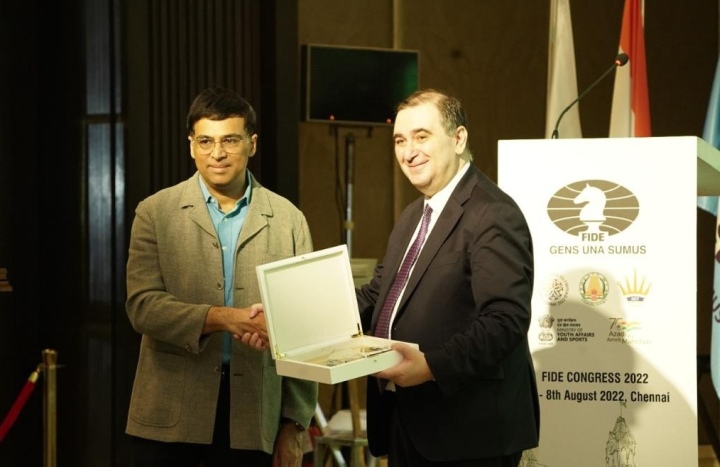
The Minister of Education and Science of Georgia Dr. Mikheil Chkhenkeli was granted an honorary award by the International Chess Federation (FIDE) for his special commitment to promoting Chess in schools. The Award Ceremony was held in Chennai, India, in the framework of the 44th Chess Olympiad. The award was presented to the Minister by FIDE Deputy-President, the Chess Grandmaster and five-time world champion Viswanathan Anand. Dr. Mikheil Chkhenkeli addressed the audience and thanked the world chess community for the presented Award. This was Mikheil Chkhenkeli’s speech: “Chess, with its rich history, has been serving people’s intellectual development for centuries. It is important that this large-scale and unique tournament, the 44th Chess Olympiad, hosts representatives from many countries from all over the world, embracing many cultures and traditions united by the love towards chess. Chess has a centuries-long history in my country as well and has been documented in Georgian literature, poetry, and historical sources. Georgian women chess players have been especially successful worldwide, the most prominent of them are the world acclaimed Nona Gaprindashvili – a five-time world champion and the first woman in chess history to earn the grandmaster title among men- and Maia Chiburdanidze, Georgian chess grandmaster and a five-time world champion. We all agree that we live in the age of technological advancements. Therefore, it is vital to raise a generation equipped, from the very early stage of life, with the skills necessary to keep up with the ongoing progress in the modern world. Chess helps students to develop complex skills. Among them are – concentration, memory, logical and critical thinking. It helps to establish value judgments, make decisions and solve problems with creativity. Chess is indeed a very effective educational tool. It is also related to the competencies defined by mathematics and other subject standards. With this in mind, the Ministry of Education and Science of Georgia made an important decision to introduce chess as a mandatory subject for first-grade students from the 2022-2023 academic year. It has to be noted that our decision aligns with the requirement envisaged by the Declaration of the European Parliament of March 15, 2012, on the introduction of chess in Education systems. Currently, the Ministry is carrying out intensive teacher training in cooperation with the Georgian Chess Federation. I’m deeply honored by the award for the commitment to promoting and developing Chess in schools granted by the International Chess Federation (FIDE). This is the recognition I highly value and cherish. I’m happy to have contributed to the development of children by supporting chess education in schools from an early age”. According to the decision of the Minister of Education and Science of Georgia, Mikheil Chkhenkeli, students will learn chess as a mandatory subject in the first grade from September 2022-2023.
Ukraine victorious at the Women’s Chess Olympiad
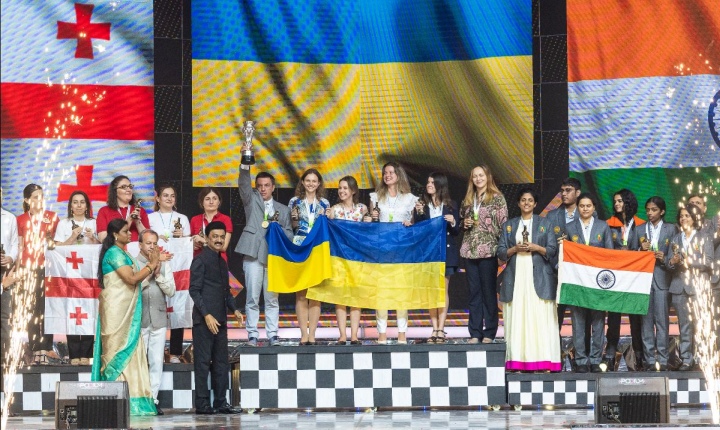
Georgia claims silver, leader India A only bronze following loss in the last round. As many as five teams had realistic chances for gold going into the last round of the Women’s section in the 44th Chess Olympiad in Chennai. India A reclaimed its sole lead in the penultimate round and was ahead of the field with 17 points, followed by as many as four teams, all on 16 points: Poland, Azerbaijan, Ukraine, and Georgia. In the absence of Russia and China, these teams formed the initial pool of favourites, making the last round wildly unpredictable. India A faced the USA, while the pursuers were paired against each other: Ukraine vs Poland, Azerbaijan vs Georgia. The top Indian team looked invincible throughout the event, but the #1 seed ran out of fuel towards the end. After seven successive wins and a draw with Ukraine came a first blow – a loss against Poland in Round 9. The hero of the Women’s section, WIM Oliwia Kiolbasa delivered her 9th consecutive win defeating Vaishali R and bringing back the suspense. Nevertheless, in the next round, Koneru and colleagues pulled themselves together and returned to the lead with a convincing 3½:½ victory over Kazakhstan. But the last round proved that any fan euphoria was untimely – India suffered a painful defeat 1-3 to the 7th seed, Team USA. Carissa Yip beat Tania Sachdev, who had a fantastic 8 out of 10 undefeated before this game, and Tatev Abrahamyan bested Bhakti Kulkarni, also inflicting her first loss. As a result, India A had to settle only for the bronze, and the gold medals were up for grabs. The land of legendary female champions, Georgia maintains the status of one of the world’s leaders in women’s chess. In Chennai, they were rated #3 in the starting list, just a couple of rating points behind Ukraine, and lived up to the expectations. In Round 6, Georgian ladies lost to India A, which seemed like a possible match for gold at the time. However, long tournament distance and intense competition proved any conclusion premature. Georgia went on winning over weaker opponents and made draws with Poland and Ukraine. In the last round, the experienced team had no mercy against the young Azerbaijan squad (who played a great event nevertheless). Nino Batsiashvili and Meri Arabidze won their games, securing at least silver medals. Ukraine is one of the initial favourites in any women’s competition. No other team could boast two former women’s world champions on the roster, Anna Ushenina and Mariya Muzychuk. Yet the team started somewhat slow. Draws with Azerbaijan and Romania in Rounds 5 and 6 seemingly indicated that the team was not in its best form, but Ukraine always stayed in the race for medals. In Rounds 8 and 9, the squad led by the Muzychuk sisters drew with direct rivals India A and Georgia. They did not lose a single match, which usually helps with possible tiebreaks, and confidently won in the last two, including the most important one in the final round, against Poland. Mariya Muzychuk set the tone by winning against Alina Kashlinskaya on board 1, and Anna Ushenina defeated the revelation of the tournament, Oliwia Kiolbasa. Ukraine and Georgia leapfrogged India A at the last moment, and all that was left was to calculate the complicated tiebreak by which Ukraine came out on top. Ukraine won gold in the women’s section for the second time after Turin 2006; this is the seventh time the Ukrainian women have won medals in the last eight Olympiads. But the 2022 victory, arriving at such a difficult time, is particularly valuable. “I am happy but very tired,” said team captain GM Michail Brodsky at the press conference right after the last round. “I can’t believe that we have won the Olympiad!” Gold – UKRAINE – 18 points (413,5 tiebreak) GM Mariya Muzychuk GM Anna Muzychuk GM Anna Ushenina IM Nataliya Buksa IM Yuliia Osmak Silver – GEORGIA – 18 points (392 tiebreak) GM Nana Dzagnidze GM Nino Batsiashvili IM Lela Javakhishvili IM Salome Melia IM Meri Arabidze Bronze – INDIA A – 17 points (396,5 tiebreak) GM Humpy Koneru GM Harika Dronavalli IM Vaishali R IM Tania Sachdev IM Bhakti Kulkarni Complete final standings and results, including team and individual performances, can be found on the official website for the Olympiad: https://chessolympiad.fide.com/women-standings. For any other information, please visit the tournament website: http://chessolympiad.fide.com. Photo: Photo: Lennart Ootes, Mark Livshitz and Stev Bonhage
Uzbekistan youngsters surprise winners of 44th Chess Olympiad
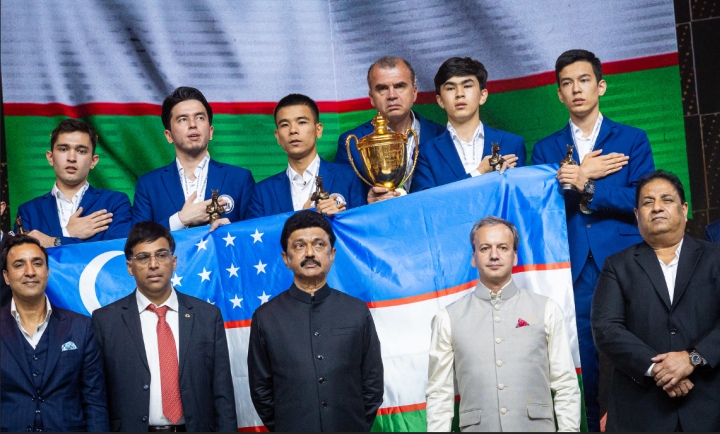
Armenia gets the silver medal, while India B, formed by young talents, outpaced its seniors and snatched the bronze History was made in the open section of the FIDE Chess Olympiad, which came to an end this morning in Chennai, India. Uzbekistan, one of the youngest teams on the roster, defeated rating favourites the Netherlands by 2.5-1.5, securing the gold medal. Undefeated over the eleven rounds, the team coached by GM Ivan Sokolov edged out Armenia on tiebreak, automatically becoming national heroes. Photo: Lennart Ootes The young Uzbek team was led by 17-year-old Nodirbek Abdusattorov (pictured above), who last Christmas dethroned Magnus Carlsen as the World Rapid Chess Champion. A chess prodigy, Nodirbek was one of the youngest players ever to achieve the Grandmaster title, at the age of 13 years, 1 month, and 11 days. The young Uzbek star had an excellent performance in Chennai, scoring 7 victories (five of them consecutive), 3 draws, and only one loss. 20-year-old Nodirbek Yakubboev, 16-year-old Javokhir Sindarov, and 20-year-old Shamsiddin Vokhidov are the other three juniors in the team that only featured one player in his late twenties: the “veteran” of the team, Jahongir Vakhidov, at 27. This huge achievement by the young Uzbek prodigies comes just at the right moment, as Tashkent was confirmed a few days ago as the venue for the 2026 edition of the Chess Olympiad. Press conference after the last round. Photo: Lennart Ootes Once again, Armenia outperformed the rating expectations and, despite being the 12th seeded, got away with the silver medal. This is a reassuring result for a team that last year lost its franchise player, Levon Aronian, who changed federations to the USA. As the former world championship challenger Nigel Short put it, “the one immutable rule of Olympiads is that the team from Armenia is always greater than the sum of its parts”. The Armenian squad was headed by Gabriel Sargissian on the first board, who, despite a poor start with four draws and one defeat, became the best scorer in the team during the second half of the competition: his 4 victories and 1 draw during the matches against direct rivals were one of the keys for the Armenian success. Robert Hovhannisyan playing on board 4, also greatly contributed to team Armenia’s success. Gabriel Sargissian won a decisive duel against Mamedyarov Shakhriyar. Photo: Lennart Ootes Along with the Uzbeks, the other positive surprise of the event was the excellent performance of the second Indian team, officially called “India B”, and formed by young promising stars. Having more than one team is a privilege traditionally given to the host country, so more of their players can gain experience in the international arena. However, it is the first time that two teams from the same country ended up in contention for the medals, and, in fact, India B managed to outpace their seniors by one point in the standings and snatched the bronze medal, relegating the “main” Indian team to the fourth position. Especially remarkable was the performance of 16-year-old Guskesh D, who made headlines all over the world when he chained 8 consecutive victories in the 8 first rounds. However, a tragedy struck in the decisive clash against the Uzbeks in the 10th round: despite having a favourable position during most of the game, towards the end, Gukesh lost the thread and blundered, losing on the spot. This result gave the match victory to the Uzbeks, and this proved decisive for the final result in the Olympiad. Gukesh was one of the stars of the Olympiad. Photo: Stev Bonhage Probably the biggest disappointment of the Olympiad was the performance of the USA team, which could only be fifth. In the absence of Russia and China, the Americans seemed the obvious favourite to win the gold. Being the top-seeded, their average rating of their players was an astonishing 2771, well ahead of India A (2696), Norway (2692) and Spain (2687). In view of these figures, not getting any medal at all seemed just unthinkable. However, with Fabiano Caruana suffering three losses and Levon Aronian scoring only one victory, the tournament favourites struggled to keep pace with the other top teams. On the other hand, the biggest overachievers of the Olympiad were the Moldovan team, seeded 48th in the starting list, without one single player above 2500. But Schitcho, Macovei, Hamitevici, Baltag and Ceres, all scored above expectations, obtaining a historical result for their country. Cuba, 19th, Brazil, 21st, and Peru, 24th, were the best teams from Latin America, while Egypt, 36th, and Tunisia, 41st, were once again the top African teams. Photos: Lennart Ootes and Stev Bonhage
FIDE Council composition announced

After the FIDE elections and the General Assembly held in Chennai, on August 7-8, 2022, FIDE is pleased to announce the composition of its Council: 1. Arkady Dvorkovich, President 2. Vishwanathan Anand, Deputy President 3. Xie Jun, Vice President 4. Sheikh Saud bin Adulaziz Al Mualla, Vice President 5. Georgios Makropoulos, Vice President 6. Michael Khodarkovsky, Vice President 7. Zhu Chen, Treasurer 8. Joran Aullin-Jansson, Vice President 9. Маhir Mammedov, Vice President 10. Olalekan Adeyemi, Vice President 11. Mario Antonio Ramirez Barajas, Vice President – secretary of the Council 12. Zurab Azmaiparashvili, Continental President for Europe 13. Tshepiso Lopang, Continental President for Africa 14. Sheikh Sultan Bin Khalifa Al Nehyan, Continental President for Asia 15. Jorge Vega Fernandez, Continental President for Americas Please note that this is the current composition as of August 9, 2022. The Confederation of Chess for the Americas (CCA) will hold elections in October, while the Asian Chess Federation (ACF) will hold them in December. Depending on the results, the composition of the FIDE Council could change accordingly. The Council is the strategic and oversight body of FIDE, and it has executive and legislative functions, and exercises the powers listed in the FIDE Charter: A) It approves and modifies, by a two-thirds majority of votes, Procedural Rules of the Ethics and Disciplinary Commission, of the Fair Play Commission and the Arbiters’ Disciplinary Committee; B) It approves and modifies, by a two-thirds majority of votes, Regulations concerning general rules about tournaments, titles and ratings; C) It approves and modifies other Regulations and Recommendations; D) It defines FIDE’s mission, strategic direction and policies, in particular concerning the organisation and development of chess at a worldwide level and all related matters; E) It approves the draft of the FIDE budget and can propose amendments; F) Following its Internal Rules, the Council approves the President’s proposals about the composition of the Management Board; G) It approves or ratifies all FIDE contracts worth more than 150.000,00 euros; H) In some other specific cases approves, the Council also ratifies or is just informed about the decisions taken by the President and the Management Board; I) supervises the activities of non-elected Commissions, which must submit to the Council their reports twice per year.
Women’s Chess Olympiad: India A shoots into sole lead
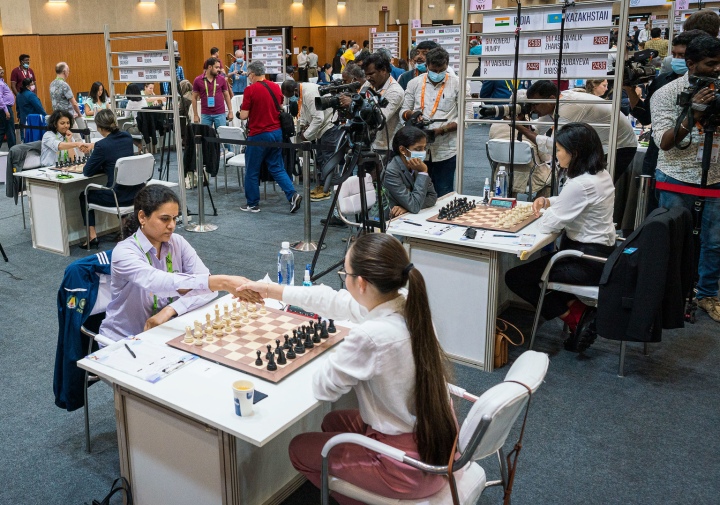
After a nightmarish ninth round, the Indian Women A team, given top billing, asserted themselves to carve out a 3.5-0.5 victory against Kazakhstan in the 10th and penultimate round of the 44th Chess Olympiad. Indian A has emerged as the sole leader with 17 points, while Poland, Georgia, Azerbaijan and Ukraine follow close behind with 16 points each. Humpy Koneru, Tania Sachdev and Bhakti Kulkarni scored victories, and R Vaishali conceded a draw. Humpy Koneru and Zhansaya Abdumalik battled in the Meran variation of the Queen’s Gambit Declined, with Humpy getting an edge early and breaking her opponent’s resistance after 55 moves. Vaishali essayed the Grinfeld Defence against Bibisara Assaubayeva with Black and pondered long on the 12th move before trading two rooks for the queen. She emerged slightly better, but eventually, the game fizzled into a draw after 50 moves. Bhakti Kulkarni employed the King’s Indian Defence against Guliskhan Nakhbayeva and launched a powerful attack on the kingside. Guliskhan was forced to part with a bishop and capitulated on the move 47. Xeniya Balabayeva tested the Semi-Slav against Tania Sachdev and kept the position balanced for a while but cracked under pressure and went down in 31 moves. Tania has been in top form in this event, scoring crucial wins for India A and aggregating 7 points. Georgia held Poland to a 2-2 draw in another match of leaders. WIM Oliwia Kiolbasa, who had a sensational 9/9, lost her first half-point today, drawing against Lela Javakhishvili. Ukraine edged past Germany by a 2.5-1.5 score, while Azerbaijan thrashed Armenia 4-0 in the most one-sided match on the top tables. India B Team defeated Netherland 1-3 with Padmini Rout, Mary Ann Gomes and Divya Deshmukh scoring victories. India C Team beat Sweden 3-1 with P V Nandhidhaa and Pratyusha pulling off wins and Eesha and Varshini settling for draws. The race for all three medals is still wide open, with the last 11th round tomorrow promising plenty of thrill and excitement. The prize awarding ceremony is slated for tomorrow evening at the Jawaharlal Nehru Stadium in Chennai. Complete results for round 10 can be found at the official website for the Olympiad, https://chessolympiad.fide.com/women-results. Standings after round 10 can be found at https://chessolympiad.fide.com/women-standings Photo: Photo: Lennart Ootes, Mark Livshitz and Stev Bonhage
Pain and glory in the Chennai Chess Olympiad
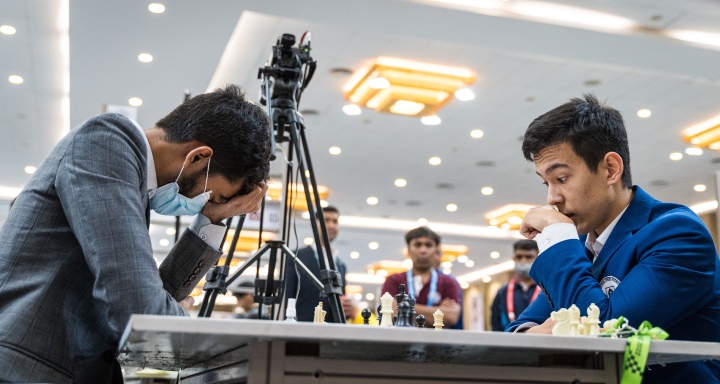
All medals are up for grabs in the final round Chess is tough, and the life of a professional player is even more so. Maintaining your emotional stability throughout a tournament can be very testing, and things can change rapidly from one day to the next. The match between the youth teams of India B and Uzbekistan was 2-1 for India B, thanks to Praggnanandhaa’s great win over Sindarov. Only Gukesh’s game remained: he was playing White against Abdusattorov. The Indian GM, with a cumulative score of 8.5 out of 9, had a decisive advantage, but a one-off mistake suddenly made the position drawn. Nonetheless, with this result, India B would have won the match, practically securing a medal. But Gukesh continued to play for the win, the game got tricky, and he made a mistake under pressure, going down in defeat. The final 2-2 result tasted heavenly to the Uzbeks, who maintained the first position and now have everything in their favour to fight for gold in the last round. The tie allowed Armenia to bounce back from yesterday’s loss with a big win over neighbour country Azerbaijan by 3-1 and to tie for first place with Uzbekistan. Robert Hovhannisyan on board four and especially Gabriel Sargissian on board 1 were the team’s heroes scoring the victories. However, Armenia has always had a “secret”, which Sargissian revealed to FIDE Press Officer IM Michael Rahal in a short postgame interview. “Even without Radjabov, Azerbaijan is a very strong team, but Mamedyarov made a mistake in the opening, and we always had the match under control. We never expected this, especially without having Levon Aronian in the team; so, for us already, this is a great result. We are all very good friends, and maybe this gives us an advantage: maybe there are some teams that don’t have a good atmosphere,” were Sargissian’s thoughts immediately after defeating Mamedyarov. Although the United States are having a relatively poor Olympiad – only Wesley So is performing to expectation on board three – two consecutive wins allowed them to climb in the standings. In fact, a win in the last round could even stand for an unexpected medal. This afternoon Fabiano Caruana and Leinier Dominguez stepped up, leading their team to victory over Turkey by 3-1. We were lucky enough to catch Dominguez for a brief postgame interview: we wanted to know what was happening in the team. “It’s my first time in India, but I am very happy to be here. The fans are incredible. When you have several players out of shape, it’s very difficult to perform well as a team,” Dominguez explained. India A scored the crucial win against Iran at the last moment and will join the group trailing the leaders. Harikrishna lost against Maghsoodloo on board one, but Vidit notched up his second win on board two against Tabatabaei to level the match. At the last moment, Narayanan broke down his opponents’ fortress for an overall 2.5-1.5. The pairings for the last round leave everything to play for, as most of the top teams have already faced each other. Leaders Armenia (17) and Uzbekistan (17) drop down to face Spain (15) and Netherlands (15). Both of these encounters will be very exciting – both the Spaniards and the Dutch are rating favorites. India (16) will battle it out with USA (16) – the winner will likely get a medal; even gold can’t be ruled out! Finally, India B (16) will play against Germany (15), to try and finish off the tournament at the top of the standings. As a side note, re-elected FIDE President Arkady Dvorkovich held a press conference this afternoon in the venue before a packed room with more than 100 journalists and press cameras. “Yesterday, the delegates showed their full trust in what we have been doing throughout this period, and the trust in what we can do during the next four years” was Dvorkovich’s opening statement, seated next to his new Deputy President Vishy Anand and Vice President Joran Aulin-Jansson. See the full press conference here. Round 11 will be played on August 9 at 10 am and can be followed live on the tournament website. The closing ceremony is scheduled to be held at 6 pm at the Jawaharlal Nehru Stadium in Chennai. For a complete list of results, please visit the official website at https://chessolympiad.fide.com/open-results/ Text: IM Michael Rahal, FIDE Press Officer, Chennai Photos: Lennart Ootes, Mark Livshitz and Stev Bonhage Photos: Lennart Ootes, Mark Livshitz and Stev Bonhage
Women’s Olympiad: Four-way tie on the top with two rounds to go
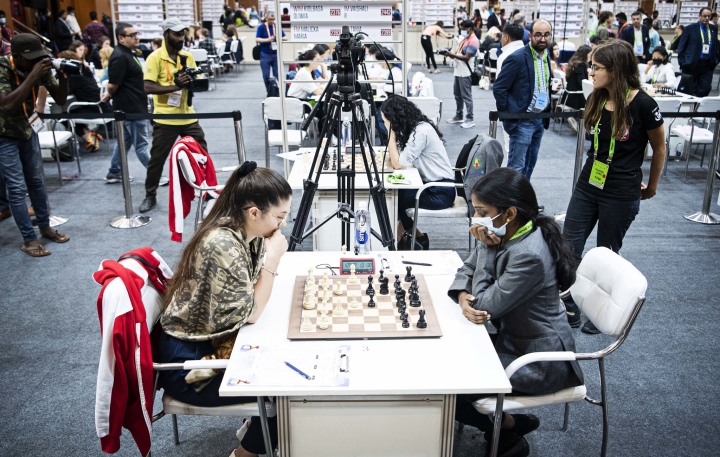
In a major setback for the sole overnight leaders in the Women’s section India A were upset by fourth seed Poland 1.5-2.5. Vaishali R lost the only game to WIM Oliwia Kiolbasa, who incidentally scored a whopping 9/9 while the three other boards ended in hard-fought draws. Humpy Koneru playing the black side of a QGD, showed good preparation and equalized early in the opening against Alina Kashlinskaya. Pieces were exchanged at regular intervals, and players decided to split a point in a dry rook ending just before the first time control. Harika Dronavalli and Monika Socko fought in a Queen’s Indian Defence, with the former grabbing the initiative from the start. Harika arranged her pieces in attacking formation to launch a real onslaught on the kingside but failed to find the winning continuation. Moreover, a hasty pawn move 25.f5 allowed Monika the trade the queens. Harika’s attack fizzled out with the game ending in a draw after 41 moves. Vaishali’s good run ended against Oliwia Kiolbasa. Vaishali lost her way in a theoretically drawn rook endgame, and Oliwia notched up her ninth (!) straight victory. India B whitewashed Switzerland 4-0, with Vantika Agrawal making her IM norm. India C also defeated Estonia 3-1. In one of the most important matches of Round 9, Georgia held second seed Ukraine to a 2-2 draw (the teams exchanged blows on boards 2 and 4), while Kazakhstan routed Bulgaria 3-1. With just two rounds to go, the race for medals is wide open, as four teams, namely Poland, Kazakhstan, India A and Georgia, are sharing first place. The complete results for round 9 can be found at the official website for the Olympiad, https://chessolympiad.fide.com/women-results. Standings after round 9 can be found at https://chessolympiad.fide.com/women-standings Photo: Photo: Lennart Ootes, Mark Livshitz and Stev Bonhage
Uzbek kids lead 44th Chess Olympiad
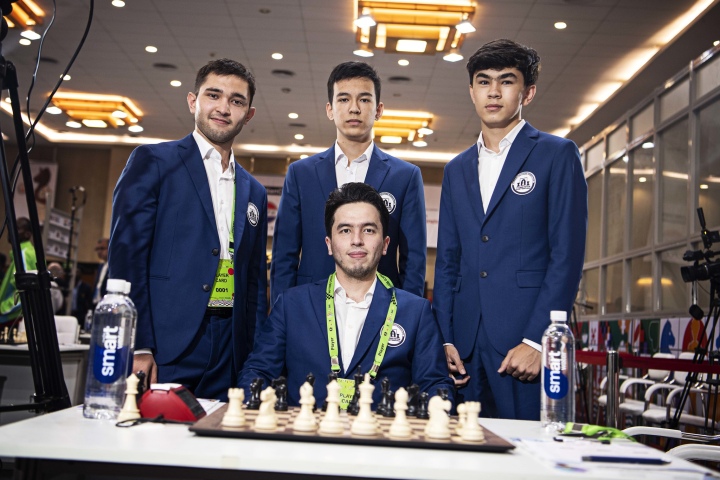
India B vs Uzbekistan, the clash of the youngsters The battle for the medal was all the rage in the ninth round of the Olympiad, played this afternoon at the Sheraton Four Points Convention Center in Mahabalipuram. No team is budging an inch, and the matches are fast and furious. Uzbekistan’s young squad, led by teenager Abdusattorov and coached by seasoned Dutch Grand Master Ivan Sokolov, compellingly defeated leaders Armenia by a 3-1 score, with wins by Sindarov and Vakhidov on the last two boards. Vakhidov’s feat is even more praiseworthy – he beat Robert Hovhannisyan (undefeated to date) with the black pieces. With this win, the Uzbekistan team is now the sole leader of the Olympiad sitting on 16 points with two rounds to go. In addition, they are the only undefeated team in the tournament – a huge surprise. As if that were not enough, the Uzbeks were greatly favoured by the other results of the round. Azerbaijan couldn’t get past a 2-2 tie against the India B juniors – Praggnanandhaa defeated Durarbayli on board three but young gun Sadhwani fell to experienced grandmaster Abasov on the fourth board. India B and Armenia are now sharing second-third places with 15 points, trailing the leaders by just one point. In the other key match of the day, the Netherlands and Iran also shared the points in a match that ended with four draws, leaving both teams with 14 points. The other teams didn’t miss the opportunity to keep their options open for the podium. Despite Levon Aronian’s unexpected defeat against Theodorou with White, the United States beat Greece by the minimal 2.5-1.5 score, in good measure due to Wesley So’s key win – he is still undefeated. Nonetheless, the hero of the day in the USA camp was Fabiano Caruana. After two consecutive defeats, he took down Greece’s number one player Mastrovasilis in a great game with Black in the Sicilian Sveshnikov Defense. The spectacular move 21…Bh6 was the beginning of a winning attack on the white king – a game for the ages. India A recovered positions at the expense of Brazil, who have been performing at a high level in the tournament. Erigaisi and Sasikiran, on the third and fourth boards, were the heroes of the national team, clearing a 3-1 victory for the local team. With only two rounds to go and three medals in play, tomorrow’s pairings are already pretty meaningful. India B (15) will face Uzbekistan (16) in a clash between the youngsters. Match two will see an Olympiad classic: Azerbaijan (14) vs Armenia (15). Whilst a draw might be a decent result for Armenia, Azerbaijan needs to go for broke to get a chance to fight for the gold medal. USA (14) vs Turkey (14), Iran (14) vs India A (14) and Serbia (14) vs Netherlands (14) are the other three pairings that will arguably decide the podium – a win is necessary, so a huge fight is expected. Alongside the Chess Olympiad, the International Chess Federation General Assembly – and general elections – have taken place in Chennai. Arkady Dvorkovich was re-elected today for a second term as FIDE President with 157 votes, against 16 for his electoral opponent, the Ukrainian chess Grandmaster Andrii Baryshpolets. The third candidate, Bachar Kouatly from France, withdrew his candidacy before the voting started. Five-time World Chess Champion Viswanathan Anand, who was part of Dvorkovich’s ticket, is the new FIDE Deputy President. Round 10 will be played on August 8 at 3 pm sharp and can be followed live on the tournament website. For a complete list of results, please visit the official website at https://chessolympiad.fide.com/open-results/ Text: IM Michael Rahal, FIDE Press Officer, Chennai Photos: Lennart Ootes, Mark Livshitz and Stev Bonhage
Arkady Dvorkovich, reelected as FIDE President
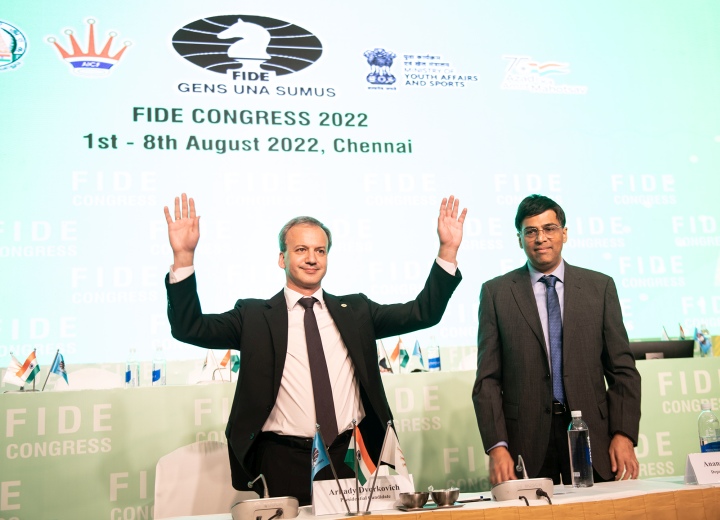
Arkady Dvorkovich has been reelected for a second term as President of the International Chess Federation (FIDE) with 157 votes, against 16 for his electoral opponent, the Ukrainian chess Grandmaster Andrii Baryshpolets. A third candidate, the French Bachar Kouatly, withdrew his candidacy after giving his speech before the voting started. Five-time World Chess Champion Viswanathan Anand, who was part of Dvorkovich’s ticket, is the new FIDE Deputy President. The elections took place during the FIDE General Assembly in Chennai, held alongside the Chess Olympiad, one of FIDE’s flagship events. The Olympiad is a team competition where countries are represented by their four best players. This year, despite the notable absences of Russia and Belarus (banned), and China (citing logistic difficulties derived from the pandemic), the Olympiad reached record participation, with 186 nations represented in the open competition, plus 160 more in the Women’s Olympiad. Born in Moscow on March 26, 1972, Arkady Dvorkovich was first elected as FIDE President in October 2018, succeeding Kirsan Ilyumzhinov. Despite being questioned by some due to his nationality and to the fact that in the past, he held important positions in the Russian government, Dvorkovich’s landslide election victory shows that he has earned the trust of FIDE’s member federations – and the wider chess community. “Yes, I am Russian, and I have served the people of my country, including to Russian chess community, as Chairman of the Board of the Russian Chess Federation”, said Arkady during his speech before the votation. “I have been trying to do it professionally and with the highest possible level of integrity. And I took a strong position on the tragic events in Ukraine as well as supported FIDE Council decisions regarding scaling down Russia’s involvement in FIDE. Moreover, while abandoning Russian partners, we have been able to find new ones around the globe, organize this Chess Olympiad [in India] and ensure financial stability for FIDE. It is far from easy for me personally, but I hope that chess can re-unite people again.” During his electoral speech before the FIDE delegates, Dvorkovich cited the following points as his main priorities for his second term: 1) To keep improving its top events, those that are part of the World Championship cycle, like the driving force of FIDE. “Not only do they generate a large interest for the game – they are a source of income required to invest in different parts of the world where chess is being developed. That should help us to make FIDE a sustainable institution, financially stable, and independent of politics”, he said. 2) To expand FIDE’s online projects, seeking new partnerships and reinforcing the existing ones, “leveraging both on the strong positive image chess has earned throughout the centuries – and the ability of chess to thrive with new technologies.” 3) To maintain and strengthen the support to member federations. After fulfilling the goal of waiving or reducing most of the fees, Dvorkovich expressed his intention “to send our best people to help, to train, to share best practices. We will provide chess materials and help to raise a new generation of arbiters, organizers, and coaches, as well as school instructors”. 4) To keep investing in promoting women’s chess. “For years, the level of female engagement stood at 10-15 percent. We already see it rising above 20% – but that is not only about the numbers. We will continue creating a friendly environment, we will provide incentives, we will engage coaches and build programs”, said the President. “These initiatives must be shaped like a long-term project, rather than punctual activities.” 5) To continue expanding FIDE’s social programs. “We will keep promoting the idea that chess is a culture and a tool to improve our societies – more than just a game or a sport. Chess is an excellent tool to develop useful skills for children in their future, like complex problem-solving, as well as socio-emotional intelligence”. Dvorkovich’s second term will also be the last, as one of the first tasks that he undertook shortly after being elected in 2018 was to renew the FIDE Charter, introduce term limits, and other democratic reforms. Among them, the “FIDE Presidential Board” was replaced by the “FIDE Council”, effectively limiting the President’s powers.