

Narendra Modi: “There are no losers: only winners and future winners”
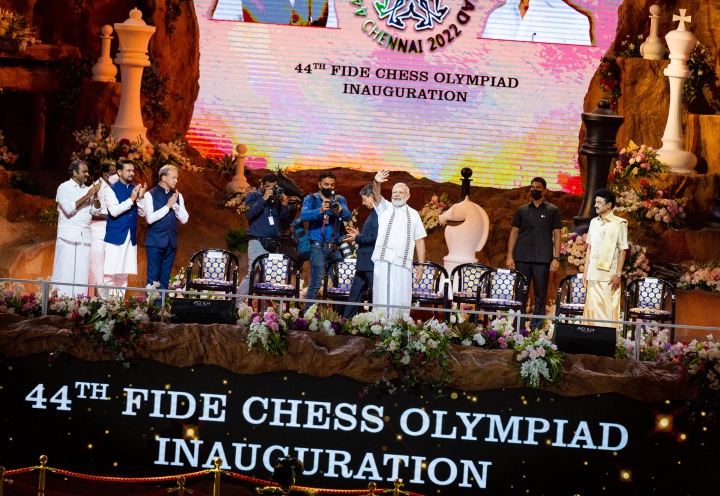
The wise reflection of India’s Prime Minister Narendra Modi garnered the biggest applause of the night from the more than 20,000 players, coaches and local chess enthusiasts at the Nehru Indoor Stadium, venue for the opening ceremony of the 44th Chess Olympiad, here in Chennai. After a marathon afternoon, full of music and colour, Modi declared the event open. The games will begin tomorrow at 3:00 p.m. at the Four Points by Sheraton Mahabalipuram Resort & Convention Center. A total of 184 teams in the open category – 158 in women – will make the Chennai Olympiad the largest in history, breaking all previous records. The ceremony commenced at 4:00 p.m. with a display of musical and dance activity, in which the event’s choreographer deployed the history of India’s Tamil Nadu state throughout the ages. Between acts, we enjoyed the classical flag parade, in which each delegations’ best players took the floor – a basic activity in any Olympic movement. Another highlight of the afternoon was the live performance by piano prodigy Lydian Nadhaswaram, who delighted us with classical and modern tunes, including a brilliant two-handed and blindfold exhibition. In 2019, Nadhaswaram won a million dollars on The World’s Best show on CBS: he’s a true musical phenomenon, a fitting opponent for the world’s best chess players. Together with Modi – “there has never been a better time for sports in India than present time. This event shows that we are stronger together” – the Chief Minister of Tamil Nadu, M.K.Stalin, also had a very significant presence at the ceremony, reminding all attendees that the event had been completed in less than four months after Moscow’s withdrawal. FIDE’s own Arkady Dvorkovich also took the stage, welcoming all the participants to this exciting event. But perhaps the most memorable moment of the night was five-times world champion Vishy Anand handing over the Olympic relay torch to Prime Minister Modi, who in turn passed it on to Pragnaandhaa and Gukesh, “the future of Indian chess”. The players of the Indian B-team lit up the Olympic flame, and received the deafening applause of the stadium. Without a doubt, in my modest opinion, the best opening ceremony I have ever attended in my life, in relation to the time available to organize it – and I was at the opening of the 1992 Barcelona Olympics! Text: IM Michael Rahal, FIDE Press Officer, Chennai Photo: Lennart Ootes
Valentina Gunina trounces Tan Zhongyi to advance into semis
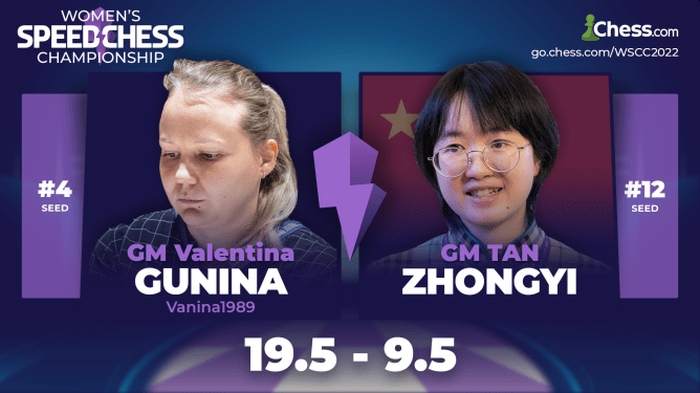
GM Valentina Gunina swept away GM Tan Zhongyi in a quarterfinal match and reached the semifinals of the FIDE Chess.com 2022 Women’s Speed Chess Championship. After a poor 0-2 start, Gunina found her A-game and won the first 5+1 segment by a resounding score of 7-3. The 3+1 games were all about Gunina, who stretched her lead to 11 points and virtually secured the match victory. Tan stoke back in the 1+1 portion and found some comfort in winning the final segment of the match by a minimal margin. Gunina earned $3,344.83 for her victory, while Tan collected $655.17. Gunina’s next opponent in the semifinals will be decided in a clash between Hou Yifan and Alexandra Kosteniuk. Asked about her preparation for the match, Valentina said: “My coach prepared some variations that my opponent was going to play. Yesterday we had a discussion about that. Today, I just repeated some of these lines, and it saved me energy.” The next quarterfinal match between GM Kateryna Lagno and GM Humpy Koneru, who have previously held Women’s World Rapid titles, will take place on July 19, at 7.30 a.m. Pacific / 16:30 Central. The FIDE Chess.com 2022 Women’s Speed Chess Championship is an online event where titled women players will play a series of blitz and bullet matches for a share of the $70,000 prize fund. To follow the FIDE Chess.com Women’s Speed Chess Championship, watch a live broadcast of the event with expert commentary on Chess.com/TV and Chess.com Twitch Channel. More info and a full schedule of the FIDE Chess.com Women’s Speed Chess Championship can be found here.
“Smartwater”, official beverage partner of 2022 Chess Olympiad

FIDE has signed a partnership with Glaceau Smartwater, a bottled water brand owned by Energy Brands, a subsidiary of the Coca-Cola Company. Smartwater will be the official and exclusive beverage partner for the 2022 Chess Olympiad in Chennai. Now sold as a premium product globally, Smartwater was first introduced in 1996 in the United States, and by 2016 it was one of the top five bottled water brands in the country, with sales worth nearly $830 million in 2017. It also gained popularity very quickly after being introduced in India at the end of 2017, in association with TED Talks India Nayi Soch. Barely two years later, India was already the fourth largest market globally for the brand, with a presence in over 50,000 outlets across the country. The brand is also available in other countries, including the United Kingdom, France, Australia, Argentina, Brazil, Chile, The United Arab Emirates, Croatia, Singapore, Serbia, Romania, Malaysia and Canada. American actress and singer Zendaya is its current global brand ambassador, following other stars like Jennifer Aniston and Gal Gadot. “FIDE is happy to partner with Smartwater”, said Emil Sutovsky, FIDE’s Director-General. “For centuries, chess was seen as an epitome of human intelligence. But nowadays, chess is mostly a sport. Smart sport. And players smartly consume a lot of water throughout long chess games. We made sure it will be Smartwater. The massive cooperation with a premium brand towards the Olympiad underlines again the significance of chess in the modern world and its attractiveness to major partnerships”. Made through vapour distillation, water is evaporated to remove impurities, condensed and then re-mineralized with electrolytes for a crisp, pure taste, all in an iconic package. “Since then, Smartwater has continued to challenge norms and stay ahead of the curve”, reads the company’s Global website. “In 2019, Smartwater alkaline and Smartwater antioxidant were introduced across multiple countries to meet the growing desire for hydration options throughout the day”. The innovations have continued with the launch of Smartwater flavours — inspired by the lightly infused waters found at spas, and Smartwater+, infused with a range of fruit essences and rejuvenating extracts. Rehydration will be an essential need for the participants of the 2022 Chess Olympiad, especially taking into account the high temperatures in Chennai at the time when the competition is played. Studies show that you only need to be 1% dehydrated to experience a 5% decrease in cognitive function. A 2% decrease in brain hydration can result in short-term memory loss and trouble with math computations. Prolonged dehydration causes brain cells to shrink in size and mass, a condition common in many elderly who have been dehydrated for years. “Water gives the brain energy to function, including thought and memory processes. Water is also needed for the production of hormones and neurotransmitters in the body”, explains The Brain & Spine Institute of North Houston. “Since the brain cannot store water and you are constantly losing water through perspiration and other body functions, it’s essential that you continuously hydrate. You’ll be able to think faster, focus more clearly and experience greater clarity when your body and mind are functioning on a full reserve of water”. This institute also offers the following tips to stay hydrated: Drink a glass of water before exercising and sip during to make the most of your workout Drink a glass of water before each meal Avoid alcohol while flying and drink water instead – trade your soda for sparkling water Drink water throughout the day, even if you are indoors and in the air conditioning 70,000 bottles and cans of Smartwater products supplied by Coca-Cola India Private Limited will ensure that the participants in the Olympiad will stay hydrated and able to perform at their highest level.
Zurab Azmaiparashvili reelected as ECU President
The ECU General Assembly 2022 took place on Saturday, 23rd July 2022 in Hotel Porto Palace Thessaloniki, Greece. More than 80 delegates, officials, and councilors from 50 European federations gathered for the ECU GA 2022 which included ECU elections and other major events on the agenda. During the ECU General Assembly a new Board of ECU was elected. Mr. Zurab Azmaiparashvili was reelected for a third term as ECU President. FIDE President Arkady Dvorkovich, who attended the ECU General Assembly, congratulated the elected team and confirmed further close cooperation between FIDE and Continental Body. In addition to organizing major chess events in the continent, FIDE has been supporting ECU through annual allocations of the Development Fund. It helps the ECU to stage various chess events and implement social programmes and policy improvement projects across Europe. The following team will be leading the European chess life in the next four years: ECU President: Mr. Zurab Azmaiparashvili Deputy President: Mrs. Dana Reizniece-Ozola Vice President: Mr. Gunnar Bjornsson Vice President: Mr. Malcolm Pein Secretary General: Mr. Theodoros Tsorbatzoglou Treasurer: Mr. Ion-Serban Dobronauteanu Vice President: Mrs. Eva Repkova Vice President: Mr. Alojzije Jankovic Vice President: Mr. Jean-Michel Rapaire Congratulations!
European Youth Rapid & Blitz Champions crowned in Thessaloniki
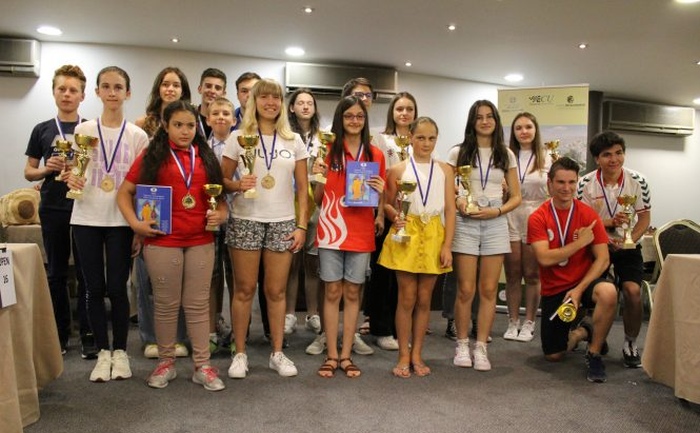
European Youth Rapid and Blitz Chess Championships 2022 took place from 20-22 July in Hotel Lazart Thessaloniki, Greece. 250 players from 28 European federations participated in the events which were played within 6 age categories: U8, U10, U12, U14, U16, and U18, open and girls separately. The first event on the schedule was European Youth Rapid Chess Championship 2022 which was held on 20th and 21st July. The Closing ceremony of the event took place on Thursday evening, with the ECU Secretary General Mr. Theodoros Tsorbatzoglou, the Vice President of Mitropa Chess Association and Secretary General of Slovenian Chess Federation Ms. Nina Rob, Tournament Director Mr. Nikos Kalesis and FIDE Events Commission member George Mastrokoukos taking part in the Awarding ceremony. Maksym Kryshtafor (UKR) was the Winner of the U8 open section scoring 8/9 points. Uzun Pavlo (UKR) scored 7.5 points and claimed silver medal, while Kovacs Balasz (ROU) won bronze with 6.5 points. Ukrainian players topped the final standings in the Girls U8 section. Svitlana Russieva (UKR) convincingly won the event netting 8/9 points, finishing two points ahead of her compatriots Tetyana Molchanova who took silver and Bierta Gutserieva (bronze). Andrei Negrean (ROU) scored impessive 8/9 points and became a sole winner in the Open U10 category. Three players tied for the second place scoring 6.5 points, each, with tiebreaks favoring Shilon Rahav Eliran (ISR) who claimed silver and Diachek Andriy (UKR) taking bronze. clinched bronze and Hanache Kai (ENG) came fourth Solomiia Svitenko (UKR) and Varvara Matskevich (FIDE) shared first place in the Girls U10 section scoring 8 points, each. According to the first tiebreak criteria – direct encounter – Svitenko lifted the trophy as she defeated Matskevich in the fourth round. Evangelia Siskou (GRE) ended up iwth 6.5 points and won bronze medal. Tykhon Cherniaiev (GER) emerged as the sole winner of the Open U12 section with the score of 7.5/9 points. Three players were in a tie for second place netting 7 points each, with Henry Edward Tudor (ROU) and Pawel Sowinski (POL) claiming silver and bronze respectively thanks to better tiebreaks over Patryk Cieslak (POL) was fourth. There was a three-way tie for the top position in Girls U12 as well with Anja Beber (SLO) taking the title by dint of slightly better tiebreaks over Arya Aydogan (TUR) was second, while Sona Krkyasharyan (ARM) won bronze medal. Svyatoslav Bazakutsa (UKR) and FM Jakub Seemann (POL) were in a tie for the first place of the Open U14 category as they scored 7.5 points, each. Since they drew their fifth round game, the first tiebreak criteria – the direct encounter wasn’t enough to determine the winner. Svyatoslav won the gold medal thanks to the better Bucholz, and Seemann Jakub claimed silver. Mykhailo Podolskyi and Pilshofer Paul scored 6 points each to tie for bronze medal, but Podolskyi Mykhailo had better tiebreaks and came third. Five players were in a tie for the first place in the Girls U14 category. Sofija Vasiljeva had best tiebreaks and won the event, Guid Taja (SLO) came second, Pert Nina (ENG) clinched bronze. FM Aron Pasti (HUN) lifted the trophy in Open U16 section scoring 7.5 points. Two players followed him with 6.5 points, each, with tiebreaks favoring FM Edvin Trost (SWE) the silver medalist and FM Laurenz Borrmann won bronze. WFM Luisa Bashylina (GER) triumphed in the Girls U16 category with 7 points. She finished half a point ahead of Vesna Mihelic (SLO) and Weronika Zabrzanska (POL) who tied for second place scoring 6.5 points, each. Tiebreak criteria favored Mihelic Vesna (SLO) who clinched silver and Zabrzanska Weronika (POL) claimed bronze. IM Ruben Gideon Koellner (GER), IM Marcell Borhy (HUN) and FM Olexiy Bilych (UKR) tied for the top of the Open U18 section. According to tiebreaks, the gold medal goes to Gideon Ruben , IM MarcellBorhy won silver and FM Bilych Olexiy came third. WFM Martyna Wikar (POL) dominated the Girls U18 section scoring 8/9. WFM Emilia Dylag (POL) and Eszter Sulyok (HUN) tied for the second place with 7.5 points, each, but Dylag Emilia came second according to tiebreaks, and Sulyok Eszter won bronze. European Youth Blitz Chess Championships 2022 were played on 22nd July with the closing ceremony held right after the final round. ECU Chief Executive officer Mr. Erald Dervishi, FIDE Vice President Ms. Anastasia Sorokina and Tournament Director Mr. Nikos Kalesis took part in the awarding ceremony. Maksym Kryshtafor (UKR) scored perfect 18/18 (!) to win the double crown at the European Youth & Rapid Chess Championship 2022. Geroge Chen (ENG) was second with 13.5 points and Stefan Apostu Rares (ROU) won bronze with 13 points. Svitlana Russieva (UKR) triumphed in the Girls U8 tournament winning another gold medal at the event. Dominika Hachkailo (UKR) clinched silver with 13 points and Bierta Gutserieva (UKR) was third with 11 points. After winning gold at the European Rapid U10 Championship, Andrei Negrean (ROU) clinched gold also in Blitz event scoring 14.5 points. Hanache Kai (ENG) won silver with 13 points and Diachek Andriy (UKR) came third with 12.5 points. Varvara Matskevich (FIDE) and Solomiia Svitenko (UKR) tied for the top of the Girls U10 section scoring 15.5 points, each. This time, tiebreak criteria favored Matskevich who won the blitz championship in this category. Aleksandra Meshkova (FIDE) came third with 13 points. Tykhon Cherniaiev (GER) won the second trophy at the event winning the European Blitz Chess Championship 2022 in Open U12 section with 16.5 points. Lukas Dotzer (AUT) won silver medal with 14 points, and Patryk Cieslak (POL) clinched bronze with 13 points. Arya Aydogan (TUR) won the Girls U12 section netting 14.5 points. Sona Krkyasharyan (ARM) came second with 14 points, and Kler Caku (ALB) finished the event in the third place with 12 points. FM Jakub Seemann (POL) was the Winner of the Open U14 category. Svyatoslav Bazakutsa (UKR) clinched silver with 13 points and Cnejev Vladimir-Alexandru (ROU) won bronze with 12.5 points. Sofja Vasiljeva (LAT) clinched gold in the Girls U14 section scoring 14
Magnus Carlsen wins 2022 SuperUnited Rapid and Blitz
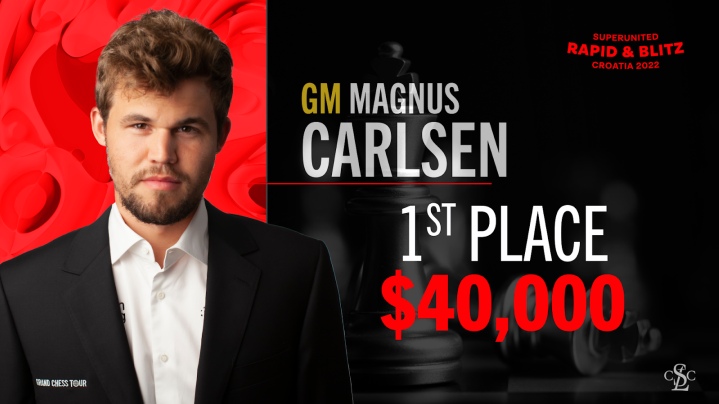
The 2022 SuperUnited Rapid and Blitz the 3rd stage of the 2022 Grand Chess Tour has come to an end. Magnus Carlsen did it again clinching the victory with two rounds to spare. The 10-player event took place in the Westin Hotel in Zagreb from July 20-24, 2022. The rapid was a 10-player single round-robin with 3 rounds each day on the first 3 days at a time control of 25 minutes for all moves and a 10-second increment from move 1. The final two days were a blitz double round-robin, with 18 rounds of 5+2 blitz. Rapid games counted double, with 2 points for a win and 1 for a draw. A Test of Endurance While Magnus had a couple of nice games on the final day, he really paved the way in Day 4 after his 5-game winning streak. After securing the title he lost his last two games and scored 4.5/9. It just goes to show what a moment of relaxation can mean, even for the best player in the world. Not long into Day-5 it became clear that everybody else was fighting for second place. The first casualty to exhaustion was Jorden Van Foreest, who had finished the Rapid in clear 1st and began Day-5 in clear 3rd, but eventually finished 6th. Van Foreest was one of the many that saw his play suffer due to exhaustion | Photo courtesy of Grand Chess Tour, Lennart Ootes The Dutchman had an incredible display of fighting spirit. He came back after every one of his losses, up until round 24, which is when it all went wrong for him. He was not able to recover from that blow and finished scoring 0.5/4 in the last rounds. Van Foreest – Vachier-Lagrave, Round 24 24.Bxe7+? [24.Nc5!! Bxc5 (24…Bxg5 25.Nxe6+ recovers the bishop with a winning position) 25.Rxc4+- Black cannot defend the minor pieces along the c-file] 24…Kxe7 and soon Black’s queenside pawns became overwhelming 0–1 Perhaps the greatest casualty to exhaustion was Wesley So, who began the day (and had spent the entire tournament at the top of the standings) in clear second and finished in a disappointing tie for 4-5 place. He seemed to have finally solved his problem with White (he won three games, more than in all the other days combined!). However, he conceded too many draws and in the final stretch only managed 0.5/3. Dominguez – So, Round 25 After endless maneuvering, Wesley takes the bait 85…Nxa5?? [85…Ne3 would have held on] 86.Bd5! the knight is dominated and was eventually lost. 1–0 Always with a cheerful disposition, Wesley’s final place in the standings did not reflect his protagonist throughout the event | Photo courtesy of Grand Chess Tour, Lennart Ootes The final day was all about the Frenchmen. Alireza Firouzja scored an impressive 7.5/9, while Maxime Vachier-Legrave an unbelievable 8/9. While most struggled to keep a grip on themselves, the Frenchmen were frantically pouring energy into their games. Carlsen – Firouzja, Round 26 46.Bxh3?? [46.Rg4! Ne4+ (46…g2 47.Bxg2= White will happily give up the bishop for the two pawns; 46…h2 47.Bg2 now the pawns go nowhere) 47.Kb2 g2 48.Bxg2 hxg2 49.Rxg2=] 46…Nxh3 47.Rg4 Nf2!-+ White cannot take the pawn on g3 because of the fork on e4. 0-1 MVL displayed tremendous endurance and scored a whopping 8/9! | Photo courtesy of Grand Chess Tour, Lennart Ootes Firouzja – MVL, Round 22 After defending tenaciously, Firouzja lets his guard down and allows the draw to slip away after 48.Kh4?? [48.Ra1 Rc7 49.Bf3 there is no way for Black to make progress] 48…Rc7 White cannot stop 49…Rh7 mate! 0–1 Firouzja scores a crucial win against Carlsen in the penultimate round on his way to shared 2nd place | Photo courtesy of Grand Chess Tour, Lennart Ootes No one would dare accuse the MVL or Alireza of lacking fighting spirit. And they certainly proved they have endurance as well. But unlike Magnus (at least in the case of Alireza and Van Foreest), they played better chasing the lead than when they had it. While Magnus, once he had it, took off with it. A lot has happened in the past five days. One of the main takeaways from the event is that despite the new format, the traditional virtues that define chess greatness remain the same: fighting spirit and endurance. From left to right: Grand Master and event organizer Zlatko Klaric, GCT Executive Director Michael Khodarkovsky, GCT Founder Garry Kasparov, tournament winner Magnus Carlsen, President of Super United Marin Marusic and President of Superbet Foundation Augusta Valeria Dragic | Photo courtesy of Grand Chess Tour, Lennart Ootes The Grand Chess Tour will conclude with the final two legs of the tour being held in Saint Louis, MO the Chess Capital of the USA. The Saint Louis Rapid & Blitz from August 25th – August 30th and Sinquefield Cup from September 1st – September 13th. Fans can follow all the action live on grandchesstour.org and on the Saint Louis Chess Club’s YouTube and Twitch.tv channels. Text: GM Robert Hungaski Photo: Grand Chess Tour, Lennart Ootes Further Information:Web: GrandChessTour.org | Twitter: @GrandChessTourInstagram: @GrandChessTour | Facebook: @GrandChessTour Venue: The Westin Zagreb, Zagreb, CroatiaJuly 20 – July 24, 2022 Press Contact:press@grandchesstour.org Livestream:GrandChessTour.org Photos:Courtesy of Grand Chess Tour and Spectrum StudiosCredits available on Flickr.
Checkmate Coronavirus: Road to Chennai. Vol 2
“The legend Nepo rolled a number, and I didn’t believe it was my ticket. I screamed crazily from joy and called my mother, telling her I won the trip!” The winners of the major prize of FIDE’s Checkmate Coronavirus project are packing their luggage to Chennai. Soon they will visit the Chess Olympiad, a free trip they won from the 2020 pandemic online project – a dream come true. Chess was affected by the pandemic like any other sport, with tournaments postponed or cancelled and clubs temporarily closed. Yet the nature of chess helped players, fans, and enthusiasts of the game to stay active and involved during this crisis, whereas online chess got an unprecedented boost. Checkmate Coronavirus, an online chess marathon launched by FIDE in May 2020, has gathered more than 120,000 participants from at least 140 countries. The weekly project prize draw winners received 1500 prizes, including souvenirs, free master classes, and mini-matches with top grandmasters. But the luckiest ones were the winners of the major prize, also awarded by a draw, so every Checkmate Coronavirus participant had a chance. Six-night trip to Chennai with paid air tickets, full board, and a chance to meet the greatest chess players of our times went to chess amateurs representing Algeria, Azerbaijan, Bangladesh, Brazil, Colombia, Egypt, Greece, Mauritius, Mexico, Morocco, Myanmar, Pakistan, Serbia, South Africa, Spain, Sudan, Sweden and Thailand. We continue to share their stories. Project participant with the playing handle HisEloquency is 25 years old, and he lives in Belgrade. “I’ve been playing chess for as long as I can remember, using made-up rules my cousins came up with. I was properly introduced to the game at around five when my father taught me all the rules, even special ones like en passant, which caused my friends a lot of confusion for many years,” he says. HisEloquency mostly plays online. It used to be difficult for him to find ardent players in his area, so he only played sporadically before discovering lichess.org in 2015/16. They played over a hundred tournaments at the Checkmate Coronavirus project before winning the grand prize. “I saw my username mentioned in the YouTube video after the stream ended. I wanted to congratulate the winners of the major prizes, as many had congratulated me when I had won the mini-match in the first prize draw. I didn’t even consider I would get drawn for a major prize again, so I was very surprised, to say the least. I double, triple and quadruple-checked everything before I started phoning friends and family. It all felt unreal”. HisEloquency is very excited about the Chess Olympiad, as they’ve never attended a chess event remotely close to the scale, and looking forward to meeting great players and fellow chess enthusiasts from around the world. Carlos Gomes is 63 years old and the oldest member of the delegation. Carlos lives in Taguatinga, Brazil, and has been playing chess for 50 years. Carlos is probably the luckiest person on the project because despite playing online chess regularly, he had only played one Checkmate Coronavirus tournament before winning a prize! He did not even watch the prize draw and learned that he had won the main prize from his friend. Carlos has never been to India. However, this won’t be his first chess tournament abroad, as he travelled to Argentina in 1993 for the Latin American Children’s Chess Cup, where his student became the champion. Now Carlos is packing for Chennai to meet the chess elite and enjoy the city. Bakhti Noureddine is 33; he has 20 years of experience in chess. He participated in more than a hundred Checkmate Coronavirus tournaments and won not only an invitation to the Chess Olympiad but also a souvenir. “At the time of the draw of six invitations to the Chess Olympiad, I was at work, so my friend called me and said that I was on the list of winners. I was super happy,” confesses the winner. “I was following the final broadcast of the last big raffle, and the legend Nepo rolled a number, and I didn’t believe it was my ticket which won. I screamed crazily with joy and called my mother, telling her I had won the trip! Was the best news ever,” – says another winner, Morad Anwar from Egypt. “I was playing day and night wishing to collect as many tickets as possible, and I almost didn’t sleep to get more chances for tickets as it was my dream to watch the Olympiad live,” he adds. “I want to explore the city and do some shopping. Visiting the beach and following the olympiad is my very first priority. I want to thank FIDE for this great opportunity and brilliant initiative called “Checkmate Coronavirus”, which was fun and exciting from first to last moment!”
Winners crowned at 2022 Biel Chess Festival
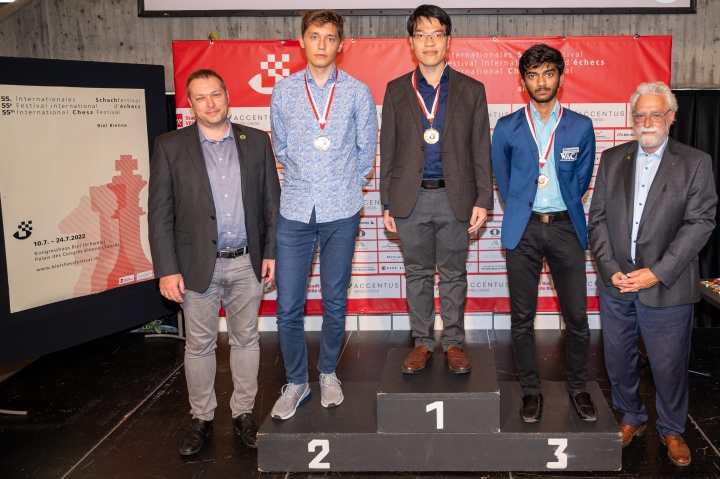
Despite all the turbulence, one constant is certain about the Biel summer: the Biel International Chess Festival opened its doors for the 55th time in an uninterrupted series – the fact that Peter Bohnenblust, president of the organizing committee, proudly highlighted in his opening speech. A popular chess forum running from July 10-22 included several exciting competitions and was financially supported by the City of Biel-Bienne, ACCENTUS, VINETUM, and FIDE Open Aid Project. The Grandmaster Triathlon was a centrepiece of the festival. The 8-player tournament combined three different time formats (blitz, rapid and classic), counting towards the final score. A win in a classical game was worth 4 points, with 1½ points for a draw. In the Rapid (15min+5s) segment, a victory was worth 2 points and a draw 1 point. The blitz (3+2) was played as a double round-robin with 1 point for a win and ½ points for a draw. He couldn’t be sure coming into the final round, but thanks to a draw against his first rival Andrey Esipenko, Lê Quang Liêm secured the title in the Grandmaster Triathlon. The Vietnamese GM, who was convincing throughout the tournament, proved to be the strongest player in classical and rapid chess and maintained his high level in blitz. He deservedly won Triathlon. Andrey Esipenko and India’s Gukesh Dommaraju completed the podium. Despite three wins in a row, Lê Quang Liêm had a tough test in the final round of the classical segment against his main rival Andrey Esipenko with Black. The Vietnamese was in trouble throughout an extremely complex game, but he found his way out to secure a draw and win the tournament. Gukesh D had a promising position with Black against Saleh Salem, but lost control over the proceedings and went down. Still, he retained third place in the final standings as fourth-placed Nodirbek Abdusattorov fell to Gata Kamsky, the Biel 2021 winner, who finished on a high note. Interestingly, the top 3 remained unchanged throughout the tournament, but the order was unclear until the very end. Final standings: Rank Player Classic Rapid Blitz Total 1 Quang Liêm Le 17½ 11 7 35½ 2 Andrey Esipenko 15½ 10 7 32½ 3 Dommaraju Gukesh 15 7 7½ 29½ 4 Nodirbek Abdusattorov 9½ 9 8 26½ 5 Saleh Salem 11 7 8 26 6 Gata Kamsky 14 1 8½ 23½ 7 Arkadij Naiditsch 12½ 6 2 20½ 8 Vincent Keymer 6 5 8 19 As part of the Year of the Women in Chess proclaimed by FIDE, the Ladies ACCENTUS Quadriathlon took place at the Biel Chess Festival with eight invited young talents. The Swiss were ruthless in this last round stealing the show. Zhuang Yongzhe (Switzerland) managed to beat Iris Ciarletta (France) with the black pieces, leapfrogged her opponent and won the event. Another local player, Gohar Tamrazyan, moved up to third place after defeating her compatriot Yulia Avilova, taking advantage of Juliette Cornileau’s loss to Laura Sumarriva. Margaux Moracchini needed a win to share third place but managed only a draw against Cecila Keymer. Final standings: Rank Player Classic Chess960 Rapid Blitz Total 1 Zhuang Yongzhe 19 3½ 10 6½ 39 2 Iris Ciarletta 9½ 5½ 9 12 36 3 Gohar Tamrazyan 19 2½ 8 5½ 35 4 Juliette Cornileau 13½ 5½ 10 5½ 34½ 5 Margaux Moracchini 17½ 1 5 9 32½ 6 Laura Sumarriva Paulin 12½ 3 7 8 30½ 7 Yulia Avilova 3 4 5 7½ 19½ 8 Cecilia Keymer 10 3 2* 2 17 The Master Tournament, a 9-round Swiss event, brought together 114 players and produced a major surprise. In the final round, Kirill Alekseenko playing with the white pieces, got an advantage against the co-leader Mahammad Muradli (Azerbaijan) on table 1 but let it slip away and had to settle for a draw. The two players finished on 7 points out of 9 and tied for first place as the games at tables 2 and 3 were drawn. It was then the Azeri GM who emerged victorious thanks to better tiebreaks. It was a breathtaking performance by Muradli, who, rated just 2523, was only 21st on the starting list, 200 rating points behind the favourites. Out of six chasers who had 6½ points before the final round, Armenia’s Shant Sargsyan claimed third place. The Indian players, who were on the top of the MTO standings for the most part, did not make it to the podium. Visakh, Sethuraman and Mendonca finished fourth, fifth and sixth, respectively. Final standings: 1 Muradli Mahammad AZE 2523 7,0 2 Alekseenko Kirill FID 2708 7,0 3 Sargsyan Shant ARM 2661 6½ 4 Visakh N R IND 2503 6½ 5 Sethuraman S.P. IND 2623 6½ 6 Mendonca Leon Luke IND 2567 6½ 7 Fedoseev Vladimir FID 2686 6½ 8 Martirosyan Haik M. ARM 2672 6½ 9 Aryan Chopra IND 2610 6 10 Motylev Alexander FID 2632 6 The Amateur Tournament (ATO) was dominated by the Indian players. In the final round the leaders Harisurya Bharadwaj overcame Gundepudi Majed Al Helao while Manmay Chopra bested Niels Stijve. The two above-mentioned winners, both Indians, scored an impressive 8/9, with Manmay Chopra coming out on top by dint of better tiebreaks. Al Helaoy (Syria) netted 7 points and took the last place on the podium, finishing a full point behind the winners. Final Ranking ATO: https://chess-results.com/tnr636483.aspx?lan=1&art=1&rd=9 Text and photos: official website Photos of the Biel International Chess Festival are available here: https://www.flickr.com/photos/143150736@N02/collections/72157720866132786/ Official website: www.bielchessfestival.ch
Vaishali R eliminates Dronavalli to reach semifinals
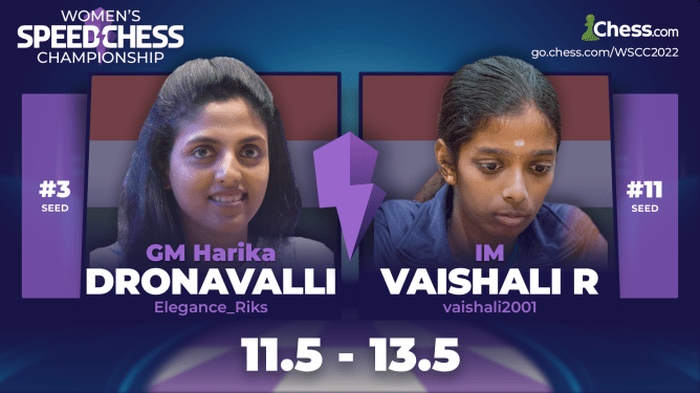
IM Vaishali R edged out GM Harika Dronavalli in a very close quarterfinal match and advanced to the semifinals of the FIDE Chess.com 2022 Women’s Speed Chess Championship. Vaishali won the first 5+1 segment by a minimal margin, but Harika did the same in the next portion of the match. The opponents entered the 1+1 stage with 8.5-8.5 on the scoreboard. Vaishali pulled away with just a few minutes on the match clock heading to the final game with a one-point lead. With her back against the wall, Harika had to win the game to send the match into a tiebreaker and came very close. She achieved an overwhelming position but, in a drastic turn of events, blundered a checkmate in one. In her post-match interview, Vaishali talked about playing alongside Dronavalli for team India at the upcoming Olympiad: “It will be my first over-the-board Olympiad, and I am very grateful for the event. Harika will also be playing. She is one of my biggest inspirations, actually. Playing alongside her will be very interesting.” The next quarterfinals match, GM Hou Yifan vs GM Alexandra Kosteniuk, begins on Thursday, July 28, at 3:30 a.m. Pacific / 12:30 Central European. To follow the FIDE Chess.com Women’s Speed Chess Championship, watch a live broadcast of the event with expert commentary on Chess.com/TV and Chess.com Twitch Channel. More info and a full schedule of the FIDE Chess.com Women’s Speed Chess Championship can be found here.
Remarkable performances at Chess Olympiads
The 44th Chess Olympiad starts in Chennai in just a week. The most popular team competition will surely bring new records (at least one is certain – the number of registered teams is growing year over year), new stories and heroes. The main focus will be undoubtedly on the team results, as every match is a joint effort to earn a match victory. However, individual achievements are historically highlighted at Chess Olympiads, with a set of gold, silver, and bronze medals awarded for the best results on every board. The top six individual results were awarded a prize already at the first Olympiad in 1927, and the tradition still stands. George Alan Thomas from England and Holger Norman-Hansen from Denmark shared the first prize in 1927; both scored 12 out of 15 (80% points). Looking forward to Chennai and browsing through the previous editions, let’s recall some of the remarkable individual results at the Chess Olympiads in XXI century. Robert Gwaze – 9 out of 9 It sounds surreal, but there was a player who got a perfect 9/9 score playing on the first board at a Chess Olympiad. Zimbabwean International Master Robert Gwaze achieved this fantastic result in Bled (2002) and won an individual gold medal, leaving Garry Kasparov behind. Robert Gwaze | Photo: lichess.org Surprisingly, Gwaze’s result is not unique. One more player scored a perfect 9/9 on the first board, playing for France, and it was no other than Alexander Alekhine! The world champion played inspired chess in Hamburg (1930) and won the brilliancy prize for his game against Gideon Stahlberg. However, Alekhine was not awarded an individual gold medal as he did not play enough games (the medalists played 17 games each). Andrei Volokitin – Performance rating 2992 In Baku (2016), Grandmaster Andrei Volokitin, playing as a reserve for Ukraine, delivered a fantastic rating performance of 2992! He scored 8½ out of 9 games, helped his team to claim silver in the Open competition and won an individual gold medal. Among others, he beat Alexander Grischuk and Eric Hansen, and the only draw he made was with Wei Yi. Andrei Volokitin in 2021. Photo: Anna Shtourman There is a significant gap between Volokitin’s performance and the closest results. In Bled (2002), Garry Kasparov swept away the opposition on the first board, scoring 7,5 out of 9, but with ‘only’ 2933 performance. At the time, the board medals were not awarded according to the performance, and the great champion did not get any, finishing only fourth by points scored. Not far behind is Georgian GM Baadur Jobava, who put in a whopping 2926 performance on Board 1 in Baku (2016). He finished the event on 8/10, beating Ghaem Maghami, Topalov, Vallejo, Lupulescu, Ponomariov, and Rapport! Baadur Jobava at 2016 Olympiad | Photo: Andreas Kontokanis GM Jorge Cori closes this improvised podium of the best-ever rating performances. Almost on par with Jobava, he showed 2925 performance in Batumi-2018 – an achievement that earned him an individual gold medal on Board 3. The leader of Peruvian chess dropped only half a point in eight games, drawing with Nepomniachtchi, and beating Wei Yi, Yannick Pelletier, and others. Nana Dzagnidze – Performance rating 2719 The whole Board 1 individual medals pedestal in Tromso (2004) is quite remarkable. Pia Cramling got bronze with 2659 performance, Hou Yifan earned silver with 2671, but Nana Dzagnidze stood above all with her best-ever women’s section performance of 2719! Georgia finished fourth as a team, much to the disappointment of its leader, who scored 8 out of 9, defeating Anna Muzychuk, Irine Kharisma Sukandar, and Monika Socko in the last three games. Nana Dzagnidze in 2020 | Photo: David Llada The second place in this record category goes to another Georgian, the legendary Maia Chiburdanidze. In Dresden (2008), then 47-year-old former World Champion scored 7½ out of 9 with 2715 performance receiving an individual gold and sharing her team’s tournament victory. Chiburdanidze led the way, defeating Alexandra Kosteniuk, Anna Muzychuk, and Hou Yifan, among others. “Prodigies and new champions hog the limelight, but sometimes former champions remind the world why they were, and in some cases still are, so great,” wrote Dylan Loeb McClain in The New York Times piece highlighting Chiburdanidze’s result. Third place goes to Chinese star Zhao Xue. In Bled (2002), she delivered 2707 performance. Zhao Xue lost one game to Ketevan Arakhamia-Grant but otherwise completely destroyed Board 4, finishing with 11 points in 12 games. Viktorija Čmilytė-Nielsen – Individual gold on the top board, twice Viktorija Cmilyte started representing her native Lithuania in Chess Olympiads at 13. At 15, she was already the leader of the team. Cmilyte can boast of an unmatched result: she won two individual gold medals on the first board in Istanbul (2000), scoring 9½/12 and Calvia (2004) netting 8½/11. Viktorija Čmilytė at 2016 Olympiad | Photo: David Llada She also narrowly missed a medal in 2006, finishing 4th by per cent of points scored. Perhaps Viktorija could even improve her record, but she switched to playing in the Open section (Khanty-Mansiysk 2010, Board 3) and then entered politics in 2015, putting her active chess career on hold. Judit Polgar – gold in Women’s, silver in Open It’s difficult to surprise by the achievements of Judit Polgar – it seems this chess goddess was omnipotent. Here is another unique one. In Thessaloniki (1988), together with her sisters, Judit claimed gold at the Women’s Olympiad for the first time. It was a smashing debut of the team that would also win the next edition. Novi Sad (1990) was her last women-only event. In Bled (2002), Judit won silver medals with the Hungarian team in the open section, defending the second board. Hungarian Women’s Team at the 1988 Chess Olympiad. Left to right: Susan Polgar, Judit Polgar, Sofia Polgar, and Ildiko Madl | Photo: Chessbase.in Undoubtfully, the 44th Chess Olympiad in Chennai will also produce jaw-dropping results, new records perhaps, and certainly much fun! Make sure to mark your calendars for its start on July 28th and put the official website chessolympiad.fide.com into bookmarks.