

Winners crowned at FIDE World Amateur Championship 2025

The FIDE World Amateur Chess Championship 2025 concluded yesterday in Vrnjačka Banja, the Serbian capital of tourism. The event attracted 284 players from 51 national federations, culminating in the crowning of winners across all six sections. The best female chess players in the U1700 event are Mouza Nasser Alshamsi, (UAE) scoring 7/9 followed by Ayala Kuanyshbay (Kazakhstan) and Disha U A from India. The open section U1700 saw the triumph of Medet Dyahaparov (Kyrgyzstan) who claimed gold with an excellent score of 8/9. Pathak Anshu Kr (India) and Dulguunjargal Dashdavaa (Mongolia) tied for second place on 7.5/9, with the former clinching silver on tiebreaks. The top female finishers in the U2000 tournament are Khuslenzaya Baldanjantsan from Mongolia (8/9), Wang Minging of Germany (7/9), and Karina Daniela Ferreira Kanzler from Brazil (5.5/9). In the open section U2000, the first place was won by Dejan Jakovljević from Serbia with 8/9. Vo Hoang Quan from Vietnam (7.5/9) took silver, while Arlan Abuzyarov from Kazakhstan completed the podium with 7/9. Tsogtsaikhan Saikhanchimeg from Mongolia (5.5 points), Anna Ivaschenko (4.5 points) and Nadezhda Antonova from Tajikistan (4 points) became the best female chess players in the U2300 competition. The most tightly contested tournament was the U2300 Open section, which ended in a three-way tie for first. Ivan Kudrin (FIDE), Sergei Krivenko, and Sergei Pogorelskikh (both Serbia) all scored 7/9, with Kudrin claiming gold, Krivenko silver, and Pogorelskikh bronze based on tiebreak scores. The closing ceremony featured a performance by a local chorus and the presentation of trophies and diplomas. It was attended by Saša Jevtić, Tournament Director; Ozgur Solakoglu, a representative of the International Chess Federation (FIDE); Andrija Jorgić, President of the Chess Federation of Serbia; and Boban Đurović, President of the Vrnjačka Banja municipality, who officially declared the competition closed. In his address, Solakoglu thanked the organizers for the exceptional level of organization and announced that Vrnjačka Banja will host two more FIDE championships in 2026. “Over these nine days, we witnessed extraordinary glory in honor of chess. From the first move to the last round, players from around the world showed not only skill and determination, but also the true spirit of amateur competition — where passion and respect for the game shines above all else. Congratulations to our winners. Thank you to every participant. You have made this championship lively, competitive and memorable. Whether you won or learned something new, you contributed something truly special. To our hosts — the Chess Federation of Serbia, the city and people of Vrnjačka Banja, arbiters, volunteers and staff — you created an atmosphere in which chess could flourish and friendships could be established,” said Solakoglu. Andrija Jorgić, President of the Chess Federation of Serbia, expressed his pride in hosting the event. “Do not forget that chess is a knight’s game,” he said, “and that the one sitting across from you is not an enemy, but an opponent at the chessboard.” Photos: Savo Tufegszic Official website: worldamateur2025.fide.com
2025 FIDE World Corporate Chess Championship opens in Goa
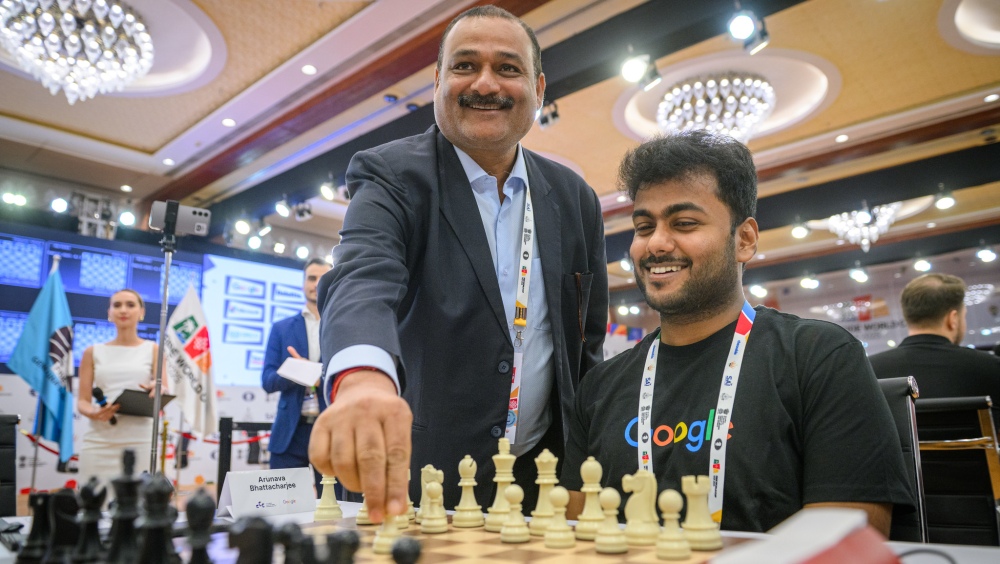
The second edition of the FIDE World Corporate Chess Championship began today in Goa, alongside the FIDE World Cup, bringing together leading international companies to compete for a World Championship title. The event highlights how chess is becoming part of modern workplaces and offers employee teams a global stage to represent their organisations. This year’s finals feature 11 teams, selected from hundreds of companies through online qualifiers and joined by a few invited wild cards. The field spans technology, finance, consulting, engineering, and fast-growing firms from emerging markets. The FWCCC has a clear identity: only true corporate teams take part. Every player is a full-time employee, manager, or board member, and organisations directly connected to chess are not eligible. At the opening ceremony, FIDE Secretary General Lukasz Turlej welcomed participants, saying: “On behalf of the International Chess Federation, I am happy to welcome everyone to Goa. This championship connects the corporate world with the universal language of chess in a special way. We appreciate the All India Chess Federation, the Goa Chess Federation, the Government of Goa, and the Prime Minister of India for enabling us to hold this event here. The corporate chess community is growing quickly, and I am confident we will keep developing these initiatives together in the future. I wish all the teams great games in this unique place, the home of the World Cup and many of the world’s top players this month.” FormatThe 11 teams play a two-day group stage followed by knockout playoffs on Sunday. All matches use a rapid time control of 10 minutes plus a 3-second increment across four boards. The group stage is a round-robin, with match points deciding the standings and game points as the secondary tiebreak. After Saturday’s group stage, the top two teams from each group advance to the semifinals. POOL A — Morgan Stanley sets the pacePool A completed the first half of its double round-robin today. Standings after Day 1: Morgan Stanley — 10 MP / 17 GP Deloitte 1 — 7 MP / 13.5 GP Microsoft — 7 MP / 12 GP UBS — 4 MP / 10 GP Tech Mahindra — 2 MP / 7 GP Equity Bank Kenya — 0 MP / 0.5 GP Morgan Stanley swept all five matches, scoring 4–0 against Tech Mahindra and Equity Bank Kenya and earning decisive wins over Microsoft, Deloitte 1, and UBS. GM Peter Acs, GM Joshua Sheng, IM Peter Lizak, and FM Gabor Szamoskozi collected 17 gamepoints, the highest of the day. Deloitte 1 and Microsoft remain close in the race for second, drawing their head-to-head match. UBS secured an important victory over Tech Mahindra, while the wild-card teams from India and Kenya fought hard throughout the round. POOL B — GRECO perfect, Google and J.P. Morgan close behindWith five teams, Pool B played four rounds today. Standings after Day 1: GRECO — 10 MP / 15 GP Google — 8 MP / 10.5 GP J. P. Morgan — 6 MP / 6.5 GP Deloitte 2 — 4 MP / 6 GP ERG — 2 MP / 2 GP GRECO delivered a flawless day, winning all four matches and conceding only half a gamepoint across the entire pool. GM Volodymyr Onyshchuk led the team on board one, supported by three International Masters who ensured stability on every board. Google secured second place with a 4–0 win over J.P. Morgan in the last round. J.P. Morgan, featuring FM Agustin Ambrogi and FM Ramon Lorente Pupo, finished third after solid results against Deloitte 2 and ERG. Although none of the players are professionals, the level of play was high, with experienced club players and titled competitors representing some of the world’s most recognisable companies. The games were sharp, the atmosphere focused, and the engagement evident. The group stage concludes on Saturday morning with the second half of the double round-robin. With Morgan Stanley and GRECO leading their pools and several challengers still within reach, the race for the title of The Smartest Company in the World remains wide open. Written by Charlize van Zyl, FIDE Press Officer (Goa, India) Photos: Michal Walusza
2025 World Women’s Team Championship: Pools announced

2025 FIDE World Women’s Team Championship pools announced ahead of opening in Linares, Spain With just three days remaining until the official opening ceremony of the 2025 FIDE World Women’s Team Championship, the International Chess Federation (FIDE) has confirmed the composition of the two competitive pools. The championship will be held in Linares, Spain, from November 17 to 24, 2025, in one of the most iconic cities in world chess. Already on site in Linares, Javier Ochoa de Echaguen, President of the Spanish Chess Federation, welcomed the first arriving delegations: “The Spanish Chess Federation is delighted to welcome all delegations attending the Women’s World Team Championship in the historic city of Linares.” Pool A: A clash of heavyweights Team FIDE, led by GM Aleksandra Goryachkina, tops Pool A with an impressive 2496 average rating. Close behind is Team USA, averaging 2406, spearheaded by rising star IM Carissa Yip. Photo: Michal Walusza Team Kazakhstan enters with a 2381 average rating and GM Bibisara Assaubayeva on board one. Following the late withdrawal of Team Algeria due to visa issues, Team Azerbaijan has been nominated as the replacement. With an average rating of 2366, Azerbaijan—led by IM Ulviyya Fataliyeva—significantly elevates the competitive depth of Pool A. Host nation Spain fields a 2339 average rating team, featuring IM Sarasadat Khademalsharieh on top board. Team Peru rounds out the pool with a 2207 average rating, led by IM Deysi Cori T., supported by several of the country’s most promising young talents. Pool B: Hou Yifan returns Pool B is headlined by the return of GM Hou Yifan, four-time Women’s World Champion, who leads Team China to the event with a strong 2473 average rating. Widely recognized as the second-highest-rated female player in history, Hou’s participation adds exceptional prestige to the championship. Photo: Rafal Oleksiewicz Team Georgia (2430), led by GM Nino Batsiashvili, brings a seasoned and balanced roster, while Team Ukraine enters with a 2399 average rating under the leadership of IM Yuliia Osmak. Three evenly matched teams—France, Uzbekistan, and India—each average around 2350. Packed with International Masters and Women Grandmasters, they bring a blend of experience and rising youth. Both Uzbekistan and India are fielding notably young squads, expected to capitalize on the opportunity to gain high-level international exposure. A Championship steeped in tradition Looking ahead to a week of intense competition, Ochoa de Echaguen added:“It is an honour for us to host this prestigious event in a venue that holds such a special place in the history of world chess. We trust that the players, coaches, and accompanying teams will enjoy an excellent stay, dedicated organization, and a competitive atmosphere that reflects the values of respect, excellence, and sportsmanship that define our sport.” Full list of teams with average rating Pool A: FIDE (2496) USA (2406) Kazakhstan (2381) Azerbaijan (2366) Spain (2339) Peru (2207) Pool B: China (2473) Georgia (2430) Ukraine (2399) France (2353) Uzbekistan (2336) India (2334) The full rosters of each team can be consulted [HERE]. For more information about the 2025 FIDE World Women’s Team Championship, media accreditation, or event logistics, please contact FIDE or the Spanish Chess Federation.
Shockwaves in Goa: Dubov, Shankland, and the day of “giant killers”
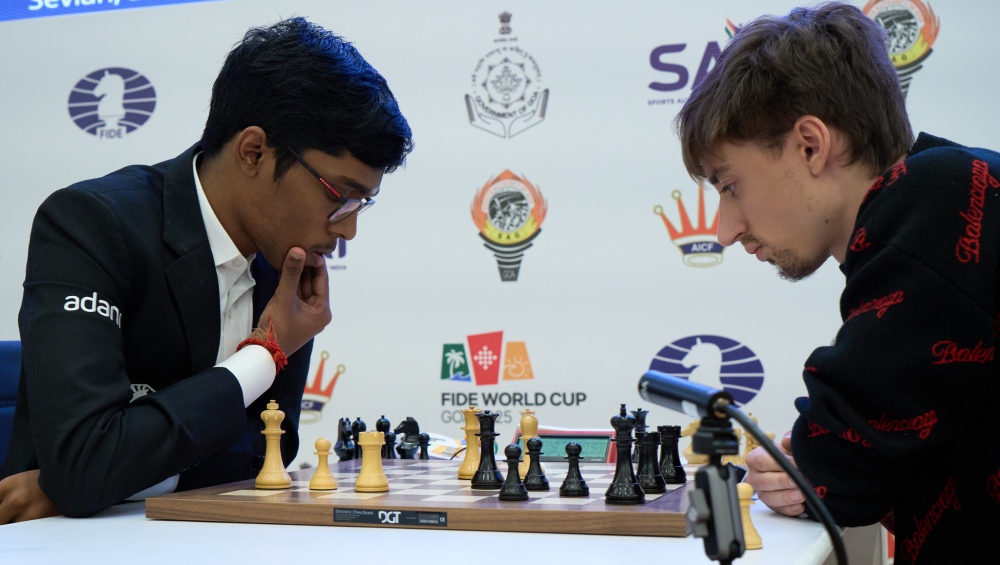
The fourth round of the FIDE World Cup in Goa ended with one of the most intense and dramatic tiebreak sessions of the event so far. Eleven matches returned to the playing hall this afternoon, with players battling it out across multiple time controls, from rapid to blitz and even Armageddon, to determine who would advance to the coveted round of sixteen. From the very start, it was clear that this would be a day of upsets and surprises. Several top seeds were eliminated, including multiple +2700-rated players, as underdogs seized their chances in rapid and blitz play. Experience, stamina, and nerves of steel became as crucial as opening preparation, as every mistake carried immediate consequences. By the end of the session, the field had been cut in half once again, revealing a captivating mix of established stars and fearless young talents. With just sixteen players remaining, the World Cup is entering its decisive phase, and the fight for the title, and for the coveted Candidates spots, is more open than ever. The round was opened by IA Dharmendra Kumar, President of the South Asian Chess Council and Chair of the 2025 FIDE World Cup Appeals Committee. He played 1.e4 for Peter Leko on board two. Quite surprisingly, no fewer than eight of the eleven tiebreak matches were decided in the very first section of the afternoon, consisting of two 15-minute games with a 10-second increment. The first player to qualify for the round of sixteen and the biggest surprise of the day was GM Aleksey Grebnev (2611), who eliminated one of the pre-tournament favourites, GM Maxime Vachier-Lagrave (2737). Known for his deep opening preparation and sharp tactical vision, Grebnev recently won the 2025 Dubai Open, a strong international event featuring several elite grandmasters, proving he is no stranger to facing world-class opposition. Although Vachier-Lagrave is a renowned specialist in blitz and rapid chess, Grebnev seized his chances brilliantly, winning the first game with White and then steering the second into a well-known theoretical draw to clinch the match. The key moment came in the first game: Despite being under pressure in a difficult endgame, the Frenchman still had drawing chances, but in time trouble he blundered with 47…Nd5+? (the correct move was 47…b5, with approximate equality). After 48.Kd4! b5 49.Bh6!, Black was suddenly lost due to the unstoppable threat of Bf8, which wins material. Soon after, another of the 2700+ favourites fell. GM Richard Rapport (2724) will have to wait another two years for another shot at the title, after losing both rapid tiebreak games to GM Sam Shankland (2654). A cornerstone of American chess for over a decade, known for his disciplined preparation and exceptional endgame technique, Shankland opted for the solid Caro–Kann Defence to neutralize Rapport’s creative initiative in the first game. The strategy paid off perfectly when the Hungarian number one faltered in the late middlegame. https://www.youtube.com/watch?v=lbp_Yg4vY0Y “I wasn’t very optimistic going into the tiebreak. In classical, it hasn’t gone too badly, but in rapid, he’s clobbered me before,” Shankland admitted in his post-game interview. This time, however, he turned the tables convincingly. In the second game, Rapport’s decision to employ the Pirc Modern Defence backfired spectacularly, as he soon found himself in a cramped, passive position, and Shankland efficiently converted the advantage, sealing the match with a 25-move miniature. GM Nils Grandelius (2645) will also be leaving Goa tomorrow, eliminated by GM Pentala Harikrishna (2697). The long-time Swedish number one, celebrated for his deep opening preparation and creative ideas, came up short in the first game, letting his opponent off the hook at a critical moment. With the psychological edge on his side, the player from Andhra Pradesh, renowned for his strategic depth and superb endgame technique, displayed his full class in the second encounter. Harikrishna crafted a strategic masterpiece, patiently outmanoeuvring his opponent to secure victory and advance to Round Five. By winning the first game and comfortably drawing the second, accepting a repetition in a completely winning position, GM Frederik Svane (2638) secured his spot in the round of sixteen, joining his compatriot Alexander Donchenko and confirming the impressive depth of the younger German generation. His opponent, GM Shant Sargsyan (2667) of Armenia, was unable to recover after losing the first game. The key moment came on move thirty White’s control of the d-file and pressure on the e5-pawn promised a lasting edge. However, after 30…Ne6! 31.Nxe5 Qg5! 32.Qxg5 Nxg5, Black would still have had reasonable drawing chances. Instead, short on time, Sargsyan spent two of his last three minutes to play 30…f6?, fatally weakening his kingside. Svane immediately seized the moment with 31.Nh4!, launching a decisive attack. Notably, Black could no longer contest the d-file with 31…Rad8, as 32.Nf5! wins material after 32…Qc7 33.Rxd8 Rxd8 34.Rxd8 Rxd8 35.Qa7, picking up at least a pawn. Despite determined resistance, the Armenian grandmaster could not save the game. GM Daniil Dubov (2684) produced one of the major upsets of the day, eliminating the 2023 Baku finalist and Indian hero GM Praggnanandhaa R (2771). Continuing the same pragmatic approach that has served him well in earlier tiebreaks, Dubov offered an early 12-move draw with the White pieces, effectively shifting the pressure onto his opponent to create winning chances in the second game. In his post-game interview with FIDE’s WIM Charlize van Zyl, Dubov explained his rationale: “Against players so good that I can’t really get an advantage in the opening, my strategy is to make a draw with White and get a game with Black.” And once again, his plan worked perfectly. In the diagrammed position, with both players down to their final minute, Praggnanandhaa erred with 35.Bxd5?, allowing 35…exf2+ 36.Qxf2 Bb6!, after which the Indian grandmaster was unable to defend against the threats along the long diagonal. “I don’t think he showed his best in this tournament, but even so, it was very close,” Dubov reflected after the game. https://www.youtube.com/watch?v=K0r3Tyz2TWk With each round that passes, GM Arjun Erigaisi (2773) looks increasingly likely to secure
Tides turning in Goa: Aronian and Martínez advance to Round of 16 as field tightens
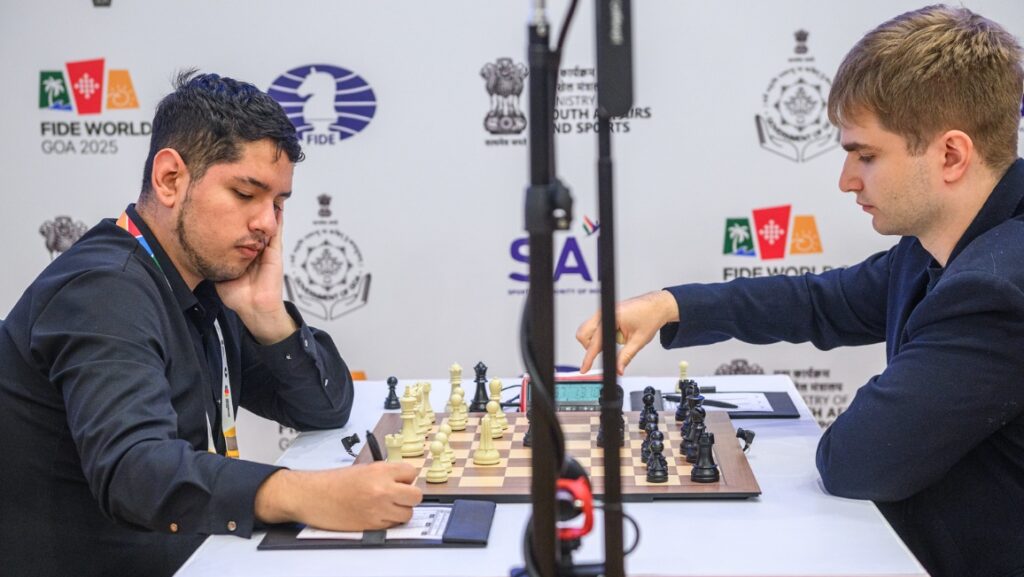
The tension in Goa was palpable as the Round of 32 of the FIDE World Cup resumed, with sixteen matches poised on a knife’s edge. The ceremonial first move, performed by Dr. Sagar Dilip Salgaocar, Managing Director of Geno Pharmaceuticals Pvt Ltd, set the stage for what would become a day filled with fierce strategic battles, high precision, and immense psychological pressure. Each player knew that a single mistake could mean the end of their World Cup journey. As the clocks started ticking, the players quickly settled into the rhythm of combat. The atmosphere inside the playing hall was a mix of quiet concentration and restrained intensity, the hum of moves being recorded, the soft clatter of captured pieces, and the quiet footsteps of arbiters echoing through the hall. Over the next six hours, fans witnessed a fascinating blend of caution and courage. While some grandmasters opted for pragmatic draws to secure qualification, others risked it all in pursuit of victory. From José Martínez Alcántara’s confident progression to the next stage to Levon Aronian’s creative handling of complications and Le Quang Liem’s composed elimination of Karthik Venkataraman, the day offered no shortage of drama. Yet, as so often happens at this stage of the event, many matches remained deadlocked, setting up a thrilling tiebreak showdown to decide who advances to the coveted final sixteen. Let’s take a deeper look into this afternoon’s action at the Rio Resort on Goa. Roughly an hour and a half into play, GM José Eduardo Martínez Alcántara (2644) became the first player to qualify for the final sixteen after forcing a draw against GM Alexey Sarana (2661). Having secured victory with Black in the previous game, the Mexican grandmaster only needed a draw with White to advance. Following his successful choice from the previous round, Martínez opted for the 2.c3 Alapin Variation against the Sicilian. Sarana appeared unfamiliar with the subtleties of the line and soon slipped in his move order. Sensing the opportunity, Martínez seized the initiative with the striking piece sacrifice 13.Nxa7! Nxa7 14.Ne5!, creating a double attack on the queen and the f7-pawn. This well-known opening trap has appeared at least five times before in master play, with five wins for White. However, after 14…Qb5 15.Bxf7+ Kd8, Martínez wisely chose the practical route, repeating moves with 16.Bb3 Ke8 17.Bf7+. Sarana had no real alternative but to accept the draw, as declining it would have meant losing significant material — and with it, his spot in the event. After confirming his qualification, Martínez joined the broadcast studio to share his thoughts on the game. https://www.youtube.com/watch?v=-nW_znq0MSo Immediately afterwards, the first draw of the afternoon was confirmed – coincidentally, between the same players who had battled for over 110 moves in one of yesterday’s final games to finish. Playing with White, GM Gabriel Sargissian (2624) agreed to a draw with GM Awonder Liang (2710), meaning their match will be decided tomorrow afternoon in the tiebreaks. In a classical Catalan Opening, Sargissian achieved a slight edge out of the opening, but Liang gradually neutralized the position, and a threefold repetition was reached around move thirty. GMs Lorenzo Lodici (2560) and Samuel Sevian (2698) continued their consistent form in Goa with a 32-move draw by repetition in a standard Italian Opening. Playing flawlessly, both grandmasters achieved a 99% accuracy score in a topical line previously tested by Lodici’s teammate, GM Daniele Vocaturo. Following yesterday’s topsy-turvy encounter, GM Daniil Dubov (2684) chose a deeply theoretical line in the Vienna Variation of the Ragozin Defence against GM Praggnanandhaa R (2771), perhaps aiming to surprise his young opponent. However, Praggnanandhaa was fully prepared, defending with 99% accuracy and steering the game into an equal rook-and-pawn ending. A draw was agreed on move thirty, another addition to the long list of balanced results in this heavily analysed correspondence line. Dubov, World Rapid Champion in 2018, when he triumphed ahead of Carlsen, Mamedyarov, and Nakamura, often shines when the clock runs low, making their upcoming tiebreak one of the most anticipated of the day. The sequence of draws didn’t end there: with elimination on the line, few players were willing to take undue risks. Within the next forty-five minutes, five additional games were drawn, adding ten more names to tomorrow’s increasingly crowded tiebreak roster. It was a solid draw with a 98% accuracy score between GM Aleksey Grebnev (2611) and GM Maxime Vachier-Lagrave (2737). Playing the 3.Bb5 Moscow Variation against the Frenchman’s Sicilian Defence, Grebnev steered the game into a French-type pawn structure after a few early exchanges. In his post-game interview with WIM Charlize van Zyl, Vachier-Lagrave admitted that he wasn’t particularly familiar with his opponent: “I didn’t know much about Grebnev until about a month ago, when he played a qualifying match for the World Cup against my team colleague GM Marc’Andria Maurizzi. He’s very solid and very confident.” Grebnev managed to secure a small edge, exerting some control over the e5-square, but never enough to truly trouble the French number one. The game soon fizzled out into a draw by repetition around move thirty. https://www.youtube.com/watch?v=ZMZkBkrQJAA The game between GM Richard Rapport (2724) and GM Sam Shankland (2654) also ended peacefully, this time with an impressive 99% accuracy score from both players. The two followed a 2018 Neo-Grünfeld encounter between top grandmasters Sjugirov and Li Chao until move thirteen. Shankland played quickly and confidently, suggesting deep home preparation, while Rapport appeared to be navigating largely on his own. The engines offered no significant improvements for either side – a truly flawless game. It’s hard to call a favourite in tomorrow’s tiebreak: both players have already proven themselves under pressure, with Shankland eliminating Vidit, and Rapport prevailing against Erdogmus earlier in the event. GM Shant Sargsyan (2667) and GM Frederik Svane (2638) produced yet another draw of exceptional quality, both recording a 99% accuracy score. In the second Catalan Opening of the day, Sargsyan opted for a line that netted him a clean pawn, but in return allowed Svane to
World Cup Round 4 Game 1: Aronian strikes, Martínez Alcantara shines on a day of fine margins and missed chances

It was a day marked by precision, patience, and deep preparation in Goa, as the players returned to the board following the rest day. Out of sixteen classical encounters, only two produced decisive results, yet every game offered a glimpse into the razor-sharp margins that define modern elite chess. From surprise novelties in the opening phase to defensive masterpieces under time pressure, the round underscored how difficult it has become to win at this level, even with the slightest of edges. The spotlight victories belonged to GMs Levon Aronian and José Eduardo Martínez Alcántara. Aronian’s creative use of the rare 3.a3!? in the Vienna Game caught Radosław Wojtaszek completely off guard, while Martínez delivered another powerful performance in Goa, outplaying Alexey Sarana in dynamic fashion. Elsewhere, draws were the order of the day, though many of them – such as Dubov–Praggnanandhaa and Svane–Sargsyan – were full of energy, resourcefulness, and unrelenting accuracy. Despite just two decisive outcomes, the round was anything but dull. Several players, including Lorenzo Lodici, Vincent Keymer, and Nodirbek Yakubboev, showed impressive defensive resilience, while others like Awonder Liang and Daniil Dubov will be reflecting on missed chances. With the first classical games now complete, tension is rising: one more classical battle remains before potential tiebreaks decide who advances to Round 5. If today’s play was a display of calculation and control, tomorrow promises fireworks. Let’s take a deeper look into this afternoon’s action at the Rio Resort on Goa. Photo credit: @mgd1_esports and @totographyclicks Several officials visited the round this afternoon, including Mr. Michael Lobo, Chairman of Goa State Infrastructure Development Corporation and Member of the Legislative Assembly. The first game to finish didn’t take long. Just over an hour into the round, GM Peter Leko (2660) and GM Arjun Erigaisi (2769) agreed to a draw, but not before a brief theoretical skirmish in a sharp Sicilian line. Seeking to surprise the Hungarian veteran, Erigaisi unleashed the Cobra Variation in the Sicilian Taimanov – a rare and venomous choice he had played only once before, back in 2012, at the Raisoni Memorial U-15 when he was rated just 1548. Visibly taken aback, Leko spent over fifteen minutes choosing his response before deciding on the principled 6.Ndb5. Yet it soon became apparent that he was out of his preparation in this sharp line. Erigaisi pressed forward energetically, even sacrificing a pawn to seize the initiative on the queenside in a position with opposite-side castling. However, with his time ticking dangerously low, Leko wisely opted for an unforced threefold repetition, ensuring a half-point and avoiding unnecessary risk. A comfortable outcome for the Indian grandmaster, who will now have the rest of the afternoon to prepare for what could be a decisive encounter tomorrow, when he will have the White pieces. An hour passed before the next game concluded, roughly marking the halfway point of the playing session. Defending with the Black pieces, GM Aleksey Grebnev (2611) opted for the ever-solid Petroff Defence against GM Maxime Vachier-Lagrave (2737). Both players rattled off the first sixteen moves in textbook fashion, following a line deeply explored in modern correspondence chess, a domain heavily guided by computer analysis, and therefore a reliable touchstone for elite preparation. Unsurprisingly, all known correspondence encounters in this variation have previously ended in draws. The Frenchman was the first to deviate from established theory, introducing a fresh idea with 17.Rab1. Grebnev, fresh off his 25th Dubai Open victory earlier this year – took his time, spending nearly twenty minutes to navigate the complications and coolly neutralize White’s modest initiative. The balance never tilted decisively either way, and soon after, the players agreed to a threefold repetition. A pragmatic outcome for both sides, and one that quietly hints this tightly contested match could well be headed for a tiebreak showdown. Three more draws were signed before the first decisive game of the afternoon finally arrived. Among them, GM Wei Yi (2754) was unable to make any headway against GM Parham Maghsoodloo (2697). The 2018 World Junior Champion and Iranian National Champion in 2017, 2018, and 2021, Maghsoodloo has long been a fixture near the 2700 mark and enjoys a strong reputation for his balanced mix of positional solidity and dynamic resourcefulness. Facing the ever-dangerous Wei Yi, Maghsoodloo chose the Caro–Kann Defence, meeting the Exchange Variation with an early queen trade, a practical decision against an opponent known for his sharp attacking style. Though this left him with an isolated queen’s pawn, the Iranian defended confidently and never appeared in serious trouble. A calm and professional performance from Maghsoodloo, who comfortably secured the draw and perhaps another sign that this match, too, may be destined for tiebreaks. GM Nils Grandelius (2645) and GM Pentala Harikrishna (2697) produced an impeccably balanced encounter, both registering an impressive 98% accuracy according to computer evaluation. The game followed a well-trodden strategic line of the Ruy Lopez, leading to a symmetrical middlegame and eventually to a completely equal rook endgame after thirty-two precise moves. Neither side faltered, and the draw was a fair result of flawless technical play. For Harikrishna, it’s another steady performance, particularly valuable considering his excellent form with the White pieces in previous rounds. With the colours reversing tomorrow, spectators can likely expect a sharper, more dynamic battle. If the previous game clocked in at 98%, this one raised the bar even higher. GM Le Quang Liem (2729) and GM Karthik Venkataraman (2579) delivered a near-flawless performance, each achieving an astonishing 99% accuracy score. Playing with the Black pieces, India’s national champion was well prepared and solid throughout. He equalized comfortably and had little difficulty steering the game toward a peaceful conclusion, securing a well-earned half point against one of Asia’s strongest grandmasters. What came as a mild surprise, however, was Le Quang Liem’s choice of the London System — a line he famously covered in detail in his own Chessable “Lifetime Repertoire” course. It’s not every day that a top-level player tests their own published repertoire over the board!
FIDE files complaint with Ethics & Disciplinary Commission naming Vladimir Kramnik as respondent

The International Chess Federation (FIDE) has formally submitted a complaint to the FIDE Ethics & Disciplinary Commission (EDC) naming former World Champion Vladimir Kramnik as the respondent. The referral follows concern in the chess community about repeated public allegations made by Kramnik against GM Daniel Naroditsky and GM David Navara, and comes after a review of the matter by the FIDE Management Board. The complaint outlines a pattern of conduct over roughly two years and cites several public statements and materials that FIDE considers relevant to potential violations related to harassment and the insulting of an individual’s dignity. The submission also includes testimony and information provided by David Navara and people close to Daniel Naroditsky. These matters will now be reviewed under the established procedures of the EDC. FIDE has taken this step to ensure that all relevant statements and evidence are examined by an independent disciplinary body and that the process is conducted fairly and with respect for all individuals involved. Comment from Yolander Persaud, Chairwoman of the FIDE Ethics & Disciplinary Commission: “Once a complaint is filed, the EDC Chair reviews it to determine if it is admissible. If accepted, the Chair identifies the charges and forwards the case to a First Instance Chamber, which will then notify both parties of the registration. The respondent is informed of the initiation of disciplinary proceedings and has up to three weeks to submit a response and any supporting documents. If additional information is required, a second exchange of statements may take place, with each party given up to two weeks to reply. After reviewing all materials, the panel will deliberate privately and issue its decision.” FIDE reiterates its commitment to a transparent, fair, and independent ethical review process. The EDC will evaluate the complaint in accordance with the FIDE Ethics & Disciplinary Code and its procedural rules. Any outcome, including possible sanctions, will be announced by the Commission in due course.
Mediterranean Stage Set for Chess History: The 2026 FIDE Candidates Come to Cyprus
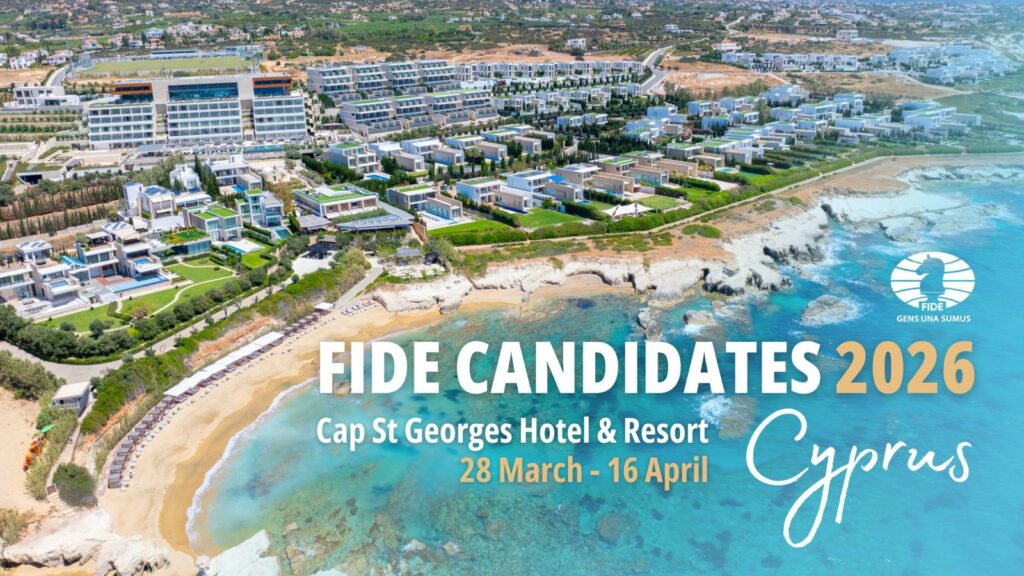
The most important tournament in the World Championship cycle will take place between March 28 and April 16, 2026 in Cyprus, bringing the event to a new host nation. Like in Toronto in 2024, the Women’s Candidates will be held alongside the Candidates. The International Chess Federation (FIDE) is pleased to announce the location for the 2026 FIDE Candidates Tournament and the FIDE Women’s Candidates Tournament. After debuting in North America in 2024, the iconic event is returning to Europe and will be held at the luxury Cap St Georges Hotel & Resort near Paphos, on the south-western coast of Cyprus. The tournament is the final qualifying step in the FIDE World Championship Cycle. This flagship event was first staged in 1950, and draws attention of entire chess world ever since. Exciting games, sportive drama, thrilling fight till the very last round – all these are emblematic Candidates stories. “The Candidates Tournament is the final and hardest test for any chess player wishing to take on a world champion in a match for the title, and it is the most difficult hurdle in the world championship cycle. Cyprus has hosted FIDE Women’s Grand Prix twice, and the time has come for the most prestigious tournament in chess calendar, the Candidates. I’d like to thank our long-term partners, Freedom Holding Corp. and the Scheinberg Family, who join forces backing the event – we are very grateful to them for their continuous support,” said FIDE President Arkady Dvorkovich. Cap St Georges Hotel & Resort is a luxury 5-star coastal resort. Set among olive groves and featuring panoramic sea views, it is one of the most exclusive private compounds on the Mediterranean. “The location and the dates of this tournament are carefully planned and considered to provide players with the best possible conditions. Ever since I stepped to Cap St. George, it felt like a right place to host such an important event. Nearly ideal setting – not only for players, but for fans and media, matched with FIDE efforts to make it an exceptional event, will bring the world a real chess feast. It is not only about a record prize fund, but rather about how the event will be presented to the chess community and wider public,” said FIDE CEO Emil Sutovsky. Key details and information about the event Two tournaments will be held side by side – the (Open) FIDE Candidates Tournament and the FIDE Women’s Candidates Tournament. The FIDE Candidates Tournament 2026 will bring together eight of the world’s top players who have qualified through a rigorous system of merit-based pathways, including the FIDE World Cup 2025, the FIDE Grand Swiss Tournament 2025, and the FIDE Circuit. In the Women’s Candidates, the qualification path also includes the Women’s Grand Prix competition. Format: In both the Open and the Women’s, the eight qualified players will compete in a double round-robin tournament, consisting of 14 rounds. Time control: The games will be played with a time control of 120 minutes for the first 40 moves, followed by 30 minutes for the rest of the game, with an increment of 30 seconds per move starting from move 41. Draw rule: Players are not permitted to agree to a draw before the completion of Black’s 40th move. Prize fund: The minimum prize fund for the event stands on a record one million euros. Tie-breaks: In the event of a tie for first place after 14 rounds, a playoff will be played to determine the winner who qualifies for the World Championship Match, due to take place in November 2026. For a detailed look at the regulations, please see: Regulations for the FIDE Candidates Tournament 2026 (PDF) Regulations for the FIDE Women’s Candidate Tournament 2026 (PDF) Venue information: capstgeorges.com/
Commonwealth Chess Championship 2025 begins in Kuala Lumpur, Malaysia
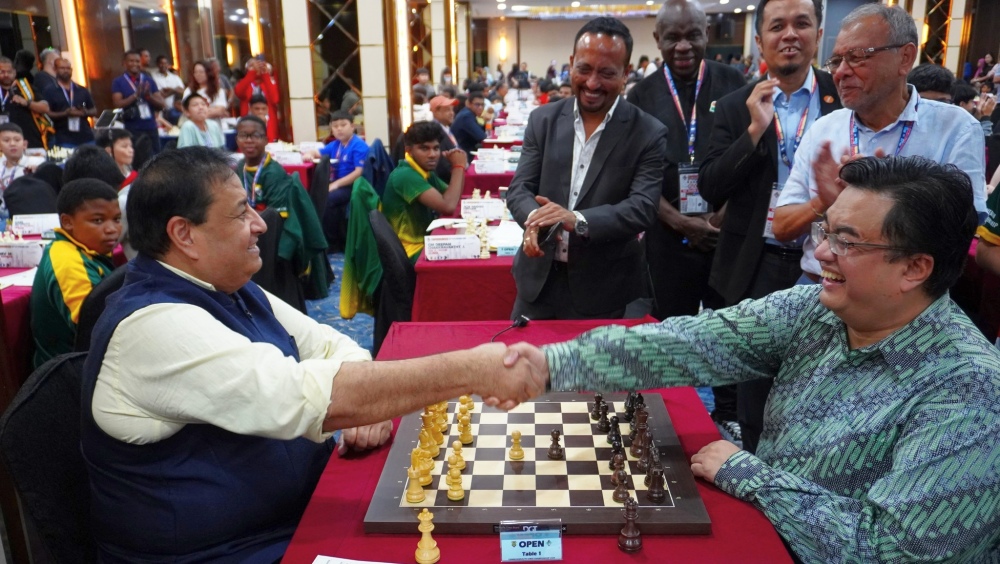
The prestigious Commonwealth Chess Championship 2025 officially kicked off in Kuala Lumpur, Malaysia, heralding a week of intense competition, strategic brilliance, and international camaraderie. Organized by the Malaysian Chess Federation under the auspices of the Commonwealth Chess Association (CCA) and the International Chess Federation (FIDE), the event runs from November 9 to 15, 2025. The opening ceremony featured a symbolic inaugural game between Bharat Singh Chauhan, President of the Commonwealth Chess Association, and Akhramsyah Muammar, President of the Malaysian Chess Federation. Their friendly encounter set the tone for a championship built on unity, friendship, and sporting excellence that the Commonwealth proudly represents. A total of 373 players from 16 Commonwealth nations are participating in this year’s edition, making it one of the largest and most competitive in the event’s history. The field boasts an impressive mix of Grandmasters, International Masters, Women Grandmasters, and promising young talents, reflecting the growing strength and depth of chess across the Commonwealth. Grandmaster Mitrabha Guha of India headlines the field as the top seed, reaffirming India’s leadership in the world of chess. The event has drawn participants from a diverse range of nations, including Australia, Bangladesh, Botswana, Canada, England, Kenya, Maldives, Mauritius, New Zealand, Pakistan, South Africa, Scotland, Singapore, Sri Lanka, and host country Malaysia, competing across multiple categories. Beyond the competitive battles, the championship stands as a celebration of the shared heritage, goodwill, and cultural exchange that unite the Commonwealth nations through the game of chess. Parings and results
World Cup Round 3 tiebreaks: When the clock decides, the better players rise
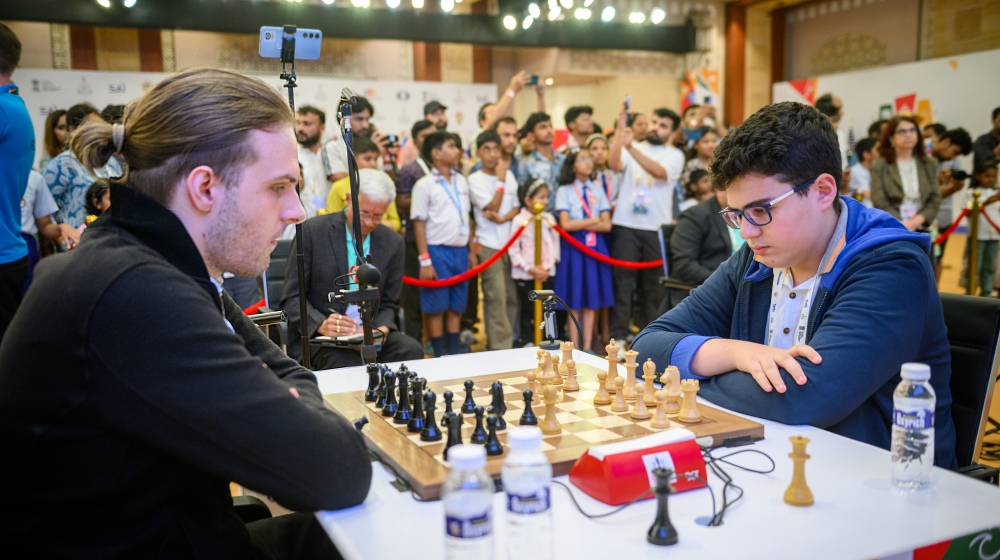
The 2025 FIDE World Cup continued to deliver high drama in Goa, as Round 3 tiebreaks produced a day filled with tension, brilliance, and heartbreak in equal measure. With places in the final 32 – and the Candidates qualification dream – on the line, nerves ran high across the playing hall. Every move carried enormous weight; a single mistake could mean the end of a months-long journey. In a recent podcast, World No. 3 Fabiano Caruana, already qualified for the Candidates, reflected on the nature of tiebreaks: “The better player usually wins.” As the clock speeds up, he explained, experience, composure, and precision tend to outweigh creative risks. That idea proved prophetic in Goa, as five of the six players rated above 2700 ultimately prevailed, their class showing through when the pressure was at its peak. The day’s results reinforced an enduring truth of knockout chess: when time dwindles and tension mounts, the difference between victory and elimination often lies not in preparation, but in psychology. Some players cracked under the relentless rhythm of rapid and blitz play; others thrived, finding clarity amid chaos. The crowd inside the playing venue could sense it – every board seemed to pulse with intensity. The round began with the ceremonial first move performed by GM Abhijit Kunte, India’s 4th Grandmaster (after Anand, Barua, and Harikrishna) and the Tournament Director of the World Cup. Born in Pune, Maharashtra, in 1977, Kunte was a true pioneer of Indian chess during the late 1990s and early 2000s – a player known for his classical style, deep positional understanding, and his lasting contributions as both coach and mentor. Three of the eleven tiebreaks were decided swiftly, ending after the first 15+10 rapid segment with clean 2–0 victories. The first player to book his ticket to the fourth round was GM Samuel Sevian, the American prodigy who once became the youngest grandmaster in U.S. history at just 13 years and 10 months. Known for his dynamic and fearless style, Sevian thrives in sharp middlegame battles where calculation and courage go hand in hand. Now hovering just below the 2700 rating mark, Sevian has been particularly impressive in rapid formats. After dispatching GM Tin Jingyao (2583) of Singapore in the second round tiebreaks, he repeated the feat today – drawing both classical games before convincingly defeating GM Evgeniy Najer (2610) in two rapid encounters. He shared his thoughts in a short but insightful post-game interview – don’t miss it! https://www.youtube.com/watch?v=G7HDnE3VZoQ&t=3s Not long after, I spotted GM Alexey Sarana (2661) leaving the playing venue with a broad smile — and a quick check confirmed why. He had just secured victory in both of his rapid games against GM Jorden Van Foreest (2697), earning his place in the fourth round. A former European Champion (2023) and a player who often hovers around the 2700 mark, the Serbian grandmaster is widely recognized for his technical precision and deep preparation. It had been a hard-fought match: after trading wins in the classical games, Sarana’s superior technique in a series of minor-piece endgames proved decisive in the rapid segment. FIDE’s interview specialist Charlize van Zyl caught up with him moments later for his thoughts on the event. “It’s a very tough tournament, and I try to take it match by match — because even in the first round, you can lose and be out,” Sarana reflected. “This tournament only happens once every two years, so it’s hard to predict anything, but of course the goal is to go as far as possible. As for the format, I think this is the most interesting tournament both to play and to watch. It’s very tense, but also very exciting — I really like the World Cup.” https://www.youtube.com/watch?v=gmhECaz1TX8 The third player to advance to the fourth round with a perfect 2–0 score in the first rapid segment was GM Nodirbek Yakubboev of Uzbekistan (rated 2689). Born in 2002, Yakubboev is one of the brightest talents in Uzbek chess and a cornerstone of the national team that captured gold at the 2022 Chess Olympiad in Chennai. A three-time Uzbek national champion, he is known for his calm, classical style, backed by deep opening preparation and remarkable resilience under pressure. After two solid draws in the classical portion against GM Thai Dai Van Nguyen (2664), Yakubboev capitalized on a brief lapse in concentration from his opponent in the second rapid game – enough to secure the win and a spot among the final 32 contenders. Black had just played 23…Rac8? – a serious mistake in an otherwise balanced position. Both 23…Kh7 and 23…Nf5 would have kept the game roughly equal, but this slip proved fatal. Yakubboev immediately pounced with the tactical shot 24.Rxe6!, the key idea being that 24…fxe6 loses to 25.Nxe6, simultaneously attacking the queen and threatening checkmate on g7. Shocked by the sudden turn of events, Nguyen spent a couple of minutes searching for defensive resources. He could have tried 24…Qd7, but instead opted for 24…Qxc3, which failed to the deadly 25.Rxe7 – the rook on a1 cannot be taken due to 25.Ne6! With this victory Yakubboev comfortably advanced to Round 4. Four more players also qualified for the next round with 1.5–0.5 match victories. Among them was GM Richard Rapport (2724), who ended the impressive run of Turkey’s young star, GM Yagiz Kaan Erdogmus (2651). Despite holding his ground in both classical games – no small feat against such a formidable opponent – Erdogmus ultimately bowed out, leaving Goa with a wealth of experience and confidence for future events. Rapport, meanwhile, displayed the trademark class that has made him one of the most admired figures in modern chess. He ground down his opponent in the first rapid game through a long technical endgame, then showed precise defensive technique in the second, holding his ground in the tricky rook and bishop versus rook ending. Born in 1996 in Szombathely, Hungary, Rapport is celebrated for his creativity and originality, his unorthodox openings, and his fearless, artistic approach