

2022 Candidates, Round 5: Great expectations and a lucky escape
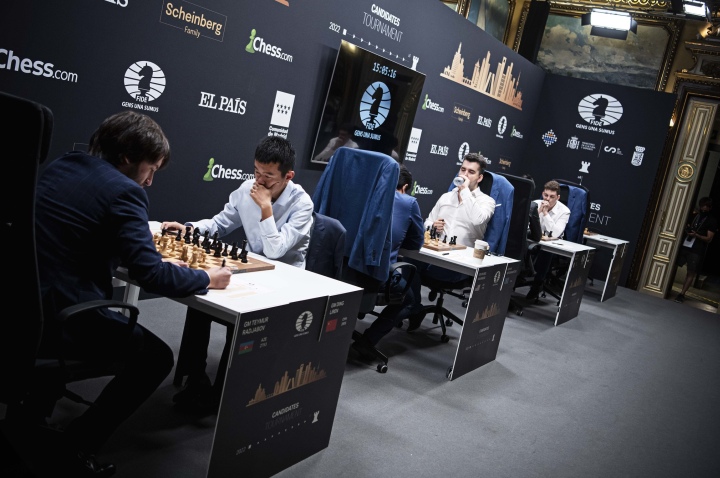
All four games ended in a draw, with the tournament leader Ian Nepomniachtchi making a lucky escape in his encounter with Hikaru Nakamura Ian Nepomniachtchi is still in the lead, with 3.5/5, while Fabiano Caruana trails him by half a point. The middle group is made of Hikaru Nakamura, Richard Rapport and Jan-Krzysztof Duda, who are on 2.5/5. Ding Liren, Teimour Radjabov and Alireza Firouzja are all on two points. The first move of the round was made by Manuel Alvarez Escudero, a 100-year-old chess player from Madrid and one of the oldest chess players alive. Just a few months ago, he played (and won) for his team in a Madrid regional league. Today he made the ceremonial move in the game Firouzja vs Duda. Firouzja, for whom he played 1.e4, is 81 years his junior. There were no easy draws in the fifth round of the 2022 Candidates as all players held their own and clinched half a point from their opponent. This was a day of great expectations, psychological battles and lucky escapes. The luckiest man of the day is Ian Nepomniachtchi. The tournament leader was playing as Black against Hikaru Nakamura. In the Petrov, blitzing most of his opening moves, Nepomniachtchi made a couple of mistakes and ended in a weaker position, where White was chasing his queen around the board while at the same time developing and organising an attack. However, Nakamura failed to find the decisive continuation, let his advantage slip away and eventually decided to accept a repetition of moves. A lucky save by Nepomniachtchi. Richard Rapport must be very satisfied after drawing as Black against one of the tournament favourites and the former contender for the title of World Champion, Fabiano Caruana. In the Taimanov variation of the Sicilian, despite White playing a relatively rare move early on, Caruana didn’t manage to get much. In fact – even though he is usually the player who confidently blitzes his openings, this time, it was Caruana who spent a lot of time on the opening. A sharp position emerged on the board with both sides pushing on opposite flanks. However, both probably thought that in this early stage of the tournament, where they are both standing well, showing their appetite for risk is not yet needed. Both players opted for a forced line, leading to a draw. The longest and possibly the most promising game of the day in terms of bringing a decisive outcome was the duel between the two players who have been on the bottom since round one. Teimour Radjabov was leading white pieces against World No. 2 Ding Liren. Both have been struggling in the tournament with three draws, and a defeat, and both were looking for their first break. It seemed that Ding was finally about to get rid of the shadow hanging over him since the last Candidates as he got into a better position against Radjabov in the Catalan. According to the computer analysis, his chances seemed promising. However, following Radjabov’s risky play right before the time control, Ding dropped the advantage with a control 40th move. After moving to a drawn rook endgame, the two quickly agreed to split a point. Alireza Firouzja is another player who had very high hopes for today’s game. Playing as White against an opponent, he leads four to zero; he was hoping to bounce back after a loss in round four to Ian Nepomniachtchi. However, the highly anticipated duel between the two youngest players of the Candidates, Alireza Firouzja (19) and Jan-Krzysztof Duda (24), ended with a disappointment for White. Duda opted for a line in the Petrov Defence where Black is slightly worse but solid. More importantly, the position that developed was such that Firouzja could not let his creativity loose. Despite White’s attempts to push forward and try and create some activity, Duda didn’t allow it. In addition, Firouzja’s ambitions to find a breakthrough cost him a lot of time, and he was in danger of ending in zeitnot. Following an exchange of several pieces, the two ended in a dead-even queen endgame. A draw was agreed upon after threefold repetition. Here follows a closer look at the games from round five of the Candidates. Fabiano Caruana vs Richard Rapport: Disappointment and resilience Fabiano Caruana was a slight favourite in this game. He leads Rapport three to one in victories, has more experience in the Candidates and at the highest level overall, and was leading the white pieces. In the Taimanov variation of the Sicilian, Caruana opted for a rare line with 6.g4, but that didn’t surprise Rapport. He responded quickly with the move 6…Nge7. Unusually for Caruana, in this game, he spent much more time on the opening than he normally does, which suggests that his opponent managed to unsettle him with the choice of moves. Instead of castling and securing their kings – as the basic chess rules say – the two launched their pawn advances: Caruana on the kingside, Rapport on the queenside. After White’s move 16.Qd4, Rapport had chances to exert more pressure on White by taking on c3, moving his king to safety and then pushing in the centre, although this continuation looks double-edged. Instead, he opted to put his queen on a5 and allowed White to take on g7 starting a sequence of moves that led to a forced draw. After making a series of ‘only moves’, the two ended up in a position where Black organised a perpetual attack on the White’s queen, so they split a point. It is a good result for Rapport, who showed remarkable resilience and managed as Black to hold one of the tournament favourites to a draw. While Caruana might be less happy with the outcome, both players are performing well and building a solid foundation for the rest of the tournament. Teimour Radjabov vs Ding Liren: Lost hopes Radjabov and Ding were at the bottom of the table from round one, with each on minus one. If either managed to score
2022 Candidates, Round 4: Nepomniachtchi alone in the lead
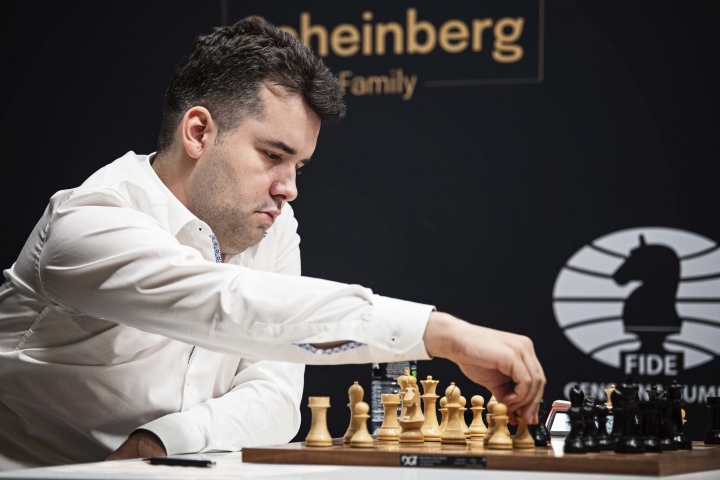
After four rounds of play, Ian Nepomniachtchi is alone in the lead in the Candidates, having defeated Alireza Firouzja, while the remaining games ended in a draw With three out of four, Ian Nepomniachtchi is half a point ahead of Fabiano Caruana, who has 2.5 points. Jan-Krzysztof Duda, Richard Rapport and Hikaru Nakamura are all on fifty percent. Following his first defeat in the tournament, Alireza Firouzja is at the bottom of the board, in the company of Ding Liren and Teimour Radjabov, with all three players on 1.5 points. Ian Nepomniachtchi made another big jump in the Candidates, having defeated the 19-year-old Frenchman Alireza Firouzja in a sharp and gripping game. This duel was the tale of the two kings in which only one would survive. In the Najdorf variation of the Sicilian, Firouzja – playing as Black – opted for a sharp double-edged line. Alireza blitzed all his moves in the opening, but once he went out of his preparation, Firouzja was struggling with finding the right plan. The complicated position on the board – where opposite castled kings had their defence lines severely probed – required meticulous calculation. Here Firouzja fell short of the task: his sacrifice of material with the hope of a vicious attack on the white king came to nothing, while Nepomniachtchni defended well, launching a devastating attack and then serving a tactical blow to his opponent, forcing him to surrender facing imminent checkmate. With two victories in the first four rounds and having demonstrated a confident and high level of play in all of the games, Nepomniachtchi is gradually angling himself for the repeat of the 2020/21 Candidates, when he took first place. As for Firouzja – he had a tough pairing in the first four rounds, having to lead black pieces in three of the four games, but in each of them, he played ambitiously and creatively, and both are essential for success, whenever it may come. World No. 2 Ding Liren’s hopes of making his first breakthrough in the tournament didn’t come to fruition. Despite achieving a slightly better position in the opening as White against Fabiano Caruana in the Ragozin and winning a pawn, he did not manage to convert. Ding created a free runner on the a-file, but Caruana was there in time to stop it. He then exchanged his queenside pawns to gain an extra pawn on the kingside but ended up in a drawish rook endgame. Still, Ding kept on pushing, but Caruana’s confidence in holding the draw never faltered. Caruana is half a point behind the leader Nepomniachtchi and ahead of everyone else. Ding is still at the bottom – hoping for a well-deserved break. The game between Richard Rapport and Hikaru Nakamura was well played by both opponents but ended in a draw. In the Berlin defence, the two quickly liquidated into an even endgame with knights and rooks. Both were familiar with the pawn structure and the nature of the position that emerged. Still – as it seems to be the tradition of today’s top-level chess players – they persisted in playing a trialling endgame before finally calling it a draw once just the two kings and knights were left on the board. Both players are on a solid fifty percent. In another Berlin defence, Jan-Krzysztof Duda drew with Teimour Radjabov. A slightly more complicated position developed following the opening than in the Rapport-Nakamura game. White had slightly more initiative but was possibly a bit too slow in building it up. Once the queens and the heavy pieces were exchanged, the two moved to an even rook endgame which ended in a draw after 41 moves. Duda is on fifty percent with four draws, and Radjabov is half a point behind, having suffered a loss in the second round. While the question for Duda is whether he will manage to keep the high level of play he has shown so far, the challenge for Radjabov is to demonstrate if he can do more than just defend and find a way to a draw. Here follows a closer look at the games from round four of the Candidates. Richard Rapport vs Hikaru Nakamura: Tense and long Among all the candidates, Rapport and Nakamura are the two who are more renowned for their creativity than detailed opening preparation. Both have qualified for the Candidates via the same event: the Grand Prix, where Nakamura was first, and Rapport came in second. This order is also confirmed with their head-to-head score: three victories, two draws and zero defeats, Nakamura – at least statistically – was the favourite. The clash of the two creative players did not produce much novelty or innovation on the board. In a well-known line of the Berlin, Nakamura was pushing his kingside pawns – h6-g5-f6 (introducing a novelty on the move nine along the way) – in a similar fashion as he did against Caruana, but there was one difference: he didn’t castle kingside, which in the above-mentioned game opened the path to his demise. In this position, the opponents quickly traded several minor pieces, which put both players on track for an endgame with a knight and a rook each, where White was minimally better, but it was even overall. It was time for Rapport and Nakamura to show that their creativity can flourish when calculating long and tedious endgame lines, but it was virtually impossible in an equal position. However, the opponents still tried. Nakamura advanced his pawns on the kingside, but Rapport wasn’t waiting: he sent his knight to the queenside hunting for Black’s pawns. White emerged a pawn up, but Nakamura’s king, knight and rook were more active, and soon Black restored material equality. The opponents ended up in a dead-even position, eliminated all the pawns and called it a day after 44 moves. A strong and stable performance by both players who now have two points out of four games. Ian Nepomniachtchi vs Alireza Firouzja: A tale of two kings This game brought
Intercontinental ChessKid Candidates kicks off on June 21
Starting on June 21, eight young chess players from around the world will be facing off in the first-ever Intercontinental ChessKid Candidates tournament. The Intercontinental ChessKid Candidates tournament will feature eight ChessKid candidates who made it to this final stage after competing in a series of online qualifiers and semifinals, with over 200 players aged under 12 from 52 countries participating. ChessKid covers the accommodation of each of the eight qualifiers, as well as their trainers, along with attending the Candidates tournament. All the participants will be playing in the same room and using the same boards and pieces as the adult grandmasters taking part in the FIDE Candidates 2022! Here are the players that are competing in the event: Sebastian Suarez, Colombia/USA (1454) Artyom Bogdanov, Kazakhstan (1513) Alex Villa Tornero, Spain (1872) Jaime Rey Martínez, Spain (1929) Miguel Herraiz Ciudad, Spain (1446) Levi Kalani Alexander Fogo Esquivel, Mexico (1532) Jesus Daniel Diaz Guerrero, Mexico (1556) Cristopher Bozhkov Stoyanov, Spain (1287) The players will be competing in a round-robin tournament that takes place from June 21 to June 23, with a closing ceremony on June 24. The time control is 25 minutes plus a 5-second increment. The full schedule:You can catch all the action here and both English and Spanish commentary at twitch.tv/chesskid.
WSCC-2022: Kosteniuk beat Stefanova to reach quarterfinals
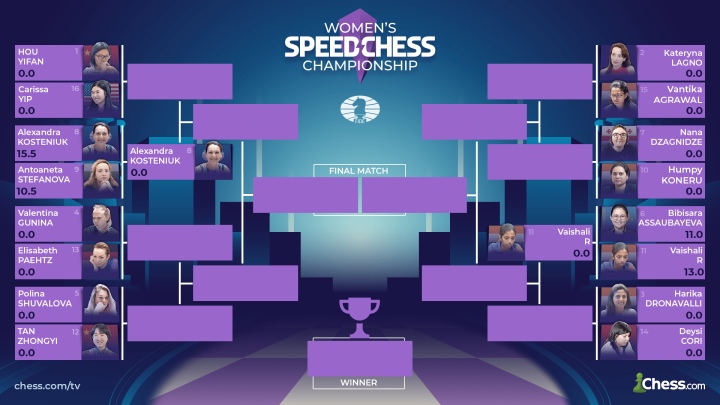
In the battle of former Women’s World Champions, GM Alexandra Kosteniuk defeated GM Antoaneta Stefanova in the second round of 16 match of the FIDE Chess.com 2022 Women’s Speed Chess Championship by a score of 15.5-10.5. Alexandra was quicker and more collected in most of the time-scrambles and deservedly punched her ticket to the quarterfinals. Kosteniuk took a slow start in the first 5+1 segment of the match, falling behind, but then picked up momentum and scored three straight wins to secure a two-point lead heading into the next stage. The 3+1 stage saw Kosteniuk stretch her lead to six points, getting the upper hand in the most chaotic, time-pressure situations. Somewhat surprisingly, Stefanova won the final, the fastest 1+1 segment of the match but did not manage to overcome a huge point deficit. “It was a very long match, and I find it difficult to keep the same level of concentration throughout the match. I was already tired after the first stage, so it is quite difficult to analyze right now. I need some time to rest and then I can go over the games. Of course, I am happy to win,” said Alexandra in a short interview with GM Irina Krush and Jennifer Shahade after the match. The third round of 16 match, GM Kateryna Lagno vs. WGM Vantika Agrawal, begins on Friday, June 24, at 5 a.m. Pacific / 14:00 Central European. To follow the FIDE Chess.com Women’s Speed Chess Championship, watch a live broadcast of the event with expert commentary on Chess.com/TV and Chess.com Twitch Channel. More info and a full schedule of the FIDE Chess.com Women’s Speed Chess Championship can be found here.
FIDE Introduces Torch Relay Tradition into Chess Olympiads
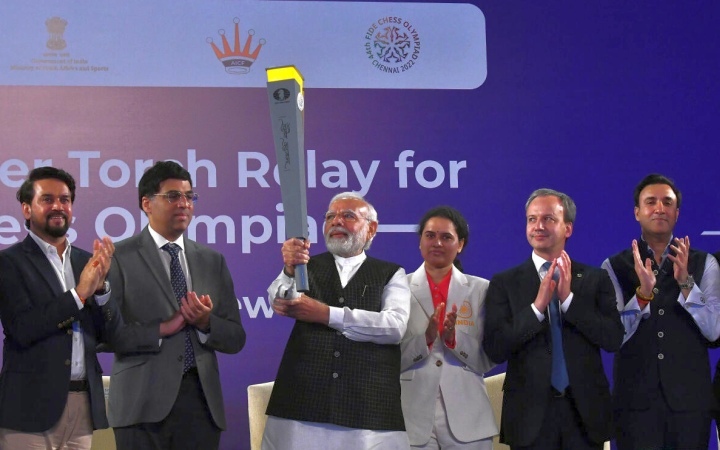
June 21, 2022 — LAUSANNE, Switzerland — The International Chess Federation (FIDE), the chess governing body, held its inaugural Torch Relay ceremony this week in India, initiated by the Indian Prime Minister Narendra Modi and FIDE President Arkady Dvorkovich. The ceremony gave the start to the 2022 Chess Olympiad as well as to the new chess tradition. Held in Chennai from July 28 to August 10, 2022, this prestigious competition, which has been organized since 1927, is being hosted in India for the first time. FIDE President Arkady Dvorkovich, believes that chess fans, and the sports community in general, will appreciate the introduction of this new tradition: “Chess is one of the oldest sports in the world, and its traditions are centuries old. We have the privilege of adding an important tradition to the chess heritage so that more people who love chess will have a way to connect with the sport. It’s also hugely important to the chess players who dedicate their lives to the sport — they are true athletes, and taking part in the Torch Relay ceremony means a lot to them,” Dvorkovich said. Prime Minister Narendra Modi said during the inaugural ceremony: “Our ancestors invented games like chaturanga or chess for analytical and problem-solving brains. Chess, via India, reached many countries of the world and became very popular. Today, chess is being used in schools as an educational tool for young people, for children.” In ancient Greece, a sacred fire was kept burning throughout the celebration of the ancient Olympics on the altar of the sanctuary of Hestia. The fire had divine connotations, and it was thought to have been stolen from the gods by Prometheus. Sacred fires were present at many ancient Greek sanctuaries, including those at Olympia. The Olympic flame as a symbol of the modern Olympic movement was introduced in the 1928 Summer Games in Amsterdam by architect Jan Wils, designer of the Olympic Stadium. It received a warm welcome, and very soon, the flame became a symbol of the Olympic message of peace, friendship, tolerance and hope. The inaugural edition of the Chess Olympiad Torch Relay will only travel through India, but in future editions, it will be expanded to the entire world, in line with the traditions of the Olympic Games. It will travel across all continents, visiting FIDE member territories, ultimately culminating in the host country and city ahead of the opening of the Chess Olympiad. During the next weeks, the torch will travel across 75 cities and regions in India, covering a total distance of 23,000 kilometers – more than half the circumference of Earth. The flame will be carried by thousands of torch bearers, including at least 50 chess Grandmasters and chief ministers who will take part in the journey. It will send a strong message of unity and cooperation among people from all walks of life. As of 2022, FIDE will recommend planning official Torch Relay Ceremonies for all Chess Olympiad organizers, including the 2024 Olympiad that will take place in Budapest, Hungary. Photo: All-India Chess Federation
FIDE President on Nigel Short’s resignation as FIDE Vice President
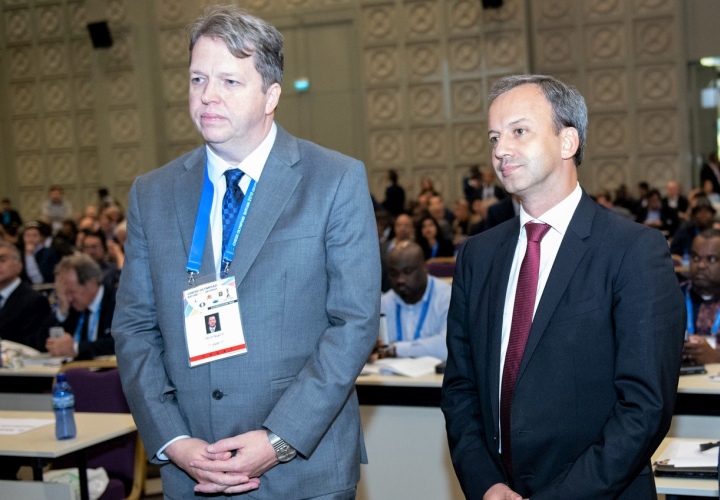
I learned with deep regret about Mr Short’s decision to resign from the position of Vice President today. I would like to note that all these years, Nigel has worked tirelessly to promote chess on all continents. Thanks to his efforts, the FIDE family has been expanded by several new federations. Often the fruits of his dedicated work were to be appreciated only years later. As an example – thanks to his efforts, the long-standing conflict in the Pakistani Chess Federation began to be resolved, ending with legitimate elections in June 2022. I am sincerely glad that in 2018 Nigel agreed to accept my nomination as the Vice President of FIDE. Several more candidates from his 2018 ticket currently work in the FIDE Council and make a significant contribution to our common duties. I would like to highlight Nigel’s organizational and leadership abilities, as well as to reinstate that his intentions have always been consistent with the mission of FIDE. Nigel’s decision is open and sincere, perhaps even a little emotional and related to the decision of EDC, but I believe that Nigel will continue his mission and agree with my proposal to find the right format for our joint work for the benefit of chess. Arkady DvorkovichFIDE President
3rd Preparation of Teachers course announced

FIDE and its Chess in Education Commission are pleased to announce the third Preparation of Teachers course. The course will be held in the English language online from July 01-03, 15:00-20:00 CET each day. The target audience is teachers with good chess basics knowledge and experience working with children. It is recommended that you have at least a level of B1 in English. Candidates for this course should have experience teaching in school and at least some knowledge of pedagogy, psychology and chess basics (how the pieces move, including articles 1-5 of the Laws of Chess – FIDE Handbook E.01 – is enough). Successful candidates will obtain the FIDE title of School Instructor. School Instructors introduce school students to the basic chess rules to improve their educational and social level and to broaden the base of chess players worldwide. They are not trying to create masters or grandmasters. It is a 3-day (15 hours) course with 2-3 breaks each day that will help develop participants’ knowledge and skills in educational chess, help them find new digital tools and platforms for online learning, and get ideas on the application of important pedagogical approaches to the teaching process of chess basics. The last hour of the course will be devoted to an exam (multiple choice questions) with a pass mark of 65 %. Candidates who achieve the pass mark will qualify for the FIDE title of School Instructor, subject to paying the title fee of €50. FIDE Chess in Education Titles are awarded for life and can only be suspended or revoked by a decision of the FIDE Ethics & Disciplinary Commission or FIDE Council, while an EDU Licence is a certification by FIDE and EDU of current proficiency to teach at the indicated level of the awarded FIDE EDU title. Chess in Education Titles, when awarded, include a three (3) year licence. Renewal of the licence requires the completion of a renewal course. During the final six months of the validity of the licence, a title-holder may renew the licence for a further three-year period to run from the end date of the current licence by following the normal procedure and paying the appropriate fees (currently €50). Here is the course description in more detail: https://cloud.fide.com/s/3PqzaH2eRGRoSb7 Candidates who wish to attend the course must complete and return the Registration Form The cut-off date for applications is June 29. However, please note that applicants are accepted on a first-come, first-served basis and the absolute maximum number of places on the course is 30. Those who are ‘late’ will be placed on a waiting list and thus be at the head of the queue for the following course. Candidates must also pay the course fee of €100 by June 30 at the latest. Candidates should note that several pre-course emails will be sent to them containing links to material that they will be expected to be familiar with. These will generally be sent out starting on June 25, so those who leave applications until the last minute are likely to find themselves at a disadvantage.
2022 Candidates, Round 3: The calm before the storm
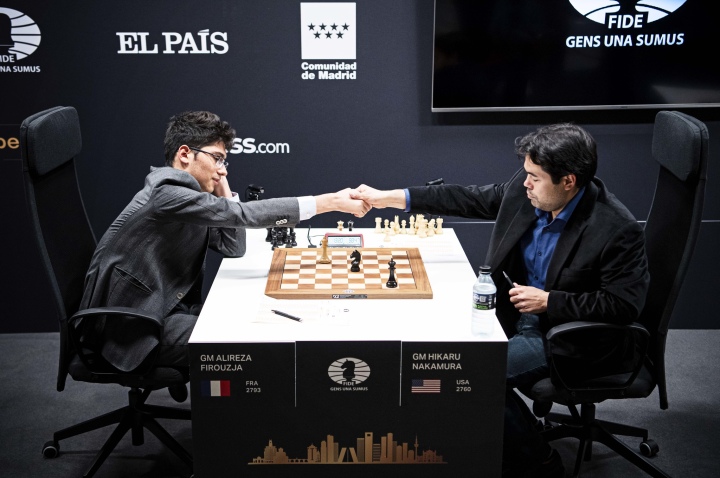
Ahead of the rest day, all four games in the third round of the 2022 Candidates finished with a draw Following three rounds of the Candidates, Fabiano Caruana and Ian Nepomniachtchi are in the lead with two points. Behind them are Duda, Firouzja, Rapport and Nakamura on 1.5. They are followed by Teimour Radjabov and Ding Liren with one point. While some of the Candidates may not be happy with their performance today, they all achieved an important goal: not to go into a free day with a defeat hanging over their heads. Despite all games ending in calm waters, it wasn’t smooth sailing in all of them. Teimour Radjabov and Ian Nepomniachtchi were the first to finish, splitting a point after nearly two hours of play. In a familiar line of the Catalan, Radjabov, playing as White, opted for massive exchanges, leading to an even position. Nepomniachtchi had a solid defence, and after a few courteous moves, the two agreed on a draw in a rook endgame. It seems that both sides welcomed the result. For Radjabov, it was an important break ahead of the rest day. After surviving a surprise attack by the aggressive young lion Firouzja in the first round, then suffering a loss to Nakamura in the second, he needed a break. With one point out of three games, he is still not out of the race for the top. Nepomniachtchi also had reasons to be content: with 1.5 points in two very difficult games, a draw as Black ahead of the rest day was a satisfying result, especially as he finished round three as one of the two leaders in the tournament. The world’s second highest-rated player Ding Liren let a victory slip away against Richard Rapport in the Grünfeld. Following Rapport’s decision to sacrifice the exchange early in the game, Ding managed to gain an advantage. It wasn’t overwhelming, but White was clearly better. Moreover, after Rapport’s mistake on move 21, Ding dug up the strongest 22.Kf1, for which Chess.com commentator IM Daniel Rensch called him a ‘machine’. However, he then failed to find a clear-cut path to victory on the next move and allowed Black to make a lucky escape with a draw. The disappointment was obvious on the face of the Chinese player, who quickly left the playing hall after the game. Many see Ding as one of the favourites, but in the first three games – with two draws and a loss – he has not demonstrated the level of play and creativity he is renowned for. As for Rapport – he goes to the rest day with 1.5/3. Having blundered a victory in the second round and saving a lost game in the third, he should probably hope that the rest day will help him stabilise his performance. The game between American Fabiano Caruana and Jan-Krzysztof Duda of Poland was played until only the kings were left on the board. The American played the English attack in the Najdorf variation of the Sicilian, a line he is known to be one of the best experts. Still, that didn’t show on the board as Duda got a slightly better endgame and had more chances to play for a win. However, Caruana defended accurately and ensured the game ended with a draw. Caruana probably isn’t very happy with a draw with white pieces in a line he knows well, but with two points out of three games, he is in the shared first place. The Polish superstar Jan-Krzysztof Duda also has no reason to be disappointed, having played strongly in all three games and showing his teeth to more experienced players. The most anticipated game of the day was between the 19-year-old superstar Alireza Firouzja and the unlikely qualifier for the Candidates, Hikaru Nakamura. It was the first time the two had played a classical game, and it was the first time in the tournament that Firouzja was leading white pieces (having played with Black in both of the first two games). Firouzja managed to surprise Nakamura in the Nimzo-Indian and got a very promising endgame. Although on the back foot, the American defended himself well and, despite some imprecisions, managed to find the right moves when it mattered the most. Firouzja’s determination to push until the very end is proven by the fact that only the two kings and a knight remained on the board when a draw was agreed upon after five hours of play. In the three rounds so far, both Firouzja and Nakamura showed resilience. Their score of 1.5/3 means that they are in a solid position for the rest of the tournament. Here follows a closer look at the games from Round 3 of the Candidates. Ding Liren vs Richard Rapport: The great escape The history of the encounters between Ding and Rapport suggests the two are evenly matched. They have played ten times before in classical games, with seven ending in a draw and Ding leading Rapport 2:1 in victories. In Madrid, Ding was on the brink of extending that lead, but he didn’t. In the Grünfeld, White (Ding) got more initiative in the centre but was exposed to attacks from Black’s heavy pieces. In a familiar line, Rapport opted for the rarer move 14…Qd6, with the idea of offering an exchange of queens, which would help Black attack the pawns. Ding rightly refused to trade the queens and then started with an advance on the kingside with the h4 move, which would prove to be very important in the later stage of the game. Rapport responded with a natural 17…Rfd8, but 18.Bg5! came as a highly unpleasant surprise for Black. Rapport opted to sacrifice an exchange by playing 18…Nxd4, hoping that his bishops pair plus an extra pawn was enough of a compensation. It was not the case, though, as after a subtle 22.Kf1 by Ding, Rapport captured on e2 with his knight and found himself on the verge of defeat. Surprisingly (given that Ding spent a lot
2022 Candidates, Round 2: A day of missed chances
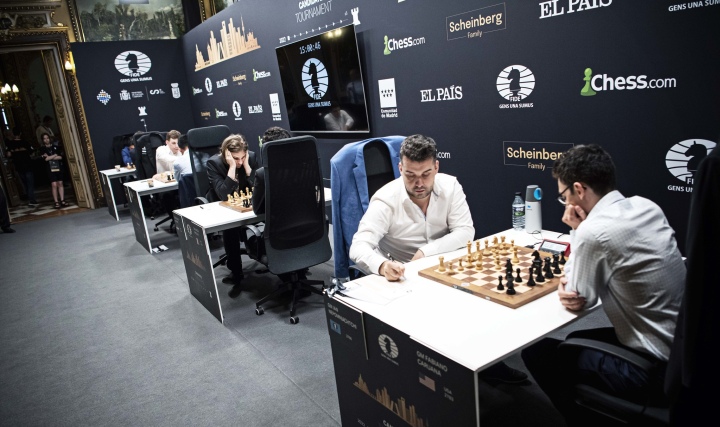
On a day of draws, Hikaru Nakamura staged a recovery with a victory over Teimour Radjabov The second day of the 2022 Candidates saw just one game ending with a victory and three draws. Following a loss in the opening round, American Hikaru Nakamura made a recovery and beat Teimour Radjabov of Azerbaijan, scoring a victory after six and a half hours of play. In the Ruy Lopez, White (Nakamura) got a slightly better position after Black failed to find the optimal moves in the opening. White gradually increased pressure on his opponent, who was constantly on the back foot. Most likely, it would not have been enough for a victory had Radjabov not given up a pawn on the move 35. The rest of the game was not a smooth sail for Hikaru, but his patience and determination eventually paid off. After his loss in round one, this is an important victory for Nakamura as it helps him secure a good place early on in the tournament. The most anticipated game of the day, the duel between Ian Nepomniachtchi and Fabiano Caruana, ended in a draw. The two are the only tournament participants to have won the Candidates once already and are the only players who started with victories in round one. In the Italian Game, Caruana, playing with black pieces, stunned his opponent with a well-prepared surprise early on in the opening. Facing Caruana’s bombshell, Nepomniachtchi did not lose heart – he sacrificed a pawn and skilfully defended in a very complicated position. Still, in the end, the computer said Black had a sizable advantage. Caruana, however, either couldn’t see it or disliked the complications. After 33 moves, the two agreed to a draw. Nepomniachtchi and Caruana enter round three as the leaders, with 1.5/2. In another Italian Game, the duel between Jan-Krzysztof Duda and Ding Liren also ended in a draw. The Polish player had a slight edge throughout the game, but Ding managed to place his pieces well enough to prevent White from making progress. After careful manoeuvering on both sides, a draw was agreed on move 41. Following a devastating loss in the first round, a draw with black pieces will surely help the world’s second highest-rated player Ding Liren stabilize. As for Duda, he started the tournament with two draws and had chances in both games, so it remains to be seen if he can keep the flame going. Today was a special day for Alireza Firouzja, who celebrated his 19th birthday. The youngest player of the Candidates might not be happy with how he played, but he has all the reasons to celebrate after saving a lost endgame against Richard Rapport. After two rounds, Fabiano Caruana and Ian Nepomniachtchi lead the field with 1.5/2, followed by four players on one point: Rapport, Firouzja, Duda and Nakamura. World number two, Ding Liren and Teimour Radjabov are on half a point. Here follows a deeper look at the games from the first round of the 2022 Candidates tournament. Richard Rapport vs Alireza Firouzja: A lucky save by the birthday boy It was a special day for Alireza Firouzja as the youngest player of the Candidates turned 19. For some time, the eyes of the chess world have been on the young French superstar, whom many are comparing to Fischer. However, the special birthday mood did not reflect on the board as he struggled as Black against the innovative Richard Rapport. Despite this, Firouzja ended the day with a good reason to celebrate, having saved a lost endgame. In a rare Chekhover variation of the Sicilian, Rapport quickly exchanged his light-squared bishop for a knight, avoiding sharp lines and entering a calm, balanced position with a slightly better pawn structure for White (similar to one Rapport had as black against Duda in game one). White did a better job in the ensuing manoeuvering play and got a slight edge. By move 32, the two entered a rook endgame, but this was when Firouzja committed a grave mistake – 32….Ra1, allowing Black to capture on c6 and then double his rooks along the seventh rank. By move 37, White was completely winning, but then it was Rapport’s turn to err. He could have given a check on g7, followed by an exchange of a pair of rooks, leading to a supported free runner down the e-file and at the same time pinning Black’s d-pawn. Instead, he played 38.Ke4 (see a diagram below), giving some breathing space to Firouzja, who was defending well. Rapport couldn’t find the winning plan, and after 47.Rg6, he dropped the rest of his advantage, and the position was even. Firouzja then returned the favour with 51…Re7?, but Rapport did not accept the gift (52.Kf5! was winning) and opted for 52.b4, leading to a forced draw. Finally, on the move 60, the two sides agreed to split a point. That was a lucky save by Firouzja. Hikaru Nakamura vs Teimour Radjabov: Imprecision and pressure In the Ruy Lopez, Nakamura played d3 and denied Radjabov a chance to enter the main line of the Berlin Defence. Radjabov opted for a rare continuation (5…Nd4) where Black has to make several moves with a bishop in the centre. However, he spent significantly more time in the opening, suggesting he was out of the book. The price of this was soon felt on the board as Nakamura created a strong edge: Black had doubled pawns and a pawn on d7, which was blocking the development of his c8 bishop. Radjabov opted to sacrifice a pawn by playing d7-d5 to complete development and unlock the potential of his bishop pair. Having a 60-minute advantage, Nakamura gradually simplified the position: he returned the pawn and exchanged the queens but managed to place his rook in the Black’s back rank and put his knight on d4, towering over the board. The computer said the position was equal, but Radjabov had five minutes on seven moves to reach the first time control. Nakamura kept his cool:
Winners crowned at Prague Chess Festival 2022
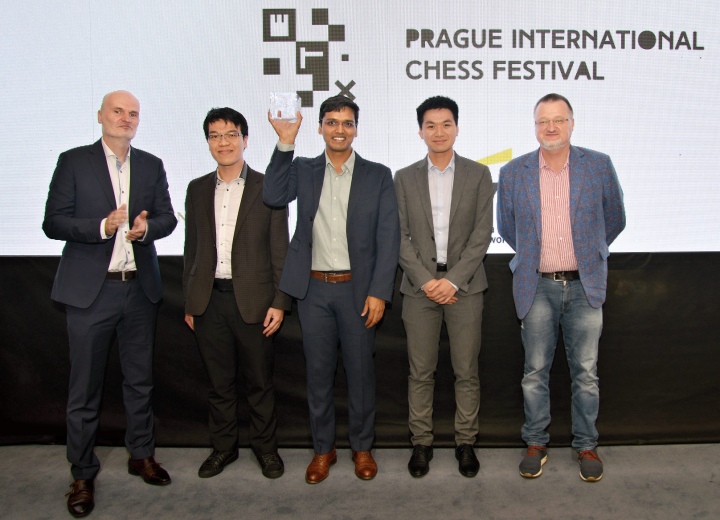
The fourth edition of the Prague Chess Festival is in the books. The event, held in several sections and financially supported by FIDE Aid Package, took place from 8–17 June 2022 in the capital of the Czech Republic. The Prague Chess Festival offered a dramatic spectacle, and the winners were again decided on the last day. In the Masters, a 10-player round-robin with classical time control, Le Quang Liem and Pentala Harikrishna entered the final round a full point ahead of David Navara, Thai Dai Van Nguyen and Sam Shankland. Ironically, the co-leaders were facing Spanish opponents. Liem managed only a draw facing Vallejo Pons with black, while Harikrishna took full advantage of his white pieces to beat David Anton, clinching the title with a solid score of 6½/9. Liem finished second; Thai Dai Van Nguyen took third place thanks to slightly better Sonneborn-Berger over Shankland and Navara. The top 3 finishers completed the event undefeated. Final standings Masters: 1 Harikrishna Pentala IND 2701 6½ 2 Le Quang Liem VIE 2709 6 3 Nguyen Thai Dai Van CZE 2610 5 4 Shankland Sam USA 2718 5 5 Navara David CZE 2681 5 6 Vallejo Pons Francisco ESP 2703 4½ 7 Vidit Santosh Gujrathi IND 2723 4 8 Maghsoodloo Parham IRI 2716 4 9 Salem A.R. Saleh UAE 2679 3 10 Anton Guijarro David ESP 2692 2 The Czech players did not fare well in the previous three editions of the Masters. This year, however, the home fans are happy. Not only will the trophy for the winner remain in Prague (Pentala Harikrishna has been living in the capital for a long time), but the two Czech players performed well and shared third place. The Challengers Tournament saw predators battle it out for a place among the elite and the prospect of advancing to the Masters. Indeed, only nineteen games out of forty-five ended in a split of points. As the tournament progressed, there was an increasingly clear trio of players – Nodirbek Abdusattorov, Vincent Keymer and Hans Moke Niemann – who had the biggest chance to win. By the last round, everything was still open. In the final round, Abdusattorov got into trouble against Slovakian youngster Jergus Pechac who outplayed him with black pieces. It was clear that the World Rapid Champion would fight for a draw in the game. In the end, Nodirbek held the draw, but it was not enough. Hans Moke Niemann and Vincent Keymer had black pieces in their games, but both won, scored 6½/9 each and proceeded into a tiebreaker. The German player achieved an overwhelming position in the first game, and just when it looked like Niemann could save himself in the rook ending, he made a crucial mistake, and black-playing Keymer celebrated his first win. Keymer left nothing to chance in the rematch and ended the game with a symbolic checkmate. After winning 2-0, he is happy with the overall victory and, above all, the ticket to next year’s Masters. Final standings Challengers: 1 Keymer Vincent GER 2675 6½ 2 Niemann Hans Moke USA 2678 6½ 3 Abdusattorov Nodirbek UZB 2661 6 4 Sasikiran Krishnan IND 2635 5 5 Pechac Jergus SVK 2598 4 6 Warmerdam Max NED 2613 4 7 Krzyzanowski Marcin POL 2535 3½ 8 Stocek Jiri CZE 2541 3½ 9 Hracek Zbynek CZE 2564 3 10 Michalik Peter CZE 2577 3 A hallmark of the Prague festival is the Futures Tournament. This year, the organizers once again managed to put together a very interesting lineup of young hopefuls from seven countries. This tournament came down to the wire as well. Kamil Warchol, the overall winner, challenged Atilla Kura in the last round and took the overall victory to Poland with a draw. Pawel Sowinski, also from Poland, joined them on the podium. The best Czech player Jiri Bouška finished just below the podium. Final standings Futures: 1 Warchol Kamil POL 1991 7 2 Kuru Atilla TUR 1949 6½ 3 Sowinski Pawel POL 2066 6½ 4 Bouska Jiri CZE 2191 5½ 5 Bokhnak Timofey CZE 2112 5 6 Kovalskyi Roman UKR 2065 4½ 7 Tolmacevs Artjoms LAT 2032 4 8 Balint Peter AUT 2097 4 9 Zelbova Lada CZE 1980 1½ 10 Peglau Charis GER 2008 ½ Over 300 players took part in the Open tournament with an invitation to the Challengers tournament 2023 at stake. The top seed Alexander Motylev conceded his opponents only two draws and, with a total of eight points, finished a full point ahead of a large group of players tying for the second place. Final standings Open: 1 GM Motylev Alexander FID 2619 8 2 GM Stremavicius Titas LTU 2495 7 3 Kozak Antoni POL 2459 7 4 GM Santiago Yago De Moura BRA 2509 7 5 IM Garriga Cazorla Pere ESP 2495 7 6 GM Petr Martin CZE 2488 7 7 GM Sankalp Gupta IND 2505 7 8 GM Popovic Dusan SRB 2484 7 9 GM Iniyan P IND 2518 7 10 GM Alsina Leal Daniel ESP 2514 7 Official website: praguechessfestival.com Text: Official website Photo: Petr Vrabec and Vladimir Jagr