

From Kakuma to Kisumu: Refugee youth make bold moves on the chessboard of hope
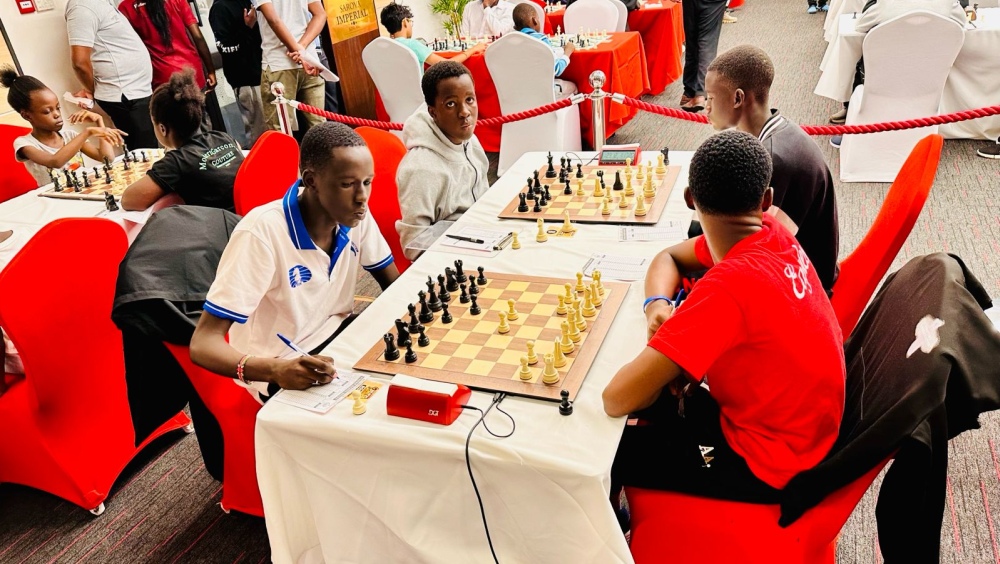
In a journey that transcends borders and circumstance, ten young players from Kakuma Refugee Camp competed in the East Africa Under-21 Chess Championship in Kisumu from November 7 to 9, 2025. Sponsored by the International Chess Federation (FIDE) and Chess Kenya, their participation was far more than a sporting opportunity, it was a celebration of courage, resilience, and the unifying power of chess. For most of these young players, life has been confined within the boundaries of the camp. Many were born in Kakuma, a place that has offered safety but limited exposure to the outside world. Yet, across 64 black-and-white squares, they have discovered a new kind of freedom, a place where talent and determination matter more than background or status. Competing in Kisumu allowed them to meet some of the best young players from across East Africa, to test their skills, share ideas, and, most importantly, to feel part of something bigger than the camp itself. Every move they make on the chessboard told a powerful story: refugee status is not a barrier, it is a beginning. The year 2025 has been declared the FIDE Year of Social Chess, a global celebration of chess as a tool for positive change and community development. Around the world, FIDE is supporting programs that use the game to empower the underprivileged, bridge social divides, and promote education and equality. In Kenya, the vision of the Year of Social Chess is brought to life through the Chess in Refugee Camps Program, a partnership between FIDE, UNHCR, the Lutheran World Federation (LWF), Gift of Chess and Chess Kenya. DGT joined the partnership with a donation of 100 clocks. The initiative aims to use chess not only to teach strategy and focus but also to build confidence, critical thinking, and resilience among refugee children. Anastasia Sorokina, FIDE’s Social Projects Manager, emphasized the transformative impact of the initiative: “Chess has the power to change lives. In Kakuma, we have seen young people grow in confidence, discipline, and hope through the game. Their journey to Kisumu is proof that opportunity can unlock incredible potential. FIDE is proud to stand with these players, as they represent not just a camp, but a spirit of strength and possibility.” The Kisumu tournament marked the third major outing for the Kakuma team this year, following their participation in the Kenya National Schools Chess Championship in Kiambu and the Kenya National Youth Championship in Kitale. Each event has expanded their horizons, giving them new experiences, friendships, and confidence in their own potential. Benard Wanjala, President of Chess Kenya, expressed pride in how far the refugee chess program has come: “What began as a small project in Kakuma has grown into one of the most inspiring chess stories in Africa. These young players are ambassadors of hope. Chess Kenya is committed to ensuring that every child, regardless of background, has a chance to learn, compete, and succeed. Their participation in Kisumu shows that chess truly unites us all.” A cornerstone of the program is the Girls’ Chess Club, where young women are taught not only the game but also vital life skills. Guided by mentors who have triumphed over their own challenges, the girls learn to lead, to believe in themselves, and to see beyond temporary hardships. Every training session is a step toward empowerment, a lesson in strategy for both the chessboard and life itself. Heading to Kisumu, the Kakuma team carried more than chessboards and pieces, they carried the hopes of a community that believes in them. In every handshake across the board, in every careful move, lay a message of unity and resilience: We belong. We can achieve. We are ready to make our move. Their journey from Kakuma to Kisumu is not just about competing, it’s about redefining what’s possible when opportunity meets determination. And for these young players, every move forward is a step toward a brighter, more inclusive future. Kakuma Chess Club triumphs at East Africa Under-21 Chess Championship Kakuma Chess Club has once again proven its growing strength on the regional stage with an impressive performance at the Victoria East Africa Under-21 Open Chess Championship. The team fielded ten young players who competed in four categories: Prestige Open, Prestige Ladies, Elite Open, and Elite Ladies. Kakuma’s players stood out in both the girls’ and boys’ sections, bringing home a remarkable collection of trophies and medals, including one gold, two silver and three bronze medals. The club’s outstanding showing in the Elite Category earned them the coveted “Best Chess Club” award, a testament to their collective excellence, teamwork, and dedication to the sport.
World Cup chaos in Goa: 2700+ giants fall like ninepins as Gukesh, Giri, and Abdusattorov are eliminated
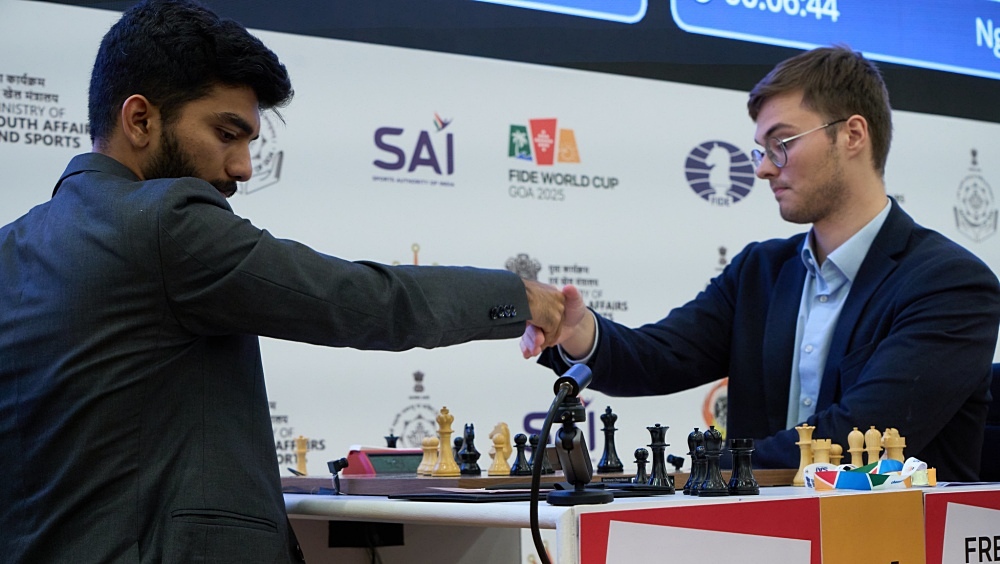
The second game of round three was every bit as thrilling as expected. The formidable German Olympiad squad – Keymer, Bluebaum, Donchenko, and the Svane brothers – created a sensation this afternoon at the Rio Resort in Goa. Four of them advanced to the fourth round, with two scoring massive upsets by eliminating the tournament’s top seed, GM Gukesh D, and fourth seed, GM Anish Giri, from the World Cup. The five German grandmasters have formed a close-knit unit during the event — sharing meals, walking to the venue together, and supporting one another throughout the rounds. And so far, their camaraderie seems to be paying off handsomely. With today’s action concluded, 11 of the 32 matches will be decided in tiebreaks tomorrow narrowing the field to the final 32 players still in contention for the prestigious World Cup trophy. Let’s take a closer look at the action as the afternoon unfolded. The round began with the ceremonial first move, performed by Mr. Ajit Roy of the Indian Administrative Service (IAS). Serving as Secretary to the Governor of Mizoram, Mr. Roy played 1.e4 on Board 1 in the game between World Champion GM Gukesh D and GM Frederik Svane of Germany. As it was Saturday, the playing hall was packed with spectators. To manage the large number of visitors, the organizers implemented a slot system, allowing fans to purchase tickets for specific time periods. Naturally, the first slot sells out almost instantly – it’s the only opportunity for visitors to enter the hall with their mobile phones and take a few selfies with the players. Although I usually head back to the media and broadcast center as soon as the games begin, this afternoon I decided to stay in the playing hall for the first thirty minutes to observe the players’ behaviour when it was not their move. As expected, most of the sixty-four participants – elite professionals that they are – remained seated, deeply focused and analysing variations even while their opponents were thinking. Focus, after all, is everything in chess. Yet a few preferred to stretch their legs in the early stages, each displaying their own distinct walking style. From today’s observations, Anish Giri stood out as the player who spent the most time pacing along the cordoned-off line. His manner is unmistakable: hands clasped behind his back, posture upright, stride calm and deliberate. He walks like a man fully in control – of his position on the board and of his composure off it – graceful, self-assured, and just a touch enigmatic. A master of opening theory, Giri is always impeccably prepared, often leaving his opponents to shoulder the burden of early thought. Maxime Vachier-Lagrave’s walking style mirrors the very essence of his chess — focused, brisk, and quietly self-assured. He paces lightly between the boards with a subtle bounce in his stride, hands sometimes tucked into his pockets or folded neatly behind his back. He walks like a man calculating variations mid-step: absorbed, calm, yet charged with a quiet inner energy. Former World Cup winner Levon Aronian also enjoys taking strolls during the opening phase. Often smiling or chatting briefly with colleagues, he can frequently be seen wandering toward the lower boards, keeping an eye on the games of his former Armenian teammates — Sargissian, Hovhannisyan, and Sargsyan – who continue to battle it out in the event. Other elite players, such as Mamedyarov, Erigaisi, and Keymer, also favour mid-opening walks, usually with their hands casually in their pockets. Meanwhile, Dubov, Praggnanandhaa, and Rapport prefer the nearby refreshment area, where two large screens display miniature versions of every game, allowing them to monitor their own boards – and everyone else’s – without breaking their rhythm. Exactly an hour and a half into play, the first player had already secured qualification to the fourth round — the stage where only 32 competitors remain in contention for the coveted Candidates spots. Having won his first game yesterday, GM Matthias Bluebaum (2687), the recent runner-up at the Samarkand Grand Swiss, opted for the Exchange Variation of the King’s Indian Defence, calmly trading off every piece in sight and forcing an effortless draw to seal his spot in the next round. His opponent, 15-year-old GM Ivan Zemlyanskii (2596), can take great pride in his performance. He leaves Goa with a well-earned €11,000 prize and, more importantly, a wealth of experience that will serve him well in future competitions. As we’ve seen repeatedly in previous rounds, the 2700+ rated players are losing momentum. The latest casualty was Slovenian GM Vladimir Fedoseev (2720), who bowed out of the event after losing his second game to Poland’s ever-dangerous GM Radoslaw Wojtaszek. A six-time Polish champion, Wojtaszek may be rated 2654 at the moment, but with a career peak of 2750, he remains one of the most respected and solid players of his generation. Needing a win with Black against such a stable opponent, Fedoseev resorted to a sharp line of the English Defence that modern theory has all but refuted. He chose the risky continuation 4…f5?, and after 5.exf5 Bxg2 6.Qh5+ g6 7.fxg6 Bg7 8.gxh7+ Kf8, Black temporarily wins a rook on h1 — but at a terrible price. The resulting attack for White is well-known to be decisive, with modern engines giving a clear +2 evaluation. Fedoseev was gambling that Wojtaszek might not recall the precise theoretical nuances, and for a brief moment, it almost worked. But in the end, his luck ran out, and the Polish grandmaster’s attack broke through convincingly. We caught up with Wojtaszek in the interview area afterward, where he shared his thoughts on the match and the critical moments of the opening. https://youtu.be/uez5jXEsnIk?si=L0eRrSToOvIBfNMz The full game can be consulted on the Live Games section of the tournament website. Dutch GM Jorden Van Foreest (2697) will live to fight another day in Goa. Needing a win after yesterday’s loss to GM Alexey Sarana (2661), the ever-creative Dutchman once again demonstrated why he’s considered one of the most
FIDE Trainer Awards 2024: Winners announced

The International Chess Federation (FIDE), together with the FIDE Trainers’ Commission (TRG), is pleased to announce the winners of the 16th FIDE Trainer Awards 2024, recognizing and celebrating the exceptional achievements of the global chess training community. These prestigious awards honor the outstanding work of trainers whose dedication and expertise have contributed significantly to chess development worldwide. Vakhtang Karseladze Award Photo: Maria Emelianova Pavel Kotsur (Kazakhstan) receives the award for the best achievement by trainer(s) in women’s and/or girl’s competitions. Recognized for his productive work with the Kazakhstan women’s national team, Kotsur served as both captain and coach, leading the team to a historic silver medal at the 45th Chess Olympiad. Mikhail Botvinnik Award Photo: Eng Chin An Richard Rapport (Hungary) wins the Mikhail Botvinnik Award for the best achievement in Open Section competitions. Rapport served as Ding Liren’s second in the 2024 World Championship Match. Although Ding lost the title, he mounted a valiant defense, with the match being decided only in the final game. Mark Dvoretsky Award Photo: Lennart Ootes Mikhail Kobalia (FIDE) has been chosen by the judges for the Mark Dvoretsky Award for the best achievement by a trainer in junior events. Over the past eight years, he has worked productively with GM Volodar Murzin. In 2024, his pupil made headlines by winning the World Rapid Championship. Yuri Averbakh/Isaac Boleslavsky Book Award 2024 The Yuri Averbakh/Isaac Boleslavsky Award for the best instructional chess book goes to published in 2023 goes to Mastering Chess Endgame Calculation – Level 1 co-authored by Adrian Mikhalchishin & Tadej Sakelšek and published by Forward Chess. The book is the first part of a trilogy designed to help chess players up to 1700 rating improve their endgame calculation skills. It covers all the important theoretical positions and techniques that are necessary for successful endgame play, and includes 400 carefully selected exercises to help readers practice and reinforce their understanding of these concepts. The exercises are arranged progressively. This book stands out for its clear and concise explanations of key concepts, combined with practical exercises. Trainer Awards jury panel The FIDE Trainers’ Commission expresses its deepest appreciation to the distinguished jury members, whose expertise, experience, and integrity guided the selection process: GM Bassem Amin GM Mihail Marin IM Willy Iclicki GM Alonso Zapata Their invaluable contribution ensured a fair, insightful, and professional evaluation of all nominations. The FIDE Trainers’ Commission warmly congratulates all winners and extends sincere thanks to all federations, trainers, and authors who submitted nominations. These awards continue to highlight the vital role of trainers and educators in nurturing chess excellence across the world.
FIDE World Cup 2025 Round 3, Game 1: Upsets, attacks, and masterclasses – Abdusattorov in danger
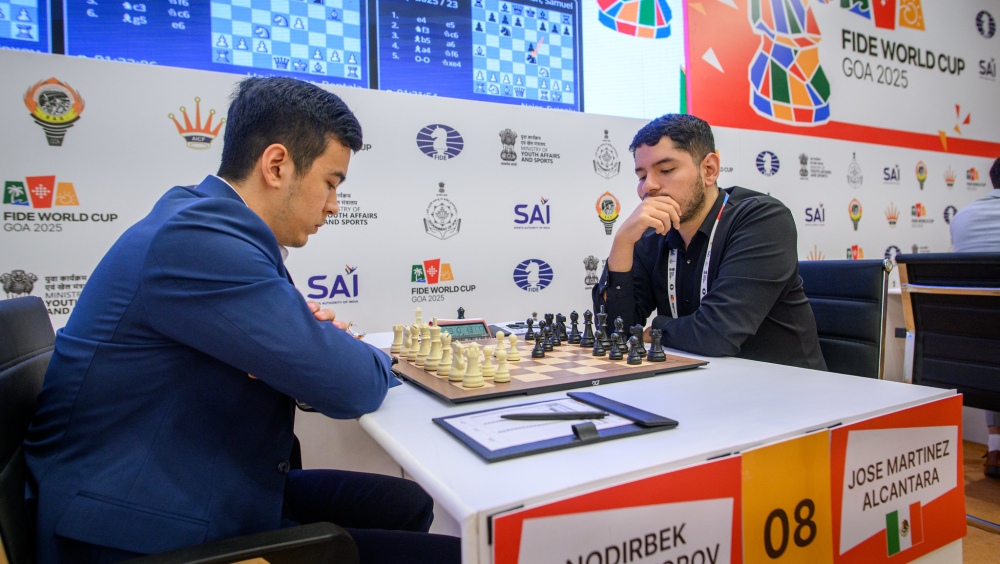
The shock of the first game of Round 3 came from GM José Eduardo Martínez Alcántara (2644), who scored a fantastic win against one of the strongest players in the tournament, GM Nodirbek Abdusattorov, Uzbekistan’s number one, rated 2750 and seeded eighth. Playing with Black, Martínez Alcántara neutralized an ambitious opening idea by Abdusattorov that involved a positional exchange sacrifice. The game became highly unbalanced, but the Mexican GM kept his cool and took over the initiative once his opponent overextended. It was a huge win that puts him in a commanding position to advance to Round 4, provided he can avoid defeat tomorrow. Martínez later analysed the fascinating encounter live in our broadcast studio. Watch his full breakdown on FIDE YouTube. https://www.youtube.com/watch?v=336BKDB7EZ0 World Champion GM Gukesh D (2752) was held to a draw by GM Frederik Svane (2638). The German grandmaster, though pleased with the result, felt there had been room for more: “It was my first time playing against the World Champion, so it was very special. A draw is fine, but I would have loved to put more pressure on him,” explained Svane in his post-game interview. https://youtu.be/MkwX3JxickE?si=YNgRWu5gjRBdhQ6F Other relatively surprising results included draws by GMs Anish Giri (2759), Richard Rapport (2724), and Daniil Dubov (2684) – all playing White against lower-rated opponents. Let’s take a closer look at the action as the afternoon unfolded. Opening ceremony and early action The round began on Board 2, where Indian GM Arjun Erigaisi (2769) faced Uzbekistan’s Olympiad medalist Shamsiddin Vokhidov (2640). The ceremonial first move, 1.e4, was played by Dr. Ajay Gaude, Director of Sports for the Government of Goa. Erigaisi humorously retrieved the pawn and switched to 1.d4 once the principal arbiter declared the round officially open. For the first time in this World Cup, none of the 32 games ended by the two-hour halfway mark — a testament both to the balance among the players and to their determination to strike first. Harikrishna’s masterclass The first decisive result arrived after two and a half hours, when GM Pentala Harikrishna (2697) dismantled GM Daniel Dardha (2605), Belgium’s four-time national champion. The Indian grandmaster — possibly inspired by his recent work as Gukesh’s second during the World Championship — played with clarity and confidence, launching a textbook kingside assault in an unbalanced Sicilian. After Dardha’s inaccurate opening play, Harikrishna demonstrated precise attacking technique. 22.Re3 (threatening 23.Rg3#) Bc7 23.Nxe4 (with the idea of 24.Nxf6#) Bxe4 24.Rxe4 f5 25.Rxe6!! Following 25…fxe6 26.Bb3!, Black would be forced to give up his queen to stop checkmate – a brilliant finish from the Andhra Pradesh native. Idani’s Creative Breakthrough Shortly afterward, GM Pouya Idani (2601) produced another upset by defeating GM Andrey Esipenko (2693) with a daring kingside pawn advance and a spectacular piece sacrifice. The key moment came after 24.Nxf7! Kxf7 25.Rxg6 Rg8 26.cxd4 Nxd4? (better was 26…exd4) 27.Bxd4 Qxd4 28.Qf5! Caught off guard by this powerful move, Esipenko resigned after 28…Rae8 29.Nf3!, unable to defend against multiple threats. “I was extremely tired after yesterday’s tiebreaks, so I want to thank my second for coming up with this idea,” said Idani. “I had some doubts before the game, but he insisted I should go for it.” https://youtu.be/daXwmJsZzfo?si=Md-lB9UTV8Q59ARM Erigaisi’s smooth victory Meanwhile, GM Arjun Erigaisi (2769) overpowered GM Shamsiddin Vokhidov (2640) in just over twenty moves, showcasing deep preparation and flawless execution. “Even though this line is considered solid, I had prepared the novelty 18.Qd2 – it’s easy for Black to go wrong if he doesn’t know it,” explained Erigaisi. “I was actually planning to play it against Wei Yi in Norway Chess.” You can replay the full game in the Live Games section on the tournament website. FIDE’s star interviewer WIM Charlize van Zyl caught up with Arjun for a quick postgame interview in which he discussed some of the key moves. https://www.youtube.com/watch?v=cgAQqQVhgvM Other winners Also taking the lead in their matches were Levon Aronian (2722), Le Quang Liem (2729), Matthias Bluebaum (2687), Shant Sargsyan (2667), Peter Leko (2666), Alexey Sarana (2661), Radoslaw Wojtaszek (2654), Pranav V (2641), and Aleksey Grebnev (2611). Ivanchuk’s press conference Earlier in the day, Ukrainian legend GM Vasyl Ivanchuk, eliminated in Round 2 by GM Samuel Shankland, met the press at the media centre. Ivanchuk praised the tournament’s organization and confirmed his participation in the World Rapid & Blitz Championships in Doha later this year. With nine participations in eleven editions of the World Cup, Ivanchuk remains one of the event’s most frequent and respected competitors. Game 2 of Round 3 will be played on November 8, starting at 3 PM local time. The action can be followed live on the FIDE YouTube Channel, featuring expert commentary by GMs Evgenij Miroshnichenko and Jan Gustafsson. To watch the games in person, tickets can be purchased [HERE] Official website: worldcup2025.fide.com/ Written by IM Michael Rahal Photos: Michal Walusza and Eteri Kublashvili
Line-ups for 2025 World Women’s Team Championship announced
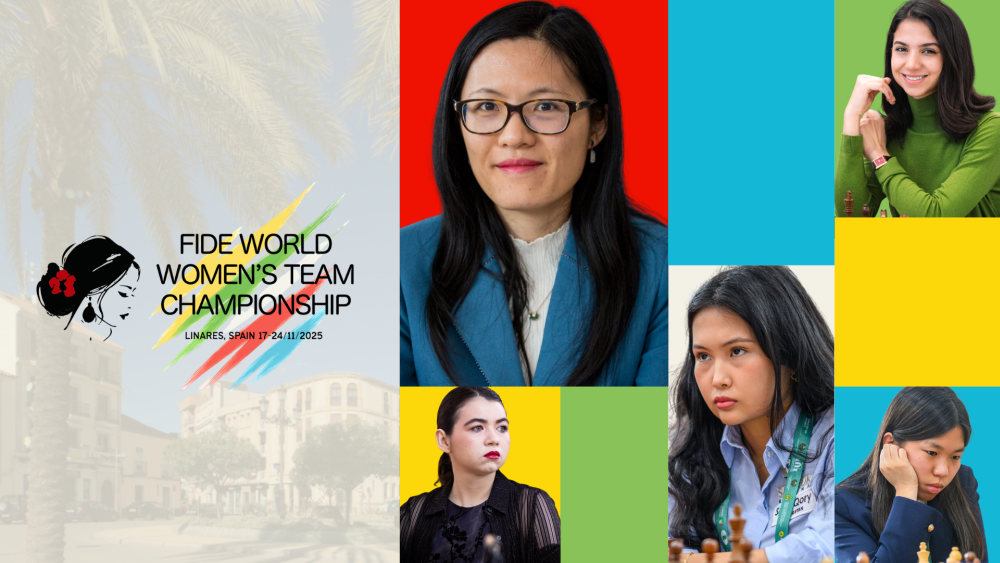
The International Chess Federation (FIDE) is pleased to announce that the 2025 FIDE World Women’s Team Championship will take place in Linares, Spain, from November 17 to 24, 2025. The event will bring together the world’s top national women’s teams as they compete for the prestigious title of World Team Champion. This will be the second time Spain has hosted the event, following the successful 2021 edition in Sitges (Barcelona). The most recent championship was held in Bydgoszcz, Poland, in 2023. “We are delighted to bring the World Women’s Team Championship to Linares,” said FIDE President Arkady Dvorkovich. “This city has a legendary connection with the game, and we are confident that it will provide a perfect stage for this major event in the women’s calendar.” Line-ups and star participants The event is expected to attract many of the strongest women players in the world. On board one, China will be fielding Hou Yifan, widely regarded as one of the greatest female chess players in history and a central figure in modern women’s chess. Hou Yifan is a four-time Women’s World Champion (2010, 2011, 2013, 2016) and has represented Team China in numerous Olympiads and team competitions, contributing to several gold medal victories, including at the World Women’s Team Championships (2007, 2009, 2011, 2015). Photo: Rafal Oleksiewicz At the 2025 FIDE World Women’s Team Championship in Linares, Hou Yifan’s participation is highly anticipated. As the leader of the Chinese national team, her return to team competition will undoubtedly be one of the major highlights of the event. Alongside Hou, Team China will feature an exciting blend of experience and youth, including two of the country’s most promising rising stars — International Masters Song Yuxin and Lu Miaoyi. Their inclusion underscores China’s continued commitment to nurturing young talent and maintaining its dominant legacy in women’s chess. “The World Women’s Team Championship is not only a celebration of competitive excellence but also a showcase of team spirit and solidarity in women’s chess,” added FIDE Managing Director Dana Reizniece. “We look forward to seeing the best players come together once again in such a historic and inspiring venue.” Photo: Michal Walusza Team USA is also coming strong with five experienced 2400 players, headed by Carissa Yip. Born in 2003, Yip is one of the brightest stars in American chess and a leading figure in the new generation of women players on the world stage. A four-time U.S. Women’s Champion (2021, 2023, 2024 and 2025), Carissa is known for her aggressive and creative style. Sarasadat Khademalsharieh will once again lead the team of the host nation, Spain. Widely known as Sara Khadem, she is one of the most talented and respected figures in modern women’s chess. Former Iranian Champion, Sara achieved the title of International Master and Woman Grandmaster, representing Iran in numerous Olympiads and World Team Championships, and in recent years has made Spain her new home. Photo: Niki Riga The 2025 edition will feature 12 teams, including: The semi-finalists from the 2023 Championship: Georgia, France, Kazakhstan, and the USA The top-rated continental teams: China (Asia), Ukraine (Europe), Peru (Americas), and Algeria (Africa) India and the FIDE teams, based on the August 2025 average rating Spain, as the host nation Uzbekistan, nominated by the FIDE President The full rosters of each team can be consulted [HERE].
Tiebreak drama at 2025 FIDE World Cup in Goa: Niemann and Oro eliminated
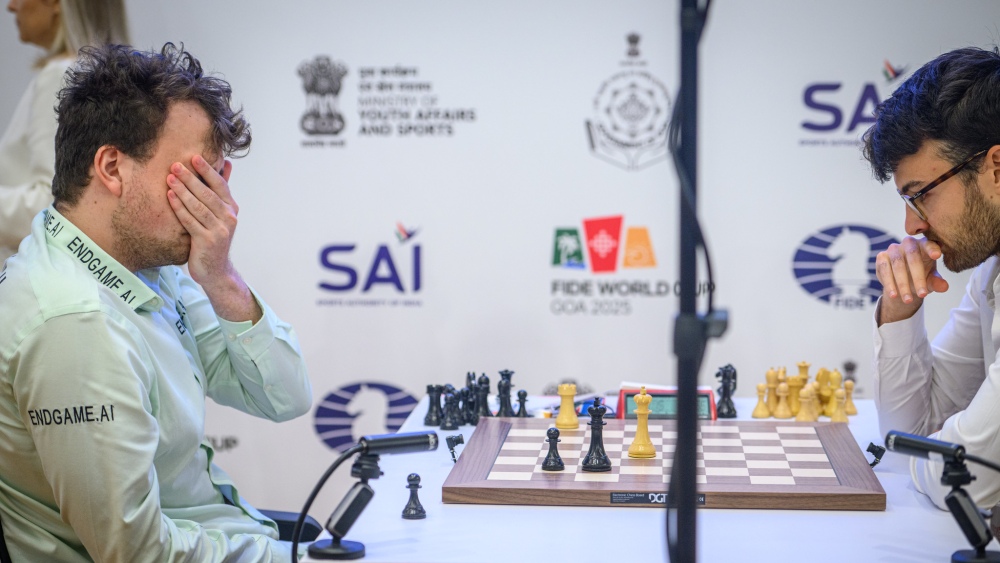
When the best player in the world – former World Champion and 2023 World Cup winner Magnus Carlsen – decides to set everything aside and join the live broadcast, you know the tiebreaks are going to be massive. And they didn’t disappoint! Favourites fell, prodigies stumbled, and the round delivered everything a chess fan could wish for: seven matches going all the way to blitz and even one Armageddon decider. The atmosphere in Goa was electric. Even Ian Nepomniachtchi’s mild post-elimination complaints on Telegram after Round Two were quickly forgotten when another top player addressed the issue directly. “The conditions are fine here,” said Vidit Gujrathi, who had just eliminated Argentine prodigy Faustino Oro. “You can always get a few complaints when you organize a big tournament. He could have been more specific, but I think people are being too harsh on him. Maybe he just lost and said something emotional – I’ll give him the benefit of the doubt. But regarding the conditions, I don’t see any reason to complain.” The Round 2 tiebreaks were officially opened by Mahesh Candolkar, President of the Goa Chess Federation, and Dr. V. Candavelou, Chief Secretary of Goa, who performed the ceremonial first move on Board 1. Rapid 15/10 The shock of the first rapid session came from the elimination of GM Hans Moke Niemann (2738). The American 10th seed was defeated by Italy’s GM Lorenzo Lodici (2560), who held him to two classical draws before winning the first of the two 15-minute rapid games in what was arguably one of the day’s key moments. Lodici seized a decisive advantage earlier, but Niemann appeared to believe he could still draw. Short on time, Niemann blundered with 72…Rg1? – just one square too far! The sequence 73.f6 Rf1 74.Be3! was the point as Black had no Rg1+. After 74…Rf3 75.h7+ Kh8 76.f7 the deal was sealed, 1-0. The only move for Black was 72…Rg2! Compared to the line above after 73.f6 Rf2! 74.Be3 (Bc1) he has the saving check 74…Rg2+. Visibly frustrated, Niemann took some time alone to review the lines on his phone before leaving the venue. Meanwhile, Faustino Oro’s dream run came to an end against Vidit Gujrathi, who prevailed in the first set of rapid games. “I was a bit worried going into tiebreaks — Faustino is very good, and I hadn’t played much rapid lately,” said Vidit. “I tried my best, prepared well, and it worked out.” FIDE’s Charlize van Zyl interviewed Vidit after the match — don’t miss the video! https://www.youtube.com/watch?v=ANF6L47_S7k After the match, Oro reflected to this author: “I fell behind on the clock in the second game and couldn’t recover.” Despite his disappointment, he left Goa with valuable experience and a growing fan base. Meanwhile, Nodirbek Abdusattorov, Shakhriyar Mamedyarov, Stamatis Kourkoulos-Arditis (pictured below), Sam Sevian, Daniel Darhda, Bogdan-Daniel Deac, Radoslaw Wojtaszek, Vladislav Artemiev, Pranesh M, Pranav V, Robert Hovhannisyan and Shamsiddin Vokhidov all won their matches at this stage, qualifying for Round 3. Rapid 10/10 The second set of rapid games (10 minutes + 10 seconds) proved even tougher: only three of the ten undecided matches were resolved. GMs Gabriel Sargissian (2611) and Shant Sargsyan (2664) both advanced after long, evenly matched fights against Maxim Rodshtein (2611) and Jorge Cori (2601) respectively. Former World Rapid Champion GM Daniil Dubov (2674) also moved on, defeating GM Jinshi Bai (2595). The Chinese player had neutralized Dubov’s advantages through four games, but a critical error in the Exchange Slav. 12…g4? – cost him dearly. After 13.Bh4! gxf3 14.Bxf3, Bai’s knight on h5 was doomed, and Dubov converted comfortably. Blitz 5/3 Seven matches came down to blitz (5 minutes + 3 seconds). The most dramatic included GM Praggnanandhaa R (2771) overcoming GM Temur Kuybokarov (2535) after falling behind and levelling the score in the first rapid set. In the decisive blitz game, Kuybokarov reached an overwhelming position, but first failed to find a couple winning continuations and then missed a draw. After 37.b6! cxb6 38. Rc1 White’s c-pawn is simply unstoppable. Temur, however, played 37.Rd7? Kf7 38.Bxe7?? (White was still winning after the precise 38.Bd4!) 38…Rxe7. Here Kuybokarov missed a simple defensive resource 39.Rd4, playing 39.Re1?? instead. After 39…Rxd7 40.cxd7 Rxh4+! 41.Kg2 Rd4, the Australian GM was forced to resign – a heartbreaking end to an excellent match. Elsewhere, GM Nikita Vitiugov (2654) bowed out to GM S. Narayanan (2617), who won both 5/3 games after six straight draws in the classical and rapid portions. Blitz 3/2 Two matches went to the final blitz stage (3 minutes + 2 seconds). As expected, the veterans’ clash between GM Ivan Cheparinov (2626) and GM Michael Adams (2635) lived up to its billing. In a show of precision and stamina, Adams won both games, advancing to Round 3 – another deep run in his illustrious career. Armageddon The last and most dramatic tiebreak saw GM Rauf Mamedov (2655) face GM Rasmus Svane (2614). Under the new bidding system for the Armageddon decider, Mamedov bid 3:00, while Svane chose 3:13, thereby securing White. “We were both struggling with the black pieces, me even more than him, so I bid slightly higher to ensure White,” Svane later explained. The decision paid off. Svane converted a slightly better endgame into victory — one of the biggest wins of his career. Looking ahead Sixty-four players remain as Round 3 begins. With three Candidates spots at stake, every match is critical. The field is wide open – and if the tiebreaks were any indication, the coming rounds promise even more spectacular battles. The full pairings for Round 3 matches can be found here [HERE]. Game One of Round 3 will be played on November 7 at 3 PM local time. The action can be followed live on the FIDE YouTube Channel, featuring expert commentary by GMs Evgenij Miroshnichenko and Jan Gustafsson. To watch the games in person, tickets can be purchased [HERE] Official website: worldcup2025.fide.com/ Written by IM Michael Rahal (Goa, India) Photos: Michal Walusza and Eteri Kublashvili
FIDE World Amateur Chess Championship 2025 kicks off in the Vrnjacka Banja, Serbia
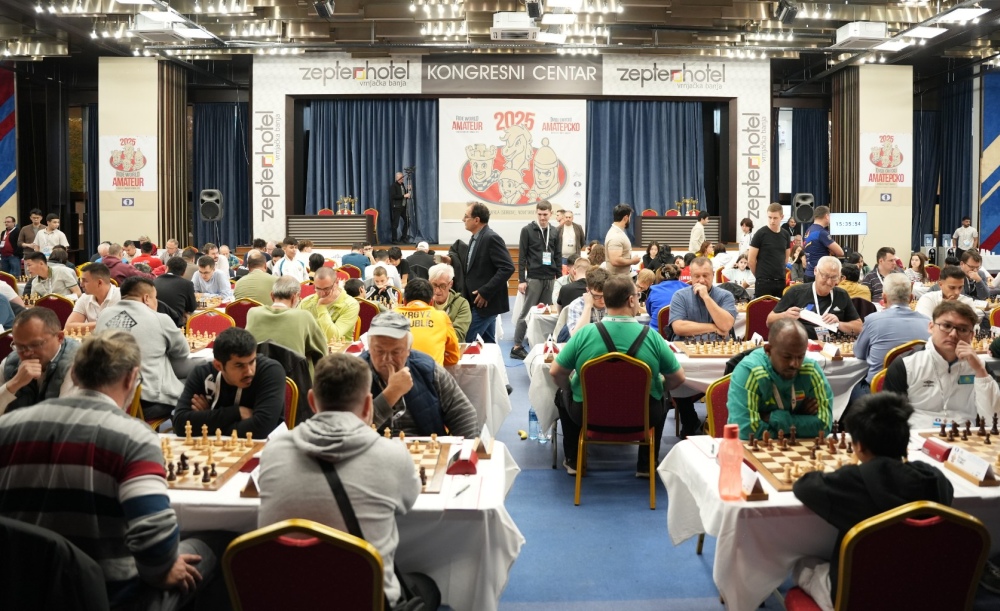
The FIDE World Amateur Chess Championship was officially opened in Vrnjačka Banja, Serbia. The event, held across three rating categories – U1700, U2000, and U2300 (both Open and Women’s sections) – has brought together around 300 players from over 50 countries. All competitions are nine-round Swiss tournaments with a classical time control. The opening ceremony took place in the hall of the Zepter Hotel and began with the national anthem of the Republic of Serbia, performed by the city choir Abrašević. The audience was then welcomed by Jasmina Trifunović, representing the Municipality of Vrnjačka Banja; Özgür Solakoğlu, representative of FIDE; and Andrija Jorgić, President of the Chess Federation of Serbia. “We are proud that Vrnjačka Banja has become one of the centers of chess events by organizing the European Individual Championship, the European Club Cup, the European Club Cup for Women, and the FIDE World School Chess Championship. Chess has become part of our cultural identity. In our Central Park, in a symbolic space we call the Chess Corner, stands a statue of the chess queen, unveiled in honor of this ancient game and of Vrnjačka Banja as the queen of continental tourism,” said Jasmina Trifunović in her welcoming speech. She emphasized that by hosting the World Amateur Championship, Vrnjačka Banja continues its tradition of chess and strengthens its reputation as a prestigious destination for top chess events. Next, FIDE delegate Özgür Solakoğlu addressed the participants, noting that this championship celebrates the spirit of amateur chess – a reminder that the love of the game belongs to everyone, not only to grandmasters and professionals. “Here, each move, each game, and each handshake reflect the very essence of what chess represents: respect, creativity, and the pursuit of excellence. This championship celebrates the heart of our sport – the passion and dedication of amateur players from all over the world. You come here not only to compete, but to share your love of chess, to make new friends, and to experience the joy and challenge that only this game can bring,” said Solakoğlu. In his address, Andrija Jorgić, President of the Chess Federation of Serbia, expressed gratitude to the Ministry of Sports – the Federation’s most important partner in building a stronger and more recognized chess scene in Serbia – as well as to the Municipality of Vrnjačka Banja for its generous support. “I would like to thank the International Chess Federation and its President, Arkady Dvorkovich, for their trust in us to organize this event. I believe we will justify that trust and that Serbia will host many similar competitions in the future. Although I have been leading the Chess Federation of Serbia for less than a year, I am proud of all the tournaments and successes we have achieved,” said Jorgić, who also commended the Serbian national team for winning bronze at the recent European Chess Championship in Georgia. Following the ceremony, Jorgić and Trifunović made the first symbolic move, marking the start of the first round. Photos: Savo Tufegszic Official website: worldamateur2025.fide.com
World Cup Round 2 Day 2: Gukesh and Erigaisi advance, Wesley and Nepomniachtchi go home
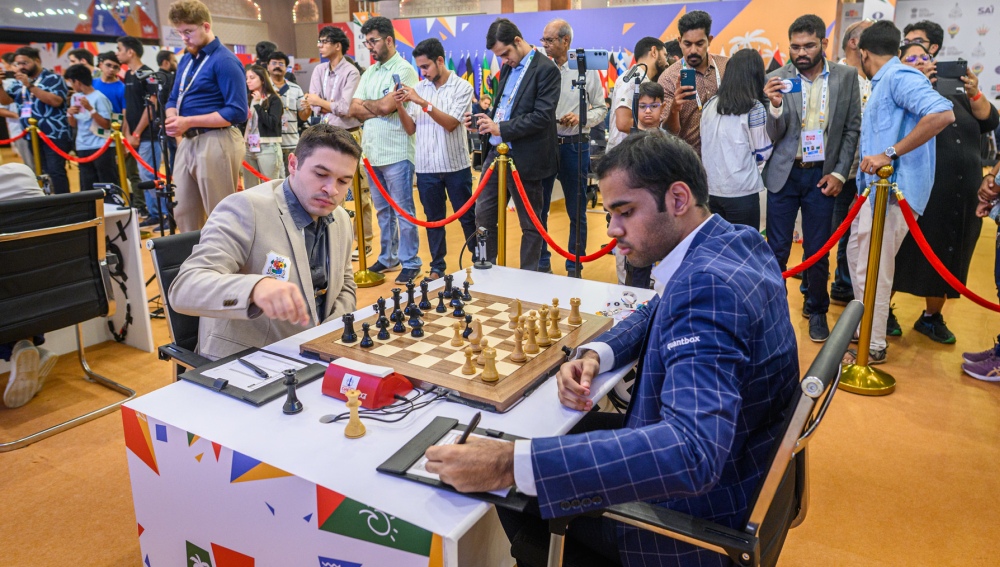
The second game delivered all the drama chess fans could hope for — successes, upsets, nerves, and suspense in equal measure. Leading the headlines was World Champion Gukesh D., who once again demonstrated impeccable form. Playing with Black, he convincingly overpowered Kazybek Nogerbek to secure his place in the third round. Moments later, Gukesh was greeted by hundreds of cheering fans waiting outside the playing hall — a testament to his growing global appeal and India’s passionate chess following. https://www.youtube.com/watch?v=3ZCVOl7ZMrI Joining him in the winners’ column were several other top favourites, including Arjun Erigaisi, Anish Giri, Wei Yi, and Vincent Keymer, all of whom delivered commanding performances to advance without the need for tiebreaks. However, not every top seed found smooth sailing. R. Praggnanandhaa, Nodirbek Abdusattorov, Shakhriyar Mamedyarov, and Hans Niemann were unable to finish off their opponents in the classical portion and will have to return tomorrow for what promises to be an intense day of rapid and blitz tiebreaks. Perhaps the biggest disappointment experienced Ian Nepomniachtchi, the two-time World Championship challenger, who suffered an early and unexpected exit. It was a stunning upset and one of the defining stories of the day. Another dramatic twist of the day came from Wesley So, whose premature exit shocked many. Facing Titas Stremavicius, an opponent rated more than 200 points lower, So found himself in a tense endgame while playing with the Black pieces. Under mounting time pressure, he resigned in what was actually a drawn position, overlooking a remarkable stalemate resource that would have saved the game. Other well-known names — including Ray Robson, Vassily Ivanchuk, David Navara, and Johan-Sebastian Christiansen — also bowed out of the competition, their World Cup dreams now on hold until the next edition in two years’ time. Let’s take a closer look at the action as the round unfolded. Inside the calm before the storm: Moments before Round 2 I usually arrive at the playing venue about twenty minutes before the start of each round. There’s something special about those quiet moments before the clocks begin to tick — the soft hum of concentration, the rustle of scoresheets, and the faint click of pieces being placed just so. While most grandmasters prefer to walk in during the last five minutes, a handful of players arrive early, savouring their own pre-game routines. At this level, arriving late is almost unheard of — not only would it bring a hefty fine, but it could even mean losing by forfeit. Among the early arrivals today were GMs Wesley So, Pranav V, Maksimovic, Lodici, and Yu Yangyi — each calmly settling in, preparing scoresheets, and collecting their thoughts for the battles ahead. A clash of generations: Vidit vs. Oro One of the earliest to take his seat was 12-year-old IM Faustino Oro, Argentina’s young prodigy. Oro, meticulous to the last detail, spent several minutes ensuring that each of his pieces sat perfectly centered on its square — a ritual of precision that mirrors his play. His opponent, India’s top GM Vidit Gujrathi, also arrived early, greeted the youngster warmly, adjusted his pieces, and then slipped into his familiar pre-game meditation: eyes closed, steady breathing, complete focus. Vidit enjoyed some extra encouragement today from his mother, who attended the round in a beautiful chess-themed sari, a touching symbol of support. Laughter, focus, and generations united Also among the early arrivals were elite grandmasters Anish Giri and Hans Moke Niemann. Rather than settling into their seats, the two shared a light-hearted moment, trading jokes and smiles in a brief escape from the tension that was soon to come. Their relaxed camaraderie offered a glimpse of the human side of competition — rivals on the board, but colleagues in a shared craft. A few boards away, GM Felix Blohberger exchanged greetings with his good friend GM Thai Dai Van Nguyen before slipping in his noise-cancelling earplugs — a now-familiar ritual that has become his signature. Away from the board, Blohberger is a rising figure in the online chess community: a respected ChessTuber whose thoughtful daily recaps give fans a unique window into the life and mindset of a professional player. Among the most respected presences in the playing hall was GM Shakhriyar Mamedyarov, a world-class competitor for over two decades and now a mentor to some of the brightest young talents in the game. One of his current protégés, 14-year-old Turkish GM Yağız Kaan Erdoğmuş, is also competing in this World Cup. The two arrived together, exchanged a few final words over opening ideas, and wished each other luck before heading to their respective boards — a quiet, meaningful moment that beautifully embodied the connection between chess’s great traditions and its promising future. The enigmatic legend: Vassily Ivanchuk Grandmaster Vassily Ivanchuk is a true legend of the chess world. Arguably one of the most experienced players in World Cup history — having competed in eight editions by most counts — “Chuki,” as he’s affectionately known, remains as unpredictable and captivating as ever. True to his unique rhythm, Ivanchuk typically arrives at the venue well before the round begins, but rather than sitting down immediately, he prefers to wander calmly along the side aisles, hands clasped behind his back, lost in thought. Perhaps this gentle ritual helps him settle his nerves and tune his mind for what lies ahead — another intense four- or five-hour battle over the board. As the final seconds ticked down and arbiters prepared to start the clocks, the atmosphere shifted — quiet intensity filling every corner of the hall. The calm before the storm was over. The games had begun. The ceremonial opening of the round As per tradition, Łukasz Turlej, the FIDE Secretary General, made the symbolic first move on board three — the game between GM Praggnanandhaa R (from Chennai, India) and GM Temur Kuybokarov (representing Australia). The ceremonial event also hosted Santosh Sukhadeve, IAS, who is the Sports Secretary for the Government of Goa, as the government representative for the occasion. Turlej is not
World Cup Round 2 Game 1: Gukesh debuts, Aronian and Wei Yi shine, Faustino continues to amaze
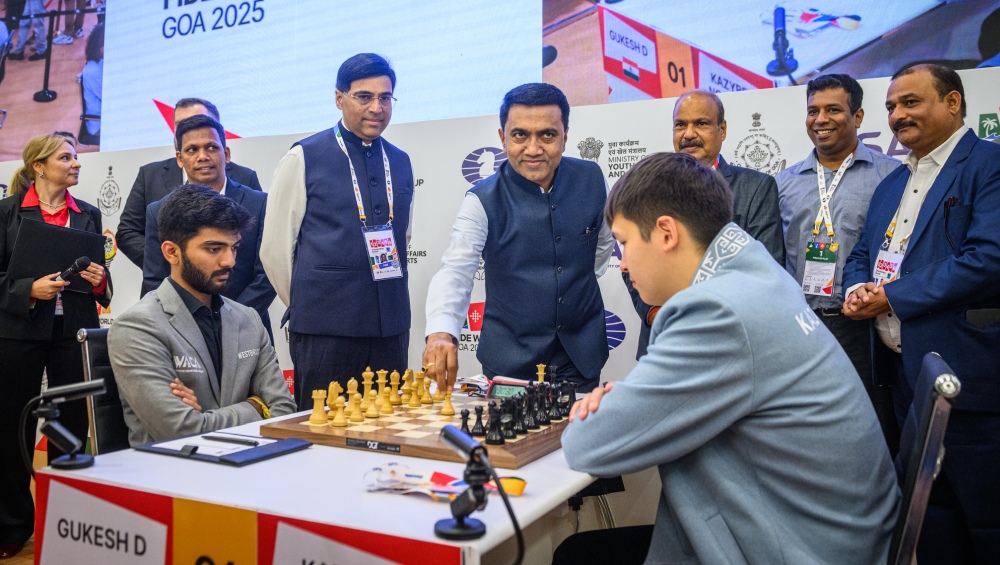
It was a huge day for Goa’s chess scene. The top fifty seeds, including World Champion Gukesh D, debuted this afternoon in the Baga Resort Rio playing hall, joining the seventy-eight qualifiers from the opening round. To honour the occasion, the state’s Chief Minister Dr. Pramod Sawant, accompanied by five-time former World Champion and FIDE Deputy President Vishy Anand, opened the round by performing the ceremonial first move on Gukesh’s board. Unfortunately for the number one seed, luck was not on his side this time. His opponent, GM Kazybek Nogerbek (2543) from Kazakhstan, held the draw with the Black pieces — not a result many can boast against the reigning World Champion. Before play began, both Anand and the Chief Minister attended a packed press conference. When asked for his top picks to win the event, Anand—as usual—was cautious, but he did point out that GM Levon Aronian “has already been enjoying Goa for the last week, so it’s quite clear that he is taking the event very seriously.” A fan’s perspective Before being a player or an announcer, I am, above all, a chess fan. One of the great perks of working as a FIDE press officer is the chance to walk around the playing area and watch, up close, the games of the best players in the world. Leaving aside Magnus Carlsen, Hikaru Nakamura, Fabiano Caruana, and Alireza Firouzja, who for one reason or another decided to skip the event, practically all the world’s top 100 are here. It’s a true who’s who of elite chess, and I don’t take for granted the privilege of being here to witness it all. Having covered chess for some time, there are only a handful of players I haven’t yet seen live. One of them is the American star Hans Moke Niemann — and he’s definitely taller than I imagined! It will be fascinating to see how he performs in his first World Cup appearance. Esipenko’s sparkling attack As expected at this level, most games ended in draws — I suspect many matches will go to tiebreaks. Still, a few players notched up early wins, mostly with the White pieces. The first decisive result came about two and a half hours into the session, when GM Andrey Esipenko (2693) defeated 2023 Baku World Cup semi-finalist GM Nijat Abasov (2587) in a dominant attacking display. Abasov had just played 17…Be7–d6, defending the pawn on e5. Esipenko thought for five minutes and unleashed a bolt from the blue: 18.Ba6!, threatening checkmate on b7. The bishop can’t be captured due to mate on a8, but Esipenko still had to calculate several defensive tries. Abasov responded with 18…c6, blocking the diagonal, but after 19.b5!, the attack became irresistible. The key variation: 19…bxa6 20.bxc6! Qc7 21.Qf5+ and White wins. In the game, 19…c5 20.b6! sealed Abasov’s fate, and he resigned a few moves later. Wei Yi strikes in style Among the later games, GM Wei Yi (2753)’s encounter with GM Kacper Piorun (2557) caught my attention. The Chinese prodigy—now a university graduate—has fully returned to professional chess, bringing back his trademark aggressive style. After 17…Bxe3, Piorun may have expected 18.Qxe3, aiming for simplification after 18…Qxe6 19.f4 Qb6! Instead, Wei Yi stunned with 18.Bf7+!! Kxf7 (18…Qxf7? 19.Qxe5+) 19.fxe3, pinning the queen and winning decisive material. In his postgame chat, Wei Yi said: “My opponent played the opening in a romantic style, like a puzzle. I haven’t been to India many times, but I really enjoy Goa. I think I prefer blitz and rapid formats, though—I spend too much time in classical games!” https://www.youtube.com/watch?v=TNc_7BhYfdQ Aronian’s beach vibes and brilliant finish A World Cup wouldn’t be complete without GM Levon Aronian (2728). A two-time champion—Khanty-Mansiysk 2005 (vs. Ponomariov) and Tbilisi 2017 (vs. Ding Liren)—Aronian is a master of knockout formats. In Goa, he started strongly, defeating Bengali IM Aronyal Ghosh (2520), in an attacking masterpiece that featured a sparkling piece sacrifice. Black had an extra piece but a shattered kingside and an out-of-play queen. Aronian’s finish was vintage brilliance: 25.Rg4+! Nxg4 26.Qxg4+ Kh8 27.Qd4+! f6 28.Qd2!, the key move, after which Black resigned. One pretty line runs: 28…Kh7 29.Re7+ Kg6 30.Qd3+ f5 31.Qxg3+ Kh5 32.Bd1 mate! Other highlights Other 2700+ favourites also began well, including Arjun Erigaisi (2773), Vincent Keymer (2755), Shakhriyar Mamedyarov (2742), Maxime Vachier-Lagrave (2737), Richard Rapport (2724), Javokhir Sindarov (2721), Vladimir Fedoseev (2720), and the newest member of the 2700+ club, Awonder Liang (2710). Liang’s opponent, Max Warmerdam, reached an equal position in a complicated Ruy Lopez battle but made the wrong choice at the critical moment. Black had to decide which pawn to take—f2 or b2? After the correct 37…Rxb2! 38.f6 Qxf6, White has to force a draw by perpetual check: 39.Rxf8+ Kxf8 40.Qc8+ Ke7 41.Qc7+ Ke6 42.Qc8+ Kd6 43.Qc6+. Instead, Warmerdam captured the “wrong” pawn with 37…Rxf2??, which failed to 38.f6! g6 (alas, 38…Qxf6 does not work anymore, as after 39.Rxf8+ Kxf8 40.Qc8+ Ke7 41.Qc5+, White wins the f2-rook) 39.Qg5!, threatening Qh6. Black had to give up the exchange with 39…Rxf3 and was checkmated on move 60. Among relatively surprising results include: Ivan Zemlyanskii (2596) defeated Ray Robson (2664). Georg Meier (2596) took down Volodar Murzin (2664), the reigning World Rapid Champion, with Black. But remember — it’s a two-game match, and anything can happen tomorrow. Finally, 12-year-old Argentine prodigy Faustino Oro continues to impress, holding elite Indian GM Vidit Santosh Gujrathi (2716) to a draw with Black from the position of strength. Looking ahead Round one of the Goa World Cup has set the stage for thrilling tiebreaks and surprises. With the stars in attendance, the beaches buzzing, and the boards on fire, the chess world will be watching Goa very closely in the coming days. Game 2 of Round 2 begins on November 5 at 3 PM local time. The action can be followed live on the FIDE YouTube Channel, featuring expert commentary by GMs Evgenij Miroshnichenko and Jan Gustafsson. To watch the games in person, tickets can be purchased [HERE] Official website: worldcup2025.fide.com/ Written by IM Michael Rahal Photos:
2025 3rd FIDE Council Meeting: List of decisions

3rd FIDE Council meeting October 28, 2025 Online List of decisions CM3-2025/01 To note President’s report. CM3-2025/02 To approve Treasurer’s report. CM3-2025/03 To support in principle the amendments to the art. 17.6. of the FIDE Charter. To ask the Constitutional Commission to draft the final version of the amendments including the transition period for implementation of the amendments. CM3-2025/04 To support in principle the amendments to the FIDE Electoral Rules. To ask the Constitutional Commission to draft final version of the amendments. CM3-2025/05 To note the Global Strategy Commission’s report. CM3-2025/06 To note the Arbiters’ Commission’s report. CM3-2025/07 To approve the recommendations of the Arbiters’ Commission on Seminars, Classification upgrades, Amendments to the lecturer list, FA norms and titles. CM3-2025/08 To note the Qualification Commission’s report. CM3-2025/09 To approve the recommendations of the Qualification Commission on titles. CM3-2025/10 To approve the Qualification Commission’s proposal regarding the Table of Direct Titles (relating to events for people with disabilities and clarifications on the names of school events). CM3-2025/11 To note the decision of the Qualification Commission regarding the Complaint Regarding Non-Rating of FIDE-Registered Tournaments Held in Bogotá, Colombia (2025). CM3-2025/12 To delegate to the President the right to confirm direct titles regarding the 23rd ASEAN Chess Championships taking into account the advisory opinion of the Qualification Commission. CM3-2025/13 To approve the recommendations of the Trainers’ Commission on titles and Academies. CM3-2025/14 To approve the recommendations of the Events Commission on titles. CM3-2025/15 To approve the recommendations of the Chess in Education Commission on titles. CM3-2025/16 To approve the recommendations of the Fair Play Commission on titles. CM3-2025/17 To approve the proposal of the Technical Commission. CM3-2025/18 To note the Commission’s for Women’s Chess report. CM3-2025/19 To note Continental Presidents’ reports. CM3-2025/20 To recommend the membership application of the Guinea Chess Federation for the approval by the FIDE General Assembly 2025. CM3-2025/21 To recommend the membership application of the Marshall Islands Chess Federation for the approval by the FIDE General Assembly 2025. CM3-2025/22 To recommend the membership application of the Kiribati Chess Federation for the approval by the FIDE General Assembly 2025. CM3-2025/23 To note the report of the Reverse Delegate for the Burkina Faso Chess Federation. CM3-2025/24 To recommend the FIDE General Assembly to expel the current Burkina Faso Chess Federation and to admit new membership application from the Burkina Faso Chess Federation. CM3-2025/25 To note the report of the Reverse Delegate for the USVI Chess Federation. CM3-2025/26 To recognise the recent elections held by the USVI Chess Federation. CM3-2025/27 To note the report of the Reverse Delegate for the Syria Chess Federation. CM3-2025/28 To approve the introduction of the FIDE annual awards. CM3-2025/29 To preliminarily approve the Agenda of the FIDE General Assembly 2025. 3rd FIDE Council meeting 2025 – List of decisions (PDF)