

FIDE World Rapid & Blitz Championships 2023 – Call for bids

1.1 The International Chess Federation (FIDE) will hold the World Rapid and Blitz Championships (R&B) and World Women’s Rapid and Blitz Championships (WR&B) in the second half of 2023 (see the Tournaments Regulations for World Rapid and Blitz Championship and World Women’s Rapid and Blitz Championship) 1.2 FIDE is opening a bidding procedure to invite any federation member of FIDE or any organiser approved by the national federation to host the event. The federation’s letter of support may be provided later when the bid’s evaluation procedure is launched. 1.3 The bid may contain special proposals on financial and commercial conditions. The FIDE Council shall decide whether these conditions are admissible. 1.4 The Bidding Form shall be filled in by an Applicant. A signed copy shall be submitted as e-mail messages to the FIDE Secretariat to office@fide.com from 10 May to 31 July 2022 by 23:59 Lausanne time (FIDE has a right to extend this deadline). All the documents shall be submitted in English. Additional documents may be requested by the FIDE General Strategy Commission (GSC) for further evaluation. 1.5 Bid Evaluation Report shall be presented by GSC for approval by FIDE Council. Priority shall be given to an Organiser applying for both events – R&B and WR&B. 1.6 Once the Organiser is granted the right to organise the event, a relevant announcement shall be made on the FIDE website. FIDE Technical Delegate (FIDE TD) may be appointed at the same time to supervise the event on behalf of FIDE in consultation with GSC.
FIDE Candidates 2022: tiebreaker playoff format

As per the decision made at the FIDE Council meeting on December 27, a playoff system has been introduced for the Candidates Tournament to be played in the case of a tie for first place. This decision has been taken after consultation with all the players who have already qualified for the competition. A majority of them favoured a play-off over the tie-break system used in previous editions. The play-off will be played no matter how many players tie for first. The system includes rapid and blitz games, in case only rapid is not enough. Here are the key points of a new play-off system: In case of a tie for first place in the Candidates Tournament, a play-off will be played that may consist of up to three stages. Stage I If there are two players tied for the first place they will play a match of two rapid games (15 min + 10 sec). In case of a 3-6-way tie, a round-robin rapid tournament will be played (15 min + 10 sec). Stage II (played in case of a tie after Stage I) If there are two players tied they will play a match of two blitz games (3 min + 2 sec). In case of a three-way tie (or more) a round-robin blitz tournament will be played (3 min + 2 sec). Stage III (played in case of a tie after Stage II) In case of a tie, depending on number of players, either knockout match or knockout tournament will be played. Each match consists of a single blitz game (3 min +2 sec). The colours are determined by drawing of lots. In case of a draw, another game will be played with the colours reversed. If there is another draw, the opponents will play until the decisive outcome. The Regulations for the event have been updated with the new rules and they can be found under paragraph 4.4.2. The Candidates Tournament 2022 will take place in Madrid, Spain, from June 16 to July 5.
2022 GCT Superbet Chess Classic Romania: Day 4 Recap
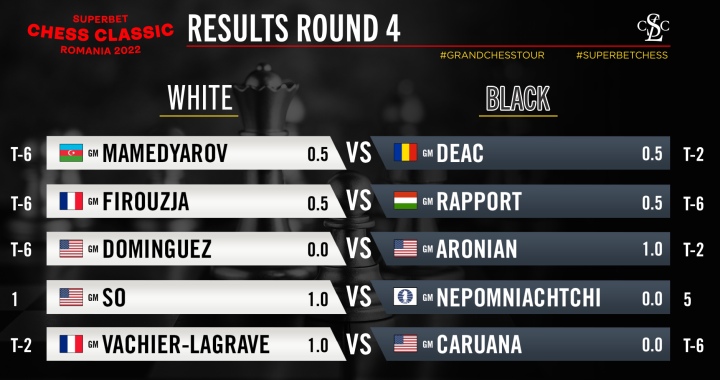
Day 4 of the Superbet Chess Classic Romania was projected to be another eventful day and it did not fail to disappoint. With three decisive outcomes, and quickly approaching the halfway point of the tournament we can only expect to see more thrilling games in future rounds. After an exciting game to take down one of his co-leaders, Grandmaster Wesley So has taken the sole lead with 3 points out of 4, distancing himself by half a point from his competitors sharing 2nd place. Shakhriyar Mamedyarov – Bogdan-Daniel Deac The game between GM’s Shakhriyar Mamedyarov and Bogdan-Daniel Deac was the first game of the round to finish. The players went for the Vienna Variation of QGD (Queen’s Gambit Declined), which is known to be a solid choice and has proven trustworthy at the highest level. Deac employed the variation with confidence and soon the players entered into theory known from correspondence chess. As per his post-game interview, Mamedyarov mentioned that he had forgot his preparation around move 17, but continued an attacking plan on the king side as the position required. It is hard to pinpoint where Mamedyarov went astray, but it never seemed that White had anything tangible, at least not according to the engines. Nevertheless, playing for a draw with accurate play toward the end while having White pieces might be somewhat disappointing for Mamedyarov. With this draw, Deac extends his great performance for another round. The local Romania hero, Bogdan-Daniel Deac is now tied for second with GMs Aronian and MVL. Ana-Maria Popescu (formerly known as Ana-Maria Brânză ), Romanian Olympic Fencing Champion, making the first symbolic move in the game between GM’s Shakhriyar Mamedyarov and Bogdan-Daniel Deac in Round 4 | Photo: Grand Chess Tour, Lennart Ootes Maxime Vachier-Lagrave – Fabiano Caruana The game between GM’s Maxime Vachier-Lagrave and Fabiano Caruana was off to an exciting start, with the two players blitzing through their moves in a trendy variation of the Open Spanish. It seemed that MVL was the one to be unprepared and may not have made the best choices in the middle game. Particularly the move 18.Ng3 seemed to give Black a good position, which might be the explanation behind Caruana’s unexpected and unnecessary sacrifice on move 20…Rxf3?, where he was left down a piece with unfounded compensation. Instead 20..b4 was pretty strong. After Caruana’s mistake, MVL stayed composed and accurately converted his extra piece to win the game and ultimately moved up in the standings to a tie for second place. Maxime Vachier-Lagrave and Fabiano Caruana – looking serious before their Round 4 | Photo: Grand Chess Tour, Lennart Ootes Wesley So – Ian Nepomniachtchi The game between the tournament co-leaders followed a typical trend of top-players’ games these days. In a forced line of the Open Catalan the players lashed out the first twenty some moves of theory after which an opposite-color endgame with an extra pawn for White ensued. Thanks to the queens on the board, it was White that had practical chances. Wesley So pursued those chances with patience and although Ian Nepomniachtchi defended valiantly until move 56, where two consecutive blunders cost him a second pawn and the game. With this win, GM Wesley So takes the sole lead in the event. GM Wesley So – in action – during his Round 4 game | Photo: Grand Chess Tour, Bryan Adams Leinier Dominguez – Levon Aronian The game between GM’s Leinier Dominguez and Levon Aronian was another excitng game of the day. In a balanced position in the Italian, Dominguez seemed to have squandered much of his time around move 20 and soon found himself in severe time pressure. Although his position was fine, it was not easy to make active enough moves under his time pressure. He slipped into a losing position, but made a brilliant comeback after surviving the time control finding a way to gain some compensation for his lost pawn. However, the blunder on move 44 left him no opportunity to hold the game. Although Dominguez never ceased to find good moves up to the final seconds on his clock, playing in time trouble certainly had a role in his demise of this game. Aronian went on to win this game with his flawless technique. The final moment and deep respect shown on the faces of both Grandmasters Leinier Dominguez and Levon Aronian in Round 4 | Photo: Grand Chess Tour, Lennart Ootes Alireza Firouzja – Richard Rapport The players repeated a line of the Four Knights Sicillian, which they had played against each other twice in 2021. This time Firouzja chose the mainline 6.Nxc6, after which the players followed one of the well-known theoretical paths. Rapport, who is an expert in this line, seemed in complete control throughout the game. He dodged all of White’s pragmatic problems iin a tacktical way and the game ended in peaceful draw after the time control. GMs Alireza Firouzja against Richard Rapport | Photo: Grand Chess Tour, Lennart Ootes The commentary team, Woman Grandmaster Anastasia Karlovich and Grandmaster Cristian Chirila together with the legendary 13th World Champion Garry Kasparov during his last day in Bucharest | Photo: Grand Chess Tour, Lennart Ootes The 2022 Superbet Chess Classic Round 5 continues tomorrow, Monday, May 9th at 6:50AM CDT with live coverage from Grandmasters Yasser Seirawan, Peter Svidler and Alejandro Ramirez in studio. Grandmaster Cristian Chirila with Woman Grandmaster Anastasia Karlovich on location. Watch all the action live on GrandChessTour.org Text: WGM Sabina Foisor Photo: Grand Chess Tour, Lennart Ootes and Bryan Adams Superbet Chess Classic Romania Sponsors Further Information: Web: GrandChessTour.org | Twitter: @GrandChessTourInstagram: @GrandChessTour | Facebook: @GrandChessTour Venue and dates: Sheraton Bucharest Hotel, Bucharest, Romania, May 5 – May 14, 2022 Press Contact:press@grandchesstour.org Livestream:GrandChessTour.org Photos:Courtesy of Grand Chess Tour and Spectrum StudiosCredits available on Flickr
2022 GCT Superbet Chess Classic Romania: Day 3 Recap
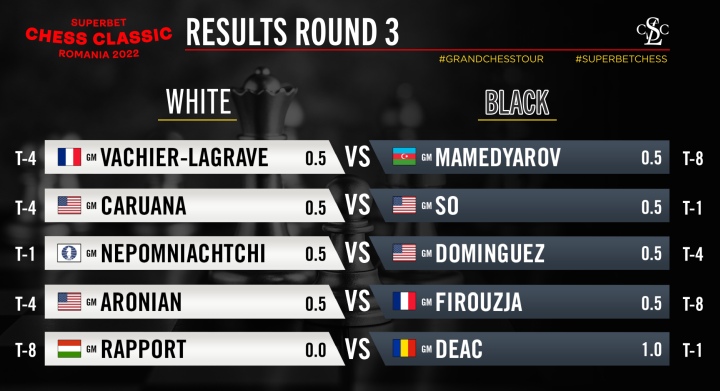
Day 3 of the Superbet Chess Classic in Bucharest did not fail to entertain the audience. It has been the most exciting day by far, but at the same time heartbreaking for some of the players, commentators, and fans. While we have been used to only seeing one decisive result per round, today could have been completely different. The most unexpected results of today happened in the game of Aronian -Firouzja, which could have finished in favor of the French-Iranian Grandmaster, instead it ended in a draw. The other unpredictable result happened in the game of Rapport – Deac, where the Hungarian GM blundered on move 40, allowing his opponent to avoid the repetition and win in the endgame. With today’s victory, Bogdan-Daniel Deac has joined Ian Nepomniachtchi and Wesley So as the co-leaders of the Superbet Chess Classic Romania. Maxime Vachier-Lagrave – Shakhriyar Mamedyarov This game was first to finish. Shakhriyar played the Caro-Kann Defense, which is one of his two main responses against 1.e4, and was met with the Two Knights Attack by the Frenchman. White did not achieve anything out of the opening and Mamedyarov forced a draw by repetition as early as on move 20. Daniel Jinca, the Director of Romanian Opera greeting GMs Shakhriyar Mamedyarov and Maxime Vachier – Lagrave right before making the symbolic first move of their Round 3 | Photo: Grand Chess Tour, Lennart Ootes Ian Nepomniachtchi – Leinier Dominguez This game kept the commentators intrigued as the players blitzed through their first 22 moves of theory in the Petroff and the game seemed very even throughout despite White’s extra pawn. Leinier Dominguez, however, was taken aback by 22.a4 followed by Qg4 by Nepomniachtchi. Considering that Ian finished the game with more time on his clock than the time he started with, we can only assume this line was part of his preparation in his World Championship Match against Magnus Carlsen. Nevertheless, despite choosing a hard path, it was safe enough for Dominguez to ensure a draw in a rook ending with a pawn down. Ian Nepomniachtchi looking calm cruising through his opening preparation in Round 3 | Photo: Grand Chess Tour, Lennart Ootes Fabiano Caruana – Wesley So The game between the two American Grandmasters followed a very well-known line in the Catalan where GM Fabiano Caruana went for a thematic pawn sacrifice. Along the way, he traded too many pieces and despite landing a passed pawn on d6, it was more of a weakness than a strength. White’s pieces were more tied down to defend the pawn rather than the d6-pawn tying up Black’s pieces. In fact, Black seemed to be the one pressing, but the decisive blow never seemed to come. As soon as Caruana managed to control Black’s majority on the queenside, the players decided to call it a day and agreed on a draw by repetition. GM Fabiano Caruana – thoughtful during his game from Round 3 against compatriot GM Wesley So | Photo: Grand Chess Tour, Lennart Ootes Levon Aronian – Alireza Firouzja After a day off at the office, Alireza Firoujza started the game energetically, surprising his opponent with the Czech Variation of the Slav Defense. Levon Aronian did not seem comfortable with his position, stumbling after forgetting to play 19.Nc3 instead of his 19.Ke2?. Firouzja showed praise-worthy technique, and by move 37 had a completely winning Bishop vs Knight endgame with an extra pawn. By move 41, Aronian had an extra pawn, but Firouzja’s pawns were close to promotion and all he needed to do was to bring his king to support them. Alas, that did not happen in time as 41…c5?? threw away the win allowing Aronian the life saving continuation 42.Nc3! In the ensuing queen and pawn ending, Firouzja’s king couldn’t find a shelter to hide and the game ended in a draw shortly after. Levon Aronian maybe predicting the calm before the storm at the beginning of his Round 3 against Alireza Firouzja | Photo: Grand Chess Tour, Lennart Ootes Richard Rapport- Bogdan-Daniel Deac This game was a true heartbreaker for the Candidate 2022 participant Richard Rapport. The Hungarian exerted a lot of pressure on the host country’s #1 player, Bogdan-Daniel Deac. Known for his flamboyant style, Richard made a number of creative moves to grab the initiaitve. After Deac faltered with 21….Qh6?, it looked as if Rapport was going to win this game in style. However, to the Romanian Grandmaster’s credit, he started showing a great deal of resistance in a close to losing position. While being in tremendous time-trouble, Deac found some resourceful, creative and pragmatic counter-play ideas. That led to Rapport blundering away his advantage just a couple of moves after he had obtained it. After a few inaccuracies made by Deac in time pressure, it seemed that a draw by repetition would be the most probable outcome. Yet, the end was tragic for Rapport as he blundered 40. Ng5??, which led to an endgame down an exchange. Deac slowly converted his advantage into a win and now the local hero is now tied for first place! A happy GM Bogdan-Daniel Deac during his post win interview | Photo: Grand Chess Tour, Lennart Ootes The 2022 Superbet Chess Classic Round 4 continues tomorrow, Sunday, May 8th at 6:50AM CDT with live coverage from Grandmasters Yasser Seirawan, Peter Svidler and Alejandro Ramirez in studio. Grandmaster Cristian Chirila with Woman Grandmaster Anastasia Karlovich on location. Watch all the action live on GrandChessTour.org Text: WGM Sabina Foisor Photo: Grand Chess Tour, Lennart Ootes Superbet Chess Classic Romania Sponsors Further Information: Web: GrandChessTour.org | Twitter: @GrandChessTourInstagram: @GrandChessTour | Facebook: @GrandChessTour Venue and dates: Sheraton Bucharest Hotel, Bucharest, Romania, May 5 – May 14, 2022 Press Contact:press@grandchesstour.org Livestream:GrandChessTour.org Photos:Courtesy of Grand Chess Tour and Spectrum StudiosCredits available on Flickr.
Yuri Averbakh (1922-2022)
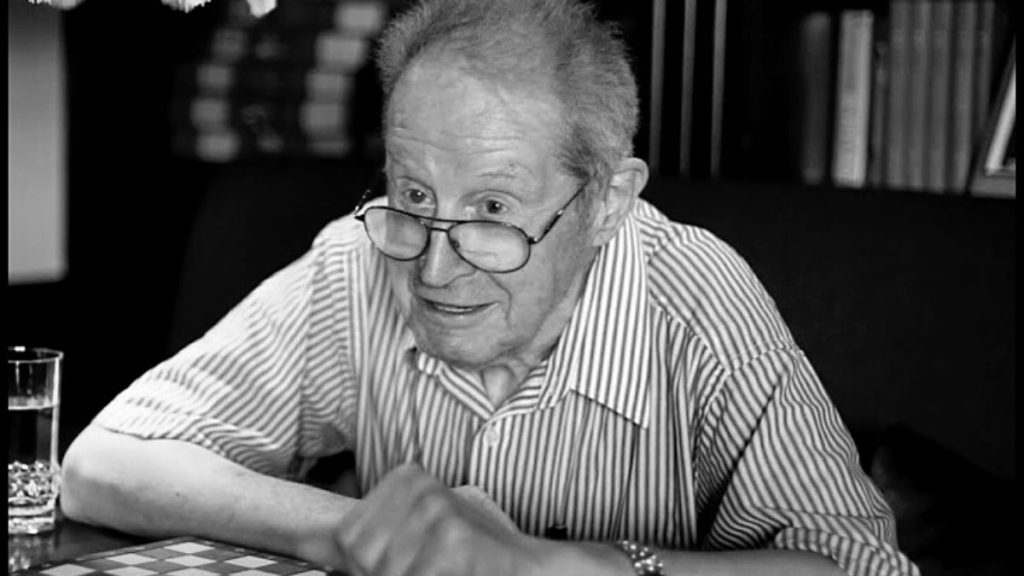
The legendary Grandmaster Yuri Averbakh, who had celebrated his centenary in February, passed away in Moscow. Averbakh started to play chess at the age of seven, but it was just one more hobby for him during his first years, and he didn’t really take it seriously, with volleyball being his main interest. Then, in February 1935, he had the chance to meet the famous chess composer Nikolai Grigoriev, at a time when Moscow was hosting its second international chess tournament, with Capablanca, Lasker, Botvinnik, and many others. “Grigoriev gave a lecture in the club, showing some of his famous pawn studies. They made an enormous impression on me, and that was the first time I sensed that chess wasn’t simply a game but was something more, that it was an art. And I also had the urge to master that field. That’s how I got involved in chess.” Finally hooked on chess at the age of 13, his first great success came three years later when he won the Soviet Union’s championship for schoolchildren. However, his incipient career would come to a halt, along with most chess organized activity, due to the World War II. He was evacuated with all his school from Moscow to Izhevsk, barely avoided being recruited himself when he reached the required age, and he would only return to Moscow in 1943. Yuri Averbakh at the tournament in Ivanovo (1944) It was then that his career took off, gaining in strength until he won the Moscow Championship of 1949, ahead of a strong field that included Andor Lilienthal and Vladimir Simagin, among many others. This was his first major success and the beginning of a decade in which he became one of the top players in the world, probably one of the top-10 at his peak. He won the Moscow Championship again the next year, and in 1952 he earned the Grandmaster title – a title he has borne for almost 70 years! Averbakh finished 5th at the Stockholm Interzonal Tournament in 1952, qualifying for the legendary Zurich 1953 Candidates Tournament, where he finished in 10th place. The next year, in 1954, he became champion of the USSR, and in 1956 he was very close to repeating this feat, sharing 1st-3rd places with Taimanov and Spassky, and ending up in second place after a tie-break stage. In his collection of selected games, published by Cadogan, Averbakh says that he learned chess “the wrong way round”, becoming a strategist before he learned properly about tactics and combinations. A very solid player, pure attack players would often feel uncomfortable when playing against him: Rashid Nezhmetdinov, for instance, was only able to get one draw in the nine games they played. Photo: ERIC KOCH @ANEFO Averbakh reduced his competitive activities when he reached his forties, leaving behind numerous victories in international events all over the world, like Jakarta, Rio de Janeiro, Adelaide, and Vienna. His latest international success was the Rubinstein Memorial held in Polanica-Zdroj in 1975. He shifted then his interest from playing the game to studying the game. And in that, he was as successful, or even more, as he was as a player. “My investigative character forced me to make a serious study of the endgame, that phase of the game where individual pieces battle against each other. Initially, I published several articles and then thought about a book devoted to various types of endings.” His endeavour turned into a monumental work, the first systematic study of the endgame in history, published in five volumes. “So many generations grew up with Averbach that we stopped feeling the importance of what he did for chess,” said Emil Sutovsky, FIDE’s Director General. “Averbakhs’s Five Books have been studied by chess players of all levels for decades. And the wonderful book “Journey to the Chess Kingdom” co-authored by Michael Beilin has been read by hundreds of thousands of children, including many future strongest players in the world.” Tall and athletic, Averbakh was physically gifted from his youth, and he cultivated his body as much as his mind. Volleyball was the first sports activity he took up seriously, taking advantage of his height. He also loved hockey and skiing – two national passions in Russia. Not so well known is the fact that, for a short period, he was also a regular at the boxing ring. “In our yard, there was a club which was turned into a dormitory for workers. It was a real rabble, where a cult of strength reigned. Therefore, if you wanted to be equal in the yard, you had to be able to give as good as you got. That’s why I took up boxing for a year,” Averbakh said in an interview with Vladimir Barsky and Eteri Kublashvili on the occasion of his 90th birthday. He was already a middle-aged man when he took swimming as a way to stay in shape. “I swam until very recently, having gone to the swimming pool from 1964 to 1996”. He would swim almost daily when he was already in his seventies and continued to do so until the doctors, worried about his pacemaker, told him to stop when he was already in his late eighties. “A healthy lifestyle with plenty of physical exercises is very important.” Photo: Boris Dolmatovsky While all this explains his longevity, it is very likely that keeping mentally active also played a huge role. He was one of those people who basically never retired and kept working as much as his health allowed. As late as 2016, he would still visit the Central Chess Club at Gogolevsky boulevard every Wednesday to meet with young talents and offer them advice. Averbakh was very fond of working with young people, but he also kept in mind the seniors and, with that intention, he found a chess centre in a library. “We were looking to attract older people to the game,” he explained in an interview with Dagobert Kohlmeyer. “They should not play in tough tournaments but rather spend their
#43
Asian Federations welcome the PDC in Bangkok Quick thinking kids crowned in Rhodes Susan Namangale: “I want to be a part of the change” On chess books Brief news from National Federations READ NEWSLETTER
2022 GCT Superbet Chess Classic Romania: Day 2 Recap

Round 2 started in an interesting fashion with a surprising opening choice by GM Maxime Vachier-Lagrave (MVL) who chose the QGA (Queen’s Gambit Accepted) against GM Wesley So. Although four of the five games ended in a draw, Mamedyarov – Rapport and Firouzja – Nepomniachtchi were fiery dynamic encounters that did not disappoint the fans or commentators. The day ended with a win for GM Ian Nepomniachtchi prevailed over the talented GM Alireza Fiouzja in topsy-turvy game. The audience also had the chance to see an interview with a legendary World Champion, Garry Kasparov, who was delighted with the organization and the progress of the Superbet Chess Classic Romania thus far. With today’s win, Ian Nepomniachtchi joins Wesley So as a co-leader of the Superbet Chess Classic Romania after the conclusion of Round 2. Wesley So – Maxime Vachier-Lagrave The only winner of Round 1, Wesley So, was up for the task of making the most out of his second White in a row. However, the opening might have caught him by surprise when he faced MVL’s QGA (Queen’s Gambit Accepted), something that is not considered in the French Grandmaster’s regular repertoire (being famous for the Gruenfeld Defense). The players went down a well-known theoretical labyrinth where they both seemed familiar with the best strategic plans. Wesley So may have had the chance to push further with 24.Qf4 instead of his choice 24.Qf3. Whether it was a sufficient advantage to carry on playing or not would require a deeper analysis, but it seemed that both players didn’t think it was enough to continue pushing for more. As a draw was the most likely outcome of that position, a repetition ensued and this was the first game to finish for the day. A happy GM Maxime at the interview after drawing Round 2| Photo: Grand Chess Tour, Lennart Ootes Shakhriyar Mamedyarov – Richard Rapport Mamedyarov essayed 1.e4, which came as a surprise for Rapport because Mamedyarov is almost exclusively a 1.d4 player. The game shortly was transposed to the French Defence, one of Rapport’s pet-lines. Rapport’s choice was risky and White soon gained the initiative. Although the position suited Mamedyarov’s style, and several possibilities were present for him, the position was difficult to assess and unexpected defensive ideas were found by one of the most creative top players – Richard Rapport. After a long series of accurate dynamic moves, the game ended in the most exciting draw of the day shortly before the players reached the time control. Shakhriyar Mamedyarov looking sharp at the start of Round 2 | Photo: Grand Chess Tour, Lennart Ootes Bogdan-Daniel Deac – Levon Aronian The game between Deac and Aronian also started with a QGA (Queen’s Gambit Accepted), which Aronian suggested in the post game interview, that has gained popularity in recent years thanks to Fabiano Caruana. For a short period of time it seemed that Deac could reach a promising position should he have tried 16.f5. Instead, he chose a passive approach which allowed Aronian to gradually outplay his opponent. Around move 34, it seemed that Aronian was pressing in a rooks and bishop versus rooks and knight endgame, but he opted not to trade off a pair of rooks with 34…Rxd1 followed by Rb2 and maintaining the pressure, and the position simplified quickly into a draw . GM Bogdan-Daniel Deac looking happy after the symbolic move was made in his game by Former Professional Boxer Mihai Leu also known as Michael Loewe | Photo: Grand Chess Tour, Lennart Ootes Leinier Dominguez – Fabiano Caruana The two Americans started with a Four Knights Sicilian, which transposed into a Lasker-Pelikan Sveshnikov Variation. Dominguez’ response was solid, but it never caused any hardship to Black’s position. Caruana defended accurately and the game ended in a draw by repetition on move 47. Fabiano Caruana looking calm after surprising his opponent in the Sveshnikov in Round 2 | Photo: Grand Chess Tour, Bryan Adams Alireza Firouzja – Ian Nepomchtchi The game between Firouzja and Nepomniachtchi has been by far the most exciting game of this event so far. Firouzja began the game ambitiously and chose 2.Bc4 to avoid Nepo’s Petroff, and as GM Yesser Seirawan suggested in the live commentary, Alireza seemed to have played the game as if “he had to win at all cost”, which is of course no wonder given the psychological battle that the two players will soon face in the upcoming Candidates Tournament. The players knew their lines and blitzed through their moves up to move 16, where Firouzja refrained from Ne3, choosing 16.h3 instead. The move did give Black some edge; yet, the position was complex and the advantage slipped through each player’s hands a number of times until nearing the time control, Ian reinforced his initiative and by move 40 he was completely winning. Nepo seemed to have given up part of his advantage by choosing to take the exchange on e1, with 42…Nxe1 , instead of taking his time with 42…Qxh3. Firouzja may have had the chance to hold on to the position, but he missed it and Nepomniachtchi ended up scoring an important victory for the day. Ian Nepomniachtchi during post win interview | Photo: Grand Chess Tour, Lennart Ootes The 2022 Superbet Chess Classic Round 3 continues tomorrow, Saturday, May 7th at 6:50AM CDT with live coverage from Grandmasters Yasser Seirawan, Peter Svidler and Alejandro Ramirez in studio. Grandmaster Cristian Chirila with Woman Grandmaster Anastasia Karlovich on location. Watch all the action live on GrandChessTour.org Text: WGM Sabina Foisor Photo: Grand Chess Tour, Lennart Ootes and Bryan Adams Superbet Chess Classic Romania Sponsors Further Information: Web: GrandChessTour.org | Twitter: @GrandChessTourInstagram: @GrandChessTour | Facebook: @GrandChessTour Venue and dates: Sheraton Bucharest Hotel, Bucharest, Romania, May 5 – May 14, 2022 Press Contact:press@grandchesstour.org Livestream:GrandChessTour.org Photos:Courtesy of Grand Chess Tour and Spectrum StudiosCredits available on Flickr.
Sergey Karjakin’s appeal dismissed
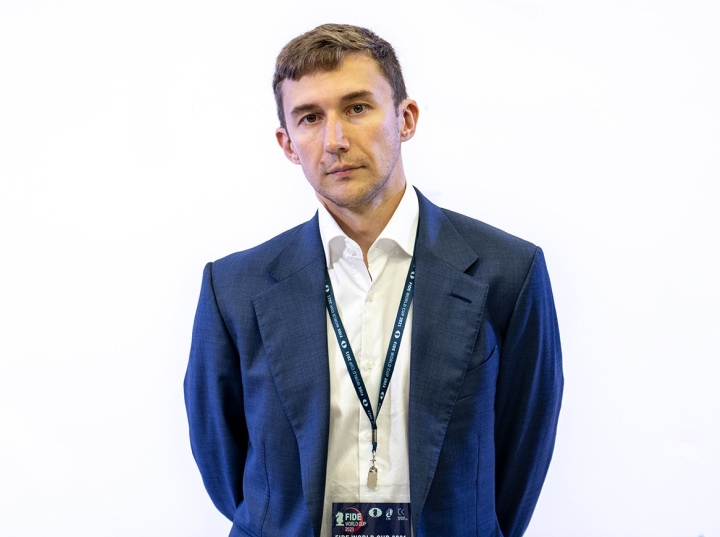
Today, May 6th 2022, the Appeal Chamber of the FIDE Ethics and Disciplinary Commission (EDC) has announced its decision to dismiss the appeal presented by Grandmaster Sergey Karjakin. The dismissal of this appeal confirms the 6-month ban that was imposed by the EDC on March 21st, 2022, after the player was found guilty of breach of article 2.2.10. In accordance with the FIDE Charter and the FIDE Ethics & Disciplinary Code, this decision is appealable to the Court of Arbitration for Sport (CAS) within twenty-one (21) calendar days following communication of this decision. This decision shall remain in effect while under appeal unless the CAS directs otherwise. The player has already been informed of this decision. The Ethics and Disciplinary Commission was formed by its Chairperson Mr Francois Strydom, and members Mr Khaled Arfa and Mr David Hater.
2022 GCT Superbet Chess Classic Romania: Day 1 Recap

The Grand Chess Tour kicked off with its first event of the tour – the 2022 Superbet Chess Classic – a 10-player classical round-robin event taking place in Bucharest, Romania. While most fans and the commentators were keeping their eyes on the game between GM Caruana (World Number 4) – GM Firouzja (World Number 3), it was GM Wesley So who became the early leader of the event after beating GM Shakhriyar Mamedyarov, the 2021 Superbet Chess Classic Romania defending champion The rest of the games of the day were drawn. The time control for the event is 90/40, SD 30, with a 30-second increment for both sides starting from move one. 13th World Champion Garry Kasparov makes the first move in the game Caruana – Firouzja | Photo: Grand Chess Tour, Lennart Ootes Fabiano Caruana- Alireza Firouzja The first game to finish was coincidentally the game that chess fans were looking forward to the most. The two chess giants qualified for the candidates via the Grand Swiss last November, in which GM Firouzja was the winner. Many were wondering what Alireza had been up to given his chess hiatus from over-the-board events, but he jokingly responded in his interview that mostly “living the life and preparing for the Candidates.” Caruana seems to have surprised Firouzja on move one with 1. c4 to which he responded with the solid 1..e6. Soon there was a transposition QGD leading to a Carlsbad pawn structure. In the ensuing middlegame, it seemed that Caruana had the upper hand for a while, but he decided not to play f4 (around move 17 or 19) leading to a calm position. After a series of relatively accurate strategic maneuvers the players did not seem to find a way to improve their position, so they agreed to a draw by repetition on move 29. Fabiano Caruana deep in thought | Photo: Grand Chess Tour, Lennart Ootes Ian Nepomniachtchi – Bogdan-Daniel Deac In a topical Petroff Defense line, GM Nepomniachtchi, (“Nepo”) was on the White side of an opening he employed in his 2021 World Championship match against Magnus Carlsen. Ian deviated from the more common 9. 0-0 in favor of 9. Qh5. GM Deac responded swiftly with 9..g6 and after dismissing White’s queen, he essayed a novelty with 11…Qe7 instead of 11…Be7, intending to trade off queens on c5. While both players were making their moves relatively fast, nudging the idea of still being in well-known theoretical territories, Deac was the first to make things complicated for himself by playing 17…c5, which allowed White a slightly better endgame after Bd2. However, Nepo responded with the risky 18.h5, after which 18…c4 would have given Black excellent chances to even fight for an advantage. Instead, Deac played the safe 18….Qd4 after which the game simplified to a position where most of White’s advantage was symbolic. The game ended in a draw by repetition. A very focused Ian Nepomniachtchi | Photo: Grand Chess Tour, Lennart Ootes Maxime Vachier-Lagrave – Leinier Dominguez This game saw two great theoreticians following another topical line in the Petroff Defense, which was popularized by the Carlsen-Caruana World Championship Match in 2018. Soon the queens were traded off the board and a symmetrical pawn structure emerged. Maxime managed to trade one his knights for Black’s light-square Bishop, but Dominguez’ position was too solid and after a few exchanges the game ended in a draw by repetition in on move 36. Focus-mode on for Maxime Vachier-Lagrave | Photo: Grand Chess Tour, Lennart Ootes Levon Aronian – Richard Rapport This game was not without surprises and in the style of both GM Aronian and GM Rapport. Although they both followed their main repertoire: Aronian was back to 1.d4 after some recent games with 1.e4, while Rapport responded with his solid Slav. Rapport chose a dxc4 system in and recaptured on d7 with his Bishop on move 10, which seems to be a new fashionable trend. Modern engines seem to believe Black is fine after some more in depth analysis despite showing some advantage for White. Aronian simply developed his pieces and prepared to take advantage of his extra space in the center, while Rapport did the same and followed the only active response with Be8 and f5 after which his bishop comfortably landed on g6. Aronian did not manage to make a dent in Black’s position and the engines even claimed advantage for Rapport had the Hungarian played 19…h6 (although it is not clear what should Black’s plan should be). After some more moves, the game fizzled out into a drawn position. Levon Aronian, looking calm at the office in Round 1 | Photo: Grand Chess Tour, Lennart Ootes Wesley So- Shakhriyar Mamedyarov Last year, in the 2021 edition of the Superbet Chess Classic Romania, the two players faced one another in the first round as well, just then, it was Mamedyarov who had the White pieces and the game ended in a draw. This year, this was the only decisive outcome of the day and it also turned out to be the longest game. Wesley So chose an ambitious set up against Mamedyarov’s Nimzo-Indian and soon achieved a position with the bishop pair. Later on, he traded his advantage leading to one with opposite-color bishops, where his dark-square bishop was superior to Black’s light-square bishop. Although the engines may show several inaccuracies on account of both players, it was So who maintained his advantage all the way to the endgame. At some point, it seemed that Mamedyarov had managed to build a fortress, but after defending for hours, he blundered a pawn push and then grabbed White’s b-pawn with 52…Qxb5?? allowing White’s queen to infiltrate on e6 and following an inevitable mate. He resigned before Wesley was able to make his winning move. Wesley So was the only one to score a full point in Round 1 | Photo: Grand Chess Tour, Lennart Ootes The coverage of the 2022 Superbet Chess Classic continues tomorrow, May 6, at 6:50
Panamanian championship: Sanchez Alvarez and Vasquez Jaen win titles

The Panamanian championship (open and women’s sections) took place from April 27 to May 5 in the Creole Chess Club, Panama. Both tournaments were 10-player round-robins with classical time control. Despite suffering an unexpected defeat at the hands of Andre Mendez in Round 4, the rating favourite, IM Roberto Carlos Sanchez Alvarez, scored an impressive 7/9 and clinched his third straight national title. Three players tied for second place, netting 6/9 each, with Slim Roses Alex Antonio and Efren Andres Ramos Espinoza claiming silver and bronze, respectively, based on the results of the direct encounters. The women’s event was a much closer contest with several players rated 1600+ vying for the top position. Lourdes Lorena Vasquez Jaen emerged victorious, finishing a half-point ahead of three players sharing the second place. Sonneborn-Berger-Tie-Break variable favoured Yolys Desiree Rondon Chancon and Ashley Alexandra Castillo Beitia, taking silver and bronze, respectively. Unlike the champion, both completed the event unbeaten. Interestingly enough, the three titled players taking part in the women’s tournament did not make it to the podium. Final standings Open: 1 Sanchez Alvarez, Roberto Carlos 2441 7 2 Alex Antonio, Slim Roses 2143 6 3 Ramos Espinoza, Efren Andres 2136 6 4 Leon Archibaldo, Orlando Andres 2195 6 5 Tapia Ostolaza, Alexei 2227 5½ 6 Sanchez Manzanares, Jorge Luis 2078 5 7 Neira Rodriguez, Carlos Fernando 2015 4 8 Andre, Mendez 1943 3½ 9 Riquelme, Eduard 1873 1 10 Jimenez Pedro 1813 1 Finals standings Women: 1 Vasquez Jaen, Lourdes Lorena 1613 7 2 Rondon Chacon, Yolys Desiree 1699 6½ 3 Castillo Beitia, Ashley Alexandra 1608 6½ 4 Chung Hurtado, Yaleika 1698 6½ 5 Gonzalez Ramirez, Yaribeth 1643 6 6 Munoz Henriquez, Alba Esther 1602 4 7 Lobo Jimenez, Mariana Esther 1381 3½ 8 Navarro Valdes, Mariana Del Carmen 1276 2½ 9 Chavarria Troy, Keytleen Denis 1427 2 10 Arosemena Castillero, Betty 1472 0½