

FIDE Grand Prix Berlin: Semifinals go to tiebreaks
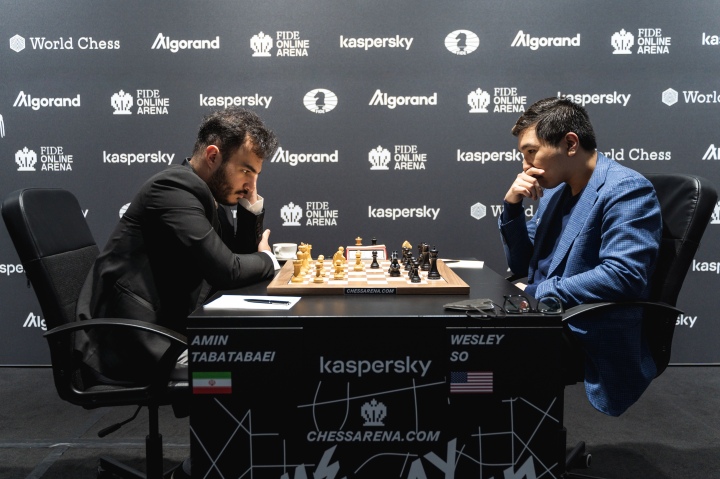
In the second round of the semifinals of the third stage of the FIDE Grand Prix in Berlin organised by World Chess, Shakhriyar Mamedyarov and Hikaru Nakamura made a second draw and will continue fighting for a spot in the final on the tiebreak tomorrow. After a huge blunder by Wesley So, Amin Tabatabaei bounced back in the second game of the semifinal and took their match to the tiebreaker. With today’s half-point, Hikaru Nakamura has secured his overall victory in the 2022 FIDE Grand Prix Series. Even if he loses the tiebreak tomorrow, he still edges out Richard Rapport in the total number of points scored in classical games. Both matches will be decided on the tiebreaks tomorrow, with Hikaru Nakamura and Amin Tabatabaei starting their matches with white pieces. On the 1st of April, we will know the names of the finalists. Amin Tabatabaei tried to surprise Welsey So in the opening, and after an interesting move order, the Romanishin Variation in Nimzo-Indian Defense appeared on the board. Wesley, playing with Black, managed to exchange his side-pawn b5 for the central pawn on d5 and not only solved his opening problems but got a quite comfortable position. The critical moment of the game came on move 23. After spending only one minute on his clock, the American suddenly went for a piece sacrifice and completely missed a very strong reply 24.Rd1-d3! which effectively parried all Black’s threats and created his own ones. Amin Tabatabaei – Welsey So The key variation in the position is 24…Nf3 25.Rxf3 Bxf3 26.Qc3 with a double attack. “That’s basically a one-move blunder from Wesley So, which is very uncharacteristic of him,” said the commentator of the tournament GM Evgeny Miroshnichenko. “What happened was just crazy. I played 23.Rd1 and I completely blundered 23…Nh4 – I thought everything falls apart. And after 24.Rd3 it is so strange that White is completely winning,” shared Amin Tabatabaei after the game. “I was incredibly lucky at that moment.” “My opponent is a great player, fighting, very aggressive, very tactical. And yeah, I just blundered Rd3 – that’s all I can say about the game. Blunders happen,” said Wesley So. The game went into an ending with an extra pawn and the bishop pair advantage for White. Wesley decided not to check Amin’s technique and resigned on move 30. Shakhriyar Mamedyarov was quite satisfied with his position in one of the Queen’s Gambit Declined variations with 5. Bf4. By advancing his pawns on the queenside, White created certain threats, but Hikaru Nakamura found an interesting way to regroup his pieces and took control over the c-file. After White’s 25.a4, Hikaru probably could have put more pressure on his opponent by keeping the pawns on a-file on the board but went for a forced line, leading to massive exchanges. None of the opponents had real chances in the drawish ending, but they kept playing until the peace was finally signed on move 51. The FIDE Grand Prix Series is brought to you by World Chess. Leading partners supporting the FIDE Grand Prix Series 2022 include: Kaspersky as the Official Cybersecurity Partner; Algorand as the Official Blockchain Partner; Prytek as the Technology Transfer Partner; FIDE Online Arena as the official Partner. Photo: Official Photo FIDE Grand Prix Berlin Press kit and Niki Riga
FIDE Grand Prix Berlin Semis: Round 1 Recap
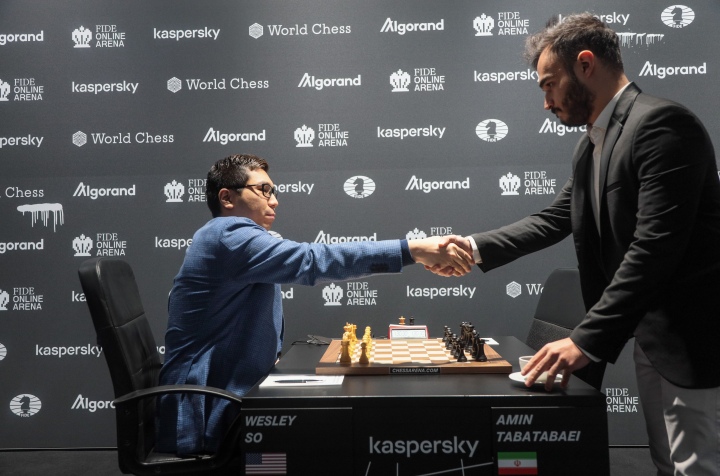
Wesley So takes the lead in the match against Amin Tabatabaei, while Hikaru Nakamura and Shakhriyar Mamedyarov drew their game. In the first round of the semifinals of the third stage of the FIDE Grand Prix in Berlin organised by World Chess, Wesley So managed to convert his advantage into a full point against Amin Tabatabaei. Hikaru Nakamura and Shakhriyar Mamedyarov played an uneventful game that finished in a draw. On Thursday, March 31, Amin Tabatabaei will play with white pieces needing to level the score in the mini-match to go to tiebreaks. Hikaru Nakamura has Black in the second game against Shakhriyar Mamedyarov. Hikaru decided to play one of the calmest systems in Petroff Defense with an early queen exchange, which is considered to be unambitious for White. In a post-game interview, Hikaru explained why he didn’t have an intention to go fpr the main lines today: “It’s quite nice to qualify but also very tricky because, for the last 24-48 hours, my thoughts are on that event and preparation. And then in today’s game, it’s an opening that many people at the Candidates might play, so I did not want to do anything too exciting.” With the queens leaving the board very early, Shakhriyar Mamedyarov had no problems keeping the balance in a symmetrical position. After massive exchanges, the game liquidated into the ending with rooks and opposite-coloured bishops and finished in a draw once the players reached the 30th move. “It was one of this Grandmaster’s draws”, said Shakhriyar, smiling. He congratulated Hikaru on qualifying for the Candidates tournament and added: “For chess, it is very important that players like Hikaru are in the Candidates. He is very popular, famous online and in the chess world in general.” It seems Hikaru Nakamura doesn’t spend any day without chess! He won the Titled Tuesday tournament yesterday on his free day and was in a hurry to get back to his hotel to participate in the Arena Kings after today’s round. Wesley So and Amin Tabatabaei went for a very complicated line in the Queen’s Gambit Declined. After blitzing out 18 moves, Wesley So spent lots of time figuring out the right plan. The line was new for him, and he was not really happy with what he got out of the opening. Both players came to the conclusion that Amin should have placed the knight on c4 right away no matter what, but the Iranian player hesitated and played Rf7 instead. After trading the knights on a4, Black was left with a passive knight on f6 versus White’s strong bishop. After losing the b7 pawn, Black found himself in a tough, most likely lost position, but Wesley wisely took his time making the precise moves and not giving his opponent any chances. Remembering the miraculous escape of Amin in the game against Yu Yangyi, the American made sure no perpetual checks would be on the board today. Amin Tabatabaei: “It’s great to play against such strong opponents. I am getting more and more experienced. If somebody can punish me in these positions, it’s top players like Wesley. I am a bit disappointed how the game went, but I need these losses to be a better player.” The semifinals continue on March 31 with the pairings as follows: Shakhriyar Mamedyarov – Hikaru NakamuraAmin Tabatabaei – Wesley So The FIDE Grand Prix Series is brought to you by World Chess. Leading partners supporting the FIDE Grand Prix Series 2022 include: Kaspersky as the Official Cybersecurity Partner; Algorand as the Official Blockchain Partner; Prytek as the Technology Transfer Partner; FIDE Online Arena as the official Partner. Photo: Official Photo FIDE Grand Prix Berlin Press kit and Niki Riga
FIDE Podcast: A new episode featuring Hou Yifan released
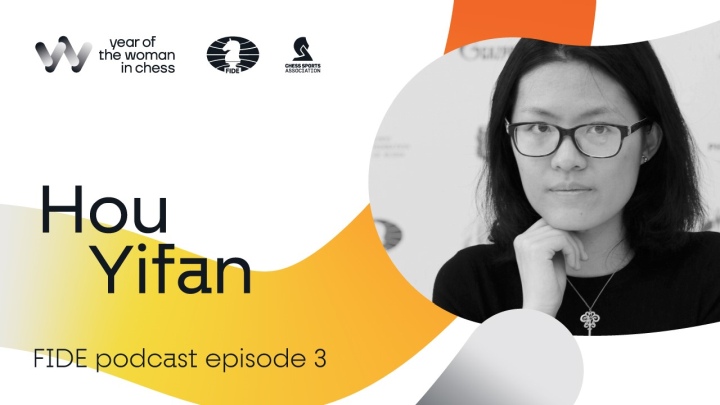
The third episode of the FIDE Podcast, the initiative born under the umbrella of the Year of the Woman in Chess, as cooperation between FIDE’s Commission for Women’s Chess, Michael Busse of Schachgeflüster podcast and Lilli Hahn of Chess Sports Association, has been released. The podcast’s monthly episodes feature a series of interviews with remarkable women in the chess world. The guest of Episode 3 is Hou Yifan, Chinese chess grandmaster, four-time Women’s World Chess Champion and the second highest-rated female player of all time. In the interview, she talks about her major chess achievements, her current work as a professor at Shenzhen University, the changes in the women’s world championship cycle, ways to improve women’s chess and many other things. Although Hou would have risen higher if she’d made chess her singular focus, she confesses that her life is not only about chess. “I agree that if I put more effort into chess, I would be stronger. Maybe one day I would break 2700, or even I could be top 50 or top even 40, 30. I don’t think that’s impossible, to be honest. But for me, I thought life shouldn’t be like that. Otherwise, it would be like a machine. A chess machine.” Hou Yifan says in her interview. In 2010, Hou Yifan won the Women’s World Championship in Hatay, Turkey, at age 16. Later she won three championships in 2011, 2013 and 2016. In 2017 she declined to defend her title. “I think I made this decision because I felt like there should be some improvements in the women’s world chess championship system. Back then, the systems of open section and women’s section were completely different. That was something that could be improved. My first and straightforward concern was why we couldn’t have the same system as the open section? I felt like that was more reasonable. Because once you win a match, you have the right to wait for the challenger, and the challenger should be qualified from the Candidates event,” she explains. “I felt like it’s probably a moment when I should do something not only for myself but also for the entire women’s chess. I was thinking, if I did not stand up to say something, maybe the system would just be like that, and if I say something, it could bring more attention to improving the system. And very soon, like in two years, the system was changed. Talking about this, I would like to thank the current management board of FIDE, who took this issue as a clear priority to improve the women’s system in general. I feel very happy that it could happen one day, and I actually helped this happen.” FIDE declared 2022 as the Year of the Woman in Chess. According to Hou Yifan, this is a great opportunity to improve women’s chess and encourage more girls and women to start playing the game. “I think FIDE already did a lot to improve women’s chess. For example, on a professional level they changed the format of the women’s world chess championship system. In the intermediate level they also try to create some projects to encourage more girls to participate in chess. And also I am very happy to see that we are going to have this Year of the Woman in Chess. It is really a great milestone in chess history for female players. I believe that this is a starting point, and there are a lot more things that we could do for women’s chess in the future. We could collaborate with other institutions bringing more resources to pay attention to women’s chess and to see how to launch more interesting projects, how to encourage more women to get involved into the chess world.” You can listen to the third episode of the FIDE podcast on the following platforms: Podbean Spotify Google Podcasts
FIDE Grand Prix Series: Nakamura and Rapport qualify for Candidates 2022
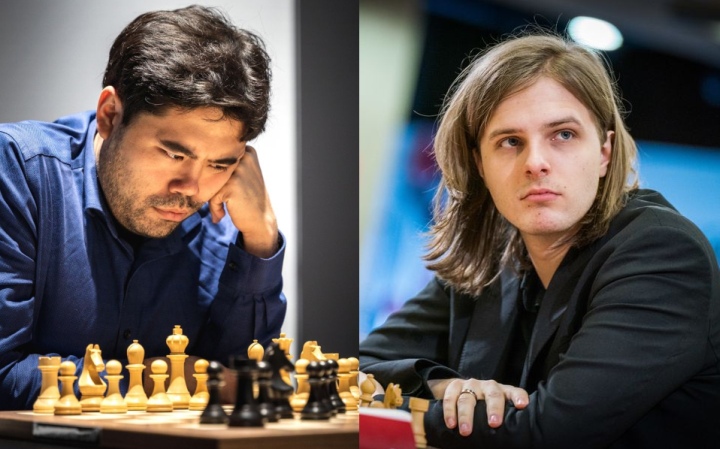
Hikaru Nakamura and Richard Rapport are officially in the Candidates 2022. Richard Rapport scored 20 Grand Prix points (7 points in the first leg for reaching semis + 13 points in the second for winning the event), while Hikaru has secured at least the same number (13 points in the first leg for winning the event + at least 7 points in the third leg for advancing into semis). No other player has even a theoretical chance to catch up with them in the FIDE Grand Prix standings. In the last and decisive round of the pool stage of the FIDE Grand Prix organized by World Chess, Hikaru Nakamura defeated Andrey Esipenko and became the winner of Pool A. He proceeds directly to the semi-final of the Berlin Grand Prix and will wait for his opponent from Pool B. Levon Aronian was the only player who could join Hikaru on tie-breaks, but he lost the game against Grigoriy Oparin. Only after the encounter between Leinier Dominguez and Vincent Keymer ended, it became clear that Hikaru and Rapport had secured their spots in the Candidates. By eliminating Dominguez, Keymer killed all theoretical chances to catch Hikaru and Richard in the Grand Prix. The local hero proceeds to the tie-break in Pool B and will be playing against Shakhriyar Mamedyarov, who quickly drew with Daniil Dubov. Both players have the same number of points. Sam Shankland and Maxime Vachier-Lagrave ended their deep theoretical discussion in a draw by perpetual check quite quickly, while Wesley So and Alexandr Predke signed a peace a few minutes later. These results set Wesley So up for a play-off for first place in pool C against Sam Shankland. Pool A Grigoriy Oparin came well-prepared today and managed to get a complicated position out of the opening against Levon Aronian. He chose a relatively rare line with 11.Bf4 and was feeling it was easier to play this position for White. The American GM was unhappy with the way he played today and noted it was a one-move blunder in the game. He completely missed White’s 20.Ba5, which was a hard blow for Black as his position just fell apart a few moves after. Andrey Esipenko chose to play the Bishop opening and found an interesting way to complicate the position. He created some threats on the kingside, and his position looked quite promising. Esipenko was sure he had some winning chances, but it was unclear where he could have improved his play. It turned out Hikaru didn’t feel the danger at first. “I didn’t feel it was getting dangerous until there were f4, g4 and Nf5 on the board. The great thing about the position is that no matter whether I’m lost, or I’m completely fine, I had only 1 or 2 choices on every move, and I just had to find a good move,” said Hikaru after the game. He thought that 27…f5, and 29…Nh5 were critical moves and he felt after that point the position should be a bit worse for Black. Esipenko was still hoping to win the game at the moment when it was his last chance to make a draw. On the move 35, he could have traded the rooks and transferred the game into the drawish ending. Instead, he chose a more ambitious plan that backfired immediately, as Hikaru consolidated his forces and scored a victory. Pool B Shakhriyar Mamedyarov and Daniil Dubov drew in 13 moves after a three-fold repetition. Shakhriyar was not happy with his position out of the opening and decided to sign a peace and await the result of the Keymer-Dominguez game to learn whether he gets to play tiebreaks tomorrow. The local hero Vincent Keymer pleased his fans with one more victory in the tournament. He got a comfortable position with White out of the opening against Leiner Dominguez and managed to regroup his forces, creating unpleasant pressure on the kingside. After a couple of inaccurate moves by Leinier his position became dangerous, and the American decided to go for a forced line which resulted in the lost ending. Vincent was very happy after his victory and that he managed to squeeze into the tiebreak tomorrow. Pool C Maxime Vachier-Lagrave knew the entire line from the game until the end and spent just a few minutes, while his opponent Sam Shankland was struggling to find the best moves and not to lose “the most embarrassing game of his life”, as he put it in a post-game interview. He got clearly caught in the Grunfeld Defence, which is the main weapon of MVL and thought he would lose this game with Maxim not making even one move on his own. “Ï was just lucky that the most obvious moves of White were the good ones; otherwise, I thought I could lose immediately,” explained Sam in a post-game interview. After the game Maxime Vachier-Lagrave spoke about his participation in the FIDE Grand Prix series organized by World Chess: “The result is bad and of course, it is more painful because I’ve been putting all my focus on this Grand Prix for the past few months. Some things were working out, but some were definitely not clicking in terms of my play.” After the game, Maxim and Sam were discussing the possible scenarios for the second game from Pool C So – Predke. Had Alexandr won the game, Sam could have qualified for the semifinals immediately. “If Predke can be my hero, that would be great. If he wins today, I will buy him dinner, drinks, whatever he wants!” said Sam with a smile. However, So and Alexandr Predke finished their game in a draw. Alexandr Predke played creatively in the opening and sacrificed one more pawn in the tournament by playing 14…Nbd7. Wesley So was happy with his position as he had a bishop pair and a good knight on d5. The American was putting constant pressure on his opponent, but Alexandr defended precisely and managed to hold his position. “I underestimated his idea of Qa2 and Qa3, which was strong. My opponent just played very well today”, said Wesley
FIDE World Cup & Women’s World Cup 2023 – Call for bids

1.1 The International Chess Federation (FIDE) will hold the World Cup & Women’s World Cup in the second half of 2023 (see the Tournaments Regulations: World Cup 2023, Women’s World Cup 2023). 1.2 FIDE is opening a bidding procedure to invite any federation member of FIDE or any organiser approved by the national federation to host the event. The federation’s letter of support may be provided later when the bid’s evaluation procedure is launched. 1.3 The prize fund of the World Cup shall be a minimum of one million eight hundred thirty-four thousand (1,834,000) USD net of any applicable local taxes. The prize fund of the Women’s World Cup shall be a minimum of six hundred seventy-six thousand two hundred fifty (676,250) USD net of any applicable local taxes. Contribution to the FIDE Development Fund from each event shall be a minimum 20% of the respective prize fund.The bid may contain special proposals on financial and commercial conditions. The FIDE Council shall decide whether these conditions are admissible. 1.4 The Bidding Form shall be filled in by an Applicant. A signed copy shall be submitted as e-mail messages to the FIDE Secretariat to office@fide.com by 20 October 2022, 23:59 Lausanne time (FIDE has a right to extend this deadline). All the documents shall be submitted in English. Additional documents may be requested by the FIDE General Strategy Commission (GSC) for further evaluation. 1.5 Bid Evaluation Report shall be presented by GSC for an approval of FIDE Council. 1.6 Once the Organiser is granted the right to organise the event, a relevant announcement shall be made on the FIDE website. FIDE Technical Delegate (FIDE TD) may be appointed at the same time to supervise the event on behalf of FIDE in consultation with GSC.
FIDE Grand Prix Berlin – Round 5 Recap
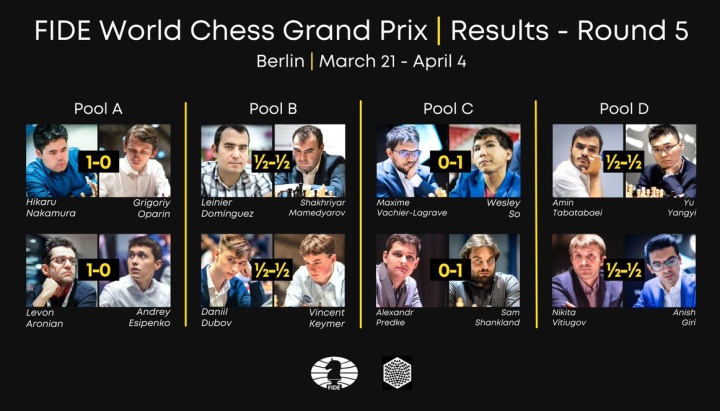
Half of the games ended with decisive results in Round 5 of the final stage of the FIDE Grand Prix Series organized by World Chess. It was a very good day for the American players as three of them, namely Levon Aronian, Hikaru Nakamura and Wesley So, defeated their opponents. All three are leading in their groups before the final round of the group stage. Hikaru Nakamura’s persistence was rewarded, as he won a difficult ending against Grigoriy Oparin and caught his main rival Levon Aronian, who outplayed Andrey Espenko. Both are in the lead in Pool A. Vincent Keymer earned a draw in his game against Daniil Dubov with precise defense. Leinier Dominguez and Shakhriyar Mamedyarov drew their game and stayed in the shared lead of pool B. Maxime Vachier-Lagrave sees his Candidates hopes evaporate after losing a hectic game to Wesley So, who now shares the lead in pool C with his compatriot Sam Shankland. Nikita Vitiugov and Anish Giri played out an uneventful draw, while Amin Tabatabaei saved a lost endgame against Yu Yangyi. All four players of pool D enter the last round in a tie, postponing the big fight for pool D victory for tomorrow. Pool A Andrey Esipenko was expecting to play against Hikaru Nakamura today and was shocked to learn he had to play against Levon Aronian 5 minutes before the start of the clock. He didn’t check the pairings carefully and gave a big advantage to Levon by playing with Black without any preparation. According to Levon, he had analysed this line in Nimzo-Indian Defense some time ago, knew the idea with h4-h5 and remembered that Black is losing after inaccurate 12…c5. Andrey explained that his move c5 was an attempt to create counterplay in the center. However, it failed as White’s attack was way too strong. After the best defensive move for Black 12…Bg7 White would have continued with 13.h5 Nh5 14.Nh7! with a powerful attack. After 13…h6? Aronian didn’t give his opponent any chance, got to Black’s king and forced his resignation on 23rd move. Hikaru Nakamura and Grigoriy Oparin played a very interesting game in the Nimzo-Indian. “At some point, I got very optimistic in the middle game. I thought I should be much better. It was so complex and after 25.g3 Qh1 I was not even sure if White was better,” commented Hikaru after the game. It seemed for the American player that Rf6 was an innacuracy that helped White to trade the rooks and win a pawn. Hikaru demonstrated an excellent technique in the ending, even though Grigoriy could put more stubborn resistance. The players analysed a computer line 47…Bc8 followed by Kh5, which could have given Black certain drawish chances but came to the conclusion this line was simply impossible to find for humans. Pool B Leinier Dominguez was trying to improve his time management today in his game with Shakhriyar Mamedyarov and played faster compared to the previous rounds. However, it seemed to the American it would have helped to think a bit longer in critical moments as he missed the clear advantage, which he got out of the opening. After 19…Bg5 White decided to go for the force line but underestimated Black’s counterplay with 21…Raf8 from far. Leinier wisely changed his original plans to capture the pawns of the queenside due to an unpleasant blow Rxf2! After 22.Qc5 played in the game, most of the pieces were traded, and the players ended up in a drawish rook ending. Daniil Dubov got a promising position in the Moeller Variation in the Ruy Lopez. After 15 moves, he had also 1 hour more on the clock and decided to sacrifice a piece in order to complicate the game, hoping to make it more difficult for Vincent Keymer to solve all problems. “It was a bit of a contradiction. I could force a draw, and I’m pretty sure I was not better, and I didn’t want to play at all. And again, while you are at home you don’t want to play, but then you come here, and your opponent is down to 3 minutes. And then I thought, ok we would play three moves he would probably blunder, and then we played two moves and I couldn’t repeat the moves any more and again I had to play, and it was a very tricky game somehow,” said Daniil, who seemed clearly disappointed with the outcome. The local hero Vincent Keymer showed great defensive skills and stopped White’s attempts to create a dangerous attack. He could have hoped for more had he found 25…Qf6 with a chance to gradually convert his extra material. Later on in the ending, Vincent blundered a pawn, giving winning chances to his opponent again but was lucky to hold onto a draw in the end. Pool C Wesley So was surprised with the opening choice of Maxim Vachier-Lagrave and could not recall if Maxime had ever played Nimzo-Indian with f3 earlier. Taking into account the tournament situation and the fact that it was the last game with White for MVL, the French Grandmaster decided to go for a sharp variation with g4 and was ready to take some risks. Maxime decided to break through with f4 in a complex position, the move that was later criticized by both players. Wesley found a very strong continuation 20…Qa4, with an idea c4 and since that moment, Black were clearly better in all variations. “Of course, with my opening choice today, I knew it involved a very big risk component, so I feel there were things I could have done better, but overall it was a very strong game by Wesley,” said Maxime after the game. Alexandr Predke didn’t get much out of the opening and decided to complicate the position by sacrificing a pawn. Sam Shankland grabbed the pawn, and it turned out White didn’t get sufficient compensation. Alexandr’s desperate attempts to fish in troubled waters of complications only precipitated his defeat. Pool D Anish Giri was fully prepared for Semi-Slav, which appeared on the board after some opening transformations and quite comfortably reached equality. His
‘Huge relief’ for Carlsen as champ survived Duda’s spirited comeback to win Charity Cup

A stunning end to the Charity Cup final saw Magnus Carlsen survive a major scare from Jan-Krzysztof Duda to clinch a second Meltwater Champions Chess Tour title of the season. The Norwegian started where he left off after the first day of the final by dominating Poland’s top player in game 1. It all appeared too easy for the champ who seemed to be breezing to victory in record time. Yet Duda, somehow, sparked an inspired comeback to win two in a row and take the match to tiebreaks. It was an astonishing turnaround that put the pressure right back up on Carlsen. Duda, the exciting young Pole with a big future ahead of him, was seen as a serious threat going into the final and one of the few players who could lay a glove on the champ. The 23-year-old had scored famous victories over Carlsen to end the champ’s record 125-game unbeaten streak and knock him out of the World Cup last year – an event Duda went on to win. And in this event, a unique elite-level fundraiser for UNICEF, Duda showed yet again that his chaotic, dangerous style can hurt Carlsen. Game 1: Carlsen on a roll Game 1, however, started with Carlsen heaping pressure on the challenger and it took just 17 moves for the writing to be on the wall. With 17… Ne4 the champ offered an ingenious knight sacrifice, Duda took the bait and captured with a pawn. But when Carlsen retook with his pawn, Duda’s position collapsed. The Pole played 19. Qxe4 which simply allowed a vicious attack. Carlsen responded with 19… Bd5 attacking the white queen and bringing his bishop into the centre of the board. Duda was paralysed and defeat was inevitable. At this point, the challenger had lost three in a row to Carlsen and now found himself needing to win the second game of the day just to stay in the final. Duda was at rock bottom. Game 2: Duda hits back Poland’s World Cup winner had one last throw of the dice with the white pieces and had to make it count. He tried to spark game 2 into life with 20. Bxe5 to create threats and mess up the position. It didn’t work initially. By now Carlsen was in safety-first mode looking for the draw that would win him the title. Yet a few moves later Carlsen lost a bishop and the game really did heat up. For the first time in the final, the champ appeared lose control in a wild position. Carlsen made the fatal mistake of pushing a pawn too far with 48. a6, overlooking a one-move checkmate threat with 48… Qa7 that Duda played which picked him up the a-pawn and forced a queen trade. Duda was now a knight for two-pawns ahead. His luck had turned. Carlsen’s pawns quickly dropped and Carlsen resigned in a hopeless position. Game 3: Duda on fire Despite the win, Duda still had to win another game to take the match to tiebreaks. But now he was no longer afraid and immediately tried to take Carlsen off piste. In the opening, the underdog pulled out the rare 3.g3 – a move that Carlsen played and lost with in a 2019 game against Levon Aronian. Duda and Carlsen castled on opposite sides and when white played 10. b4 to launch an attack it was clear the game would catch fire. The champ didn’t flinch and responded with the brave 10… Qxb4 putting his queen out in the open. The board appeared to be full of tactics with Duda on the attack and both black’s king and queen in danger. Duda found the tricky 18. Ng5 and the engine favoured him. Carlsen played 22… a5 and then Duda found the crushing 23. Bxc6. Carlsen resigned on move 25 and Duda – incredibly – was in the lead. Game 4: Duda gets the draw The Pole had the momentum doing into the final game of the set and only needed a draw to take it to tiebreaks. Duda successfully neutralised the champ and then took control. There was nothing better left for Carlsen but to force a draw. Duda had got himself back on level terms and the first blitz tiebreaker of the Charity Cup was on the cards. Tiebreaks The tension continued in the first of the blitz tiebreaks as the game appeared to be heading towards a draw before a moment of magic from Carlsen that tricked his opponent into playing 46… Bxg3 that led to Duda losing a rook. Carlsen set a trap, Duda fell for it and the champ was now one-up. Game 2 started with Duda offering a speculative knight sacrifice early out of the opening with the complex 14.Ng5 that led to an unbalanced position, but again Carlsen didn’t flinch. After the desperate lunge of 19. Qg6 Duda was left too open and was forced to resign. The tournament was over. Carlsen said: “Huge relief now. This was right out of the playbook of what feels like every tournament last year after the first few ones where it seems like I’m cruising and then there’s one bad moment and it all falls apart. But yeah, I managed to survive.” The event was supported by NEAR Foundation and was being held as a fundraiser for UNICEF. So far, more than $100,000 has been raised. The next tournament in the Meltwater Champions Chess Tour is a Major, which starts on April 20. For further comments contact: Leon Watson leon@championschesstour.com About the Meltwater Champions Chess Tour The Champions Chess Tour is the leading online chess Tour worldwide determining the world’s best chess player over a full competitive season of online chess. The 2022 season begins in February 2022 and features monthly tournaments culminating in a Final in November 2022. The best chess players in the world are competing in rapid chess. All games take place online on www.chess24.com with players competing for a total prize pool of over USD 1.5 million. For more information visit www.championschesstour.com. About Play
Winners crowned at Sao Tome and Principe Championship

The Absolute Individual National Championship of Sao Tome and Principe was held from March 03-19, 2022. The open event consisted of two stages: the semifinals and the Grand Final. The highest-rated participant of the open section Sergio Pereira lived up to his reputation and convincingly won the competition conceding his opponent just a half-point. Waldyr Espírito Santo finished one and a half points behind the champion and took silver; the bronze winner Admilton de Ceita dos Santos scored 6 points. With these results, the top four qualified for the national team to represent Sao Tome and Principe at Chess Olympiad that will take place in Chennai (India) this July. Final standings Open: 1. Sergio Pereira – 8.52. Waldyr Espírito Santo – 73. Admilton de Ceita dos Santos – 6 4. Osvaldo dos Santos Lima – 5.55. Fabio Costa Alegre – 5 The women’s tournament, a five-player round robin was much closer affair as Jualzimira de Oliveira Bastos Rita and Stela Lourenço Lima tied for first place, scoring 3 points each, with the former claiming the title thanks to better tiebreaks. Izidora Lourenço Lima netted 2.5 points and came third. Final standings Women: 1. Jualzimira de Oliveira Bastos Rita – 32. Stela Lourenço Lima – 3 3. Izidora Lourenço Lima – 2.54. Cristiana Biko – 1.55. Marcia Gomes – 0
FIDE President Arkady Dvorkovich turns 50
Today FIDE President celebrates his jubilee. All of us at FIDE wish Arkady Dvorkovich the happiest of celebrations, full of love and warm feelings. Let the path ahead be filled with successes and inspired moves, be it in chess, football or life!
FIDE Grand Prix Berlin – Round 4 Recap
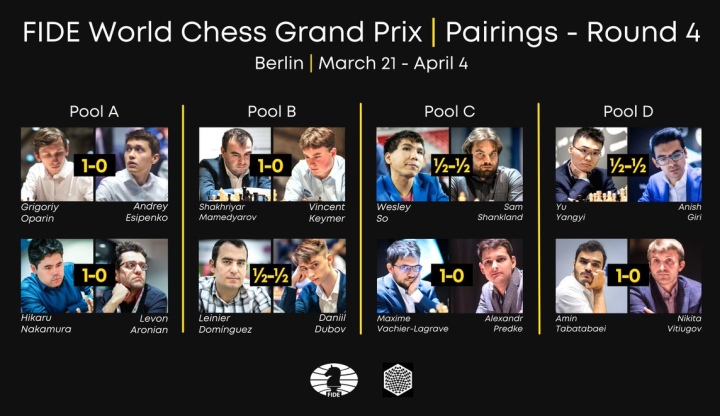
Five games out of eight ended with decisive results in Round 4 of the final stage of the FIDE Grand Prix Series, organized by World Chess. In a crucial game for the overall Grand Prix standings, Hikaru Nakamura defeated Levon Aronian and caught up with him. Grigoriy Oparin outplayed Andrey Esipenko and took the lead in Pool A, leaving Levon and Hikaru half a point behind. The game between Leinier Dominguez and Daniil Dubov ended in a draw; Leinier thus remained in the lead of pool B, now shared with Shakhriyar Mamedyarov, who outplayed Vincent Keymer. Maxime Vachier-Lagrave also took revenge on Alexandr Predke, and before the free day, the pool C ended up with all players tied on 2/4. Amin Tabatabaei avenged his first-round loss to Nikita Vitiugov, bringing all players of the pool D tied on 50% too. Pool A The game between Hikaru Nakamura and Levon Aronian was following the line in Ruy Lopez from the game Esipenko-Aronian in Round 3, but Hikaru chose to play 12.a4 instead of 12.Ne4. After numerous exchanges, White managed to get a promising position in the following endgame with rooks and minor pieces left on the board. “I think Levon got careless and thought there was no risk at all and went for Rg5-Rh5, but after I found 29.Ne7 I believe it’s very difficult for Black practically,” commented Hikaru after the game. It turned out to be one of the critical moments of the game and Hikaru assumed it was still possible to hold this position for Black with an accurate play. Aronian thought the mistake came even earlier on the 27th move, where he had to choose c6 instead of b6 played in the game. Hikaru managed to get a very strong passed pawn on d-file and placed his rooks on the seventh rank, forcing his opponent to defend against numerous threats and eventually converting his advantage. “It’s funny. It’s probably very bad for both of us because Grigoriy will probably win this game,” commented Nakamura on the Pool A situation after winning against Aronian. One inaccurate move 10…c5 by Andrey Esipenko in a well-known position that emerged from Nimzo-Indian gave his opponent Grigoriy Oparin a chance to get a very comfortable position with the stable edge due to the weak and isolated d-pawn in the Black’s camp. The game was a good example of how to handle this type of position: Grigoriy blocked the d-pawn, exchanged a few minor pieces and got prepared to win the pawn in a couple of moves. Andrey Esipenko’s desperate attempt to complicate the issue by playing 30…d4 and 31…a5 only postponed the catastrophe for Black, and even though the game finished the last today, the outcome was never in doubt. Pool B Shakhriyar Mamedyarov tested an original idea 8.Nh4 in the four knights English Opening against Vincent Keymer. He read about this move in an old book and remembered that g5 should not be good as White gets quite a strong attack on the kingside. Vincent decided to check if the sacrifice was a correct one and got into trouble after an unexpected 13.Qd2, missing that White’s pieces would get to Black’s King very quickly if he trades his knight for the Bishop on h6. After making a few precise moves, White transposed into a winning ending with a rook and four pawns vs two knights and a pawn and handily converted his advantage. Daniil Dubov played Two Knights defence today, but Leinier Dominguez didn’t show any intention to check a Fried Liver Attack and chose a solid line with 4.d3. Daniil was playing very fast today and had a huge time advantage by move 20. Black found the way to sharpen things after move 20 – Dubov thought he had some chances to get an advantage at this stage. However, Leinier found an excellent recourse 23.f4 followed by 24.Re1 thwarting Black’s attempts to get a strong initiative. After trading major pieces, a drawish bishop vs. knight ending appeared on the board, and the peace was signed after 52 moves of play. Pool C Two American GMs played a very solid game. Sam Shankland forgot to check the line with Bf4 and Qb3, which happened in the game and got a slightly worse ending due to the double pawns on b file. He decided to play more actively and put his rooks on a-file. “At some point, I really didn’t like my position but the move 16.Bf3 by Wesley was careless as I had g5, and Black is fine after that.” By playing g5, Sam Shankland offered a temporary pawn sacrifice, and following exchanges, the game ended in a draw. “If Maxime wins, then all of us are at 50%, and we will have a four-player tiebreak at the end,” said Sam after the game, while the MVL-Predke game was still in progress. Maxime Vachier-Lagrave and Alexandr Predke played a hard-fought game in a Ruy Lopez. After a long manoeuvring play, Maxime was hoping to get some attacking chances on the King’s side, but his opponent was finding interesting resources and even sacrificed a pawn to sharpen the game. Hoping to get a complex position with some winning chances, Maxime went for an unclear queen’s sacrifice. In time trouble Alexandr Predke didn’t find the best way to stop White’s threats, and after inaccurate 37… Rb2, Maxime gained the upper hand. “Objectively, I was worse or maybe even losing at some point… scary, but at the same time, I knew I had chances—that’s all I could hope for in this situation,” commented Maxime Vachier-Lagrave after the game. Pool D Yu Yangyi and Anish Giri waged a tense and very complicated battle in the Hungarian variation of the Gruenfeld Defense. The opponents followed a well-known theoretical path for awhile, but as Anish said in the post-game interview, he mixed something up and by move 14 they stepped into uncharted territory. With his 16th move, the Dutchman started chipping away in the center by f6 but it seems that White had an edge, although, in a very sharp position.