

FIDE Word Cup: 12-year-old IM Faustino Oro steals the show in Goa tiebreaks
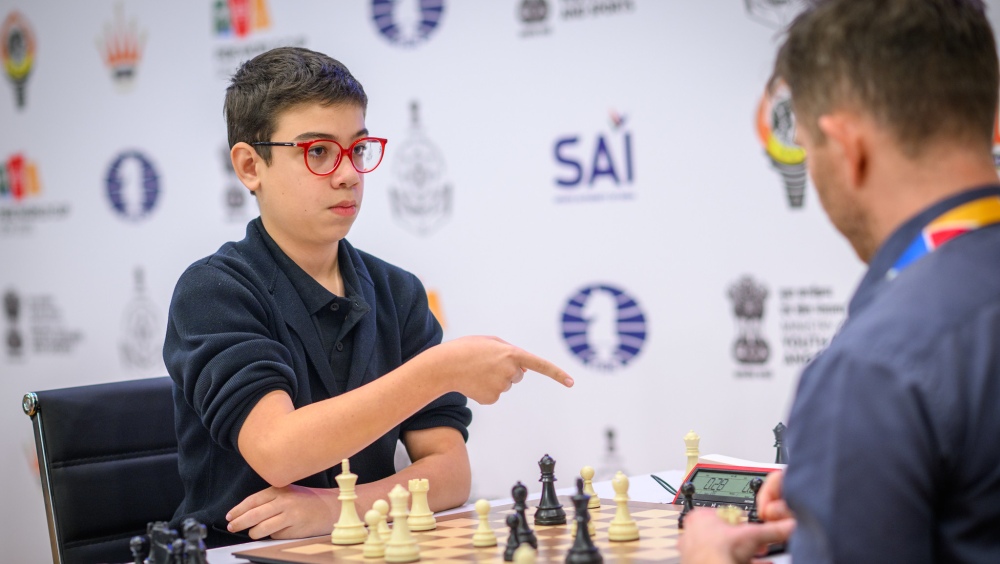
The nerve of the tiebreaks Blitz and rapid tiebreakers are nerve-racking spectacles. In rapid games, players have enough time to think, plan, and avoid blunders, yet must still manage their time carefully. It’s a delicate balance between classical depth and blitz speed. Blitz, on the other hand, is fast, intuitive, and electric — a format where players rely on instinct, pattern recognition, and split-second calculation. Common online and in casual play, blitz demands confidence, courage, and above all, emotional control under pressure. Few embody these qualities better than 12-year-old Argentinian IM Faustino Oro. The prodigious talent, already known for online victories against Magnus Carlsen and Hikaru Nakamura, showed maturity beyond his years by defeating seasoned GM Ante Brkic in Goa today. The round was ceremonially opened by Sanjiv M. Gadkar IAS, Secretary Protocol, Government of Goa, on Board One, where GM Robert Hovhannisyan faced FM Kavin Mohan. For tomorrow’s all-important second round, the Chief Minister of Goa is expected to make the honorary first move for World Champion Gukesh D. Rapid rounds: Surprises and systems Out of twenty matches, fourteen were decided within the first two rapid games — overturning many pre-round predictions. Most rating favourites advanced, though not all without a fight: six matches ended 2-0, and eight concluded 1.5-0.5. A noticeable difference from the classical portion was the choice of openings. Many players opted for flexible “systems” such as the Colle, London, and Anti-Sicilian setups — less theoretical but highly dynamic, well-suited to faster time controls and reduced defensive resources. With these results, Round 2 is set. All fifty seeds have arrived, ready to enter the action tomorrow afternoon — a round that promises fireworks and fascinating matchups. Let’s look at this afternoon’s action in more depth. The early qualifiers The first player to qualify under the 15+10 rapid section was GM Sunilduth Lyna Narayanan (2617). The strong Kerala Grandmaster, currently ranked India’s number seventeen, defeated IM Steven Rojas Salas (2413) of Peru by a clean 2-0. A 52-move grind with Black in the first game left Rojas Salas struggling, and Narayanan finished him off in style with a 22-move miniature in the second, capitalizing on a major blunder. According to Theophilus Wait, Lichess Operations Director present in Goa, Narayanan warmed up for the day with over fifty bullet games online: “I play a lot of bullet — that’s one of my ways to get in shape. I play fast and check a bunch of lines with the computer later.” It seems the routine paid off handsomely. Other clear 2-0 victories included: GM Jorge Cori (2601, Peru) defeating IM Aldiyar Ansat (2470, Kazakhstan). GM Temur Kuybokarov (2535, Australia) beating GM Jan Subelj (2532, Slovenia) in a match highlighted by a brilliant checkmating finish. Kuybokarov sealed the game with 49…Nh3+ 50.Kh2 Nf2+ 51.Kg1 Rh1+! 52.Kxf2 Qxe3 mate 0-1. GM Tin Jingyao (2583, Singapore) defeating IM Jegor Lashkin (2492, Moldova). GM Ghosh Diptayan (India, 2564) overcoming GM Peng Xiongjian (2520, China) by the same score. IM Bojan Maksimovic (2532, Bosnia) eliminating GM Emre Can (2541, Turkey) — both classical games had been drawn. Narrow escapes and determined youngsters Eight matches ended 1.5-0.5, mostly favouring higher-rated players. Among the standouts was FM Kavin Mohan (Malaysia, born 2011), who drew both classical games against GM Robert Hovhannisyan (2629) before narrowly losing in the rapid portion — a superb showing for the 14-year-old. Elsewhere, GM Alisher Suleymenov (2491, Kazakhstan) defeated GM Arturs Neiksans (2585, Latvia), while GM Denis Makhnev (2525, Kazakhstan) ousted GM Diego Flores (2563, Argentina) winning by the same margin. After his elimination, Neiksans congratulated his opponent and humorously announced his return to the commentary desk: The 10+10 Rapids: One match decided, five headed to blitz Six matches advanced to the second two-game rapid set (10+10). The play was fiercely balanced, with only IM Aronyak Ghosh (2520, India) managing to win both games and advance. His opponent, GM Mateusz Bartel (2575, Poland), fought hard and even gained attacking chances in the final game before a sudden blunder ended his run: Bartel’s 20.Qf3?? allowed 20…Nh4, a double attack that forced immediate resignation. Blitz deciders: Youth and nerves of steel With six games already behind them, players entered the blitz tiebreaks (5+3) — a pure test of energy, nerves, and composure. All five matches were decided at this stage, featuring both upsets and heroic efforts. The headline story came from IM Faustino Oro (Argentina, 12 years old), who won both blitz games to qualify for Round 2. Overjoyed, “Fausti” was whisked off for a fair-play check before returning for a quick post-match chat: “I’m so happy to have qualified. It’s been a very tough match,” he said. “I missed a key tactic in the final game, but luckily for me the position was still tricky.” https://www.youtube.com/watch?v=thmg-CpdxU0 Elsewhere, GM Daniil Yuffa (2618, Spain) survived a marathon match against IM Shiyam Thavandiran (Canada, 2400), eventually clinching both blitz games but acknowledging his opponent’s resilience. GM Max Warmerdam (2577, Netherlands) also needed blitz to overcome GM Lalit Babu M R (2506, India), in a match where momentum swung dramatically. Two other tightly contested duels saw GM Kazybek Nogerbek (2538, Kazakhstan) defeat GM Raja Rithvik (2541, India), and GM Ahmed Adly (2589, Egypt) edge past GM Karen Grigoryan (2481, Armenia) — the latter still a formidable competitor and former 2650-rated player. Looking ahead The first day of tiebreaks offered everything — drama, blunders, brilliance, and youthful audacity. With all 50 seeds now entering the fray, Round 2 promises high-voltage encounters as established stars meet fearless challengers. Goa’s World Cup is heating up, and if today’s rapid and blitz battles are any indication, the days ahead will be nothing short of spectacular. Game 1 of Round 2 begins on November 4 at 3 PM local time. The action can be followed live on the FIDE YouTube Channel, featuring expert commentary by GMs Evgenij Miroshnichenko and Jan Gustafsson. To watch the games in person, tickets can be purchased [HERE] Official website: worldcup2025.fide.com/ Written by IM Michael Rahal Photos: Michal Walusza and Eteri
FIDE World Cup R1 Day 2: Favourites advance, but drama awaits in the tiebreaks
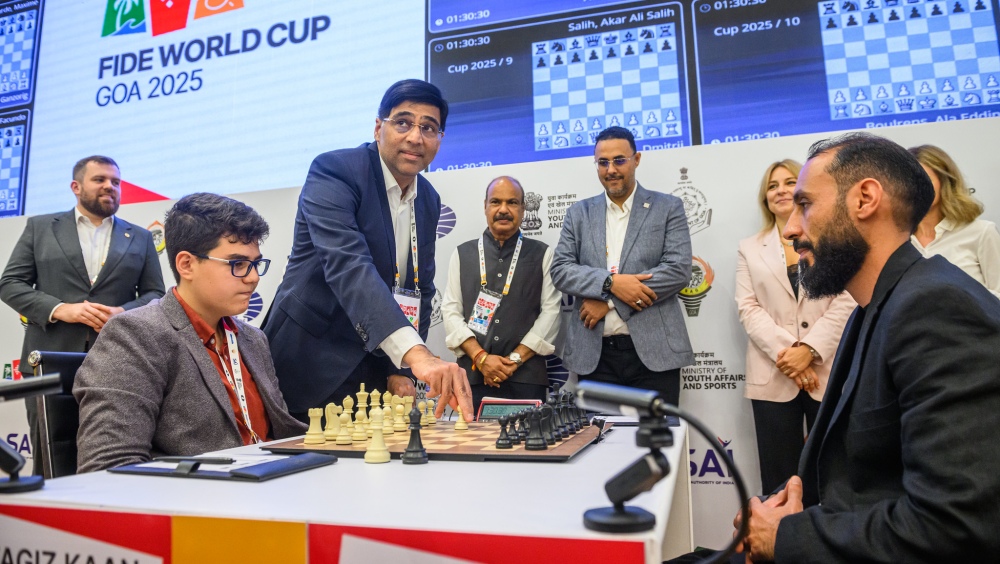
With the gradual arrival of most of the top 50 seeds, the second game of round one commenced on time in the convention hall of the Baga Resort Rio in Goa. Among others, I spotted elite 2700+ GMs Nodirbek Abdusattorov, Shakhriyar Mamedyarov, Javokhir Sindarov, Vladimir Fedoseev, and Jorden van Foreest acclimatising to the new location. I also had the pleasure of having lunch with the 13th seed, Le Quang Liem from Vietnam. Commentator Jan Gustafsson noted that players might need a bit more time to adapt: “Two days seem to be cutting it rather close if you arrive from a distant time zone.” Top Indian Olympiad player Vidit Gujrathi obviously doesn’t have this disadvantage, though he still enjoyed a relaxed stroll around the playing hall toward the end of the round. More top players are expected to arrive throughout the day, with the rest of the field assembling at the venue tomorrow — eager to learn who they will face in the second round of the knockout. All of them, including World Champion Gukesh D., will join the action in round two. The venue welcomed a very special guest to perform the ceremonial first move. Vishy Anand — former five-time World Champion and current FIDE Deputy President — opened the round by playing 1.c4 for Turkey’s Yagiz Kaan Erdogmus on board one. The move was met with 1…e5, played on behalf of his opponent, Abugenda Nagi of Libya, by Mr. Ali Fouzi, President of the Libyan Chess Federation. Just fifteen minutes into the playing session, three players had already secured qualification to the second round. Amin Bassem, Étienne Bacrot, and Nikita Petrov were each awarded victories by forfeit after their opponents failed to appear for their two-game matches. Barbadian International Master Orlando Husbands, however, arrived too late for the first game of his match but eventually made it to the venue and put his opponent — top German Grandmaster Frederik Svane (2640) — to the test. Though he ultimately lost and was eliminated, he fought valiantly and made his presence felt on the board. Over the following hours, the hall was filled with deep concentration. As I moved among the tables in search of the most compelling encounters, the atmosphere was almost tangible — focus at 100%, and the tension of high stakes evident on every face. The first decisive result was confirmed shortly after the midpoint of the round. American 15-year-old prodigy Andy Woodward scored the opening victory of the afternoon, defeating India’s Gusain Himal with a convincing 2–0 overall score. Playing with the black pieces, Woodward had already seized the initiative. With his last move, 19…Ngf4, he attacked the pawn on g2. White needed to eliminate the knight immediately, but after just three minutes of reflection, Gusain blundered with 20.Kf1?, allowing 20…Nxg3+ 21.fxg3 Nh5!, creating the decisive threat of 22…Nxg3, which would win material. The strength of the bishop on a7, dominating all the dark squares around White’s king, became apparent. Recognizing the hopelessness of his position, Gusain resigned soon after. With this victory, Woodward advances to face a formidable opponent in round two — Austria’s Kirill Alekseenko (rated 2679). As more results began to come in, attention turned to one of the most anticipated encounters of the day — the game featuring one of the youngest participants in the tournament, 14-year-old Argentinian prodigy IM Ilan Schnaider (rated 2401), against former European Champion Aleksandar Indjic, a strong Serbian Grandmaster rated 2635 — and, at 6’8″, arguably the tallest GM in the world! Having lost the first game, Schnaider needed a victory to force a tiebreak. After the opening, he had exactly the kind of dynamic position he was hoping for. The Serbian’s king on d7 was in serious trouble in this chaotic position, clearly favorable for White. Schnaider spent nearly fifteen minutes here, weighing his attacking options, before deciding on 17.Nf4, and ended up just slightly better. However, he missed a golden opportunity to press for the full point. Instead the move played, he could have launched a powerful assault with 17.Qa4+! The key idea is after 17…c6 fails to 18.Be7! attacking the queen and preparing dangerous follow-ups such as Qa3–d6 or Re4. It’s likely that a player of Schnaider’s caliber examined this line but dismissed it due to the absence of an immediate tactical breakthrough. Needing only a draw to advance, Indjic chose to simplify the earliest opportunity and calmly secured qualification after a draw in a double-rook endgame. Yesterday’s biggest upset came when Chilean GM Cristóbal Henríquez Villagra unexpectedly lost on time in a theoretically drawn endgame against an opponent rated 150 points lower. Determined to make amends, he struck back today with an impressive attacking victory that forced a tiebreak. Henríquez Villagra concluded the game in style with the precise and elegant 45.Re8+!. The point is simple yet beautiful: after 45…Qxe8, White delivers a classic “Dovetail Mate” with 46.Qd6#. A clean and instructive finish — and a fitting way to erase the memory of yesterday’s disappointment. Combination of the day It’s always difficult to single out the best combination of the day — with so many great games unfolding simultaneously, it’s nearly impossible to keep track of them all. Nevertheless, Spain’s number one, GM David Antón Guijarro, secured his 2–0 qualification to the next round with a brilliant queen sacrifice against Angolan IM David Silva. Silva has just played 31.Rea1, threatening Ra7 and giving up his bishop on g5, in order to seize control of the seventh rank and threaten the f7-pawn. Antón thought for a few minutes before confidently accepting the challenge with 31…Bxg5. After 32.Ra7, he stunned the spectators by sacrificing his queen: 32…Qxa7! 33.Rxa7 Rf6!, attacking White’s queen and turning the tables completely. After 34.Qd1 Rxf2, Silva resigned. A spectacular illustrative line might be 35.h3 Rxf1! 36.Bxf1 Be3+ 37.Kg2 Bxe4+, with a decisive attack. It’s clear that Antón had foreseen this entire sequence before giving up his queen — a testament to both courage and calculation. Meanwhile, the recent Women’s World
Ljubomir Ljubojević turns 75
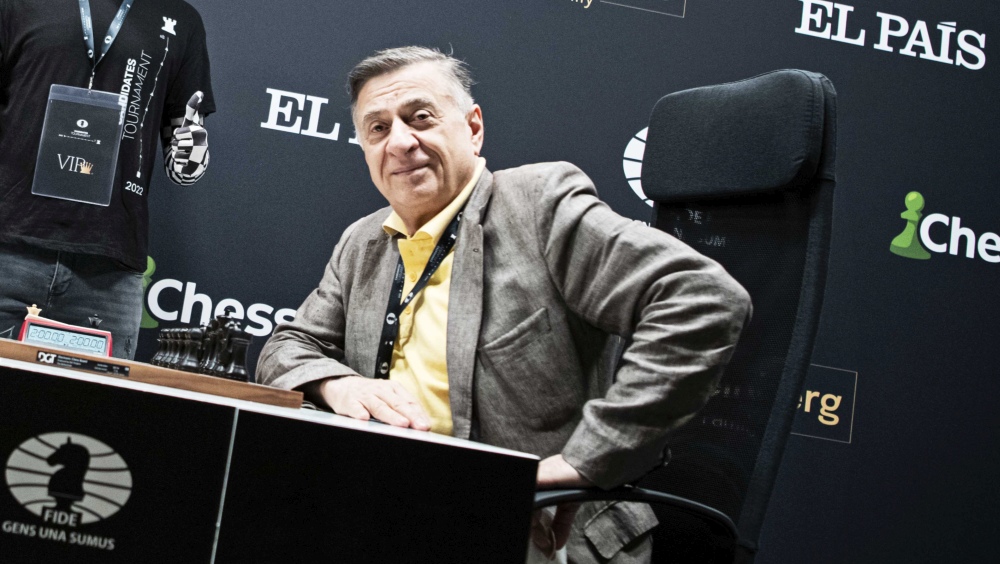
Photo: Stev Bonhage Today, the one and only Ljubomir Ljubojević turns 75. A brilliant star—once ranked world #3, and arguably the strongest of all when on fire. Colorful and explosive, he was never built for steady, pragmatic success at the board—but oh, how high he soared! Debuting at not quite 23 years old in the Interzonal in 1973, Ljubomir started with 5.5 out of 6, then reached 8 out of 11, though he missed victory in his key game against rival Lajos Portisch. And, as happened to him more than once — and would again — he tragically rushed in the famous game against Bronstein, with more than two hours on his clock versus just a few minutes for his opponent. Instead of a win came a painful loss, and Ljubojević cracked, finishing in the middle of the standings. Photo: Douglas Griffin on X That failure seems to have left an indelible mark on the sensitive grandmaster. Despite regularly ranking among the world’s top ten, time after time he was overtaken by more determined—and sometimes simply luckier—colleagues, and he never qualified for the Candidates. Still, looking at the ever-cheerful grandmaster, no one would have said he was unhappy. The soul of any chess gathering—vivid, emotional, fluent in five languages and quick to analyze in five more—he was a welcome guest at every elite tournament of his era. In the 1983 FIDE rating list, Ljubojević ranked third in the world, yet one senses that wasn’t what mattered most to him. What truly captivated him were the tournaments themselves—their unique atmosphere. From Belgrade, Bugojno, and Nikšić to Tilburg, Wijk aan Zee, and Linares (where he settled after marrying in the mid-1980s), Ljubojević thrived. Bugojno 1982. Ljubojević is far left in the first row. Photo: http://www.jovanpetronic.com By then, new heroes had taken the stage—Kasparov and his generation—but “Ljubо,” as the entire chess world affectionately called him, did not yield ground. Far from it: he was the only player besides Karpov to share first place with Kasparov in a super-tournament—Brussels 1987 (8.5/11, ahead of the entire elite and two Belgian masters) and the World Cup stage in Barcelona 1989 (11/16, undefeated!). In those events, he was both dazzling and pragmatic, and it seemed the younger players would not soon surpass the maestro—not yet forty at the time. But then, suddenly, it was over. There would still be a solid showing at the 1990 Manila Interzonal, some brilliant games in Belgrade super-tournaments, and worthy performances for the Yugoslav and later Serbian national teams. For many years, Ljubо played in Monaco at Oosterom’s tournaments—the organizer had great affection for the charismatic grandmaster—but top-level chess effectively ended for Ljubojević in the early 1990s, just as a powerful new wave of players emerged. The bohemian, passionate chess—one in which Ljubojević had few equals—was fading away. And he didn’t know how to play any other kind. Since then, he has more often appeared as an honored guest or commentator. Still expressive as ever — when we spoke a couple of years ago, it was hard to believe that this energetic, though no longer young, man was already in his seventies. That expressiveness has never left him; it shines through everything he does, especially his analysis. I remember talking with Ljubо back in the late 1990s — and I wouldn’t say the gray hair had changed him one bit. It’s only a pity that post-game analysis, at the board or even blindfold, has become such a rarity. During the 2022 Candidates Tournament in Madrid, you could catch Ljubojević at breakfast passionately defending his view — in one of his countless languages — against anyone, even the highest-rated players. You could see he still felt like a fish in water in this environment. To me, though, Ljubojević is more like a great bird, still soaring. May your flight be long, Ljubо! Emil Sutovsky, FIDE CEO
FIDE strengthens ties with IOC, UEFA and ARISF
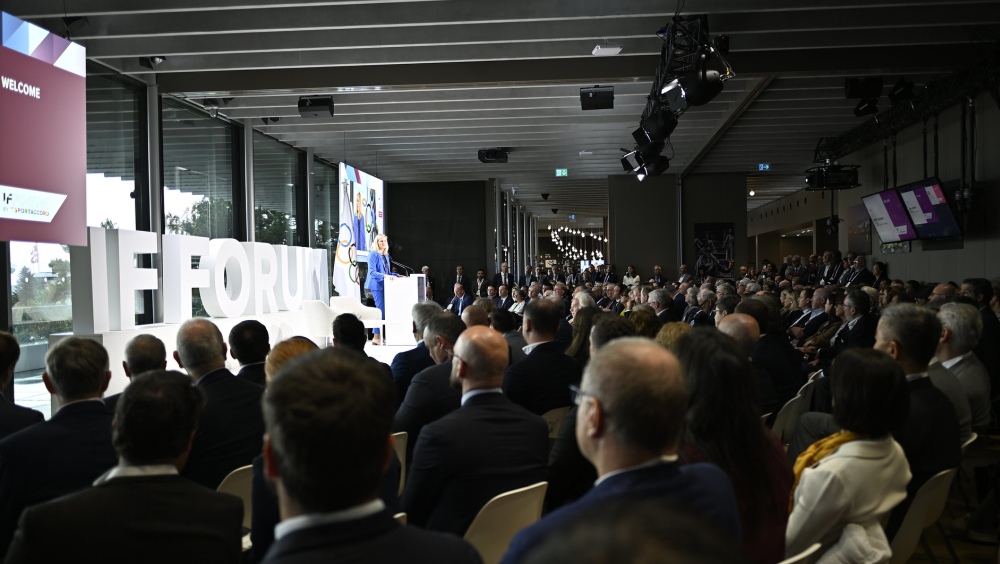
FIDE President Arkady Dvorkovich held meetings with leaders of the IOC and UEFA in Switzerland, and participated in the ARISF General Assembly and the IF Forum. At the end of October FIDE President Arkady Dvorkovich had a series of meetings and engagements in Switzerland, successfully advancing the integration of chess into the wider sports community. Starting from 27 October, Dvorkovich represented FIDE at the Association of IOC Recognised International Sports Federations (ARISF) General Assembly which took place at the Olympic Museum in Lausanne, Switzerland, reaffirming the central role of recognised federations within the Olympic Movement. FIDE is one of 39 International Federations recognised by the IOC and listed among the members of (ARISF). Together with Grandmaster Mohammed Al-Mudahka, the President of the Qatar Chess Association, Dvorkovich took part in the IF Forum, which focused on new global realities facing sport and sports organisations. Organised by SportAccord – which brings together stakeholders representing over 120 International Federations governing Olympic and non-Olympic sport – the event is the world’s most influential gathering in global sport. Dvorkovich also met with representatives from the IOC and other international sports bodies, where agreements were made to further integrate chess into global sports activities, including those of the International School Sport Federation (ISF). At UEFA headquarters, Dvorkovich met with President Aleksander Ceferin. They discussed future cooperation and the potential for innovative sport events combining chess and football, leveraging the mass appeal of both sports to reach new audiences. Strengthening ties with local authorities, Dvorkovich also met with leaders of Canton Vaud in Lausanne, where FIDE is headquartered. “It was a very intense few days – we had a lot of productive meetings with representatives from the world of sports and discussed new projects which will make FIDE more involved with and more prominent in the wider world of sports,” FIDE President Arkady Dvorkovich said. “Of course, during this time we also had our regular activities, such as the Council meeting, which was held online. We are continuing to work hard on opening new links and creating new opportunities for the world of chess, and I am hopeful we will have more great news to share in the near future,” Dvorkovich added.
Winners crowned at FIDE World Senior Individual Championships 2025
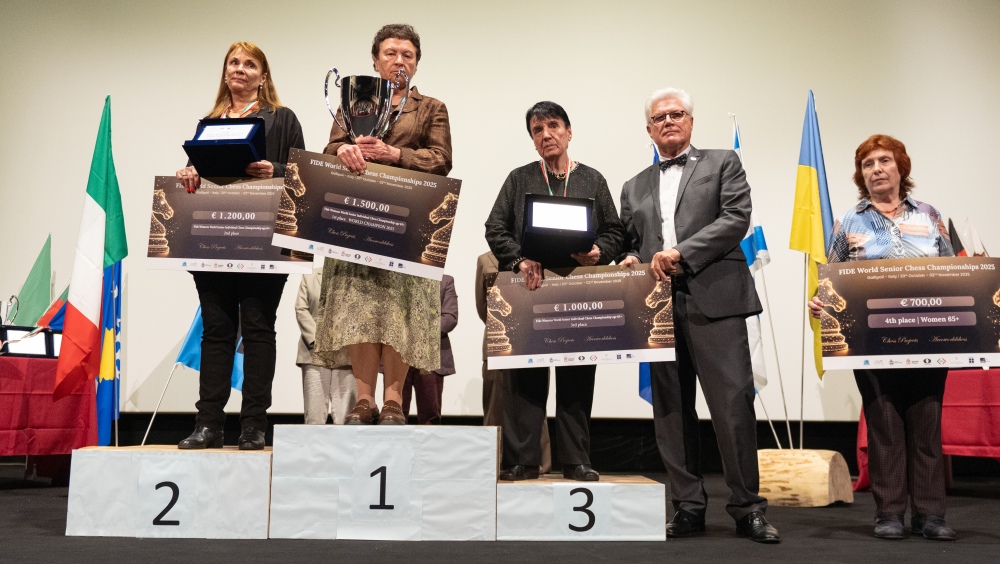
The record-breaking FIDE World Senior Individual Chess Championships 2025 concluded in Gallipoli, Puglia, Italy, after eleven intense rounds, with winners emerging in all four sections. GM Victor Mikhalevski (Israel) came out on top in the 50+ Open. Heading into the final round tied for the lead with GM Mikheil Kekelidze (Georgia) on 8.5/10, he scored a crucial victory over IM William Paschall (USA) to secure the title, while his rival could only manage a draw with GM Paul Motwani (SCO). Kekelidze took silver with 9/11, while GM Michele Godena edged out GM Murtas Kazhgaleyev for the bronze thanks to his victory in their direct encounter. Both the champion and the runner-up finished the event undefeated. Final standings 50+ Open The 65+ Open was the most tightly contested of the four tournaments. Four players—Alexander Reprintsev (UKR), Christian Maier (GER), Zurab Sturua (GEO), and Evgenij Kalegin (FIDE)—entered the final round sharing the lead on 8/10. When all four drew their games, IM Mark Ginsburg (USA) and GM Nikolay Legky (France) caught up by notching victories. The Buchholz tiebreak favored Alexander Reprintsev, who captured the gold medal, with Zurab Sturua and Christian Maier completing the podium. Final standings 65+ Open GM Ketevan Arakhamia-Grant (SCO) delivered a commanding performance in the 50+ Women’s section, scoring 8.5/11. The native of Georgia seized the lead in Round 5 and never looked back, clinching the title with a round to spare. Top seed GM Pia Cramling (SWE) and WGM Maritza Arribas Robaina (CUB) finished a full point behind the champion, tying for second place. The Swede took the silver medal as the winner of their direct encounter. Final standings 50+ Women WGM Galina Strutinskaia (FIDE) dominated the 65+ Women’s tournament. Scoring a remarkable 10.5/11, the fourth seed conceded just a single draw to her opponents and secured the title with a round to spare. Despite losing to the champion in Round 6, Marina Makropoulou finished strongly with two victories to claim silver with 7.5/11. Nona Gaprindashvili (GEO) and Larisa Khropova (FIDE) scored the same number of points, with the legendary Georgian champion rounding out the top three. Final standings 65+ Women The closing ceremony was held in Gallipoli’s historic Schipa Theatre, attended by Patrick van Hoolandt, Chair of the Appeals Committee; Yana Sidorchuk, FIDE Technical Delegate; organizers Cristina Pernici Rigo (Arcoworldchess) and Matteo Zoldan (Chess Projects); and several guests of honor. These included Pierluigi Piscopo, Counselor of the Italian Chess Federation; and Anio Iannuzzielo, Director of the Grand Hotel Costa Brada. The ceremony began with a minute of silence in memory of GM Daniel Naroditsky, who passed away at the end of October. It then continued with a performance by the multi-talented chess player and singer Nathan Resika, who delighted the audience with arias from Bizet, Verdi, and Mozart. The award ceremony followed, with the top finishers receiving trophies, medals, and symbolic checks. Official website: worldseniorchampionship2025.com/
Vincent Keymer and Anish Giri enter top 5 Open in FIDE November 2025 rating list
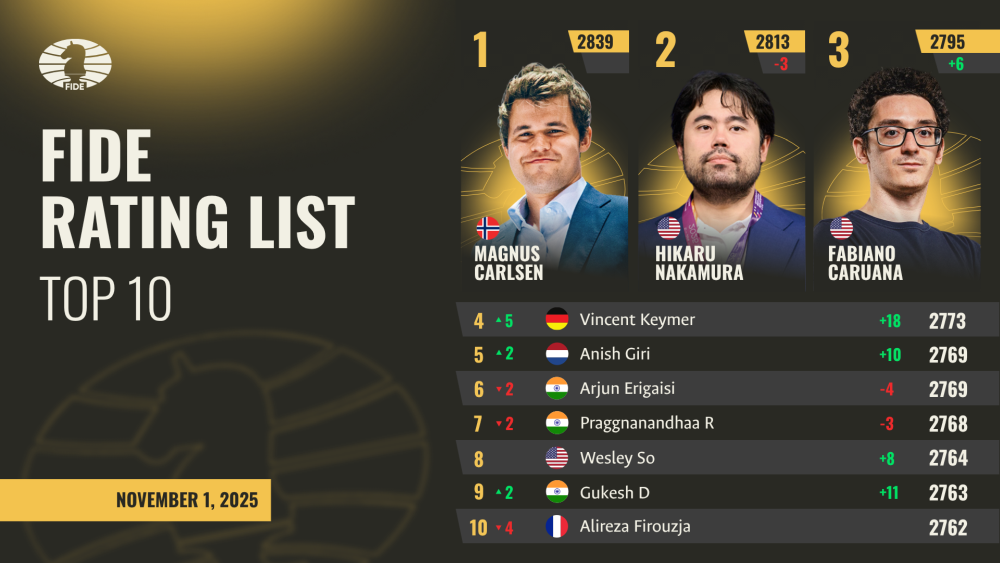
The FIDE November 2025 rating list was primarily shaped by two major team events: the European Team Championship in Batumi, Georgia, and the European Club Cup in Rhodes, Greece (both Open and Women’s sections). While the Women’s Top 10 remains unchanged, the Open Top 10 saw significant shifts. Vincent Keymer (pictured below) and Anish Giri gained 18 and 10 rating points, respectively, in these competitions—propelling both into the Open Top 5. Keymer makes his debut in this elite group, while Giri returns after an 18-month absence. Fabiano Caruana consolidated his hold on third place following his successful title defense at the U.S. Championship, while reigning World Champion Gukesh D re-entered the Open Top 10 thanks to his standout performance at the 2025 European Club Cup. Photo: Michal Waluzsa Biggest gains in top 10 Open and Women Rakshitta, Ravi WGM IND 2381 (+58) Mkrtchyan, Mariam WIM ARM 2353 (+35) Klek, Hanna Marie WGM GER 2357 (+29) Tsolakidou, Stavroula IM GRE 2479 (+26) Kashlinskaya, Alina IM POL 2475 (+25) Toncheva, Nadya FM BUL 2352 (+20) Keymer, Vincent GM GER 2773 (+18) Badelka, Olga IM AUT 2395 (+18) Anton Guijarro, David GM ESP 2648 (+17) Indjic, Aleksandar GM SRB 2635 (+17) Narva, Mai IM EST 2420 (+17) Rapport, Richard GM HUN 2740 (+16) Ravi Rakshitta (pictured below) delivered an outstanding performance at the White Horse GM Tournament 2025. Her +58-point surge not only earned her the top monthly gain but also marked a triumphant return to the Women’s Top 100 and a career-high 63rd position on the list. Photo: Baku Open Mariam Mkrtchyan, Hanna Marie Klek, and Nadya Toncheva excelled at the European Women’s Team Championship, gaining 35, 29, and 20 rating points respectively. All three have re-entered the Women’s Top 100. Stavroula Tsolakidou (pictured below), Alina Kashlinskaya, and Olga Badelka also overperformed in Batumi, and later added 8, 13, and 5 more points, respectively, following strong showings at the 29th European Club Cup for Women. Photo: Michal Walusza Similarly, Aleksandar Indjić, David Antón Guijarro, and Richard Rapport delivered excellent results in both events, contributing to their rating gains. Mai Narva gained 21 points in Batumi, dropped 4 in Rhodes, but still finished the month with a net +17-point increase.
World Cup 2025 kicks off in Goa: Anand honored, young stars shine
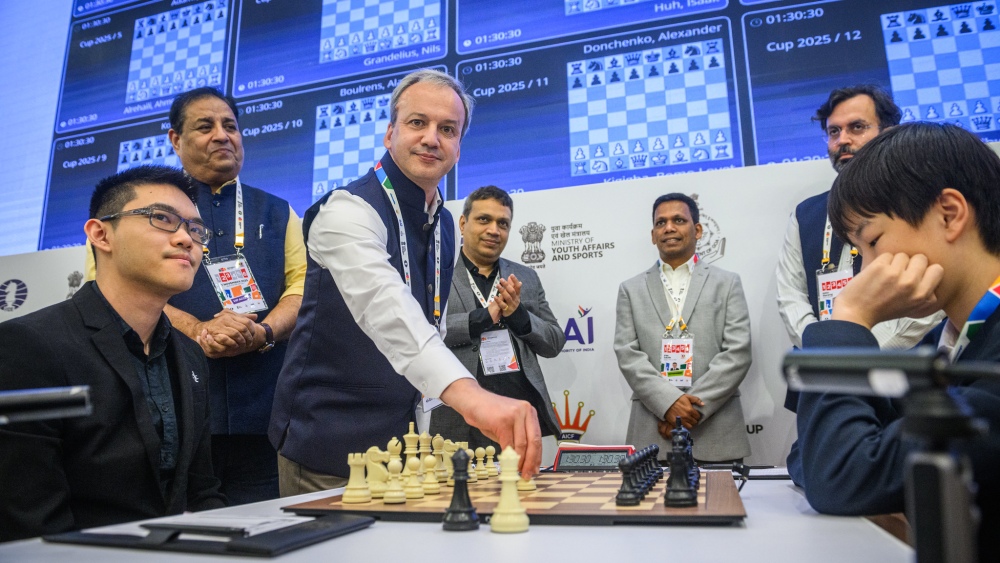
The first game of Round One of the FIDE World Cup began this afternoon at 3:00 PM local time in the Baga Resort Rio’s convention centre in Goa, India. The pristine venue hosted the opening clashes of what promises to be a thrilling month-long event, featuring 206 of the world’s top players battling for three coveted spots in the Candidates Tournament — the final step toward challenging for the World Championship title. The round opened with the traditional ceremonial first move: FIDE President Arkady Dvorkovich played 1.e4 on behalf of GM Jeffery Xiong (USA). AICF President Nitin Narang mirrored the move for GM Pranav V (India). According to tournament regulations, the top 50 seeds are automatically qualify for Round 2, meaning 78 games were contested today. Move of the day One of the first games to conclude in Round 1 featured the sensational Yagiz Kaan Erdogmus, currently rated 2651 and rapidly ascending the world rankings. Born in 2011, the Turkish prodigy is, as of 2025, the youngest grandmaster in the world — and today, he once again demonstrated why. Facing Candidate Master Nagi Abugenda (Libya, 1972), Erdogmus unleashed a brilliant attacking display in an Exchange French Defence. White, already behind in development and with his king stranded in the centre, was caught in the crossfire of a sharp tactical strike. From this moment, Black’s attack erupted with the bold sacrifice 10…Nce5!, forking the queen and bishop. The young grandmaster spent only six minutes calculating the sequence. “I thought this was going to be a long game and that I would win in the endgame,” said Erdogmus afterward. “But then he started to play very aggressively. I think he missed knight e5, and after that he’s just losing.” After 11.dxe5 Nxe5 (another fork), 12.Qxd5 Be6! followed — a developing move that renewed the attack by targeting the overloaded queen. When White retreated with 13.Qe4, Erdogmus continued energetically with 13…f5!, and after 14.Qe3, he had already foreseen the decisive 14…Bd5!, simultaneously attacking the rook on h1 and threatening 15…Nf3+ winning the queen. With no way to parry all the threats, Abugenda resigned a few moves later, conceding victory to the young Turkish star in impressive fashion. On board two, GM Jeffery Xiong (USA, 2648) prevailed in a difficult endgame against CM Li Yiheng (Hong Kong, 1994). Despite the 650-point rating gap, the 12-year-old from Hong Kong played far above his rating, testing the American grandmaster’s technique at every turn. https://www.youtube.com/watch?v=u79ZODb5XFQ In his post-game comments, Xiong praised his young opponent’s resilience and talent: “I wasn’t at all surprised because he is a very young player and, as someone who was already giving GMs a tough fight when I was thirteen years old, I knew going in that he was a prodigy and that I should take it very seriously.” On board three, GM Maxim Rodshtein (Israel, 2647) took the lead in his two-game mini-match against CM Qin Oscar Shu Xuan (New Zealand) with a crisp victory as Black. Rodshtein seized the initiative early, gradually building pressure before launching a decisive kingside attack that left his opponent defenceless. Meanwhile, on board five, England’s former world top-ten player GM Michael Adams (2646) showcased his renowned technical precision. In a queen endgame, Adams converted his outside passed pawn into a new queen, sealing a clinical victory in trademark style. Rounding out the top results, GM Vladislav Artemiev (FIDE, 2637) also outplayed CM Heskiel Ndahangwapo of Namibia, trapping his opponent’s queen in the middlegame — a rare tactical motif at this level, and one that drew murmurs of admiration from spectators following the games online. With so many fascinating games on display, it was impossible not to notice several dazzling moments of creativity. One game, in particular, stood out for its sheer precision and ingenuity. In his encounter with IM Satbek Akhmedinov (Kazakhstan, 2372), GM Pranesh M. (India, 2630) found the only move to force victory in a razor-sharp position. In the position, where 47.Bd4+ would have allowed 47…Qxd4, saving the game, and 47.Rf1 would have fallen to 47…Rxg2+!, Pranesh instead uncorked the spectacular 47.Qg7!! Now the twin threats of 48.Bd4+ and 48.Rc6+ loomed, either of which would have decided the game instantly. Akhmedinov tried to resist with 47…Ra1+, but Pranesh calmly blocked with 48.Rf1+!, picking up the rook on a1 and forcing immediate resignation. Outstanding stuff from the young Indian grandmaster. The World Cup’s opening round once again reminded everyone of its trademark unpredictability, as several underdogs punched above their weight to produce surprises and memorable results. The biggest upset of the day came when Chile’s top player, GM Cristóbal Henríquez Villagra (2605), fell with Black in a tricky rook + bishop vs bishop endgame against IM Agibileg Uurtsaikh (Mongolia, 2448). A handful of grandmasters were unable to break through and had to settle for draws — likely saving their energy and preparation for Game 2. Among them: FM Mohan Kavin (Malaysia, 2346), who held GM Robert Hovhannisyan (Armenia, 2633) to a solid draw. IM Reja Neer Manon (Bangladesh, 2369), who split the point with GM Aryan Tari (Norway, 2631). Another standout performance came from FM Daniel Barrish (South Africa, 2284), who pressed with Black throughout against Goa’s own GM Raunak Sadhwani (2641) before agreeing to a draw after 56 moves — a truly impressive result for the young South African. Last but not least, the only female player in the field, recent Women’s World Cup champion GM Divya Deshmukh (India), was defeated by GM Stamatis Kourkoulos-Arditis (Greece, 2583). Divya showed ambition from the start, sacrificing a pawn in the opening to build attacking chances. However, the compensation never fully materialized. As the game steered into a complex double-rook endgame, time pressure took its toll — one misstep was all it took for the Greek grandmaster to seize control and convert the point. Divya will have another opportunity tomorrow to even the match. https://www.youtube.com/watch?v=3X6iRvyRrrM Asked afterward about the unusual atmosphere created by dozens of cameras and spectators crowding the top boards, Kourkoulos-Arditis smiled: “I’ve never
Pranav Venkatesh, clear winner of the 8th Salamanca Masters
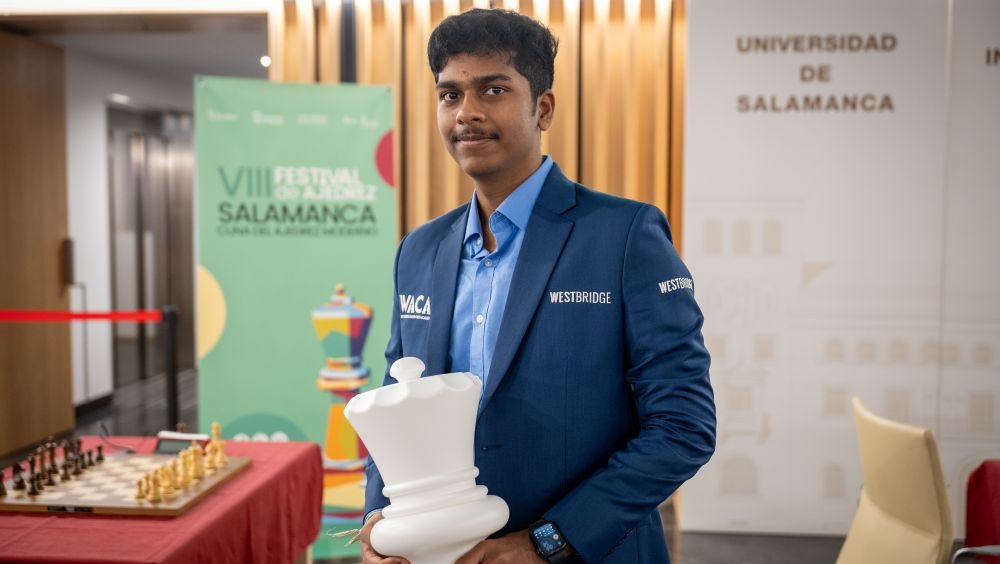
The eighth edition of the ‘Salamanca Cradle of Modern Chess’ Festival paid tribute to the city’s fundamental role in the history of the game. It was here, in 1497, that the student Lucena first compiled the modern rules in his work Arte de ajedrez con 150 juegos de partido. An original copy of this incunabulum is preserved in the University’s Historical Library. The tournament, held from October 22 to 25, featured a double round-robin format with a time control of 30 minutes plus a 5-second increment per move. The competition brought together six outstanding players: Ruslan Ponomariov, Pranav Venkatesh, and Julio Granda in one side, and Sara Khadem, Nadya Toncheva, and Sabrina Vega in the other. Heading into the final day, Pranav, the reigning World Junior Champion, stood as the sole leader with 6.5 points, a half-point ahead of the defending Salamanca champion, Ponomariov. The highlight of the last day was their second encounter in the eighth round (Pranav had won the first with the white pieces). Ponomariov achieved a comfortable advantage, exerting pressure on the Indian GM’s hanging pawns – but a single mistake cost him dearly. With 32.Qa3? (much better was 32.Rdc1! maintaining pressure) White allowed Pranav to launch a powerful counterattack with the thematic pawn thrust 32…d4! which turned the tables. After 33.Bxa8 (33.exd4? Bxg2 34.Kxg2 Qe4+) d3! Black won an exchange. Pranav’s conversion was not flawless – at some point it seemed Ruslan might hold a draw – but in the end, time trouble took its toll. 0-1 With this win Pranav practically secured the prestigious title in Salamanca. The World Junior Champion finished strong with two wins on the final day, scoring 9.5/10 and achieving an impressive performance rating of 2949. Another compelling storyline was the battle was for third place on the podium, which for the first time in the eight tournaments was going to be won by a female player. In the final round the strong Iranian-born player Sara Khadem, who became a Spanish national in 2022, was fighting against the tournament’s revelation, the young Bulgarian Nadya Toncheva. Toncheva emerged victorious, establishing herself as a player to watch closely in the women’s chess. She scored 50% against very strong opposition, a remarkable achievement. The success of this eighth edition—the number 8 being highly symbolic in chess—has been undeniable. The organizers acknowledge the sponsorship of the Salamanca City Council, the University of Salamanca (together with Alumni), and the Regional Government of Castilla y León. Final standings: Pranav V – 9½/10 Ruslan Ponomariov – 8 Nadya Toncheva – 5 Sara Khadem – 3½ Julio Granda – 2½ Sabrina Vega – 1½ Photo: Universidad de Salamanca Official website: salamancachess.com/
Opening ceremony of the 2025 FIDE World Cup dazzles in Goa

The Dr. Shyama Prasad Mukherjee Indoor Stadium in Goa hosted this afternoon the 2.5-hour-long opening ceremony of the 2025 FIDE World Cup, marking the official start of one of the world’s most prestigious chess events. A vibrant mix of India’s leading music and film industry artists delighted an audience of over a thousand players, officials, and guests with a series of breathtaking performances interwoven with inspiring speeches from dignitaries and chess leaders. At 4:30 p.m. sharp, the evening’s presenters welcomed everyone to the ceremony, noting that 206 top players from around the world will compete for the USD 2 million prize fund in what promises to be the toughest intellectual battle ever, focused on strategy, determination, and motivation. After the audience stood for the Indian national anthem, the dignitaries performed the traditional lighting of the lamp a symbolic act representing blessings, greatness, and positivity. The distinguished guests included Dr. Mansukh Mandaviya, Union Minister of Youth Affairs and Sports; Dr. Pramod Sawant, Chief Minister of Goa; Dr. Ramesh Tawadkar, Minister for Art & Culture, Tribal Welfare and Sports & Youth Affairs of Goa; FIDE President Mr. Arkady Dvorkovich; and AICF President Mr. Nitin Narang. A curtain-raising video followed, celebrating The Spirit and Story of Chess, and concluding with the stirring line: “Where strategy meets spirit and champions are born.” The Hormuzd Khambata dance company then took the stage with a dazzling performance paying tribute to Goan color and culture. Among the evening’s speeches, two stood out. Mr. Nitin Narang, President of the All India Chess Federation, read a recorded message from Prime Minister Narendra Modi, who expressed his hope that the FIDE World Cup would inspire a new generation of players. He emphasized that “the event offers a special opportunity not only to showcase talent but also to motivate the youth ” and with these words, he declared the FIDE World Cup 2025 open. FIDE President Arkady Dvorkovich followed, reminding everyone that the tournament is among the most important and dramatic in the FIDE calendar. Of the 206 players participating, only three will qualify for the 2026 Candidates Tournament, the gateway to the world championship match. Dvorkovich described Goa as “not just a coastal paradise, but the Colosseum of Chess” where legends are forged and new champions born. He concluded by wishing all players good luck and fair play, adding: “While we cannot yet say who will be the winner in Goa, two things are certain: this will be a great event, and the players will experience the full breadth of Indian hospitality, which is difficult to match.” As Dvorkovich ended his remarks, the audience rose for the FIDE anthem, followed by an energetic live performance of The Spirit of Goa by Hema Sardesai and her band. Then came a special moment: GM Divya Deshmukh, the recent 2025 Women’s World Cup Champion and the only female player in this event, joined the presenters on stage to conduct the drawing of lots. By selecting black for Gukesh, the top seed, it was determined that all odd-numbered players will start their first games with the black pieces. Divya shared her excitement: “Playing on home soil and representing India gives me an extra sense of pride and motivation.” A flute and beatbox performance by the Qudrot Duo followed, before the dignitaries reunited on stage to unveil the Viswanathan Anand World Cup Trophy – a magnificent brass and gold-plated creation, symbolizing passion, precision, and performance. A final video screening of the official World Cup song – It’s Your Move – preceded the night’s closing performance by the legendary Usha Uthup band, who brought the house down with powerful renditions including Skyfall from the James Bond film of the same name. Round 1 begins on November 1 at 3 PM local time. The action can be followed live on the FIDE YouTube Channel, featuring expert commentary by GMs Evgenij Miroshnichenko and Jan Gustafsson. To watch the games in person, tickets can be purchased [HERE] Official website: worldcup2025.fide.com/ Written by Michael Rahal Photos: Michal Walusza
FIDE, AICF and KIIT University sign landmark MoU to promote chess in education and society
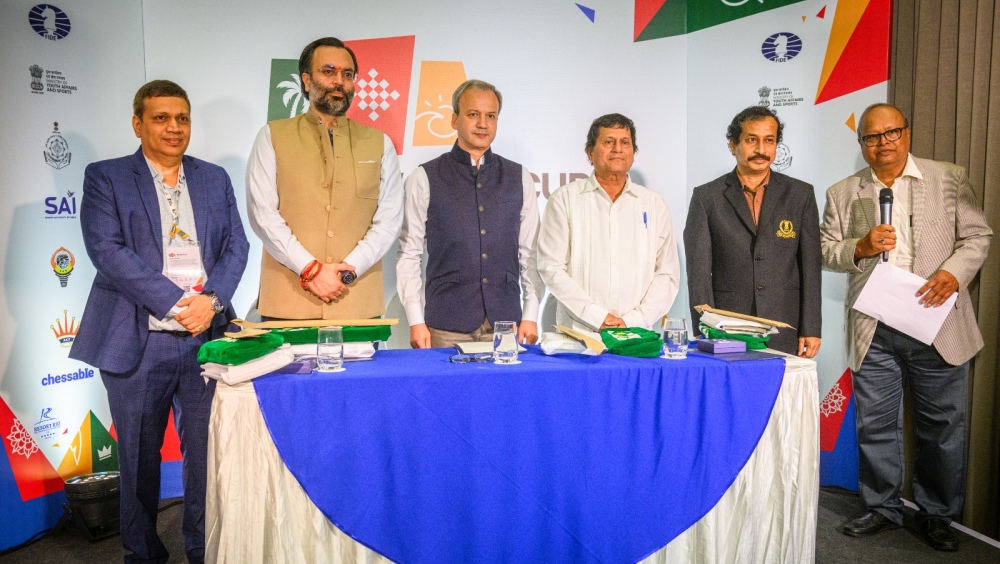
Goa, India — October 31, 2025 A new chapter for chess and education was written this morning at the Hotel Rio Resort in Goa, India, where the International Chess Federation (FIDE), the All India Chess Federation (AICF), and KIIT University officially signed a Memorandum of Understanding (MoU) to promote the values of chess in education and society across India, Asia, and the world. The signing took place just hours before the opening of the 2025 FIDE World Cup, highlighting the shared commitment of all parties to use chess as a tool for learning, inclusion, and personal growth. President Arkady Dvorkovich, representing FIDE; President Nitin Narang, representing the AICF; and Dr. Achyuta Samanta, Founder of KIIT and KISS Universities and Member of Parliament, signed the MoU in a ceremony attended by chess officials, educators, and media representatives. The agreement establishes a framework for cooperation through 2025 and 2026, focusing on joint initiatives such as training programs, workshops, conferences, research, case studies, school competitions, and awareness campaigns. The collaboration also aims to enhance teacher training and develop educational programs that bring chess into classrooms and communities — beginning in India and expanding globally. “We have recently launched the 2026 Year of Chess in Education, following this year’s Year of Social Chess. There is an ongoing effort to fulfill the social mission of our beloved game, and we are delighted to find more and more partners joining us in this endeavor. This Memorandum will help us promote chess in schools and share best practices and knowledge—not only in India but globally,” said Arkady Dvorkovich, President of FIDE. “It’s a proud moment to sign this MoU, with India leading the way in Social Chess. I am confident that AICF, KIIT, and FIDE will make every effort to ensure that every school provides access to chess from an early age,” said Nitin Narang, President of AICF. “We are committed to promoting all forms of sports in India, and our chess programs have been running successfully for many years. I warmly invite everyone to the January conference in the beautiful city of Bhubaneswar, and I hope it will be a great success,” said Dr. Achyuta Samanta, Founder of KIIT and KISS Universities. As part of the agreement, an International Conference on Social Chess and Educational Chess will be held in January 2026 in Bhubaneswar, hosted by KIIT University. This event will form part of FIDE’s global initiatives: the Year of Social Chess 2025 and the Year Chess in Education 2026, bringing together international and Indian experts to explore how chess can foster social inclusion and educational innovation. In closing the ceremony, Arkady Dvorkovich presented KIIT University and the AICF with the Social Chess Years Award Medal, in recognition of their commitment to advancing chess for social good. This landmark collaboration underscores India’s growing leadership in the global chess movement — demonstrating how the game can transform education, empower youth, and connect communities worldwide. About AICF The All India Chess Federation (AICF) is the national governing body for chess in India, overseeing the game’s development and organization from grassroots to elite levels across the country. About KIIT University KIIT (Kalinga Institute of Industrial Technology), based in Bhubaneswar, India, is one of the country’s leading universities, renowned for its commitment to inclusive education, innovation, and social impact through its sister institution, KISS (Kalinga Institute of Social Sciences).