

FIDE Grand Prix Berlin – Round 4 Recap
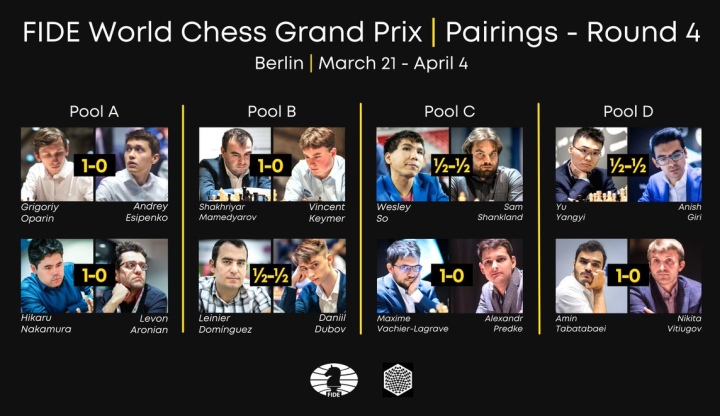
Five games out of eight ended with decisive results in Round 4 of the final stage of the FIDE Grand Prix Series, organized by World Chess. In a crucial game for the overall Grand Prix standings, Hikaru Nakamura defeated Levon Aronian and caught up with him. Grigoriy Oparin outplayed Andrey Esipenko and took the lead in Pool A, leaving Levon and Hikaru half a point behind. The game between Leinier Dominguez and Daniil Dubov ended in a draw; Leinier thus remained in the lead of pool B, now shared with Shakhriyar Mamedyarov, who outplayed Vincent Keymer. Maxime Vachier-Lagrave also took revenge on Alexandr Predke, and before the free day, the pool C ended up with all players tied on 2/4. Amin Tabatabaei avenged his first-round loss to Nikita Vitiugov, bringing all players of the pool D tied on 50% too. Pool A The game between Hikaru Nakamura and Levon Aronian was following the line in Ruy Lopez from the game Esipenko-Aronian in Round 3, but Hikaru chose to play 12.a4 instead of 12.Ne4. After numerous exchanges, White managed to get a promising position in the following endgame with rooks and minor pieces left on the board. “I think Levon got careless and thought there was no risk at all and went for Rg5-Rh5, but after I found 29.Ne7 I believe it’s very difficult for Black practically,” commented Hikaru after the game. It turned out to be one of the critical moments of the game and Hikaru assumed it was still possible to hold this position for Black with an accurate play. Aronian thought the mistake came even earlier on the 27th move, where he had to choose c6 instead of b6 played in the game. Hikaru managed to get a very strong passed pawn on d-file and placed his rooks on the seventh rank, forcing his opponent to defend against numerous threats and eventually converting his advantage. “It’s funny. It’s probably very bad for both of us because Grigoriy will probably win this game,” commented Nakamura on the Pool A situation after winning against Aronian. One inaccurate move 10…c5 by Andrey Esipenko in a well-known position that emerged from Nimzo-Indian gave his opponent Grigoriy Oparin a chance to get a very comfortable position with the stable edge due to the weak and isolated d-pawn in the Black’s camp. The game was a good example of how to handle this type of position: Grigoriy blocked the d-pawn, exchanged a few minor pieces and got prepared to win the pawn in a couple of moves. Andrey Esipenko’s desperate attempt to complicate the issue by playing 30…d4 and 31…a5 only postponed the catastrophe for Black, and even though the game finished the last today, the outcome was never in doubt. Pool B Shakhriyar Mamedyarov tested an original idea 8.Nh4 in the four knights English Opening against Vincent Keymer. He read about this move in an old book and remembered that g5 should not be good as White gets quite a strong attack on the kingside. Vincent decided to check if the sacrifice was a correct one and got into trouble after an unexpected 13.Qd2, missing that White’s pieces would get to Black’s King very quickly if he trades his knight for the Bishop on h6. After making a few precise moves, White transposed into a winning ending with a rook and four pawns vs two knights and a pawn and handily converted his advantage. Daniil Dubov played Two Knights defence today, but Leinier Dominguez didn’t show any intention to check a Fried Liver Attack and chose a solid line with 4.d3. Daniil was playing very fast today and had a huge time advantage by move 20. Black found the way to sharpen things after move 20 – Dubov thought he had some chances to get an advantage at this stage. However, Leinier found an excellent recourse 23.f4 followed by 24.Re1 thwarting Black’s attempts to get a strong initiative. After trading major pieces, a drawish bishop vs. knight ending appeared on the board, and the peace was signed after 52 moves of play. Pool C Two American GMs played a very solid game. Sam Shankland forgot to check the line with Bf4 and Qb3, which happened in the game and got a slightly worse ending due to the double pawns on b file. He decided to play more actively and put his rooks on a-file. “At some point, I really didn’t like my position but the move 16.Bf3 by Wesley was careless as I had g5, and Black is fine after that.” By playing g5, Sam Shankland offered a temporary pawn sacrifice, and following exchanges, the game ended in a draw. “If Maxime wins, then all of us are at 50%, and we will have a four-player tiebreak at the end,” said Sam after the game, while the MVL-Predke game was still in progress. Maxime Vachier-Lagrave and Alexandr Predke played a hard-fought game in a Ruy Lopez. After a long manoeuvring play, Maxime was hoping to get some attacking chances on the King’s side, but his opponent was finding interesting resources and even sacrificed a pawn to sharpen the game. Hoping to get a complex position with some winning chances, Maxime went for an unclear queen’s sacrifice. In time trouble Alexandr Predke didn’t find the best way to stop White’s threats, and after inaccurate 37… Rb2, Maxime gained the upper hand. “Objectively, I was worse or maybe even losing at some point… scary, but at the same time, I knew I had chances—that’s all I could hope for in this situation,” commented Maxime Vachier-Lagrave after the game. Pool D Yu Yangyi and Anish Giri waged a tense and very complicated battle in the Hungarian variation of the Gruenfeld Defense. The opponents followed a well-known theoretical path for awhile, but as Anish said in the post-game interview, he mixed something up and by move 14 they stepped into uncharted territory. With his 16th move, the Dutchman started chipping away in the center by f6 but it seems that White had an edge, although, in a very sharp position.
FIDE Veterans Support Program 2022: A tribute

A few weeks ago, FIDE announced the names of twelve chess seniors who will benefit from FIDE’s support to chess veterans. A total of €30,000 will be distributed among them with each receiving €2,500. As we did on previous occasions, we would pay tribute to these illustrious veterans with a few words about each one of them, summarizing their careers and achievements: Alexey Yuneev (Russia) Jay Bonin (USA) Jiri Lechtynsky (Czech Republic) Vija Rozlapa (Latvia) Giorgi Macharashvili (Georgia) Reynaldo Vera (Cuba) Evgenij Ermenkov (Bulgaria) Alexey Kosikov (Ukraine) Sheila Jackson (England) Galina Strutinskaia (Russia) Rani Hamid (Bangladesh) Gediminas Rastenis (Lithuania) Vija Rozlapa Born in 1942 in Liepaja, Vija Rzlapa learned chess at the age of 12 and immediately showed great promise. Just four years later she won the Latvian Girl Championship (1958) and then Soviet Girl Championship (1960). In 1970 Vija became a national master. A four-time Latvian Women Champion (1967, 1971, 1972, 1974) she started her career as a chess trainer back in 1964 and successfully continues nowadays. She has been working in Riga Chess School since its foundation in 1972. The list of her students includes GM Alexei Shirov, WGM Laura Rogule (LAT) and NA Egons Lavendelis. An active participant of senior events Vija Rzlapa has won bronze at the World Senior Team Chess Championship twice (2014, 2015). Alexey Yuneev Born in 1957 Leningrad, Alexey Yuneev came master in 1980 and nine years later won his native city championship. A graduate of the Gertsen Pedagogical University, Yuneev has been working as a trainer-instructor since 1985 to date in the St. Petersburg State Palace of the Youth Creativity. The list of his students includes GM N. Vityugov, gold winner as a member of the Russian team at the World Team Championships (2010, 2013), Champion of Russia (2021, super finals winner), and GM M. Matlakov, (European Champion 2017), runner-up in the Championship of Russia (2021, super finals). Since 1990 Alexey Yuneev has been in charge of the municipal union of the chess instructors, which is a very important body for the St. Petersburg chess development. Starting from 2000 has been organizing and holding chess workshops for chess instructors helping more than 300 people to improve and hone their teaching skills which indirectly translates into thousands of young chess players. Giorgi Macharashvili Born in 1955 in Tbilisi, Giorgi Macharashvili became a professional chess coach in 1976. The author of 11 books, since 1992 he has served as the main coach of national youth and cadets’ teams at World and European Chess Championships. With Giorgi at his helm, the National Georgian Women’s team won silver at the European Team Chess Championship. The long list of his students includes GM Nana Dzagnidze – Women’s World Blitz Champion (2017), European Women’s Champion (2017) and the winner of Chess Olympiad (2008); WGM Maia Lomineishvili – the winner of Olympiad (2008) and European Junior Champion U14 and U20; WGM Ketino Kachiani-Gersinska, the winner of Word Junior Championship U20 (1989 and 1990). Reinaldo Vera Born in 1961, Reinaldo Vera achieved his first international success at Junior World Championship (Innsbruck, 1977) where he finished fourth. In 1979, he was awarded the IM title and nine years later received GM title. A prominent fixture of the National team for over 20 years, a two-time Cuban Champion, Reinaldo Vera took part in four World Team Championships and ten Chess Olympiads. His best result was an individual gold medal on the third board (Elista, 1998). His tournament record includes winning or sharing the first places in Havana (1980), Varna (1986), Leon (1996), and San Sebastian (2007). FIDE Senior Trainer since 2007 he gives chess lessons both live and online. Evgenij Ermenkov Born in 1949, Evgenij Ermenkov has been a competitive chess player the last 60 years of his life. He became the junior champion of Bulgaria at the age of 17 and quickly moved up in the rankings. He became an IM in 1974 and three years later received GM title. The 5-time national champion he represented Bulgaria at Chess Olympiads from 1978 to 1992. His most notable achievement in team competitions is silver medal on board 4 at the Olympiad in Novi Sad (1990). Ermenkov’s tournament resume includes victories in Albena (1997 and 1979), Plovdiv (1978 and 1979), Varna (1986), Dieren (1990), Beirut (2004) and Imperia (2005). Jay Bonin Born in 1955 in New York, Jay Bonin is known the “Iron Man of Chess”. One of the most active tournament players in history of chess, he played over 25,000 tournament games (over 13,000 games since the US Chess Federation started collecting data in 1991 and an estimated 12,000 games for his almost 20 years of tournament play prior). His prolific and long chess career took off in 1980s, when Bonin won the New York State Championship (1982). He later won this title in 1997 and 1999. In 1983 he earned the title of FIDE Master and two years later became Jay also won the championship of the Marshall Chess Club (in which he worked as a manager and tournament director from 1977 to 1979 and then from 1998 to 2002) in 1984, 1987 and 1997. The year 1997 was marked by his unique achievement as Bonin won “Triple Crown” of New York chess events: The New York State Championship, Manhattan Chess Club Championship, and Marshall Chess Club Championship. His life as a chess professional was twice profiled in the New York Times. A popular chess teacher, author, and lecturer, Jay Bonin is a true legend of US chess. Jiri Lechtynsky Born in 1947, Jiri Lechtynsky was one of the leading players of Chezcoslovakia in 1970s and 1980s. He earned the title of IM 1974 and eight years later became GM. The participant of three Chess Olympiad he played for Czechoslovakia in 1974 in Nice (with a score of 5/7 as a second reserve player), in 1980 in La Valletta, Malta (with a score of 2,5/4 as a second reserve player), and in 1986 in Dubai (with a score of 4/6 as a second reserve
FIDE Grand Prix Berlin – Round 3 Recap
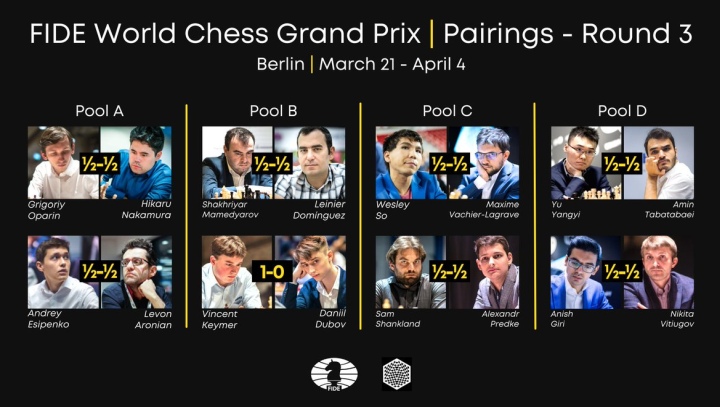
The local hero Vincent Keymer outplayed Daniil Dubov and joined Leinier Dominguez in the lead of Pool B of the third leg of the FIDE Grand Prix Series, organized by World Chess. The rest of Round 3 games ended in a draw, which allowed Levon Aronian, Alexandr Predke, and Nikita Vitiugov to keep leading positions in other groups. Two more games could have finished decisively today. Grigoriy Oparin came very close to upsetting Hikaru Nakamura, who eventually escaped with a draw. Sam Shankland had winning chances in the endgame with Alexandr Predke but could not make it work. It was the longest game of the day, which ended in a draw after 57 moves. Pool A Nakamura played the most existing game of the round. Oparin guessed his opponent’s choice in the opening right, which was the Queens-Indian Defence today. It has been more than five years since Hikaru Nakamura played it in the tournaments, so he was not expecting the idea of h4-h5-h6. White quickly got quite a promising position but had to play precisely in order not to give a chance for Black to consolidate. A beautiful move 19.Bg6 came as a huge surprise to Hikaru, who simply missed this option. “I was very upset with myself during the game because essentially I blundered one move. In this line with 19.Bg6 and after 19…fxg6 20. Qe7 Rd5 White has this Re6. I simply have forgotten this move existed,” said Hikaru in his post-game interview. Similarly to the game against Aronian in Round 1, the American player was ready to resign once his opponent had played 20.Bb1. Even better was 20.Bf5! simply winning a piece. Grigoriy failed to find these continuations and opted for 20.Bh7, which gave Hikaru some hope to escape with a draw. Despite being down a pawn, Black had some compensation due to the pair of Bishops and active pieces. After a few exchanges, the game ended in a draw after a three-fold repetition. “After finding Bg6 it feels it would be nice to win the game, but it is what it is,” said Grigoriy Oparin after the game. Andrey Esipenko and Levon Aronian tested one of the lines in the Ruy Lopez but Andrey mixed something up right in the opening and was clearly disappointed with his play. He had to show a certain level of creativity not to get into trouble and came up with an interesting idea 17.Bg5 which changed the course of the game. Levon Aronian saw the strongest continuation 17…Kh8 but started seeing ghosts in some lines as he pointed out after the game. He chose another option 17…h6 but it turned out that White could trade the queens and maintain the balance in the game that was drawn on move 33. Pool B The Ragozin Variation was played in the game Mamedyarov – Dminguez and for the first time in the tournament Shakhriyar Mamedyarov was satisfied with the outcome of the opening. He came up with a very tricky idea Ba2 hoping to get a very strong attack on the King’s side. The American Grandmaster proved he has nerves of steel once again and found very precise moves to stop ambitious plans of Azeri Grandmaster. 17-year-old Vincent Keymer managed to break his drawing streak in Berlin by defeating Daniil Dubov. Players chose a complicated line in Vienna Variation of Queen’s Gambit, where Daniil showed an original set up of the pieces by placing his knight on d7 with an idea of pushing c5. Vincent started to like his position after Black put his queen on e8 as he felt it was easier to play with White. The German thought he could afford many waiting moves without worsening his position. In contrast, Daniil thought he should get better after White’s Bishop maneuvers g5-f4-g3 as, in his opinion, it was not the way to play for victory with White. “I was trying to find some ways to get a better position, and I thought it must be winning, It became complicated and then I blundered a piece”, described the game Daniil. According to the heartless computer, the position became hopeless for Black after move 21 when Daniil didn’t remove his knight from d3 but went for a very complex line. White always had the upper hand from that moment to the very end. Vincent Keymer scored a crucial victory over Daniil Dubov, leaving him on minus two after three days of play. Pool C Sam Shankland and Alexandr Predke had an interesting discussion in the Carlsbad structure of the Queen’s Gambit. Alexandr chose an interesting plan of advancing his pawns and the queenside and trading his light-squared bishop on a6. White regrouped his pieces and managed to place his knight on the central square e5 but didn’t achieve much by this point. The first critical moment happened on move 23 when Predke carelessly played Nc4 missing a strong reply 24.a4, which left Black with weaknesses on the queenside. Shankland transposed into a rook ending with a pawn up, but it was not enough for a victory. Maxime Vachier-Lagrave used his pet Gruenfled Defence against Wesley So reached a draw quite comfortably. “I have no idea what to play against Maxim’s Gruenfeld after seven years now”, confessed Welsey So. He didn’t expect the line with c5 and Bf5, which was previously played by Alexander Grischuk and had prepared for a different variation. Maxim didn’t want to burn bridges despite the tournament situation and found the precise way to avoid any trouble. After massive exchanges, the players ended up in an equal ending and signed the peace after 37 moves. Pool D The game Yu Yangyi – Amin Tabatabaei saw a rock-solid Makagonov-Bondarevsky system in which White has problems getting any edge. After the Chinese player made a thematic breakthrough in the center e3-e4, the game liquidated in a drawn endgame in which the opponents spit the point on move 30. Nikita Vitiugov essayed the Paulsen System of Sicilian against Anish Giri, and very
Fourth Chess in Education Lecturer course announced
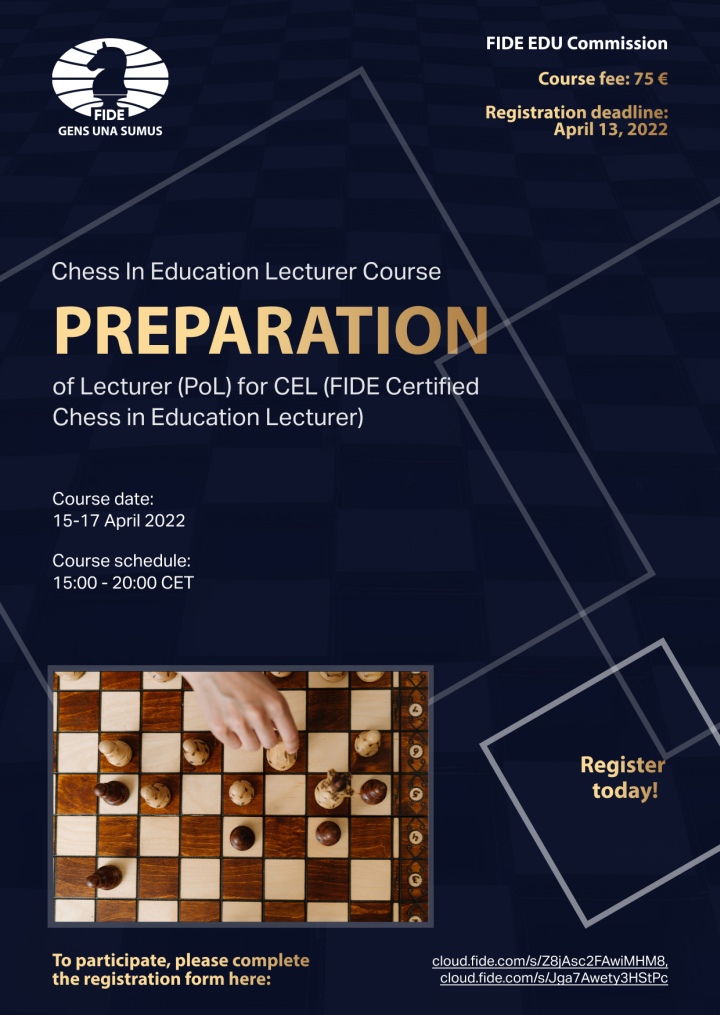
This fourth course of the Chess in Education Lecturer series will be held on 15-17 April. Those who gain this qualification (CEL) will be those, exclusively, who we appoint to the paid lectureships of the FIDE School Instructor seminars. ‘I have learned a lot,’ WGM Eva Repkova, Chairperson of FIDE Commission for Women’s Chess. CEL Lecturers will be experts in educational chess (not necessarily experts in competitive chess). They will be trained by the EDU Commission, after an online capacitation course of 15 hours, with some offline extras. This training has a cost of €75, which covers both access to materials and preparation, and the exam. Those who successfully pass the course will receive the diploma of Certified FIDE Chess in Education Lecturer (CEL). This is valid for three years, and it implies an administrative fee of €50. Here is the course description in more detail:https://cloud.fide.com/s/kY9Fs5pQ5D9gDS7 ‘A nice experience, fantastic course,’ FM Vlad Ungureanu, national coordinator of Romania chess in schools program. Applications for the course are open now and will close on 13 April. If you want to apply, please fill in the Registration form for “Preparation of Lecturers”, Your CV & Motivation letter should pay special attention to your relevant experience in “educational chess”, rather than “sport chess” (please check this explanatory document if you are unsure about the difference between these two concepts). ‘This kind of course is a very good idea,’ FM Leontxo Garcia The course will be held 15-17 April, in English, online 15:00-20:00 CET (Central European or FIDE time). Applicants must complete the Registration Form (DOC), (PDF). The course is limited to a maximum of 20 people (first come, first served). Applicants who cannot be given an assured place will be placed on the waiting list for the subsequent course.
Support Ukrainian Chess Players and their Families
The FIDE Commission for Women’s Chess in cooperation with chess24 seeks your donations to help our Ukrainian chess players and their families. In light of the recent events, the FIDE Commission for Women’s Chess has established a fundraising for Ukrainian chess players and their families being affected by the ongoing war in Ukraine. We have also reached out to a number of women chess players in Ukraine that all of us know well in our chess community. They are being caught up in a conflict that would have been unimaginable just a month ago. You can join this great initiative of providing support to the Ukrainian chess players and their families by making your donation here.
#40
Geir Nesheim, new Chair of the Social Commission Ahmed Adly, new Chair of the Athletes Commission FIDE’s support program to chess veterans: a tribute French Chess Federation acquires “delegation” status in France Brief news from National Federations READ NEWSLETTER
FIDE Grand Prix Berlin – Round 2 Recap
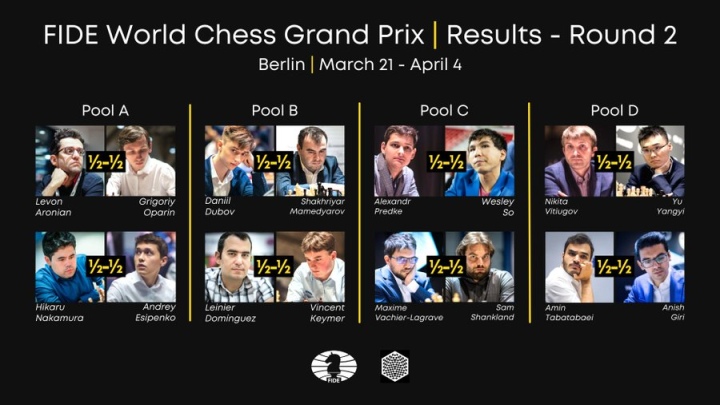
It was a peaceful, but by no means uneventful day at the third leg of FIDE Grand Prix Series organized by World Chess although all eight games in Round 2 were drawn. “Let’s talk about how dramatically the situation changed in every group after today’s round” joked the tournament commentator GM Evgeny Miroshnichenko and certainly, the standings have not changed at all as we have the same leaders as after Round 1 in each pool, namely Levon Aronian, Leinier Dominguez, Alexandr Predke, and Nikita Vitiugov. Round 2 results still don’t tell the entire story, as, despite peaceful outcomes, the games were hard-fought and enthralling. Pool A In the Giuoco Piano Levon Aronian, playing with White against Grigoriy Oparin, essayed the idea 12.Ra3, introduced by Nils Grandelius in the match against David Howell. After the game the American player added that he learnt from the best. He could not regret his choice as the game turned out to be very eventful. By lifting his rook White offered a pawn sacrifice, hoping to get some long-term initiative instead. Grigoriy spent a lot of time trying to remember his notes but eventually had to figure everything over the board. “At that point, I had to take the pawn. With the whole concept of Black’s play, it doesn’t make any sense otherwise,” Oparin explained after the game. Aronian managed to regain the pawn in the ensuing complications, but he is not sure if 21.g4 was the best option. According to Levon, he could have played 21.Nc8 trading the knight for the bishop, followed by g3, which he thinks is more unpleasant for Black. On the other hand, it looks like after 21…g5, Black is OK. Grigoriy defended with precision, and the peace was signed right after the first time control. Hikaru Nakamura obtained a promising position in Nimzo-Indian against Andrey Esipenko with a strong knight on e5. American Grandmaster played creatively in the opening, trying to get something interesting but then allowed the opponent to grab initiative by planting his knight on c4. “The game was basically around two squares e4 and e5. At some point, I just needed to trade the knights on c6 and make a draw, but I didn’t want to and just kept playing,” said Hikaru after the game. He called his plan with b4 and Na4 “insane” as after those moves, Black emerged clearly better, and for the rest of the game Andrey pressured Hikaru. Being in a time trouble Andrey didn’t find the a precise way to keep the tension, and after the massive exchanges, the game stirred into the ending with a visible edge for Black due to the pair of Bishops and better pawn structure. Nevertheless, it was hard to break through the position of White, and the American escaped with a draw thanks to the resilient defence. Pool B: The game Leinier Dominguez – Vincent Keymer saw a topical line of the Ruy Lopez in which the American introduced a novelty (the first line of Stockfish) on the move 14. After a tactical battle in the centre, Leinier won a pawn for which Black did not have sufficient compensation. After trading the queens, a very interesting ending with opposite-colour bishops and extra pawn for White appeared at the board. According to Lenier, he thought Black could not allow g6 move and had to take on g5 on 49th move. It seemed White had good winning chances, but the endgame requires a detailed analysis to make the final conclusions. To Vincent’s credit, he defended exceptionally well and saved a half-point in the game. Daniil Dubov surprised Shakhriyar Mamedyarov with a rare 4.Nc3 in the Italian Game, but did not achieve much. Daniil pointed out that c5 was a strategically risky move for White as if White doesn’t manage to push d4, he can be worse. The Azerbaijani GM played solid, logical moves and got some play against the d3-pawn that outweighed White’s pressure in the center. The opponents started repeating the moves in a very complex balanced position in which draw seemed like a logical outcome. “I think both sides could actually play in the final position, I don’t think I was better or worse; in general, it all felt very logical, and I think it was just a decent game. The reason why we repeated the moves is that if my opponent will play Nh7 when I don’t have d4 I’m much worse. That’s why I needed his rook to go away from d8,” explained Daniil after the game. Pool C Alexandr Predke, playing with White, managed to pose some serious problems for Wesley So in Giuoco Piano, which he called “very playable”. As the American confessed in a post-game interview, he missed the move 23.Ne3, which gave White a dangerous activity in the center. Alexandr thought that he had good winning chances, but it seems that Black’s position was not that bad, as Wesley reached a draw with several precise moves. “This is the first time I play against Alexandr… He is a very good player; yesterday, he won a very good game against Maxime,” said Wesley at the post-game interview. Maxime Vachier-Lagrave and Sam Shankland played the Berlin Defense, which is known as the Berlin Wall. Many great players have struggled to breach this solid barricade, and the French GM could not complete the task. Sam went for a strategically risky line, allowing White to play f5 as he was looking for a more dynamic fighting position. In a critical moment of the game Sam correctly sacrificed an exchange and got good compensation in the form of two pawns and active pieces. After trading a pair of rooks, none of the sides had winning chances and the game finished in a draw. It turned out that both players had visited the Berlin Wall and surprisingly didn’t think about chess while walking next to it. Sam Shankland was actually thinking about his close relative who lived in Germany many years ago. “My dad grew up in Germany, my grandparents
FIDE Council Meeting, March 15, 2022: List of decisions

The FIDE Council held on March 15, 2022, in online format, made several important decisions: 1. To award the organisation of the 44th Chess Olympiad to the All India Chess Federation to be organised in Chennai within the period from 28.07.(opening ceremony) till 10.08. (departure). 2. To award the organisation of the 94th FIDE Congress to the All India Chess Federation to be organised in Chennai within the period from 31.07. (arrival) till 09.08. (departure) and to approve 07.08. as the date for FIDE elections. 3. To note strong preference to organise the Chess Olympiad for people with disabilities at the same dates as the 44th Chess Olympiad. 4. Taking into account the current recommendations of the IOC, to suspend the national teams of Russia and Belarus from participation in official FIDE tournaments until further notice. In the individual tournaments of the FIDE World Championship cycle, players from these countries will be allowed to participate under the FIDE flag. 5. To postpone the Women’s Candidates Tournament 2022 to the last quarter of 2022 and to continue consultations with players regarding the format of the tournament. 6. To approve the proposals of the FIDE Medical Commission in principle. To request the FIDE Management Board and FIDE Medical Commission to prepare details regarding practical steps in respect of the implementation. 7. To hold the next meeting of the FIDE Council on 27-29 April 2022 in the United Arab Emirates. 8. To approve the bid of the Isle of Man for the organisation of the Grand Swiss 2023 and Women Grand Swiss 2023.
FIDE Grand Prix Berlin – Round 1 Recap
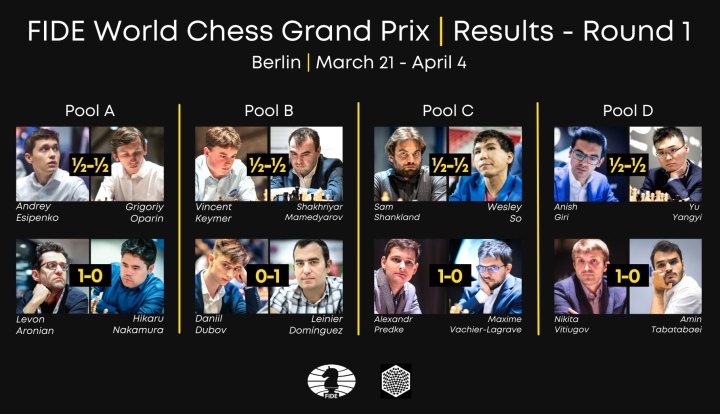
The third leg of the FIDE World Chess Grand Prix Series organized by World Chess got off to a promising start, with four players securing victories and four games ending in a draw The first round of the final leg of the FIDE Grand Prix saw Levon Aronian, Leinier Dominguez, Alexandr Predke and Nikita Vitiugov score victories and grab the lead in their pools. The four other games all ended in a draw. Pool A: Andrey Esipenko didn’t manage to give himself a birthday present in his game against Grigoriy Oparin as the two split a point. Nevertheless, the present was “delivered” a few days earlier when Esipenko joined the tournament becoming the last-moment replacement of Dmitry Andreikin. Esipenko turned 20 today and as a real professional player spent the whole day at the board. The opponents tested a popular line of the Catalan in which Black solved all his opening problems, reached equality and confidently made a draw in a slightly inferior endgame. Hikaru Nakamura challenged Levon Aronian with Black in a sharp line of the Queen’s Gambit Accepted that the latter had played against Leinier Dominguez just a month ago at the first FIDE Grand Prix leg. Levon expected anything but this line today but still had “a couple of ideas” in his pocket. He deviated with 14.Qd2 (one of the possible moves in this position) and probably threw Hikaru off his preparation as just five moves down the road, he committed a serious inaccuracy 19…Bf5. Still, the position remained quite unbalanced but another grave mistake by Nakamura 23…Nf4? became the last straw. Aronian immediately transposed to a won endgame and smoothly scored a full point. According to Hikaru, the critical moment came on move 20 when he spent most of his time contemplating g5. He didn’t go for it and ended up in a worse position. “If Levon would have played 25.Qa5 instead of 25.Qa7 I would probably just resign the game, I was just ready to go home,” said Nakamura with a smile on his face, admitting that the game went off the track for him either way. Pool B: Vincent Keymer obtained a slightly better position in a quiet line of the Queen’s Gambit against Shakhriyar Mamedyarov, but after massive exchanges the Azerbaijani GM had no problems holding a draw in a bishop ending. Leinier Dominguez defeated Daniil Dubov in a topsy-turvy game that could have ended in a draw. The American gradually outplayed his opponent in a fresh position with two knights vs. two bishops that emerged from a classical line of the Nimzo-Indian but let his advantage slip away in a mutual time scramble. During the post-game interview, the American grandmaster noted he missed the queen’s manoeuvre Qe4-Qh4 and thought his position looked very dubious at that point. He exchanged his Bishop for the Knight on f3, opening g-file for his opponent, but managed to survive the toughest times of the game by moving his knights to h5 and f6 squares. Surprisingly, right after passing the time control, Dubov dropped the ball with 43.Rf3?? and after 43…Rc2! he had no other option but a hopeless rook endgame in which he capitulated just a few moves later. Pool C: Sam Shankland and Wesley So played a trendy line of the Nimzo-Indian tested on a very high level recently. Once again Shankland impressed everyone with his home preparation as he introduced a novelty 12.Ne2 and had analysed everything at home until move 23, albeit with a different move order. “The whole position looks symmetrical but it’s not so easy for Black as White gets first on d5 square with the knight and Black’s knight on f6 is passive,” noted Sam after the game. Wesley managed to equalize with a series of precise moves. The opponents ended up in a rook endgame in which White had some practical chances. Shankland even managed to win a pawn, but it was not enough with four-vs-three on one side. So demonstrated necessary accuracy and reached a draw on the move 50. The game Alexandr Predke – Maxime Vachier-Lagrave saw a very sharp line of the English Opening in which the former demonstrated much better preparation. On the move fourteen, the Frenchman quite optimistically castled short, apparently missing quite a strong pawn sacrifice 15.g4! White opened the lines on the kingside and arranged his pieces for an attack which became unnecessary after Maxime blundered with 19…Nxe4? and threw in the towel facing the loss of a piece. Despite the result, the French grandmaster doesn’t lose hope: “I know I just need to win this tournament and obviously it’s not a good start for me but there are a few more games to go and I will be ready to fight.” Pool D: Anish Giri didn’t follow the recommendations of his own Chessable course in the Petroff Defence and instead surprised his opponent Yu Yangyi with an interesting novelty 9.Be3, achieving a good compensation for the sacrificed pawn. The Dutchman quickly restored material equality and got the upper hand. Anish built up pressure with precise moves, but just one mistake 26.h5? was enough to change the evaluation from “White is winning” to “not so clear”. “Probably I played well until very far but it took me a lot of time. To be honest I can’t say I regret taking the time as I could not see all those ideas in the game at first.” The Chinese player got some dangerous activity on the queenside and even emerged slightly better, but after going through a very tough position earlier, he accepted a draw. Nikita Vitiugov probably caught Amin Tabatabaei on the back foot by introducing a novelty 13.Qxd2 (the first line of Stockfish) in the Open Variation of the Ruy Lopez. Indeed, the GM from St-Petersburg quickly won a pawn and although his conversion was not ideal, he eventually put away the Iranian in a rook endgame. “I believe that after 14…f6 White is significantly better, but later on Black definitely had some drawing chances,” said Nikita after the game. Amin agreed that the biggest chance to equalize the game came on move 30 after White played 30.Ra5. “I should have played
Ahmed Adly, new Chair of the Athletes Commission
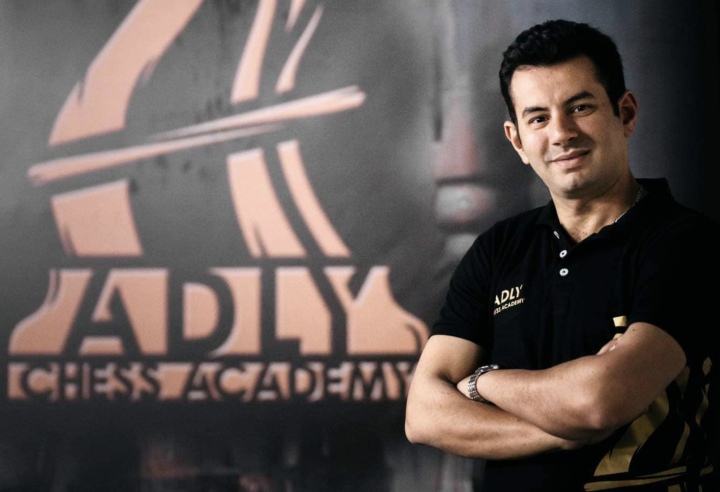
Grandmaster Ahmed Adly, from Egypt, is the new Chair of the Athletes Commission for a period of six months. He takes the baton from the Women’s World Champion Ju Wenjun. When the Commission was created in the beginning of 2021, FIDE received nine candidacies for the ten elected positions. Therefore, voting was not required, and these nine candidates made it directly into the Commission. In order to reach the number of members established on the regulations another four members were appointed by the FIDE Council: IM Ekaterina Atalik (proposed by Ms Tulay), IM Jomo Pitterson (proposed by Mr. Wilkinson) and IM Alina Kashlinskaya (proposed by Mr. Dvorkovich). Dinara Saduakassova (Kazakhstan) was the first athlete to chair this Commission for a period of half a year, followed by Ju Wenjun and now Ahmed Adly, in a six-month rotation. After the FIDE Congress 2022, a new electoral process will be held, electing 15 new members for a four-year term. Born in February 1987, Adly is one of the strongest African players in history, and a world-class player who won the World Junior Chess Championship in Armenia in 2007, as well as a bronze medal in the World Championship Under 18 in Greece, 2004. In 2005, 2011 and 2019, he won the African Chess Championship, and in February 2021, he won the Africa Online Open with a score of 7.5/9. Ahmed is also the CEO of his own chess school, a FIDE official Academy in Cairo that bears his own name. With a 600 sqm venue and a staff of 26 people working there, Adly Chess Academy trains more than 250 pupils, who are already achieving their first successes in national and continental competitions. The purpose of the Athletes Commission (ATH) is to enable the players’ voices and experiences to be heard and used for the improvement of chess as a sport. Involving athletes in the decision-making process is a core component of good governance within sports organizations, allowing them to provide early feedback on potential decisions that will affect them. This peer-to-peer cooperation helps to safeguard the credibility of the sport. Likewise, this body will actively promote and support the establishment of Athletes’ Commissions in Area Associations and Member Federations. The figure of an Athletes Commission is common among members and stakeholders of the Olympic movement, like other International Federations (IFs), National Olympic Committees (NOCs), the World Anti-Doping Agency (WADA), or the Organizing Committees of the Olympic Games (COCGs).