

FIDE Grand Prix: Esipenko replaces Andreikin in Berlin
GM Dmitry Andreikin withdrew from the third leg of the FIDE Grand Prix Series, organized by World Chess, due to personal reasons. Following the FIDE President’s decision, and according to the regulations, he will be replaced by GM Andrey Esipenko, as the highest-rated eligible player in as of December 2021 list. OAnastasiia Photo: Anastasiia Korolkova The third and final leg of FIDE Grand Prix will take place in Berlin from March 21 to April 04.
Second workshop on increasing inner strength to be held on March 27
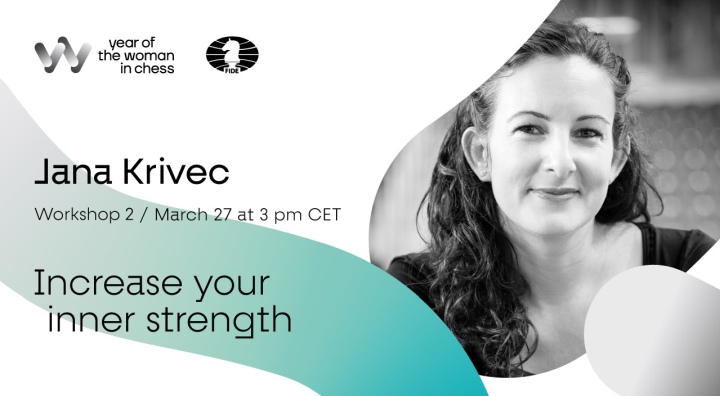
WGM Jana Krivec, a Doctor of Psychology and a university professor, author of a book titled “Improve Your Life By Playing A Game” and a seven-time winner of the Slovenian Women’s Championship, continues a series of monthly workshops “Increase your inner strength”, scheduled between February and November 2022. The project is a part of the Queens’ Festival, also under the umbrella of the Year of the Woman in Chess, that the FIDE Commission for Women’s Chess prepared for this year. It aims to increase awareness of the power of the mind, help people to get to know themselves better, understand their inner world and learn some useful mental techniques to increase inner strength. “Within webinar 2 of the workshop “Increase your inner strength”, we will be the detectives of our own personality traits. We will discuss the concept of identity, self-awareness, personality, self-esteem and optimism. Participants will be asked to complete surveys, and we will discuss how to interpret the results. That is how we will begin our journey to our inner self,” Jana Krivec said about the second event of the project. The second workshop is scheduled for Sunday, March 27, at 15:00 CET. If you are interested, please fill out this form.
Workshop: How to Teach Pawn Endings by Artur Jussupow

The FIDE Trainers’ Commission announced a new workshop “How to Teach Pawn Endings” by GM Artur Jussupow, a World Championship Candidate who has been ranked as high as third behind legends Garry Kasparov and Anatoly Karpov at their peak. The seminar will be held in English via Zoom. Photo: Vladimir Jagr Here are several most important topics to be discussed at the workshop: 1. Correct approach to the study of pawn endgames, all the necessary elementary positions2. Classification of pawn endgames into two types3. Description of typical pawn endgame ideas4. Difficulties that our students may encounter when studying the opposition.5. Using the pawn endgame to train calculating variations, to develop strategic thinking, to develop logical thinking6. Forms of training used in studying the pawn endgame7. Other challenges for the trainer. Answers to the questions “This wonderful study by M. Zinar from 1987 will help you get rid of the inappropriate overestimation of the role of the opposition in the pawn endgame. We will discuss this study on March 26,” Artur Yussupow said, introducing his seminar. White to play and draw Fee: €50 for Licensed Trainers, €80 for others. Current licensed FIDE Trainer title-holders will be given credits towards potential title upgrades at attendance in a future seminar. Artur decided that all proceeds from the workshop are to be given to the FIDE Ukraine Support Fund. You can also join this great initiative of providing support to the Ukrainian chess players by making your donation here. Please download and complete the following registration form and email at: trainers@fide.com *Female Participants are Free – FIDE’s The Year of the Women in Chess – with Nomination or Endorsement of the FIDE Commission for Women’s Chess.
Russia and Belarus teams suspended from FIDE competitions

Taking into account the current recommendations of the IOC, the FIDE Council suspends the national teams of Russia and Belarus from participation in official FIDE tournaments until further notice. In the individual tournaments of the FIDE World Championship cycle, players from these countries will be able to participate under the FIDE flag.
Chennai to host the 2022 Chess Olympiad
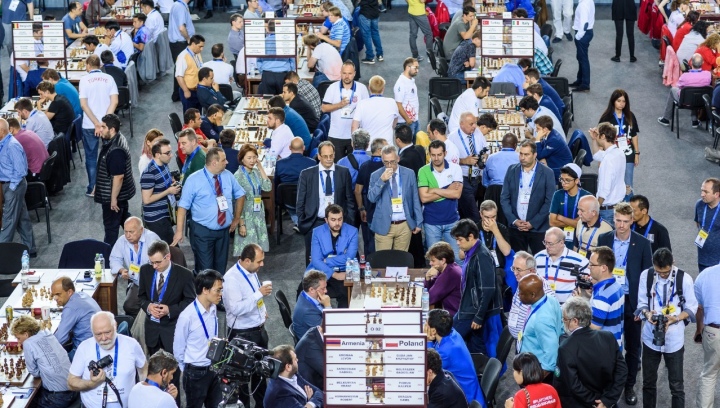
The FIDE Council has approved today the bid presented by the All India Chess Federation (AICF) to host the 2022 Chess Olympiad in Chennai, the capital of the Tamil Nadu state. The exact schedule is still being discussed and will be announced in the coming days, but the event will take place between the end of July and the beginning of August, not very far off from the dates originally planned. The venue will be the convention centre at the Four Points by Sheraton, located in the Mahabalipuram area, one of the main touristic destinations in southern India. Situated in the Bay of Bengal in eastern India, this city of 7 million inhabitants is also home to the legendary World Champion Viswanathan Anand, the first-ever Grandmaster from India. But the chess tradition of Chennai goes even further back, as the first Indian player to ever achieve the International Master title, Manuel Aaron, also grew up in the city. And, of course, Chennai previously hosted the 2013 World Championship, where Magnus Carlsen was first crowned World Champion, defeating Vishy Anand. The AICF Secretary Bharat Singh Chauhan, who is also a Chairman of the FIDE Technical Commission (TEC), underlined the importance of the experience already gained by him and his team in recent years. “The experience with Delhi Chess Open, the largest event of its kind in the world, will be a big help, as we have already dealt with large numbers. But Olympiad is a big game. I am sure we will make it the best,” he said. The 44th Olympiad, which was supposed to take place in Moscow and Khanty-Mansiysk, was shifted out of Russia following FIDE’s reaction to the war in Ukraine.
The winners of FIDE Grand Prix crowned in Belgrade
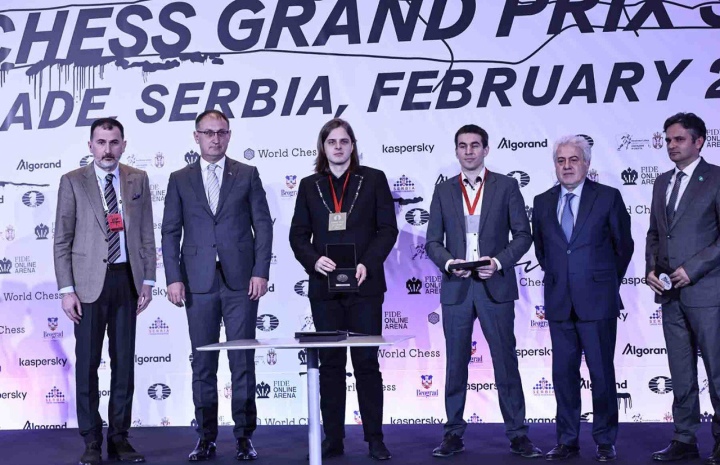
The second leg of the 2022 FIDE Grand Prix Series organized by World Chess was concluded in Belgrade’s Crowne Plaza hotel, with the closing ceremony attended by local and international chess representatives, players, and distinguished guests from Serbia and abroad Following the intonation of the Serbian national anthem, the guests were shown a short video recapping the events which took place in Belgrade over the past 14 days. The president of the Serbian Chess Federation, Dragan Lazic, said that Serbia was honoured to play host to such an important and big global chess event. “We have not had a chess event like this in Serbia for over 25 years… We are pleased that all the participants and guests were happy with the conditions and that everything went smoothly. We would like to express our gratitude to FIDE and Mr Arkady Dvorkovich for their support… I wish grandmasters Rapport and Andreikin lots of success in further tournaments, and we in Serbia will be rooting for them”, Lazic concluded. In a pre-recorded statement, FIDE President Arkady Dvorkovich congratulated Serbia and its chess federation on organising the event and providing the players and guests with excellent conditions. “Congratulations to the winners, Richard Rapport and Dmitry Andreikin. Stay healthy, and best regards to you and your families. See you in the next tournaments”, Dvorkovich said. FIDE Deputy – President Bachar Kouatly thanked the president of Serbia, the government and the Serbian chess federation for supporting the event. Speaking about Richard Rapport, Kouatly said that he is “representing the creativity in chess we all like when we look at his games”. Both Richard Rapport and runner-up Dmitry Andreikin were awarded medals for their success. Andreikin thanked his family for the support and complimented the organisers for providing good playing conditions. The final speech was by the winner of the second leg of the Grand Prix series, Richard Rapport, who praised Belgrade and Serbia for the help and support he received in the country. “I had a great time in Belgrade since I’ve started living here eight years ago. I’d like to thank the people of Belgrade who welcomed me many years ago and helped me develop and grow as a person. Of course, the crown jewel of these people is my wife, so I’d like to thank her. I really hope that chess will keep on growing in Serbia as it should. I know for a fact that the culture is craving for it. Let’s hope there will be many big tournaments of such magnitude as the Grand Prix here in Serbia”, said Rapport before adding that he hopes he qualifies for the Candidates. Following Rapport’s speech, the national anthem of Hungary – the winner’s nation – was played, and the ceremony was closed. Leading partners supporting the FIDE Grand Prix Series 2022 include: Kaspersky as the Official Cybersecurity Partner; Algorand as the Official Blockchain Partner; Prytek as the Technology Transfer Partner; FIDE Online Arena as the official Partner Text: Milan Dinic Photo: Mark Livshitz Official Photo FIDE Grand Prix Belgrade Press kit
Chess chosen as exhibition discipline at Mediterranean Games
The International Committee of the Mediterranean Games (ICMG) held its ordinary meeting last weekend in Oran, as a part of the city’s preparations to host the 19th edition of the Mediterranean Games this summer. Among others, the Committee made a very important decision related to chess. According to the president of the Algerian Chess Federation (FADE), Brahim Djelloul Azzeddine, the discipline of chess was chosen for exhibition during the Mediterranean Games, scheduled to be held from June 25 to July 6, 2022 in Oran (Algeria). A program has been developed to exhibit chess from June 29 to July 2 at the regional library of Oran (former cathedral) and in public places, he said. The International Committee of the Mediterranean Games (ICMG) has endorsed a proposal to this effect by the Commissioner of the games, Aziz Derouaz, who has had an agreement with the Minister of Youth and Sports of Algeria. The key part of the program is a competition, featuring the best chess players from Arab and Mediterranean countries.
FIDE Grand Prix: Richard Rapport triumphs in Belgrade
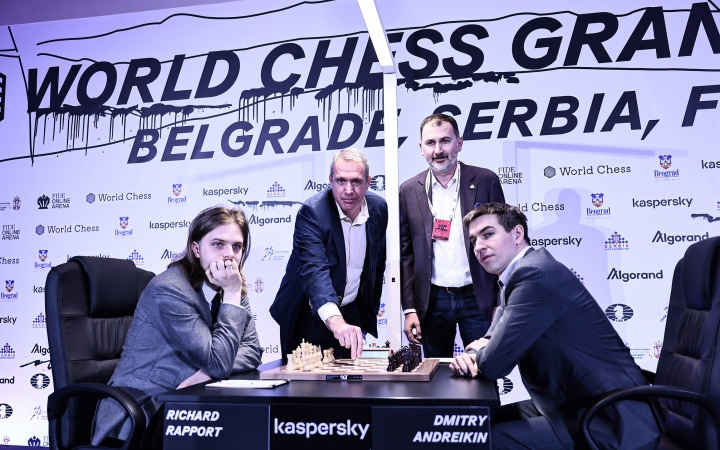
With 1.5 vs 0.5, Richard Rapport defeated Dmitry Andreikin in the FIDE Grand Prix second leg final Following a draw in the first game of the finals, Hungarian Grandmaster Richard Rapport won the second game against the two-time Russian champion, Dmitry Andreikin. In the final minutes of the game, in a position that seemed completely equal for Black, Rapport (who played as White) found a way to throw Andreikin off his balance and snatch victory. Fortune favours the bold In the Janowski variation of the Queen’s Gambit Dmitry Andreikin (leading black pieces) managed to achieve a balanced, comfortable position after the opening. Black had a slightly exposed king but his pieces were active, he was controlling the c-file, making threats on both sides of the board and had a weak pawn on e6 which seemed to be well protected. The computer was saying the position was equal. The crucial moment in the game came on Black’s 29th move, following a two-fold repetition. Rapport had just over 13 minutes on the clock, while Andreikin had just over two minutes. Everyone in the audience in Belgrade – including the chief trainer of the Russian national team, Alexander Motylev, and chess legend Alisa Maric – was expecting to see Rapport repeat a move and for the game to end in a draw. Like Rodin’s sculpture, sitting with his head in his hand, sunk in thought – Rapport spent 12 minutes analysing the position before playing 29.Qe5, forcing sharp complications. With just around two minutes on the clock and ten moves away from the first-time control, this was a bold decision to make. White was threatening the black knight on e4 and aiming for his weak e6 square. The computer still said that the position was even, but it seemed that psychology rather than calculation mattered more at this point. Andreikin moved his knight to d2, threatening White’s rook on f1. Almost instantly, Rapport responded with a forceful move 31.f5, attacking the weak pawn on e6, the final defence of the black king. Here Black’s concentration broke – instead of giving a check with 32…Qb6, which would lead to a draw, Andreikin, in inverted move order, first took the rook on f1, thus opening a path for the white king towards the left side of the board, where he eventually found shelter from Black’s perpetual checks. Andreikin thought he had a draw after sacrificing his rook on e1 (35…Rc7 offered some chances to prolong the resistance) and then brought his queen to e3, giving checks to the white king who seemed defenceless. To the naked, untrained eyes, it still seemed that Black had a perpetual check, but Rapport saw that this wasn’t the case. After each check, White moved his king towards the a-file, where his queen from g7 could quickly jump back to b2 and defend him. In a move that can only be described as a desperate attempt, Andreikin gave a check on f1 with his queen, which was immediately dealt with by the white bishop from h3. It was all over. Dmitry Andreikin’s facial expression showed a man who was completely crushed and shattered by what just happened to him. He nervously shook his opponent’s hand in defeat. That was it. Hungarian Grandmaster Richard Rapport won the second leg of the Grand Prix, in Belgrade (where he has been living for some time now). The winner of FIDE Grand Prix Belgrade shared this thoughts on his performance in a post-game interview. The road to victory Richard Rapport’s path to first place in Belgrade was not easy. He started in Pool C, playing against Vidit Santosh Gujrathi, Vladimir Fedoseev and Alexei Shirov. With four draws and two victories (both against Gujrathi), Rapport secured first place and a ticket for the knockout stage. In the semi-finals, he was up against Maxime Vachier-Lagrave – the Blitz world champion and winner of Pool D, dubbed the “group of death” as it was made up of extremely strong grandmasters. In the first game of the match, Rapport defeated Vachier-Lagrave in the Frenchman’s favourite opening, the Gruenfeld. Then in the second game, Rapport managed to hold the Frenchman to a draw despite the game being sharp and the position favouring White. In the first game of the finals Rapport drew as Black against Dmitry Andreikin, who reached the final stage following a victory against Anish Giri in the tiebreaks. Following a relatively quick draw in the first game, everyone expected a big fight in the second – final – game, and both Andreikin and Rapport did not disappoint. Rapport’s success in Belgrade continued his great performance in Berlin, in the first leg of the Grand Prix Tour, where he reached the semi-finals. With this victory in Belgrade, Richard Rapport is now on 20 points and is the overall leader in the Grand Prix series. With his strong performance in the first leg of the event in Berlin, and his victory now in Belgrade, Rapport has strong chances to take one of the two places leading to the Candidates tournament. Next stop – Berlin The third and final stage of the FIDE 2022 Grand Prix series will take place in Berlin from 21st March to 4th April. There are 24 players taking part in the Grand Prix series altogether. Each player takes part in two out of three of the tournaments. Each tournament starts with 16 players, split into four pools. The four winners of the pools progress to the second stage, where they play a knockout tournament, consisting of semi-finals and a final. Players receive Grand Prix points according to their finishing position in each tournament. The two players with the most Grand Prix points across the two tournaments they play, qualify for this year’s Candidates Tournament. The overall standings in the Grand Prix Series following leg two are as follows: Player Berlin Belgrade Overall Richard Rapport 7 13 20 Hikaru Nakamura 13 13 Levon Aronian 10 10 Dmitry Andreikin 10 10 Vidit Gujrathi Santos 3 4 7 Anish
FIDE Grand Prix Belgrade Finals: Game One Recap
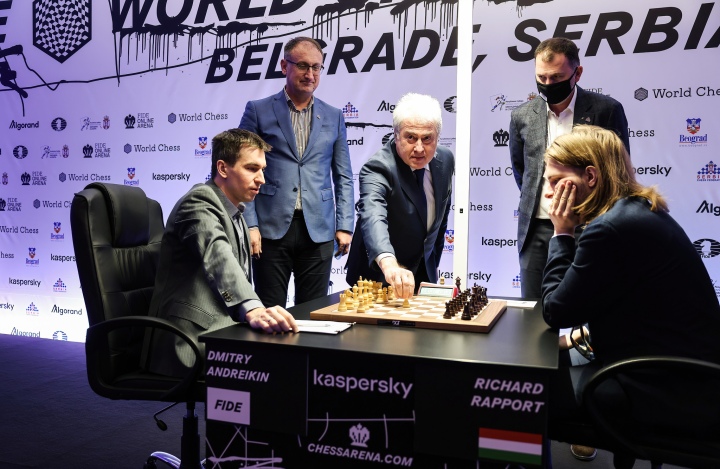
Dmitry Andreikin and Richard Rapport drew their first game in the finals of the FIDE Grand Prix Belgrade The final match of the second leg of the Grand Prix Series organized by World Chess was opened by FIDE Deputy President and renowned grandmaster Bachar Kouatly. Starting with the Petroff, the players moved to the Four Knights game and then switched to the Scottish Game. Somewhat surprisingly, Dmitry Andreikin opted for a very drawish course. The opponents played out a popular line that has been tested many times in high-level games. After massive exchanges, a well-known drawish endgame emerged on the board, that Andreikin played himself just a month ago. As innocuous as it may seem, Black has to demonstrate some accuracy in this ending. Suffice it to say that Vidit Gujrathi lost this very endgame with Black in Tata Steel Masters 2022. Richard Rapport knew all the correct answers, and, after the exchange of bishops, White got a tiny edge in the rook endgame thanks to a more active rook. However, despite his king being cut off on the eighth rank and White being able to pose some threats, Black’s position was fundamentally solid as a rock. Andreikin tried to squeeze water from a stone by sacrificing a pawn and activating his king but quickly realised that Rapport had more than sufficient defensive resources. Following the repetition of moves, the opponents shook hands and split a point. Today’s game had a distinct psychological dynamic. Andreikin opted for a very solid line where the position was even but where Black had to be constantly on alert. In such drawish positions, it is easy for one side to lose focus and it seemed that Andreikin – who spent much more time thinking about the moves than his opponent – was hoping that would be the case. However, Rapport did not relax one bit and played precisely, making sure he ends up with half a point. In the second game Rapport will be White while Andreikin will be Black. The second game of the Grand Prix finals will be played on Sunday, 13th March at 3 PM local (CET) time. The FIDE Grand Prix Series is brought to you by World Chess. Leading partners supporting the FIDE Grand Prix Series 2022 include: Kaspersky as the Official Cybersecurity Partner; Algorand as the Official Blockchain Partner; Prytek as the Technology Transfer Partner; FIDE Online Arena as the official Partner. Text: Milan DinicPhoto: Mark Livshitz Official Photo FIDE Grand Prix Belgrade Press kit
FIDE and FFE host international conference “Chess for Mental Health”

The “Chess for Mental Health” international event, a joint effort of FIDE and French Chess Federation (Fédération Française des Échecs or FFE) with the support of Imagine Institute, Teladoc Health and AESIO Mutuelle, was held on March 9 2022, in Paris. “Among its many assets, the game of chess brings many benefits in the service of mental health. Achievements and projects are multiplying at the international level. The French Chess Federation is proud to host this international conference organized by our Health Social Disability Commission and our International Commission,” Eloi Relange, the President of FFE, said. “We have set up Health Social Disability Commission of FFE to pilot a set of programs dedicated to issues related to health, well-being and social inclusion through the game of chess. The Infinite Chess Program is the first of a set of measures focused on research and mental health in order to make chess a new tool at the service of health professionals and citizens,” Franck Droin, President of the Health Social Disability Commission of the FFE, added. The list of other key participants of the conference included Ministry of Health and Solidarity Franck Belivier, FIDE Managing Director Dana Reizniece-Ozola, Prime Minister Services Interministerial Delegate Autism and neurodevelopmental disorders Claire Compagnon, World Health Organization Director, Mental Health and Substance Use, WHO Devora Kestel, President of the Psychiatric French Society and President of CNQSP FFE, “Health Social Handicap” Maurice Bensoussan and others. “Professional sport is not the only mission of FIDE. Chess and sports, in general, have to be used for other goals as well to make society stronger. Chess is an excellent tool for doing that, and we are trying to use these opportunities. Especially lately, we have developed various social initiatives where chess is used not for the sake of teaching the game itself but for the sake of social cohesion, increasing mental skills, girls empowerment and other things. Last year we also adapted our social responsibility guidelines, which goes very well with those principles that have been already encoded in our charter and policies,” FIDE Managing Director Dana Reizniece-Ozola noted. Introducing chess to children with Autistic Spectrum Disorder is one of the key social initiatives of FIDE. The INFINITE CHESS Project aims to enhance knowledge and awareness about chess for children with ASD, give practical advice for teachers and parents, study the benefits of introducing chess and develop teaching methods. In the second part of the conference, Anastasia Sorokina, FIDE Vice President and leader of the INFINITE CHESS project, opened the discussion on chess for children with Autistic Spectrum Disorder, which was followed by presentations made by specialists from different countries, who shared their practical experiences in teaching chess to children with ASD. Speakers, including Natalia Popova, curricula author, leader of the two-year-long project teaching chess to children with ASD, Ala Mishchanka, Special needs educational assistant with more than 15 years of experience, Luis Blasco De La Cruz of FIDE’s Commission for Chess in Education, María Rodrigo Yanguas, WFM and a sports psychologist, Erick Takawira, Director of the KZN Chess Academy, and Kanthi Devi Sarjoo, speech/language pathologist/audiologist from the Browns’ School, Emmanuel Nieman, Chess Trainer, Eric Desailly of Foundation Ellen Poidatz, François Lescure, President of Teladoc Health France, and Sophie Krief, CEO of AESIO Mutuelle, covered various topics related to mental health, including autism, DYS, concentration, hyperactivity. The results of their studies showed that chess could improve multiple aspects of mental health. According to the speakers, many recent studies have already highlighted the benefits of playing chess to support the development of children with autism spectrum disorders, the DYS (dyslexia, dyspraxia, dyscalculia) or attention and hyperactivity disorders. But these results must be confirmed by new studies, more extensive and more followed over time. “Observational data compiled indicated that chess is a viable medium to improve children’s social skills with an autistic spectrum disorder. The use of role-playing in the chess lessons elicited emotive language and developed their creativity and imagination,” Kanthi Devi Sarjoo, Browns’ School Speech-Language Pathologist/Audiologist (South Africa) said. Finally, Aurélie Renard-Vignelles, Edith Jebob Duvernet, Maxence Augier, and Dr Maurice Bensoussan discussed troubles of DYS, concentration, and hyperactivity. Presentations are available for download (pdf): 1 – Chess and Mental Health – Dana Reizniece-Ozola Presentation 2 – Chess and Mental Health – INFINITE Autism Anastasia Sorokina 3 – Chess and Mental Health – South African experience 4 – Chess and Mental Health- Autism French Project 5 – Chess and Health – Spanish Experience Maria Rodroguo Yangas 6 – Chess and mental Health – ADHD and DYS French Projects 7 – Chess and Mental Health – Luis Blasco de la Cruz