

Ekaterina Atalik wins Turkish Women’s Championship
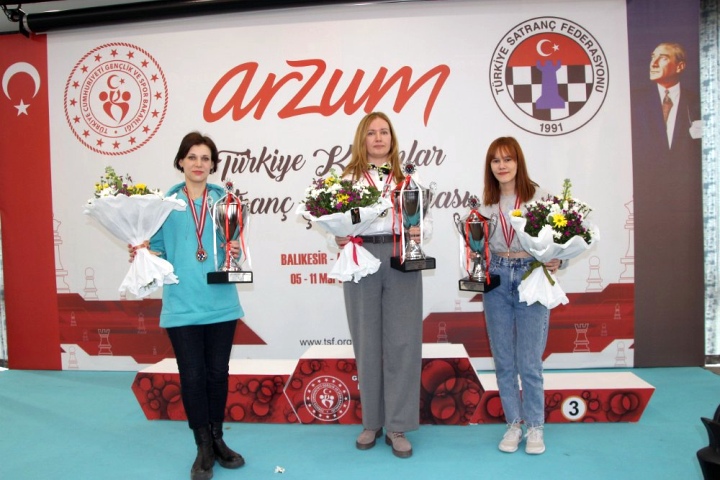
IM Ekaterina Atalik emerged as the winner of the Turkish Women’s Chess Championship, claiming her third straight and sixth overall title. The 2022 Arzum Turkey Women’s Chess Championship, a nine-round Swiss tournament with classical time control took place in Balikesir Provincial House under the sponsorship of Arzum Elektrik Ev Aletleri A.Ş. The event brought together 81 participants from all over the country although some top players did not take part. The #1 in the Turkish women rating list IM Ekaterina Atalik entered the event as a prohibitive favorite and did not disappoint. The only IM in the tournament, she crushed the competition and scored 8/9 conceding her opponents just two draws (including a short one in the final round to secure the title). WFM Yulia Gökbulut (pictured below) finished second, just a half-point behind the champion, and picked 21 rating points. WCM Çiğdem Onur netted 7/9 and claimed bronze. As the tournament fate would have it, the champion and the silver winner did not meet over the board in this tournament. The closing ceremony was attended by the President of Turkish Chess Federation Gülkız Tulay, Ayvalık District Governor Hasan Yaman, Balıkesir Provincial Director of Youth and Sports Lokman Arıcıoğlu, Ayvalık District Sports Manager Şükrü Balkan, VE Hotels Ayvalık Hotel Manager Mehmet Şahin Kork, referees, players and parents. Ayvalık District Governor Hasan Yaman, made a speech in which he expressed his satisfaction with the championship held in Balikesir Ayvalık and his desire to hold other chess tournaments in the future. Final standings: 1 Atalik, Ekaterina 2415 8/9 2 Gokbulut, Julia 1902 7½/9 3 Onur, Cigdem 2004 7/9 4 Hereklioglu, Sude 1917 6½/9 5 Akat, Elifnaz 1673 6½/9 6 Alagoz, Zumra Meryem 1573 6½/9 7 Isgenderova, Hayale 2202 6/9 8 Caglar, Sila 2182 6/9 9 Acarbay, Algi 1985 6/9 10 Catal, Uktenur 1833 6/9 Official website: http://kadinlar2022.tsf.org.tr/ Photo: official website
FIDE GP Belgrade: Andreikin set up final with Rapport
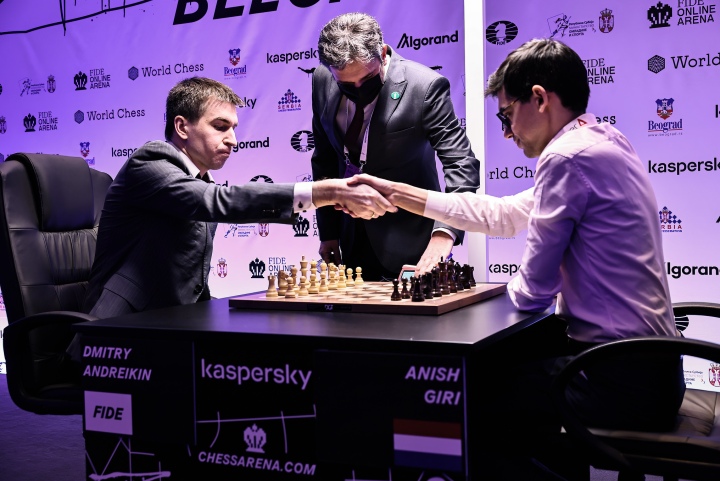
Dmitry Andreikin has defeated Anish Giri in the tiebreak match by a score of 1½:½ to reach the final of the Grand Prix Belgrade, of FIDE Grand Prix Series organized by World Chess. Following a quick draw in the first game of the tiebreaks, Andreikin won as Black against Giri in the second game, despite having an inferiour position. In the finals of the second leg of the Grand Prix, Dmitry Andreikin will be playing a two-game match against Richard Rapport on the 12th and 13th of March. Game One: A quick draw In the first game of the tiebreaks, Dmitry Andreikin was White. In the Bishop’s Opening, the position was pretty even from the onset. Anish Giri played fast, suggesting that he was very confident in the line he opted for. By move 13 Andreikin had just eight minutes while Giri had over 14. White castled short early and launched his f-pawn, opening the f-file. However, the advance took time and Black got an upper hand in development. With his 14thmove Giri castled long, leaving his knight unprotected but this piece was taboo for Andreikin. After an overambitious move 15.Qb3 by Andreikin, Giri emerged better but just a few moves down the road the game came to an abrupt halt as the two agreed on a draw following a threefold repetition after just 22 minutes of play. Giri, later on, said that he wasn’t fully sure about the advantage the position gave him and, at the time, he thought a draw was a good outcome as he’d be leading the white pieces in the second game. In the break between the games, both players went their separate ways: while Giri was pacing up and down a part of the playing hall, Andreikin was in the restroom for players, psyching himself up. After the clock showed there was under a minute before the start of the second game, the two players approached the table, took off their jackets and set across from one another. As the final second of the break expired, Chief Arbiter Nebojsa Baralic pressed the clock and the second game of the tiebreaks began. Game Two: A surprising twist Giri was white this time and he opted for 1.e4. In the Taimanov variation of the Sicilian, White quickly castled on the kingside while Black left his king in the centre and pushed h-pawn to h4. Giri reacted in a simple but very effective way, by arranging his pieces in the centre, preparing for any course of action. In the following play, Giri decided to close the centre (opening it up was a viable option) and made a breakthrough on the queenside as Black’s minor pieces were misplaced and the rooks disconnected. White soon managed to penetrate with his rook along the b-file, putting Black under pressure. After Andreikin snatched a pawn with 31…Qxa3 he found himself on the brink of defeat. However, instead of playing 32.Nb5 with the idea of bringing the knight into attack via Nd6, Giri dropped his advantage by exchanging rooks on f8, followed by 33.Nc6. At this point, Giri had to demonstrate accuracy to maintain balance but it was a difficult task given that he was in severe time trouble. On move 36 White made a serious blunder, allowing the tables to turn. Most likely the Dutchman missed an in-between move 36…Qc6, expecting just a natural capture of the knight. From that point on Black was in full control. Giri had some slim hopes for a perpetual but Andreikin quickly shattered them by trading the queens with a nice tactic. The game transposed into a knight endgame where Black had two unstoppable “a” and “d” passers. As soon as the latter reached the second rank the Dutchman threw in the towel. With this somewhat surprising victory, Dmitry Andreikin is set to play in the finals against Richard Rapport, who defeated Maxime Vachier-Lagrave in the semi-finals. The final The first game (out of two) of the finals will take place on 12th March at 3 PM local (CET) time. Dmitry Andreikin will be leading the white pieces in the first game, and Richard Rapport will be Black. The FIDE Grand Prix Series is brought to you by World Chess. Leading partners supporting the FIDE Grand Prix Series 2022 include: Kaspersky as the Official Cybersecurity Partner; Algorand as the Official Blockchain Partner; Prytek as the Technology Transfer Partner; FIDE Online Arena as the official Partner. Text: Milan DinicPhoto: Mark Livshitz Official Photo FIDE Grand Prix Belgrade Press kit
FIDE Grand Prix Belgrade – Knockout: Day Two Recap
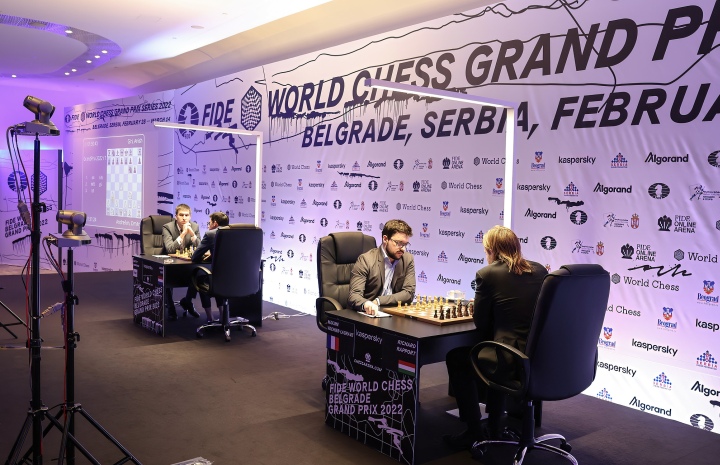
Rapport eliminated Vachier-Lagrave as Andreikin and Giri go to tiebreaks The second round of FIDE Grand Prix Belgrade semifinals saw two draws. Hungarian Richard Rapport secured a place in the finals by holding Maxime Vachier-Lagrave to a draw in a very exciting game that saw lots twists and turns. Following a draw in the first round of the semi-finals, Dmitry Andreikin and Anish Giri split a point again. In the Queen’s Pawn Opening, Andreikin played 3.b3, going for a less common line, used by Vladimir Kramnik against Alexander Grischuk in the 2016 Candidates tournament. Andreikin also tested this system against Salem Saleh in a blitz game back in 2019 and won convincingly. Speaking about the 3.b3 line in the post-game analysis, Andreikin referred to the game between Kramnik and Grischuk in 2016. As destiny would have it, Giri was Kramnik’s second at that event and, as he said, “Kramnik tortured me with that position.” However, Giri avoided all the troubles after 12.Nb1, as White allowed Black to place his knight on e4, forcing exchanges. The position was immediately even and remained so until the end of the game. Following exchanges of two minor pieces, Giri put his queen on g5 aiming for White’s weak e3-pawn. Andreikin had to advance his e-pawn trading the queens and the game steered into calm, drawish waters. White managed to achieve a pawn majority on the queenside but it did not promise much. Overall, Black was on the good side of equality thanks to a solid pawn structure and well-coordinated pieces. Following a repetition of moves, a draw was agreed on move 32. In the post-game analysis, the players agreed that Black has a slight edge but that the position offered both sides a big margin of safety. The two will be playing in the tie-break on Friday, 11th March. Unlike the first semi-final game where both sides had some good chances to play for a win, today’s game was quieter. However, the two sides will be under more pressure on Friday as they will have less time to think and calculate. So far, the two played one rapid game and it ended in a draw. “I have a great feeling about tomorrow. Giri is a slight favourite as he had practise in the rapid with Magnus Carlsen’s series. I will try to show my best”, said Andreikin. Giri responded by mentioning that his opponent went to the finals of the 2021 World Cup after winning all the tiebreaks, “so I’d say I’m the underdog. However, I should be able to give a good fight”. The second game of the semi-finals was more exciting, as Maxime Vachier-Lagrave had to win, given that he suffered a defeat in the first encounter. As expected, Maxime Vachier-Lagrave, who was leading white pieces in today’s game, came into the match swinging. In the Improved Steinitz of the Ruy Lopez, White got the initiative early on in the game, castling quickly and preparing an attack on Black’s kingside. The first critical moment was on move 11 where Vachier-Lagrave spent nearly 35 minutes thinking about the move 11.g3. It seems that Rapport was first to surprise his opponent, introducing a novelty 12…Qd7, which is the first line of Stockfish. The Frenchman continued to play aggressively but it looks like he overstretched himself with the move 13.f5 (13.Qd3 or 13.Nc3 were better options), allowing Black to equalise. Black quickly jumped at the opportunity to blunt White’s advances by exchanging queens and a couple of minor pieces on the kingside. By move 22 the game transpired into an even endgame where each side had a knight and two rooks. A draw, so much needed for the Hungarian, was within his reach, but Rapport’s decision to castle long allowed the Frenchman to push his pawns and create some play on the queenside. In the subsequent manoeuvring Black deserted his king on the queenside but doubled the rooks along the h-file, hoping to get to White’s monarch. However, the computer analysis suggests that White is clearly better in this position. The Frenchman was carrying out his attack brilliantly finding several the only moves. Rapport lost his a-pawn and exposed his king to checks which he used to push him forward, further into dangerous territory. By move 43, White had a dominant position. However, now it was the Frenchman’s time to err as he did not find a subtle 44.b3 and allowed Black to capture White’s last remaining pawn on the queenside and activate his c-passer. Within seven moves, Vachier-Lagrave completely dropped the advantage and the position was again even despite White’s extra exchange. Rapport was on the brink of saving half a point again and with it – a pass to the finals, avoiding tiebreaks. This time around the Hungarian did not waste this golden opportunity. Black eventually managed to promote his c-pawn, for which White had to give up a rook. MVL dangerously advanced his central pawns but Rapport had his own trump, namely another c-passer rushing to the first rank. Rapport demonstrated precise calculation in this pawn race: as soon as both sides promoted queens, it turned out that White could not avoid a perpetual without worsening his position. This hard-fought draw propelled Richard Rapport to the final. The tiebreaks The tiebreaks take place on Friday, 11th March, at 3 PM local (CET) time. Following the drawing of lots, Dmitry Andreikin will be leading the white pieces in the first rapid game. According to the regulations, the players will play two rapid games (15 minutes for each player + 10 seconds increment per move, starting from move one). If the scores are level after the rapid games, then after a new drawing of colours, two games shall be played with a time control of 3 minutes for each player + 2 seconds increment per move, starting from move one. If the score is still level after the Blitz games, then one sudden-death game shall be played. The FIDE Grand Prix Series is brought to you by World Chess. Leading partners supporting the
The First Global Interactive Community Chess Simul

Over the past two years, the pandemic has significantly transformed the lives of individuals and communities. We have entered a new digital era, however, the online sphere has opened up new horizons, which has also affected the chess world. The number of people starting and actively playing the game, devoted fans following tournaments, broadcasts, and prominent figures in the sport has grown at an astonishing pace and scale. New communities, events, and platforms have been born in parallel. Judit Polgár, the best female chess player of all time, and the Hungarian Pavilion of Dubai Expo 2020 joint action “Judit Polgár vs The World”, the world’s first interactive community chess simul, strengthen and put this togetherness into a new context. On 20 March, Judit Polgár and the Hungarian Pavilion at Dubai Expo 2020 will host a global and integrated social event where millions of people will virtually sit down and play – live – against a single player. During the 11-board online simul, Judit Polgár faces ten influencers with a total of 6 million followers, and virtually the world on the “world board”. In the influencers’ section, among others, Judit will play with a children’s community on one board, and in line with our “2022 – Year of Women in Chess” initiative, members of a women’s community on another. Arkady Dvorkovich, the President of FIDE acknowledges: “This event can be regarded as a milestone in the global promotion of chess, offering a unique experience to a record number of participants thanks to its innovative and brand new format. I am curious of the final result, but even more so eager to enjoy the sportive tension and excitement that will be in the air while the world will be challenging the legendary chess queen Judit.” “I am extremely excited for this challenge and inclusive social event as Chess Connects Us in the virtual universe”, admits Judit. Influencers vs Judit The influencers will make their moves after consulting with their followers.The participants:● Agadmator – Antonio Radic (Croatia)● Botez Sisters (USA–Canada)● Samay Raina (India)● Rey Enigma (Spain)● Pepe Cuenca + Chess24/ES (Spain)● Jennifer Shahade + US Chess Girls Club (USA)● Silver Knights – children’s community (USA)● Anna Cramling (Sweden)● Anna Rudolf (Hungary)● BENIIPOWA (Hungary) The World vs Judit Can the world chess community beat Judit Polgár?On the world board, all participants in the game can vote on the next move on a dedicated platform. The system will make the move suggested by most players. The matches will be played in the Hungarian Pavilion’s Dome in the event’s built-in studio on custom digital chessboards. Judit will comment on the moves and strategies from there, involving influencers and their followers in the conversation. Professional commentators and surprise guests will support the show from the studio in Budapest. The First Global Interactive Community Chess Simul will be available live on the ChessConnectsUs Twitch Channel.
Pools for third leg of FIDE Grand Prix 2022 announced
Berlin, March 9, 2022 — The pools for the last leg of the FIDE Grand Prix Seies, organized by World Chess have been determined. The tournament in Berlin will be held from 21 March to 4 April at the World Chess Club Berlin. The event features 16 elite chess players competing for a prize fund of €150,000 and the last two places in the Candidates Tournament scheduled to take place in Madrid in June. The draw ceremony, held over Zoom, was chaired by the Chief Arbiter Klaus Deventer who divided the players into groups via randomized selection procedure. The players were allocated to four different pools: Pool A: Levon Aronian (USA), 2785Hikaru Nakamura, (USA), 2750Dmitry Andreikin (FIDE), 2719Grigoriy Oparin (FIDE), 2674 Pool B: Shakhriyar Mamedyarov (Azerbaijan), 2776Leinier Dominguez (USA), 2756Daniil Dubov (FIDE), 2711Vincent Keymer (Germany), 2655 Pool C: Wesley So (USA), 2778Maxime Vachier-Lagrave (France), 2761Sam Shankland (USA), 2704Alexandr Predke (FIDE), 2682 Pool D: Anish Giri (Netherlands), 2771Nikita Vitiugov (FIDE), 2726Yu Yangyi (China), 2713Amin Tabatabaei (Iran), 2623 The third leg of the FIDE Grand Prix Series 2022 will take place in Berlin at Mittelstrasse 51-52 from March 21 to April 4. The rounds start at 3PM CET. The FIDE Grand Prix Series is brought to you by World Chess. The games will be broadcast live at worldchess.com: https://chessarena.com/broadcasts/13606 For further questions, please contact: media@worldchess.com Media Accreditation Form: https://forms.gle/nnfJ9b2LRDYebGg3A About World Chess: World Chess is a London-based chess gaming and entertainment group and FIDE’ official broadcaster and commercial partner. World Chess organized the FIDE Championship Matches in Russia, the USA, and the UK, and revolutionized the sport by signing the biggest media partnerships in history. World Chess develops Armageddon, the chess league for prime-time television. World Chess also runs FIDE Online Arena, the exclusive official chess gaming platform. More at worldchess.com.
FIDE and Chess24 hold fundraising marathon for Ukraine on Women’s Day

A series of events aiming to support Ukrainian chess players and their families affected by the war were held yesterday, on International Women’s Day, by the FIDE Commission for Women’s Chess together with Chess24. The charity marathon included the Chess for Ukraine arena tournament named after the World Champions Anna & Mariya Muzychuk and Anna Ushenina, the team competition and a fundraiser to help female chess players in Ukraine. The main hosts of the Women’s Day special broadcast were IM Jovanka Houska and the Chair of the FIDE Commission for Women’s Chess IM Eva Repkova. They were joined by special female guests who spoke about the role of chess in their lives, and their feeling about being a woman in a male-dominated chess community. FIDE Managing Director WGN Dana Reizniece-Ozola, who was one of the guests of the broadcast, pointed out that the sense of belonging to a chess community gives a person a very important sense of the security. “This whole project is dedicated to a very serious and very important cause, which is helping our chess players in Ukraine. This is a very good momentum, when you see how important actually it is if you belong to such a community like chess family. Because if gives you a better chance that somebody will really care of you and try to help when you are in a difficult position. That is demanding from yourself as well. Because that demands also that while you are in a better position you ought to help the others. This is such a heartwarming feeling that there might be somebody out there who would think of me when I have some difficulties or some crisis.” Another guest, the Chair of Commission for Women’s Chess in Americas WGM Martha Fierro talked about the development of chess and especially women’s chess in Ecuador: “In Ecuador chess is becoming more popular. When I started to play in 1991, there were not so many women players. But now we have more support from the government and media and more and more ladies and girls join in.” Women’s Day Team Competition was joined by teams from chess24, FIDE, Play Magnus & Chessable. The FIDE WOM team was represented by WGN Dana Reizniece-Ozola (FIDE Managing Director), the women’s world champion (2001–2004) GM Zhu Chen (FIDE Treasurer), WIM Salomeja Zaksaite (Chair of FIDE Fair Play Commission) and WGM Martha Fierro (Chair of Commission for Women’s Chess in Americas). A 7-team round-robin tournament was won by FIDE WOM team scoring 16/18 points. Team Chess24 finished a point behind the winner. Chess24 Spain with 13 points came out third. During the tournaments viewers were asked to make their donations in the fundraiser for Ukrainian chess players and their families. While preparing the broadcast the FIDE WOM Commission reached out to a number of women chess players in Ukraine, caught up in a conflict that would have been unimaginable just a month ago, and got their feedback. Here are some of letters received: “I am in Kharkiv, with no electricity, no mobile service, no 4g, no groceries at the stores, and those few places that do sell groceries charge crazy prices. Every three hours jets are dropping bombs on peaceful civilians.” “I am in Kherson. I had a few hours to make the decision to leave the city with small children, leaving my very sick husband at home by himself. We do not have safe sheltering. The only thing we can do is to pray and hope to not to go crazy from being so helpless.” “I spent six days and five nights in the basement without utilities, and am now looking for another place of refuge. I witnessed the hell on Earth.” You can read more and make a donation here. The fundraising campaign is not over yet. Please help us show our support for Ukrainian chess community! You can watch the full broadcast of the events on FIDE’s official Youtube channel.
FIDE Grand Prix Belgrade – Knockout: Day One Recap
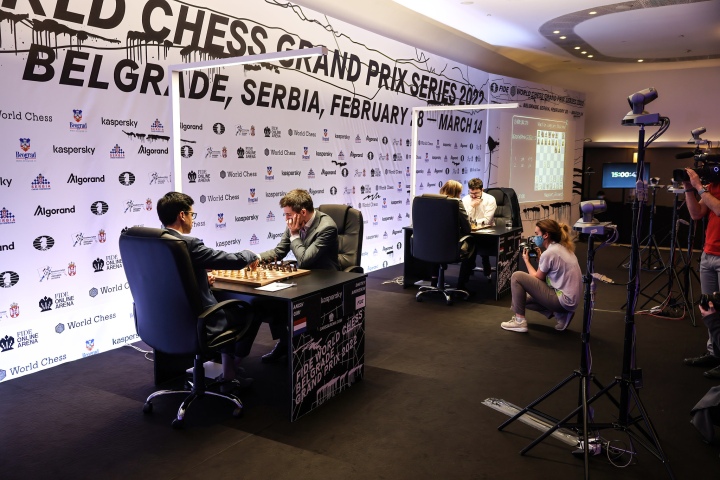
Richard Rapport defeats Maxime-Vachier-Lagrave as White, while Giri and Andreikin draw The first round of the semi-finals of the second leg of the Grand Prix saw one decisive result and one draw. Richard Rapport defeated Maxime Vachier-Lagrave. Before this game, the two had played eight classical games, five of which were drawn and three were won by the Frenchman. Despite the head-to-head record favouring Vachier-Lagrave, every game is a story of its own, and this one did not have a happy ending for MVL. Rapport opened with 1.d4, and Vachier-Lagrave responded with his favourite, the Gruenfeld. The opponents tested a relatively rare variation in which the Hungarian introduced a logical novelty (the first line of Stockfish) 14.Bd2. White got an edge that only increased after Black opted not to contest for the open c-file on move 19. MVL tried to put pressure on the white king in the centre, however, Black was doomed after that. Indeed, Rapport had a very dangerous d-pawn and a stronger bishops pair. Black was better developed, but it just did not work for him in concrete variations. By move 23 White’s d-pawn seamlessly advanced to d7. Soon afterwards, the e-pawn joined the race and – supported by a strong pair of bishops – Black was hopeless in preventing defeat. On move 37 the Frenchman capitulated. The outcome of the first knockout round suggests that Maxime will have to play for a win in the second game, as he will be leading white pieces, and the Frenchman will certainly enter the match swinging. On the other board, the game between Anish Giri and Dmitry Andreikin ended in a draw, despite both sides (especially White) having a chance to win at certain points. The odds were even before the match as Giri and Andreikin played five classical games and drew all five of them. Their most recent clash was at the 2021 Tolstoy Memorial 2021, where they split a point. In the Sicilian with 3.b3, an offbeat line that has become trendy recently, the opening was similar to the one Nihal Sarin played against Andreikin in the 2021 World Cup. White (Giri) came out of the opening with a slightly better position, as he had more space, quickly castled long and put some pressure on the kingside. Andreikin rushed things with 17…c4? but this dubious move quickly backfired after a simple exchange followed by 19.b4. White dominated the board, but after 19…h6, attacking his g5-knight, Anish sacrificed it on f7 (which is not in his style), letting a greater part of his advantage slip away and allowing Black to find breathing space. Instead, a simple and natural knight retreat 20.Nh3 would have posed insurmountable problems for Black. White continued to pressure but then overstretched himself with 23.Rd5, giving an exchange for an attack that didn’t work. Following the exchange of queens on move 28, the tables have turned, and Black was now better; however, he had to be very precise as White had a very active bishops pair. Most likely, after avoiding the worst, Andreikin was happy with a draw, as a few more moves down the road the two split a point. In the post-game analysis, Giri and Andreikin said that it was a complicated game where they both missed some crucial lines and concluded that the outcome was fair. Pairings for day two of the knockout: Dmitry Andreikin vs Anish Giri Maxime Vachier-Lagrave vs Richard Rapport The round starts on Thursday, 10th March, at 3 PM local (CET) time. Leading partners supporting the FIDE Grand Prix Series 2022 include: Kaspersky as the Official Cybersecurity Partner; Algorand as the Official Blockchain Partner; Prytek as the Technology Transfer Partner; FIDE Online Arena as the official Partner. Text: Milan DinicPhoto: Mark Livshitz Official Photo FIDE Grand Prix Belgrade Press kit
2022 Women’s Speed Chess Championship announced

Happy International Women’s Day! On this special occasion, FIDE is thrilled to announce that the 2022 edition of the Women’s Speed Chess Championship has been confirmed and is set to start on May 24. The event was born from a partnership between FIDE and Chess.com and is the most important online tournament for titled women in the world. This year, fans will enjoy top women players vying for their piece of the $70,000 prize fund! Last year, fans had the chance to appreciate the lightning-fast chess of many of the leading women of our time. Six out of the top 10 active women in the world participated, including GMs Hou Yifan, Kateryna Lagno, Lei Tingjie, Nana Dzagnidze, and Anna Muzychuk. Other formidable players such as GM Humpy Koneru, current Women’s Blitz World Champion IM Bibisara Assaubayeva, and Women’s Rapid World Champion GM Alexandra Kosteniuk also joined last year’s field. With such fierce competition, not even Hou, a four-time world champion and the highest-ranked woman in the world, had an easy time. The Chinese grandmaster clinched the title only after defeating GM Harika Dronavali in the nick of time, winning the last two bullet games of the match to uneven the score. Earlier this year, FIDE declared 2022 as the Year of Women in Chess. According to FIDE’s Managing Director, Dana Reizniece-Ozola, partnering with Chess.com once more to promote the Women’s Speed Chess Championship is part of the effort to celebrate women in chess. “Celebration does not mean being entertained or amused. Celebration is about appreciation,” said Reizniece-Ozola. “With FIDE announcing 2022 as the Year of Women in Chess, the power of great women in chess is celebrated. And this tournament organized by Chess.com is one such event. Chess moves women forward and women move the chess world forward.” With an increased prize fund and tweaks to improve the event’s format, this year’s Women’s Speed Chess Championship promises to be the best yet. Make sure you tune in to Chess.com/TV, Chess.com Twitch channel, or FIDE YouTube to catch the live broadcast with expert commentary!
FIDE Workshop for Changes in Regulations held online
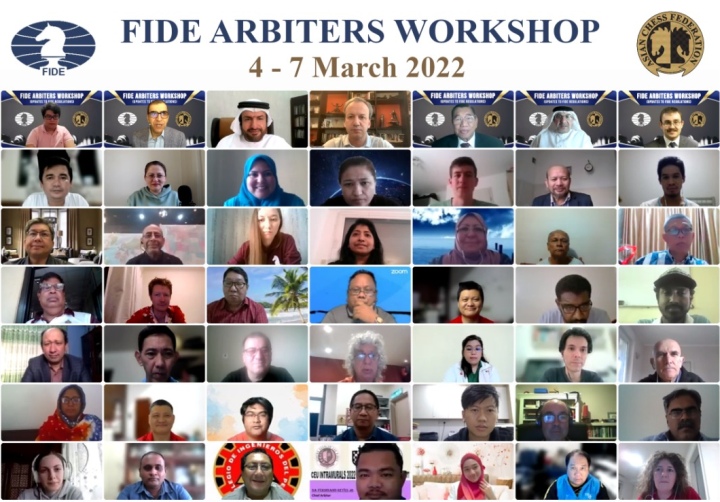
The FIDE Workshop for Changes in Regulations organized in partnership with the Asian Chess Federation was held online from March 4-7, 2022 via Zoom. At the opening ceremony, the Asian Chess Federation General Secretary Hisham Al Taher welcomed participants and the Guest of Honour FIDE President Arkady Dvorkovich. The FIDE President said that the FIDE General Assembly held last December had approved these changes to regulations and emphasized the importance of keeping up with the latest FIDE regulations for arbiters and organizers. Arkady Dvorkovich thanked Arbiters for their participation, welcomed feedback and invited comments for further discussion with FIDE. Mr. Dvorkovich drew attention to the recent FIDE Council decision caused by the current geopolitical situation and the tragic war in Ukraine – Russian players can take part in FIDE events only under the FIDE flag. He confirmed that FIDE had to move the Chess Olympiad and FIDE Congress from Russia. FIDE opened bids for hosting Chess Olympiad and has already received a bid from All India Chess Federation. There can be separate bids for Chess Olympiad, Olympiad for People with Disabilities and FIDE Congress. FIDE President invited all potential bidders to contact FIDE. A total of 180 participants from 53 countries registered for the Workshop, namely 30 Asian countries, 10 European countries, 7 African countries and 6 countries from the Americas. The Workshop was attended by 49 International Arbiters, 54 FIDE Arbiters, 63 National Arbiters and eight International Organizers. FIDE Qualification Commission Secretary Alex Holowczak of the U.K. made a report on changes to FIDE title and Rating Regulations which came into effect 1st January 2022 explaining the logic behind the changes. Rules Commission Chairman Abdulrahim Mahdi of the UAE presented the updates to the FIDE Laws of Chess and online regulations. Rules Commission Secretary Mehrdad Pahlevanzadeh of Iran told about updates to Arbiter title regulations, classification and updates to Fair Play regulations. ACF Executive Director Casto Abundo of the Philippines rounded off the seminar with a lecture on How to Organize Chess Tournaments. The Workshop was a project of the Asian Chess Federation aimed to assist Arbiters and Organizers and speed up a post-pandemic return to over-the-board chess.
FIDE Grand Prix Belgrade: Round 6 Recap
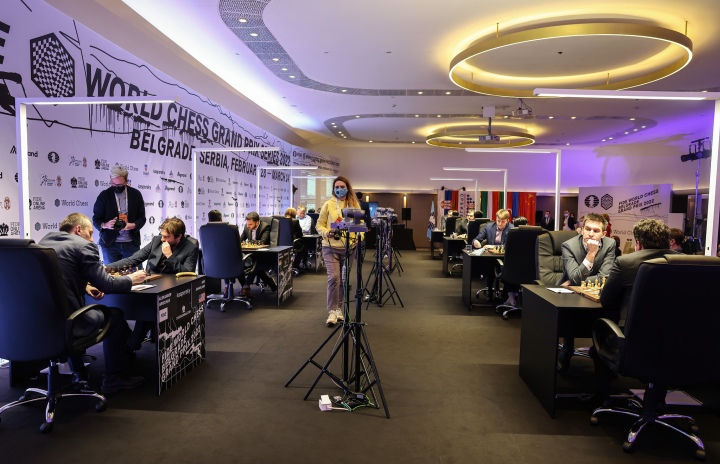
Dmitry Andreikin, Anish Giri, Richard Rapport and Maxime Vachier-Lagrave move on to the next stage of the FIDE Grand Prix Belgrade The final – sixth round – of the group stage of the Grand Prix finished in Belgrade, with four clear winners progressing to the semi-finals. Despite players such as Richard Rapport and Anish Giri entering the round as comfortable leaders in their groups, it was a tense day as things could have still gone wrong even for them. On the other hand, players such as Etienne Bacrot, Shakhriyar Mamedyarov and Nikita Vitiugov had to play for a win in order to secure a place in the tiebreaks. These circumstances were promising an exciting final round of the group stage of the Belgrade leg of the Grand Prix. The first move in the round was made by Lukasz Turley, FIDE Vice President, in the game between Nikita Vitiugov and Anish Giri. Pool A: In Pool A it was Andreikin and Shankland who had the most chances to move to the next stage. If they drew their games, or if both won, the two would have to play each other in the tiebreak. However, if Andreikin lost and Shankland drew, it would be the Bacrot and the American who would have to decide in tiebreaks who moves forward to the semi-finals. Dmitry Andreikin opted for a rare line in the Queen’s Gambit Accepted against Etienne Bacrot but did not get even a slight edge. Bacrot was holding his own quite comfortably, and a draw seemed like the most logical outcome. Trying to reverse his fortune, Andreikin ventured upon a queen sacrifice for a rook and minor piece, but it did not offer much had Bacrot played the natural move 27…Qxd5. The game was full of twists and turns where both sides had a significant advantage and then blundered it away. The final portion of this encounter was a real blunder fest. Black had just a rook for the queen at some point but allowed the opponent to weave a mating net around his king. A miracle victory by Andreikin, who qualified for the semis. Sam Shankland essayed the Sicilian defence against Alexander Grischuk, who responded with the Rossolimo Attack. White opted for a very solid setup, restricting Black’s activity. Shankland played the right logical moves, but unfortunately for him, they led to massive exchanges and a draw was agreed on move 24. Pool B: Anish Giri was the favourite to win in Pool B. He was Black against Nikita Vitiugov. In their previous game, in the second round, Giri was victorious as White. In the round six game, Vitiugov had to win in order to get a chance to fight Giri again, but in the tiebreak. Starting with the English Opening, the game quickly transposed into a sideline of the Tarrasch Defence. It seemed that Vitiugov managed to surprise Giri as Black spent a lot of time on the opening: nearly 32 minutes on move eleven and 15 minutes on his 15th move. The time was well-spent as Anish got a comfortable position and after exchanges in the centre reached equality. With a solid pawn structure and no queens on the board, Giri was safe, and the two called it a draw. With this draw, Anish Giri was on 4/6 and in clear first place in Pool B. “It’s very important that I qualified and not so much how the games went… All the games were tough, and my play was decent. I’m happy with my score, and I’m looking forward to the next phase”, said Giri in his post-game interview. Pentala Harikrishna lost as White to Amin M. Tabatabaei. The two had no chances to qualify for the next stage, but they still played an exciting game. In the Open Line of the Ruy Lopez, White sacrificed an exchange, getting a pawn and a bishops pair as compensation, following the idea introduced in the game Caruana – Dominguez in 2021. Tabatabaei offered a repetition on move 23 but White opted to play on. However, immediately after this, following a strange move 28.b3, White opened the queenside to Black. Tabatabaei’s rooks jumped into action, and his extra exchange quickly came to fore. The Iranian finished the event with his first and only victory. Pool C: Richard Rapport drew with Alexei Shirov, and with this result, sealed his card for the next stage of the tournament. In the English Opening, the Hungarian opted for the line he had tested back in 2013 but with black pieces. Shirov was trying to create some chances on the queenside but did not manage to get anything substantial. Everything was in Rapport’s hands, who opted for a safe path to a draw that promoted him to the next stage. Vladimir Fedoseev and Vidit Santosh Gujrathi had a theoretical discussion in a popular line of the Petroff Defense. Castling on opposite sides promised a sharp game, and the opponents did not disappoint. Black pushed his pawns towards the centre, pressing White’s c4-square. Fedoseev had to switch to defence and allowed Vidit to seize the advantage, which he increased by cutting off White’s king on a1. Vidit Gujrathi was in control, but a strong computer-like move 30…Rd8! escaped his attention. White avoided the worst and after several unsuccessful tries by Vidit the game ended in a draw. Pool D: One of the most anticipated games of the round was between Shakhriyar Mamedyarov, who was leading white pieces against Maxime Vachier-Lagrave. The only way Mamedyarov could qualify for the next stage was to score a victory against the Frenchman, who was the leader in the extremely strong Pool D. After 1.d4, MVL decided not to play his pet Gruenfeld and opted for a more solid opening. In the Carlsbad Variation of Queen’s Gambit, the two players castled to the opposite wings suggesting a sharp game. White tried to engineer some activity on the kingside but the Frenchman was quick in his counterplay. His dark-squared bishop was a particularly functional piece, cementing defence and eyeing the b2-pawn in White’s camp. By move 30 Mamedyarov exhausted his attacking options and