

FIDE introduces the use of electronic scoresheets in cooperation with Clono

The International Chess Federation has approved allowing the use of Clono electronic scoresheet to record the moves of the games at official chess competitions, in replacement of traditional, paper-based scoresheets. The Clono scoresheet app runs on a tablet, and the input is done on a graphical chess board where the scoresheet is presented in standard algebraic format. The system offers smooth integration with other existing tools. For instance, it can automatically create a tournament profile with tournament info, time control, groups and players, simply importing the tournament xml-file directly from the tournament management service. It can receive the player’s and game info, pushed directly from the pairing program. Likewise, Clono can send the PGN live feed to its own broadcast server and multigame viewer, as well as to third party websites. FIDE and Clono have agreed to cooperate for the purposes of developing and digitalizing chess in the work frame of the Chess-ID project. For the time being, the agreement has a non-commercial nature, and the aim is to lower the threshold for the chess community to use the new system.
FIDE delegation makes tour of Latin America
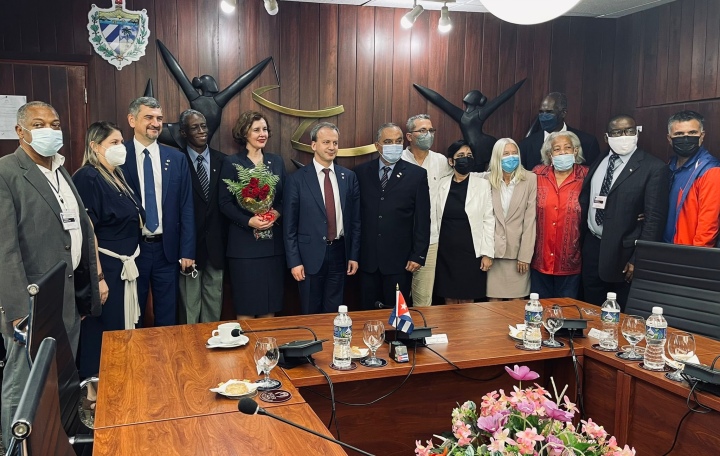
The FIDE delegation, headed by President Arkady Dvorkovich, including managing director Dana Reizniece-Ozola and executive director Victor Bologan, travelled to Cuba, Panama, Ecuador, and Mexico to strengthen ties between FIDE and sports institutions in the region and promote chess in Latin America. The first stop on tour was Cuba. In Havana, FIDE representatives met the President of the Cuban National Institute of Sports, Physical Education and Recreation (INDER) Osvaldo Vento Montiller, the Cuban Olympic Committee President Roberto Léon Richards Aguiar, and the President of the Cuban Chess Federation Carlos Rivero. Among the issues discussed was the inclusion of chess in the regional games and the long-established tradition of Cuban chess. During the visit, the main focus was on the social aspect of chess. The delegation visited the “Grandparents’ House”, where chess is an important tool for promoting “active ageing”. The FIDE representatives were also briefed about the other social activities in the country. “Caissa XXI” project involves 12 chess masters and grandmasters who reach out to slums and train approximately 800 children a month. This great initiative gives children from low-income families motivation and skills to climb the social ladder. “This is a country where they not only love chess but smartly use it for the benefit of society. Such initiatives like Chess in Slums, Сhess in Prisons, Chess for Seniors allow using our game for education&empowerment. Amazing!” Dana Reizniece-Ozola said. Cuba has taken huge steps in introducing chess in schools. Kids have chess lessons twice a week, and also research on chess influencing cognitive skills has been conducted. FIDE will support the 55th Capablanca Memorial, and as part of the Year of the Woman in Chess, a women’s tournament will be organized in Cuba. “We are happy to be here. We have many ideas for joint projects, and we have come to learn from Cuba how they do things with chess to achieve the results they have,” said FIDE President Arkady Dvorkovich, summing up his two-day stay in the country. Panama was the second stop in the round of visits. Upon arrival in the country, the FIDE delegation was received by the First Lady of Panama Yazmín Colón de Cortizo. The First Lady was particularly interested in teaching chess as a ‘vehicle’ for introducing other subjects: language, mathematics and STEM. The second meeting was to Damaris Young, a former basketball player, lawyer, and the first woman president of the Olympic Committee of Panama. She made a presentation in which she emphasized the competitive side of sports and its value as a tool of inclusion. FIDE would like to thank the Panamanian Chess Federation (FAP) and its President Jose Carrillo Pujol for their hospitality and the productive meetings that they scheduled during the visit. After Panama, the FIDE delegation flew to Guayaquil, Ecuador, invited by FIDE Vice-President Martha Fierro to take part in the opening ceremony of “Chess in your neighbourhood”. The project, co-financed by the FIDE Development Fund through FIDE Americas, also enjoys extensive public and private support in Ecuador. Marcos Molina, President of the Health and Sport Commission of the National Assembly, stressed that this initiative aims “to liberate the hearts of these children, and targets the most vulnerable classes, classes that deserve greater attention from the E status”. The FIDE delegation also had the opportunity to meet with the President of the Republic of Ecuador, Guillermo Lasso. During the visit to Mexico, the FIDE management had a working meeting with María José Alcalá Izguerra, the President of the Mexican Olympic Committee (COM). After the meeting, they cut the ribbon for the new “Center for Chess Development”. “It is a place that will allow chess to be promoted and at the same time create the conditions for training and improving in chess from a very young age,” said Alcalá Izguerra. In addition, a continental FIDE Planning and Development Commission’s meeting was organized, using the opportunity of continental representatives getting together at the 8th Ibero American Individual Chess Championship. The delegates from 28 countries who arrived at the meeting were given a warm welcome by Mario Ramirez Barajas, the President of the Mexican Chess Federation.
Exciting chess in the FIDE Grand Prix Berlin final
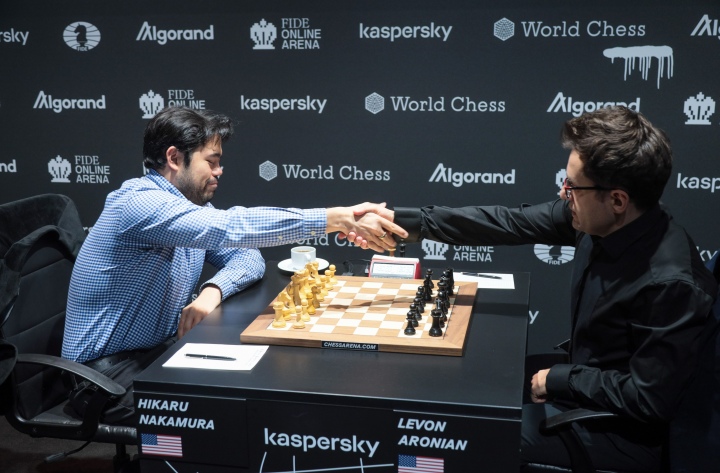
The first game between Nakamura and Aronian ends in a draw IM Michael Rahal – Berlin, February 15th 2022 – Levon Aronian and Hikaru Nakamura have definitely been the strongest players in this event, and they are clearly well-deserved finalists. Their first game today was one of the most exciting games of the tournament, but it’s not the first time they have faced each other. According to the database, Aronian and Nakamura have played on 188 occasions, with a 103½ – 84½ score for Nakamura. However, most of these encounters were blitz and rapid, many of them in online events. In classical chess, they have battled it out 45 times, the first time in the 2005 Gibraltar Masters: Aronian has a huge 27-18 point advantage in these official games. The first player to appear today at the venue was Hikaru Nakamura. An early starter, Hikaru has normally been arriving about ten minutes before the start of the game. His ritual is basically the same: prepare a coffee and two or three bottles of still water – he always checks the bottle cap carefully: pink for still water and blue for gas water. He also picked up a couple of chocolate bars today – an energy boost might always come in handy. All players are body-checked with security wand metal detectors twice before the game: the first time as soon as they enter the venue and the second time after they have taken off their jackets and other belongings. Contrarily, Levon Aronian is usually the last player to arrive and goes straight to the board. He generally stops by the arbiter’s table to clean his hands with hydrological gel and then greets his opponent, takes off his blazer and gets ready for the game. The fair play officer in charge of these security checks is GM Alex Colovic from Macedonia. He was kind enough to explain to us the nuances behind his job. Nakamura opened the game with 1.e4, and Aronian chose 1…e5, his main defensive weapon for many years. The opening was a classical Ruy Lopez: Levon wanted to play the Marshall Attack, a very aggressive option for Black but which nowadays seems to end in a draw every time it’s played in an elite game. “I am always happy just to play chess, I don’t really care what opening it is, it’s a great privilege. I think it was interesting, I got a nice position after Hikaru made this erroneous plan with Nh2-Ng4” were Aronian’s first impressions in the post-game conference, in conversation with IM Michael Rahal, FIDE press officer for the event. Hikaru chose 8.h3, one of the many anti-Marshall systems, which was actually Ian Nepomniachtch’s choice against Magnus Carlsen in their 2021 Dubai World Championship match. Aronian also has vast experience in this line, both with White and with Black: he actually played it six times against Ding Liren two months ago in the Chess.com Speed Chess Blitz online event. When asked after the game if the Marshall was a good opening choice for Black, Nakamura was very clear: “Everything is sound with the computers these days; it doesn’t even matter what you play. I wanted to play something slow today”. Although 9…d5, in gambit style, is still a theoretical option, Aronian decided to play it safe with 9…d6. Nakamura introduced a novelty 12.Nh2 instead of playing in the center with 12.d4, a move that has been seen in more than fifty grandmaster games. Unfazed, Aronian completed the standard manoeuvre 12…Nd8-e6 followed by 15…Ra-e8 keeping his options totally open while at the same time prophylactically preventing all of White’s pawn breaks. Things were looking good for Black. Nakamura spent a lot of time around moves 15-20: the feeling in the press room was that maybe he was uncomfortable with the position. Aronian’s opening preparation has been excellent in this event, and he has played these types of structures many times before: he is one of the world’s leading experts in Ruy Lopez middlegame positions. The key moment of the game happened on move twenty-two. Nakamura went for 22.Bh6, attacking his opponent’s rook but apparently sacrificing his pawn on d3. Aronian had obviously calculated this beforehand and quickly captured the pawn with his knight. The online commentators expected Nakamura to play 23.Rd1 and win the exchange, but Hikaru smelled a rat and started thinking. Nakamura thought he was clearly still in the game: “It became very complicated. I am down a pawn, but I have this outside pawn on a5 and this pawn on b4, and it gets very tricky because the pawns on the side are more important than the pawns in the center. I was already quite confused because I thought that Levon was much better”. After a while, he opted to exchange rooks and continue the game a pawn down. He did have some positional compensation, although it was clear that Black was better: the question was how much? Commentating online for World Chess, GM Evgenij Miroshnichenko affirmed: “If Aronian wins today, it practically means the end of the match. Hikaru really has to be very careful not to lose. It’s understandable; he wants to try his chance with White, at least to apply some pressure, but somehow losing seems easier than winning”. After the game, the players discussed for a few minutes several options. In the press conference, Nakamura mentioned that “There was a critical moment in the game when Levon played 25…Qa8 where instead he could have played 25…Qb8. The whole evaluation of the position hinges on that one position. When I got my rook to b1, I was already quite optimistic”. It’s always difficult to say, but maybe Aronian could have included 27…a5. Slowly but surely, Aronian’s advantage slipped away. Although he was low on time, Nakamura began to play the best moves, and the game was heading towards a draw, according to computer analysis. However, it was very tricky: any bad move could immediately be fatal. “I think that I was too optimistic,” said
FIDE Trainers’ Commission continues its program of Seminars & Workshops in 2022

Five seminars are being organised in India under the All India Chess Federation’s “Chess for Everyone” initiative and to ensure there are certified trainers everywhere in India to support capacity building, there will be FIDE Trainer Seminars in Shimla, Himachal Pradesh, from 18-20 February, in Patna, Bihar from 25-27 February, in Bengaluru, Karnataka from 4-6 March, in Guwahati, Assam from 11-13 March and in Visakhapatnam, Andhra Pradesh from 25-27 March. These will be conducted by a team led by FIDE Senior Trainers Ramesh RB, Vishal Sareen, Sekhar Sahu and Praveen Thipsay. Europe, Africa and Asia will be served by a FIDE Trainer Online Seminar being organised in English from 11-13 March by the Asia Chess Academy. Perhaps the most exciting development is the first of four workshops to be conducted by FIDE Senior Trainer and Grandmaster Artur Jussupow, himself a student of the great Mark Dvoretsky and also a World Championship Candidate who has been ranked as high as third behind legends Garry Kasparov and Anatoly Karpov at their peak. Photo: Vladimir Jagr Jussupow will share his methodology and approach on ”How to Teach Pawn Endings’ for six hours online on 26 March, offering complete lessons for use by trainers and which is also invaluable training for any player. It is a part of the FIDE Trainers’ Commission Trainer Professional Education and Development Program, and so existing licensed trainers will get credits towards title upgrades while new trainers will be given bonus points for the written exam in future seminars. Other languages are not forgotten in this period leading up to the World Chess Olympiad in July. To start with, amongst many more planned, there will be a FIDE Trainer Online Seminar from 15-17 April to serve Spanish speaking Americas, May is expected to see a seminar in Serbo-Croatian languages for the Balkan states, while 3-7 June will have a seminar in Olginka, Russia.
Borislav Ivkov (1933-2022)
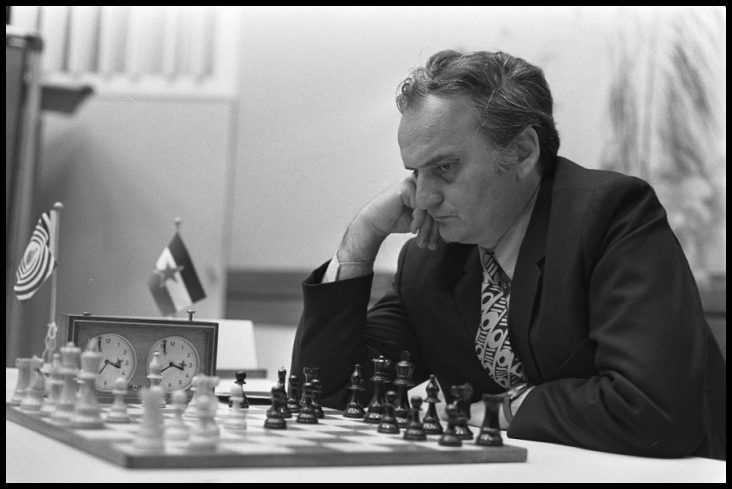
The legendary Yugoslav (Serbian) Grandmaster, Borislav Ivkov, passed away in Belgrade at the age of 88. He was not just a master of chess but also a maestro of the written word who sought the meaning of life. Milan Dinic, Editor of the British Chess Magazine, relives the moments with the Serbian legend, a friend of his family, in this distinctive obituary that he kindly shared with us. Borislav Ivkov was born in 1933 in Belgrade, then the Kingdom of Yugoslavia. He became the youth champion of Belgrade at the age of 14, and at the age of 17, he won the first World Junior Championship in Birmingham in 1951. He was awarded the title of Grandmaster in 1955 and for many years was considered one of the strongest Yugoslav and world players, next to Svetozar Gligoric. His peak was in the 1950s (when he was in the top 10 in the world) and in the 1960s. A stellar career Ivkov had an outstanding career marked with successes in both national and international events. A three-time champion of Yugoslavia, he qualified for the 1965 Candidates matches (he lost to Bent Larsen) and played four more Interzonal tournaments during the 1960s and 1970s. The winner of numerous strong tournaments (including Mar del Plata 1955, Buenos Aires 1955, Santiago 1959, Beverwijk 1961, Zagreb 1965, Amsterdam-IBM 1974), Ivkov also took the champion title at the European Senior Individual Championship in Davos in 2006. Borislav Ivkov was a regular member of the Yugoslav chess team from 1965 until 1980, winning ten team medals in 12 Olympiads (six silver and four bronze medals) and five board medals. He played for Yugoslavia in the European team championships six times, winning three team silvers, one bronze and one gold board medal. Ivkov also took part in the historic match USSR vs the Rest of the World (1970), playing on the tenth board. Photo: Dutch National Archive At these and many other events Ivkov was ahead of the likes of Gligoric, Najdorf, Larsen, Uhlmann, Portisch, Bronstein, Petrosian (when he was World Champion), Stein, Korchnoi and Jansa. Several world champions fell prey to Ivkov, including Bobby Fischer, Tigran Petrosian, Vasily Smyslov, Mikhail Tal and Anatoly Karpov. He also drew all of his games with Botvinnik. A great writer Apart from being a world-class grandmaster, Borislav Ivkov was known as a prolific writer. In his native Serbia, he published several books about chess and life, including ‘My sixty-four years in chess’, ‘Black on white’, ‘Mesmerized by chess’, and ‘Parallels 1 and 2’. His books are dedicated to his career in chess but also – to the lives and characters of great players, the people he met, the places he visited and the experiences he had. In one of the books, instead of a foreword, he wrote a few joking lines dedicated to my father: “Vladan Dinic, the bard of Yugoslav journalism and a well-known chess lover, said to me: ‘From all of your books you may be able to put together one decent book!” Recently, he told my father that he was working on another book. We don’t know if he finished it or not… A big Character Borislav Ivkov – or, Bora, as he was known – a true gentleman, one of those people who can charm their way in and out of any conversation, showing their vast knowledge about almost every topic but never coming across as arrogant or impatient. To me, he was an example of what chess really needs – a friendly person, well-spoken, well-dressed, knowledgeable, interested in the world, happy talking to others and interesting to talk to. One occasion stands out in my memory when I think of Bora Ivkov. Several years ago, he spoke at the promotion of my father’s book about Bobby Fischer and his time in Belgrade during the 1992 rematch with Spassky (at the time, my father was closely involved in the event and covered it as a journalist, spending a lot of time with Fischer). One of the guests at the promotion was a famous opera singer from Serbia, Jadranka Jovanovic. Bora started by saying how in one tournament in the 1950s in Latin America (I can’t remember which one), he was rushing to finish the game so he could go and see – of all the things – a boxing match! What was even more surprising was that after the match Bora went to see a classical music concert. Now, boxing and classical music are two things you don’t place together, let alone someone seeing both in one evening. Bora shared this story as a prelude to another one: he was flying back to Europe from a tournament and, during the long-haul flight, most of the players took out their pocket sets and played or analyzed games. However, Ivkov, at some point, noticed an unusual hat which belonged to one of the female passengers a few seats in front… ‘I was so intrigued that during the whole flight, I was trying to find a way to politely approach that woman…’ As he, later on, found out – that woman was the very person present at the book promotion, the opera singer Jadranka Jovanovic! And, for me, that is Bora Ivkov – not just a great chess player but an amazing fountain of interesting stories about life, people and places. Back in 2017, I interviewed him for the British Chess Magazine, which I edit. As I sat down to write this obituary, I read the interview and looked at my notes. We discussed famous players, events, topics, chess and computers, as well as life in general. The interview was so extensive that I had to break it down into two parts. Here I share a few of the things Bora said, which should be noted in the history of the great game. Ivkov, in his own words: “My whole playing life I did not understand chess” In one of the first sentences in that interview, Bora Ivkov summed up his chess life: “To be honest, my whole playing
FIDE Grand Prix: Andreikin replaces Ding in Belgrade

FIDE regrets to inform that GM Ding Liren will be unable to play in the second leg of the FIDE Grand Prix Series organized by World Chess, to be held in Belgrade from February 28 to March 14. Despite the will and the efforts from both parties, there are insurmountable obstacles that prevent him from playing. According to the regulations, GM Dmitry Andreikin will take his place in Belgrade. FIDE has already communicated with Andreikin, who confirmed his readiness to compete in the event. In the eventuality any of the participants expected for the third and last leg of the FIDE Grand Prix being forced to withdraw for whatever reason more than 15 days prior to the start of the tournament, GM Ding would be considered, by rating, the first reserve. FIDE is also willing to count on Ding in case any unforeseen circumstances force us to designate a wildcard. However, we realize that the chances of him getting to actually play in the Grand Prix this year are very slim under the current circumstances. We are very sorry that the travel restrictions have impacted Ding’s career during the past two years so dramatically. We look forward to having him compete in the international circuit again as soon as possible.
Yaniela Forgas wins Cuban Women’s Championship
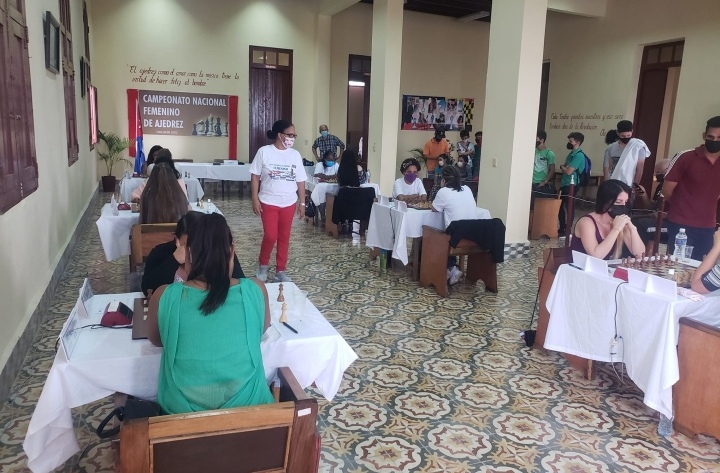
After one-year hiatus caused by COVID-19, the Cuban Women’s Championship returned to Eradio Domínguez Provincial Chess Academy in Holguín. The 12-player round-robin, held from January 30 to February 12, 2022, brought together the best national female players (the top eight rated plus four qualifiers). For the first time, the participants played on smart boards. The tournament turned into a close race between Yaniela Forgas, the defending champion Lisandra Ordaz (both pictured above) and Yerisbel Miranda Llanes, with the first two heading into the final round tied for the first place. Forgas scored a crucial victory over Yuleisy Hernández with black pieces and clinched the title as Ordaz managed only a draw in her game with the lowest-rated participant Zirka Frómeta. Yerisbel Miranda Llanes jumped on the opportunity to catch up with Ordaz, and after prevailing over Gil Hernandez, she took silver thanks to better Sonneborn-Berger. Lisandra Ordaz had to settle for bronze. “It was an intense fight from the beginning to the end. All the participants played giving their best,” said the new champion, who netted 8½ out of 11 despite suffering two defeats. The tournament statistics confirm Forgas’ worlds about a tremendous competitive spirit reigning in the event. Indeed, only 21 games out of 66 were drawn. Final standings: 1 WIM Forgas, Moreno Yaniela 2303 8½ 2 WIM Miranda, Llanes Yerisbel 2261 8 3 IM Ordaz, Valdes Lisandra Teresa 2371 8 4 WGM Arribas, Robaina Maritza 2204 6½ 5 WFM Hernandez, Gil Ineymig 2348 6½ 6 FM Hernandez, Machado Patricia 2196 6 7 WGM Hernandez, Moya Yuleisy 2250 5½ 8 WFM Bosch, Valls Leannet Mariah 2162 4½ 9 WGM Frometa, Castillo Zirka 2055 4 10 WGM Linares, Napoles Oleiny 2211 4 11 WIM Gonzalez, Ochoa Yoana 2124 3 12 WFM Gutierrez, Espinosa Karen 2120 1½ Photo: Federación Cubana de Ajedrez
Arbiters’ Manual 2022 released
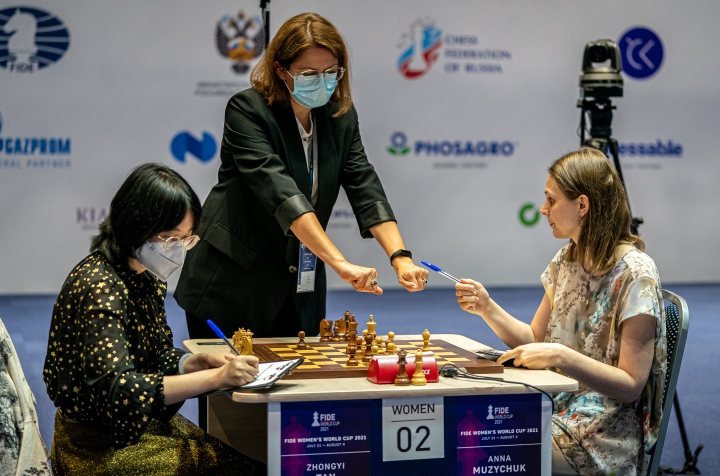
Last week, the FIDE Arbiters’ Commission released the edition 2022 of the FIDE Arbiters’ Manual. This new edition includes some important changes in regulations that every arbiter should be familiar with. It would also be highly recommended that players read this document – as well as, of course, the laws of chess. Chapter 10 is now called FIDE Regulations for arbiters, with new regulations on titles, training, classification and selection of arbiters in FIDE World Events. Chapters 6 and 7 reflect the recent changes in the regulations for ratings and titles. They are critical for our colleagues delivering player norms. The Arbiters’ commission also reviewed the exam questions and have updated them accordingly, preventing discrepancies between the official text and the concrete examples presented. The International Arbiter Shohreh Bayat, Councillor of the ARB Commission, was the leader of the project. On her behalf, and on behalf of FIDE, we would also like to thank all those who contributed with their time and their inputs. In particular, Alex McFarlane, Gopakumar Sudhakaran, Juergen Klueners, Aris Marghetis, David Sedgwick, Jens Wolter, and Alex Holowczak. Arbiters’ Manual 2022 (pdf)
FIDE Grand Prix Berlin final: Aronian vs Nakamura
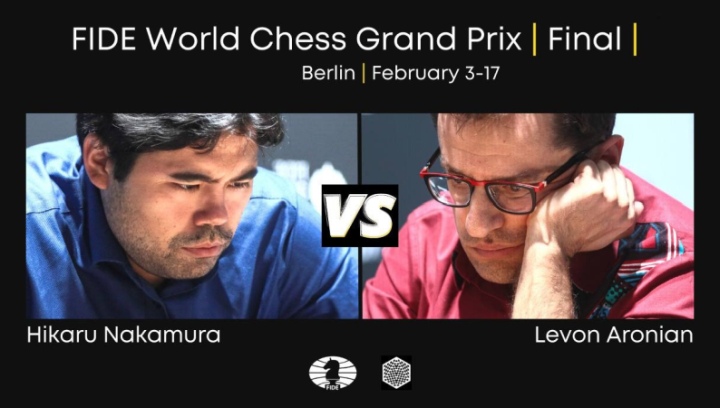
IM Michael Rahal – Berlin, February 12th – Levon Aronian and Hikaru Nakamura, both playing with Black, scored safe draws in their games today against Leinier Dominguez and Richard Rapport and advanced to the final of the 2022 FIDE Grand Prix Berlin. In his game against Dominguez, Aronian decided to play very solidly, developing his bishop on e7 instead of his usual Bc5. Although Dominguez got a small edge from the opening, it was clearly not much. Once again better prepared, Aronian was blitzing out his moves while Dominguez was finding it hard to hang on to any kind of initiative. The game fizzled out to a rook ending with three pawns apiece, and a draw agreed on move 31. Aronian’s preparation for this line was excellent. In conversation with Press Office Michael Rahal, he said: “I have analysed this position a bit from White and Black, of course. It’s slightly worse for Black, he keeps a small advantage and presses, but it’s a solid type of position. If White doesn’t play the most precise moves, it gets into a drawish type of position. I thought that playing solidly would be a good idea in a game in which I needed a draw”. Leinier was definitely not expecting this line today: “I was slightly surprised by Levon’s opening choice as he normally plays Bc5. I was hoping to get some pressure, but after b4, which looks natural, it gets very concrete, and I am not even better. It’s a bit sad for a must-win situation, as I am not even close. Black is doing very well here; I couldn’t do much more”. When questioned about his excellent result here and his focus on the Candidates spot, Aronian dodged the issue: “Generally, I just want to work on my chess and improve as a player, and continue doing what I love. It’s not directed especially towards a goal. Of course, some of the work I did pays off, but this is an ongoing process in which you work but try not to think of what you are working for”. Although eliminated, Dominguez was pleased with his result: “The result is objectively not bad at all as I keep decent chances for the last event. I think that I have to work more on my physical shape: my level tends to drop a bit towards the end of the tournament. I get a bit tired, especially when you have tense games, which is the case in these top events”. You can watch a postgame interview with both players on the World Chess Youtube channel The second semifinal game was certainly more exciting. With White, Rapport opened with the King’s Indian Attack, which he had employed a couple of years ago in a Bundesliga game. Nakamura reacted in a principled manner, occupying the center and establishing strong outposts for his knights on e4 and c4. Even though most of the pieces were still on the board, Rapport couldn’t find the way to get things going and soon had to adopt a passive approach. Sensing that the initiative was on his side, Nakamura offered a draw on move 30, which Rapport accepted. “I was happy with the outcome of the opening, but I should have probably traded on e5 some pieces. I tried to do something smarter that didn’t work out” was Rapport’s first impression after the game. Nakamura was surprised by Rapport’s opening choice: “I wasn’t expecting it. I vaguely looked at this Nc6 idea recently. My opponent in the final, Levon has actually played this a few times, so it was certainly familiar. But with my knight on e4 supported by my pawn on d5 his bishop on g2 is never active but the match situation – Rapport forced to play for a win – didn’t allow for much more”. “I could have played on, but who wants to waste time. Who cares about rating points? Winning the match was the only important thing”, was Nakamura’s point of view when he was asked about continuing in the final position. Speaking of his tournament performance, Rapport was very critical:” I think I played very poorly here, and I was very fortunate to qualify from the group stage. Also, I came here from playing Wijk aan Zee, an extremely long event, and here I played long games and ran out of stamina. I will play the next event in Belgrade, which is actually like home turf for me as I have been living there for a while”. As there are no tiebreaks, the players will enjoy a free day tomorrow. The first game of the final will be played on Tuesday, February 15th. Hikaru Nakamura will have white pieces. You can watch a postgame interview with both players on the World Chess Youtube channel About the Tournament The three-tournament Grand Prix series, which will unfold from February to April, features twenty-four of the world’s best Grandmasters, who will compete in two of the three events. In order to make the series more exciting and reduce the percentage of draws, FIDE and World Chess have changed the format. This innovative approach is new for the chess world but very similar to the Super League: the first stage has four pools of four players, and the winner of each pool advances to the semifinals and then to the final. The venue of the first leg is the World Chess Club Berlin, located at the City Centre on Unter den Linden, 26-30, and the games will be played from February 4th-17th every afternoon at 3 pm. Along with the two qualification spots for the Candidates, the event has a 150.000 euros prize fund, 20.000 euros more than the 2019 series. All the games will be broadcasted live with expert commentary in three languages at https://chessarena.com/broadcasts/13604 More information and the full schedule can also be found on the worldchess.com website. Full pairings can be found here. Due to COVID restrictions currently in place, only a limited number of tickets are available. Please note that the 2G+ rule applies to the event, which
FIDE Grand Prix: Aronian and Nakamura pull ahead
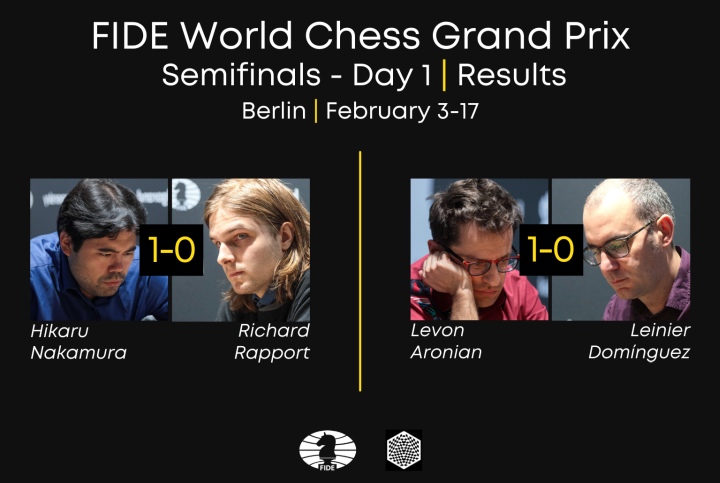
Rapport and Dominguez Perez must win on-demand tomorrow IM Michael Rahal – Berlin, February 12th 2022 – The semifinals began punctually with the ceremonial first move made by German cabaret artist Matthias Deutschmann on board one. After the customary greetings, Nakamura indicated his intention of opening the game with 1.d4 and Deutschmann firmly moved the d-pawn two steps forward. The rules and regulations of the 2022 FIDE Grand Prix determine a €24,000 prize for the winner while the runner-up receives €18,000. Both semifinalists receive checks for €12,000. In addition to the prize money, the winner of the Berlin leg gets 13 Grand Prix points, quite a few more than the 7 received by the semifinalists. Winning here – or at least advancing to the final – is definitely a huge step towards the final goal: the two spots that qualify to the Candidates. The USA Olympic teammates Levon Aronian and Leinier Dominguez Perez have played at the highest level for more than fifteen years. According to the database, their first encounter was played in Beersheba (Israel) in the 2005 World Team Championship, in the match between Cuba and Armenia. That game ended in a relatively quick draw and, since then, they have faced each other 59 times, excluding online events, with a clear advantage on the scoreboard for the former Armenian player: 37½ – 22½. However, if we factor out the OTB rapid and blitz games, Aronian barely leads by 4-3. Having won his preliminary group with a round to spare, Aronian has essentially enjoyed two rest days, while Dominguez returned to the playing venue yesterday to eliminate Wesley So. But these things can work both ways – you can never know if extra games and effort favours a player or makes him even more tired. Although, according to rating Richard Rapport would be considered a favourite, things are not so clear if we go over their head-to-head record. Excluding blitz and rapid events, Nakamura has scored 2½ points in the 3 games where they have played. Also, the American qualified to the semifinals with no need of a tiebreak, which means one extra rest and preparation day for him. Finally, every classical game of this tournament has an added importance for Nakamura: he has already confirmed here that he will only play for the USA in the Moscow Olympiad if he is one of the four main boards, never as a reserve. Currently, he is in fifth place behind Caruana (2792), So (2772), Aronian (2772) and Dominguez (2752), so he still has some ground to cover. Board 1: GM Hikaru Nakamura (USA 2736) – GM Richard Rapport Hungary (2779) Rapport went for the Queen’s Gambit declined in this very important game. In the opening, Nakamura kept looking at the games monitor and checking out the other board: obviously, he was also interested in Aronian’s choice in a sharp line. For many moves, the position was identical to Kasparov-Smyslov from the 1988 USSR Chess Championship, until Nakamura diverged with 15.Kb1 (15.Nf4 was played in that game and a draw was agreed son after). Rapport kept the balance with precise defensive moves until Nakamura initiated some interesting tactics on the kingside with 23.Bxg6!?, giving up the exchange but securing an outside h-passer. Low on time, Rapport couldn’t find the best defence, and soon he decided to return the material. However, although only a pawn down, the rook ending was very difficult to defend for Black due to Nakamura’s active king and passed center pawns: with a few accurate moves, Hikaru wrapped up the game. In conversation with IM Michael Rahal, Press Officer for the event, Nakamura felt that he had played well, but complicated things unnecessarily: “Of course, it should be winning, but it’s very tricky: with one bad move and I can lose, Black has two pawns as well, going down the a and b files. I was quite mad at myself because at the beginning, I think I had an easier win. But it is what it is, and you just try to play the best moves even after you make a mistake.” Rapport recognized that giving back the exchange was a mistake: “I didn’t realize that 15 moves ahead it would be so forcing”. You can watch a postgame interview with both grandmasters on the World Chess Youtube channel. Board 2: GM Levon Aronian (USA 2772) – GM Leinier Dominguez (USA 2752) The game between Aronian and Dominguez was a treat to spectators, full of twists and turns, an absolute rollercoaster. Aronian’s preparation for the game was unparalleled: he played the opening so fast that it seemed that he expected this line to appear on the board. “You can never guarantee you will get certain positions on the board, but since Leinier employs this opening, which is very interesting for Black, I thought there was a probability that this might happen. It’s a difficult position for humans to play as it requires immense pressure, and I had the feeling that after a difficult tiebreak, it was my best chance to surprise Lenier” were Aronian’s impressions after the game. The opening, a Queen’s Gambit accepted, is one of Leinier’s specialities, but Aronian came with a very aggressive idea that wins the exchange (a rook for a minor piece) but lags in development. “Dominguez has less than an hour on his clock, which makes me question the depth of his preparation. He was the one to pick this very sharp line, and yet he is thinking too much,” was online commentator Evgenij Miroshnichenko’s take on Leinier’s choice of variation. Low on time, Dominguez was unable to keep generating threats to compensate his material deficit, and at some point, Aronian forced the exchange of queen’s, leading to an easily won ending. In the postgame press conference, Leinier admitted that the game hadn’t gone his way: “It’s obviously a very difficult position to play in practice. I probably took too much time thinking about the different possibilities. Tactically I