

Tickets now on sale for FIDE World Cup 2025!
The wait is over! Tickets are now available for the opening rounds of the FIDE Chess World Cup 2025, taking place in Goa, India from 1 to 26 November 2025. You can now book your seats for the first two rounds (1 to 6 November 2025) and witness world-class chess up close. This year’s World Cup brings together 206 of the world’s best players, competing for a $2 million prize fund and three qualification spots in the FIDE Candidates 2026. Among the stars in action are World Champion Gukesh, Arjun Erigaisi, Praggnanandhaa, Nodirbek Abdusattorov, Anish Giri, Vincent Keymer, and many more. Choose your experience We’ve designed several ticket options to help you enjoy the World Cup in your own way: Playing Hall Ticket:Step into the arena and experience world-class chess up close. You can choose from four time slots to see the action live, including a special Photo Slot that allows limited photography before play begins. Fan Zone Pass:Join live commentary sessions with India’s top chess voices; IM Tania Sachdev, IM Sagar Shah, GM Harshit Raja, GM Sahaj Grover, Amruta Mokal, and Sahil Tickoo. You’ll get to interact with them throughout the day and even meet players who visit the fan zone after their games. Ticket pricing Classical Game Days (1, 2, 4 & 5 November) Playing Hall Tickets: Photo Slot 1 – ₹500 | 2:00 PM (Photography permitted until 3:10 PM) Slot 2 – ₹300 | 4:15 PM Slot 3 – ₹300 | 5:15 PM Slot 4 – ₹300 | 6:15 PM until end of play Fan Zone Ticket: ₹1,000 Full-day access to the Fan Zone Playoff Days (3 & 6 November) Full Day Ticket: ₹800 Grants full-day access to the playoff rounds, where every move could decide a player’s World Cup journey. Fan Zone Ticket: ₹1,000 Full-day access to the Fan Zone Terms and Conditions All ticket purchases are final and non-refundable. Internet handling fees may apply per ticket. Arrive at least 15 minutes before your scheduled time slot. Please do not attend if you feel unwell. Unlawful resale will result in ticket cancellation without refund. Seating is first-come, first-served. Entry to the playing hall is subject to limited capacity. No mobile phones or electronic devices allowed inside (except for Photo Slot 1). Phones must be deposited before entering. Silence must be maintained in the playing hall. Photography is only permitted during Photo Slot 1. Fan Zone Pass grants full-day access. Slot Ticket allows entry only during your chosen time slot Cash-and-carry food counters will be available on-site. The organizer reserves all rights of admission and policy updates. Tickets are limited and selling out quickly, don’t miss your chance to witness the FIDE World Cup 2025 in person. Book your tickets now
ChessMom Project returns for 2026 Chess Olympiad in Uzbekistan

FIDE and the FIDE Commission for Women’s Chess are proud to announce the return of the ChessMom Project for the 46th Chess Olympiad, to be held in Uzbekistan in 2026. This pioneering initiative was first introduced at the 2024 Chess Olympiad in Budapest and received overwhelmingly positive feedback from participants and federations alike. The ChessMom Project reflects FIDE’s commitment to supporting professional women chess players who are mothers, helping them continue their chess careers while caring for their young children. “I think it is important that women in chess feel supported. We cannot take all the barriers for women away, but with programs like ChessMom we want to help professional chess players balance their career and personal life.” — Dana Reizniece, FIDE Deputy Chair of the Management Board The core mission of the project remains unchanged: to ensure that motherhood and a professional chess career can go hand in hand. The program provides financial support for female players with babies, allowing them to travel and compete with the assistance of a caregiver. For the 2026 edition, an important update has been introduced: Mothers with children under two years of age (previously under one) at the time of the Olympiad are now eligible to apply. Key details for the 2026 ChessMom Project FIDE will support 10 female chess players, based on rating (highest to lowest) At least 1 player per Continent in guaranteed FIDE will provide reimbursement up to €1,000 per player (or €500 EUR from same continent as Olympiad host country) who travels with an under 2 years old child, to cover the caregiver’s flight ticket to the 46th Chess Olympiad (most airlines do not charge for child under 2, traveling with an adult) Child and accompanied caregiver shall be considered as part of the National Official Delegation with all applicable rights. Meaning providing lodge and meals, and any other applicable discounted fee as part of the Official Delegation (not visitor) National Federations* should consider child and accompanied caregiver as part of the National Official Delegation with all applicable rights. Application requirements Interested national federations and eligible players are invited to prepare the following information: Player’s full name, FIDE ID, national federation, and citizenship Visa requirement for Uzbekistan Child’s full name and date of birth Accompanying person’s full name, relationship to the player or child, and citizenship Letter of request from the player Letter of concurrence from the National Federation confirming participation in the 2026 Olympiad Further details – including the official application form, timeline, and submission deadlines – will be announced once the official Olympiad regulations are published by the organizers. Note to National Federations National teams participating in Chess Olympiad normally receive three (3) rooms as part of their official accommodation package — typically, two double rooms and one single room for five (5) players. For delegations that include a player approved under the ChessMom Project, the single room will be upgraded to a double room to allow the caregiver and the baby to stay comfortably together with the delegation. It is important to note that this adjustment does not increase the total number of rooms provided to each delegation. The delegation will still receive a total of three rooms, as per standard allocation. Building on the success of 2024 The first edition of ChessMom took place at the 2024 Chess Olympiad in Budapest, where six mothers from across the world received support through the program: Alina Kashlinskaya (Poland), Nana Dzagnidze (Georgia), Yuliia Osmak (Ukraine), Aster Melake Bantiwalu (Ethiopia), Rauha Shipindo (Namibia) and Nolwazi Nkwanyane (Eswatini). Their stories demonstrated that motherhood truly can coexist with continued professional growth. As Namibian player Rauha Shipindo shared: “I am so grateful to those who initiated the ChessMom program. It is trying to close the gap that is there for women. If I have a newborn like this, I might weigh in and say, will I stay to look after my little one, or will I go to the Chess Olympics? So it’s combining that gap and closing it.” Continuing the mission With the 2026 edition, the ChessMom Project continues to break new ground in supporting women in chess. It stands as a symbol of FIDE’s ongoing dedication to equality, inclusion, and respect for the diverse paths that bring players to the chessboard. FIDE and the FIDE Commission for Women’s Chess will work tirelessly to continue this mission. “We are committed to ensuring that no woman is forced to choose between motherhood and her professional career as a chess player. ChessMom continues to grow, raise awareness, and send a message that mothers who play chess are not alone.” — Francisco Javier Cruz Arce, FIDE Women’s Commission Member and Project Initiator More details about the project will be shared soon. For additional information about the project, please contact Francisco Javier Cruz Arce, at fj_007@yahoo.com.
FIDE Al-Ain ACMG Academy launch: A new era of global talent development

The FIDE Trainers’ Commission is delighted to announce the official launch of the FIDE Al-Ain ACMG Academy, scheduled to begin on 1 December 2025. FIDE President Arkady Dvorkovich emphasized that this flagship initiative represents a cornerstone of FIDE’s long-term global strategy to develop young chess talents and ensure that every federation has equal access to world-class instruction. “The FIDE Al-Ain ACMG Academy reflects our vision of a truly global chess community — one where talent, passion, and opportunity meet. By connecting young players with some of the greatest trainers in history, we are building a bridge to the future of chess education and giving every federation the chance to nurture its next generation of champions,” said Dvorkovich. Sheikh Sultan bin Khalifa bin Sultan bin Shakhbout Al Nahyan, President of the Al Ain Chess & Mind Games Club, presented the launch of FIDE Al-Ain ACMG Academy as a project of global importance: “This Academy is more than a training project — it is a dream shared by us and FIDE that every child deserves the chance to learn, dream and become a champion. Together with the FIDE Trainers’ Commission, we are creating a global platform that welcomes every young player, no matter where they come from — to engage in high-level training and learn from some of the greatest minds in chess history.” The Academy brings together a constellation of legendary chess minds — including Hou Yifan, Rustam Kasimdzhanov, Alexander Khalifman, Vladimir Chuchelov, Artur Jussupow, Iossif Dorfman, Adrian Mikhalchishin, Ramesh R B, Vladimir Potkin, Aleksey Dreev, Vladimir Malakhov, Yevgeniy Vladimirov, Melikset Khachiyan, Yannick Gozzoli, Farrukh Amonatov, Alonso Zapata, and other great lecturers to be announced soon — who will deliver a comprehensive 400-hour training program designed to inspire and elevate the next generation of champions. Training will be conducted in twelve specialized groups, across four languages (English, Russian, Spanish, and French), and will run from December 2025 to May 2026. The curriculum blends advanced chess instruction with personal development sessions, emphasizing both intellectual growth and character building. A key highlight of the program will be the FIDE Al-Ain ACMG Academy Training Camp, which will take place in two stages — an online phase followed by an in-person camp in Al-Ain, United Arab Emirates, scheduled for mid-January 2026. Participation in the camp will be determined based on selection criteria to be announced at a later stage. FIDE invites all National Chess Federations to nominate four promising young players — two boys and two girls aged 8 to 16 — to take part in this prestigious program. Nominations should be submitted by completing the [Registration Form] and sending it to trainers@fide.com no later than 14 November 2025. The FIDE Al-Ain ACMG Academy embodies FIDE’s enduring commitment to excellence, inclusivity, and the advancement of chess education worldwide — shaping not only future grandmasters but also future leaders through the universal language of chess. For more details and updates, please visit the FIDE Trainers’ Commission website.
FIDE World Rapid & Blitz Chess Championships 2025: Registration period nearing close
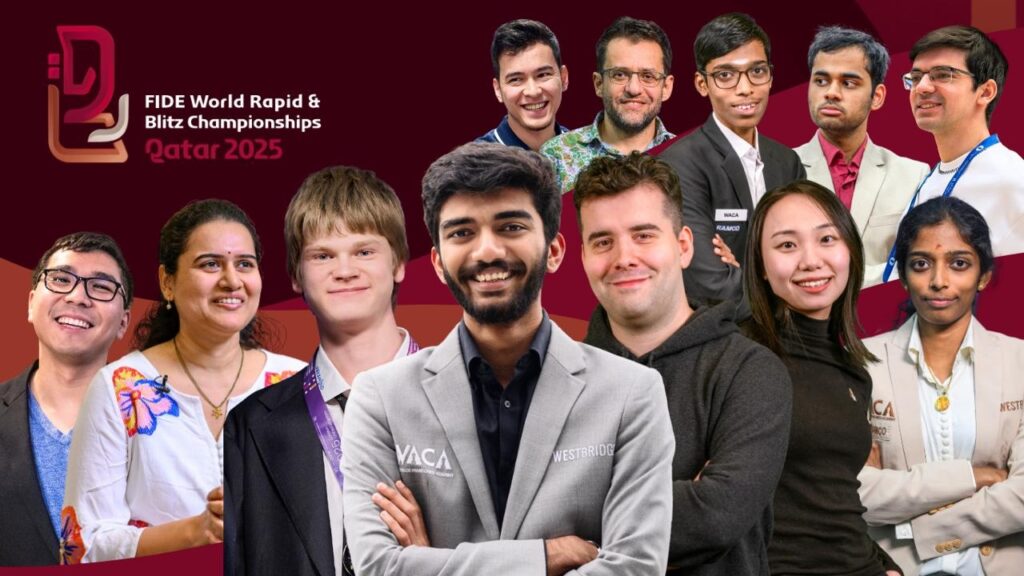
What better way to end the year than with a high-stakes chess tournament featuring the world’s top players, a one-million-euro prize fund, and popular fast-paced time controls? The 2025 FIDE World Rapid & Blitz Championships offer exactly this to chess players and fans around the globe. This year, from December 25-31, the annual event heads to Doha, Qatar – a world-class setting for a world-class competition. Registration is now open, and FIDE invites all eligible players to take part in one of the most exciting events on the chess calendar. [Register now] Event overview Rapid: Open section: 13 Swiss rounds Women’s section: 11 Swiss rounds Blitz: Two-stage format: Swiss stage: 19 rounds (Open), 15 rounds (Women) over two days Knockout stage: Only the top four players from the Swiss stage proceed to the semifinals (Open and Women). Matches in the knockout are over four games, and ties after these lead to a “sudden death” game. Prize fund Open Rapid Championship: €350,000 Open Blitz Championship: €350,000 Women’s Rapid Championship: €150,000 Women’s Blitz Championship: €150,000 Eligibility Players with a FIDE rating of 2550 (Open section) or 2250 (Women’s section) or higher in any recent FIDE rating list (Standard, Rapid, or Blitz) are eligible to participate. Reigning national champions also qualify regardless of rating. Players who do not meet the above criteria may be nominated by the FIDE President and/or the organiser. Registration Entry fee: $100 for the Open section and $50 for the Women’s section. Late entry fee: Double the original fee if paid less than 10 days before the tournament. The list of registered players includes: Open: Gukesh D, Nodirbek Abdusattorov, Levon Aronian, Vasyl Ivanchuk, Arjun Erigaisi, Volodar Murzin, Praggnanandhaa R, Ian Nepomniachtchi, Shakriyar Mamedyarov, Wesley So, Anish Giri, Maxime Vachier-Lagrave. Women: Humpy Koneru, Vaishali R, Zhu Jiner, Lei Tingjie, Bibisara Assaubayeva and Nana Dzagnidze. Travel & accommodation support Open section players rated above 2750 and women’s section players rated above 2500 will have travel and accommodation covered. The 2024 medalists (gold, silver, bronze) will have full accommodation covered. Accompanying person fee: Accompanying person’s fee in amount of 100 USD must be paid by 1 November 2025, which covers: Transportation during the event: airport-hotel-airport, hotel-playing hall-hotel; Accreditation; Visa support; General admission ticket Registration can be done [HERE]. The deadline for submitting entries is November 01, 2025. All foreign players and their accompanying persons shall stay only in the official hotels, which can be booked while completing the registration form. Regulations for 2025 FIDE World Rapid & Blitz Championships: Open (PDF) Women’s (PDF) With exciting formats, strong incentives for top performers, and full global attention, the stage is set in Doha for one of the landmark events of the chess calendar.
Global tech and finance giants qualify for second FIDE World Corporate Chess Championship Finals

Teams from blue-chip companies including Microsoft, Google, JP Morgan, and Deloitte are among the qualifiers for the over-the-board finals, which will take place alongside the World Cup in Goa, India. Following the online qualifications and knockout stages in early to mid-October, FIDE is pleased to announce the qualifiers for the finals of the 2025 FIDE World Corporate Chess Championship. The competition for the title of “The Smartest Company in the World” will see eight teams compete in an over-the-board tournament to be held from November 14 to 16 in Goa, alongside the World Cup. The qualifying stage saw over 30 teams from across the globe compete, with the online stage culminating in a fierce knockout bracket to determine the eight finalists. The inaugural edition of the event, held in New York in June 2024, saw corporate giants such as Google, Deutsche Bank, Goldman Sachs, BlackRock, and UBS in the finals, with Chessify taking the title following a thrilling final against ChessMood. A key feature of this year’s competition is its exclusive focus on fully non-professional corporate players. This strategic decision ensures a true test of business talent and provides a peer-to-peer competition, excluding teams from chess companies or those composed of chess professionals. “We are thrilled that famous world companies have fielded teams in the World Corporate Championship, showing that chess is very much present in the world of business. The World Corporate Championship is not just a competition for the title of The World’s Smartest Company; it is also a mini business forum, allowing professionals from different business backgrounds to connect through the common love for chess,” said Joran Aulin-Jansson, Vice-President of the FIDE Council. “We are excited that the finals are taking place alongside the World Cup in India. We think this is a great opportunity for forging new connections between chess and the business world. Given that India is a booming global economy as well as a chess powerhouse, this seems like an excellent opportunity for all,” he added. For more information about the event, please visit the official website at worldcorporate.fide.com.
Mihai Șuba (1947 – 2025)
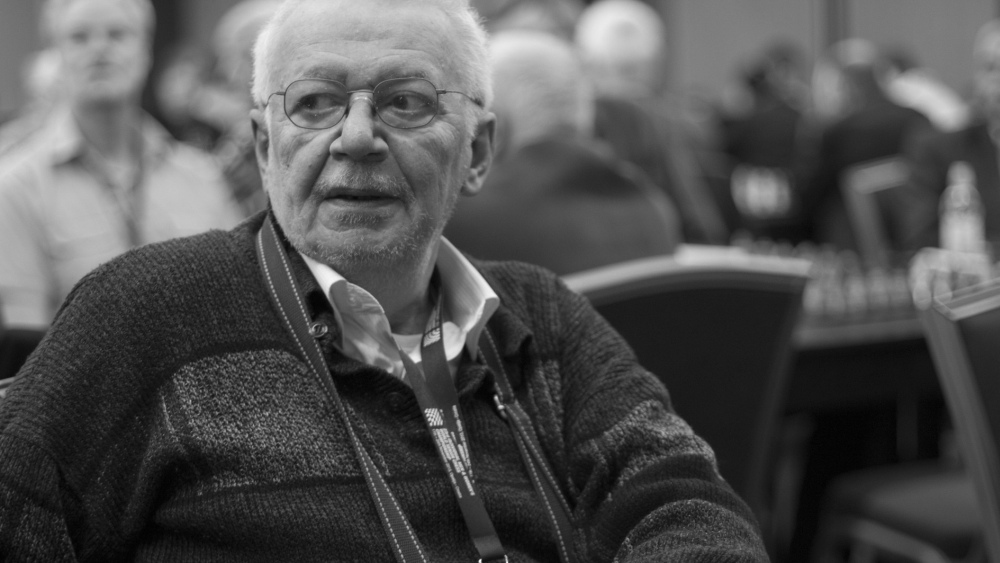
FIDE and the chess world mourn the passing of Romanian Grandmaster Mihai Șuba, a formidable player, an esteemed author, trainer and theoretician. He was 78. Born on June 1, 1947, Șuba began playing chess relatively late. Despite this, his ascent through the ranks was rapid; he earned the International Master title in 1975 and became a Grandmaster in 1978. Șuba’s peak came in the early-mid 1980s. He clinched his first of two Romanian Championship titles in 1980 and 1981 and repeated the feat in 1986. From 1978 to 1986 Mihai played for his native country at five Chess Olympiads. His breakthrough on the international stage came at the 1982 Las Palmas Interzonal, where he finished third—behind Zoltan Ribli and former World Champion Vasily Smyslov—narrowly missing qualification for the Candidates Matches. His most iconic international victory came at the prestigious 1983 Dortmund tournament, where he triumphed ahead of a strong field. Șuba also finished equal first at Prague 1985 and Timișoara 1987. In 1986, he reached his FIDE career-high rating, entering the world’s top 30. Suba’s legacy extends far beyond the board. He was the author of the acclaimed book Dynamic Chess Strategy (1991), a seminal work that challenged orthodox views of classical positional play and emphasized the fluid, evolving nature of advantage. After settling in Spain, Suba developed a close connection with the Valencian Community, where he not only excelled as a player but also contributed significantly to chess education and promotion. FIDE and the global chess family extend their deepest condolences to GM Suba’s family, friends, and students. Photo: Derek Bridges
Preview: FIDE World Cup 2025 – Goa, India
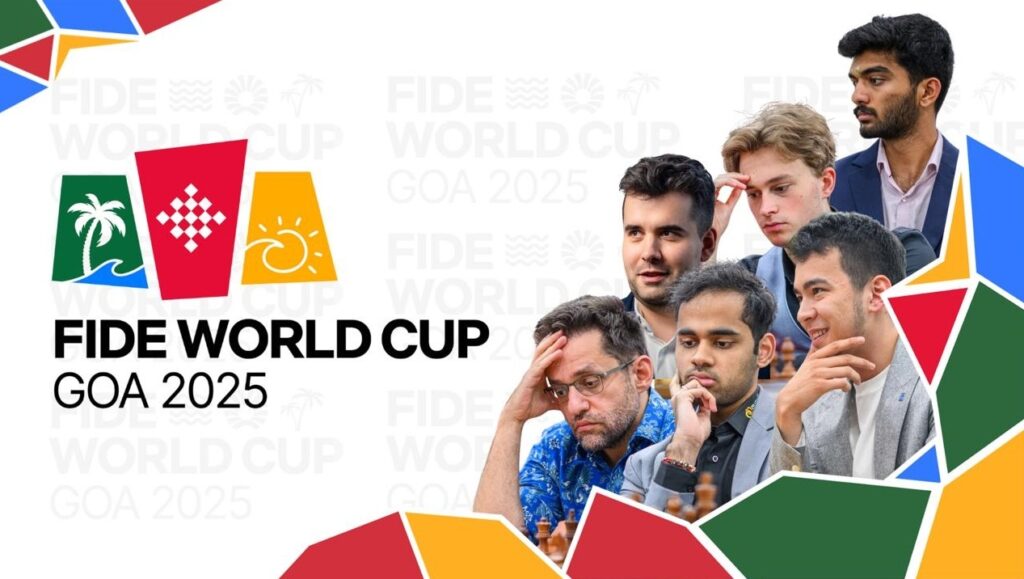
Two hundred and six of the world’s best chess players from more than 80 countries will descend on Goa, India, this week for the 2025 FIDE World Cup, arguably the most important individual chess event of the year. From October 30 to November 27, players will battle through a gruelling knockout format for a share of the USD 2 million prize fund and, more importantly, the three coveted qualification spots for the 2026 FIDE Candidates Tournament — the gateway to the next World Championship match. “India is not just the ancient home of chess; it is a global modern powerhouse. This World Cup is being held here because India is now a central pillar in the global structure of our sport. For the next four weeks, Goa will not just be a coastal paradise; it will be the Colosseum of Chess. This is where legends are forged and broken, and new champions born – a process that has been dramatically enriched by the incredible new generation of Indian stars,” said Arkady Dvorkovich, FIDE President The structure of the World Cup is unique within elite chess. It’s an eight-round, single-elimination knockout event, where each match consists of two classical games played under standard time controls. If the score is tied after those, the players return on the third day for a series of rapid and blitz tie-breaks to decide who advances. The top 50 seeds — comprising many of the world’s highest-rated grandmasters — receive byes into the second round, while the remaining 156 competitors begin their campaigns on the afternoon of November 1st. All games will take place in the Resort Rio, Goa’s largest convention hall and a five-star luxury venue just moments from Baga Beach, offering a fittingly grand stage for one of the most prestigious tournaments on the chess calendar. “I’m really excited and looking forward to playing in the World Cup. Anywhere in India is great of course, but I have some nice memories of Goa as I played some junior events there,” declared Gukesh D, current World Champion, one of the favourites, seeded straight into round two. For the first time since 2002, the FIDE World Cup returns to Indian soil. On that occasion, Viswanathan Anand, the legend from Chennai, defeated Rustam Kasimdzhanov in the two-game final held in Hyderabad, a victory that helped cement India’s emergence as a major force in world chess. More than two decades later, India hosts the event from a position of unprecedented strength. The country now boasts D. Gukesh, the reigning World Champion; Olympiad team titles in both the Open and Women’s sections; and Divya Deshmukh, the current Women’s World Cup winner and the only female participant in this year’s World Cup. Add to that a remarkable generation of rising stars — Arjun Erigaisi, R. Praggnanandhaa, Nihal Sarin, and others — and India’s chess renaissance will be on full display in Goa. At the top of the starting list stand the three Indian superstars, who will be playing on home soil and must be considered the main favourites for the title. Top seed D. Gukesh arrives in Goa in scintillating form, fresh from a 2927 performance at the European Club Cup 2025, where he won gold on board one and played a decisive role in his team’s overall victory. Arjun Erigaisi, though dropping a few rating points in the same event, has been one of the most consistent elite players this year and will be eager to reaffirm his status among the very best. Meanwhile, R. Praggnanandhaa opted to skip the European Club Cup, choosing instead to rest and prepare after a demanding Grand Chess Tour final in Brazil, ensuring he comes to Goa fully recharged. Among the international contenders, Germany’s Vincent Keymer stands out as a major threat. Currently world number four on the live rating list, he gained 18 rating points across the European Club Cup and European Team Championship, where he secured silver on board one, just behind Gukesh. Another clear favourite is Anish Giri, the recent Samarkand Grand Swiss winner. In superb form and with his Candidates qualification already secured, Giri enters the World Cup relaxed but motivated — looking to extend his streak after taking bronze at the European Team Championship. “I’m looking forward to playing the World Cup. It’s a great event and a lot of fun. I’ve played a lot of them, and I was actually very near to qualifying once. Although I played very well that year, I still remember losing a semi-final to Peter Svidler. It’s definitely a very tricky qualification path,” Giri said, after winning in Uzbekistan. The American duo of Wesley So and Levon Aronian can never be ruled out in an event of this nature. Wesley So arrives in Goa on the back of a second-place finish at the U.S. Championship, completing an eleven-game unbeaten run. Renowned for his composure and strength in rapid and blitz formats, So’s consistency and knockout experience make him a formidable contender. Levon Aronian, the 2017 World Cup winner, has also enjoyed a resurgent 2025, collecting multiple titles in prestigious events and finishing third — also unbeaten — at the U.S. Championship. Few players in the field can match his combination of creativity, resilience, and experience under pressure. Among other 2700+ players to watch are China’s Wei Yi, India’s Nihal Sarin, and Hungary’s Richard Rapport. All three have delivered impressive performances in recent months, with Wei Yi continuing his steady return to top form, Nihal showing growing maturity and consistency on the elite stage, and Rapport producing dynamic results throughout October. Each will be eager to make a deep run and claim one of the three coveted qualification spots for the 2026 Candidates Tournament. With such a large field, some strong players will begin their campaigns early and face stiff opposition right from Round One, while the top seeds will enter in Round Two. Excelling in classical chess remains essential, but in this knockout format, tie-breaks — rapid and blitz games played
FIDE World Senior Individual Chess Championship 2025 crosses midpoint
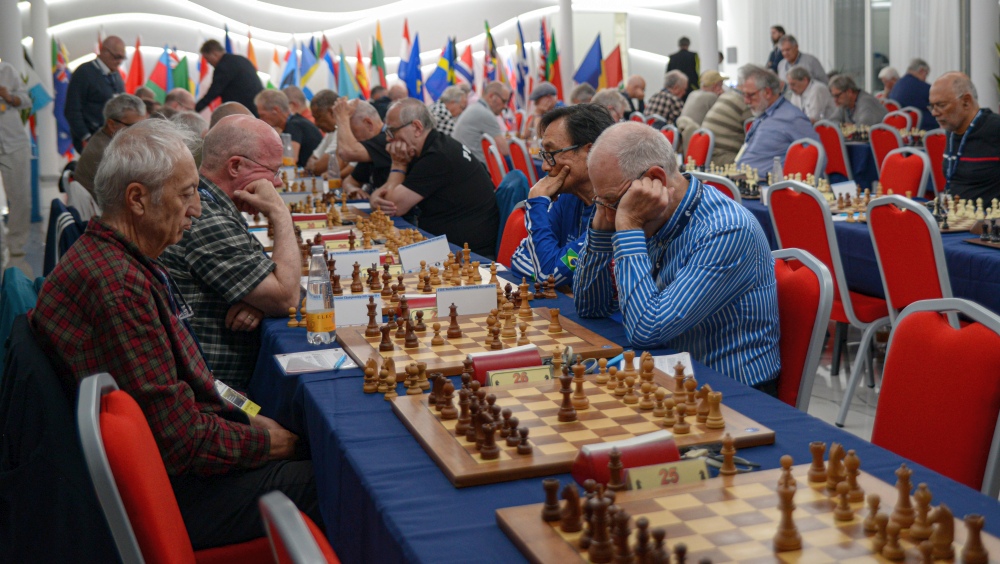
The record-breaking FIDE World Senior Individual Chess Championship 2025 has passed its halfway mark. After six rounds of intense competition in Gallipoli, Puglia, Italy, participants are enjoying a well-deserved day off. The 50+ Open section has featured the fiercest battle for the top spots so far. After six rounds, four Grandmasters – Michal Krasenkow (Poland), Mikheil Kekelidze (Georgia), Rogelio Antonio (Philippines), and Victor Mikhalevski (Israel) – share the lead with 5/6 points. They are closely followed by a large group of eleven players, which includes three of the top seeds, all on 4.5 points. Meanwhile, Alexander Mikhalevski (Victor Mikhalevski’s elder brother) reached the rest day as the sole leader in the 65+ Open tournament, scoring 5.5/6. His position, however, is far from secure, as ten players—including several top seeds—are just half a point behind. The pre-tournament favorites occupy the top positions in the 50+ Women’s section, with Ketevan Arakhamia-Grant (Scotland) leading the field with 5/6. Pia Cramling (Sweden), Masha Klinova (Israel), and Silvia Alexieva (France) trail her by half a point. Galina Strutinskaia (FIDE) has been a dominant force in the 65+ Women’s tournament so far. With a score of 5.5/6, she will head into Round 7 a full point ahead of her closest competitors: Tatiana Bogumil (FIDE), Nona Gaprindashvili (Georgia), and Larisa Khropova (FIDE). With five rounds remaining, all four tournaments remain wide open, promising an exciting finish. Full results and pairings are available on Chess-Results. Official website: worldseniorchampionship2025.com/
European Club Cup 2025 concludes in Rhodes, Greece

A curtain fell on the 40th European Chess Club Cup and the 29th European Women’s Chess Club Cup, held in Rhodes, Greece. SuperChess clinched its maiden title in the Open tournament, while Cercle d’Echecs de Monte-Carlo won its eighth crown in the Women’s section. Heading into the final round, SuperChess held a perfect score and a one-match-point lead over Hungary’s Tuxera Aquaprofit Nagykanizsai Sakk Klub. The two teams clashed for the top spot, with SuperChess needing only a draw to secure the trophy. They emerged victorious with a 3.5-2.5 match score, finishing the tournament with a perfect 14 match points. Alkaloid (North Macedonia) and Novy Bor (Czech Republic) tied for second place with 12 match points each. Alkaloid took the silver medal due to a better Sonneborn-Berger tiebreak. 40th European Chess Club Cup 2025 – Final Standings Cercle d’Echecs de Monte-Carlo (Monaco) claimed its eighth gold medal in the European Women’s Chess Club Cup. Having entered the final round with a perfect score, the team had nearly secured the title regardless of the outcome. After a long and intense fight, they drew their match against the Turkish Airlines sports club, finishing with 13 match points—three points clear of the runner-up. Sirmium Sremska Mitrovica (Serbia) took the silver medal with 10 match points. Three teams tied for third with 9 match points each: Tajfun SK Ljubljana (Slovenia), SuperChess (Romania), and CE Gambit Bonnevoie (Luxembourg). With the best tiebreak, Tajfun SK Ljubljana completed the podium. 29th European Chess Club Cup for Women 2025 – Final Standings The top performers on each board in both sections were recognized for their tournament results. The best individual results (Open section): Board 1: 1. GM Gukesh D; 2.GM Vincent Keymer; 3.GM Anish GiriBoard 2: 1.GM Xiao Tong; 2.GM Wei Yi; 3.GM Ido GorshteinBoard 3: 1.GM Benjamin Gledura; 2.GM Richard Rapport; 3.GM Parham MaghsoodlooBoard 4: 1.GM Nihal Sarin; 2.GM Alexey Sarana; 3.GM Aravindh ChithambaramBoard 5: 1.GM Nils Grandelius; 2.GM Bogdan-Daniel Deac; 3.GM Daniil YuffaBoard 6: 1.GM David Anton Guijarro; 2.GM Puranik Abhimanyu; 3.GM Daniel Dardha The best individual results (Women’s section): Board 1: 1.GM Zhu Jiner; 2.GM Aleksandra Goryachkina; 3.GM Anna UsheninaBoard 2: 1.GM Divya Deshmukh; 2.IM Leya Garifullina; 3.GM Nana DzagnidzeBoard 3: 1.IM Stavroula Tsolakidou; 2.IM Nurgyul Salimova; 3.GM Alexandra KosteniukBoard 4: 1.FM Liwia Jarocka; IM Alina Kashlinskaya; 3.IM Lu Miaoyi During the Closing Ceremony, the Special Awards were presented to: South Aegean Region – for supporting Chess and European Chess Championships City of Rhodes – for supporting Chess and European Chess Championships Chess Club Ippotis – For outstanding organisation of European Chess Championships in Rhodes Hotel Rhodes Palace – For outstanding hospitality and hosting of European Chess Championships in Rhodes Aegean University – ECU Academic Partnership Award ECU Fair Play Award – IM Sebastian Poltorak – Offering a draw to his opponent who needed medical assistance The ceremony took place yesterday evening at the Amalfi Club and Restaurant in Rhodes. Attendees included ECU President Zurab Azmaiparashvili, ECU Vice Presidents Jean Michel Rapaire and Alojzije Jankovic, ECU Tournament Director Petr Pisk, ECU Secretary General Theodoros Tsorbatzoglou, Vice Governor of the South Aegean Region Zisimos Vasileios Delaportas, Vice Mayors of Rhodes Mixalis Pligos and Georgios Patas, Vice President of the Ippotis Chess Club Kambouropoulos, and other distinguished guests who took part in the awards ceremony. Text and photos: European Chess Union Official website: eccc2025.com/ Photo gallery of the event
Winners crowned at 2nd Chess Olympiad for People with Disabilities
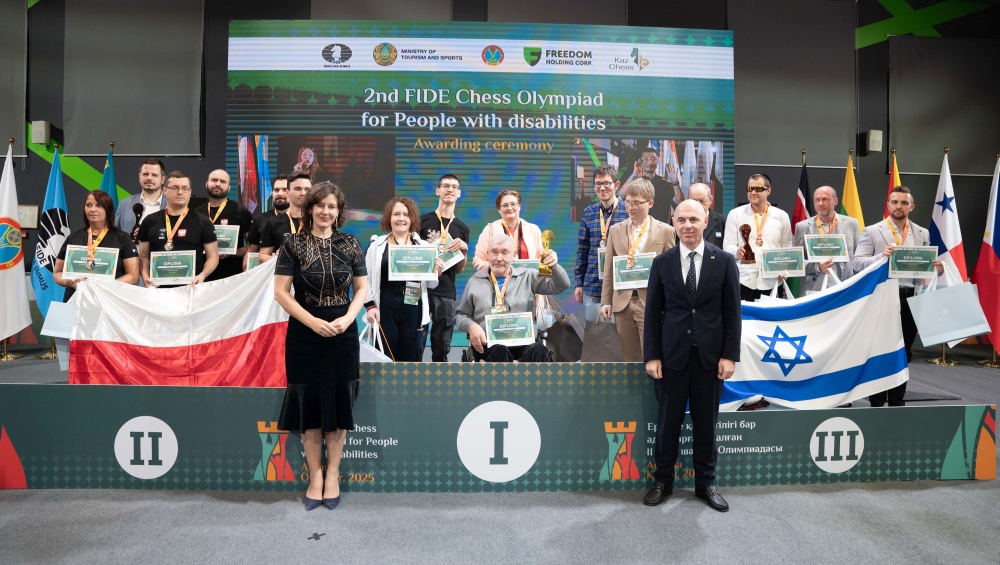
The 2nd Chess Olympiad for People with Disabilities concluded today in Astana, marking a historic celebration of inclusivity, determination, and unity – coinciding with the Republic Day of Kazakhstan. The final day began with a vibrant cultural performance featuring traditional Kazakh dances, music, and local cuisine, creating a festive atmosphere for the participants. The ceremonial first move was made by Andrey Gromov, President of the International Physically Disabled Chess Association (IPCA), together with Gulmira Dauletova, Executive Director of the Kazakhstan Chess Federation (KazChess). “It’s the first time Kazakhstan has organised such an event,” said Gulmira Dauletova. “After hosting the World Cadets Championship just weeks ago, preparing this Olympiad in only 20 days was a huge challenge – but our team worked tirelessly, and we are proud that everything went so well. The players are happy, and that means everything to us.” “Our main goal was to create smiles. Seeing the players enjoy themselves, especially during moments like our ‘Hug Day,’ was the most rewarding part,” she added. A short but powerful history The Chess Olympiad for People with Disabilities has a brief yet inspiring history. It began in 2020 with the first Online Olympiad, which saw 61 teams from 45 countries and nearly 400 players – Poland took gold in that inaugural edition. Three years later, the dream of meeting over the board became reality in Belgrade, Serbia, where 23 teams competed in the first in-person event – Poland once again emerged victorious. This year in Astana, the Olympiad reached a record 34 participating teams, making it the largest and most inclusive edition to date.The story continues: starting in 2026, the Olympiad for People with Disabilities will be held alongside the main Chess Olympiad, beginning in Samarkand, Uzbekistan. “For me, it’s special that chess allows people with all kinds of abilities to compete on an equal footing,” said Dana Reizniece, Deputy Chair of the FIDE Management Board. “Chess is one of the most inclusive sports in the world – and aligning these Olympiads ensures that everyone remains part of the same global chess family.” Thomas Luther, Chairman of the FIDE Commission for People with Disabilities, added: “From next year, the Olympiad for People with Disabilities will take place alongside the main Olympiad and the FIDE Congress – a major step that guarantees the continuity and growth of this event.” Stories of Inspiration Inclusivity in chess extends to every corner of the world. Blessing Jemani, captain of the Zimbabwean team, shared a powerful story about his young student Tinashe Mvududu, who plays chess using his legs.“He teaches us that disability is not inability,” said Jemani. “He’s an inspiration to our entire chess community – and though he couldn’t join us this year, we hope to see him competing next year in Uzbekistan.” Position of the Day The final round delivered thrilling chess moments — notably, the game between Ihar Rasikhin (FIDE 2) and Luisa Fernanda Molina Valdes (Colombia), featuring a brilliant “Greek gift” sacrifice: 26. Bxh7+ Kxh7 27. Qxf7 Qd8?? (after 27…Rxe1! 28. Rxe1 Qc4! White is only slightly better) 28. Qh5+ Kg8 29. g6, and Black resigned facing inevitable checkmate. Awarding Ceremony The closing ceremony was filled with emotion and pride. Dana Reizniece delivered a heartfelt speech, expressing gratitude to all contributors: “The 2nd Chess Olympiad for People with Disabilities has been a true festival of humanity – a magnificent demonstration of the unbreakable spirit of chess. On behalf of FIDE, I would like to express our deepest gratitude to the Government of Kazakhstan and President Kassym-Jomart Tokayev for their continuous support of chess and its development. Our thanks also go to the Akimat of Astana and Mayor Zhenis Kasymbek for their warm hospitality, and to the Kazakhstan Chess Federation and its President Timur Turlov for their exceptional organisation. We are deeply grateful to our partners, Freedom Holding Corporation and all sponsors, for their invaluable support, and to the National Paralympic Centre for providing world-class playing conditions. Finally, heartfelt thanks to the arbiters, fair play team, and volunteers whose dedication ensured everything ran flawlessly.” Team standings The final standings crowned the champions of the 2nd Chess Olympiad for People with Disabilities: 1st Place – FIDE 1 (Babarykin, Ermakov, Lipilin, Zakharova, Obodchuk)2nd Place –Poland (Tazbir, Molenda, Piekielny, Leszner, Wolanski)3rd Place – Israel (Gruenfeld, Streltsov, Gurbanov, Aleksandrova) Full results: chess-results.com Special awards and board winners Special prizes Youngest player with hearing disability: Farkas Virag (Hungary) Youngest player with physical disability: Atassi Celine (USA) Youngest player with visual disability: Kuanyshuly Nurgisa (Kazakhstan 2) Oldest player with hearing disability: Jimenez Moron Elias (Panama) Oldest player with physical disability: Babula Milan (Czech Republic; pictured below) Oldest player with visual disability: Bibikov Yuriy (Kazakhstan 3) Longest chess career (female): Dietsche Birgit (Germany) Best game: Cheyzer Crystal Mendoza (Philippines) Best performance: Maksim Ermakov (FIDE 1) Board winners Outstanding performances were also recognised on each board, highlighting individual excellence throughout the event: Board 1: 1. Gruenfeld, Yehuda (Israel) 2. Varadi, Viktor (Hungary) 3. Amato, Leonel (Argentina) – pictured belowBoard 2: 1. Ermakov, Maksim (FIDE 1) 2. Pavicevic, Jovan (Serbia) 3. Glazar, Domagoj (Croatia)Board 3: 1. Kishan, Gangolli (India) 2. Rasikhin, Igor (FIDE 2) 3. Musokeri, Prince (Zimbabwe)Board 4: 1. Salamon, Julia (IBCA) 2. Ali Mohamed, Mohamed (Egypt) 3. Cherono, Mercy (Kenya)Board 5: 1. Kambarova, Aiganym (Kazakhstan 2) 2. Sarkar, Md Ali Nawaz (Bangladesh) 3. Pavicevic, Jovana (Serbia) Passing the flag to Uzbekistan During the ceremony, Gulmira Dauletova officially handed over the FIDE flag to Askar Ibraimov, Specialist of the Chess Federation of Uzbekistan for the Paralympic direction – symbolizing the transfer of hosting duties to Samarkand in 2026. “How it started years ago – it was a challenge,” said Akaki Iashvili, FIDE Special Tasks Director. “But thanks to the FIDE DIS Commission, KazChess, the government, volunteers, arbiters, and the Fair Play team, we created optimal conditions and a beautiful atmosphere. The journey continues.” With this symbolic moment, the 2nd Chess Olympiad for People with Disabilities officially came to a close – leaving behind unforgettable memories and setting the stage