

FIDE distributes €30,000 among distinguished veterans
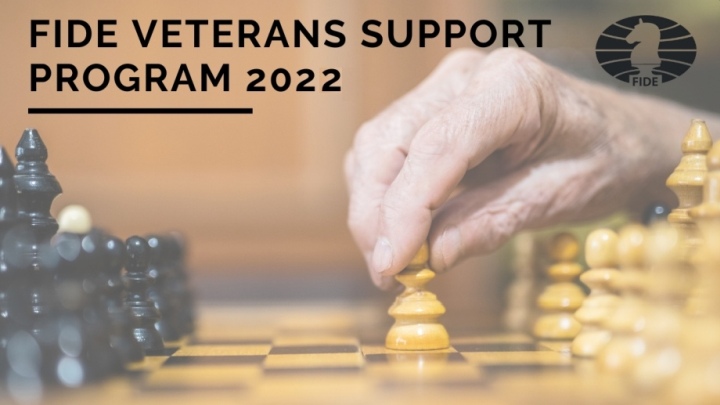
After carefully considering the numerous applications received, the special panel appointed by the FIDE Council decided that these will be the twelve chess players, coaches, and promoters to benefit from FIDE’s support to chess veterans in 2022: Alexey Yuneev (Russia) Jay Bonin (USA) Jiri Lechtynsky (Czech Republic) Vija Rozlapa (Latvia) Giorgi Macharashvili (Georgia) Reynaldo Vera (Cuba) Evgenij Ermenkov (Bulgaria) Alexey Kosikov (Ukraine) Sheila Jackson (England) Galina Strutinskaia (Russia) Rani Hamid (Bangladesh) Gediminas Rastenis (Lithuania) A total of €30,000 will be distributed among these seniors with each person from the list receiving €2,500. Depending on Covid-19 restrictions, FIDE will either increase a prize fund in veteran championships this year or allocate a similar amount for the second instalment to our distinguished seniors.
FIDE Grand Prix: Nakamura joins Aronian in semifinals
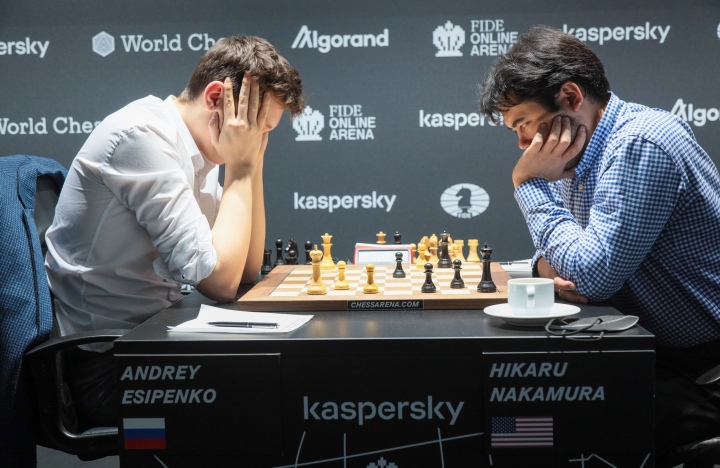
So-Dominguez and Rapport-Wojtaszek to battle in out in the playoffs IM Michael Rahal – Berlin, February 10th 2022 – The final round of the qualifying stage was without any doubt the most exciting chess witnessed in Berlin during the last few days. With a lot at stake, all the games (with the exception of Aronian – Dubov) were fought to the bitter end. The ceremonial first move was executed by Richard Lutz, CEO of Deutsche Bahn (German Railways). Mr. Lutz is a strong player himself, and Deutsche Bahn has been a regular supporter of chess in Germany over the years. He opened the game for Vidit with 1.c4 against local player Vincent Keymer, and the games were on! Pool A In a must-win scenario, Andrey Esipenko opened with 1.e4 against Hikaru Nakamura. A draw would be enough for the American, so he went back to the solid 1…e5, his main option for the last few years. Esipenko chose the Italian Opening, and both players more or less blitzed out their opening moves, following a previous 2019 game between Alekseenko and Grischuk. The Russian could have won a pawn with 14.Bxa6 – a move he considered for nearly 15 minutes – but instead, he preferred to advance in the center. With 16.d5, he closed the position and went for a structure resembling the King’s Indian defence: for that reason, as soon as he got the chance, Nakamura lashed out with the typical counter 21…f5. Esipenko took over the initiative and firmly wedged his pawn to e6, achieving a decisive advantage. But in the time scramble, he missed several winning opportunities, allowing Nakamura to escape unscathed into a slightly worse queen ending which he was able to hold to a draw. In his postgame interview with FIDE Press Officer IM Michael Rahal, a visibly relieved Hikaru Nakamura gave his take on the game: “In the opening I got very creative, mixing up a bunch of plans. I thought I was worse, and Andrey played very well. Just when I thought I was fine I blundered with Kh7, and I was close to resigning”. Although all eyes were on the Esipenko-Nakamura game, next to them, Alexander Grischuk and Etienne Bacrot were fighting it out to avoid last place. Bacrot left his French defence at home and brought out the classical variation of the Sicilian defence. Possibly suspecting this, Grischuk followed the 2021 game between Anish Giri and Maxime Vachier-Lagrave (MVL is coached by Bacrot) but Etienne deviated with the novelty 15…Qc5, offering the exchange of queens, which Grischuk declined. The online commentators were slightly worried that Bacrot was risking too much by leaving his king in the center of the board, with so many heavy pieces surrounding it, but this is the well-known strategy in the variation. The Frenchman missed a huge winning opportunity on move twenty: facing an attack on his queen, Bacrot instantly moved it away with 20…Qb6. However, the unbelievable tactic 20…Nxe4! would have led to a winning position, in view of 21.Nxe4 Bxe4! 22.Rxc5 dxc5 23.Qe1 Rxd1 24.Qxd1 Rxh2 followed by 25…Rh1 winning. As soon as this idea was voiced in the postgame conference, Alexander immediately saw the whole line in his head. Grischuk didn’t allow a second chance and struck back with a classic Sicilian knight sacrifice on d5, opening the game for his pieces and achieving a winning attack. Although he missed some opportunities to finish the game – among other things because Bacrot was huge in defence – in the end, he got the job done. Pool B In the first game, Grigoriy Oparin chose an enterprising but risky variation of the Reti opening, winning a pawn but falling behind heavily in development. Radoslaw Wojtaszek took up the gauntlet and began to centralize his pieces – a win would give him excellent chances to take clear first. The precise 18….Nd3+ installed a strong pawn on d3 and was the prelude to a kingside offensive. In addition to his precarious position, Oparin was dangerously falling behind on the clock. When everything seemed to be on point for Poland’s number two, a couple of inaccurate moves allowed Oparin to exchange queens and with a daring exchange sacrifice, he took over the imitative and forced a three-fold move repetition draw. In the postgame interview, Radek lamented his missed opportunities: “I was sure that I was winning at some moment, but I had to play the correct moves, and I failed”. Asked about improvement ideas for his participation in the third leg, Oparin was very clear: “I have played so badly here that I have many things to improve, tactics, openings, and recover my best form”. Meanwhile, with Black against Vladimir Fedoseev, Richard Rapport was doing his best to unbalance the position. His opening choice was already a sign of intent: the offbeat Chigorin defence. Fedoseev played it safe with the solid 3.Bf4 line and again, Rapport chose to unbalance the pawn structure by recapturing 6…cxd6, doubling a pawn, but avoiding symmetry at all cost. However, Fedoseev kept his calm, opened the position and initiated exchanges on the c-file. It seemed that the Russian missed a good chance to achieve an advantage on move twenty-two: instead of 22.Re1, the computer was blasting out 22.e4! The position remained balanced, and Fedoseev did have a chance to claim a three-fold move repetition which he declined. Possibly not the best decision as after the queen exchange, Rapport took over and, with excellent endgame technique, outplayed his opponent. In an incredible turn of events, Richard Rapport will now face Radoslaw Wojtaszek for a place in the semifinals. The winner of tomorrow’s playoffs will play against Hikaru Nakamura. Pool C The first game to finish was a quick draw between Levon Aronian and Daniil Dubov. Although hardly fifteen minutes went by from the beginning of the round, Aronian had an explanation ready: “I wasn’t expecting this line, so when Daniil played 8…Nbd7, I remembered my analysis, which was a long and very sharp line”. Aronian
Media warm-up for FIDE Grand Prix held in Belgrade
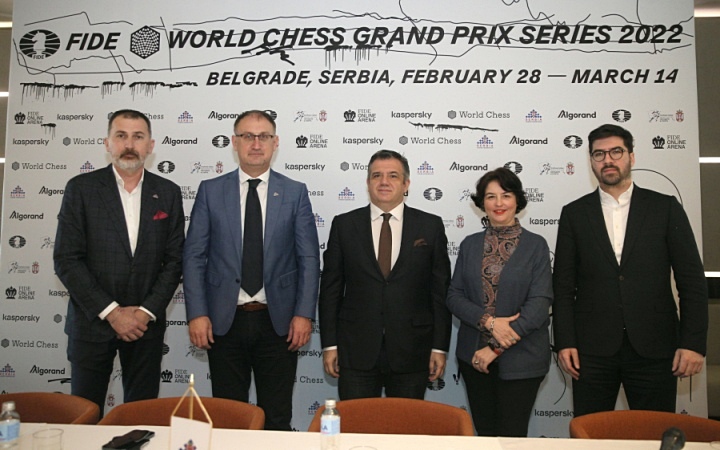
Scores of reporters and media crews show up for the media ‘warm-up’ event, showing how eagerly the tournament is anticipated in Serbia. Ahead of the second leg of the World Chess Grand Prix, which will take place in Belgrade (Serbia) between the 28th February and 14th March, the Chess Federation of Serbia organised a ‘warm-up’ event for the media. A significant number of journalists from Serbia and the region who turned up reminded how important and popular the 64-square game is in this once great chess country. The media event started with a short video depicting the historic chess tournaments and figures who visited, played or were born in Yugoslavia. Previously the capital of the mighty chess nation, it has been decades since the region has been home to a major chess event involving many of the world’s strongest players. The anticipation of the Grand Prix tournament has already attracted a lot of public interest, and the Serbian government has pledged its support for the event. Speaking at the media conference in Belgrade’s Crowne Plaza Hotel (where the tournament will be played), Alisa Maric – once one of the strongest world female Grandmasters – said that she is very happy as, after many decades, Serbia will once again play host to the chess elite. “This tournament is taking us back to the old times when the best players from all over the world came and played here. I hope that this is just the beginning and that this event will also serve as motivation to our own young players to strive forward and flourish.” The President of the Chess Federation of Serbia, Dragan Lazic, expressed his gratitude to FIDE for entrusting Belgrade to host one of the Grand Prix events: “Serbia has not hosted such a big event since the 1990s. I believe that this is just the first step towards achieving our ambition – for Serbia to be the host of a Chess Olympiad.” Lazic added that the organisers would do everything to ensure that the players enjoy their time here, have excellent playing conditions and feel safe and comfortable. Support for the event is also provided by the Serbian government. Belgrade deputy mayor, Goran Vesic, stressed the importance of the event for Serbia – its image, chess tradition and culture. Vesic said that the government would consider how to further increase and improve chess programs in schools and make them part of the curriculum. The 2022 FIDE Grand Prix, a part of the world championship cycle, consists of three tournaments. The tournaments take place in Berlin (Germany) and Belgrade (Serbia) between February and April 2022. The two top performing players in the Grand Prix will qualify for the 2022 Candidates Tournament in Madrid (June-July). Text: Milan Dinic Photo: Marko Metlas/Alo!
FIDE Grand Prix: Levon Aronian, first semifinalist
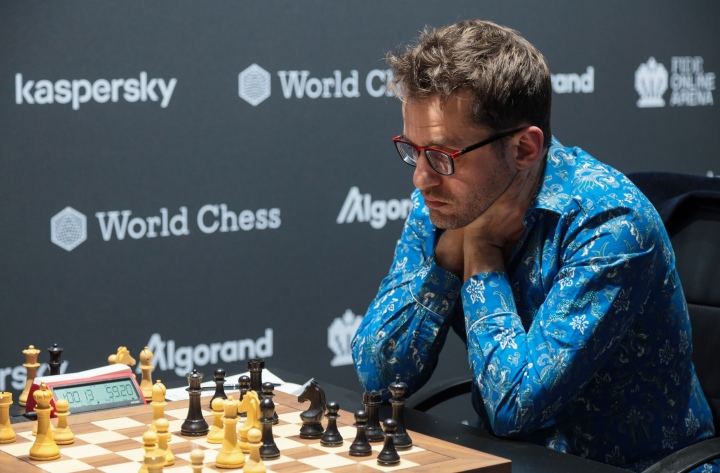
The last round will decide the other three spots. IM Michael Rahal – Berlin, February 9th 2022 – Today’s round in the Berlin Grand Prix began with a bit of drama. The President of the German Chess Federation, Ullrich Krause, had been invited to execute the first “ceremonial” move on GM Vincent Keymer’s board. However, while fifteen of the sixteen players were already firmly seated, most of them fully concentrated, Keymer’s opponent – GM Levon Aronian – had yet to appear. The signs of relief on Chief Arbiter Ivan Syrovy’s face when Aronian finally stepped into the playing venue at exactly 14.59 were clearly visible. The former Armenian player, now representing the USA, greeted his opponent and awaited 1.d4, in this case, played by Krause, and the round was on. And an exciting round it was! Four wins and four draws in an eight-player round-robin is a remarkable statistic. In addition, Aronian’s win over Keymer qualifies the USA competitor to the semifinals, while Esipenko and Dominguez scored important wins with Black that allow them to keep their qualifying chances intact for tomorrow’s final round. Pool A Trailing Hikaru Nakamura by half a point, but playing Black, Alexander Grischuk had a really difficult task ahead of him. His opening choice, the double-edged King’s Indian Defence, definitely seems the way to go to fight for a win. However, after Nakamura’s 6.Be3 – the Semi-Averbakh variation, a fitting choice as the legendary Russian Grand Master turned 100 yesterday – Grischuk plunged into deep 15-minute thought. He finally decided to follow the main line but around move twenty, he was already down to his last twenty minutes, a startling contrast to Nakamura’s one hour twenty. At the critical moment, Nakamura transferred his bishop to b2, zeroing in on Grischuk’s king, already weakened on the dark squares thanks to an early h-pawn push by the American. With hardly any thinking time and facing a direct attack, the Russian buckled under the pressure – his position crumbled, leaving Grischuk out of the race for qualification. Asked by Press Officer Michael Rahal what could he take away from the game, his reply, as usual, wasn’t disappointing: “I probably have to stop playing the King’s Indian”, finding some light humour in a desperate tournament moment. In the other game of the A-pool, Andrey Esipenko had no other chance but to shoot his last bolt to defeat the last-placed competitor of the group, Etienne Bacrot. He was probably going to play the Marshall Attack, but Bacrot nipped that idea in the bud, deciding on a solid anti-Marshall line with a rapid exchange of queens. The game remained mainly balanced until Bacrot played 27.Bc4. Esipenko grabbed the chance to plant his rook on d4 and began to advance his kingside pawns, eventually creating a passed g-pawn that ultimately decided the game in his favour. In his postgame interview, Bacrot said that he had been quite lazy in his calculations and should never have fallen into this passive endgame position. Esipenko was obviously very happy with the outcome and will now have White against Nakamura in the last round: whoever wins will qualify to the semifinals, but Nakamura also advances with a draw. Pool B The first game of the afternoon to finish was a quick affair. Playing with White against the co-leader of the group, Radoslaw Wojtaszek decided to play it safe. Slightly surprised by his opponent’s opening choice, Radek recognized in the postgame interview that he had missed 18…Rc4 and that he even thought that he was slightly worse, given which he decided to initiate mass exchanges leading to a three-fold repetition in a completely level position. Although Vladimir Fedoseev still has to face (with White) Rapport in the last round, his solid opening choice clearly indicates that a draw was a good result for him today. Meanwhile, in the other game, Grigoriy Oparin repeated the Tarrasch variation he already played in the third round. When the pawn structure stabilized, he found himself with another isolated d-pawn position which he seems to enjoy defending: a weak pawn but in exchange for active piece play. However, when things seemed to be going well for Richard Rapport, he missed 23…Ng3 and had to take on the defensive. Oparin started piling on the pressure and gradually increased his advantage in the endgame. On move 41, just after the time control, Oparin missed a great opportunity to win on the spot with 41…Re2+ before capturing the pawn on f2. In the postmortem on the board, both players thought that it was a draw, but further analysis seemed to confirm the win for Black. These results leave everything open for the last round: a very exciting and interesting tournament situation where the winner of the game between Fedoseev and Rapport could easily win a spot in the tiebreaks. Pool C Possibly inspired by the President of the German Chess Federation’s first move, Vincent Keymer went all-out for Aronian’s throat in today’s game. Trailing the leader by two points but playing with the white pieces, Keymer went for a crazy pawn-grab in the solid Ragozin Defence (13.Nxe5 instead of the prudent 13.0-0), allowing his opponent to force his king into the center with hardly any protection. An unrelenting battle began, with players attacking with heavy shots such as 17.g4, 17…g5 and 18.b4. Computer analysis indeed confirmed that the players were finding the best moves, but White’s position seemed to be always hanging by a thread. Things remained tactically balanced until Keymer blundered big with 29.Rh5? (29.f3 was still equal according to the computer). Aronian seized the moment, capturing the two center pawns, and the game was over. In the postgame interview, both players mentioned that they had analyzed the position after 13.Nxe5 some time back, but it was hard to remember the various lines. In the other game of the group, both Vidit Gujrathi and Daniil Dubov, tied on two points out of four, faced their last opportunity to win a full point and catch Aronian. A Tarrasch defence transposed into a sideline of the Queen’s Gambit Accepted. Although Dubov declared that he had spent the
#38
A podcast, many workshops, and more #womeninchess World Championship Match 2023: call for bids FIDE and ISF launch the World School Online Chess Cup The chess world celebrates the centenary of Yuri Averbakh “Chess for Freedom” keeps making waves READ NEWSLETTER
The oldest living Grandmaster Yuri Averbakh turns 100
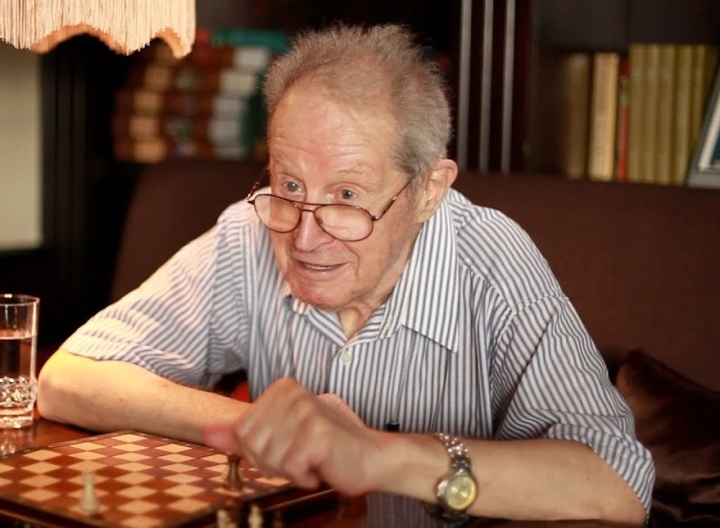
Yuri Lvovich Averbakh was already a legendary figure. Now he is also centenary. The oldest living Grandmaster turns 100 today, after beating the odds last year and overcoming a serious COVID infection that took him to hospital. Tall and athletic, Averbakh was physically gifted from his youth, and he cultivated his body as much as his mind. Volleyball was the first sports activity he took up seriously, taking advantage of his height. He also loved hockey and skiing – two national passions in Russia. Not so well known is the fact that, for a short period, he was also a regular at the boxing ring. “In our yard, there was a club which was turned into a dormitory for workers. It was a real rabble, where a cult of strength reigned. Therefore, if you wanted to be equal in the yard, you had to be able to give as good as you got. That’s why I took up boxing for a year,” Averbakh said in an interview with Vladimir Barsky and Eteri Kublashvili on the occasion of his 90th birthday. He was already a middle-aged man when he took swimming as a way to stay in shape. “I swam until very recently, having gone to the swimming pool from 1964 to 1996”. He would swim almost daily when he was already in his seventies and continued to do so until the doctors, worried about his pacemaker, told him to stop when he was already in his late eighties. “A healthy lifestyle with plenty of physical exercises is very important.” While all this explains his longevity, it is very likely that keeping mentally active also played a huge role. He is one of those people who basically never retired and kept working as much as his health allowed. As late as 2016, he would still visit the Central Chess Club at Gogolevsky boulevard every Wednesday to meet with young talents and offer them advice. Photo: Boris Dolmatovsky Averbakh was very fond of working with young people, but he also kept in mind the seniors and, with that intention, he found a chess centre in a library. “We were looking to attract older people to the game,” he explained in an interview with Dagobert Kohlmeyer. “They should not play in tough tournaments but rather spend their time-solving chess problems. Working with studies helps prevent Alzheimer. If you are over seventy, the stress of a tournament can be dangerous to your health. (…) But a calm and reflective attitude to chess is very useful, especially when you are very old.” Averbakh started to play chess at the age of seven, but it was just one more hobby for him during his first years, and he didn’t really take it seriously, with volleyball being his main interest. Then, in February 1935, he had the chance to meet the famous chess composer Nikolai Grigoriev, at a time when Moscow was hosting its second international chess tournament, with Capablanca, Lasker, Botvinnik, and many others. “Grigoriev gave a lecture in the club, showing some of his famous pawn studies. They made an enormous impression on me, and that was the first time I sensed that chess wasn’t simply a game but was something more, that it was an art. And I also had the urge to master that field. That’s how I got involved in chess.” Finally hooked on chess at the age of 13, his first great success came three years later when he won the Soviet Union’s championship for schoolchildren. However, his incipient career would come to a halt, along with most chess organized activity, due to the World War II. He was evacuated with all his school from Moscow to Izhevsk, barely avoided being recruited himself when he reached the required age, and he would only return to Moscow in 1943. Yuri Averbakh at the tournament in Ivanovo (1944) It was then that his career took off, gaining in strength until he won the Moscow Championship of 1949, ahead of a strong field that included Andor Lilienthal and Vladimir Simagin, among many others. This was his first major success and the beginning of a decade in which he became one of the top players in the world, probably one of the top-10 at his peak. He won the Moscow Championship again the next year, and in 1952 he earned the Grandmaster title – a title he has borne for almost 70 years! Averbakh finished 5th at the Stockholm Interzonal Tournament in 1952, qualifying for the legendary Zurich 1953 Candidates Tournament, where he finished in 10th place. The next year, in 1954, he became champion of the USSR, and in 1956 he was very close to repeating this feat, sharing 1st-3rd places with Taimanov and Spassky, and ending up in second place after a tie-break stage. In his collection of selected games, published by Cadogan, Averbakh says that he learned chess “the wrong way round”, becoming a strategist before he learned properly about tactics and combinations. A very solid player, pure attack players would often feel uncomfortable when playing against him: Rashid Nezhmetdinov, for instance, was only able to get one draw in the nine games they played. Photo: ERIC KOCH @ANEFO Averbakh reduced his competitive activities when he reached his forties, leaving behind numerous victories in international events all over the world, like Jakarta, Rio de Janeiro, Adelaide, and Vienna. His latest international success was the Rubinstein Memorial held in Polanica-Zdroj in 1975. He shifted then his interest from playing the game to studying the game. And in that, he was as successful, or even more, as he was as a player. “My investigative character forced me to make a serious study of the endgame, that phase of the game where individual pieces battle against each other. Initially, I published several articles and then thought about a book devoted to various types of endings.” His endeavour turned into a monumental work, the first systematic study of the endgame in history, published in five volumes. “So
FIDE World Championship Match 2023 – Call for bids

1.1 The International Chess Federation (FIDE) will hold the World Championship Match in spring 2023. The Regulations shall be approved by March 15, 2022. FIDE is opening a bidding procedure to host the event. 1.2 The basic provisions are the following: a) Number of standard games to be played – 14b) Total duration – up to 21 daysc) Recommended prize fund – 2,000,000 (two million) eurosd) The Organiser shall cover all organisation expenses according to the Regulations and FIDE standardse) The Organiser shall respect the rights of the FIDE sponsors and partners, including for the video broadcast. 1.3 The Applicant shall fill in the Bid Form. A signed copy shall be submitted as an e-mail message to the FIDE Secretariat to office@fide.com from February 7, 2022, to June 7, 2022, by 23:59 Lausanne time. FIDE has the right to extend this deadline if considered necessary. All the documents shall be submitted in English. The bid should be accompanied by a non-refundable fee of three thousand (3,000) euros. Additional documents may be requested by the FIDE General Strategy Commission (GSC) for further evaluation.
FIDE Grand Prix: Aronian and So make their claim
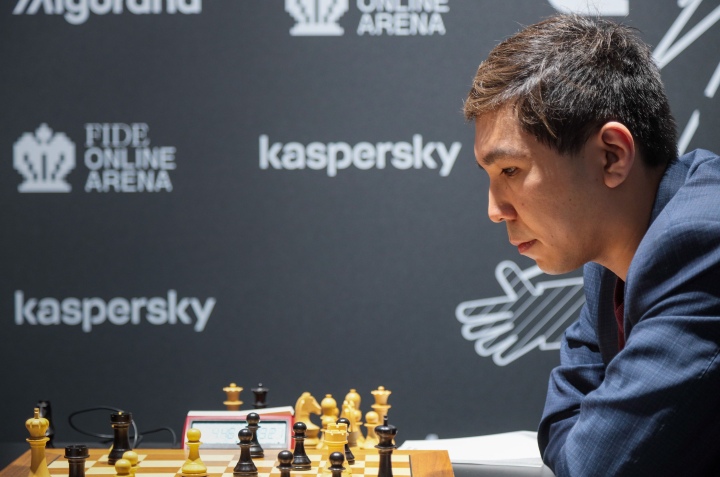
The players will enjoy a free day tomorrow IM Michael Rahal – Berlin, February 7th 2022 – The participants in the Berlin Grand Prix have a maximum of exactly fifteen minutes to play their first move on the board after the arbiter starts the round. However, elite players are generally already seated or at least in the building five or ten minutes earlier. So, at the start of today’s round four, when GM Pentala Harikrishna played 1.e4 and his opponent GM Alexei Shirov was clearly absent, you could sense the nervousness around the room. The organizers quickly contacted him at the official hotel and, luckily for Shirov, he was in his room. Visibly nervous at the prospect of “losing on time”, he ran to the playing venue, arriving a few seconds before being forfeited. In his postgame interview, Shirov apologized profoundly: he hadn’t checked the schedule and had mistakenly thought that there was no game today. Going into the free day, and with only two rounds to go in the qualifying group stage, only two players – GM’s Levon Aronian and Wesley So – dominate their groups with three points out of four. But as we witnessed today, anything can happen: also, tiebreaks are looming on the horizon for players with equal scores at the end. Pool A In yesterday’s press conference, GM Hikaru Nakamura said that “everyone will be going for a specific player in the group from now on”, clearly referring to his opponent today, Etienne Bacrot, currently last in the group standings. However, although Bacrot is no longer a professional player – “…my focus nowadays is on coaching Maxime Vachier-Lagrave (MVL), and therefore it’s difficult to play with the top players” – he still prepares the games thoroughly and, for the second time, brought out the French defence. “After all, I am a French player!” he said after the game”. Today he caught Nakamura by surprise with 10…g5!?, a nice opening idea introduced last year by World Championship challengerrr GM Ian Nepomniatchchi. The play took on a forced nature and Nakamura decided that in view of his tournament situation, it was not the day to play on in a win-lose manner. “I was afraid the position could collapse if I continued the final position” was Bacrot’s final conclusion after the game. “However, it’s still very nice to sense the following of the French chess fans that support me”. In the other game of the group, the two Russians faced each other for the second time, both of them in need of a win to catch Nakamura in the standings. With Black, Andrey Esipenko went for the reliable Nimzo-Indian reaching a slighly inferiour middlegame position which was complex enough to make Alexander Grischuk go wrong. “I got completely confused. After 22.Qd3 Andrey played Qc6, and I started calculating some lines, but I will not say which ones. Because if I say, tomorrow I will have not only a PCR test but also a psychiatric test,” joked Grischuk after the game, stirring up a laugh from the spectators in the press room. Esipenko defended with precision, and the draw became inevitable. “Both my strength and my weakness is that I am a perfectionist,” concluded Grischuk after the game. Pool B GM Vladimir – “I am very strong in closed positions” – Fedoseev made his claim for first place in group B today by crushing GM Grigoriy Oparin with Black. “I had a blackout and missed …Qg4″. Maybe there is some incredible tactic that saves the game, but I couldn’t see it” was Oparin’s postgame explanation. Already famous in the postgame press conferences for his incredible calculation skills, Fedoseev recited several interesting lines that he had calculated, but which all led to good positions for him. It was clear he had everything under control: with this important win, he ties for first place in the group. When he was asked by WGM Dina Belankaya if would like to have a chess opening named after him, Fedoseev surprised us all by responding: “I already invented two openings. For example, the line 1.d4 d5 2.c4 e6 3.Nc3 a6 was developed by me and I am very proud of this idea”. GM Richard Rapport was out for the win today against GM Radoslaw Wojtaszek in the other game of the group. With White, he played an excellent technical game against Black’s isolated queen-pawn but couldn’t convert, in good measure thanks to his opponent’s tenacious defence. After the game, Rapport was asked what he considered the best skills to have as a chess player. His answer stood out: “The engines are pretty strong, so I suspect that accurate calculation is the best skill to have as a chess player”. Pool C In the game that might have decided the winner of this group, GM Levon Aronian displayed some fine opening preparation to hold a comfortable draw against GM Vidit Gujarathi, maintaining top position going into the rest day. “I have analyzed this to play with White actually, and also from the Black side. It’s kind of a solid line for Black, and my conclusion is that maybe it’s a tiny bit better for White but nothing really special. I think it’s important in this type of position to play precisely: I have to act fast with …a5—a4 as there is a strategical risk,” said Aronian after the game in conversation with Press Officer IM Michael Rahal. In the other game of the pool, GM’s Daniil Dubov and Vincent Keymer fought out a very technical battle in a Caro-Kan: neither of the two wanted to share the last place anymore. Today the Russian prevailed, notching up a win that allows him to tie for second place and keep his winning aspirations intact. “This is chess nowadays. The Caro-Kan used to be a really fighting opening, but now, with the line I played, sometimes you will run into something like this. You have to be very well prepared to play 15 only moves in a
FIDE Grand Prix: Levon elevates his game in Berlin
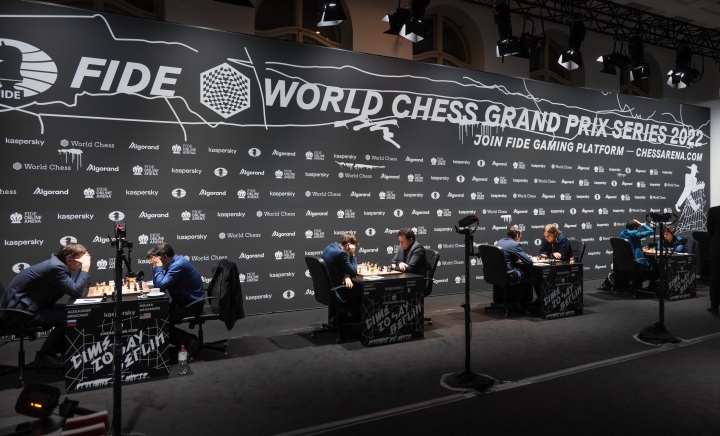
“With three PCR tests left, anything can happen yet” says Grischuk IM Michael Rahal – Berlin, February 6th 2022 – The day began with some online drama concerning the correct spelling of one of the players’ names. Luckily enough, one of his countrymen saved the day: Once the round began, online commentator Jesse February quickly noticed some interesting facts. “We almost had the Grand Prix Attack played in the FIDE Grand Prix: we had the Berlin Defense played in Berlin, and today we have the French Defense being played by the French player!” Most of the games started with 1.e4 (5 out of 8): two Sicilians, two Caro-Kan’s and one French. As in previous rounds, fighting chess is the norm. Four of the games ended with a win, and three more of them could easily have gone to one of the two players. Only Dominguez-Harikrishna was peaceful to the end, and even that game concealed some interesting nuances. Pool A With Hikaru Nakamura leading the group on 1½/2, everyone expected that Alexander Grischuk would go all-out to win this crucial game with White. However, his choice of line against the American’s Queen’s Gambit Accepted was to go for a rather dull queenless middlegame, more to the liking of Kramnik than a great option in a must-win situation. “I’m not sure how serious Grischuk is for playing this for the win, to be honest”, was online commentator Evgeni Miroshnichenko’s take on the Russian’s approach to the game. However, things spiced up when Grischuk went for 18.Nxb7. “I felt something was wrong, but I couldn’t see anything concrete. I calculated some lines deeply but I missed the …a5 idea, and I was actually quite lucky to have Rc1 in that position,” was Grischuk’s relieved answer to Press Officer IM Michael Rahal after the game. After some well-calculated tactics, the game ended in a peaceful outcome, leaving Nakamura ahead in the group. Asked about his chances to represent his country in the upcoming Moscow Olympiad, Nakamura gave a surprising answer: “A lot depends on what happens with the ratings in the next months. If I am not in the top four, there is a 0% chance of me playing. So, I would say right now, the odds of me playing are probably like 5%. I am not going to play as a reserve.” Meanwhile, Andrei Esipenko defeated Etienne Bacrot for the first time in a classical game: their only previous encounter in the Grand Suisse 2019 ended in a draw. Bacrot went for the French Defence (!), deviating from his usual opening preferences. The game was quite double-edged for the most part, although objectively balanced according to the computer, but Esipenko managed to outsmart his opponent towards the end. A much-needed win for the young Russian prodigy after yesterday’s heartbreaking defeat, leaving this group wide open. Pool B Radoslaw Wojtaszek missed a clear chance to increase his advantage over the rest of the field today. If he had played 21…e4! instead of 21…exf4, his opponent would have been in big trouble. As Vladimir Fedoseev pointed out after the game, “I would have been close to losing if Radek had played this move” and recited all the pertinent calculations in the pressroom. Meanwhile, the longest game of the round was played on the other board of the group. Having won an exchange after a dubious opening by his opponent Grigoriy Oparin, Richard Rapport was on the verge of notching up his second win in a row. However, even he didn’t clearly understand after the game where he had gone wrong. “I think it should be winning for Black of course, but there is a race where I am trying to promote four pawns, and he is trying to promote two, and in the end, I couldn’t promote a single one of them, which is very hard to accomplish” explained Rapport after the game. Both players thought that the interesting ending with rook and two pawns against two knights and one pawn should end, as it did, in a draw. With these results, this group is totally open, and anyone of the four can end up on the top. Pool C The first game to finish was Levon Aronian’s fine win over Vincent Keymer. Aronian had actually analyzed the Caro-Kan positions after the interesting but not so obvious opening idea 12…cxd3, isolating a doubled pawn. Online commentator Miroshnichenko praised Levon’s play in the tournament: “He outsmarted Vidit in a seemingly equal position, then he had no trouble making a draw with Dubov, and now once again he is much better.” Keymer wasn’t able to find the precise way to get his pieces into play, and Aronian gradually ground him down and finished him off with textbook endgame play. Leading his group clearly with 2½/3, he was quick to downplay his expectations: “I take it day per day, you know, there are three rounds to go, we will see how tomorrow will go. But so far, I think my play is fine.” In the other game of the group, Vidit scored an important victory over Daniil Dubov: “This was a much-needed win because in the last six games I scored something like 1.5 points” was his first reaction in the postgame interview. “The key moment was when I played 23.Nb4, and he went for something active that didn’t turn out well for him due to lack of piece coordination”. “In general, I overestimated this 23…Na5 idea and then a couple of moves later I didn’t really see what to play” was Dubov’s postgame explanation on the rapid collapse of his position. “People now use the word blunder in a wrong way. When you play bad moves, they are just bad moves.” With these results, Aronian maintains a comfortable one-point lead over Vidit, who gets back to 50%, and now Dubov and Keymer share the last place. Pool D The main result in this group was Wesley So’s first win in the tournament over Alexei Shirov. Although funnily enough, these two players had only disputed four classical games before, it was clear from the beginning that they were going for a fight.
Levan Pantsulaia wins 81st Georgian Championship
GM Levan Pantsulaia claimed his back-to-back national titles after winning the 81st Georgian Championship. The 12-player round-robin with classical time control took place in Tbilisi from January 25 to February 05, 2022. The event brought together the best Georgian players except for Baadur Jobava. Playing in his home town just like a year ago, Levan Pantsulaia grabbed the lead early and convincingly won the title with a round to spare, scoring 8 points out of 11. Now he has four victories in Georgian Championship under his belt (2008, 2015, 2021 and 2022). Despite losing to the champion, GM Merab Gagunashvili and IM Noe Tutisani had a good tournament and finished just a half-point behind Pantsulaia. Kudos to the lowest-rated Noe Tutisani (pictured below), who earned bronze, completed his second GM norm and picked 30 rating points along the way. The rating Mikheil Mchedlishvili became the only participant to defeat the champion in the last-round encounter, but it was his only consolation as he did not get into the top-3. Final standings: 1 GM Pantsulaia, Levan 2579 8 2 GM Gagunashvili, Merab 2573 7½ 3 IM Tutisani, Noe 2412 7½ 4 GM Mchedlishvili, Mikheil 2587 7 5 GM Paichadze, Luka 2566 7 6 IM Kacharava, Nikolozi 2480 6½ 7 GM Quparadze, Giga 2477 6 8 IM Lortkipanidze, Nodar 2414 5 9 FM Akhvlediani, Irakli 2433 4 10 FM Chkhaidze, Nikoloz 2288 4 11 GM Sanikidze, Tornike 2464 3 12 IM Petriashvili, Nikoloz 2418 ½ Photo: Georgian Chess Federation Facebook page