

Levan Pantsulaia wins 81st Georgian Championship

GM Levan Pantsulaia claimed his back-to-back national titles after winning the 81st Georgian Championship. The 12-player round-robin with classical time control took place in Tbilisi from January 25 to February 05, 2022. The event brought together the best Georgian players except for Baadur Jobava. Playing in his home town just like a year ago, Levan Pantsulaia grabbed the lead early and convincingly won the title with a round to spare, scoring 8 points out of 11. Now he has four victories in Georgian Championship under his belt (2008, 2015, 2021 and 2022). Despite losing to the champion, GM Merab Gagunashvili and IM Noe Tutisani had a good tournament and finished just a half-point behind Pantsulaia. Kudos to the lowest-rated Noe Tutisani (pictured below), who earned bronze, completed his second GM norm and picked 30 rating points along the way. The rating Mikheil Mchedlishvili became the only participant to defeat the champion in the last-round encounter, but it was his only consolation as he did not get into the top-3. Final standings: 1 GM Pantsulaia, Levan 2579 8 2 GM Gagunashvili, Merab 2573 7½ 3 IM Tutisani, Noe 2412 7½ 4 GM Mchedlishvili, Mikheil 2587 7 5 GM Paichadze, Luka 2566 7 6 IM Kacharava, Nikolozi 2480 6½ 7 GM Quparadze, Giga 2477 6 8 IM Lortkipanidze, Nodar 2414 5 9 FM Akhvlediani, Irakli 2433 4 10 FM Chkhaidze, Nikoloz 2288 4 11 GM Sanikidze, Tornike 2464 3 12 IM Petriashvili, Nikoloz 2418 ½ Photo: Georgian Chess Federation Facebook page
Aronian leads the pack in the Berlin Grand Prix
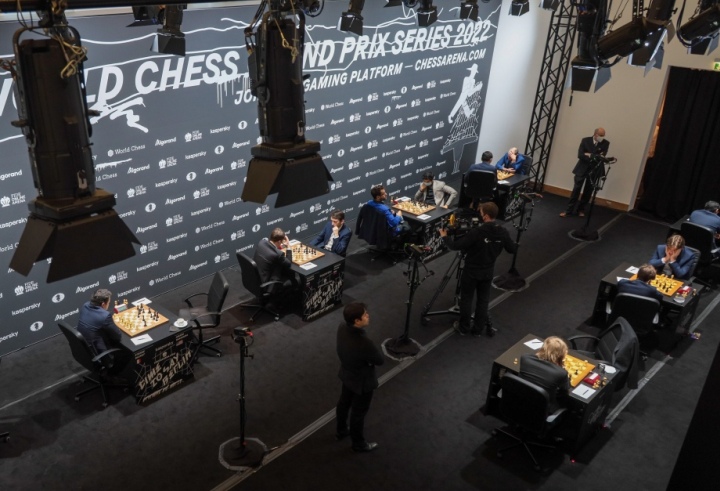
Fedoseev and Wojtaszek also score their first victories. Berlin, February 4th, 2022 – The first round of the group stage began at exactly 3 pm at the City Centre on Unter den Linden with the opening call from Ivan Syrovy, Chief Arbiter of the event. By that time, and according to the rules of the tournament, all the players had been PCR-tested and were firmly seated at their boards. For one of them, American GM Hikaru Nakamura, who enjoys a wild card invitation for the series, today was the first classical chess game for him in more than two years. In fact, he had even been dropped from the FIDE classical rating list due to inactivity! Although some of the games ended in uneventful draws, the 30-move rule proved to be a good sports decision, as the players had to battle it out for most of the afternoon, offering a great show for all the attending spectators and thousands of online viewers. The Spanish audience was in for double enjoyment: the variation of the round was without any doubt the Catalan opening, three of the eight games paying homage to Barcelona. At the end of the day, Polish GM Radoslaw Wojtaszek, along with Russian GM Vladimir Fedoseev and USA GM Levon Aronian, scored the first decisive points of the tournament, leaving Aronian as the only leader in Pool C. Pool A The first game to finish was a solid draw between French GM Etienne Bacrot and American GM Hikaru Nakamura. Although Bacrot tried to prove an edge in a symmetrical Berlin position (a nice twist for the first game), Hikaru showcased his defensive skills and kept the advantage to a minimum. In their postgame interview with tournament Press Officer IM Michael Rahal, Nakamura said, “I think at the end of the game I was playing too quickly, maybe because I haven’t played classical chess for so long and it felt too boring!” The second game of this pool was a classic. Russian GM Alexander Grischuk, a three-time qualifier to the Candidates via the Gran Prix series, brightened up the afternoon with one of his forty-five-minute, out-of-the-opening deep thoughts, in a position that most mortals would have dedicated less than three. But apparently, the time spent was worth the while: his 19-years-old opponent, Russian GM Andrey Esipenko, couldn’t capitalize on the huge time gap on the clock, and both of them ended up in time trouble. When all seemed to be doomed for Esipenko, he found a great three-move repetition drawing resource after Grischuk missed the winning 28…Nc3! Online commentator GM Evgeny Miroshnichenko was impressed, declaring, “I am amazed at Esipenko finding all that. Well calculated.” Pool B Both games in this group ended with a decisive result. In the first one between the two Russians (players from the same federation must resolve their games in the first and fourth rounds) GM Vladimir Fedoseev outplayed his young opponent GM Grigory Oparin in a double-edged isolated pawn middlegame. Oparin understood after the game that his position was slightly worse but defendable until he played 25…h3? (instead 25…hxg3 was better), leaving him to face very difficult endgame situations. Fedoseev started to coordinate his minor pieces, and soon the game was over. Meanwhile, in the other encounter, Polish GM Radoslaw Wojtaszek was able to get a slight edge from the opening, but his opponent Hungarian GM Richard Rapport, defended with great precision. At the critical moment, Rapport sacrificed a pawn, no doubt intending to hold a minor piece knight ending but then missed a nice king manoeuvre to penetrate in his position. An important win for Poland’s number two, seeking to emulate the success of his compatriot GM Jan-Krzysztof Duda, winner of the 2021 World Cup. Pool C Both of the games in this group were very exciting. USA GM Levon Aronian took the early lead in the pool with an excellent technical win over Indian GM Vidit Gujrathi. The game was more or less balanced during most of the opening and middlegame, but at some point, Vidit started playing slightly too passively. In his postgame interview, Aronian suggested precisely this: “It’s a very sharp opening where lots of things can go wrong. It was unpleasant for me, but maybe his approach was a bit too passive.” Levon added that “After 21.Bg3 I felt that I was out of danger, and it should be a draw, but it’s pleasant to push a little bit with White.” Vidit understood that “With hindsight allowing his f5 pawn thrust was a mistake”, but his position was already difficult to defend. In the second encounter of this pool, local GM Vincent Keymer and GM Danil Dubov played what would be the longest game of the round, in which the Russian demonstrated textbook technique defending a rook vs rook and bishop ending in a draw. Keymer had enjoyed a much better position during most of the game, maybe even winning at some point, but as Dubov correctly pointed out after the game: “The problem is choosing the best between several good moves”. Pool D Both games in this group ended in very solid draws with excellent opening preparation by the players handling the black pieces. Indian GM Pentala Harikrishna followed his top-notch Caro-Kan opening preparation for most of the game, reaching a position he had analyzed previously, a pawn up but with no real winning chances. “I analyzed this endgame quite deeply a few years back, and I thought White was much better, but maybe I made a mistake” was Spanish GM Alexei Shirov’s conclusion in the postgame interview. In the face-off between the two American GM’s , Wesley So and Leinier Dominguez, a peaceful outcome could be expected. Both players agreed that the game had been very equal and Wesley praised his opponent’s opening preparation. “Today wasn’t ideal. I think I’m still jetlagged” was So’s explanation in his interview. Both of the players are part of the American Olympic Team. Facing a question regarding this topic, Wesley declared his optimism: “Last time in Batumi, Hikaru and I were in bad shape, yet we still won silver. I think,
FIDE Grand Prix Day 2: No risk, no reward
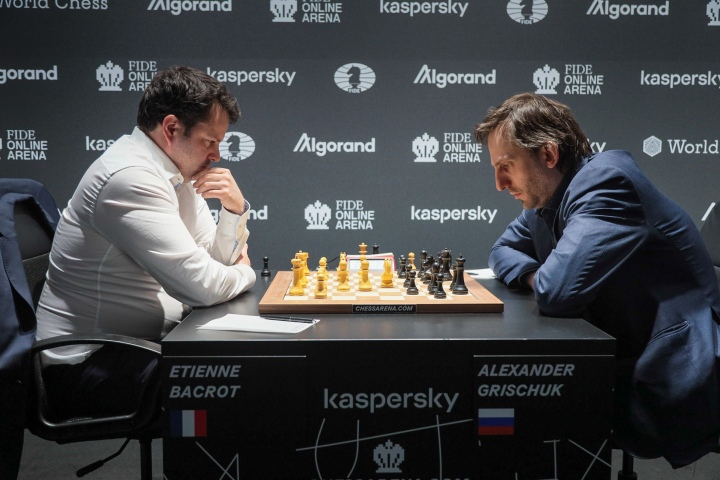
Berlin’s Grand Prix second round leaves no stone unturned Berlin, February 5th 2022 – “I don’t understand why Svidler predicted that everyone will play very safe. In this format, you have to risk”. This statement by Alexander Grischuk after his game with Bacrot sums up the general feeling of the players in this new tournament format. With only one player of each group qualifying for the semifinals, cautious play is not to be recommended. Tired of boring 30-move draws, fans all over the world are having the time of their lives enjoying the exciting games delivered each afternoon from the playing venue in Berlin’s center. Surrounded by magnificent buildings and monuments (the Brandenburg Gate is within walking distance), players seem to be inspired by the historical events that have come to pass in this area. Thanks to the fighting spirit being displayed on the boards, after two of the six rounds, each group already has a sole leader: Hikaru Nakamura, Radoslaw Wojtaszek, Levon Aronian and Lenier Dominguez. All four are on 1½/2, but anything can happen as all games are played with great intensity. Pool A This group is clearly one of the toughest of the four, and today’s round proved to be no exception. In the first game to finish, French GM Etienne Bacrot missed a huge opportunity to score his first point in the tournament and punish his opponent’s risky opening strategy. Bacrot had a huge advantage after only fifteen moves. “15.d5 is on the board and I don’t see the move for Black. I think it was a disastrous opening experience for Alexander Grischuk,” affirmed online commentator GM Evgeny Miroshnichenko. However, under huge pressure both on the board and on the clock, Grischuk once again demonstrated why he is one of the best players in the world as he defended tenaciously in a very difficult position until the draw was unavoidable. “Bacrot has all the reasons to be disappointed” was Mironischenko’s final conclusion after Grischuk’s narrow escape. But as Grischuk pointed out after the game, “Only one player qualifies from each group, so you need to take risks”. In the other game, USA’s representative Hikaru Nakamura, conducting the white pieces, scored a very important win against Russia’s GM Andrey Esipenko. The opening was classical English, and Hikaru seemed to achieve a small edge. Episenko was defending well until move 23 when he blundered big with …Qe6? allowing Hikaru to win a pawn and the game. In a postgame conversation with IM Michael Rahal, Press Officer for the event, Nakamura mentioned that Esipenko had missed 25.Re4! (he had probably only considered 25.Rxc7, which also looks slightly better for White). The American finished off the game with a display of excellent queen and pawn ending technique and now leads this group after two rounds. Pool B Poland’s GM Radoslaw Wojtaszek vs Russia’s GM Grigory Oparin was a tough technical battle. After losing yesterday, the 24-year-old winner of the 2016 Higher League was eager to score his first point in the tournament, but the in-form Polish number two had other plans. “Radek” was ahead for most of the game, nursing an extra pawn and the bishop pair, but Oparin was continuously on the lookout for “tricks” with his knight and was finally able to force a drawn rook ending. “I missed one move and then I couldn’t see how I could win. It felt really close, but I’m not sure where it went wrong” was Wojtaszek’s feeling after the game. Oparin said: “Obviously, a half-point out of two was not what I was looking for but OK, with two Black’s, things could have gone worse! The game of the afternoon was the incredible fight between GM Richard Rapport from Hungary and GM Vladimir Fedoseev (Russia). Rapport bounced back from his loss yesterday, defeating Fedoseev in an exciting and complicated game. With 22. Ng4! Rapport initiated a so-called “king-walk” plus a piece sacrifice, completely unclear but intuitively interesting. His plan was to create a mating net around his opponent’s king. Maybe Fedoseev was holding at some point, but it was always very complicated, and both players agreed in the postgame interview that it had been very interesting. Thanks to this win, Richard has caught his opponent in the Pool B standings, and both of them are now only half a point behind the leader, Radoslaw Wojtaszek. Pool C Both games in this group finished in a draw at about the same time, just under the 2.5 hours mark. The first two players to exit the playing venue were Russian GM Danil Dubov and USA GM Levon Aronian. Their game ended in a perpetual check just after the 30-move limit, leaving Aronian as the group’s sole leader with 1.5/2. Although his opponent is one of the world’s leading experts in the London System with White, Dubov tried his hand in this setup. Aronian defended with the precise 5…Nh5 continuation and secured the bishop pair. “Daniil is always a surprising player with an exciting style, so I was trying to predict during my preparation what he would play!” were the kind words to his opponent in his postgame interview. However, Dubov managed to keep the balance thanks to his excellent piece coordination coupled with the symmetrical pawn structure that didn’t offer any chances to play for a win. In the other game, Indian GM Vidit Gujrathi, playing with Black, demonstrated excellent opening preparation in a popular line that goes into a minor piece ending very fast. Facing the question by Press Officer IM Michael Rahal in the postgame interview, Vidit explained that “As Black, I have a limited choice. I thought I’d just play, and it’s up to my opponent if he wants to play more ambitiously. The endgame is well-known to be slightly worse, but more often than not, it ends in a draw”. His opponent, German GM Vincent Keymer, knew that this line was very solid for Black, but he “decided to try something different but my opponent defended very well, and I didn’t really get a chance”. Faced with the prospect of two consecutive games with Black in the next two
2022 FIDE Grand Prix kicks off in Berlin
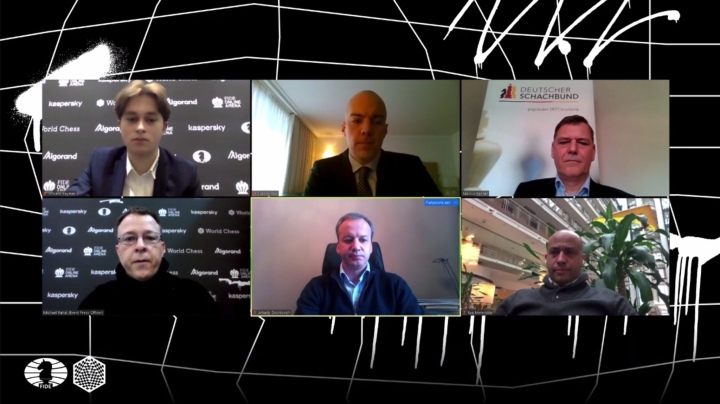
Berlin, February 3rd 2022 – The first leg of the 2022 FIDE Grand Prix Series, organized by World Chess, will begin tomorrow in Berlin. During the next two weeks, sixteen of the world’s best chess players will battle it out for the two final Candidates spots, which is scheduled for June in Madrid. The venue is the World Chess Club Berlin, located at the City Centre on Unter den Linden, 26-30, and the games will be played from February 4th-17th every afternoon starting at 3 PM. Along with the qualification for the Candidates, the event has a €150,000 prize fund, a €20,000 increase over the 2019 series. The first-round clashes are expected to be fast and furious, with heavy-hitters Andrey Esipenko and Levon Aronian taking on Alexander Grischuk and Vidit Gujrathi, respectively. In addition to these great match-ups, the all-American stand-off between Wesley So and Lenier Dominguez will set the pace in pool D. Full pairings can be found here. The event opened this morning with an online zoom press conference featuring Arkady Dvorkovich, president of the World Chess Federation (FIDE); Ilya Merenzon, CEO of World Chess, organizers of the Grand Prix; Marcus Fenner, General Secretary of the German Chess Federation and Chief Arbiter Ivan Syrovy. Also present in the conference call was elite Grand Master and chess prodigy Vincent Keymer, representing Germany in the series. In his opening statement, FIDE President Arkady Dvorkovich said: “We are officially opening the FIDE Grand Prix Series 2022, organized by World Chess. The series kicks off in Berlin, a city known for its strong chess culture. We hope that the tournament format changes will make the games even more exciting for all chess fans”. Ilya Merenzon, CEO of World Chess, added: “World Chess as the organizer of the Grand Prix has done its utmost to make this tournament safe offline and spectacular online.” The General Secretary of the German Chess Federation, Marcus Fenner, stated that “we will utilize this tournament to further increase the interest in chess in Germany and specifically the Berlin area, and together with the Berlin Chess Association we have prepared a series of side events which will be developed in the third leg of the series.” Christian Milde, General Manager of Kaspersky in Central Europe, pinpointed the common ground between chess and cybersecurity: “As official cybersecurity partner of the FIDE World Chess Championship series since 2017, we are delighted to see the start of the new Grand Prix Series in Berlin. Chess and cybersecurity have a lot in common, including sharp minds and strategic thinking excellence. These are also essential skillsets for our work at Kaspersky and part of our commitment to building a safer future for everyone.” And Keli Callaghan, VP of Marketing at Algorand, declared: “Algorand is honoured to be a longtime supporter of World Chess as the organization transforms and modernizes the traditional game by infusing blockchain into various applications. We are thrilled to be supporting the FIDE Grand Prix Series in 2022 and proud to partner with organizations who are harnessing the power of decentralized technology.” Tournament system The three-tournament series, which will unfold from February to April, features twenty-four of the world’s best Grandmasters, who will compete in two of the three events. In order to make the series more exciting and reduce the percentage of draws, FIDE and World Chess have changed the format. This innovative approach is new for the chess world but very similar to the Super League: the first stage has four pools of four players, and the winner of each pool advances to the semifinals and then to the final. All the games will be broadcasted live with expert commentary in three languages at https://chessarena.com/broadcasts/13604. More information and the full schedule can also be found on the worldchess.com website. Due to COVID restrictions currently in place, only a limited number of tickets are available. Please note that the 2G+ rule applies to the event, which means that visiting the venue is only possible for those who either have a complete vaccination with EU-certified vaccine or proof of recovery and can additionally present a booster dose certificate or a negative test result. For further questions, please contact: media@worldchess.com Twitter: @theworldchess #TimeToSayBerlin Official Photo FIDE Grand Prix Berlin Press kit:https://www.dropbox.com/sh/ggyqowtp6odrqcg/AADc5Kkk34nd2q8CMQlqnRTsa?dl=0 Leading partners supporting the FIDE Grand Prix Series 2022 include: Kaspersky as the Official Cybersecurity PartnerAlgorand as the Official Blockchain PartnerPrytek as the Technology Transfer PartnerFIDE Online Arena as the official Partner About World Chess: World Chess is a London-based chess gaming and entertainment group and FIDE’ official broadcaster and commercial partner. World Chess organized the FIDE Championship Matches in Russia, the USA, and the UK, and revolutionized the sport by signing the biggest media partnerships in history. World Chess develops Armageddon, the chess league for prime-time television. World Chess also runs FIDE Online Arena, the exclusive official chess gaming platform. More at worldchess.com. About Kaspersky Kaspersky is a global cybersecurity and digital privacy company founded in 1997. Kaspersky’s deep threat intelligence and security expertise are constantly transforming into innovative security solutions and services to protect businesses, critical infrastructure, governments and consumers around the globe. The company’s comprehensive security portfolio includes leading endpoint protection and a number of specialized security solutions and services to fight sophisticated and evolving digital threats. Over 400 million users are protected by Kaspersky technologies, and we help 240,000 corporate clients protect what matters most to them. Learn more at www.kaspersky.com. About Algorand Algorand is building the technology to power the Future of Finance (FutureFi), the convergence of traditional and decentralized models into a unified system that is inclusive, frictionless, and secure. Founded by Turing Award-winning cryptographer Silvio Micali, Algorand developed a blockchain infrastructure that offers the interoperability and capacity to handle the volume of transactions needed for financial institutions and governments to smoothly transition into FutureFi. The technology of choice for more than 700 global organizations, Algorand is enabling the simple creation of next generation financial products, protocols and exchange of value. For more information, visit www.algorand.com. About Prytek The Prytek Group combines technology companies and services companies to create a new asset class. We build legacy service businesses and combine them with deep tech technologies to increase margins. We buy
FIDE Grand Prix 2022: Ding and Andreikin replaced by Esipenko and Wojtaszek
February 1, 2022 – FIDE has named two replacements for the first leg of the Grand Prix after receiving last-minute information that two players will not be able to compete in the tournament that starts in Berlin on February 3 due to visa and health issues. GMs Ding Liren and and Dmitry Andreikin are replaced by GMs Andrey Esipenko and Radoslaw Wojtaszek. The FIDE President, upon consultation with the organizers and arbiters team, made a decision on the replacements as per the event’s regulations. Updated Pools: Pool A: 1. Alexander Grischuk (Russia), 27642. Hikaru Nakamura, (USA), 2736 3. Andrey Esipenko* (Russia), 2714 4. Etienne Bacrot (France), 2642 Pool B: 1. Radoslaw Wojtaszek* (Poland), 26862. Richard Rapport (Hungary), 2763 3. Vladimir Fedoseev (Russia), 2704 4. Grigoriy Oparin (Russia), 2681 Pool C: 1. Levon Aronian (USA), 2772 2. Vidit Gujrathi (India), 2727 3. Daniil Dubov (Russia), 2720 4. Vincent Keymer (Germany), 2664 Pool D: 1. Wesley So (USA), 2772 2. Leinier Dominguez (USA), 2752 3. Pentala Harikrishna (India), 27174. Alexei Shirov (Spain), 2704 *Andrey Esipenko and Radoslaw Wojtaszek replaced Ding Liren and Dmitry Andreikin FIDE and the organizers wish all the participants the best of luck with the event. FIDE Grand Prix, organized by World Chess, is a 3-event series that features 24 players, each of whom will compete in two out of three tournaments. Two winners of the Grand Prix Series will qualify for the Candidates Tournament. The series will take place in Berlin, Germany, and Belgrade, Serbia. Leg 1 – Berlin 03.02 – 17.02 Leg 2 – Belgrade 28.02 – 14.03 Leg 3 – Berlin 21.03 – 04.04 1 R. Wojtaszek* Ding Liren 2 Anish Giri Anish Giri 3 Wesley So Wesley So 4 Levon Aronian Levon Aronian 5 S. Mamedyarov S. Mamedyarov 6 A. Grischuk A. Grischuk 7 Richard Rapport Richard Rapport 8 M. Vachier-Lagrave M.Vachier-Lagrave 9 L. Dominguez L. Dominguez 10 Hikaru Nakamura Hikaru Nakamura 11 Nikita Vitiugov Nikita Vitiugov 12 P. Harikrishna P. Harikrishna 13 Vidit Gujarathi Vidit Gujarathi 14 A. Esipenko* D. Andreikin 15 Daniil Dubov Daniil Dubov 16 Yu Yangyi Yu Yangyi 17 Sam Shankland Sam Shankland 18 V. Fedoseev V. Fedoseev 19 Alexei Shirov Alexei Shirov 20 Alexandr Predke Alexandr Predke 21 Grigoriy Oparin Grigoriy Oparin 22 Vincent Keymer Vincent Keymer 23 Amin Tabatabaei Amin Tabatabaei 24 Etienne Bacrot Etienne Bacrot *Andrey Esipenko and Radoslaw Wojtaszek replaced Ding Liren and Dmitry Andreikin in the Leg 1 The prize fund for each event is EUR 150,000, which is a EUR 20,000 increase from 2019. Regulations for the FIDE Grand Prix Series 2022 (pdf) Each 16-player event will consist of a group stage followed by a knockout semi-final and final. At the group stage, the participants will compete in four double-round-robin tournaments, with only the winners of each pool advancing. Both semi-finals and the final will consist of 2 regular time limit games, plus tiebreaks if needed. Players receive Grand Prix points according to their finishing position in each tournament: Round Grand Prix points Winner 13 Runner-Up 10 Semi-final loser 7 2nd in pool 4 3rd in pool 2 4th in pool 0 The FIDE Grand Prix Series 2022 is supported by Algorand as the Official Blockchain Partner, Kaspersky as the Official Cybersecurity Partner, FIDE Online Arena as the official gaming platform and Prytek as the Technology Transfer Partner of the Series. The official broadcast of the event will be streamed for free at worldchess.com. For more information, visit https://worldchess.com/series/grandprix2022 and fide.com. About World Chess: World Chess is a London-based chess gaming and entertainment group and FIDE’ official broadcaster and commercial partner. World Chess organized the FIDE Championship Matches in Russia, the USA, and the UK, and revolutionized the sport by signing the biggest media partnerships in history. World Chess develops Armageddon, the chess league for prime-time television. World Chess also runs FIDE Online Arena, the exclusive official chess gaming platform. More at worldchess.com.
FIDE launches a new podcast
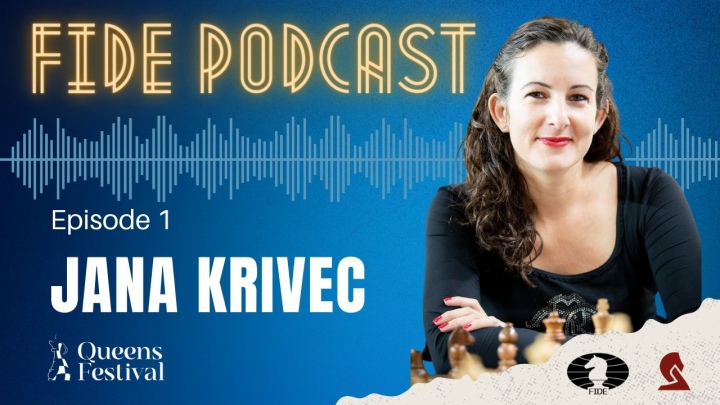
FIDE is pleased to announce the launch of its new podcast, a format that keeps growing in popularity in general, and particularly among chess players. Hosted on Podbean, the first podcast episode is already available there. In the coming days, you should also be able to subscribe from all the leading apps like Spotify, Apple Podcasts, Pandora, and Google Podcasts. This initiative is born under the roof of the Year of the Woman in Chess, thanks to a cooperation between FIDE’s Commission for Women’s Chess, Michael Busse of Schachgeflüster podcast, and Lilli Hahn of Chess Sports Association. FIDE would like to express its gratitude to Lilli and Michael for their generous and enthusiastic contribution, without which this podcast wouldn’t be a reality now. With the idea of giving voice and visibility to women, the inaugural season of the broadcast will feature a series of monthly interviews with remarkable women in the chess world conducted by Lilli Hahn. Players, organisers, arbiters, authors, and journalists will take the floor to share their knowledge, experience, and vision with us. Our first guest has been the Woman Grandmaster and seven-time Slovenian Women’s Champion Jana Krivec, who is also a Doctor of Psychology and a university professor. Jana knows exactly how you can “Improve Your Life By Playing A Game“. This is the title of her 2021 book, in which she brings new insights into the connection between psychological concepts and chess. “Chess is a true polygon to learn things that are really important for life in general. It is more and more popular in the sense of educating children. But I still think that people see chess as something that is mainly useful for developing mathematical skills. This is not the main thing that chess develops,” says Jana in his chat with Lilli. “We can learn a lot from a chess game from a psychological point of view if only we pay attention and understand what we are doing; what feelings are behind a particular action or move.” Click on the following link to listen to the first episode of the FIDE podcast.
Workshop: Increase your inner strength
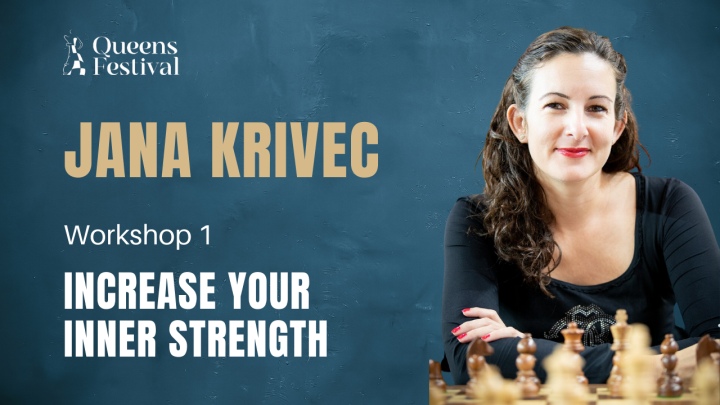
WGM Jana Krivec is a Doctor of Psychology and a university professor, apart from a seven-time winner of the Slovenian Women’s Championship. Last year she authored a book titled “Improve Your Life By Playing A Game“, an exciting journey through a wide range of psychology topics explained from the perspective of a tournament chess player. You can learn more about this book and Jana’s experience by listening to the first episode of the FIDE podcast, in which Jana was our inaugural guest. As part of the initiatives that the FIDE Commission for Women’s Chess has prepared for the Year of the Woman in Chess, Jana Krivec will offer a series of monthly workshops under the title “Increase your inner strength”, between February and November 2022. Their aim is to increase awareness of the power of the mind, help you to get to know yourself better, understand your inner world and learn some useful mental techniques to increase your inner strength. The first of them is scheduled for Sunday, February 27, at 15:00 CET. If you are interested, please fill out this form. To be led by women, these workshops are part of the Queens’ Festival, also under the umbrella of the Year of the Woman in Chess.
Tata Steel Chess: Winners crowned in Wijk aan Zee
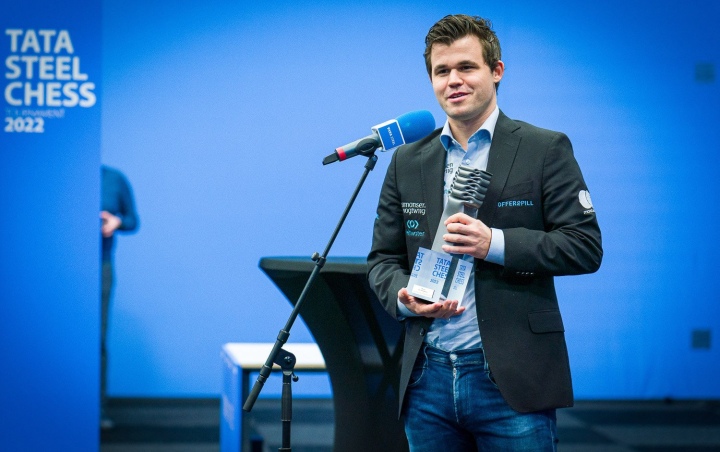
The winner of the Tata Steel Masters, Magnus Carlsen, did not make a single move in the final round as he got a win over Daniil Dubov by forfeit. The World Champion scored 9½/13 and finished 1½ points ahead of Shakhriyar Mamedyarov and Richard Rapport, who tied for second place. Looking back at his performance in the Tata Steel Masters 2022, Magnus Carlsen said: “I think there have been a lot of very good moments here in this tournament. I think I’ve had nine winning positions, and I converted five of them, which is probably one or two too little considering what I had, but there are a lot of positives, especially compared to the last couple of years where I didn’t play well and frankly didn’t get many chances. So the huge amount of chances that I got, it’s of course partly due to my opponents playing a bit weaker than usual, but I think I also managed to create more of them than normal. And obviously, the total score, plus five, is great and more than enough for tournament victory, but there’s always this thought that it could have been even better, but that will have to be another time. I’m really satisfied, in general.” Shakhriyar Mamedyarov and Richard Rapport preserved the status-quo by making quick draws with white pieces with Fabiano Caruana and Anish Giri. Other games of Round 13 were much more exciting. Sergey Karjakin tested Vidit Gujrathi in a well-known endgame, that emerged from the Four Knights Opening. Although it looks drawish, Black had to demonstrate some accuracy, which the Indian GM failed to do. White kept posing problems here and there and snatched a pawn on the move 29. Sergey’s conversion might not have been optimal, but he got the job done in a bishop endgame. Nils Grandelius got a great attacking position on the white side of the Sicilian against Jan-Krzysztof Duda, but did not play the most energetic 19.g5! and allowed Black to grab the initiative. With his back against the wall, the Sweed found the way to muddle the waters by sacrificing a pawn, but it would not have worked had Duda found the precise move 26…Qb7. After the Polish GM imprudently captured the knight on c3, Nils set the board on fire with a nice bishop sacrifice 27.Bxg7! White’s heavy pieces pounced on Black’s king, but Jan-Krzysztof defended with precision and liquidated into an equal queen endgame in which the opponents shook hands. Sam Shankland did not manage to equalize on the black side of the London System against Jorden Van Forest but set up a defensive line with the knight on d6 in an endgame. The American had all the chances to save a half-point in a pawn race on the opposite wings, but his idea of the b-file interference led to disaster – White seamlessly converted two extra pawns in a queens and bishops endgame. Rameshbabu Praggnanandhaa and Andrey Esipenko waged a fight in Saemisch System of the Nimtzo Indian. After Andrey made a few hesitant moves, the Indian GM regrouped his pieces, sacrificed a pawn and got a dangerous initiative in the center and the kingside. To relieve the pressure, the Russian GM gave up an exchange but found himself in a hopeless position. Rameshbabu could have finished the game quickly by keeping the queens on the board, but he traded the most powerful pieces and allowed Andrey to build some sort of fortress. White still had to find the right plan of breaking, but Esipenko dismantled the entire construction with 58…Be6? and resigned immediately. Final standings: 1 Carlsen, Magnus 9½ 2 Mamedyarov, Shakhriyar 8 3 Rapport, Richard 8 4 Giri, Anish 7½ 5 Karjakin, Sergey 7 6 Van Foreest, Jorden 7 7 Esipenko, Andrey 6½ 8 Caruana, Fabiano 6½ 9 Duda, Jan-Krzysztof 6 10 Vidit, Santosh Gujrathi 6 11 Shankland, Sam 5½ 12 Praggnanandhaa R 5½ 13 Grandelius, Nils 4½ 14 Dubov, Daniil 3½ The Challengers tournament that took place concurrently with the Masters saw the rating-favourite Arjun Erigaisi steamroll his opponents. The Indian youngster turned in a brilliant performance and, just like Magnus, won the event with a round to spare. His main competitors Thai Dai Van Nguyen and Jonas Buhl Bjerre fell two points shy of the champion’s impressive result (10½/13) and tied for the second position in the final standings. Final standings: 1 Erigaisi, Arjun 10½ 2 Nguyen, Thai Dai Van 8½ 3 Bjerre, Jonas Buhl 8½ 4 L’Ami, Erwin 7½ 5 Jumabayev, Rinat 7½ 6 Van Foreest, Lucas 7 7 Murzin, Volodar 7 8 Warmerdam, Max 6½ 9 Ganguly, Surya Shekhar 6 10 Dardha, Daniel 5½ 11 Shuvalova, Polina 4½ 12 Maurizzi, Marc`Andria 4½ 13 Vogel, Roven 4 14 Zhu, Jiner 3½ Official website: tatasteelchess.com/ Photo: Jurriaan Hoefsmit and Lennart Ootes – Tata Steel Chess Tournament 2022
Carlsen wins Tata Steel Masters with a round to spare
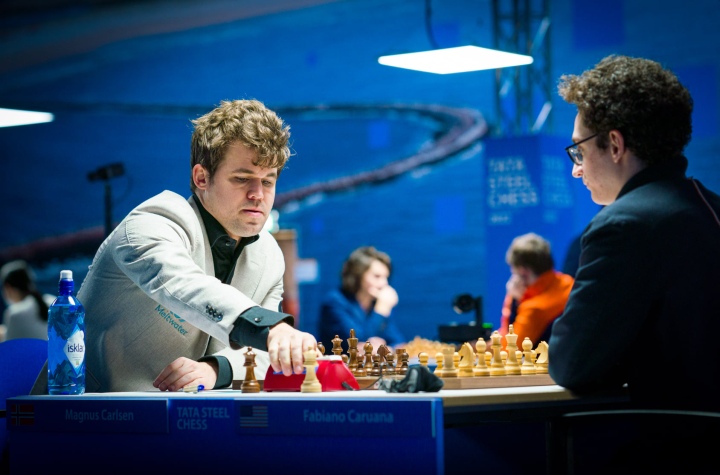
Magnus Carlsen clinched his eighth title in Wijk aan Zee after beating Fabiano Caruana in Round 12 of Tata Steel Masters 2022. The World Champion, who will get a win by forfeit in the final round, is a full point ahead of his closest competitors, Richard Rapport and Shakhriyar Mamedyarov. Sam Shankland scored his first victory in the event after defeating Sergey Karjakin in an interesting theoretical battle. Fabiano Caruana got some space advantage on the white side of Rossolimo Variation of the Sicilian Defence against Magnus Carlsen, but the World Champion had some counterplay on the light squares. After Magnus penetrated with his queen to e2 with the idea of transferring his most powerful piece to g4 in a roughly equal position, Fabiano reacted with a natural but wrong 26.f3? This mistake allowed Carlsen to sacrifice an exchange for excellent positional compensation. Four moves down the road, Caruana made the final error with 30.Bc3? trading queens but giving up his e5-pawn. The final portion of the game turned into a vivid display of Magnus’ endgame technique. Slowly but surely, Black stretched White’s defence with two passers and won on move 49th. Andrey Esipenko obtained a long-lasting advantage over Richard Rapport in the Ruy Lopez with a very precise play, but the Hungarian demonstrated patience and tactical resourcefulness to save a half-point. Vidit Gujrathi achieved a very promising position in the Italian against Shakhriyar Mamedyarov, with virtually all his pieces eyeing Black’s king. Even after missing a couple of very strong continuations, the Indian GM still had better chances, but then the unthinkable happened – Vidit committed a terrible blunder 26.Qg4?? that cost him a piece. The rest of the game was a walk in the park for Mamedyarov, who wrapped it up before the time control. Jan-Krzysztof Duda did not get much on the white side of Moscow Variation of Slav Defence against Jorden Van Foreest. After turning down a few drawing continuations, the Polish GM had to play with accuracy to score a half-point. Anish Giri outmanoeuvred Nils Grandelius in the Gruenfeld Defense as White but failed to find the best continuation 24.Rda1 and opted for 24.Qc6? The Swedish GM replied correctly, and after another substandard move by Anish, the evaluation of the position immediately changed in Black’s favour. Somewhat surprisingly, at this very moment, a draw was agreed. Sam Shankland demonstrated an excellent opening preparation against Sergey Karjaking in one of the lines of the Nimtzo-Indian with 4.f3 that supposedly does not promise White much. Apparently, 17…Qb7 was a serious mistake, although in order to prove it, Sam had to play with great precision. Most likely, Sergey underestimated the power of 21.Qc7! that gave White a sizable advantage which Shankland turned into a full point just five moves down the road. Standings after Round 12: 1. Маgnus Carlsen – 8½; 2-3. Richard Rapport and Shakhriyar Mamedyarov – 7½; 4. Anish Giri – 7; 5. Andrey Esipenko – 6½; 6-9. Vidit Gujrathi, Sergey Karjakin, Fabiano Caruana and Jorden Van Foreest – 6; 10-11. Jan-Krzysztof Duda and Sam Shankland – 5½; 12. Praggnanandhaa R. – 4½; 13. Nils Grandelius – 4; Daniil Dubov – 3½. Official website: tatasteelchess.com/ Photo: Jurriaan Hoefsmit and Lennart Ootes – Tata Steel Chess Tournament 2022
Tata Steel Masters: Carlsen leads, Rapport moves to second position
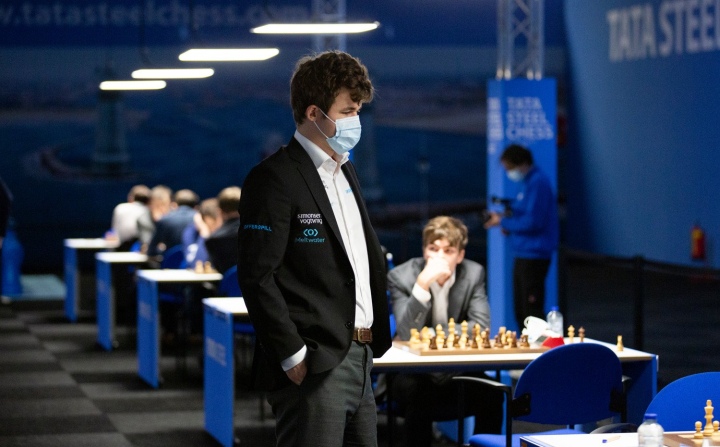
Magnus Carlsen preserved his leading position despite missing a clear win against Vidit Gujrathi. Anish Giri suffered a painful defeat at the hands of his compatriot Jorden Van Foreest and slid to the third position. Richard Rapport moved to second place in the current standings after getting a win by forfeit over Daniil Dubov. The Russian GM had to drop out of the event due to testing positive for Covid-19. Following the footsteps of Andrey Esipenko, Magnus Carlsen tried the Italian Game with Nc3 against Vidit Gujrathi, but the Indian GM passed the test and reached equality. However, the World Champion found a way to pose some problems for his opponent and after Vidit’s mistake 28…Re8? got a won rook endgame. Then it came Magnus’ turn to err as he hastily played 36.d7? (missing a very important intermezzo 36.Re7+! which is not easy to spot) and let the opponent escape with a draw. Jorden Van Foreest opted for very aggressive Saemisch system in the Nimtzo-Indian as White against his countryman Anish Giri and built an impressive pawn center. As it often happens in this system, Black put pressure on the c4-pawn but then literally drew fire on his own king by casting short. Jorden sacrificed an exchange on f6 and got an excellent long-lasting positional compensation that grew into a crushing attack. Anish returned material but only put off the inevitable – Black capitulated right after the time control. The game Shakhriyar Mamedyarov – Sergey Karjakin saw an old but still popular line of the Italian. In a sharp position, both opponents played optimally and sealed a draw by repetition on the move 23. Rameshbabu Praggnanandhaa and Fabiano Caruana manoeuvred for a while in a roughly equal position that emerged from Semi-Slav Defense but with 22.Ne2 the Indian allowed a breakthrough b6-b5. Black was slightly better, but White’s next move 23.Nd4 turned out to be a grave mistake. Fabiano got a remote a-passer which he aptly used as a decoy for White’s pieces to launch a deadly attack. Andrey Esipenko tried to push on the black side of Ruy Lopez against Nils Grandelius and even sacrificed a piece, but after the Sweed’s precise reaction had to assume the defensive. White got the upper hand, but being in time trouble, Nils decided not to take chances and took a draw by repetition. Jan-Krzysztof Duda – Sam Shankland was the shortest game of the round – the opponents split a point in the middle of the opening. Standings after Round 11: 1. Маgnus Carlsen – 7½; 2. Richard Rapport – 7; 3-4. Shakhriyar Mamedyarov and Anish Giri – 6½; 5-8. Vidit Gujrathi, Sergey Karjakin, Andrey Esipenko and Fabiano Caruana – 6; 9. Jorden Van Foreest – 5½; 10. Jan-Krzysztof Duda – 5; 11. Sam Shankland – 4½; 12-14. Nils Grandelius, Praggnanandhaa R. and Daniil Dubov – 3½. Official website: tatasteelchess.com/ Photo: Jurriaan Hoefsmit and Lennart Ootes – Tata Steel Chess Tournament 2022