

“I Fight to the End!” championship and fundraiser returns in April

The corporate chess championship fundraising for critically ill children will see its second edition in spring. Held in partnership with the Chess Federation of Russia, the “I Fight to the End!” tournament is a fundraiser for the Lighthouse Charity Foundation. This organisation offers help to critically ill children and young adults under 25 by supporting children’s hospices in Moscow and the Moscow region. Around one thousand families get help through the Foundation’s programmes and projects. The first edition of the “I Fight to the End!” championship was organised a year ago. In addition to the tournament, Daniil Dubov gave a chess masterclass at the Lighthouse Children’s Hospice in Moscow. Seventeen kids participated in a simultaneous exhibition with the grandmaster. There will be five separate tournaments in the 2022 championship, played according to the Arena system on Lichess.org. Each tournament will last 90 minutes, and a participant may play an unlimited number of blitz games during this time. Read more about the system of play below*. The match days are 4, 6, 8, 11, and 13 April 2022, from 7 till 8:30 PM Moscow time. Employees of various organisations are entitled to take part in the event. One team consists of three participants. The entrance fee from a team is 50,000 rubles. You can find the registration form and the contact emails in the Regulations (click to download), articles 6 and 7. The winners and medalists of five tournaments will be determined by the individual and team placings. The winners will get diplomas, cups, and memorable gifts. *More about the Arena tournament format: The time control is 3 minutes plus 2 seconds increment per move. There will be 2 points for a win, 1 point for a draw, and 0 for a loss. If a player wins two games in a row, a doubling of points will be activated, and a flaming sign will reflect it. The following games will bring twice as many points while a player continues on the winning streak. Thus, a victory will fetch 4 points, draw 2 points and “blow out the flame” (stopping the streak), while a loss will simply stop the streak. For example, two wins followed by a draw will bring 6 points: 2 points for the first win, 2 for the second (after which the winning streak is activated) and 2 for a draw (because the points get doubled while on a winning streak).
30 Federations will receive free training from FIDE licensed trainers
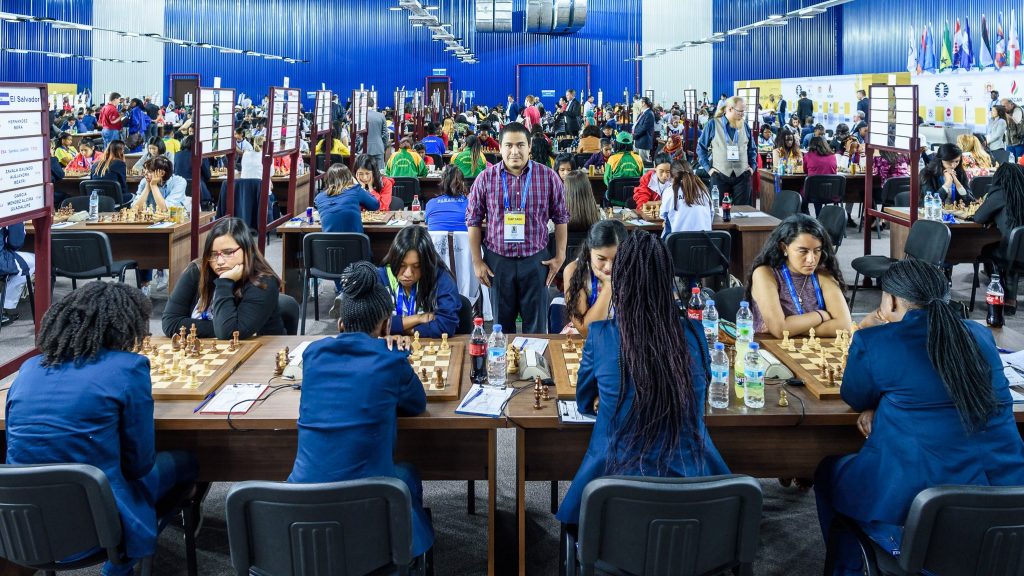
At the beginning of the year, FIDE offered training support to Federations in FIDE development categories 4 and 5, which are planning to participate in the coming Moscow Olympiad. 30 Federations have responded to this call and will receive free training from FIDE licensed trainers. Fifteen of these federations are from Africa, six from Asia, six from the Americas, and three from Europe. This program will be for both open and women teams, and all trainers with a FIDE license (FIDE Instructor, FIDE Trainer and FIDE Senior Trainer) will be invited to offer their services. The successful applicants will be selected by the 30 Federations on a first-come, first-serve basis on 28 March 2022. The online training will begin the following week. Photo: Batumi Olympiad © Alina L’Ami
FIDE holds round table on “Chess in Prisons” project
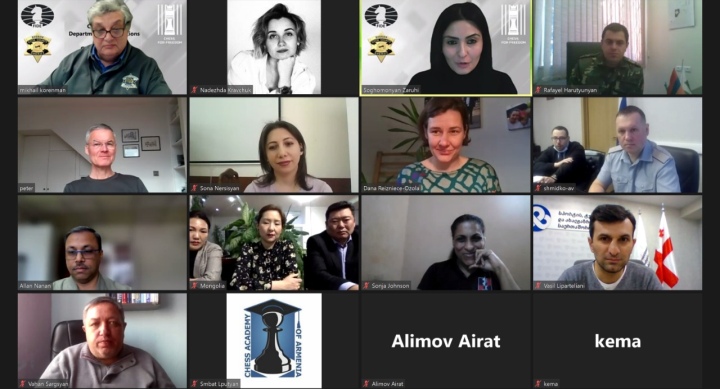
In October 2021, 41 teams from 30 countries representing all continents participated in the Intercontinental Online Chess Championship for Prisoners. The three-day tournament aimed to popularize chess as an efficient tool for reintegrating incarcerated people and provided an opportunity for inmates to play with their peers across the globe. It was decided that the event would take place on an annual basis. To discuss the future cooperation and expand the initiative, a round table discussion was held with the organizers of the tournament, representatives of prisons and correctional facilities of Russia, Mongolia, Armenia, Norway, Georgia, Trinidad & Tobago and England. They shared their experience in chess education in prisons and provided some fresh ideas on how to improve and promote the event. Back in 2021, team Mongolia won the first Intercontinental Online Chess Championship among Prisoners after defeating team Zimbabwe in the final. It was hardly surprising as the country has a long history of the Chess in Prisons program. National chess competitions have been held since 1958. A national team player WGM Batchimeg Tuvshintugs who works at the Court Decision Making Agency, made a presentation about Сhess in Prisons in Mongolia. She proposed the idea of organizing chess tournaments among prisons’ staff too and training correctional institutions’ employees: officers, educational departments, enabling them to help their inmates to improve chess skills in future events. The Chess for Freedom project was also supported by Russia on a national level. One thousand chess programs were launched nationwide, with 22000 prisoners involved. Around 700 inmates played online chess tournaments. Major general Andrey Shmidko, head of the department of social, psychological and educational work with convicts of the Federal Penitentiary Service of Russia, supervisor of the Chess in Prisons project in Russia, said that the chess in prisons movement was launched in the country 22 years ago under the guidance of the world champion Anatoly Karpov. “10 years ago, the program became international. We are happy that the initiative was supported by FIDE and attracted so many countries,” he added. For the first time in the history of international chess tournaments held in prisons, winners were determined in the women’s section too. Here, team Georgia won all three matches and came in the clear first. The awarding of the winners was held outside the prison walls. Georgian chess legend Nona Gaprindashvili together with the International Foundation of Sport, Tourism and Youth, awarded the winners at the Sheraton Metekhi Palace Hotel. She was joined by the Minister of Justice Rati Bregadze and the President of the Chess Federation, Gia Giorgadze. “When a person ends up in such circumstances, whatever the reason may be, such an event can give them hope. Chess teaches you to think in advance, for yourself and for your family. It is a good activity.” Nona Gaprindashvili said during the awarding ceremony. Trinidad and Tobago was among the countries where nothing was done in terms of chess events in the correctional institutions due to the pandemic. “Thanks to FIDE and its project, the communication started, the activity plan was implemented, and in October, the team of Trinidad and Tobago could take part in the championship. From the federation to the ministry of communication – everyone was involved, and we managed to present a women team (which we did not have). We managed to train them during 2-3 months, and they did participate.” Sonja Johnson, President of the Chess Association of Trinidad and Tobago, said. The country has already made a plan for chess activities in correctional institutions in 2022. The sustainable chess program includes establishing chess clubs in six prisons across the country. As noted by Chess in Schools and Communities’ Prisons Coordinator Peter Sullivan representing England, the most important period was not the tournament itself but the time before it. Three months ahead, all the excitement started – prisoners were preparing, officials playing chess among themselves, media got interested in the initiative. The important decision was taken to allow inmates at participating prisons direct access to the internet to make their moves from prison computers. Previously access to the internet was severely restricted in UK prisons and primarily limited to education. But the Ministry of Justice has approved prisoners to take part in the first Intercontinental Online Championship for Prisoners. Also, the first results of scientific research initiated by Smbat Lputian, deputy head of the Armenian Chess Federation, and carried out by the Armenian Chess Institute were presented during the videoconferencing meeting. According to them, chess culture is perceived among the convicts not only as a game but also as an opportunity to enter a new social space, where there are no borders. It gives them a feeling of freedom, freshness, redirecting all the potential to their own development. It is the way of re-evaluating self-knowledge and one’s own behaviour, which opens a wide field of re-socialization and social inclusion while acquiring new skills and new relationships, regardless of age, gender, race and nationality. “It is so encouraging to see how life-changing chess can be. The inmates themselves admit that it builds self-confidence and motivates them to show the better part of themselves.” Mikhail Korenman, a chess tutor at Chicago Cook County Jail and the driving force of the initiative, added. “Last year, FIDE reinforced the Chess in Prisons activity that long ago had started under the patronage of the world chess champion Anatoly Karpov. The Chess in Freedom project, as we call it, has become a vital part of our social initiatives where we use chess for educating and empowering various groups of society. We will not only expand our tournament for prisoners (the goal for this year is to reach the participation of 64 countries), but will prepare a training programme and consider the post-prison integration activities.” Dana Reizniece-Ozola, FIDE Managing Director, concluded.
Tata Steel Masters R10: Carlsen stays in front
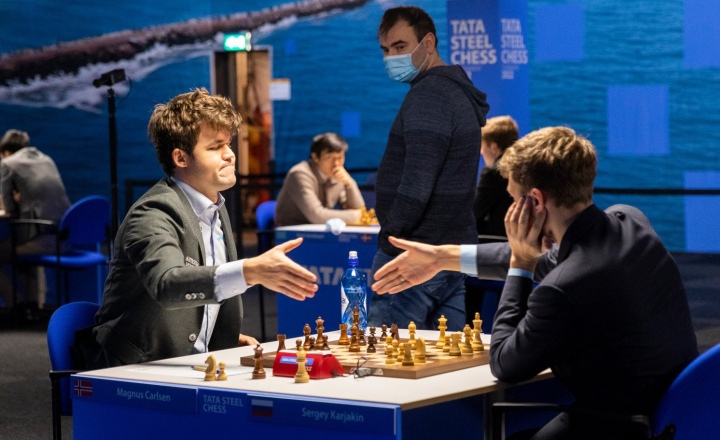
All the players in the leading group drew their games in Round 10 of Tata Steel Masters except for Vidit Gujrathi, who fell to his compatriot Rameshbabu Praggnanandhaa in a long gruelling Inian derby. Nils Grandelius scored his first victory in the event defeating Daniil Dubov. Sergey Karjakin and Magnus Carlsen played one of the shortest games at Tata Steel 2022 – the opponents made a quick draw in a well-known theoretical line of the Berlin system in Ruy Lopez. Anish Giri essayed a sharp variation of English Opening as White against Jan-Krzysztof Duda, but the Polish GM demonstrated an excellent preparation and got a slight edge. Anish had to switch to defence and work hard for a draw he reached right before the time control. The game Fabiano Caruana – Richard Rapport saw the same line of English Opening as the above-mentioned encounter, and again, Black had no problems reaching a comfortable position. Things took an unexpected turn after Fabiano blundered with 21.Rd4, apparently missing a strong intermezzo 22…e5! which gave Black a favourable endgame with a strong bishop vs a knight and powerful pawn mass on the kingside. Richard instructively conducted this ending and scored a clean victory of the #2 rated player in the world. Andrey Esipenko gradually outplayed Jorden Van Foreest on the white side of the Italian Game. The Russian GM got an overwhelming position by move 31, but when the time came to reap the harvest, he missed a forced win and gave Black some hopes for escape. Still, White emerged with an extra pawn which he eventually converted after a series of mutual inaccuracies. Shakhriyar Mamedyarov repeated the line that he had tried against Magnus Carlsen in the game with Sam Shankland but did not solve all his opening problems either as White prevented a thematic c7-c5. However, after a couple of Sam’s inaccuracies, Shakhriyar engineered some counterplay on the kingside to secure a draw. In a game ridden with mutual mistakes, Nils Grandelius scored his first victory at Tata Steel Masters over Daniil Dubov. The evaluation changed several times throughout this encounter, with Dubov making the final error (72.Kf4?? instead of 72.e6 or 72.Re6) when a draw was just a step away. Vidit Gujrathi and Rameshbabu Praggnanandhaa tested a topical line of the Nimtzo-Indian in which White emerged with an extra pawn but paid the price of weakening his king. After Vidit missed a couple of chances to consolidate his position, he committed a severe error 33.Qxh6? and handed Rameshbabu a dangerous initiative. Black, in turn, wasted several opportunities to finish off the opponent with a direct attack and took a much longer route in an endgame. White built some sort of a fortress, but Black managed to trade the knights and sailed to victory in a rook endgame with just seconds on the clock. Standings after Round 9: 1. Маgnus Carlsen – 7; 2. Anish Giri – 6½; 3-4. Shakhriyar Mamedyarov and Richard Rapport – 6; 5-7. Vidit Gujrathi, Sergey Karjakin and Andrey Esipenko – 5½; 8. Fabiano Caruana – 5; 9-10. Jan-Krzysztof Duda and Sam Shankld and Jorden Van Foreest – 4½; 11. Sam Shankland – 4; 12-13. Praggnanandhaa R.and Daniil Dubov – 3½; 14.Nils Grandelius – 3. Official website: tatasteelchess.com/ Photo: Jurriaan Hoefsmit and Lennart Ootes – Tata Steel Chess Tournament 2022
Belarusian Championship: Tsaruk and Zeliantsova clinch titles
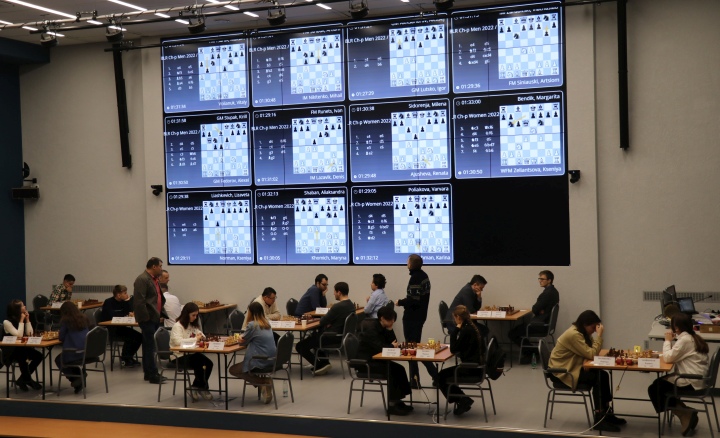
The Belarusian Chess Championships took place in the Republican Center for Olympic Training in Chess and Checkers in Minsk from January 9-19, 2022. The open event, a 12-player round-robin, saw a major sensation as 7th rated 16-year old FM Maxim Tsaruk (below on the left) from Minsk wrestled his maiden title in a tough competition with much more experienced GMs and IMs. Maxim came into the final round a half-point ahead of four contenders, including the highest-rated GM Alexei Fedorov, whom he faced with black pieces. The youngster demonstrated patience and resilience in an inferior position (although at some point it was quite alarming) and reached so much needed draw. This result secured him the title as all his main competitors also split points. The champion scored 8/11 and picked up 61 rating points. Four players netted 7½/11 and tied for second place. The tiebreaks favoured IM Denis Lazavik, who took silver and Alexei Fedorov (bronze). None of the participants (including the champion) completed the tournament undefeated. Final standings: 1 FM Tsaruk, Maksim 2347 8 2 IM Lazavik, Denis 2465 7½ 3 GM Fedorov, Alexei 2552 7½ 4 GM Stupak, Kirill 2478 7½ 5 IM Zarubitski, Viachaslau 2420 7½ 6 GM Aleksandrov, Aleksej 2502 7 7 IM Nikitenko, Mihail 2506 5½ 8 FM Stribuk, Artiom 2230 5 9 FM Siniauski, Artsiom 2300 3½ 10 GM Lutsko, Igor 2311 3½ 11 Volianuk Vitaly 2224 2 12 FM Runets, Ivan 2249 1½ The women’s tournament brought together 10 participants competing in a round-robin format and turned into a close race between the only titled players WFMs Kseniya Zeliantsova (pictured below) and Varvara Polyakova. Both netted 7½ and finished two points ahead of bronze-winner Kseniya Norman. The Koya-tiebreak tipped the balance in Kseniya’s favour as she became the champion; Varvara had to settle for silver. Final standings: 1 Zeliantsova, Kseniya 1953 7½ 2 Poliakova Varvara 2072 7½ 3 Norman Kseniya 1809 5½ 4 Liashkevich Lizaveta 1584 5 5 Sidorenja Milena 1546 4½ 6 Ajusheva Renata 1624 3½ 7 Khomich Maryna 1601 3½ 8 Shaban Aliaksandra 1616 3 9 Bendik Margarita 1534 2½ 10 Koishman Karina 1465 2½ Photos, detailed information about all participants are available on the official website of the Belarus Chess Federation: https://openchess.by/news/2718.html.
Tata Steel Masters R09: Carlsen wins, regains sole lead
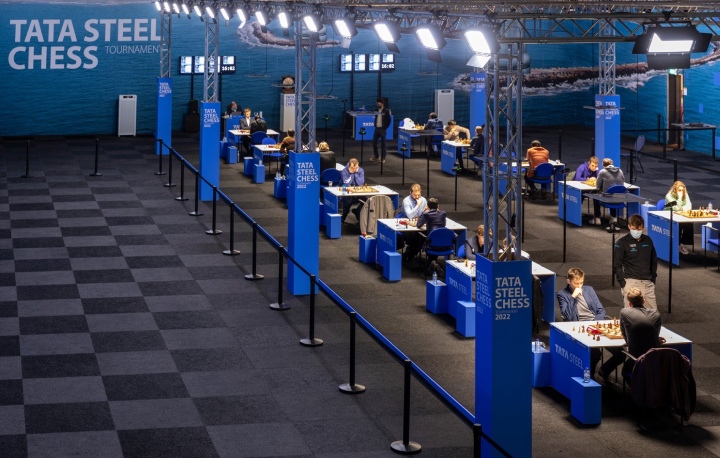
Magnus Carlsen scored a crucial victory over one of his main competitors Shakhriyar Mamedyarov to sprint into the lead. Anish Giri is trailing the World Champion by a half-point after defeating Sam Shankland. Fabiano Caruana chalked up his second win in the event, while Sergey Karjakin converted his extra exchange in the game with Rameshbabu Praggnanandhaa. Shakhriyar Mamedyarov valiantly stepped in Magnus’ territory in the Catalan Opening with black pieces but missed an intermediate move 14…Nb4 that cost him an exchange. Shakhriyar still had some compensation, but after White’s rooks quickly infiltrated Black’s camp by the move 24, it was all over for him. Anish Giri opted for a seemingly innocuous King’s Indian setup as White against Sam Shankland and gradually outplayed his opponent in a rook+biship vs rook+knight endgame. Sam tried to relieve the pressure with a pawn sacrifice (probably the American GM underestimated a powerful breakthrough 24.g4!) that handed Anish a decisive advantage. Ten moves down the road, Shankland threw in the towel. It is the fourth straight victory by the Dutch GM. Richard Rapport tested Vidit Gujrathi in the Catalan and eventually won a pawn, but the Indian GM put up a stubborn defence, and the drawish tendency of opposite-coloured bishop endgames took its toll. Jan-Krzysztof Duda and Andrey Esipenko waged a fight in a fresh, unbeaten position that emerged from the Queen-Pawn game. The Polish GM vedged his pawn to c6 and put heavy pressure on Black’s position, but for some reason discarded a straightforward continuation 21.Qb4, bringing his queen into an attack, in favour of 21.Qc3. Still, after Black’s innacuracies, Duda ended up clearly better but move by move he let Esipenko off the hook. The opponents shook hands in a roughly equal position right after reaching the time control. Jorden Van Foreest got a clear advantage on the light squares against Daniil Dubov, but with a couple of listless moves (instead of 28.Kh2 much better was 28.Qf3), he allowed the Russian GM to breathe life into his dark-squared bishop and create a counterplay sufficient for a draw. Fabiano Caruana went for a slightly inferior by strategically complicated position on the black side of French Defense against Nils Grandelius, and this approach paid off in the end. The Swedish GM cracked under pressure (32.Rad1?), giving up his a-pawn, and after the opponents exchanged mutual mistakes before the time control, Black’s two passers decided. Rameshabu Praggnanandhaa boldly sacrificed an exchange as White in the London System against Sergey Karjakin and got sufficient compensation to say the least, but completely misplayed an endgame, making a fatal error on the control 40th move. Standings after Round 9: 1. Маgnus Carlsen – 6½; 2. Anish Giri – 6; 3-4. Vidit Gujrathi and Shakhriyar Mamedyarov – 5½; 5-7. Richard Rapport, Sergey Karjakin and Fabiano Caruana – 5; 8-9. Jorden Van Foreest and Andrey Esipenko – 4½; 10. Jan-Krzysztof Duda – 4; 11-12. Sam Shankland and Daniil Dubov – 3½; 13. Praggnanandhaa R. – 2½; 14.Nils Grandelius – 2. Official website: tatasteelchess.com/ Photo: Jurriaan Hoefsmit and Lennart Ootes – Tata Steel Chess Tournament 2022
FIDE welcomes ALRUD as Official Legal Consultant

The International Chess Federation (FIDE) and ALRUD Law Firm have signed an agreement stipulating that the law firm’s specialists will provide broad legal support on issues that emerge from the federation’s activities. The agreement took effect on 1 January 2022, and it will be valid for one year but can be further extended. For ALRUD, chess is not only a means of personal achievements and personal growth for its employees but also a resource that enables the law firm to rally interests around this sport at the corporate level and provide social assistance. The law firm’s representatives regularly take part in various chess tournaments, including the first FIDE Online World Corporate Chess Championship, which took place in February 2021. ALRUD was also the highest donor during the fundraising that FIDE organized in parallel to that event, with the purpose of gathering funds to support social initiatives. As part of its cooperation with FIDE, ALRUD plans to continue its active involvement in promoting chess and developing intellectual sports in Russia and abroad. About ALRUD ALRUD is one of the leading full-service Russian law firms, serving domestic and international clients. We stand for high-quality advice, excellent service, and rigorous ethical standards. Established in 1991 by Senior Partners Maxim Alekseyev and Vassily Rudomino, ALRUD is widely recognized as one of the leading and most reputable Russian law firms. Our team extends more than 100 professionals, led by 11 equity partners, who bring expertise and experience across the full range of legal services. We provide full scope of legal services to local and international clients in the areas of corporate/M&A, competition/antitrust, banking & finance, intellectual property, commercial law, data protection/cybersecurity, dispute resolution, inward investment, employment, restructuring/insolvency, real estate, and tax. Outside of our domestic market, our clients are spread across Europe, Asia, North and South America. ALRUD serves clients across a range of industries, including energy and natural resources, mining, banking and finance, consumer goods and retail, investment management, government and public services, healthcare and pharmaceuticals, industrials, chemicals, technology, media and telecoms, transport, and logistics.
Deadline extended: Bids for FIDE Women’s Candidates Tournament and WGP Series 2022-23

1.1 The International Chess Federation (FIDE) will hold the Women’s Candidates Tournament in the first part of 2022 (see the Tournament Regulations). 1.2 FIDE is opening a bidding procedure to invite any federation member of FIDE or any organiser approved by the national federation to host the event. 1.3 Any Applicant shall fill in the Bidding Form. A signed copy shall be submitted as an e-mail message to the FIDE Secretariat to office@fide.com no later than February 15, 2022, 23:59 Lausanne time (FIDE has the right to extend this deadline). All the documents shall be submitted in English. Additional documents may be requested by the FIDE General Strategy Commission (GSC) for further evaluation. 1.4 Bid Evaluation Report shall be presented by GSC for approval of the FIDE Council. 1.5 Once the Organiser is granted the right to host the event, a relevant announcement shall be made on the FIDE website. FIDE Technical Delegate (FIDE TD) may be appointed at the same time to supervise the event on behalf of FIDE in consultation with GSC. 1.1 The International Chess Federation (FIDE) will hold the Women’s Grand Prix Series from August 2022 to June 2023 (see the Tournament Regulations). 1.2 FIDE is opening a bidding procedure to invite any federation member of FIDE or any organiser approved by the national federation to host the event. The federation’s letter of support may be provided later when the bid’s evaluation procedure is launched. 1.3 The bid may contain special proposals on financial and commercial conditions. The FIDE Council shall decide whether these conditions are admissible. 1.4 Bid Forms shall be filled in by an Applicant. A signed copy shall be submitted as e-mail messages to the FIDE Secretariat to office@fide.com no later than March 01, 23:59 Lausanne time (FIDE has the right to extend this deadline). All the documents shall be submitted in English. Additional documents may be requested by the FIDE General Strategy Commission (GSC) for further evaluation. 1.5 Bid Evaluation Report shall be presented by GSC for approval of the FIDE Council. 1.6 Once the Organiser is granted the right to organise one of the four Women’s GP tournaments, a relevant announcement shall be made on the FIDE website. FIDE Technical Delegate (FIDE TD) may be appointed at the same time to supervise the event on behalf of FIDE in consultation with GSC.
Petrosyan and Mkrtchyan win Armenian Champioship
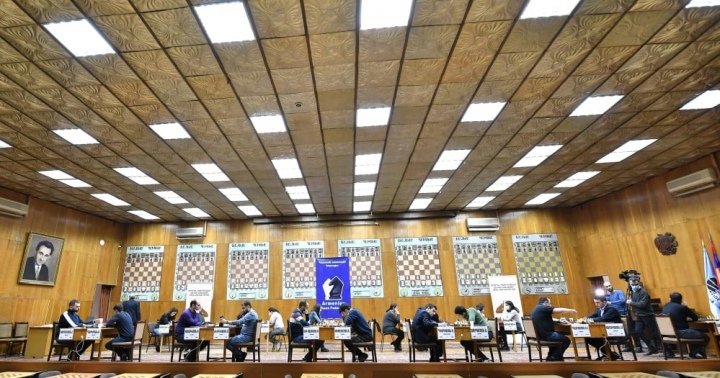
Manuel Petrosyan and Mariam Mkrtchyan are new Armenian champions. Both won the first national titles in their careers. The 82nd Armenian Championship Highest League and 77th Armenian Women’s Championship took place in Yerevan from January 12–23, 2022. Both events were round-robin tournaments with classical time control. The Highest League turned into a close race of Manuel Petrosyan (pictured above), Haik Martirosyan and Shant Sargsyan taking turns on the top. Petrosyan was coming to the final round a half-point ahead of his main competitors, with all three contenders playing with black pieces. The former U18 World Junior Champion (2016) took things into his own hands and clinched the title with an excellent score of 8/11 after defeating Arman Mikaelyan. Martirosyan and Sargsyan also won their games, finishing on 7½/11, with Haik (pictured below) taking silver thanks to better tiebreaks. The bronze-winner Shant Sargsyan became the only unbeaten participant. Final standings: 1 GM Petrosyan, Manuel 2620 8 2 GM Martirosyan, Haik 2621 7½ 3 GM Sargsyan, Shant 2628 7½ 4 GM Ter-Sahakyan, Samvel 2637 6½ 5 GM Gabuzyan, Hovhannes 2589 6 6 GM Harutyunyan, Tigran K. 2552 5½ 7 IM Gharibyan, Mamikon 2467 5 8 GM Pashikian, Arman 2606 5 9 GM Mikaelyan, Arman 2508 4 10 IM Shahinyan, David 2486 4 11 GM Petrosian, Tigran L. 2573 3½ 12 GM Andriasian, Zaven 2578 3½ It all came down to the wire in the 77th Armenian Women’s Championship, a 10-player round-robin tournament, as two leaders, a four-time champion Maria Gevorgyan and the top-rated Mariam Mkrtchyan (pictured above), clashed in the final, ninth round. Mariam Mkrtchyan prevailed in a long, tense battle to clinch her maiden title. The defending champion Susanna Gaboyan, trailing the leaders by a half-point, bested Asya Edigaryan to take silver. Maria Gorgyan had to settle for bronze. Final standings: 1 WIM Mkrtchyan, Mariam 2300 7 2 WIM Gaboyan, Susanna 2254 6½ 3 WGM Gevorgyan, Maria 2218 6 4 Hakobyan, Astghik 2053 4½ 5 WIM Gasparian, Narine 2004 4½ 6 Khachatryan, Veronika 2007 4 7 WFM Avetisyan, Mariam 2012 3½ 8 Arakelyan, Nare 1912 3½ 9 Yedigaryan, Asya 2022 3 10 WFM Khachatryan, Anna 2134 2½ Photo: Armenian Chess Federation Facebook page
Tata Steel Masters: Mamediarov pulls level with Carlsen
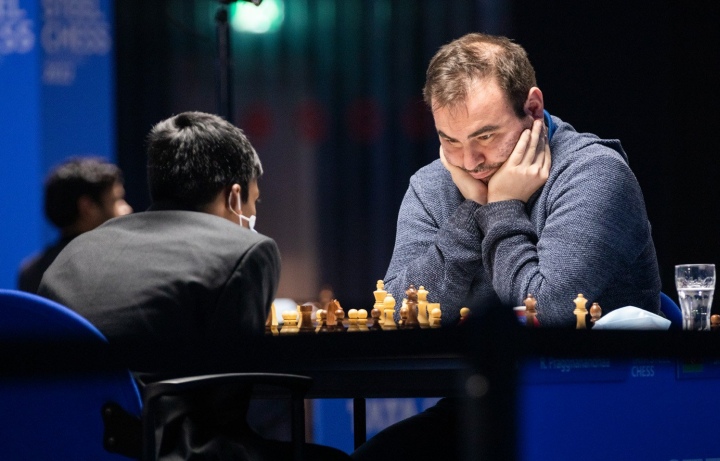
There is the duality of power on the top after Round 08 in Tata Steel Masters as Shakhriyar Mamedyarov defeated Rameshbabu Praggnanandhaa to tie for the first place with Magnus Carlsen, who made a draw with Sam Shankland. The leaders will clash in Round 9 after the rest day on Monday. Vidit Gujrathi and Anish Giri are trailing the leader by a half-point after scoring victories over Andrey Esipenko and Nils Grandelius, respectively. Shakhriyar Mamedyarov essayed an early queen sortie 4.Qa4 in the English Opening, which his opponent Rameshbabu Praggnanandhaa correctly met with a pawn sacrifice. However, on the move ten, the Indian youngster was too cooperative, exchanging the light-squared bishops. Three moves down the road, he erroneously protected his c6-pawn as Shakhriyar chipped away at the centre with 14.f3 and got a huge advantage. Mamedyarov’s conversion was not ideal, but eventually, the Azerbaijani GM put his opponent away in a knight endgame. Andrey Esipenko had a theoretical discussion in a long theoretical line of the Italian Opening, in which the Dutch GM sacrificed a knight but got three pawns in return. The opponents steered into a complicated endgame in which exchanges favoured black. That is exactly what happened, and Anish started gradually pressing for a win by advancing his kingside pawns. Esipenko had some defensive resources, but after a terrible mistake, 45.Nd2? Giri weaved the mating net around White’s king. Anish scored his third full point to tie for third position, just a half-point behind the leaders. Nils Grandelius opted for a sharp provocative line against Vidit Gujrathi, luring his opponent into chasing Black’s knight with e4-e5 and g2-g4. The Indian GM went for it and found an excellent follow-up 9.Nf5! sacrificing the knight. Nils turned it down, but Vidit traded his knight for the dark-squared bishop and grabbed the initiative. On move 18, Black had an interesting defensive option 18…Bf5, but this move slipped under the radar of the Swedish GM. White took total control over proceedings, and his victory became just a matter of time. Nils’s blunder on the move 34 put an end to his resistance. Magnus Carlsen sprang an opening surprise by playing Hennig-Schara Gambit as Black against Sam Shankland, but his opponent did not cling to extra material, completed development and after breaking in the centre transposed in an opposite-coloured bishops drawish endgame. The grandmasters split a point on the move 35. Richard Rapport comfortably equalized with Black in the Advance Variation of French Defense against Sergey Karjakin. Realizing that White’s position does not promise much, the Russian GM forced a draw by repetition. Jan-Krzysztof Duda spent a lot of time in the opening, but passed the test as Black in Daniil Dubov’s pet Catalan and reached an equal position. The Russian GM slacked off a bit in a drawish rook ending and lost a pawn, but quickly restored his focus, found the right setup and instructively reached a draw. The game Caruana – Van Foreest saw the line in the Open Ruy Lopez with 11…Nxf2 sacrifice, extensively analysed and tested back in 1940s. Black trades two minor pieces for a rook and a pawn but gets compensation in the form of a powerful center. According to modern chess engines, Black’s position is playable, and this encounter was further proof – Fabiano started repeating moves and got no objection from his opponent. Standings after Round 7: 1-2. Маgnus Carlsen and Shakhriyar Mamedyarov – 5½; 3-4. Vidit Gujrathi and Anish Giri – 5; 5. Richard Rapport – 4½; 6-9. Sergey Karjakin, Fabiano Caruana, Jorden Van Foreest and Andrey Esipenko – 4; 10-11. Sam Shankland and Jan-Krzysztof Duda – 3½; 12. Daniil Dubov – 3; 13. Praggnanandhaa R. – 2½; 14.Nils Grandelius – 2. Official website: tatasteelchess.com/ Photo: Jurriaan Hoefsmit and Lennart Ootes – Tata Steel Chess Tournament 2022