

Tata Steel Masters R07: Carlsen moves into the lead

Magnus Carlsen won his second straight game in Round 7 to grab the lead in Tata Steel Masters 2022. The World Champion beat the debutant Rameshbabu Praggnanandhaa with black pieces while neither of his closest competitors managed to score a full point. Daniil Dubov forfeited his game against Anish Giri after the Russian GM refused to play with a face mask. It was a request by the organizers after someone Dubov contacted with had tested positive for Covid-19. Magnus Carlsen opted for the Queen’s Gambit Accepted as Black against Rameshbabu Praggnanandhaa and had to solve some problems in a rare line that starts with 7.b3 followed by Ba3. The Indian youngster obtained a promising position but played somewhat slowly and hesitantly and found himself down a pawn with no compensation. After Magnus traded most of the opponents attacking pieces, his advantage on the queenside quickly became decisive. Jorden Van Foreest introduced an interesting novelty on the white side of Nimtzo-Indian Defence (9.Ne5) against one of the leaders, Vidit Gujrathi, but his opponent reacted precisely and got some counterplay against c4-pawn. The Dutchman quickly opened position in the centre planted his rook on d5, and got rid of his weakness. It looks like both sides were eager to press for a win in a roughly equal position, but it was the Indian who let his guard down and carelessly played 36…Rc8. The punishment was quick and cruel – after a series of forced moves, White’s rook penetrated to f7, and it was all over for Black. Jan-Krzysztof Duda got the upper hand in the London System against Fabiano Caruana but did not find a subtle 13.dxc5 with the idea of Qd1-a4-h4. The Polish GM played 13.Qa4 immediately, and the Amerian avoided the worst by trading central pawns. White still had a more pleasant position, but Jan-Krzysztof erroneously left his king in the center, and Fabiano gradually intercepted the initiative by advancing his kingside pawns. Duda somewhat belatedly evacuated his king to the queenside, and using Caruana’s inaccuracies was very close to equality but miscalculation right after the time control dashed his hopes for a draw. Black emerged with the queen and an extra pawn vs a rook and knight and seamlessly converted his material advantage. Richard Rapport and Shakhriyar Mamedyarov traded three pairs of minor pieces in the Sicilian Defence and found themselves in a roughly equal and bland position but found the way the set fire on the board by castling to the opposite wings and launching attacks. The moment many thought White was getting there faster, Black played a series of only moves to maintain balance. When the dust settled, an absolutely equal rook endgame arose on the board in which the opponents shook hands. Sam Shankland demonstrated very deep opening preparation as Black in a seemingly risky line of the Sicilian Defense against Andrey Esipenko and preserved an extra pawn, but his king got stuck in the center. Later on, the American mishandled the position by advancing central pawns and creating weakness in his camp. Esipenko came very close to victory but, for some mysterious reason, opted for 36.Qb6 instead of much more natural 36.Qa5 or 36.Qb5. White still had the upper hand, but Sam defended patiently and resourcefully and saved a half-point. Sergey Karjakin had no problems equalizing against Nils Grandelius in the Petroff Defense and, thanks to two bishop advantage, could feel optimistic about the endgame. Nils sent his knight on a risky trip to h7, where it got stuck for good. Luckily for the Swedish GM, Karjakin allowed 25.f5! to block his light-squared bishop and create an impregnable fortress. Thirteen moves down the road, a draw was agreed. Standings after Round 7: 1. Маgnus Carlsen – 5; 2. Shakhriyar Mamedyarov – 4½; 3-6. Vidit Gujrathi, Richard Rapport, Andrey Esipenko, Anish Giri – 4; 7-9. Sergey Karjakin, Fabiano Caruana, Jorden Van Foreest – 3½; 10-11. Sam Shankland, Jan-Krzysztof Duda – 3; 12-13. Daniil Dubov, Praggnanandhaa R. – 2½; 14.Nils Grandelius – 2. Official website: tatasteelchess.com/ Photo: Jurriaan Hoefsmit and Lennart Ootes – Tata Steel Chess Tournament 2022
Five FIDE Trainer Seminars to be held in India

The FIDE Trainers’ Commission (TRG) is pleased to announce unprecedented five FIDE Trainer Seminars to be organised by the All India Chess Federation (AICF) in February and March 2022. India, currently ranked in the top-3 nations in the world and increasingly dominant in junior rankings, is widely seen as the country with a great future. The AICF, together with the Government of India, continues to invest heavily in the development of chess in schools and capacity building, be it organisers, arbiters or trainers. The FIDE Trainers Seminars will both train and certify local trainers up to international standards. Four of India’s six FIDE Senior Trainers – Ramesh RB, Vishal Sareen, Chandra Sekhar Sahu, and Praveen Thipsay – who have been instrumental in developing the generations of young players – will conduct the seminars. The AICF made a promise to bring chess to every corner of India and deliver the goods. For the first time, the FIDE Trainer Seminars will be held in Shimla, Himachal Pradesh from February 18-20, in Patna, Bihar from February 25-27, in Bengaluru, Karnataka from March 4-6, in Guwahati, Assam from March 11-13 and in Visakhapatnam, Andhra Pradesh from March 25-27. Full details of each seminar will be available at the AICF website and TRG website. All the potential participants can already make enquiries about registration at indianchessfed@gmail.com.
Chess Federation of Sri Lanka celebrates 50th anniversary

The Chess Federation of Sri Lanka (CFSL) celebrates its 50th anniversary. The CFSL was formed in 1972, the year the World Chess Championship match between Boris Spassky and Robert James Fischer, a real milestone in chess history, took place. In the wake of this event, the local chess enthusiasts got together and established the Chess Federation of Sri Lanka on 3rd September 1972 under the presidency of Mr VP Vittachchi. A few years down the road, Mr Bodinagoda, the Chairman of the Lake House, became President and launched several progressive projects. There were some ups and downs between 1988 – 1999 due to political instability in the country and security level. The current era began in 1999 under the presidency of Mr Derrick Perera with two huge events, the Asian Junior Chess Championships held in a grand style in 2000 and 2001. Derrick was appointed as the General Secretary of the Asian Chess Federation in 2002. Christopher Parakrama of Royal College became the first national chess champion, and Sri Lanka debuted in Chess Olympiad back in 1978. The national team led by Arjuna Parakrama also included Harsha Aturupane, L.C. Goonatilleke and Sunil Weeramantry. After sporadic showings from 1982 to 1996, Sri Lanka has participated in all Chess Olympiads starting from 2000 (Istanbul, Turkey). Still, the highest achievement belongs to Suneetha Wijesuriya, who brought honour to the country at the FIDE Chess Olympiad 1992 in Manila by winning board gold. A new chapter started with Mr Luxman Wijesuriya’s taking the position of the CFSL President. He is also the General Secretary of South Asian Chess Council and Commonwealth Chess Association and a Vice President of Asian Chess Federation. Mr Luxman Wijesuriya has established a strong structure of internal events with cash prizes, spread the information on ratings and titles among players, and organized official Asian events regularly. This work gave Sri Lankan chess a much-needed boost, with Sachini Ranasinghe winning the Asian Zonal Women’s Chess Championship 2011 and becoming the first WIM in the country. She qualified for the FIDE Women World Cup in 2012 and became the first Sri Lankan player to take part in the event. Later on, Romesh Weerawardena turned in an excellent performance in the Asian Zone 2013 to win the IM title. Nelunika Methmani also got the WIM in the same year. Then Harshana Thilakaratne completed three IM norms and reached a 2400 rating. Ranindu Dilshan Liyanage became the first player to represent Sri Lanka in FIDE Chess World Cup held in 2021 in Sochi, Russia. CFSL has become one of the most active sports federations in Sri Lanka and Asia. Even in difficult pandemic years, the CFSL held over 100 online events and one OTB tournament. The CFSL have planned a lot of activities to mark its 50th anniversary as below: Golden Jubilee International Youth Chess Championships 2022 – 12 categories World Junior Online Chess Championships 2022 Asian Nations Cup Youth Chess Championships Asian Schools Chess Championships 2022 Training programmes for Technical officers Golden Jubilee International Open Grand Master Chess Championships Religious Ceremony on 2nd and 3rd of September 2022 The gathering of all top Chess Players and Officials
Tata Steel Masters: Thee on top after Round 6

Magnus Carlsen notched up his second win at Tata Steel Masters 2022 over Richard Rapport and joined the leaders Vidit Gujrathi and Shakhriyar Mamedyarov, who drew their games. Sergey Karjakin scored his first victory in the tournament over Jorden Van Foreest, while Fabiano Caruana suffered a painful defeat in a dramatic turn of events. Magnus Carlsen essayed a rare move 7.Be3 in the Catalan Opening (most likely prepared for the title match with Nepomniachtchi), but Richard Rapport found a logical sequence to reach an almost equal position. After the World Champion attacked the a7-pawn, the Hungarian GM struck in the center and snatched White’s d4 in return. It seems that Richard did not calculate all the consequences correctly as he almost immediately faltered with 20…Qe7? (missing very strong continuation 20…Ne5 with the idea of 21.Qxd4 Bxa3!) and then simply gave up a pawn. The rest was a smooth sail for Magnus, who deftly converted his material advantage. Fabiano Caruana and Anish Giri played an exciting, topsy-turvy game in the Double Fianchetto. As soon as the American started slowly regrouping his pieces for a kingside attack, the Dutchman timely ripped the position open on the queenside and grabbed the initiative. However, Anish did not play energetically enough and allowed Fabiano to launch a real onslaught with 24.f5, sacrificing a pawn. Caruana had a great chance to get there, but instead of going after Black’s king, he hastily snatched an exchange giving Black more than sufficient compensation. The opponents exchanged inaccuracies before the time control, but all of them pale compared to Fabiano’s 40.Rb6?? – the American tragically moved his rook to the square controlled by Black’s knight, lost an exchange and threw in the towel twelve moves later. Sergey Karjaking scored a fine positional victory over Jorden Van Foreest in their first-ever classical game. The Dutchman introduced an interesting idea of transferring his dark-squared bishop to b8 in the Italian Opening, but it did not work out for Black as White advanced his c-pawn to stir into a Kings-Indian-Defense-like position with a space advantage. Karjakin was making steady progress, and after Van Foreest imprudently advanced his pawn to a4, White surrounded and eventually won it. Jorden might have had some chances for a fortress in a closed position, but Sergey opened it up with a4-a5, infiltrated the opponent’s camp and forced his capitulation. Shakhriyar Mamedyarov ran into Nils Grandelius’ excellent opening preparation and timely made his arguably strongest “move” in the game, offering a draw in an inferior position. The Swedish GM failed to resist the temptation of making a draw with Black against one of the leaders and took a half-point. Jan-Krzysztof Duda demonstrated very deep opening preparation as Black in the Semi-Tarrasch Defense against one of the leaders Vidit Gujrathi. The moment White’s pieces started lurking around the Black’s king, the Polish GM reacted with a nice tactical sequence giving up two minor pieces for a rook and advancing his queenside pawns. Upon some reflection, the Indian GM decided to restore material equality, and the opponents agreed upon a draw by repetition. Daniil Dubov missed good winning chances in his signature Catalan Opening against Andrey Esipeko. White obtained a substantial advantage but seeming innocuous move transposition allowed Black to wriggle out with a nice tactical blow 36…Rxa2! The position became equal and a few moves later Daniil forced a draw by perpetual check. Sam Shankland and Rameshbabu Praggnanandhaa made just a few original moves in a sharp line of Sveshnikov Sicilian with 7.Nd5. The American GM introduced a novelty on the move 21, but the Indian youngster’s demonstrated that Black had no problem reaching a draw despite a two-pawn deficit. Standings after Round 6: 1-3. Vidit Gujrathi, Маgnus Carlsen, Shakhriyar Mamedyarov – 4; 4-5. Richard Rapport, Andrey Esipenko – 3½; 6-8. Jan-Krzysztof Duda, Anish Giri, Sergey Karjakin – 3; 9-13. Sam Shankland, Fabiano Caruana, Daniil Dubov, Jorden Van Foreest, Praggnanandhaa R. – 2½; 14.Nils Grandelius – 1½. Official website: tatasteelchess.com/ Photo: Jurriaan Hoefsmit and Lennart Ootes – Tata Steel Chess Tournament 2022
Groups for First Leg of FIDE Grand Prix 2022 announced
Berlin, January 21, 2022 — In just two weeks, Berlin will host the first round of the FIDE Grand Prix Series 2022, organized by World Chess. From February 3 to 17 sixteen elite chess players, including Grandmaster Harikrishna, who replaced the drop-out Wei Yi, will compete for the chance to win the last two spots in the Candidates tournament to be held later this year as well as for a EUR 150,000 prize fund. The drawing of lots ceremony determined the pools for the first leg of the Series. The ceremony, held over Zoom, was chaired by the Chief Arbiter Ivan Syrovy and CEO of World Chess Ilya Merenzon, and attended by the Grand Prix participants. Before the drawing, the players were divided into four baskets according to January standard rating: Basket 1: 1. Ding Liren (China), 27992. Levon Aronian (USA), 27723. Wesley So (USA), 27724. Alexander Grischuk (Russia), 2764 Basket 2: 1. Richard Rapport (Hungary), 27632. Leinier Dominguez (USA), 27523. Hikaru Nakamura, (USA), 27364. Vidit Gujrathi (India), 2727 Basket 3: 1. Dmitry Andreikin (Russia), 27242. Daniil Dubov (Russia), 27203. Pentala Harikrishna (India), 27174. Vladimir Fedoseev (Russia), 2704 Basket 4: 1.Alexei Shirov (Spain), 27042. Grigoriy Oparin (Russia), 26813. Vincent Keymer (Germany), 26644. Etienne Bacrot (France), 2642 Chief Arbiter allocated the players to four different groups via a randomized selection procedure. The group stage promises exciting games, with the pairings to be determined at the opening ceremony: Pool A: 1. Alexander Grischuk (Russia), 27642. Hikaru Nakamura, (USA), 2736 3. Dmitry Andreikin (Russia), 2724 4. Etienne Bacrot (France), 2642 Pool B: 1. Ding Liren (China), 27992. Richard Rapport (Hungary), 2763 3. Vladimir Fedoseev (Russia), 2704 4. Grigoriy Oparin (Russia), 2681 Pool C: 1. Levon Aronian (USA), 2772 2. Vidit Gujrathi (India), 2727 3. Daniil Dubov (Russia), 2720 4. Vincent Keymer (Germany), 2664 Pool D: 1. Wesley So (USA), 2772 2. Leinier Dominguez (USA), 2752 3. Pentala Harikrishna (India), 27174. Alexei Shirov (Spain), 2704 The first leg of the FIDE Grand Prix will take place in the city center at Unter den Linden 26-30 from February 4 to 17. The rounds start at 3 PM Berlin time. The games will be broadcast live at worldchess.com:https://chessarena.com/broadcasts/13604. For further questions, please contact media@worldchess.com. Official Photo FIDE Grand Prix Berlin Press kit:https://www.dropbox.com/sh/ggyqowtp6odrqcg/AADc5Kkk34nd2q8CMQlqnRTsa?dl=0 About FIDE Grand Prix 2022: The competition consists of three legs that span over three months and two cities: First leg: February 3 — 17, Berlin, GermanySecond leg: February 28 — March 14, Belgrade, SerbiaThird leg: March 21 — April 4, Berlin, Germany The FIDE Grand Prix will feature 24 players, with each player competing in two out of three events. Each 16-player event will consist of a group stage followed by a knockout semi-final and final. At the group stage, the participants will compete in four double-round-robin tournaments, with only the winners of each pool advancing. Both the semi-finals and final will consist of 2 regular time limit games, plus tiebreaks if needed. Players receive Grand Prix points according to their finishing position in each tournament: Round Grand Prix points Winner 13 Runner-Up 10 Semi-final loser 7 2nd in pool 4 3rd in pool 2 4th in pool 0 Two winners of the Series will qualify for the Candidates Tournament that will take place later in 2022. Allocations Leg 1 – Berlin Leg 2 – Belgrade Leg 3 – Berlin 1 Ding Liren Ding Liren 2 Anish Giri Anish Giri 3 Wesley So Wesley So 4 Levon Aronian Levon Aronian 5 S. Mamedyarov S. Mamedyarov 6 A. Grischuk A. Grischuk 7 Richard Rapport Richard Rapport 8 M. Vachier-Lagrave M.Vachier-Lagrave 9 L. Dominguez L. Dominguez 10 Hikaru Nakamura Hikaru Nakamura 11 Nikita Vitiugov Nikita Vitiugov 12 P. Harikrishna P. Harikrishna 13 Vidit Gujarathi Vidit Gujarathi 14 D. Andreikin D. Andreikin 15 Daniil Dubov Daniil Dubov 16 Yu Yangyi Yu Yangyi 17 Sam Shankland Sam Shankland 18 V. Fedoseev V. Fedoseev 19 Alexei Shirov Alexei Shirov 20 A. Predke A. Predke 21 G. Oparin G. Oparin 22 V. Keymer V. Keymer 23 A. Tabatabaei A. Tabatabaei 24 E. Bacrot E. Bacrot Regulations for the FIDE Grand Prix Series 2022 (pdf) About World Chess: World Chess is a London-based chess gaming and entertainment group and FIDE’ official broadcaster and commercial partner. World Chess organized the FIDE Championship Matches in Russia, the USA, and the UK, and revolutionized the sport by signing the biggest media partnerships in history. World Chess develops Armageddon, the chess league for prime-time television. World Chess also runs FIDE Online Arena, the exclusive official chess gaming platform. More at worldchess.com. About FIDE: The International Chess Federation (FIDE) is the governing body of the sport of chess, and it regulates all international chess competitions. Constituted as a non-governmental institution, it was recognized by the International Olympic Committee as a Global Sporting Organization in 1999. FIDE currently has its headquarters in Lausanne, but it was initially founded in 1924 in Paris under the motto “Gens una Sumus” (Latin for “We are one Family”). It was one of the very first International Sports Federations, alongside the governing bodies of the sports of Football, Cricket, Swimming, and Auto Racing. It is now one of the largest, encompassing 199 countries as affiliate members, in the form of National Chess Federations. Chess is nowadays a truly global sport, with dozens of millions of players in all the continents, and more than 60 million games on average played every day. More information: www.fide.com
Tata Steel Masters: Mamedyarov and Rapport catch up with Vidit
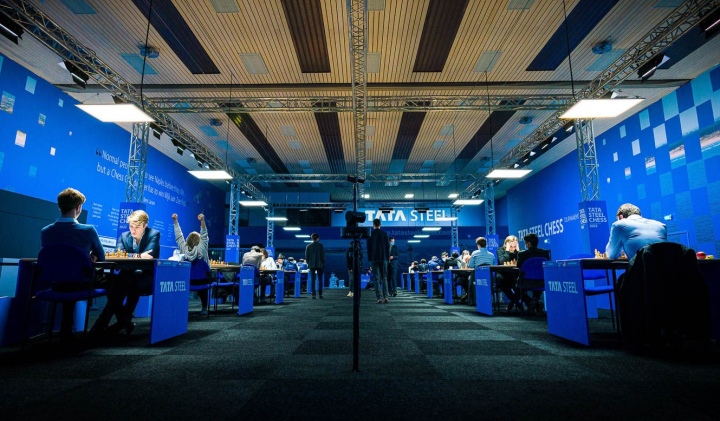
Shakhriyar Mamedyarov and Richard Rapport scored victories in Round 5 of Tata Steel Masters and joined Vidit Gujrathi at the top of the standings with 3½/5. The other five games, although very interesting and hard-fought, were drawn. Magnus Carlsen and Andrey Esipenko are trailing the leaders by a half-point. Jorden Van Foreest had a very interesting theoretical discussion with Shakhriyar Mamedyarov in the Open Variation of the Ruy Lopez, in which the Dutchman opted for a rare line on move ten. Jorden demonstrated a sensible idea of planting one his night on d4, but Shakhriyar struck with 18…c5 going for complications. Apparently, White missed something (20.Bc2 instead of 20.Ng5 looks better) as after the dust settled, Black emerged with two minor pieces for a rook and good practical winning chances. Van Foreest put up a stubborn defence, but when a draw was near at hand, he made a fatal error allowing Mamedyarov to protect his c-passer with tempo. Combining threats to White’s king with advancing his c-pawn, Shakhriyar won the game on the move 44. Richard Rapport fell into an excellent opening preparation of Rameshbabu Praggnanandhaa in the Nimtzo-Indian and had to assume the defensive despite an extra pawn. However, the young Indian squandered a couple of good attacking opportunities and, after erroneous 17…d3? the Hungrian got the upper hand. Indeed, White preserved an extra pawn while his queen covered critical squares on the queenside. A few moves down the road, Rapport traded the queens and transposed in an endgame where his queenside pawns quickly decided the battle. Magnus Carlsen sowed the wind but nearly reaped the whirlwind in the game with Nils Grandelisus. On move 18, the World Champion, playing with Black, opened up the center at the potential cost of two pawns. However, Nils snatched just one of them and opted for solid but somewhat passive 20.Ba4 instead of 20.Qb4+ followed by 21.Qb3. After White missed this chance, Black was pressuring for the rest of the game, but the Swedish GM held his ground and reached a draw. Andrey Esipenko essayed sharp 7.g4 gambit in the Semi-Slave (introduced by Shirov and Shabalov in the 1990s) against Fabiano Caruana but ended up down a pawn with some compensation that seemed insufficient. The opponents exchanged inaccuracies in a highly complicated position, but at some point, many thought that Fabiano took control as he got two passers on the queenside. To his credit, Esipenko did not lose heart and found a tremendous defensive idea of attacking Black’s g7 pawn and escaped with a draw, although Caruana might have missed his winning chance on move 33. As played, the opponents transposed into a drawish ending in which Andrey demonstrated necessary accuracy. Jan-Krzysztof Duda – Sergey Karjakin was another fierce battle. The Russian GM caught his opponent unprepared in a sharp line of the Queen’s Gambit Accepted and emerged with an extra pawn. However, the position remained extremely complicated, with White launching an onslaught on the kingside. Trying to convert his extra pawn Karjakin overplayed his position with 34…Rg4, but being in time trouble, Duda missed the winning refutation 35.Rf1 and settled for a draw by repetition. Anish Giri surprised Vidit Gujrathi with his line choice in the Petroff Defense and got an edge, but one somewhat abstract, rule-of-thumb move from his part (17.Rad1) allowed the leader to intitiate massive exchanges in the center and completely equalize. Sam Shankland went for a long and forced sequence with a pawn sacrifice against Daniil Dubov in the Catalan opening to transpose into an endgame. White preserved an extra pawn, but Black had a sufficient positional compensation and made a draw quite comfortably. Standings after Round 5: 1-3. Vidit Gujrathi, Richard Rapport, Shakhriyar Mamedyarov – 3½; 4-5. Magnus Calsen, Andrey Esipenko – 3; 6-8. Fabiano Caruana, Jan-Krzysztof Duda, Jorden Van Foreest – 2½; 9-13. Sam Shankland, Sergey Karjakin, Daniil Dubov, Anish Giri, Praggnanandhaa R. – 2; 14.Nils Grandelius – 1. Official website: tatasteelchess.com/ Photo: Jurriaan Hoefsmit and Lennart Ootes – Tata Steel Chess Tournament 2022
List of Open Tournaments to receive FIDE Aid Packages 2022
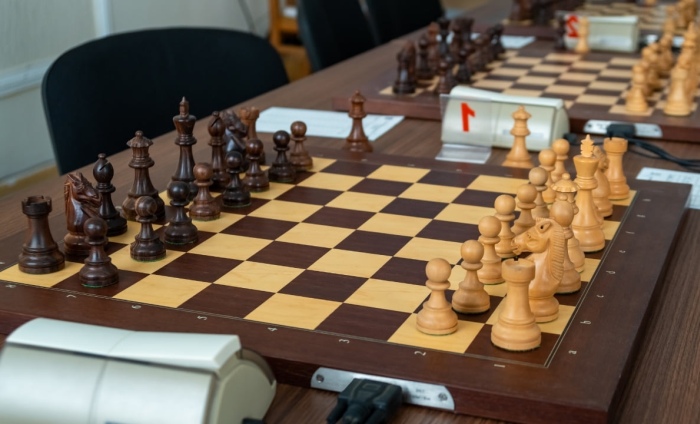
Following a successful implementation of the FIDE aid package for Opens in 2021, we are happy to extend and expand it for the year 2022. Initially budgeted at €150,000, it eventually got to €180,000! This impressive amount will be distributed among 50 Opens in as many countries/federations. Technical information: 110 applications received 50 Opens has been selected, including: Africa – 7Americas – 10Asia – 8Europe – 25 List of selected Opens Tournaments (pdf)List of selected Opens Tournaments (docx)
Tata Steel Masters: Mamedyarov and Praggnanandha win
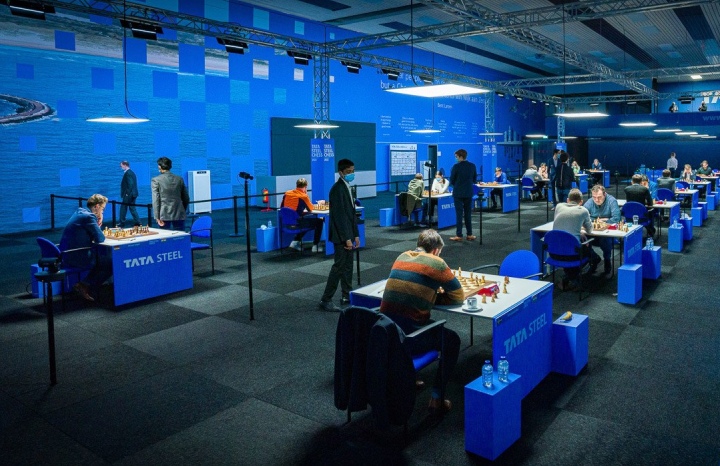
Rameshbabu Praggnanandhaa bounced back after yesterday’s defeat and scored his first victory in the Tata Steel Masters 2021 over Nils Grandelius. The Swedish GM is having a very tough tournament so far. Shakhriyar Mamedyarov also notched up his first win, outfoxing Jan-Krzysztof Duda in endgame complications. All other games were drawn. Vidit Gujrathi preserved his top position going into the first rest day as a sole leader. Magnus Carlsen and Jorden Van Foreest played a very exciting and entertaining game in which the World Champion missed a chance to catch up with the leader. The Dutchman did not shy away from complications in a stonewall type position as he boldly sacrificed a pawn and later on another for an active play on the kingside. Jorden did not even hesitate to offer the dark-squared bishop sacrifice (which Magnus declined), but on the move 37, he gave his opponent a golden opportunity to obtain a decisive material advantage. However, Magnus did not venture upon evacuating his king to the centre (38.Ke2!), with the position quickly liquidating into an equal rook + bishop vs queen endgame. A draw was agreed on move 54. Shakhriyar Mamedyarov scored his first-ever victory over Jan-Krzysztof Duda in a see-saw game, although at some point, his opponent was in command. In the Queen’s Gambit Declined, the opponents followed the encounter Carlsen – Radjabov (2021) until the move 15, when the Azerbaijani GM introduced a novelty 15.Ng3 (the third line of Stockfish). Duda handled things with confidence, while Mamedyarov overpressed with 26.Re8 and found himself down a pawn in a tough but still very complicated position. Luckily for Shakhriyar, being in severe time trouble, Jan-Krzysztof, first let his advantage slip away, then missed a draw and capitulated right after reaching time control. The leader Vidit Gujrathi and Andrey Esipenko tested a popular line of the Italian Opening in which Russian GM steadily held his ground with Black. Andrey even emerged a pawn up, but White had sufficient counterplay. Probably satisfied with a half-point, Esipenko opted not to ask further questions and took a draw. Rameshbabu Praggnanandha won a fine positional game in Gruenfeld Defense against Nils Grandelius that reminds of masterpieces by Tigran Petrosian in the King’s Indian Defense. After an instructive exchange of his dark-squared bishop for a knight in a closed position, the Indian youngster seamlessly executed a classical plan of playing against the opponent’s so-called bad bishop and pulled out a well-deserved victory in a rook endgame. After Fabiano Caruana did not manage to pose serious problems for Daniil Dubov on the white side of Anti-Marshall, the opponents gradually steered into a completely drawn endgame and buried the hatchet. Sergey Karjakin and Anish Giri spent just a few minutes reconstructing a well-known theoretical draw by repetition in Gruenfeld defence, while Sam Shankland and Richard Rapport quickly traded minor pieces and queens in the Petroff Defence and shook hands in an equal rook ending. Standings after Round 4: 1. Vidit Gujrathi – 3; 2-6. Magnus Calsen, Richard Rapport, Andrey Esipenko, Jorden Van Foreest and Shakhriyar Mamedyarov – 2½; 7-9. Fabiano Caruana, Jan-Krzysztof Duda, Praggnanandhaa R. – 2; 10-13. Sam Shankland, Sergey Karjakin, Daniil Dubov, Anish Giri, – 1½; Nils Grandelius – ½. Official website: tatasteelchess.com/ Photo: Jurriaan Hoefsmit and Lennart Ootes – Tata Steel Chess Tournament 2022
Call for submissions: FIDE Veterans Support Program 2022
The International Chess Federation is pleased to announce the continuation of its support to chess veterans. A number of grants will be awarded next month to distinguished players, coaches and organizers aged 65+. Anyone over this age who has contributed to the development of chess and who is in an unstable financial situation is eligible to submit an application. We invite federations, clubs, and players themselves to send their applications, including a CV of the nominee, to the FIDE Secretariat: office@fide.com. The deadline for submissions is February 1, 2022. Just like in 2021, a total of €65,000 will be allocated to this program. This amount is to be distributed among distinguished chess seniors.
Training on new developments in the chess regulations held online
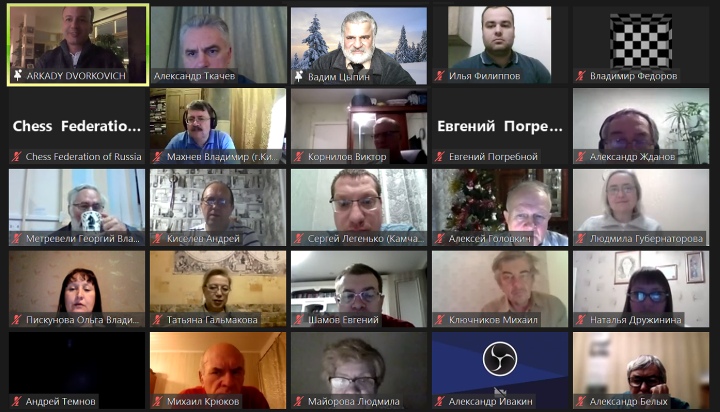
The Russian Chess Academy ushered in a new chess year – the year that would feature the Chess Olympiad in Moscow – with a seminar for International / FIDE / National Arbiters and tournament organizers held in an online format (webinar) on January 14, 2022. Titled “Changes to the FIDE Regulations effective January 01, 2022”, this webinar in the Russian language attracted a vast audience. The Zoom platform counted 179 logged-in attendees from nine national federations: Russia, Armenia, Azerbaijan, Belarus, Kazakhstan, Latvia, Moldova, Ukraine, and Uzbekistan. No entry fees were charged to the attendees. The participants of the webinar were welcomed by FIDE President Arkady Dvorkovich. He expressed confidence that this important event would serve to share the best practices and processes. The webinar attendees had a chance to learn about new developments in the chess regulations and understand the rationale behind them and study typical problems and issues. Webinar Leader IA/IO/FL Alexander Tkachev (Russia), the CFR Technical Director, and the Director of the Russian Chess Academy explained that the changes that came into effect in January 2022 reflect a huge collaborative effort of the FIDE Council, the Qualification Commission, and the national chess federations that took part in the detailed survey that laid the groundwork for important modifications. Many other stakeholders, such as the Arbiters’ Commission and the Fair Play Commission, took an active role in the process. The result is the new set of Regulations that better meet the needs of all segments of the global chess family: elite players, norm seekers, amateurs, organizers, and arbiters. “Working with the new Regulations will require some adjustment from all of us. Let’s keep our minds open and embark on this road together!” Mr Tkachev said. He also stressed the benefits of the collaboration between national federations connected by common geography, culture, history, or language. The new editions of the FIDE Rating Regulations, FIDE Rapid and Blitz Rating Regulations, and FIDE Title Regulations that became effective in January 2022 were presented during the webinar. Some changes were made to comply with other FIDE documents that have priority (e.g., the FIDE Charter); others codify existing best practices that have already taken root to make the game of chess even more transparent, fair, and democratic. The seminar attendees were provided with the multi-page comparison tables that captured every change, addition, or deletion in the three Regulations documents. Common pitfalls that arbiters and organizers can encounter in title norm tournaments were explained by Guest Lecturer IA/IO Vadim Tsypin (Canada). The agenda of the webinar also included the topic of changed responsibilities of the chief arbiters and the rating officers in organizer federations, as well as changes to report submission and norm certificate issuance. The expertise accumulated by the Chess Federation of Russia was shared with attendees. Information and photos by the Chess Federation of Russia and the Russian Chess Academy