

Call for submissions: FIDE Veterans Support Program 2022
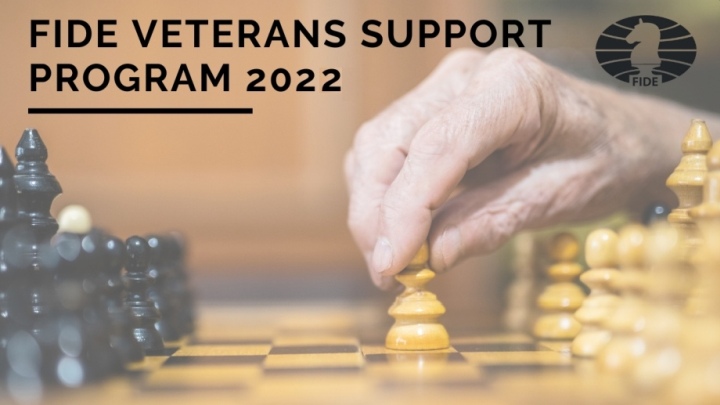
The International Chess Federation is pleased to announce the continuation of its support to chess veterans. A number of grants will be awarded next month to distinguished players, coaches and organizers aged 65+. Anyone over this age who has contributed to the development of chess and who is in an unstable financial situation is eligible to submit an application. We invite federations, clubs, and players themselves to send their applications, including a CV of the nominee, to the FIDE Secretariat: office@fide.com. The deadline for submissions is February 1, 2022. Just like in 2021, a total of €65,000 will be allocated to this program. This amount is to be distributed among distinguished chess seniors.
Training on new developments in the chess regulations held online
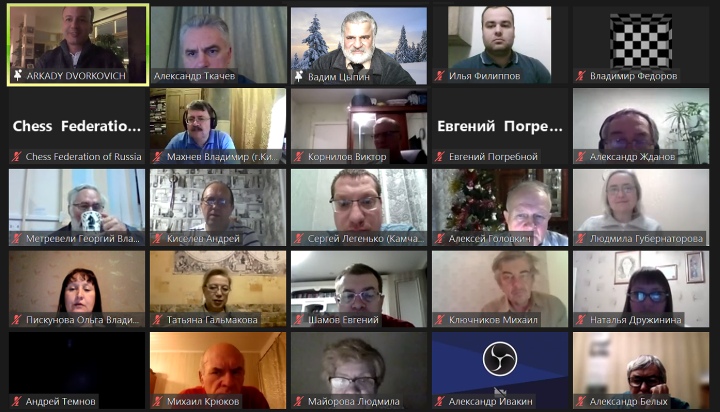
The Russian Chess Academy ushered in a new chess year – the year that would feature the Chess Olympiad in Moscow – with a seminar for International / FIDE / National Arbiters and tournament organizers held in an online format (webinar) on January 14, 2022. Titled “Changes to the FIDE Regulations effective January 01, 2022”, this webinar in the Russian language attracted a vast audience. The Zoom platform counted 179 logged-in attendees from nine national federations: Russia, Armenia, Azerbaijan, Belarus, Kazakhstan, Latvia, Moldova, Ukraine, and Uzbekistan. No entry fees were charged to the attendees. The participants of the webinar were welcomed by FIDE President Arkady Dvorkovich. He expressed confidence that this important event would serve to share the best practices and processes. The webinar attendees had a chance to learn about new developments in the chess regulations and understand the rationale behind them and study typical problems and issues. Webinar Leader IA/IO/FL Alexander Tkachev (Russia), the CFR Technical Director, and the Director of the Russian Chess Academy explained that the changes that came into effect in January 2022 reflect a huge collaborative effort of the FIDE Council, the Qualification Commission, and the national chess federations that took part in the detailed survey that laid the groundwork for important modifications. Many other stakeholders, such as the Arbiters’ Commission and the Fair Play Commission, took an active role in the process. The result is the new set of Regulations that better meet the needs of all segments of the global chess family: elite players, norm seekers, amateurs, organizers, and arbiters. “Working with the new Regulations will require some adjustment from all of us. Let’s keep our minds open and embark on this road together!” Mr Tkachev said. He also stressed the benefits of the collaboration between national federations connected by common geography, culture, history, or language. The new editions of the FIDE Rating Regulations, FIDE Rapid and Blitz Rating Regulations, and FIDE Title Regulations that became effective in January 2022 were presented during the webinar. Some changes were made to comply with other FIDE documents that have priority (e.g., the FIDE Charter); others codify existing best practices that have already taken root to make the game of chess even more transparent, fair, and democratic. The seminar attendees were provided with the multi-page comparison tables that captured every change, addition, or deletion in the three Regulations documents. Common pitfalls that arbiters and organizers can encounter in title norm tournaments were explained by Guest Lecturer IA/IO Vadim Tsypin (Canada). The agenda of the webinar also included the topic of changed responsibilities of the chief arbiters and the rating officers in organizer federations, as well as changes to report submission and norm certificate issuance. The expertise accumulated by the Chess Federation of Russia was shared with attendees. Information and photos by the Chess Federation of Russia and the Russian Chess Academy
Tata Steel Masters: Vidit shoots ahead

Vidit Gujrathi prevailed over Daniil Dubov in a wild game to grab a sole lead in Tata Steel Masters. Andrey Esipenko, Jorden Van Foreest and Richard Rapport also scored victories and now sit on 2/3 together with Magnus Carlsen and Jan-Krzysztof Duda, who drew their game. True to his creative style Daniil Dubov introduced a novelty in the Italian Opening against Vidit Gujrathi as early as on the move 8. The Indian GM took the seemingly risky approach, first trading his dark-squared bishop and then accepting a central pawn sacrifice. As a result, he fell behind in development, whereas Black’s king got stuck in the centre. Still, Vidt managed to maintain balance finding all the right answers in a critical situation. Daniil pushed hard and sacrificed an exchange, but surprisingly it did not change the evaluation of position as roughly equal. Indeed, the white queen was chasing down the black king, but there were no decisive threats in sight. A real drama happened on move 32 – after a series of checks, the Russian GM decided to protect his rook with 32.f3, which turned to be a fatal mistake. Most likely, Dubov missed that his rook was taboo due to checkmate in three. Vidit immediately traded the rooks, escaped with his king and quickly converted the material advantage. Richard Rapport instructively outplayed Nils Grandelius on the black side of the Sicilian Defense and finished off his opponent with a textbook combination. Nils Grandelius – Richard Rapport 29…Rh1! An excellent illustration of the deflection motif! White resigned after 30.Rg1 Rxg1 31.Qxg1 Qc3 with imminent checkmate on b2 0-1 In the Russian derby, Esipenko – Karjakin, Black was patiently defending a slightly worse position but all of a sudden left his bishop en prise. Sergey got a couple of passers in return, but Andrey found the correct way to retain his bishop, rearranged his pieces and promptly neutralized all the opponent’s threats to score a full point. Jorden Van Foreest surprised Rameshbabu Praggnanandhaa with a rare line 3.Bc4, which is mostly seen in the games by low-rated players. The Dutchman offered a pawn sacrifice and obtained positional compensation that became more than sufficient when his Indian opponent opted to trade the light-squared bishop at the cost of doubling his pawns along the e-file. Although Jorden put serious pressure on Black’s weaknesses, Praggnanandhaa held his own up to some point but eventually decided to return a pawn for some activity. Unfortunately, this activity quickly petered out while Black’s weak pawns fell. The game transposed into a rook endgame in which White’s queenside pawns were unstoppable. Jan-Krzysztof Duda followed the footsteps of Ian Nepomniachtchi in the Anti-Marshall against Magnus Carlsen and got a slight edge. The World Champion had to demonstrate resilience and accuracy to reach a draw in an endgame. Anish Giri won a theoretical duel and a pawn in Anti-Meran against Shakhriyar Mamedyarov, but maybe Black’s position was not as bad as it looked as the opponents split the point on the move 21. Fabiano Caruana desperately tried to extract water from the Berlin endgame stone as White against Sam Shankland, but all his attempts were thwarted by the opponent’s precise play. Standings after Round 3: 1. Vidit Gujrathi – 2½; 2-6. Jan-Krzysztof Duda, Magnus Calsen, Richard Rapport, Andrey Esipenko and Jorden Van Foreest – 2; 7-8. Fabiano Caruana, Shakhriyar Mamedyarov – 1½; 9-13. Sam Shankland, Sergey Karjakin, Daniil Dubov, Anish Giri, Praggnanandhaa R. – 1; Nils Grandelius – ½. Official website: tatasteelchess.com/ Photo: Jurriaan Hoefsmit and Lennart Ootes – Tata Steel Chess Tournament 2022
TRG announces Trainer Professional Education & Development Workshops

The FIDE Trainers Commission (TRG) is pleased to announce the first of a series of Trainer Professional Education & Development Workshops to be organised quarterly with credits to be awarded towards title awards in seminars. Each 6-hour workshop will be held on a designated Saturday, usually from 10 a.m to 12 p.m, then from 1 p.m. to 3 p.m. and finally from 4 p.m. to 6 p.m. In our better teaching series, FIDE Senior Trainer and Grandmaster Artur Jussupow will present “How to Teaches Pawn Endings” on March 26, followed by “How to Teach Calculation” on May 14, then “How to Teach Rook Endings on October 24 and finally “How to Teach Positional Play” on December 10. The fee for each workshop is 80 Euros for the public, 50 Euros for licensed trainers. Recognising that 2022 is FIDE’s The Year of the Woman in Chess, there will be no fee charged for female participants nominated or endorsed by the FIDE Commission for Women’s Chess. A series of seminars on “Use of Technology in Chess” will also be organised by TRG, the first one with Chessable, on February 26, which will be free for all licensed trainers. Full details will be available at the TRG website: www.trainers.fide.com
New set of FIDE regulations came into force

A new set of regulations covering FIDE titles, rapid and blitz games and ratings became effective as of January 1, 2022. Worked out by FIDE Qualification Commission (QC), the new regulations came out after a lengthy period of consultation with other Commissions, federations, individual players, and chess supporters worldwide. Two important meetings, one limited to the QC members and another open to all, took place in 2020. The most significant point of interest was the minimum time controls for games to be rated by FIDE. After many different views were expressed, the QC put together a detailed questionnaire, again open to all (but not anonymously). There was then another worldwide Zoom meeting where final decisions were taken. As a result, 3-hour games (90+90) will be accepted provided that both players are rated below 2400, an increase from 2200. Hopefully, it will help the organisers of tournaments with shorter time controls to submit their events for FIDE rating. FIDE Title Regulations effective from January 1, 2022 Changes made to FIDE Title Regulations (effective from 1 January 2022) (Word document) FIDE Rating Regulations effective from January 1, 2022 Changes made to FIDE Rating Regulations (effective from 1 January 2022) (Word document) FIDE Rapid & Blitz Regulations effective from January 1, 2022 Changes made to FIDE Rapid and Blitz Rating Regulations (effective from 1 January 2022) (Word document) It should be noted that these regulations are intended for the long term. Chess is now returning to normal after almost two years of lockdowns and quarantine, but the damage to the rating system caused by this gap in results is yet to be assessed. Possibly, some short term adjustments will be required. If so, the chess community will be kept informed, although the consultations might not be as lengthy.
Tata Steel Masters: Magnus Carlsen join leaders
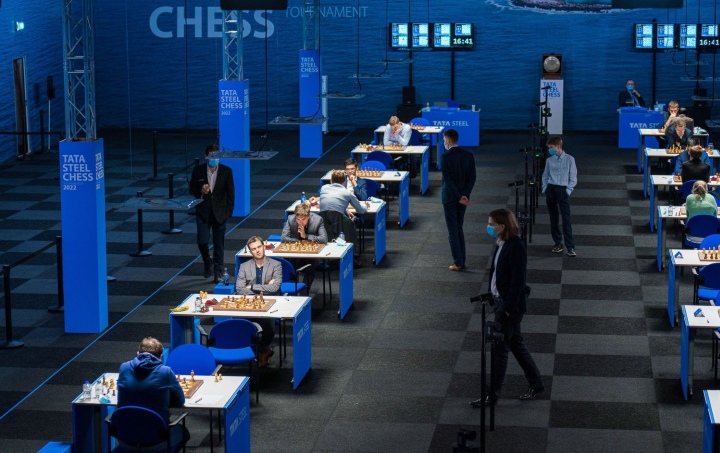
Magnus Carlsen scored his first victory at Tata Steel Masters 2022, defeating Anish Giri in Round 2 and joined Jan-Krzysztof Duda and Vidit Gujrathi at the top of the standings. The only other winner of the day is Richard Rapport who took full advantage of Jorden Van Foreest’s mistake in a knight endgame. All other games were drawn. Magnus Carlsen reaped the fruits of his preparation for the title match against Ian Nepomniachtchi. The World Champion played the Catalan with a pawn sacrifice on c4, and by move 12, the opponents stepped into uncharted territory. Five moves down the road, Anish allowed an interesting exchange sacrifice which gave White sufficient compensation but no visible advantage. However, Anish almost immediately made severe miscalculation and White’s pieces pounced on the Black’s king. Giri managed to trade queens, but Magnus’s passed c-pawn became a knockout punch. Jorden Van Foreest maintained the balance for most of the game against Richard Rapport but a terrible mistake 35…Nd7? in a pawn ending cost him dearly. White emerged with two extra pawns, and the rest was a smooth sail for the Hungarian. In the games, Vidit – Caruana and Karjakin – Dubov players made just a few their own moves. Both encounters followed long theoretical lines known for drawish tendencies. No surprise, both pairs split points. Shakhriyar Mamedyarov opted for a rare and very aggressive line 3.g4!? (after 1.d4 Nf6 2.c4 e6) against Andrey Esipenko and quickly got a fresh position. The young Russian played very sensibly, arranging his pieces in the centre but spent a lot of time. Nevertheless, after the queens left the board, the opponents somewhat surprisingly decided to bury the hatchet. Sam Shankland and Nils Grandelius also agreed to a draw after White built a fortress with a rook and a knight against the queen, but it was American who had a fair chance to pull out his first victory. Unfortunately, Sam did not find 32.Rh1!, forcing Black to part with a pawn with no compensation. Later on, Shankland missed an interesting option Rd7 on moves 35 and 36 and let the opponent trade his most active pieces. Rameshbabu Praggnanandhaa and Jan-Krzysztof Duda played a very solid game in which White had a slight advantage that was virtually impossible to turn it into something tangible. A draw came as a logical outcome. Standings after Round 2: 1-3. Jan-Krzysztof Duda, Magnus Calsen and Vidit Gujrathi – 1½ ; 4-11. Fabiano Caruana, Richard Rapport, Shakhriyar Mamedyarov, Sergey Karjakin, Andrey Esipenko, Praggnanandhaa R. and Jorden Van Foreest – 1; 12-14, Sam Shankland, Nils Grandelius, Anish Giri – ½ Official website: tatasteelchess.com/ Photo: Jurriaan Hoefsmit and Lennart Ootes – Tata Steel Chess Tournament 2022
Brahami and Nassr win 2021 Africa Junior Championship
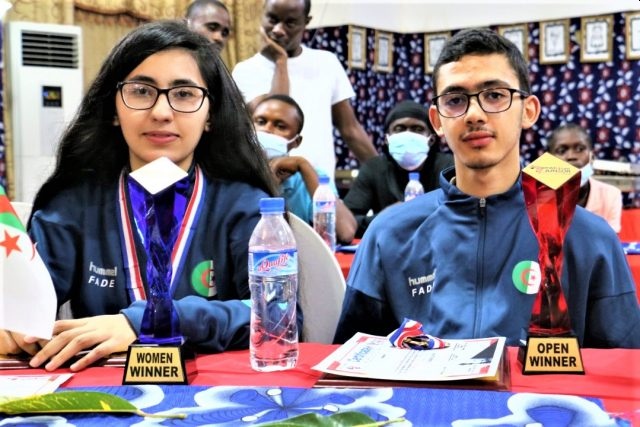
FM Lamine Brahami and WIM Lina Nassr, both of Algeria, are the proud winners of the 2021 Africa Junior Chess Championship. The event held in the Liberian capital of Monrovia from December 29, 2021 to January 4, 2022 saw FM Brahami Lamine score 8 points out of 9 rounds to take his maiden African title. WIM Lina Nassr won the Ladies section by a perfect score 9/9 to grab her second title. She won her first Africa Junior title in the 2017 edition held in Lome, Togo. Both tournaments were officiated by Nesla Adnane of Algeria (Chief Arbiter) and Mario Kpan of Ivory Coast, who provided photos for this article. Open Section The Open Section had a total of 18 players from 8 federations. Liberia, as the host nation, fielded eight players. Other federations included Algeria, Cameroon, Egypt, Mauritania, Nigeria, Sierra Leone and Uganda. The race for the top spot between Lamine Brahami and Callistus Denyefa Eyetonghan (pictured below) culminated in the final round. Both had 7 points, and each had a chance of claiming the title. Brahami Lamine beat David Lery Debblay of Liberia and won the gold medal as his main competitor lost to one of the top Egyptian junior players, David George. Still, with 7 points, Callistus tied for second place with Mohamed Abderrahim Taleb of Mauritania and took silver thanks to the victory in the direct encounter. Lamine Brahami qualified for the 2022 World Junior Chess Championship. Final standings: 1 Brahami, Lamine ALG 2212 8 2 Eyetonghan, Denyefa Callistus NGR 2005 7 3 Mohamed, Abderrahim Taleb MTN 1923 7 4 George, Samir David EGY 2063 6 5 Noumbo, Vidal CMR 1756 6 Ladies Section WIM Lina Nassr took the title after winning all her games, while her younger sister WCM Manel Nassr netted 8 points to earn the silver medal. WFM Naledi Marape came in third with 7/9. The champion punched her ticket to the 2022 World Junior Chess Championship. Final standings: 1 WIM Nassr, Lina ALG 9 2 WCM Nassr, Manel ALG 8 3 WFM Marape Naledi BOT 7 4 Abigail, Karyah LBR 6 5 Meleh, N. Davis LBR 5 Text and photo: Kenya Chess Masala
Tata Steel Masters: Duda, Vidit and Van Foreest take the lead
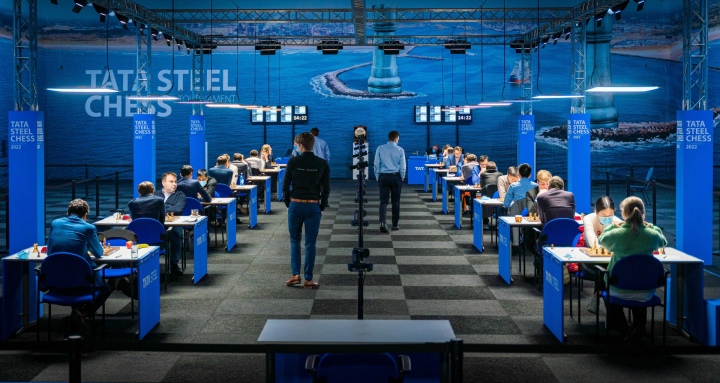
After the rating favourites Magnus Carlsen, Fabiano Caruana and Anish Giri drew their games, Jan-Krzysztof Duda, Vidit Gujrathi and Jorden van Foreest jumped on the opportunity to grab the lead in the tournament. The World Champion made a comfortable draw against Andrey Esipenko with black pieces on the move 21. Probably after last year defeat at the hands of the Russian youngster, Magnus opted not to take chances in a roughly equal position. Fabiano Caruana got the upper hand against Sergey Karjakin but missed a couple of good attacking opportunities (21.f4 and 30.bx5) and allowed his opponent to escape with a draw. Praggnanandhaa R. passed the test facing Anish Giri in a rare line of the English Opening with Black. Anish took control over the centre and made a promising pawn sacrifice to grab the initiative, but the Indian youngster cold-bloodily neutralized White’s threats and reached a safe haven. Daniil Dubov sacrificed c4-pawn in his trademarked g3-line against Shakhriyar Mamedyarov but found himself in dire straits after a series of precise Black’s moves. Luckily for him, the Azerbaijani GM did not demonstrate accuracy in a won position and got the Russian off the hook. Jan-Krzysztof Duda took control over the d-file in the game with Richard Rapport, but it would not have been enough had the Hungarian taken an active defensive line. As played, the Polish GM gradually crushed his opponent in an endgame. Vidit Gujrathi took a great start after grinding down Sam Shankland in a slightly better endgame. It seems that 33…f6 was a decisive mistake that ruined the day for Black. Jorden van Foreest also started with a victory over Nils Grandelius, just like in 2021. In the game riddled with mutual inaccuracies, White eventually advanced queenside pawns and scored a full point. Standings after Round 1: 1-3 Jan-Krzysztof Duda, Vidit Gujrathi, Jorden Van Foreest – 1; 4-11 Magnus Carlsen, Fabiano Caruana, Anish Giri, Shakhriyar Mamedyarov, Sergey Karjakin, Andrey Esipenko, Praggnanandhaa R. – 1/2; 12-14 Richard Rapport, Sam Shankland, Nils Grandelius – 0 Photo: Jurriaan Hoefsmit and Lennart Ootes – Tata Steel Chess Tournament 2022
FIDE – ISF World School Online Chess Cup: Registration begins
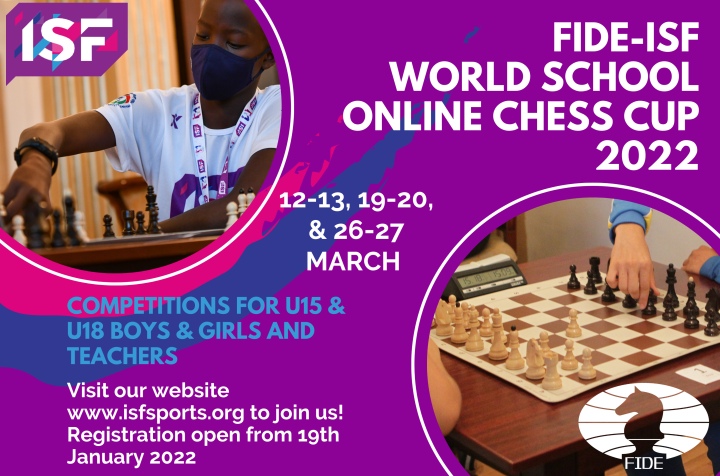
The FIDE – ISF World School Championship Online Chess Cup 2022, organised by FIDE and the International School Sport Federation (ISF), aims to motivate young students and teachers to be active and participate in the online chess competition. Following the success of the first-ever ISF World Schools Championship Online Chess Cup held in October 2020 that brought together boys and girls from 37 countries and five continents, the event invites students and teachers from FIDE and ISF member countries as well as students from all over the world to take part. The tournament will be held on Tornelo online platform in boys and girls U15 and U18 age categories and in men and women teachers in March of 2022. The qualification tournaments for students are scheduled for March 12 and 13, while the finals will take place on March 19 and 20. The teachers’ event will be held on March 26 (qualification tournaments) and March 27 (finals). The tournament registration will begin on January 19 and be open until March 05, 2022 (for students) and March 12, 2022 (for teachers) on the ISF website. The participation fee is 30€ per participant. The winners in each category will get a ticket to the World Chess Olympiad 2022 in Moscow with free accommodation for two nights in the official hotel of the Olympiad. All the medalists will also be awarded free participation at the lessons with top grandmasters. The top-5 ranked players in each age and gender category will receive the ISF – FIDE ranking certificate, while all the remaining finalists will get participation certificates. The Regulations for the FIDE – ISF World School Championship Online Chess Cup 2022 can be found here. About International School Sport Federation (ISF) Based in Belgium, International School Sport Federation (ISF) has been organising international competitions to encourage education through sport and student-athletes since its foundation in 1972. ISF was recognised by the IOC in 1995, and it currently has 113 members which compete in 45 different sport disciplines. Many of these sports have their own World Schools Championships every two years, while some others are part of the bi-annual Gymnasiade. In September 2021, FIDE and ISF signed the memorandum of understanding on ensuring the development and promotion of chess through school sport. The document signed within the framework of the School Sport Forum held in Serbia encourages and supports the education of youth through chess sport and culture, contributes to the social and intellectual development of youngsters, and promotes chess sport and chess in education on a local and international level.
Manifesto: The Year of the Woman in Chess

The Commission for Women’s Chess is truly grateful to the FIDE President Mr Arkady Dvorkovich, the FIDE Council and the Management for their decision to have declared 2022 the Year of the Woman in Chess. This is our chance to take a leap forward in our mission of forming gender equity policies, practices and programs. In recent years, we have achieved a number of long-lasting strategic goals, from encouraging women to actively participate in all aspects of chess life by offering them free educational seminars to implementing gender quotas for various official positions and assignments. While our colleagues have worked tirelessly to provide better conditions for top female players and to greatly increase the prize funds, our commission has focused on connecting, inspiring and educating female players of all backgrounds from around the world. Last year we organised The Queens’ Festival 2021, a series of continental and global tournaments with over 460 participants from 82 countries. Many thousands more followed the side events featuring female role model guests and presenters on FIDE social media. Creating a strong women chess community is very important for us to continue pursuing our goals and representing the interests of women in chess. To follow in this spirit, throughout this Year of Woman in Chess, we are planning the following events and collaborations to make this an epic year for women: To establish a yearly award for women in various categories. To increase communication with national federations on the importance of nominating an “Ambassador for Women” in their country and encouraging them to organise support programs for women and girls. To organise “Global Exchange Forums” to share ideas that will improve the environment for women in chess. To create the “Queens Pavilion” during the Chess Olympiad 2022 in Moscow. To strengthen the collaboration with other FIDE commissions to support women’s participation in all aspects of chess life, even more intensely for this special year. The “Queens Festival” was very successfully organised for the first time in 2021. The plan for 2022 is to expand it with various exciting side events and more countries participating. Inspirational female role models will be featured weekly through the different FIDE channels: social media, a relaunched newsletter, and a newly created podcast. There are also other plans for the Year of the Woman in Chess which we will announce throughout the year on FIDE media: you can subscribe to receive the news directly in your email. We would also like to hear and promote your initiatives and ideas. Please, email us your stories, suggestions and pictures to women@fide.com, and share your initiatives online using the hashtag #womeninchess. With your help and support, we can make this an outstanding and game-changer year! Eva RepkovaChair of FIDE Women’s Commission