

FIDE Chess.com Grand Swiss: Round 7 Recap
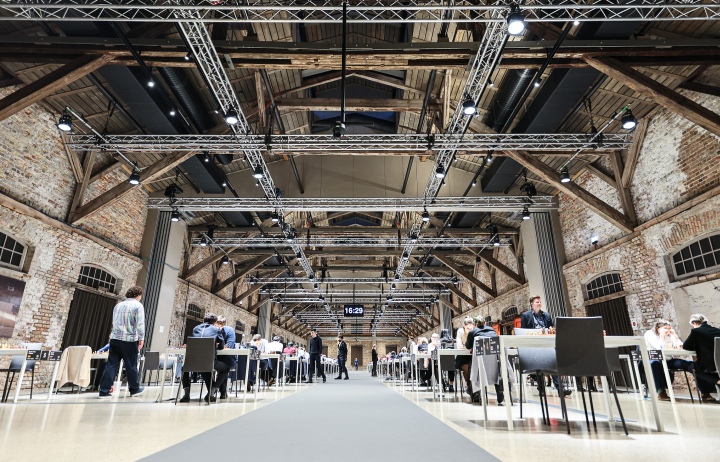
After seven rounds of play at the Grand Swiss, Alireza Firouzja and Lei Tingjie are the sole leaders. Round seven was a day of draws in the Open section and a day of decisive outcomes in the Women’s tournament Open event Naturalised Frenchman Alireza Firouzja is the victor of the seventh round of the Open section at the 2021 FIDE Chess.com Grand Swiss. As the only player among the top ten boards who has secured a victory, he is now firmly in the first place, half a point ahead of everyone else. Firouzja is followed by a trio on five points: Maxime Vachier-Lagrave, Krishnan Sasikiran and Alexei Shirov. Firouzja played on board one against Russian GM Evgeniy Najer. Seeded only 38th, Najer gradually moved up, despite letting winning positions slip to draws in rounds four and six. In the Petrov Defence, Firouzja gained the initiative and transitioned to a better endgame with a free runner on the a-file. However, Black positioned his rook behind the passer and was holding his ground. Alireza made his last attempt and sent his king to the queenside at the cost of the g-pawn. The game saw a dramatic finale on the 50th move: Alireza Firouzja – Evgeniy Najer Evgeniy prematurely gave up his f-pawn 50…f1=Q? and had to resign after 51.Rxf1 Rb2+ 52.Ka8 Rb3 53.Rc1 Kg6 54.Rc7 h5 55.Rb7 Rxh3 56.Rb6+ Kg5 57.Kb7 Ra3 58.Ra6 Rb7 59.Kc7 1-0 By moving his king forward instead 50…Kg6 (h6 or f6) Black would have been right on time to create a sufficient counterplay and reach a draw: 51.a8=Q Rxa8 52.Kxa8 Kg5 53.Rf1 Kh4 54.Rxf3 Kxh3, and so on. Former Indian champion Krishnan Sasikiran drew as White against Maxime Vachier-Lagrave. In a topical line of the Najdorf Variation of the Sicilian, both sides castled on opposite flanks and entered uncharted territory on the move 19. After the game, both players said they couldn’t find a way to improve their position, so a draw was a logical conclusion. Both are now on five points out of seven games. Andrey Esipenko, a promising 19-year-old Russian GM, who was knocked out by Magnus Carlsen in the fifth round of the 2021 World Cup, was up against the experienced local Alexei Shirov. In a highly complicated position that arose from the Morphy Defence of the Ruy Lopez, Esipenko got the upper hand, but Shirov managed to engineer some counterplay. The critical moment of the game came on move 33: White could have posed much more serious problems with 33.e4-e5. Esipenko grabbed a pawn instead, but that gave Shirov a respite that he used to consolidate his position, managing to hold his opponent to a draw. The highest-ranked player in the Grand Swiss, American Fabiano Caruana, was on board four, playing as White against compatriot Samuel Sevian. The opponents tested a sharp line of the Nimzo-Indian in which Black was up to the challenge. Moreover, despite being three pawns up at some point, Fabiano was under pressure and had to find the correct answers. Eventually, White managed to trade most of the pieces and steer the game into an equal endgame leading to a draw. The last game to finish on the top ten boards of the open event was between David Navara and one of the young Russian stars Alexei Sarana. In the Sicilian Defennce and the opponents went to a seemingly even endgame with a rook and a knight each. White had a slight advantage and declined Black’s draw offer. After the knights were traded, David still had the upper hand, but Alexei put up a stubborn resistance. After nearly six and a half hours of play, the two sides agreed to a draw. One of the leading world players Levon Aronian is not having a good tournament in Riga. In Round 7, he was defeated as Black by Ukrainian GM Andrei Volokitin. With just one victory and five draws (four of which were in a row), Aronian is on 3.5/7, and with slim chances of reaching the top spots. Women’s event Chinese player Lei Tingjie is alone in the lead at the inaugural Women’s Grand Swiss, half a point ahead of everyone else. Elisabeth Paehtz is in second place with 5.5/7, followed by Alexandra Kosteniuk and Alina Kashlinskaya, who are on five points. Lei Tingjie, the only player in the tournament with 5/6, won as Black against Nino Batsiashvili, securing that she is still alone in the lead even after Round 7. In the Queen’s Gambit Accepted, Batsiashvili sacrificed a central pawn but mishandled the opening and got no compensation whatsoever. The rest of the game was a smooth sail for the leader, who forced White’s resignation on the move 28. When asked to comment on her good run, Lei Tingjie said: “I just play chess and am relaxed for this tournament”. Elisabeth Paehtz, in her own words, is “playing the tournament of her life”, as she defeated Natalija Pogonina on board two and has 5.5/7. In the Morphy Defence of the Ruy Lopez, Paehtz gave up a pawn early on to gain the initiative. After exchanges in the centre, White managed to plant her knight on c6, disturbing Black’s pieces and ultimately regaining the sacrificed pawn. On the move 39, Black missed her last chance for counterplay and ended up in a hopeless position with a rook vs a knight and a bishop. Former women’s world champion Alexandra Kosteniuk secured a quick victory against Zhu Jiner of China, who was half a point up against the Russian before this round. Kosteniuk opened the game with 1.d4, which is not her usual first move. In the Nimzo-Indian Defence, White opted for a very aggressive setup, but Black’s reaction was far from best as by move 19 Kosteniuk already got a crushing attack on the kingside, which ultimately led to Black’s demise. Kostneniuk is now on 5/7 and in the run for one of the top places. Top seed Mariya Muzychuk drew her game against Lela Javakhishvili. The Ukrainian obtained a very promising position on the white side of the Modern Defence but made a couple of natural but not optimal moves allowing Javakhishvili to equalise. The opponents agreed on a draw after a threefold repetition on the move 25. Both players
FIDE partners with TON Labs to Launch Global NFT Marketplace ChessNFT.com

Marketplace to launch on the Free TON Network ahead of the upcoming FIDE World Championship in Dubai this November Lausanne, Switzerland — Wednesday, November 3rd, 2021 — FIDE, the International Chess Federation, has partnered with TON Labs, the core developer of the Free TON Network, to launch ChessNFT.com – a new, holistic chess non-fungible token (NFT) ecosystem. This launch will position FIDE as the first-ever global sports federation to launch its own NFT marketplace. With complete marketplace functionality due later this month, ChessNFT will welcome new crypto demographic, bringing utility to both chess players and fans through the digitalization and gamification of iconic match moments, unique collectables, chess-related art and many more exciting opportunities. The platform’s interface will accommodate the bid on and purchase of chess NFTs that live on-chain through the use of both fiat and cryptocurrencies. Alexander Filatov, Co-Founder and CEO of TON Labs, commented, “Pairing the classic and universally loved sport of chess with the world of blockchain and crypto has the capability of bringing chess to the forefront of the minds of an entirely new cohort of fans across the globe. Free TON’s unique technology will allow us to deliver a seamless experience to millions of users monthly. By creating this platform, we are giving the wider chess community the opportunity to explore their passion in a unique, fully decentralized, digital capacity as well as experiencing true NFTs.” This partnership comes as FIDE chose the Free TON Network due to its ability to process transactions on a global scale. This feat is made possible through Free TON’s multi-threading features with several workchains which dynamically scale to meet user demand. User security is ensured thanks to full decentralization and unmatched throughput of transactions per second. Arkady Dvorkovich, President of FIDE, concluded, “FIDE has started an exciting and ambitious journey of digitalization to bring new experiences and opportunities to the chess enthusiasts around the world. We are excited for one of the first steps to be a comprehensive NFT marketplace, coming right in time for the world championship match in Dubai this November.” About TON Labs Founded in May 2018, TON Labs is a global collective of experts in decentralized application development, and the core developer of the Free TON network — a decentralized, community-driven blockchain and its major component TON OS. As the core developer of Free TON, TON Labs is committed to optimizing the development of applications easily accessible to global communities and enterprises. True end-to-end decentralization is enabled by the TON Operating System (OS), a technology stack that expedites blockchain development and lives on the community-driven Free TON blockchain. With absolute trust and legitimate data ownership, developers are furnished with the tools to foster mass adoption of liberating and integrous tech. For more information, please visit https://tonlabs.io/ About FIDE The International Chess Federation (FIDE) is the governing body of the sport of chess regulating all international chess competitions. Constituted as a non-governmental institution, it was recognized by the International Olympic Committee as a Global Sporting Organization in 1999. It was one of the very first International Sports Federations, alongside the governing bodies of the sports of football, cricket, swimming, and auto racing. It is now one of the largest sports federations, encompassing 196 countries as affiliate members, in the form of National Chess Federations. For more information, please visit https://www.fide.com. For Media Enquiries: WachsmanTonlabs@wachsman.com FIDE: David Lladapress@fide.com
FIDE Online Cadets & Youth Rapid Grand Prix Series gets underway

The Cadets and Youth Rapid World Championship cycle continues as the Grand Prix Series kicks off on Monday, November 1. The first online world championship cycle event for young chess players – Cadets and Youth World Cup – ran in August and gathered more than 1600 participants. The three winners in 10 categories (open and girls under 10, 12, 14, 16) qualified directly for the Super Final in December, and those placed 4-8 (5 players) and one highest-rated player among 9-16 got their spots in the Grand Prix to take another shot on qualification. They are joined by two top players from each continent – the winners of the Continental Online Championship 2021 and the Continental School Championships 2021. The Grand Prix consists of two round-robin tournaments from 1-8 and 19-24 November. The three overall winners of the series will qualify for the Super Final. In total, 110 players from 33 countries will compete, India and Russia standing out with the biggest number of participants (16 and 13) and rating-favourites in several categories. India dominates the open section with their players on top of the starting lists in Open U18 – IM Rautela Saksham, U16 – Pranav V, and U14 – Bharath Subramaniyam H. Russia’s hopes are high in the girls’ part of the event as WFM Mariya Yakimova (U16), Victoria Merkulova (U12), and Ksenia Asachenko (U10) are the highest-rated in their groups. Other rating-favourites are WIM Bach Ngoc Thuy Duong (Girls U18) from Vietnam, WFM Fiorella Contreras Huaman (Girls U14) from Peru, Ryo Chen (Open U12) from the USA, and Khagan Ahmad (Open U10) from Azerbaijan. Our YouTube channel will provide live broadcast with commentary by GM Farrukh Amonatov: youtube.com/fidechannel You can find the results, regulations, and other information on the official website:https://youth-grandprix.fide.com/
World Team Championship 2022 – Call for bids

1.1 The International Chess Federation (FIDE) will hold the World Team Championship in April of 2022 (see the Tournament Regulations). 1.2 FIDE is opening a bidding procedure to invite any federation member of FIDE or any organiser approved by the national federation to host the event. 1.3 Bid Forms shall be filled in by an Applicant. A signed copy shall be submitted as e-mail messages to the FIDE Secretariat to office@fide.com from 1 to 30 November 2021 by 23:59 Lausanne time. All the documents shall be submitted in English. Additional documents may be requested by the FIDE General Strategy Commission (GSC) for further evaluation. 1.4 Bid Evaluation Report shall be presented by GSC for approval by the FIDE Council. 1.5 Once the Organiser is granted the right to organise the event, a relevant announcement shall be made on the FIDE website. FIDE Technical Delegate (FIDE TD) may be appointed at the same time to supervise the event on behalf of FIDE in consultation with GSC.
November rating list: Maxime Vachier-Lagrave returns to top-10

The October of 2021 was marked by the national championships in two chess superpowers (the U.S and Russia) and local team competitions and tournaments in Germany, Poland, Croatia and Spain. Those who did well in these events became the primary beneficiaries of the November rating list. Despite tying for first place in the U.S. Championship, Fabiano Caruana lost nine points and slid down to the third position in the November rating list. Ironically, the champion performance cost Wesley So six points and two places in the top-10. Meanwhile, Maxime Vachier-Lagrave returned to the top-10 after picking 3 points in Bundesliga. The Frenchman edged out Richard Rapport, who dropped 7 points in the same competition. Photo: Anastasiia Korolkova The only active player in the women’s top-10 in October was Aleksandra Goryachkina, who tried her hand in the Russian Superfinal (open section) and picked up two rating points. Biggest gains Kiolbasa, Oliwia POL 2403 (+27) Kovalenko, Igor LAT 2668 (+21) Saric, Ivan CRO 2665 (+21) Cheparinov, Ivan BUL 2677 (+18) Gunina, Valentina RUS 2480 (+18) Yip, Carissa USA 2418 (+16) Shirov, Alexei ESP 2673 (+14) Sevian, Samuel USA 2668 (+14) Cori, Deysi PER 2396 (+14) Anton Guijarro, David ESP 2669 (+11) Van Foreest, Jorden NED 2701 (+10) The winner in this category Oliwia Kiolbasa did exceptionally well in the Polski Ekstraliga, earning 27 rating points that translated into a 28-position jump in the rating list. Photo: Krzysztof Szeląg The winner of the Turnir Mira 2021, Igor Kovalenko, netted 9 points in Croatia and then built up momentum in Bundesliga picking another 12 points. These results catapulted the Latvian from 99th to 67th position in the rating list. The namesakes Ivan Saric and Ivan Cheparinov did a great job in team events across Europe, picking 21 and 18 points, respectively. The winners of the Russian and U.S. championships Valentina Gunina and Carissa Yip (pictured below), earned not only the prestigious titles and seizable prize money but also substantial rating increases of +18 and +16 points, respectively. Photo: Crystal Fuller Unlike the gold and silver winners of the U.S. Championship who lost some rating, Sam Sevian has all the reasons to be proud of his performance as he picked 14 points and mounted to 70th position in the rating list. Jorden Van Foreest is back into the 2700+ club after getting a 10-point addition for the victory in the TePe Sigeman tournament in Malme (the results of this event, which took place at the end of September, were incorporated in the November rating list). Photo: Lars OA Hedlund We have three newcomers in the top-100 Open in November. Liviu-Dieter Nisipeanu returned in the top-100 following his good performance in Romania Team Championship and Bundesliga, whereas two young talents Aryan Tari and Bogdan-Daniel Deac, are debuting in this prestigious list.
FIDE Chess.com Grand Swiss: Round 6 Recap
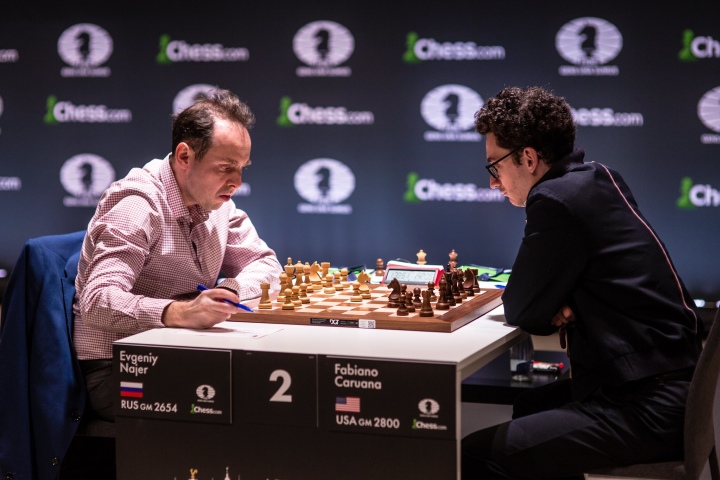
Halfway through the 2021 Grand Swiss, five players are tied for first place in the Open event, while Lei Tingjie is the sole leader in the women’s section. Round Six was the final round before a one-day break at the Grand Swiss, with many players welcoming the pause in the games to regroup their thoughts and plan their approach for the second, most important part of the tournament. The Open After six rounds of the 2021 FIDE Chess.com Grand Swiss five players are tied for first place in the Open event: Round Five leaders, Alireza Firouzja, Alexei Shirov and Evgeniy Najer, are joined by Maxime Vachier-Lagrave and four-time Indian champion, Krishnan Sasikiran. The top game of the day was on board one where a clash of generations took place. Alexei Shirov (who became GM back in 1990) was White against Alireza Firouzja (born in 2003). Shirov opened with his usual 1.e4 and – what else to play in Riga? – soon the Tal variation of Caro-Kann Defense was on the board. Alexei Shirov, in his element, was developing an initiative with White, but Firouzja did not agree to be haunted by ghosts, took a hanging pawn on h4 and proved that his own attacking ideas are stronger. White found himself in a very unpleasant situation, but Black’s mistake on the 36th move let Shirov get away with it. ”The naturalised Frenchman stormed out of the playing hall, while Alexei Shirov confessed that he was happy with the outcome as he was “clearly worse, maybe lost.” 2015 European Champion Evgeniy Najer is having a great tournament, but it seems that luck isn’t with him. He was White against Fabiano Caruana on board two, which was the last game on the top boards to finish, lasting around six hours. The Four Knights Sicilian Sicilian quickly transposed to a very sharp and double-edged position with both kings in the centre. A very sharp position transpired quickly, with both kings in the centre. Russian Grandmaster managed to realign his pieces better and push through the centre, putting the world’s second strongest player on the backfoot. As it often happens, the sharp fight ended in a calm bishop vs knight endgame with a pawn up for White. Caruana showed precision and stubbornness in defenсe not giving his opponent an immediate breakthrough. After 59 moves he claimed threefold repetition. Najer was confused but the arbiters confirmed and he had no option but to accept a draw. Had he defeated Caruana, Najer would have been to sole leader of the tournament. Caruana is now on 4/6, trailing the top five by half a point. Maxime Vachier-Lagrave started aggressively in his game against Pavel Ponkratov. The Russian played the French defence, to which the Frenchman responded by making moves quickly, clearly coming confident in his preparation and sacrificing a pawn early in the opening. Following 15…h5, Vachier-Lagrave increased pressure on the kingside creating a strong advantage which ended in a win on move 26. MVL finished the first half of the tournament with 4.5/6 putting him in a comfortable position to attack the top two spots which lead to the Candidates. The Frenchman is clearly satisfied with his own performance in the first half of the event: “So far my play is convincing. I did not have any long games, so it’s all good. But now the decisive games are happening and I will need more wins. It’s a quest, it’s not over.” The game between Samuel Sevian and Yu Yangyi on board five was off to a very slow start. Some three-quarters of an hour into the round, the players made just six moves in the London system of the Queen’s Pawn Opening. Throughout the 30 moves played in the game, the position was equal without much excitement and the players called it a draw. On board five, 17-year-old Nihal Sarin was up against David Navara who after a slow start in the tournament with two draws, sprung to the top boards with 2.5 points in the last three rounds. The Czech opted for the Gruenfeld Defence. A sharp position developed on the board and on move 16 Navara, in his trademark creative style, decided to give up his queen for two rooks. However, the material imbalance seemed to favour White. Sarin managed to create passers on files a and c, but Navara’s play was more precise. The position eventually transpired into a rook vs queen endgame where the Czech created a fortress and drew the game. Indian GM Krishnan Sasikiran, four-time national champion, also joined the top leaders of the tournament with 4.5/6 having won as Black in the Nimzo-Indian against the promising Russian player Alexandr Predke. Levon Aronian, who was on 3/5 before this round, was white against Alexander Donchenko. The English Opening was played. Aronian played fast and managed to develop nicely on both flanks, eventually achieving space advantage and creating weaknesses for his opponent, but Donchenko held his own. In the opposite-coloured bishop’s endgame a draw was agreed upon repetition. With 3.5/6 both Aronian and Donchenko are trailing the leaders by a point. The shortest game in the tournament – lasting just 14 moves – was played between Georgian Baadur Jobava and Jules Moussard of France. Speaking after the game, Jobava said his first reaction was to feel sympathy for his opponent as he himself has been in similar positions. “But this is a sport. Someone has to win and these things happen”. Another quick game with a decisive outcome was played between Sergei Movsesian and Lucas Van Foreest where Black was beautifully mated on move 29. Women’s Event After six days of play the standings in the inaugural Women’s Grand Swiss are as follows: Lei Tingjie (4.5/6), followed by four players on four points: Nino Batsiashvili, Elisabeth Paehtz, Zhu Jiner and Natalija Pogonina. Lei Tingjie became the sole leader of the women’s event after winning with white pieces against Jolanta Zawadzka on the top board. The Ragozin was played and Black managed to align her pieces better, however, after 27…c5 the initiative was handed over to White. Tingjie played dominantly, forcing her opponent to give way, ultimately creating a winning position. On board two Zhu Jiner was white against Elisabeth Paehtz. In the Kalashnikov Sicilian, Paehtz got into serious
FIDE Chess.com Grand Swiss: Round 5 Recap

Alexei Shirov and Evgeniy Najer have joined Alireza Firouzja as the leaders of the Open Event. In the Women’s section, six players are tied for the top after five rounds of play Despite an extra hour of sleep (due to clocks changing the night before), Sunday was a tough day at the 2021 FIDE Chess.com Grand Swiss. Not only were players facing very difficult opponents but many of them were randomly selected for the anti-doping control following the games, which is usually seen by the players as one of the biggest inconveniences. Open Event Tournament leader Alireza Firouzja was on board one playing as white against Maxime Vachier-Lagrave. In the Najdorf Variation of the Sicilian Defence, MVL timely got rid of his backward d6-pawn by playing 23…d6-d5 and equalized completely. Eight moves down the road the game ended with a draw. Firouzja is still in the lead but is joined by two more players. On the second board, Yu Yanhgyi of China opted for Petrov’s Defence as Black against Norwegian Aryan Tari. White managed to get to a slightly more comfortable position but predictably couldn’t create much from that. Yangyi, however, tried to force his way in the endgame. Aryan was playing precisely and managed to hold with relative ease. After nearly six hours, the game ended in a draw. The duel between Pavel Ponkratov and Samuel Sevian on board three was the first one to finish. In the Catalan, White went for a line which led to the repetition on move 23. Ponkratov played so quickly that he finished the game with more time than he started with (due to time increment in each move). Croatian Ivan Saric’s run has come to a halt after he was defeated by Alexei Shirov, a native of Riga, Latvia. Shirov, who was black, played the Morphy Defence in the Ruy Lopez. White’s problems in a complicated position started after his queen’s foray to g4, but the real mistake (21.dxc5?) came four moves later. Being in his element, Alexei quickly coordinated his pieces and forced the Croatian’s capitulation. With four out of five, Shirov has now tied for the top place in the tournament. Top seed Fabiano Caruana won as White against David Howell of England, getting back among the leaders of the tournament. In the Ruy Lopez, world number two played very fast while Howell was more than an hour and 10 minutes behind as early as move 18, suggesting that he was caught out by Caruana’s preparation. By move 23, Howell had 11 minutes on his clock, meaning he had 17 moves to make before the first time control. Nevertheless, he did not manage to solve all his opening problems and lost a pawn after missing some tactics (23.Rxc6!). Fabiano seamlessly converted his advantage to score a clean victory. World number four, Levon Aronian, was Black against Grigoriy Oparin. On 1.e4 Aronian responded with Petrov’s defence. Oparin took much longer to make his moves, suggesting that the Russian walked into Aronian’s preparation. By move 20, the position transpired into a drawn bishop ending, and the two agreed to split a point. On board five, Evgeniy Najer, who missed a win against Ivan Saric in Round Four, recorded a victory as Black against Armenian Robert Hovhannisyan. The Najdorf Variation of the Sicilian was played, and the position was mostly equal, but Hovhannisyan was slightly weaker on time. The Russian sacrificed his weak d6-pawn but got excellent compensation in the form of two bishops and more active pieces. White should have proceeded with extreme caution, but on move 27 Hovhannisyan made a decisive mistake that cost him a pawn and eventually the game. Najer played with confidence and made sure victory didn’t slip like it did yesterday. Speaking after the game, Najer said that it was difficult for him to go over his slip in Round 4 but that each game is a new challenge. Asked about how much luck plays a role in chess, the Russian GM said that “it’s not more than 5% given how logical chess is compared to other sports”. With this victory, Najer is one of the three leaders of the tournament. One of the more interesting games of the day was played on board 37 between Rinat Jumabayev and Volodymyr Onyshchuk. In the Pirc Defence each side was pushing a pawn down the opposite flanks. After wild complications, the final position saw four queens on the board! As it was Black’s turn, White’s king quickly perished. After five rounds, there are three leaders in the Open event, with 4/5. They are followed by a score of GMs on 3½ points. Women’s Event In the women’s section, there were six decisive games on the top-10 boards. Six players are tied for the top place: Lei Tingjie, Nino Batsiashvili, Harika Dronavalli, Elisabeth Paehtz, Zhu Jiner and Jolanta Zawadzka. The duel between the tournament leader Lei Tingjie and top seed Nana Dzagnidze started with the English Opening. A strategical battle in the centre took place but the game was very level. On move 30, the two agreed to a draw. With 3½/5 top-seed Dzagnidze is no longer in the lead, trailing the top-6 by half a point. On board two, Nino Batsiashvili scored a spectacular victory against former women’s World Champion, Alexandra Kosteniuk. The Ragozin line in the Declined Queen’s Gambit was played leading to a strategical battle in which White built a strong pawn formation in the centre. Bacashvili set it in motion and then delivered a crushing blow: Nino Batsiashvili – Alexandra Kosteniuk With 17.Nxh6+! Nino destroyed Black king’s fortress. After 17…Kxh7 18.fxe4 Kg7 19.e5! Black has no defence against numerous threats. | 1-0, 33 moves Batsiashvili is now on 4/5. Harika Dronavalli was on third board, up against the two-times Russian Champion Natalija Pogonina. Dronavalli exerted heavy pressure in the Italian Game and got a decisive advantage, but a couple of suboptimal moves from her part were enough to let the victory slip away. The opponents split a point in a dead equal position. Alina Kashlinskaya, the 2019 European Women’s Individual Chess Champion, was playing on the fourth board against Zhu Jiner of China. In the Nimzo-Indian Defence Kashlinskaya overlooked the idea of Black’s sacrificing the a5-knight as her position quickly
ARB Lecturer Training Programme CALL OF INTEREST announced

Training Arbiters worldwide is one of the major missions of the FIDE Arbiters’ Commission. While FIDE Arbiter seminars are mostly organised with the support of Federations or Continental Chess Associations, Lecturers are under the direct responsibility of the FIDE Arbiters’ Commission. Since the inaugural sessions in 2008, almost 100 colleagues have been accredited as FIDE Lecturers touching approximately 11,000 candidates worldwide. Naturally, the list of Lecturers has been evolving over time and it currently contains 73 names: 6 of them covered more than 20 seminars over the years, while 12 colleagues are still waiting for their first seminar as the main Lecturer. Whatever the profiles, differences in seniority, gender, location, etc. the FIDE Arbiters’ Commission wanted to have ALL Lecturers on board to reach the next level of quality! That’s why we introduced in 2020 the Lecturer Training Programme (LTP). We want our teachers to be well trained, better supported in their mission and connected with each other. The introduction of the FIDE Arbiter Training Portal earlier this year is another important milestone on our way to develop the sector of Arbiters’ Education! Step by step, the commission and the whole community will get better equipped to seek excellence as arbiters, for the well-being of chess players. Call of interest While priorities in the first part of the year were put on designing and executing the Online/Hybrid Arbiters’ Training Programme, we are now ready to open a call of interest to our colleagues who wish to contribute to the training of arbiters. This is the first step of the LTP recruitment process. The call is open to International Arbiters of category A or B. The experience in tournaments is important (and should be reflected by the category); however pedagogical skills and teaching ability are a must to be recruited. Candidates interested should send their details to Alex McFarlane (EDU Leader – ahmcfarlane@yahoo.co.uk) and Nebojsa Baralic (Secretary – secretary.arbiters@fide.com), by November 20th 2021: Identification and contact details Arbiter resume, including languages spoken (with the level of proficiency) and experience in teaching Motivations to get accredited as a lecturer Practical contribution: please submit 5 multiple choice questions which you would consider suitable to ask in a FIDE Arbiter Exam It is hoped that most who express an interest can be part of the LTP. However, if demand exceeds requirements, criteria used in selection will include the predicted geographical spread required in the near future and the quality of the practical contribution submitted. The ARB Education Team FIDE Arbiter’s Commission website: arbiters.fide.com
FIDE Chess.com Grand Swiss: Round 4 Recap

The fourth day of the 2021 FIDE Chess.com Grand Swiss was marked by draws, several of which were made fairly quickly. With 3.5 out of four, Alireza Firouzja still leads in the Open section. In the Women’s section, Lei Tingjie defeated Valentina Gunina and, with 3.5/4, is the sole leader The Open event All the games in the top five boards in the Open section of the Grand Swiss ended in a draw, leaving Alireza Firouzja as the sole leader on 3.5/4, with more than ten players behind on three points. World number two, Fabiano Caruana, is in the third tier of players, with 2.5 points. The game between the Chinese player Yu Yangyi and tournament leader Alireza Firouzja finished with a draw after an hour and a half of play. In an interview after the game, dissatisfied with his performance, Yu Yangyi noted he did not check his preparation well and that he ended up in a position in the Slav Defence which he wasn’t very comfortable with. Despite having white pieces, the Chinese player opted for a line which led to a draw, and the opponents shook hands on the move 30. On board two, Nihal Sarin and Pavel Ponkratov also split a point. In the semi-Slav defence, Sarin was thinking for a long time whether he wanted a draw or not, but, in the end, he decided not to take chances and went for repetition as White. The tragic person of the day is Evgeniy Najer, who was very close to winning as White against Ivan Saric in the last game to finish on the top boards. After the Croatian’s mistake on the move 45, the Russian got an overwhelming position, although some accuracy was required. Unluckily for Evgeniy, he missed an important subtlety on the move 55: Evgeniy Najer – Ivan Saric In the position that emerged after 54…f7-f5, White had a study-like win 55.Bf6+! Bxf6 56.Rc7 Bxg5 57.Rxd7 Kf6 58.Rb7, and so on. Najer played a more natural 55.gxf6+ Kf7 56.Rc6? and allowed Saric to build an unbreacheable fortress. After both players reached the next critical time control, the Russian realised he couldn’t do much and had to accept a draw. Top seed Fabiano Caruana has drawn his game against fellow compatriot Dariusz Swiercz. In the Queen’s Gambit Declined, the position quickly transpired into a rook and bishop ending in which both sides were equal. The top seed player at the tournament, Caruana, now has just one victory and three draws in four rounds. On board six, Maxime Vachier-Lagrave broke through in the centre in the game with Anton Demchenko and wedged his pawn on e6: Maxime Vachier-Lagrave – Anton Demchenko Be it for good or bad Black should have rolled the dice taking this pawn immediately 19…Nxe6 and there is no forced win for White in sight. Anton opted for 19…Qc6? but after 20.Re4! Ned5? 21. Nxd5 Nxd5 22.Rg4 Rxe6 23.Bb3 found himself in a hopeless position | 1-0, 28 moves With three out of four, Vachier-Lagrave came out as the only winner of the day on the top boards and has again reminded everyone he is one of the key players who will be attacking the top spots at the Grand Swiss. One of the most exciting games of the round was between the only woman playing in the Open event, Aleksandra Goryachkina and one of the top world youngsters, Hans Moke Nieman. After a risky play by Nieman in a sharp position, presumably trying to take advantage over Goryachkina’s time trouble, White managed to regroup to launch an attack on the black king’s castle, putting the black monarch on the run. Surprisingly, the game ended in a draw after Goryachkina missed a clear win in severe time trouble. Jorden Van Foreest, who took the Wijk aan Zee this year, scored an impressive victory against Surya Shekhar Ganguly of India. In the English Opening, Van Foreest sacrificed a pawn but got an excellent compensation that quickly morphed into powerful pressure in the centre and the kingside. After Ganguly’s mistake on move 25, Jorden sacrificed an exchange and finished his opponent off with a direct attack. A big upset of the round was young Danish star Jonas Buh Bjerrel (17) victory against over a hundred points higher rated player, former Indian champion and the former World Under-16 Champion, Baskaran Adhiban. With two out of four Bjerrel is now in the middle of the standings, while the former Indian Champion will need to do some serious thinking about how to get back into the tournament. The Women’s event Unlike the previous three days, day four brought a lot of draws in the Women’s event, with just one decisive game in the top five boards. Lei Tingjie became the sole leader of the inaugural Women’s FIDE Chess.com Grand Swiss after defeating Valentina Gunina in the Caro-Kann. Gunina found herself in a strategically difficult position and tried to complicate matters by sacrificing a pawn and then exchange. Very often, this approach has worked for her but not this time, as Lei returned part of her extra material to steer into a won endgame. With this loss, Gunina is no longer among the leaders in the women’s event. Top German player IM Elisabeth Paehtz was White against top-seed Nana Dzagnidze on board one. Black also responded with the Caro-Kann defence and had some problems in the opening as well, but unlike Valentina, Nana managed to equalise by move 19. The position transpired into a rook endgame with both sides being equal, and the two called it a draw. Former Women’s World Champion Alexandra Kosteniuk won her game on board six against Bibisara Assaubayeva, as did Alina Kashlinskaya, who bested Rout Padmini. With 3/4 Kosteniuk and Kashlinskaya have joined the pack of players trailing Lei Tingjie by half a point. In the women’s event, there are now ten players with three points: Nana Dzagnidze, Elisabeth Paehtz, Zhu Jiner, Harika Dronavalli, Natalija Pogonina, Nino Batsiashvili, Lela Javakhishvili, Alexandra Kosteniuk, Alina Kashlinskaya and Jolanta Zawadzka. Round 5 Round 5 starts at 2 PM on the 31st of October. The pairings for Round 5 for the Open event can be found here: grandswiss.fide.com/open/ The pairings for Round 5 of the Women’s event can be found here: grandswiss.fide.com/grand-swiss-women/ For more information about the tournament, please visit: https://grandswiss.fide.com/ Press
Word Championship for People with Disabilities: Last call to register

The 4th FIDE World Chess Championship for People with Disabilities will take place online from November 4-14, 2021. Organized by Dresdner Schachfestival E.V. under the auspices of FIDE, it is an individual 9-round Swiss tournament with an additional team ranking. Registration for participation is open here until November 1, 2021. So far, 162 participants from 37 countries have ready registered for the competition. Players with disabilities from Argentina, Armenia, Azerbaijan, Australia, Bangladesh, Brazil, Canada, Chile, China, Colombia, Ecuador, England, Spain, France, Georgia, Germany, Guyana, India, Israel, Italy, Kenia, Kyrgyzstan, Saudi Arabia, Latvia, Mongolia, Nigeria, Panama, Philippines, Poland, South Africa, Russia, Turkey, Ukraine, USA, Uzbekistan, Venezuela and Vietnam are getting ready for the November event. For many of them, chess is not just a hobby; it is a source of inspiration, their lifework, and a way to find new friends. “I can’t do any other sports except chess because my hands and legs don’t work. And chess is the only sport which is suitable for me,” says 14 y.o. Dariia Kudainazarova from Kyrgyzstan. “I personally don’t like the online format of the event, but because of the pandemic, we need to stay at home, and this is not comfortable and sometimes boring. Of course, the offline format is better, but we can’t stop tournaments, so we play online.” Some of the participants are not only playing themselves; they are sharing their love for chess with others. “I started playing chess when I was 10. My uncle was the one who inspired and taught me how to play. I was a high school chess player, but I stopped playing chess for 25 years because of my study and my family. I came back to chess in 2005, not only as a player but also as an organizer. In the Philippines, I have been organizing monthly tournaments for 12 years.” says 62 y.o. Gilbert Perez, one of the oldest players of the championship. In 2017 Perez moved to Canada. He played in Manitoba chess tournaments, became a champion and finished second several times. “Last year, they recommended me to play for Canada. So I changed federation from the Philippines to Canada. I played board 2 for Canada last November at the first FIDE Chess Olympiad for People with Disabilities. My dream is to develop youth and people with disabilities to play chess because I believe that only in chess we can beat a person without a disability. Before this pandemic, I was a volunteer coach in 2 schools in Manitoba and was teaching kids in our chess club,” he says. Galina Sudmale, 69, from Latvia, is one of those for whom the online format of the event was the decisive criterion for participation. “I decided to enter the tournament mainly because I didn’t need to go anywhere,” she says. “My dad taught me how to play chess a long time ago. Now, when I was left without work, I began to teach children myself. I try to organize and participate in competitions regularly. Now, due to the pandemic, I had to take a break, so I spend more time playing online.” The full list of registered players can be found here. The opening ceremony, technical meeting, drawing of lots and test round will be held on November 04; Round 1 of the 4th FIDE World Chess Championship for People with Disabilities is scheduled for November 05. Tournament regulations (pdf) Further Information: Website: www.schachfestival.de worldchess-disabled.com/en/