

November rating list: Maxime Vachier-Lagrave returns to top-10

The October of 2021 was marked by the national championships in two chess superpowers (the U.S and Russia) and local team competitions and tournaments in Germany, Poland, Croatia and Spain. Those who did well in these events became the primary beneficiaries of the November rating list. Despite tying for first place in the U.S. Championship, Fabiano Caruana lost nine points and slid down to the third position in the November rating list. Ironically, the champion performance cost Wesley So six points and two places in the top-10. Meanwhile, Maxime Vachier-Lagrave returned to the top-10 after picking 3 points in Bundesliga. The Frenchman edged out Richard Rapport, who dropped 7 points in the same competition. Photo: Anastasiia Korolkova The only active player in the women’s top-10 in October was Aleksandra Goryachkina, who tried her hand in the Russian Superfinal (open section) and picked up two rating points. Biggest gains Kiolbasa, Oliwia POL 2403 (+27) Kovalenko, Igor LAT 2668 (+21) Saric, Ivan CRO 2665 (+21) Cheparinov, Ivan BUL 2677 (+18) Gunina, Valentina RUS 2480 (+18) Yip, Carissa USA 2418 (+16) Shirov, Alexei ESP 2673 (+14) Sevian, Samuel USA 2668 (+14) Cori, Deysi PER 2396 (+14) Anton Guijarro, David ESP 2669 (+11) Van Foreest, Jorden NED 2701 (+10) The winner in this category Oliwia Kiolbasa did exceptionally well in the Polski Ekstraliga, earning 27 rating points that translated into a 28-position jump in the rating list. Photo: Krzysztof Szeląg The winner of the Turnir Mira 2021, Igor Kovalenko, netted 9 points in Croatia and then built up momentum in Bundesliga picking another 12 points. These results catapulted the Latvian from 99th to 67th position in the rating list. The namesakes Ivan Saric and Ivan Cheparinov did a great job in team events across Europe, picking 21 and 18 points, respectively. The winners of the Russian and U.S. championships Valentina Gunina and Carissa Yip (pictured below), earned not only the prestigious titles and seizable prize money but also substantial rating increases of +18 and +16 points, respectively. Photo: Crystal Fuller Unlike the gold and silver winners of the U.S. Championship who lost some rating, Sam Sevian has all the reasons to be proud of his performance as he picked 14 points and mounted to 70th position in the rating list. Jorden Van Foreest is back into the 2700+ club after getting a 10-point addition for the victory in the TePe Sigeman tournament in Malme (the results of this event, which took place at the end of September, were incorporated in the November rating list). Photo: Lars OA Hedlund We have three newcomers in the top-100 Open in November. Liviu-Dieter Nisipeanu returned in the top-100 following his good performance in Romania Team Championship and Bundesliga, whereas two young talents Aryan Tari and Bogdan-Daniel Deac, are debuting in this prestigious list.
FIDE Chess.com Grand Swiss: Round 6 Recap
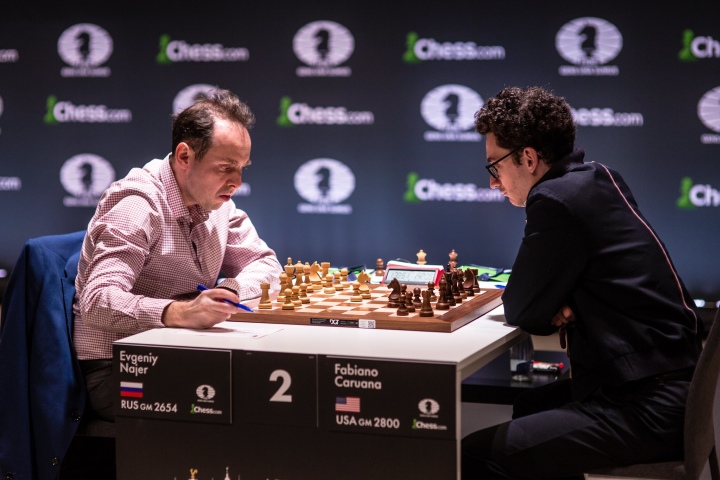
Halfway through the 2021 Grand Swiss, five players are tied for first place in the Open event, while Lei Tingjie is the sole leader in the women’s section. Round Six was the final round before a one-day break at the Grand Swiss, with many players welcoming the pause in the games to regroup their thoughts and plan their approach for the second, most important part of the tournament. The Open After six rounds of the 2021 FIDE Chess.com Grand Swiss five players are tied for first place in the Open event: Round Five leaders, Alireza Firouzja, Alexei Shirov and Evgeniy Najer, are joined by Maxime Vachier-Lagrave and four-time Indian champion, Krishnan Sasikiran. The top game of the day was on board one where a clash of generations took place. Alexei Shirov (who became GM back in 1990) was White against Alireza Firouzja (born in 2003). Shirov opened with his usual 1.e4 and – what else to play in Riga? – soon the Tal variation of Caro-Kann Defense was on the board. Alexei Shirov, in his element, was developing an initiative with White, but Firouzja did not agree to be haunted by ghosts, took a hanging pawn on h4 and proved that his own attacking ideas are stronger. White found himself in a very unpleasant situation, but Black’s mistake on the 36th move let Shirov get away with it. ”The naturalised Frenchman stormed out of the playing hall, while Alexei Shirov confessed that he was happy with the outcome as he was “clearly worse, maybe lost.” 2015 European Champion Evgeniy Najer is having a great tournament, but it seems that luck isn’t with him. He was White against Fabiano Caruana on board two, which was the last game on the top boards to finish, lasting around six hours. The Four Knights Sicilian Sicilian quickly transposed to a very sharp and double-edged position with both kings in the centre. A very sharp position transpired quickly, with both kings in the centre. Russian Grandmaster managed to realign his pieces better and push through the centre, putting the world’s second strongest player on the backfoot. As it often happens, the sharp fight ended in a calm bishop vs knight endgame with a pawn up for White. Caruana showed precision and stubbornness in defenсe not giving his opponent an immediate breakthrough. After 59 moves he claimed threefold repetition. Najer was confused but the arbiters confirmed and he had no option but to accept a draw. Had he defeated Caruana, Najer would have been to sole leader of the tournament. Caruana is now on 4/6, trailing the top five by half a point. Maxime Vachier-Lagrave started aggressively in his game against Pavel Ponkratov. The Russian played the French defence, to which the Frenchman responded by making moves quickly, clearly coming confident in his preparation and sacrificing a pawn early in the opening. Following 15…h5, Vachier-Lagrave increased pressure on the kingside creating a strong advantage which ended in a win on move 26. MVL finished the first half of the tournament with 4.5/6 putting him in a comfortable position to attack the top two spots which lead to the Candidates. The Frenchman is clearly satisfied with his own performance in the first half of the event: “So far my play is convincing. I did not have any long games, so it’s all good. But now the decisive games are happening and I will need more wins. It’s a quest, it’s not over.” The game between Samuel Sevian and Yu Yangyi on board five was off to a very slow start. Some three-quarters of an hour into the round, the players made just six moves in the London system of the Queen’s Pawn Opening. Throughout the 30 moves played in the game, the position was equal without much excitement and the players called it a draw. On board five, 17-year-old Nihal Sarin was up against David Navara who after a slow start in the tournament with two draws, sprung to the top boards with 2.5 points in the last three rounds. The Czech opted for the Gruenfeld Defence. A sharp position developed on the board and on move 16 Navara, in his trademark creative style, decided to give up his queen for two rooks. However, the material imbalance seemed to favour White. Sarin managed to create passers on files a and c, but Navara’s play was more precise. The position eventually transpired into a rook vs queen endgame where the Czech created a fortress and drew the game. Indian GM Krishnan Sasikiran, four-time national champion, also joined the top leaders of the tournament with 4.5/6 having won as Black in the Nimzo-Indian against the promising Russian player Alexandr Predke. Levon Aronian, who was on 3/5 before this round, was white against Alexander Donchenko. The English Opening was played. Aronian played fast and managed to develop nicely on both flanks, eventually achieving space advantage and creating weaknesses for his opponent, but Donchenko held his own. In the opposite-coloured bishop’s endgame a draw was agreed upon repetition. With 3.5/6 both Aronian and Donchenko are trailing the leaders by a point. The shortest game in the tournament – lasting just 14 moves – was played between Georgian Baadur Jobava and Jules Moussard of France. Speaking after the game, Jobava said his first reaction was to feel sympathy for his opponent as he himself has been in similar positions. “But this is a sport. Someone has to win and these things happen”. Another quick game with a decisive outcome was played between Sergei Movsesian and Lucas Van Foreest where Black was beautifully mated on move 29. Women’s Event After six days of play the standings in the inaugural Women’s Grand Swiss are as follows: Lei Tingjie (4.5/6), followed by four players on four points: Nino Batsiashvili, Elisabeth Paehtz, Zhu Jiner and Natalija Pogonina. Lei Tingjie became the sole leader of the women’s event after winning with white pieces against Jolanta Zawadzka on the top board. The Ragozin was played and Black managed to align her pieces better, however, after 27…c5 the initiative was handed over to White. Tingjie played dominantly, forcing her opponent to give way, ultimately creating a winning position. On board two Zhu Jiner was white against Elisabeth Paehtz. In the Kalashnikov Sicilian, Paehtz got into serious
FIDE Chess.com Grand Swiss: Round 5 Recap

Alexei Shirov and Evgeniy Najer have joined Alireza Firouzja as the leaders of the Open Event. In the Women’s section, six players are tied for the top after five rounds of play Despite an extra hour of sleep (due to clocks changing the night before), Sunday was a tough day at the 2021 FIDE Chess.com Grand Swiss. Not only were players facing very difficult opponents but many of them were randomly selected for the anti-doping control following the games, which is usually seen by the players as one of the biggest inconveniences. Open Event Tournament leader Alireza Firouzja was on board one playing as white against Maxime Vachier-Lagrave. In the Najdorf Variation of the Sicilian Defence, MVL timely got rid of his backward d6-pawn by playing 23…d6-d5 and equalized completely. Eight moves down the road the game ended with a draw. Firouzja is still in the lead but is joined by two more players. On the second board, Yu Yanhgyi of China opted for Petrov’s Defence as Black against Norwegian Aryan Tari. White managed to get to a slightly more comfortable position but predictably couldn’t create much from that. Yangyi, however, tried to force his way in the endgame. Aryan was playing precisely and managed to hold with relative ease. After nearly six hours, the game ended in a draw. The duel between Pavel Ponkratov and Samuel Sevian on board three was the first one to finish. In the Catalan, White went for a line which led to the repetition on move 23. Ponkratov played so quickly that he finished the game with more time than he started with (due to time increment in each move). Croatian Ivan Saric’s run has come to a halt after he was defeated by Alexei Shirov, a native of Riga, Latvia. Shirov, who was black, played the Morphy Defence in the Ruy Lopez. White’s problems in a complicated position started after his queen’s foray to g4, but the real mistake (21.dxc5?) came four moves later. Being in his element, Alexei quickly coordinated his pieces and forced the Croatian’s capitulation. With four out of five, Shirov has now tied for the top place in the tournament. Top seed Fabiano Caruana won as White against David Howell of England, getting back among the leaders of the tournament. In the Ruy Lopez, world number two played very fast while Howell was more than an hour and 10 minutes behind as early as move 18, suggesting that he was caught out by Caruana’s preparation. By move 23, Howell had 11 minutes on his clock, meaning he had 17 moves to make before the first time control. Nevertheless, he did not manage to solve all his opening problems and lost a pawn after missing some tactics (23.Rxc6!). Fabiano seamlessly converted his advantage to score a clean victory. World number four, Levon Aronian, was Black against Grigoriy Oparin. On 1.e4 Aronian responded with Petrov’s defence. Oparin took much longer to make his moves, suggesting that the Russian walked into Aronian’s preparation. By move 20, the position transpired into a drawn bishop ending, and the two agreed to split a point. On board five, Evgeniy Najer, who missed a win against Ivan Saric in Round Four, recorded a victory as Black against Armenian Robert Hovhannisyan. The Najdorf Variation of the Sicilian was played, and the position was mostly equal, but Hovhannisyan was slightly weaker on time. The Russian sacrificed his weak d6-pawn but got excellent compensation in the form of two bishops and more active pieces. White should have proceeded with extreme caution, but on move 27 Hovhannisyan made a decisive mistake that cost him a pawn and eventually the game. Najer played with confidence and made sure victory didn’t slip like it did yesterday. Speaking after the game, Najer said that it was difficult for him to go over his slip in Round 4 but that each game is a new challenge. Asked about how much luck plays a role in chess, the Russian GM said that “it’s not more than 5% given how logical chess is compared to other sports”. With this victory, Najer is one of the three leaders of the tournament. One of the more interesting games of the day was played on board 37 between Rinat Jumabayev and Volodymyr Onyshchuk. In the Pirc Defence each side was pushing a pawn down the opposite flanks. After wild complications, the final position saw four queens on the board! As it was Black’s turn, White’s king quickly perished. After five rounds, there are three leaders in the Open event, with 4/5. They are followed by a score of GMs on 3½ points. Women’s Event In the women’s section, there were six decisive games on the top-10 boards. Six players are tied for the top place: Lei Tingjie, Nino Batsiashvili, Harika Dronavalli, Elisabeth Paehtz, Zhu Jiner and Jolanta Zawadzka. The duel between the tournament leader Lei Tingjie and top seed Nana Dzagnidze started with the English Opening. A strategical battle in the centre took place but the game was very level. On move 30, the two agreed to a draw. With 3½/5 top-seed Dzagnidze is no longer in the lead, trailing the top-6 by half a point. On board two, Nino Batsiashvili scored a spectacular victory against former women’s World Champion, Alexandra Kosteniuk. The Ragozin line in the Declined Queen’s Gambit was played leading to a strategical battle in which White built a strong pawn formation in the centre. Bacashvili set it in motion and then delivered a crushing blow: Nino Batsiashvili – Alexandra Kosteniuk With 17.Nxh6+! Nino destroyed Black king’s fortress. After 17…Kxh7 18.fxe4 Kg7 19.e5! Black has no defence against numerous threats. | 1-0, 33 moves Batsiashvili is now on 4/5. Harika Dronavalli was on third board, up against the two-times Russian Champion Natalija Pogonina. Dronavalli exerted heavy pressure in the Italian Game and got a decisive advantage, but a couple of suboptimal moves from her part were enough to let the victory slip away. The opponents split a point in a dead equal position. Alina Kashlinskaya, the 2019 European Women’s Individual Chess Champion, was playing on the fourth board against Zhu Jiner of China. In the Nimzo-Indian Defence Kashlinskaya overlooked the idea of Black’s sacrificing the a5-knight as her position quickly
ARB Lecturer Training Programme CALL OF INTEREST announced

Training Arbiters worldwide is one of the major missions of the FIDE Arbiters’ Commission. While FIDE Arbiter seminars are mostly organised with the support of Federations or Continental Chess Associations, Lecturers are under the direct responsibility of the FIDE Arbiters’ Commission. Since the inaugural sessions in 2008, almost 100 colleagues have been accredited as FIDE Lecturers touching approximately 11,000 candidates worldwide. Naturally, the list of Lecturers has been evolving over time and it currently contains 73 names: 6 of them covered more than 20 seminars over the years, while 12 colleagues are still waiting for their first seminar as the main Lecturer. Whatever the profiles, differences in seniority, gender, location, etc. the FIDE Arbiters’ Commission wanted to have ALL Lecturers on board to reach the next level of quality! That’s why we introduced in 2020 the Lecturer Training Programme (LTP). We want our teachers to be well trained, better supported in their mission and connected with each other. The introduction of the FIDE Arbiter Training Portal earlier this year is another important milestone on our way to develop the sector of Arbiters’ Education! Step by step, the commission and the whole community will get better equipped to seek excellence as arbiters, for the well-being of chess players. Call of interest While priorities in the first part of the year were put on designing and executing the Online/Hybrid Arbiters’ Training Programme, we are now ready to open a call of interest to our colleagues who wish to contribute to the training of arbiters. This is the first step of the LTP recruitment process. The call is open to International Arbiters of category A or B. The experience in tournaments is important (and should be reflected by the category); however pedagogical skills and teaching ability are a must to be recruited. Candidates interested should send their details to Alex McFarlane (EDU Leader – ahmcfarlane@yahoo.co.uk) and Nebojsa Baralic (Secretary – secretary.arbiters@fide.com), by November 20th 2021: Identification and contact details Arbiter resume, including languages spoken (with the level of proficiency) and experience in teaching Motivations to get accredited as a lecturer Practical contribution: please submit 5 multiple choice questions which you would consider suitable to ask in a FIDE Arbiter Exam It is hoped that most who express an interest can be part of the LTP. However, if demand exceeds requirements, criteria used in selection will include the predicted geographical spread required in the near future and the quality of the practical contribution submitted. The ARB Education Team FIDE Arbiter’s Commission website: arbiters.fide.com
FIDE Chess.com Grand Swiss: Round 4 Recap
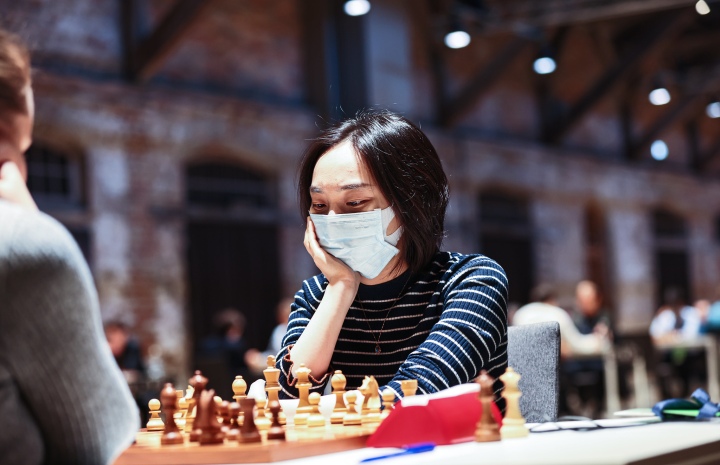
The fourth day of the 2021 FIDE Chess.com Grand Swiss was marked by draws, several of which were made fairly quickly. With 3.5 out of four, Alireza Firouzja still leads in the Open section. In the Women’s section, Lei Tingjie defeated Valentina Gunina and, with 3.5/4, is the sole leader The Open event All the games in the top five boards in the Open section of the Grand Swiss ended in a draw, leaving Alireza Firouzja as the sole leader on 3.5/4, with more than ten players behind on three points. World number two, Fabiano Caruana, is in the third tier of players, with 2.5 points. The game between the Chinese player Yu Yangyi and tournament leader Alireza Firouzja finished with a draw after an hour and a half of play. In an interview after the game, dissatisfied with his performance, Yu Yangyi noted he did not check his preparation well and that he ended up in a position in the Slav Defence which he wasn’t very comfortable with. Despite having white pieces, the Chinese player opted for a line which led to a draw, and the opponents shook hands on the move 30. On board two, Nihal Sarin and Pavel Ponkratov also split a point. In the semi-Slav defence, Sarin was thinking for a long time whether he wanted a draw or not, but, in the end, he decided not to take chances and went for repetition as White. The tragic person of the day is Evgeniy Najer, who was very close to winning as White against Ivan Saric in the last game to finish on the top boards. After the Croatian’s mistake on the move 45, the Russian got an overwhelming position, although some accuracy was required. Unluckily for Evgeniy, he missed an important subtlety on the move 55: Evgeniy Najer – Ivan Saric In the position that emerged after 54…f7-f5, White had a study-like win 55.Bf6+! Bxf6 56.Rc7 Bxg5 57.Rxd7 Kf6 58.Rb7, and so on. Najer played a more natural 55.gxf6+ Kf7 56.Rc6? and allowed Saric to build an unbreacheable fortress. After both players reached the next critical time control, the Russian realised he couldn’t do much and had to accept a draw. Top seed Fabiano Caruana has drawn his game against fellow compatriot Dariusz Swiercz. In the Queen’s Gambit Declined, the position quickly transpired into a rook and bishop ending in which both sides were equal. The top seed player at the tournament, Caruana, now has just one victory and three draws in four rounds. On board six, Maxime Vachier-Lagrave broke through in the centre in the game with Anton Demchenko and wedged his pawn on e6: Maxime Vachier-Lagrave – Anton Demchenko Be it for good or bad Black should have rolled the dice taking this pawn immediately 19…Nxe6 and there is no forced win for White in sight. Anton opted for 19…Qc6? but after 20.Re4! Ned5? 21. Nxd5 Nxd5 22.Rg4 Rxe6 23.Bb3 found himself in a hopeless position | 1-0, 28 moves With three out of four, Vachier-Lagrave came out as the only winner of the day on the top boards and has again reminded everyone he is one of the key players who will be attacking the top spots at the Grand Swiss. One of the most exciting games of the round was between the only woman playing in the Open event, Aleksandra Goryachkina and one of the top world youngsters, Hans Moke Nieman. After a risky play by Nieman in a sharp position, presumably trying to take advantage over Goryachkina’s time trouble, White managed to regroup to launch an attack on the black king’s castle, putting the black monarch on the run. Surprisingly, the game ended in a draw after Goryachkina missed a clear win in severe time trouble. Jorden Van Foreest, who took the Wijk aan Zee this year, scored an impressive victory against Surya Shekhar Ganguly of India. In the English Opening, Van Foreest sacrificed a pawn but got an excellent compensation that quickly morphed into powerful pressure in the centre and the kingside. After Ganguly’s mistake on move 25, Jorden sacrificed an exchange and finished his opponent off with a direct attack. A big upset of the round was young Danish star Jonas Buh Bjerrel (17) victory against over a hundred points higher rated player, former Indian champion and the former World Under-16 Champion, Baskaran Adhiban. With two out of four Bjerrel is now in the middle of the standings, while the former Indian Champion will need to do some serious thinking about how to get back into the tournament. The Women’s event Unlike the previous three days, day four brought a lot of draws in the Women’s event, with just one decisive game in the top five boards. Lei Tingjie became the sole leader of the inaugural Women’s FIDE Chess.com Grand Swiss after defeating Valentina Gunina in the Caro-Kann. Gunina found herself in a strategically difficult position and tried to complicate matters by sacrificing a pawn and then exchange. Very often, this approach has worked for her but not this time, as Lei returned part of her extra material to steer into a won endgame. With this loss, Gunina is no longer among the leaders in the women’s event. Top German player IM Elisabeth Paehtz was White against top-seed Nana Dzagnidze on board one. Black also responded with the Caro-Kann defence and had some problems in the opening as well, but unlike Valentina, Nana managed to equalise by move 19. The position transpired into a rook endgame with both sides being equal, and the two called it a draw. Former Women’s World Champion Alexandra Kosteniuk won her game on board six against Bibisara Assaubayeva, as did Alina Kashlinskaya, who bested Rout Padmini. With 3/4 Kosteniuk and Kashlinskaya have joined the pack of players trailing Lei Tingjie by half a point. In the women’s event, there are now ten players with three points: Nana Dzagnidze, Elisabeth Paehtz, Zhu Jiner, Harika Dronavalli, Natalija Pogonina, Nino Batsiashvili, Lela Javakhishvili, Alexandra Kosteniuk, Alina Kashlinskaya and Jolanta Zawadzka. Round 5 Round 5 starts at 2 PM on the 31st of October. The pairings for Round 5 for the Open event can be found here: grandswiss.fide.com/open/ The pairings for Round 5 of the Women’s event can be found here: grandswiss.fide.com/grand-swiss-women/ For more information about the tournament, please visit: https://grandswiss.fide.com/ Press
Word Championship for People with Disabilities: Last call to register

The 4th FIDE World Chess Championship for People with Disabilities will take place online from November 4-14, 2021. Organized by Dresdner Schachfestival E.V. under the auspices of FIDE, it is an individual 9-round Swiss tournament with an additional team ranking. Registration for participation is open here until November 1, 2021. So far, 162 participants from 37 countries have ready registered for the competition. Players with disabilities from Argentina, Armenia, Azerbaijan, Australia, Bangladesh, Brazil, Canada, Chile, China, Colombia, Ecuador, England, Spain, France, Georgia, Germany, Guyana, India, Israel, Italy, Kenia, Kyrgyzstan, Saudi Arabia, Latvia, Mongolia, Nigeria, Panama, Philippines, Poland, South Africa, Russia, Turkey, Ukraine, USA, Uzbekistan, Venezuela and Vietnam are getting ready for the November event. For many of them, chess is not just a hobby; it is a source of inspiration, their lifework, and a way to find new friends. “I can’t do any other sports except chess because my hands and legs don’t work. And chess is the only sport which is suitable for me,” says 14 y.o. Dariia Kudainazarova from Kyrgyzstan. “I personally don’t like the online format of the event, but because of the pandemic, we need to stay at home, and this is not comfortable and sometimes boring. Of course, the offline format is better, but we can’t stop tournaments, so we play online.” Some of the participants are not only playing themselves; they are sharing their love for chess with others. “I started playing chess when I was 10. My uncle was the one who inspired and taught me how to play. I was a high school chess player, but I stopped playing chess for 25 years because of my study and my family. I came back to chess in 2005, not only as a player but also as an organizer. In the Philippines, I have been organizing monthly tournaments for 12 years.” says 62 y.o. Gilbert Perez, one of the oldest players of the championship. In 2017 Perez moved to Canada. He played in Manitoba chess tournaments, became a champion and finished second several times. “Last year, they recommended me to play for Canada. So I changed federation from the Philippines to Canada. I played board 2 for Canada last November at the first FIDE Chess Olympiad for People with Disabilities. My dream is to develop youth and people with disabilities to play chess because I believe that only in chess we can beat a person without a disability. Before this pandemic, I was a volunteer coach in 2 schools in Manitoba and was teaching kids in our chess club,” he says. Galina Sudmale, 69, from Latvia, is one of those for whom the online format of the event was the decisive criterion for participation. “I decided to enter the tournament mainly because I didn’t need to go anywhere,” she says. “My dad taught me how to play chess a long time ago. Now, when I was left without work, I began to teach children myself. I try to organize and participate in competitions regularly. Now, due to the pandemic, I had to take a break, so I spend more time playing online.” The full list of registered players can be found here. The opening ceremony, technical meeting, drawing of lots and test round will be held on November 04; Round 1 of the 4th FIDE World Chess Championship for People with Disabilities is scheduled for November 05. Tournament regulations (pdf) Further Information: Website: www.schachfestival.de worldchess-disabled.com/en/
FIDE Chess.com Grand Swiss: Round 3 Recap
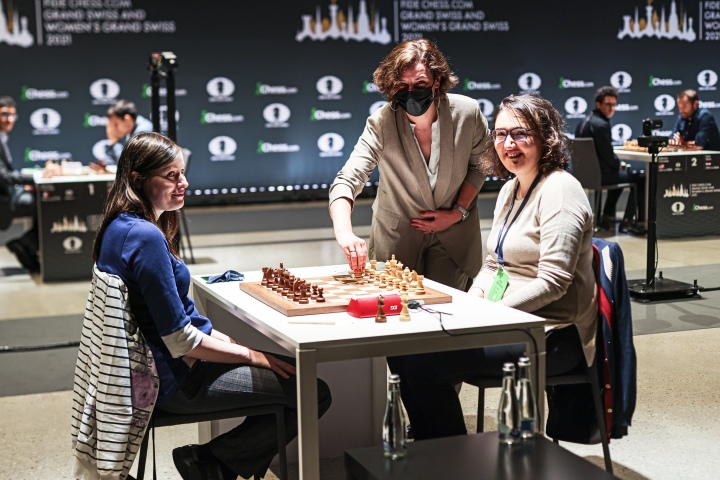
After three rounds of games in Riga, out of 157 participants, naturalised Frenchman Alireza Firouzja became the only player – in the entire Grand Swiss – to have won all three games The third round of the Grand Swiss was opened by FIDE Managing Director Dana Reizniece-Ozola, by making the first move on board one of the women’s tournament. This is the first time that the Grand Swiss is featuring a women’s section. “FIDE is strongly committed to improving women’s chess, and having the women’s tournament was very important. Also, Latvia – my home country – is a place where approximately half of the managerial positions are held by women, without any quotas, but naturally, so, this seems to be the natural place to launch a bigger fight for women in chess”, says Dana Reizniece-Ozola. The Open Tournament After three rounds of games, the Iranian-born rising chess star Alireza Firouzja has managed to distinguish himself as the sole leader in the Open section of the Grand Swiss. Playing on the first board, Firouzja was up against Alexandr Predke who had a spectacular win in the second round against Nodirbek Yakubboev. In the Ruy Lopez, Firouzja gradually arranged his pieces, slowly numbing Black’s resistance. With a strong bishop on b2 and an extra pawn in the centre, he exerted serious pressure on Black’s position. However, Alireza did not find the most precise moves and Alexandr managed to transpose into an even endgame at the cost of a pawn. Firouzja pressed on and, after a trade of the rooks in the 42nd move, White gradually regained the advantage making the most of Black’s inaccuracies. Predke continued to resist, but White’s b-passer became the decisive factor – Firouzja ultimately forced his opponent to resign, having played for nearly six hours. On board two, Fabiano Caruana was leading white pieces against Ivan Saric of Croatia (pictured below), who had an excellent start with two out of two. Before this game, the two met five times with Caruana leading two to one, with two draws. After dropping half a point in round two to Nihal Sarin, the world number two Caruana – who had white – was eager to win against Saric. Caruana managed to grab the initiative in the Four Knights Sicilian at the cost of being low on time. After Black castled on the queenside, White launched a dangerous attack on the left wing, which gave him an extra pawn and the decisive advantage. However, when the time came to rip the harvest White captured on g5 with a wrong piece and missed a clear win: Fabiano Caruana – Ivan Saric Most likely, Fabiano instinctively turned down 31.Nxg5, wary of 31…Rd2 but after 32.Bxe5 Rxg2+ 33. Kh3 White captures the f7-pawn, winning. Instead, 31.hxg5 was played and after 31…Rd4! 32.Rc7 Bxe4 33.Rc8+ Kb7 34.Rxf8 Bg6 the game transposed into an opposite-coloured bishop ending in which the Croatian defended well, and after nearly five hours, the two agreed to a draw. There was almost a big upset on board three in the game between Levon Aronian and Anton Demchenko. In the Four Knights opening, the game progressed normally, but after an imprecision in the middlegame by Aronian – who is the fifth strongest player in the world – White’s queen penetrated the queenside, leading to the loss of a pawn by Black. Demchenko gradually advanced his free runner on the a-file, and after the exchange of the queens, the game entered a rook endgame that looked extremely dangerous for Black. After a heroic effort and having shown patience and defiance, Aronian managed to save a draw but not without some help from his opponent, who missed a couple of winning continuations. One of the top seeds, Maxime Vachier-Lagrave, drew as Black with Alexander Donchenko. With two out of three, the Frenchman still has strong chances to fight for the top. The first game with a decisive outcome in the Open section was one between Vasif Durarbayli and Daniil Dubov, in which the Russian instructively exploited his dominance over the light squares. Also among the top boards, Yu Yangyi was victorious against Matthias Bluebaum. There are now as many as six players trailing Alireza Firouzja by half a point: Yu Yangyi, Pavel Ponkratov, Robert Hovhannisyan, Nihal Sarin, Ivan Saric, and Evgeniy Najer. The Women’s Tournament After just three rounds, there are no more players with a maximum score in the Women’s section. The top group is made up of nine players with 2.5 points, led by Nana Dzagnidze of Georgia. Nana Dzagnidze, who had a perfect start with two out of two, found herself in trouble as White against Natalija Pogonina (pictured above). The Reti opening was played, where White plays slowly, trying to gradually outmanoeuvre the opponent. After 11.g4, the position quickly sharpened, and Pogonina came up with an interesting pawn sacrifice. Dzagnidze accepted the offer but fell under a vigorous attack. Caught on the backfoot, Nana had to give up her queen, and the position transpired into a rook and two bishops vs a queen and knight endgame. Nana built some sort of a fortress that did not look unassailable but using Black’s inaccuracies, the Georgian held her defence line, and the game was eventually drawn. On board two, Harika Dronavalli defeated the former World Champion Antoaneta Stefanova although, for the most part, Black was in no danger of losing. However, the Bulgarian made a wrong choice in a rook endgame that cost her half-point: Harika Dronavalli – Antoaneta Stefanova Being in some sort of zugzwang, Antoaneta decided to keep material equal and played 38…f5? but after 39.exf5 Kxf5 40.g4+ Kg6 40.Ke4! things went downhill for her. Black should have sacrificed a pawn instead (38…c5! 39.Rxc5 Rd1) to activate her rook with good drawing chances. Round 3 saw the – so far – shortest game of the tournament. On board four, after some 40 minutes of play, Elisabeth Paehtz drew as White against Lei Tingjie. The Ruy Lopez was played, and after massive exchanges in the centre, the two ended up in a drawish endgame. After 30 moves of play, the opponents decided to split a point. Shortly after this, another quick draw occurred – between Salome Melia and Olga Girya. As was noted by Anna Muzychuk, there are clear lines that lead to a
16th IBCA Chess Olympiad: Russia carries the day

The 16th Chess Olympiad for the Blind and Visually Impaired, organized under the auspices of the International Braille Chess Association (IBCA), took place in Rhodes, Greece, from October 16-26, 2021, as part of the 2021 Rhodes Chess Festival. Despite the difficulties presented by the Covid-19 pandemic, the Olympiad was well-attended and featured teams from twenty-two countries on three continents, including, for the first time in the IBCA history, Team Canada-Québec that became the only one to make an exhausting and dangerous journey from the Americas. The Olympiad for the Blind and Visually Impaired was a nine-round Swiss team tournament under the FIDE Olympiad rules. Each team featured four players and one reserve. A remarkable new sports record was set by Team Russia that won all its nine matches and became the champion scoring 18 match points. The silver medals (14 match points) went to team Poland thanks to better tiebreaks over team Serbia which earned bronze. The closing ceremony on October 26th became a massive celebration for Braille players and their supporters. Non-seeing players, their accompanying guides (human and canine), captains, coaches, officials, and spectators gathered in the sumptuous Jupiter Hall of the Rodos Palace Hotel, adorned with Greek national motifs. A real constellation of dignitaries attended the ceremony, including Mr Nikos Nikolis, Vice Governor of the Region of South Aegean, responsible for sports; Mr Giannis Papas, Member of the Parliament of Greece; Mr Antonis Kambourakis, Mayor of the Rhodes municipality; Mr, Stefanos Fasias, Vice-President of the Hellenic Sports Federation for Persons with Disabilities; Mr Efstathios Efstathopoulos, President of the Greek Chess Federation; Dr. Charudatta Jadhav, the IBCA President, and the newly elected members of the IBCA Presidential Board. In his opening speech, Mayor Kambourakis reminded that the IBCA Olympiad was one of five constituent events of the Rhodes 2021 Chess Festival, along with the 2021 FIDE World Amateur Chess Championship, the 44th World Chess Solving Competition, and two Congresses. Greece became one of the pioneers in reopening chess life after the pandemic. The strategic thinking of Greek national and regional authorities, the excellent collaboration between FIDE, the IBCA, the WFCC, the organizers and local authorities made it possible for over three hundred participants from more than fifty countries to meet in person and enjoy chess. The people of Rhodes Island opened their hearts and minds to everyone. They especially welcomed the non-seeing players, displaying courtesy and friendliness that made the stay of people with disabilities especially enjoyable and memorable. An extended address by the IBCA President Dr Charudatta Jadhav summarized new achievements of the Braille chess community. He remarked that the 16th Olympiad Chess Olympiad for the Blind and Visually Impaired was a complete success and a remarkable achievement for players, officials and organizers, made possible with the unparallel hospitality of Rhodes and its people. Non-seeing players demonstrated bravery, focus, discipline and a high level of maturity. Everyone showed fair play and good sportsmanship. The strongest teams and the strongest players won their matches and games in an exemplary manner. Dr Jadhav thanked the Chief Arbiter and the Deputy Chief Arbiter for their excellent work. They always acted in the best interests of the competition and ensured the best conditions for the players with disabilities. The CA and the DCA also generously used their considerable skills in Braille chess arbitering to train a cadre of local arbiters in the intricacies of these specialized competitions, thus ensuring cohesiveness and excellent functioning of the arbiter team for the tournament with challenging time control. The IBCA President reminded that the quadrennial IBCA Congress was held during the Olympiad. The elections to the IBCA governing bodies achieved unprecedented diversity and gender balance. Congress adopted a new Constitution which strengthens the IBCA governance and makes the organization more democratic and transparent. The IBCA and its national members, the organizations, specifically established for the promotion of Braille chess for blind and visually impaired, work in harmony with respective countries’ governments, NGOs, national Paralympic Committees, FIDE, and other international associations as partners respecting each other’s core areas of expertise and advancing the goals set in the United Nations Convention on the Rights of Persons with Disabilities, the EU Charter of Fundamental Rights, and similar documents. Dr Jadhav thanked the FIDE President, Mr Arkady Dvorkovich, for his personal attention to the needs of handicapped players and many new initiatives, such as the 2020 FIDE Online Olympiad for the Disabled and the 2020 FIDE Olympiad for the Disabled. The IBCA President highlighted the record set by the Braille players from Russia at the Olympiad and stated that several lessons can be learned from Russia’s magnificent performance. It took two components to achieve such a remarkable feat: the bravery, skills and dedication of Russian players plus exemplary institutional support provided by the Russian state and chess authorities. Federal and regional authorities in Russia understand the needs of disabled people and view sports, including chess, as an essential tool for their full and effective participation and inclusion in society. The leadership of the Chess Federation of Russia supports visually impaired players organizationally, financially and morally, and celebrates their successes widely, which is evident from the personal congratulations sent by the CFR President to the IBCA Olympiad winners. Other countries would do well if they studied the Russian model of government, NGO, and public support to adjust to their national conditions. The Vice-President of the Hellenic Sports Federation for Persons with Disabilities Mr Stefanos Fasias continued with the theme of the importance of government and societal support for players with disabilities and described the measures Greece takes in this direction. The President of the Greek Chess Federation, Mr Efstathios Efstathopoulos mentioned the importance of all constituent events of the Rhodes Festival for chess life in Europe and worldwide and congratulated the players, organizers, officials, arbiters, and volunteers from all events on their dedication and excellent conduct of the events. It was a big challenge to hold competitions of such magnitudes while strictly adhering to the health measures and COVID-19 protocols, but
FIDE Chess.com Grand Swiss: Round 2 Recap
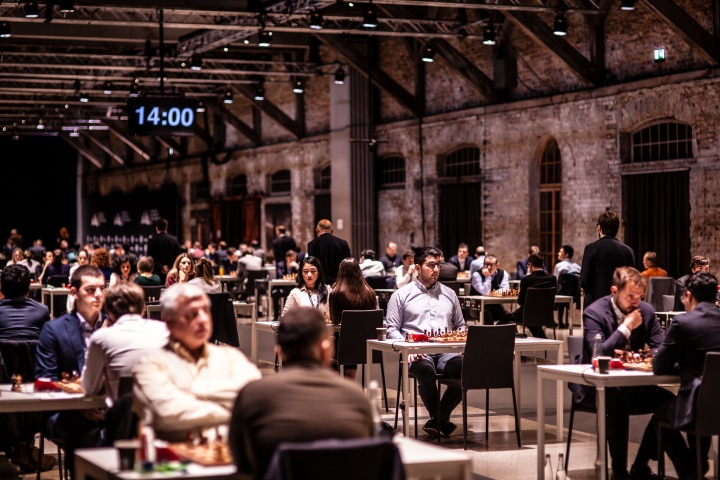
After just two days of play, only three players have a maximum score at the Open Grand Swiss. In the Women’s event, two duos of Georgians and Chinese lead the group of altogether seven players with a maximum performance after the second round. Croatian player Ivan Saric cruised to the top of the scoreboard after winning in the second game in a row. Kirill Alekseenko’s choice of a rare line in the Marshall Attack backfired as Saric managed to neutralize Black’s initiative and emerged with an extra pawn. In an opposite-colour bishops were no help for the Russian as the Croatian promptly won a second pawn forcing Alekseenko’s resignation. Ivan Saric will play Fabiano Caruana in Round 3. In a fantastic game on board eight, Alexandr Predke of Russia introduced an amazing novelty in the King’s Indian Defence sacrificing his queen for two minor pieces a pawn against Nodirbek Yakubboev: Alexandr Predke – Nodirbek Yakubboev 12.hxg4!! Bxd4 13.Bxd4 – White got sufficient positional compensation and even a certain edge but stunned Yakubboev failed to put up resistance and crumbled after 13…Kh7 14.Be2 f5? 15.exf5 gxf5 16.Rh5 +- | 1-0, 34 moves. The Russian is on two points and he will be playing Alireza Firouzja who had some serious problems with Black against Dariusz Swiercz of the US at some point, but eventually his knights proved stronger than a rook and two connected passers of his opponent: Alireza Firouzja – Dariusz Swiercz 58…Nxh2! was a killer blow as 59.Qxh2 fails to 59…Ng3+ 60. Kg1 Ne2+ 61.Kh1 Qxh2+ 62.Kxh2 Rh4# | 0-1, 61 moves On board one 17-year-old Nihal Sarin managed to hold world number two Fabiano Caruana to a draw, despite later saying that he considered his own position to be “completely lost”. “I thought there was like 20% chance that I could save this game,” Sarin said. After a draw in the first round, Maxime Vachier-Lagrave secured a speedy victory as White against Amin M. Tabatabaei, after the Iranian made a mistake in the opening. In an interview following the game Vachier-Lagrave said he feels in his element and is in high hopes for the rest of the tournament. The last game to finish in the second round was that of Latvian Grandmaster Arturs Neiksans who played against England’s David Howell. In the Queen’s Indian Defence Neiksans made use of the opponent’s flub (17.Nd4? instead of a natural 17.e3) and achieved an absolutely won position. For a long time Howell was teetering the brink of defeat but his grit and determination paid off in the end as the Englishman held his ground and, in the late hours of the evening, forced his opponent to concede to a draw. In the Women’s event, Nana Dzagnidze demonstrated resourcefulness in an unbalanced position and defeated Iulija Osmak to maintain her lead in the tournament. On board two Alexandra Kosteniuk – dressed in a black and white squared dress – drew with Lela Javakhishvili, as did Polina Shuvalova against Olga Badelka. The second top game to end with a decisive outcome was between Lei Tingjie and Ekaterina Atalik. The Chinese prevailed in what might be the wildest game in the women’s tournament with advantage changing hands several times, and now will be facing Elisabeth Paehtz in Round 3 after the German was victorious against Leya Garifullina. Alongside Dzagnidze and Lei Tingjie, five more female players have a maximum score after the first two rounds. Round 3 Round 3 starts at 2 PM on the 29th of October. The pairings for Round 3 of the Open event can be found here:https://grandswiss.fide.com/open/ The pairings for Round 3 of the Women’s event can be found here:https://grandswiss.fide.com/grand-swiss-women/ For more information about the tournament, please visit:https://grandswiss.fide.com/ Press enquiries: press@fide.com Text: Milan Dinic Photo: Mark Livshitz and Anna Shtourman
Arkady Dvorkovich: “Chess life can continue even at a difficult time”
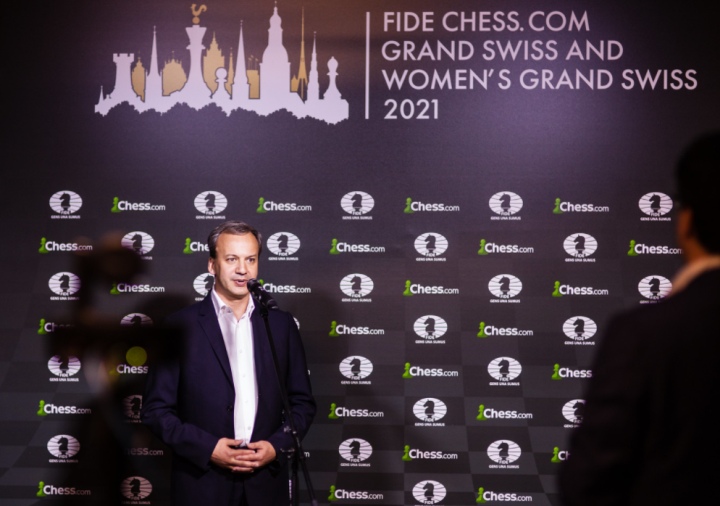
The First Round of the 2021 FIDE Chess.com Grand Swiss started yesterday with FIDE President Arkady Dvorkovich making the first move on Board one, in the game between top-seed Fabiano Caruana and Maksim Chigaev of Russia. Later on, Mr Dvorkovich spoke about the event and the issues surrounding it – from the health and safety of players to the plans and ambitions of FIDE in the coming period, both in the Baltics and globally. – How difficult was it to organize this event in light of the current circumstances in Latvia? – Any event that we have been organizing in the course of the pandemic is a tough one at this one is not an exemption. I really appreciate the efforts of everyone in our team and our partners that help us to keep our calendar and our chess life intact and organize the Grand Swiss tournaments, the part of the World Championship cycle here in Riga. It is a very important event in the annual chess calendar as it determines participants of the Candidates Tournaments – two in the open cycle and one in the women’s cycle. For many players, it’s the only chance to get qualified; that’s why it was critically important to have it. We are thankful to the Latvian Government, Latvian Chess Federation, all our partners here in Latvia and our financial partners – the Sheinberg Family, Chess.com and other providers like Coca-Cola for the opportunity to have this event during the difficult pandemic period. We have a very good composition of players. While some players were unable to come, most of them kept their schedules and came to Riga and it’s going to be a fantastic tournament, a very strong one with great players participating and fighting for a chance to compete for the world championship crown. I think we took all the necessary steps and measures to control the health situation and to provide safety of players and all the people involved. I think this is also a sign of respect to the people of Latvia, who are now keeping themselves safe during the lockdown. Nevertheless, I think the situation here at the tournament is more secure than even in some countries where there are no quarantines or lockdowns. We took all the measures to ensure the strongest possible safety. – Let’ just take a step back. How did it come that this event was transferred from the Isle of Man to Riga? – Originally, this tournament had to take place at the Isle of Man; it was a tradition to hold these tournaments in partnership with the Scheinberg Family. We had this tournament two years ago, just an open one, as a part of our world championship cycle, and we were planning to repeat it this year, now with also women’s Grand Swiss tournament, but the restrictions that the Isle of Man still has would not allow the players to come without lengthy quarantines and many obstacles prohibitive for holding such events. So we were thinking about plan B, and in consultations with our partners – the Scheinberg Family and Chess.com – we came to the conclusion that Latvia could be the right place. The decision was based on many reasons like chess traditions in Latvia, a very good team of organizers, including Dana Reizniece-Ozola, FIDE Managing Director, and also the desire of our partners to do this in the beautiful European country. At that point, Latvia was one of the safe places in terms of the pandemic. It is not now, but I think that the conditions here that we established, based on the medical protocol and all safety requirements, are even more secure for players and everyone involved than in many countries where formal rates of the pandemic are lower. I truly believe we made the right decision. If Riga was not the only best choice, then it was one of the best choices we could have for this tournament. Even with all the difficulties we have right now because of the covid, I think the whole team is very much capable of organizing this. I know that all players enjoy the hospitality and beauty of Riga and Latvia right now. – There are many people asking why this event haven’t been postponed or moved online. What is the position of FIDE? – We do believe that while the pandemic is still not over, chess life shall continue. It’s about profession; chess players want to compete and do their best to get the titles and continue their careers. Online is not a perfect substitute. It’s a good compliment to over-the-board chess but not a perfect substitute. We are talking about the world championship cycle, the classic one, where players qualify for major events like Candidates Tournaments through other major over-the-board events, and we decided to keep it, based on the evaluation of risks and our trust in the safety measures we take. Otherwise, the whole calendar would be destroyed, and we would end up with the world championship cycle postponed altogether. That would not make anyone better. It’s a balance of risks and benefits that we are looking at. It is an excellent opportunity to show that chess life can continue even at a difficult time. – FIDE has established a very strict health and safety protocol. How hard will that be to implement? – Every time there is a rule and common sense as well. Logic and common sense should also work. We insist that every player follows the rules. If anyone violates rules in a way that will create risks for other players and people around, for a person herself or himself, we will not tolerate it. – During the World Cup in Sochi, one of the players tested positive for Covid-19. What are you going to do in case it happens here in Riga? – We have a certain procedure that we will follow. Any unlikely case like that – I would put it this way as everyone