

FIDE Chess.com Grand Swiss Riga: Round 1 Recap
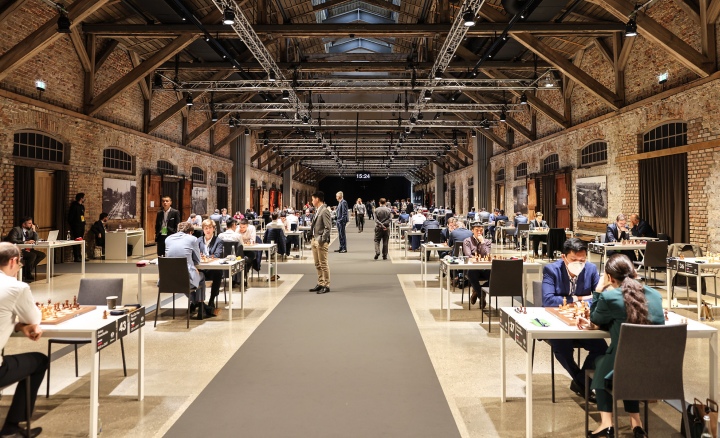
The first day of what is set to be one of the strongest Swiss tournaments ever held saw very tough games in the open section, with the majority of the encounters resulting in draws. The inaugural Women’s Grand Swiss delivered significantly more decisive outcomes. At about half-past one local time in Riga, most of the players taking part in the 2021 FIDE Chess.com Grand Swiss and Women’s Grand Swiss gathered at the Hansas Perons playing hall, eager for the round to begin. By two, the participants were at their designated tables, face to face with their opponents in the first round of what is promising to be one of the strongest Swiss tournaments ever held in the history of chess. The opening of the round was preceded by a minute of silence to honour the deceased Latvian chess coach and former director of the Riga Chess School Aivars Stašāns (1954 – 2021), who passed away on Tuesday evening. After a detailed address by the acting arbiter Ana Srebrnic, asking the players to carefully read and strictly follow the Health Protocol and the dress code, the clocks were allowed to start. The first move on the top board in the open event was made by FIDE President Arkady Dvorkovich in the game Caruana vs Chigaev. Open tournament The first day did not bring many surprises, with most of the games on the top boards in the Open event ending in a draw. Out of the top ten players in that section, only three won their games: world number two and former contender for the title of World Champion Fabiano Caruana, the promising naturalised Frenchmen Alireza Firouzja and the rising Russian star Kirill Alekseenko. World number two, Fabiano Caruana played the Sicilian Keres Attack, gradually building up the pressure on his opponent before making a thematic knight sacrifice on d5. Maksim Chigaev maintained balance for a while but slipped with 27…Rg6? and had to resign seven moves down the road. Firouzja’s charge to victory over Nijat Abasov went via the Steinitz attack in the Petroff, which led to a sharp position with opposite-side castling. After energetic 17.g4! Nijat snatched a poisoned pawn, which was a poor choice – Alireza’s pieces jumped into action and quickly got to Black’s king. Kirill Alekseenko, who was the wild-card at the previous Candidates Tournament in Yekaterinburg, scored a convincing victory over his Ukrainian namesake, Kirill Shevchenko, setting the base for a promising start in the event. The other top-ten ranked players in the Open event – Levon Aronian (pictured below), Maxime Vachier-Lagrave, Nikita Vitiugov, Andrey Esipenko, Pentala Harikrishna, Daniil Dubov, Vladimir Fedoseev – all finished their games with a draw. The only woman who decided to participate in the open event – Aleksandra Goryachkina – drew her game against the Peruvian chess prodigy, Jorge Cori. Goryachkina has already qualified for the Candidates as the runner-up of the World Championship match in 2020, so she has decided to take part in the Open event and see how high she can reach. Playing until the late hours of the evening, the former contender for the title of World Champion, Boris Gelfand, lost as White against Dmitrij Kollars of Germany. After the first round of the Grand Swiss, out of 103 players in the Open section, only 20 have started with a victory. Women’s Grand Swiss The first round of the inaugural Women’s Grand Swiss saw many more decisive outcomes than the open section. Former Women’s World Champion and top-seeded player in the Women’s Grand Swiss, Mariya Muzychuk, drew her game Aleksandra Maltsevskaya of Russia on board one. Not even the support of her sister Anna, who is a commentator with the Chess.com broadcast team of the event, could help her claim victory against an over hundred-points lower-rated opponent. Second-ranked Nana Dzagnidze of Georgia staged an unpleasant start for Olga Girya, defeating her in the Catalan. In a queen vs queen endgame, Dzagnidze’s conversion was not optimal, but eventually, she secured a free-running pawn on c-file, which gradually made its way forward, followed by her king pushed ahead by the desperate checks from Girya. Former Women’s World Champion and the winner of this year’s inaugural Women’s Chess World Cup, Alexandra Kosteniuk, also started with authority, winning as Black against Sophie Milliet of France. In Round 1, 18 of 50 players in the Women’s event have started the tournament with a victory. Round Two Round Two starts at 2 PM on the 28th of October. The pairings for the second round for the Open event can be found here:https://grandswiss.fide.com/open/ The pairings for the second round of the Women’s event can be found here:https://grandswiss.fide.com/grand-swiss-women/ For more information about the tournament, please visit:https://grandswiss.fide.com/ Press enquiries: press@fide.com Text: Milan Dinic Photo: Anna Shtourman
FIDE Chess.com Grand Swiss officially opened in Latvia
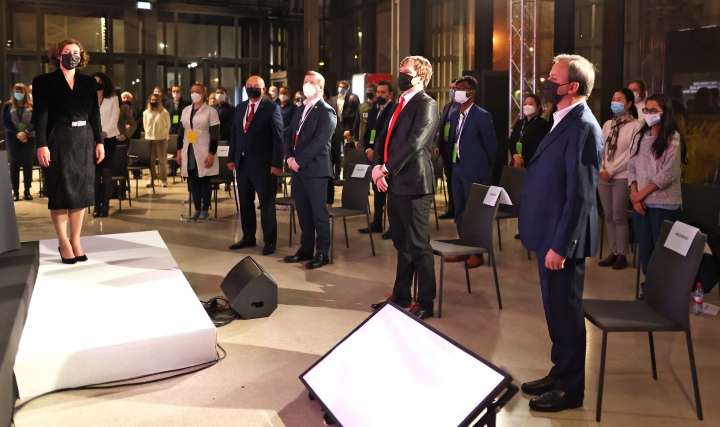
The world’s chess elite gathered in Riga’s Hansas Perons centre for the opening of the 2021 FIDE Chess.com Grand Swiss and the inaugural Women’s Grand Swiss. Altogether 158 strong players from all over the world are taking part in the event, which will decide the qualifiers for the 2022 Candidates Tournament that will produce the challenger for the title of the World Champion Dana Reizniece-Ozola, FIDE Managing Director and a Latvian native, noted that it is a great honour for her country to be hosting an event of such importance. Commenting on the current situation in Latvia, where a four-week Covid-lockdown was recently introduced, Reizniece-Ozola said she shares the concerns of players and that she feels the frustration caused by the pandemic. “When all of this was developing, I felt like playing a chess game against COVID and taking it on myself”, said Reizniece-Ozola, who is also a Woman Grandmaster. In his speech at the opening ceremony, FIDE President Arkady Dvorkovich noted that the Grand Swiss is “the most important FIDE tournament and not just the qualifying event” as he thanked the players for coming. By reiterating that FIDE and the organisers have imposed strict health and safety measures for all, Dvorkovich has said that the international chess body wanted to “show our respect to all people in Latvia and everyone involved in this event” concerning the current situation. FIDE President thanked the Scheinberg Family and Chess.com as well as Coca Cola and the Latvian Chess Federation for sponsoring the event. He expressed FIDE’s gratitude to the Latvian government and the mayor of Riga for hosting the Grand Swiss, as well as to Dana Reizniece-Ozola, “who made this event happen”. “Chess life continues whatever happens. We will do everything possible to ensure the safe conduct of the tournament so that you are free to focus on your games and play well”, Dvorkovich said. “Thank you, good luck and stay healthy”, FIDE President concluded. The guests were also greeted by pre-recorded messaged by the Latvian Minister for Education and Science, Anita Muižniece, as well as the mayor of Riga, Mārtiņš Staķis. Both noted the legacy of Mikhail Tal and how important this event is for Riga and Latvia, inviting players to experience the city and thanking them for their participation. The President of the Latvian Chess Federation, Rejs Mundi, reminded the participants that in 2019 Riga hosted the FIDE Grand Prix, which was won by Shakhriyar Mamedyarov after a suspenseful Armageddon game in the tie-break against Maxime Vachier-Lagrave. “In the spirit of the 2019 event, I wish for this tournament to be a thriller until the end”. He wished players luck but noted that it could only apply to “exactly half of the players, as you can’t all be lucky”. The drawing of lots Following the performance of two singers who sang Latvian folk songs wearing traditional attire, the drawing of lots took place. Arkady Dvorkovich drew white pieces for the open tournament’s top-seed and world number two, Fabiano Caruana. The top player in the women’s section, Mariya Muzychuk, drew black pieces for herself. The 2021 Grand Swiss The first round of the Grand Swiss will start on the 27th of October at 2 PM local time. The open event will have one of the longest time controls ever used in chess: each player will have 100 minutes for the first 40 moves, followed by 50 minutes for the next 20 moves, plus 15 minutes for the remaining moves, with 30 seconds added per move from the start of the game. The time control for the Women’s Grand Swiss will be slightly shorter: 90 minutes for the first 40 moves, followed by 30 minutes for the rest of the game with an increment of 30 seconds per move starting from move one. Both tournaments are part of the qualifications for the 2021-23 World Championship cycle, with the top two players in the open event qualifying for the 2022 Candidates Tournament and the following six securing spots in the Grand Prix. The winner of the Women’s Grand Swiss will qualify directly for the Women Candidates and the four best players will qualify for the next year’s Women’s Grand Prix. The pairings for the first round of the Grand Swiss can be found here:http://chess-results.com/tnr587230.aspx?lan=1&art=2&rd=1&flag=30 The pairings for the first round of the Women’s Grand Swiss can be found here:http://chess-results.com/tnr587231.aspx?lan=1&art=2&rd=1&flag=30 Information about the event can be found here:https://grandswiss.fide.com/general-information/ Text: Milan Dinic Photo: Mark Livshitz Official website: grandswiss.fide.com
Winners crowned at FIDE World Amateur Chess Championship
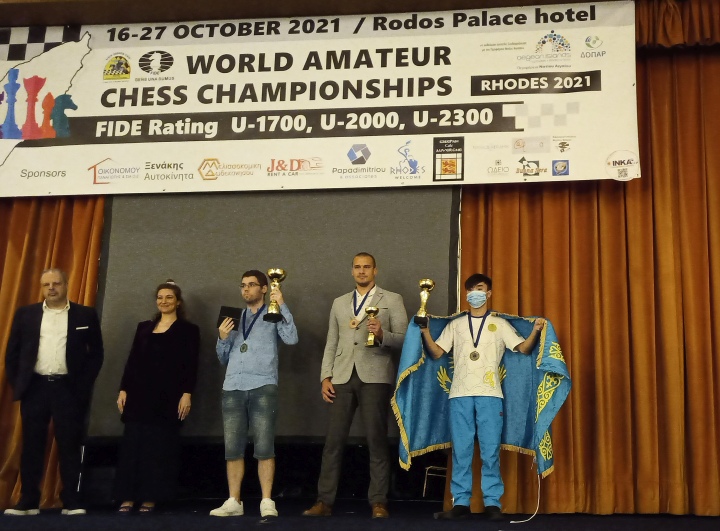
2021-10-26ADDENDUM: The FIDE World Amateur Chess Championships 2021 were held in Rhodes, Greece between 16th and 26th of October 2021. During the awarding ceremony on 25th of October, the Chief Arbiter of the tournament wrongly interpreted the regulations of the event and in U2000 category of the tournament winners were announced incorrectly. After the immediate report to FIDE, the decision was taken to award two sets of silver and bronze medals, and to distribute the money prizes accordingly. It must be noted that since the number of female players didn’t reach the minimum established to hold a separate tournament, both categories open and women were merged in just one competition. Female players were eligible for awards in both – this is the detail the CA misinterpreted. The prize distribution has been adjusted accordingly: below you can find the final prize list at the bottom of this article. ############# The 2021 FIDE World Amateur Chess Championship was one of the first over-the-board World Championship in nearly two years and a big step in returning to normal life after the pandemic. It ran as part of the Rhodes 2021 Chess Festival from October 17-25. The closing ceremony held on October 25 featured Mr Nikos Nikolis, Vice Governor of the Region of South Aegean, responsible for sports; Dr Charudatta Jadhav, the IBCA President; Mr Benard Wanjala, Chairman of Chess Kenya, and a representative from the Rhodes municipality and the local chess club Ippotis. FIDE representative Mr Ozgur Solakoglu recalled the greetings to the participants sent by the FIDE President, Mr Arkady Dvorkovich, and expressed satisfaction that the amateur players of all ages who came to Rhodes demonstrated love for the beautiful game, good sportsmanship, and courtesy to each other. Mr Solakoglu highlighted no COVID-related health emergencies during the ten days of the championship because everyone adhered to the strictest health protocols as set by the regulators in the host country Greece. He thanked organizers and arbiters for the excellent teamwork that made this tournament a success. Secretary-General of the European Chess Union Mr Theodoros Tsorbatzoglou explained that FIDE and the continental associations treat amateur chess as a base of the pyramid that allows the game to grow organically and involve players of all ages and skill levels. He congratulated everyone on resuming over-the-board events and promised that 2022 would feature many exciting World and European competitions. The excitement in the audience was palpable when the world-renowned singer Juga was introduced and a clip of her famous Oh, Capablanca song was played on screen. Juga made a passionate speech defending real women, wonderful role models like Vera Menchik, Nona Gaprindashvili, Judith Polgar, against the pop-culture fictional Beth Harmon character. Juga is currently working on the Chess Divas series that will be devoted to those brave real-life women. To the delight of all assembled, the singer gave an avant-première of her new song from the series called Shakhmatistka, created in collaboration with the Women’s World Champion Alexandra Kosteniuk. After such an emotional high, the festivities concluded. Chief Arbiter Vadim Tsypin read the award lists in all categories, the assembled dignitaries presented cups and medals to happy players, and Juga generously gifted her exclusive CDs. The champions came from six different countries on three continents: Women U-1700 Glenda Madelta (KEN) Open U-1700 Mukhtar Ainakul (KAZ) Women U-2000 Marigje Degrande (BEL) Open U-2000 Peter Anand (IND) Women U-2300 Alexandra Zherebtsova (RUS) Open U-2300 Dimitrios Ladopoulos (GRE) During the awarding ceremony the Chief Arbiter of the tournament wrongly interpreted the regulations of the event and in the U-2000 category of the tournament winners were announced incorrectly. After the immediate report to FIDE, the decision was taken to award two sets of silver and bronze medals, and to distribute the money prizes accordingly: Under-2000 Category Gold medal Peter Anand A (IND) €1,000 Silver medal Degrande, Marigje (BEL) €900 Silver medal Celik, Berkay (TUR) €600 Bronze medal WCM Sultanbek, Zeinep (KAZ) €800 Bronze medal CM Mohamed, Saeed Laily (UAE) €400 Tarnowska, Aleksandra (POL) €700 Under-2000 Women Category Gold medal Degrande, Marigje (BEL) Silver medal WCM Sultanbek, Zeinep (KAZ) Bronze medal Tarnowska, Aleksandra (POL) It must be noted that since the number of female players didn’t reach the minimum established to hold a separate tournament, both categories open and women were merged in just one competition. Female players were eligible for awards in both – this is the detail the CA misinterpreted At the end of the ceremony, the Tournament Director Nikolaos Kalesis called upon amateur players of the world to come together in Malta for the next FIDE World Amateur Championship in October 2022. The complete results of the event can be found here. Information and photos by the Rhodes 2021 Chess Festival press service
FIDE Candidates Tournaments and Women’s Grand Prix Series 2022-23: Call for bids

1.1 The International Chess Federation (FIDE) will hold the Women’s Grand Prix Series from August 2022 to June 2023 (see the Tournament Regulations). 1.2 FIDE is opening a bidding procedure to invite any federation member of FIDE or any organiser approved by the national federation to host the event. The federation’s letter of support may be provided later when the bid’s evaluation procedure is launched. 1.3 The bid may contain special proposals on financial and commercial conditions. The FIDE Council shall decide whether these conditions are admissible. 1.4 Bid Forms shall be filled in by an Applicant. A signed copy shall be submitted as e-mail messages to the FIDE Secretariat to office@fide.com from 6 October to 6 December 2021 by 23:59 Lausanne time (FIDE has the right to extend this deadline). All the documents shall be submitted in English. Additional documents may be requested by the FIDE General Strategy Commission (GSC) for further evaluation. 1.5 Bid Evaluation Report shall be presented by GSC for approval of the FIDE Council. 1.6 Once the Organiser is granted the right to organise one of the four Women’s GP tournaments, a relevant announcement shall be made on the FIDE website. FIDE Technical Delegate (FIDE TD) may be appointed at the same time to supervise the event on behalf of FIDE in consultation with GSC. 1.1 The International Chess Federation (FIDE) will hold the Candidates Tournament in June-July 2022 (see the Tournament Regulations). 1.2 FIDE is opening a bidding procedure to invite any federation member of FIDE or any organiser approved by the national federation to host the event. The federation’s letter of support may be provided later, when the bid’s evaluation procedure will be launched. 1.3 The bid may contain special proposals on financial and commercial conditions. The FIDE Council shall decide whether these conditions are admissible. 1.4 Bid Forms shall be filled in by an Applicant. A signed copy shall be submitted as e-mail messages to the FIDE Secretariat to office@fide.com from 6 October to 20 November 2021 by 23:59 Lausanne time (FIDE has the right to extend this deadline). All the documents shall be submitted in English. Additional documents may be requested by the FIDE General Strategy Commission (GSC) for further evaluation. 1.5 Bid Evaluation Report shall be presented by GSC for approval of the FIDE Council. 1.6 Once the Organiser is granted the right to organise the event, a relevant announcement shall be made on the FIDE website. FIDE Technical Delegate (FIDE TD) may be appointed at the same time to supervise the event on behalf of FIDE in consultation with GSC. 1.1 The International Chess Federation (FIDE) will hold the Women’s Candidates Tournament in the first part of 2022 (see the Tournament Regulations). 1.2 FIDE is opening a bidding procedure to invite any federation member of FIDE or any organiser approved by the national federation to host the event. 1.3 Any Applicant shall fill in the Bidding Form. A signed copy shall be submitted as e-mail messages to the FIDE Secretariat to office@fide.com from 16 August to 15 September 2021 by 23:59 Lausanne time (FIDE has a right to extend this deadline ). All the documents shall be submitted in English. Additional documents may be requested by the FIDE General Strategy Commission (GSC) for further evaluation. 1.4 Bid Evaluation Report shall be presented by GSC for approval of the FIDE Council. 1.5 Once the Organiser is granted the right to host the event, a relevant announcement shall be made on the FIDE website. FIDE Technical Delegate (FIDE TD) may be appointed at the same time to supervise the event on behalf of FIDE in consultation with GSC.
Dutch Championship: Anne Haast clinches her fifth title
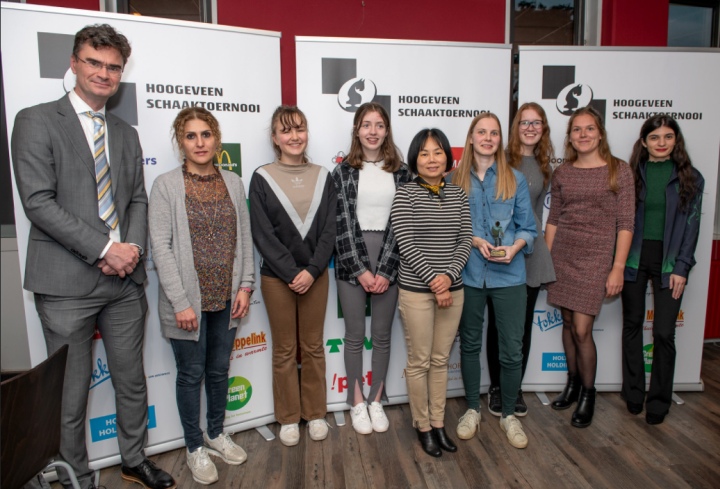
Anne Haast came as the winner of the 2021 Dutch Women’s Championship. It is her fifth national title (she previously won this event in 2014, 2015, 2016 and 2017). The 2021 open and women’s Dutch championship were held in Hoogeveen had different formulas. The women’s event was a classical 8-player round, while men competed in a preliminary knockout stage to qualify for the final four who will return over the board in November to determine the champion. With several top players missing in the open competition, Roeland Pruijssers, Max Warmerdam, Robin Swinkels and Hing Ting Lai made it to the final stage that will take place in Rotterdam. Haast had a shaky start as she lost in Roun 2 to Tea Lanchava but after scoring three victories in a row, the resident of Tilburg and a happy mom of a one-year-old daughter was coming into the final round sharing the lead with Eline Roberts. Anne quickly dismantled the hedgehog formation of Machteld Van Foreest (Jorden and Lukas’ sister) to score a full point, while Eline fell in a sharp battle with Maaike Keetman. The 15-year old Eline Roberts (pictured below) tied for second with GM Peng Zhaoqin and settled for bronze but showed great promise. “If she continues like this, she will certainly succeed one day,” the five-time Dutch Women’s champion said. Final standings: 1 WGM Haast, Anne 2318 5 2 GM Peng, Zhaoqin 2359 4 3 Roebers, Eline 2297 4 4 WIM Ratsma, Rosa 2306 3½ 5 WFM Keetman, Maaike 2136 3½ 6 IM Lanchava, Tea 2214 3 7 FM Kazarian, Anna-Maja 2125 3 8 Van Foreest, Machteld 2132 2 Official website: schaken.nl/ Photo: Frans Peters
Allan Stig Rasmussen wins 2021 Danish Championship
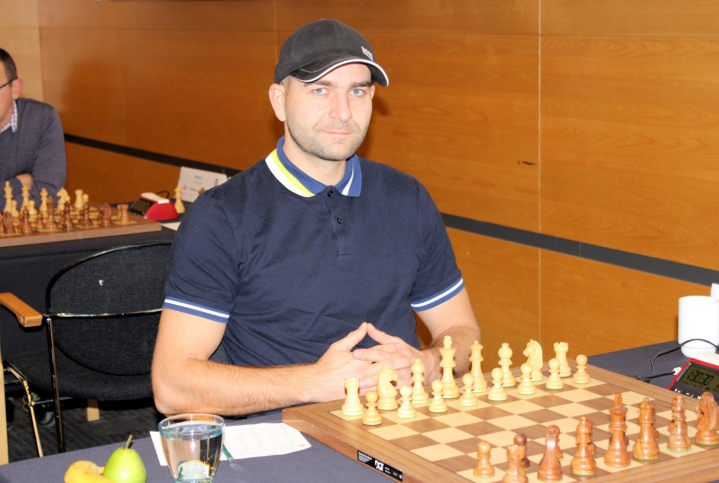
GM Allan Stig Rasmussen came out on top of the 2021 Danish Championship, earning his fifth national title. The 2021 Danish Chess Championship, a 10-player round-robin with classical time control, was held in Svendborg from October 16-24. As the tournament fate would have it, the winner of the event was determined in the final round in the game between the leader Rasmussen and GM Sune Berg Hansen, who was a half-point behind. Trying to complicate matters, Hansen opted for a risky line of Alekhine Defence with Black only to find himself in a precarious position by move 18. Apparently, Rasmussen was not in the mood to take any chances as he forced a draw by threefold repetition to secure the title. Hansen and Rasmussen engaged in a post mortem GM Jesper Sondergaard Thybo, the only participant to beat the champion, was in the run for the top position in the standings for most of the event, but the penultimate round defeat at the hands of IM Nikolaj Borge left him out in the cold. To his credit, Jesper pulled himself together and clinched silver after crushing IM Jens Ove Fries-Nielsen in the final round. Jesper Sondergaard Thybo won silver Sune Berg Hansen scored an equal amount of points with Thybo but had to settle for bronze due to inferior tiebreaks. Final standings: 1 GM Rasmussen, Allan Stig 2566 7 2 GM Thybo, Jesper Sondergaard 2602 6½ 3 GM Hansen, Sune Berg 2528 6½ 4 GM Schandorff, Lars 2458 6 5 IM Borge, Nikolaj 2381 4 6 GM Chatalbashev, Boris 2536 4 7 IM Fries-Nielsen, Jens Ove 2378 4 8 IM Haubro, Martin 2426 3 9 IM Antonsen, Mikkel 2409 2½ 10 FM Rewitz, Poul 2264 1½ Official website: skak-dm.dk/Photo: Mads Boe
World Chess Championship for People with Disabilities: Registration continues
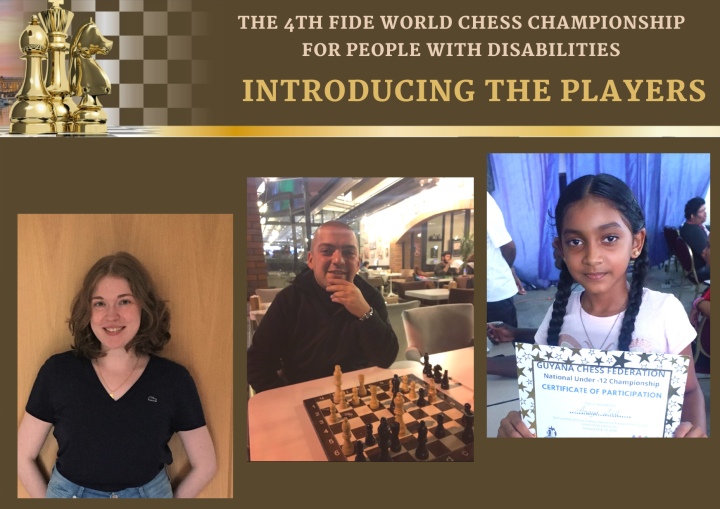
The 4th FIDE World Chess Championship for People with Disabilities will be held online by Dresdner Schachfestival E.V. under the auspices of FIDE from November 4-14, 2021. Registration is still on until November 1, 2021. 100+ players from 29 countries have already applied for the tournament. Participants from France, Saudi Arabia, Turkey, India, Bangladesh, Mongolia, Italy, Kyrgyzstan, Turkey, South Africa, Spain, Latvia, Russia, Brazil, USA, Argentina, Ukraine, Georgia, Canada, Israel, Kenya, Colombia, Poland, Australia, Vietnam, Germany, Guyana, Venezuela and China will compete in the 9-round Swiss tournament, an individual competition with an additional team ranking. Some of them are titled chess players, winners of national and international events, while others are just starting their competitive chess lives. Just a couple of weeks ahead of the 4th FIDE World Chess Championship for People with Disabilities, we’re introducing this year’s participants in a series of articles. Tatiana Flores Bernholz (Spain) Tatiana Flores, 23, lives in Germany. She learned how to play chess at the age of 5 at school; she found it fun at first but quickly lost interest in it and stopped playing after primary school. After long years of being sick at home and in hospitals, she was finally getting better and picked up chess again to kill time and have something new to think about. “I unexpectedly fell so much in love with it that I decided to devote my life – or at least a big part of it – to chess. And even to combine it with my profession as a journalist,” she says. Tatiana hopes to become a GM one day or a trainer to share her passion for the game with others. Now she is looking forward to the Championship to start: “I love playing online chess and think it’s a good format for this Championship, especially because it’s for people with disabilities and illnesses for whom it’s not easy to travel. I’m also very happy about the time control because there’s time enough to squeeze everything out of our games. I’m also relieved that the registration was uncomplicated and already looking forward to the nine days of play.” Umuralp Yalçınkaya (Turkey) “My mother taught me chess when I was a child,” says 34-year old Umuralp Yalçınkaya of Turkey. “My interest in the game sparked was during the health period I lived at the age of 25. Between 2013 and 2014, I had one surgery on my knee and two on my right hand in less than a year. For me, chess was a factor that made my recovery process out of the hospital enjoyable”. After the completion of treatment, Umuralp started participating in official chess tournaments not far from his home. He thinks that competitive chess helps him to improve his game a lot. “The message I want to give to people is that chess has no age; you gain experience by playing,” he says. This year the 4th FIDE World Chess Championship for People with Disabilities will take place online due to continuous Covid-19 restrictions across the world. However, Umuralp is one of those who likes the online format of the event: “If it wasn’t a tournament that I can play online, I wouldn’t have the opportunity to participate”. Anaya Lall (Guyana) Eleven-year-old Anaya Lall from Guyana is one of the youngest participants of the World Chess Championship for People with Disabilities. She has been playing chess since she is 6. In 2018 Anaya started competing in national tournaments and became the first deaf chess player to represent her country in international tournaments. In 2020, at the age of 10, Lall represented Guyana in the girls under-10 category at the FIDE Online World Cadets and Youth Rapid Chess Championship. The young talent was selected based on her performance in the recent online events. Apart from the game, Anaya enjoys learning about STEM and has many hobbies. “In my spare time, I also like to draw. I love animals and the outdoors. And I love Guyana,” the girl added. Participation in the 4th FIDE World Chess Championship for People with Disabilities became possible for Anaya thanks to the online nature of the event. “I would like to have a very successful experience in my first Disability tournament!” she says. Registration of the participants of the 4th FIDE World Chess Championship for People with Disabilities is open until November 1, 2021, via online form. Tournament regulations (pdf) Further Information: Website: www.schachfestival.de worldchess-disabled.com/en/
Rhodes hosts Olympiad for Blind and Visually Impaired and IBCA Congress
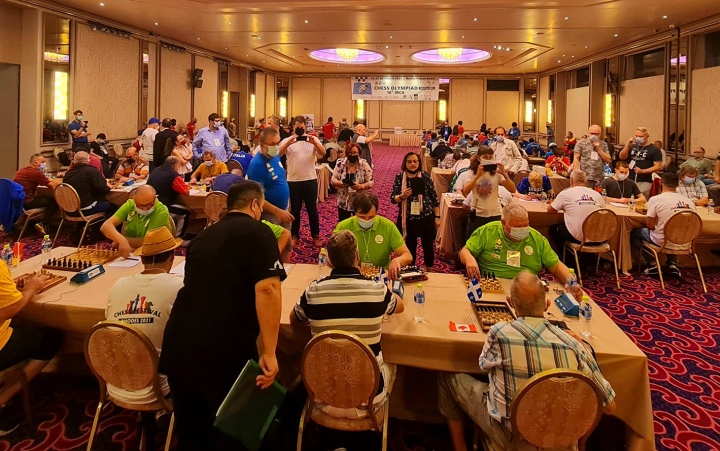
The 16th International Braille Chess Association (IBCA) Olympiad for the Blind and Visually Impaired takes place in Rhodes, Greece, from October 16-27, 2021, as part of the 2021 Rhodes Chess Festival. After five rounds, team Russia is leading the field with 10 match points, followed by Poland and India with 8 match points each. On Friday, October 22, a free excursion to the Old City of Rhodes for all participants was organized, followed by a quadrennial IBCA Congress. IBCA is the supreme body responsible for chess for the blind and visually impaired. The IBCA is part of the International Blind Sports Federation and an Affiliated Member of FIDE. Founded in 1958, the IBCA has grown to more than fifty countries on four continents. Its two major competitions are the Blind Chess Olympiad and the Blind World Chess Championship. Despite the difficulties presented by the Covid-19 pandemic, the 2021 IBCA Congress was well-attended and featured delegates from 28 countries. In his report, the IBCA President Dr. Charudatta Jadhav (India) highlighted the following achievements during the past four years: Registering the IBCA as a charitable organization in France; Admission of six new countries from Asia and the Americas as the IBCA members; Excellent cooperation with FIDE, primarily via the Commission for the Disabled (DIS); Development of accessible mobile chess software. Dr Jadhav thanked the FIDE President, Mr Arkady Dvorkovich, for his attention to the needs of disabled players and many new initiatives, such as the 2020 FIDE Online Olympiad for the Disabled and the 2020 FIDE Olympiad for the Disabled. The Congress adopted a new Constitution that improves its governance, making the organization more democratic and transparent. The Congress elected the new IBCA governing bodies for 2021-2025. Following the lead of other international sports organizations, including FIDE, for the first time in its history, the IBCA expanded the representation of women in its highest body, the Presidential Board, to 40% and now includes representatives from the three continents. The following candidates were elected: President: Dr. Charudatta Jadhav (India) Presidential Board members: First Vice-President: Mr Nikolaos Kalesis (Greece)Second Vice-President: Ms Diana Tsypina (Canada)Secretary: Mr Olivier Deville (France)Treasurer: Ms Natasha Dalle (Belgium) Executive Board members: Mr Sasa Bozic (Serbia), Mr Fernando Daza (Colombia), Mr Sergio Harnandan (Netherlands). The Congress approved the official IBCA event calendar for 2022-2025. The 17th IBCA Olympiad for the Blind and Visually Impaired will take place in Serbia in 2025. Photo: IBCA Facebook page
Grand Swiss exempt from the new coronavirus restrictions in Latvia

The 2021 FIDE Chess.com Grand Swiss and Women’s Grand Swiss to take place with stricter health safety measures, following the introduction of a four-week lockdown in light of the worsening situation surrounding the COVID-19 pandemic in Latvia The Latvian government has confirmed that international top-level sports events are allowed to be held during the monthlong lockdown. The list of authorized activities includes a total of 30 events, including the Basket Champions League, FIBA Euroleague Women, as well as the FIDE Chess.com Grand Swiss and the Tal Memorial. The 2021 FIDE Chess.com Grand Swiss and Women’s Grand Swiss have been allowed to take place after the organizers have provided guarantees of strict healthcare measures at the event, ensuring the tournament will be a safe, closed environment. In light of the new restrictions, the event will be closed to the public, and only players and accredited staff, as well as a limited number of accredited journalists, will be allowed to attend. Measures at the event will include accredited access only, on-site testing, access to sanitisers and masks, and social distancing. Further stricter measures may be introduced depending on the situation. All of the players and those who will have accreditations to attend must follow the health and safety protocols or will face immediate removal from the tournament. FIDE and the organizers would like to assure players and participants that we are doing our best to host the event in Riga in a secure and still comfortable way. FIDE President Arkady Dvorkovich: “We are very grateful for the fact that the tournament has been allowed to take place. FIDE and its organizing partners will always prioritize the health and safety of players, participants and the staff involved in its events. We hope that the situation in Latvia will improve swiftly, and we call on everyone – including the players and staff at the Grand Swiss – to strictly follow the rules and to do their best to contribute to preventing and containing the spread of the virus”. Due to a sharp rise in the numbers of COVID-19 cases, the Latvian authorities have introduced a strict four-week lockdown from Thursday 21st October until 15th November. Nearly all stores, entertainment venues and schools will be shut and services suspended. A stay at home order will be in effect from 8 PM until 5 AM. More information about Covid-19 in Latvia can be found here: https://covid19.gov.lv/en. Official website: grandswiss.fide.com
Nikita Vitiugov and Valentina Gunina become new Russian champions
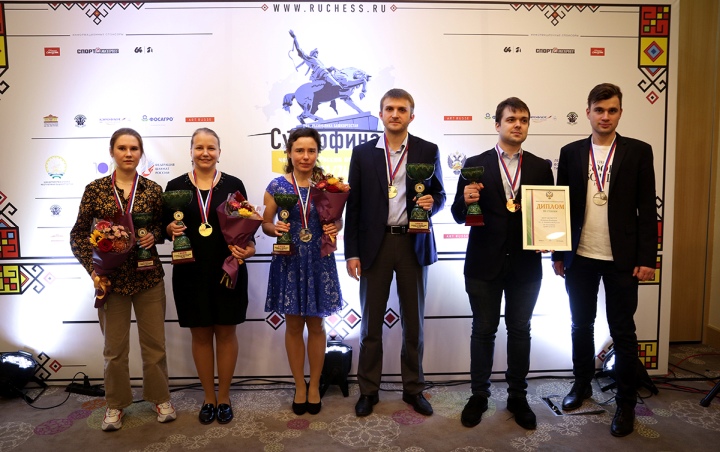
The Russian Championships Superfinals finished in Ufa on the 20th of October. Both events were 12-player round-robins with classical time control. In the last 11th round of the open tournament, Vladimir Fedoseev, who needed a win to catch up with the leader, lost to Pavel Ponkratov in a dramatic fight. The games Chigaev – Alekseenko, Goryachkina – Andreikin, Predke – Motylev, Rakhmanov – Vitiugov, and Esipenko – Matlakov were drawn. Grandmaster Nikita Vitiugov scored 7 points out of 11 to become the Russian champion for the first time in his career. “When the game was about to finish, I was confident that this was going to be a tie-break. It was a difficult moment: on the one hand, the tournament is over, and on the other hand, the fight for the first place is not yet out of the question. I already have experience finding myself in a similar situation and going down to Peter Svidler in a tie-break. I went for a walk because I simply wanted to be as fresh for the game as possible. I relaxed only when the situation clarified after the last move in the Esipenko – Matlakov game,” said the tournament winner. “As for my participation, this is my 15th Russian championship; I have played in as many superfinals as all other participants put together, and maybe even more. I was lucky in some games, but the opposite happened to me as well. The evaluation bar’s sudden spikes towards one or the other player happened in nearly every game. I would not give up and keep on fighting, but it was not without lucky strikes for me either. You will never win such a tournament without them.” he added. Maxim Matlakov won silver with 6½ points. Vladimir Fedoseev and Dmitry Andreikin tied for third place with 6 points each, but the bronze goes to Fedoseev thanks to more victories. It is worth mentioning that all three prize-winners are from Saint Petersburg. Final standings: 1 GM Vitiugov, Nikita 2727 7 2 GM Matlakov, Maxim 2682 6½ 3 GM Fedoseev, Vladimir 2704 6 4 GM Andreikin, Dmitry 2728 6 5 GM Predke, Alexandr 2666 5½ 6 GM Esipenko, Andrey 2720 5½ 7 GM Motylev, Alexander 2624 5½ 8 GM Ponkratov, Pavel 2659 5½ 9 GM Alekseenko, Kirill 2710 5½ 10 GM Goryachkina, Aleksandra 2602 4½ 11 GM Rakhmanov. Aleksandr 2657 4½ 12 GM Chigaev, Maksim 2639 4 In the women’s tournament, the critical game of the final round between Valentina Gunina and Polina Shuvalova ended in a draw. Having scored 8 points out of 11 without a single loss, Valentina Gunina (Moscow) became the four-time Russian Women’s champion. “Of course, I am very happy, but the final game was a nail-biter. I’d been preparing for one thing, but Polina chose the line, which she had never played before. Of course, it is hard to play against an unexpected variation. I thought that I did OK, but it isn’t easy to assess it without due analysis. Actually, I’ve been exhausted for the previous three days, so in such a case, one’s brain can generate interesting reactions; that’s why I’m glad that it all ended this way,” said Gunina after the game. Evgenija Ovod (Saint Petersburg) drew against Alina Bivol and took silver place with 7½ points, edging out Polina Shuvalova (Moscow), who also scored 7½ points but had to settle for bronze due to fewer games with Black. The games Galliamova – Guseva, Pogonina – Garifullina, Voit – Kashlinskaya, and Bodnaruk – Girya were drawn. Final standings: 1 GM Gunina, Valentina 2462 8 2 IM Ovod, Evgenija 2331 7½ 3 IM Shuvalova, Polina 2509 7½ 4 IM Kashlinskaya, Alina 2493 6½ 5 WGM Pogonina, Natalija 2467 6 6 WGM Garifullina, Leya 2409 6 7 IM Galliamova, Alisa 2421 5½ 8 GM Girya, Olga 2410 4½ 9 IM Guseva, Marina 2394 4 10 WGM Voit, Daria 2357 3½ 11 IM Bodnaruk, Anastasia 2415 3½ 12 IM Bivol, Alina 2392 3½ The Superfinals are a part of the Chess in Museums international programme realised by the Chess Federation of Russia and the Elena and Gennady Timchenko Foundation. The total guaranteed prize fund was 11 million rubles: 7 million rubles in the open section and 4 million rubles in the women’s tournament. The Superfinals were organised by the Chess Federation of Russia with the support of the Russian Ministry of Sport, the Government of the Republic of Bashkortostan, and the Elena and Gennady Timchenko Foundation. The CFR general partner is PhosAgro. Partners: Aeroflot, Art Russe, Chess Federation of the Republic of Bashkortostan, and the Bashkortostan State M.V. Nesterov Art Museum. Photo: Eteri Kublashvili