

CFR Team and Georgia win the group stage
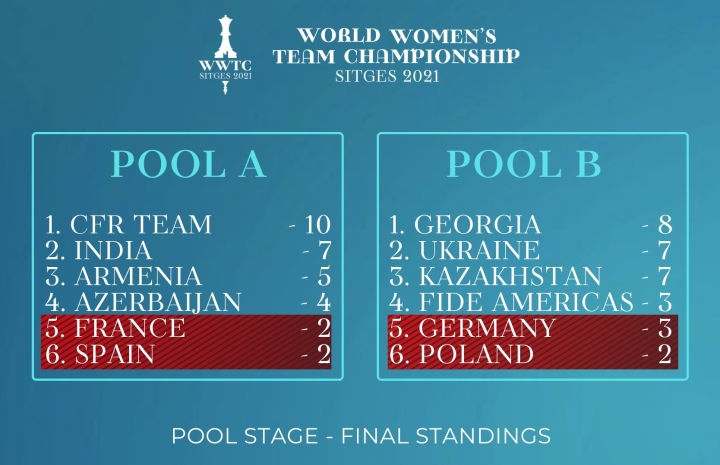
The inability to play under their flag has not affected the morale of the Russian chess players: if anything, it seems to have given them extra motivation. The team headed by Aleksandra Goryachkina, who turned 23 yesterday, bulldozed through the pools stage, scoring five lopsided victories. Moreover, they haven’t lost a single individual game either: from 20 games played so far in the competition, they have won 14 and drew 6. The dominant performance by CFR Team is the main sensation of the event. The Russians will advance to the next stage alongside India, Armenia, and Azerbaijan, while France and Spain were sent packing. In fact, the Azerbaijani had a bit of luck on their side against the host country: they had inferior positions in two of the games, but the Spanish players ruined them and suffered a severe loss that put an end to their aspirations in the tournament. India, second in the group, lost – like everybody else – against CFR Team, but they also conceded a draw against Azerbaijan. Without Humpy in the team, they would need to take up a notch if they are serious about winning the event or even aiming for the silver. Georgia came out on top in pool B, with a much more modest performance compared to the Russians. Three victories and two draws were good enough to take the top spot in the group, one point ahead of Ukraine and Kazakhstan. Nino Batsiashvili, with 4/5, and Lela Javakhishvili, with 3/4, are the top scorers in the Georgian team, while Nataliya Buksa (4/4) (pictured below) and Dinara Saduakassova (4/5)are the best performers among those in the chasing teams. The FIDE Americas team, which englobes players from all over the continent, managed to qualify in the last moment, despite having won only one match. The 1-3 loss they suffered in the last round against Georgia was good enough to leapfrog Germany by half a point in “board points”, which is the main tie-break. The Germans will have to say goodbye to Sitges, just like Poland, much to their keen disappointment. Text: David Llada Photo: Niki Riga and Lourdes Porta Official website: worldwomensteams.fide.com
Rakeem Jeter: “Chess gives an opportunity to improve”
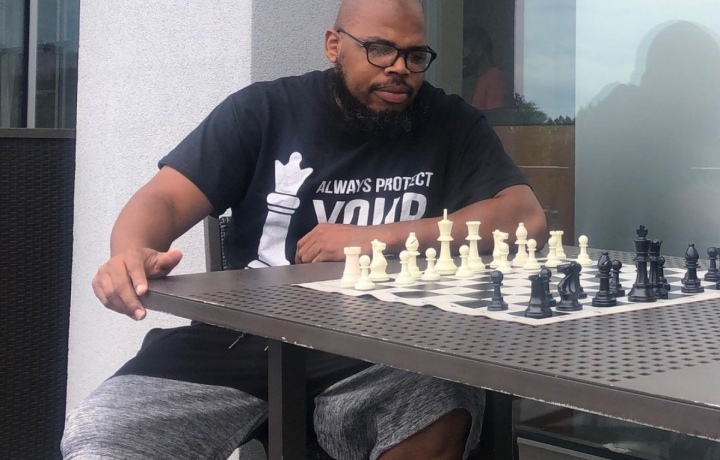
The first Intercontinental Online Chess Championship for Prisoners is scheduled for October 13-14, 2021, on the International Day of Education in Prison. With 31 countries registered, the event is going to be the biggest Chess in Prison tournament ever. Sometimes chess is not something that can change the lives of prisoners; it is something that prevents people from going to prison. In West Philadelphia, Rakeem Jeter, who goes by ‘Rock,’ is using the game of chess to reach at-risk teens offering them free chess coaching. He is sure that chess has real-life benefits that can change the lives of youngsters from communities riddled with crime and a climbing murder rate. FIDE Managing Director Dana Reizniece-Ozola talked to Rakeem to find out how learning the game teaches people to think about the consequences or repercussions of every move made in real life. – Rakeem, tell us your story. You are familiar with the city’s youth facilities and even served prison time yourself. How did you get incarcerated? – My first introduction to the prison system was when I was 15. I was like a typical Philadelphian kid, getting into trouble. I committed some robberies, and I was arrested. In my neighbourhood, that’s what people are doing; a lot of people are introduced to the prison system at an early age. – You played chess before you got into prison. Normally, people consider that the chess players know the relationship between the cause and the consequences, so all this didn’t work? – Actually, I started playing chess when I was getting in trouble. I think I was 14, I was getting in trouble, and they told me to see the counsellors. And the counsellor had a chessboard set in his office. I didn’t want to talk to him, so I was just looking at the chessboard, and one day he said: “You wanna learn to play chess?” I said yes. So he showed me the pieces and how they moved, and I learned really fast. And then I started playing, and it soon became one of my favourite games. I was playing in the neighbourhood, playing wherever I went. – You’re a perfect character of the second season of Netflix series like “The Queen’s Gambit”. Apart from playing in parks, since 2017, you’ve been part of the free Chess Chat Program under a non-profit Organization called Childhood lost. Do you think that your example motivates youngsters you’re playing with? – Yes, I think they are motivated by understanding my personal story and knowing that I came from a place just like theirs. Chess is just a vehicle that I use. I really don’t care whether or not they like the game itself; I just want them to understand that they can be sharper by learning the game of chess. First, they don’t want to play chess; they think that chess is for nerds and uncool. But little by little, I get them engaged using tools that they are familiar with – entertaining them to bring them to the board. – When in prison yourself, you were the one who taught your inmates how to play chess. – Absolutely! That’s where I first got the love for teaching chess. We were locked there, and I wanted to play chess, so naturally, I started teaching others how to play chess so that we could play. And as I was teaching, they were getting better and more competitive, so we had fun playing games. – You also played correspondence games and had at least five games going at any time. – Yes, correspondence chess was like my life language in prison. Regardless of anything happening in the world, I was always in the thick of chess games. I had a little correspondence book, and every game was on its own little board in my book. Correspondence chess always gave me something to look forward to. – How do you teach people to play chess? – I naturally teach them by letting them watch the moves that I make. I say, “I’m not gonna say a word, I’ll just show you the way how they move”. We are doing it with each piece and at the end, I am asking them how this or that piece move. Normally, it takes them 15-20 minutes. But then, when we start to play the game, I realize that they forget how the pieces move, so then I just correct them as they go along. A 45-minute session takes them to learn how the pieces move, and then we start learning different strategies, openings and stuff like that. – It takes 45 minutes for you to teach somebody to play chess, but how much time does it take for chess to teach the essential things to a person playing it? – It takes a lifetime to learn all those things that chess can give you, and I still have to learn them too. That’s why I love the game; it offers infinite possibilities. – What is your chess life about? – I do play tournaments. When I started teaching chess actively, I noticed that my chess game went down. I started to lose more and more. I realized that I am not that competitive as tournament players are. I am rated about 1800 or somewhere around. So I do play tournaments, but I also play on the street. I love bullet chess, as I want to play fast, I don’t want to play long games. I prefer to play with 1-minute time control on a computer or my phone and 2-3 minutes on the streets. – What are the things you want your students to learn from you and from chess? – One thing they notice is how I do myself with the other people. It’s about patience. They see me not losing patience and not losing my cool. I am able to demonstrate that outside of chess, and that gives me credibility and an opportunity to have their hear. I talk about the streets
Team CFR and Georgia hold the lead in Sitges
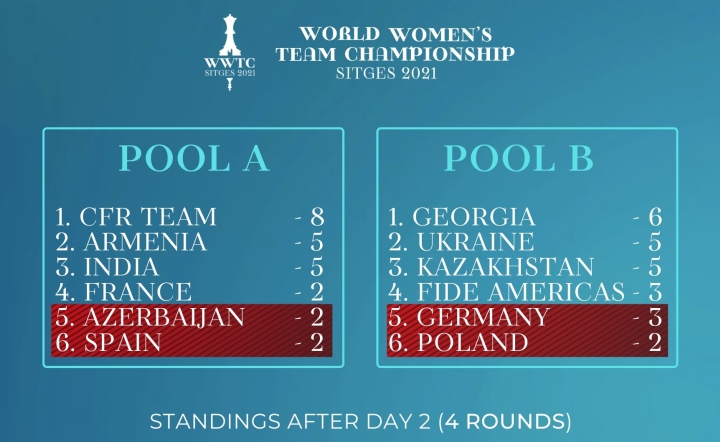
The second day of play brought almost no changes to the standings: the Russian stars, playing under the denomination “CFR Team” due to the WADA sanctions, remain the unchallenged leaders in pool A, followed by Armenia and India. In group B, Georgia tops the standings, being the only team still undefeated in its pool. The leader of the Russian team, Aleksandra Goryachkina, celebrated her 23rd birthday by scoring an important victory over Gunay Mammadzada. The World Championship finalist made chess look easy: on the black side of a Berlin Defense, she opened the a-file, activated her rook, won a pawn, and converted her advantage flawlessly. It was not the best of days for the Azerbaijani players: Mammadova blundered a pawn against Kosteniuk that cost her the game, while Turkan, the youngest of the Mamedjarov clan, allowed a rook lift that ended in an elegant mate attack by Kashlisnkaya. Shuvalova wrapped up the team victory (3½-½) with a draw against Fataliyeva. In the second round of the day, CFR Team defeated a direct rival, India, with victories by Kosteniuk and Lagno. Goryachkina, with a better position, allowed a perpetual check. At the bottom of the table, the host team beat France, which gave Spain some hope to qualify. However, a harsh defeat against Armenia in the next round sent the Spaniards back to the last position in the standings. Only a victory by a wide score margin against Azerbaijan, and a bit of luck, could allow Spain to stay in the competition. In pool B, Georgia had a perfect start of the second day after crushing Germany by 3½-½. Despite the absence of Bela Khotenashvili, who had to withdraw from the team at the last minute, the Georgians seem to be in good shape. They are so far the only team that hasn’t suffered a defeat in group B, having scored two victories and two draws. They ended the day with a 2-2 against Poland, a team that, surprisingly, is the tailender after four rounds, a lacklustre performance for a squad that usually outperforms expectations at team events. The last round of the pools stage, the fifth, will take place on Wednesday, at 15:00. The competition will then move to the knockout playoff. Text: David Llada Photo: Niki Riga Official website: worldwomensteams.fide.com
Carlsen’s lead cut to 4 points but So blows chance to take full advantage
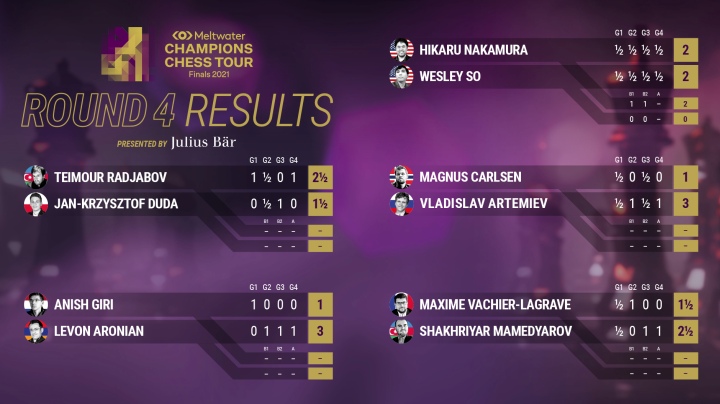
Wesley So blew a chance to get within two points of Magnus Carlsen as both the frontrunners lost in a dramatic day at the Meltwater Champions Chess Tour Finals. The American started off 5 points behind Carlsen on the leaderboard and could have cut that to 2 with a much-needed win over fellow countryman Hikaru Nakamura. But after the pair played out four ultra-safe draws to leave their match hanging on tiebreaks, So then crashed out in the blitz section. Instead of taking the maximum 3, he had to settle for knocking a single point off Carlsen’s lead. It was an opportunity squandered for So who must have been left regretting his tactics in the rapid section of the game. So left the broadcast without being interviewed after the defeat and so wasn’t able to explain. So’s loss came after Norway’s World Champion was downed by Russia’s latest big chess hope Vladislav Artemiev, who beat him twice in a nervy Round 4 match. Artemiev showed nerves of steel as he calmly steered the fourth game in his favour as Carlsen launched increasingly desperate attacks. The Russian had missed a chance of his own to finish off Carlsen in three as he needlessly offered up a draw by repetition while in a strong position. Carlsen, at that point, breathed a sigh of relief. Artemiev, who was the runner-up in both the Goldmoney Asian Rapid and the Aimchess US Rapid, was always going to be a dangerous opponent for the title-chasing Carlsen. Artemiev showed exactly why in the second game as he crashed through to go ahead and set up a difficult evening for Norway’s world number 1. Carlsen, it seemed, played overly risky chess when he could have locked the game down. Artemiev said afterwards that he had tried to play more aggressively against the champion, and his plan worked well. He added: “It’s a little surprise for me that I play in the Finals tournament because before that, I only played in three tournaments.” It was a bad day at the office for the Dutch number 1 Anish Giri, who lost three games in a row to a resurgent Levon Aronian. Shahriyar Mamedyarov, meanwhile, scored his first match-win in the Finals with a 2-5-0.5 victory over the Frenchman Maxime Vachier-Lagrave. The last result was a 2.5-0.5 win for Teimour Radjabov who beat the Pole Jan-Krzysztof Duda. The Finals of the 2021 Meltwater Champions Chess Tour sees the world’s best chess players face off across nine rounds of rapid chess from September 25 to October 4. Tune in on www.chess24.com, YouTube or Twitch starting at 17:00 CET each day. For further information, please contact: Leon Watson, PR for Play Magnus Groupleon@chessable.com+44 7786 078 770
Training program for arbiters of online and hybrid events continues

When the COVID-19 pandemic hit the world over a year ago, people learned new ways of living. Online chess tournaments already existing before the pandemic became a new reality. With the number of online and hybrid tournaments increasing, it became obvious that the role of arbiters in such events is not the same as in OTB tournaments. Although playing chess online is no different from playing it in person, being an efficient online arbiter means not only ensuring that laws of chess are followed and acting in the “best interest of the competition”, but having proper knowledge of the online/hybrid chess regulations, supervising such games, knowing online platforms, general concepts, fair play and basic tools to operate. Earlier this year, the FIDE Arbiters’ Commission released a new program to support the development of arbiters in online and hybrid events. Two levels of seminars included an 8-hour basic course for online arbiters and local chief arbiters in hybrid events, and an 8-hour advanced course to cover the roles and duties of chief arbiters in such tournaments. “We wanted to design a course which would not be limited to teach technical aspects about one or two platforms but highlight to the arbiters the questions they would have to ask themselves about the tools and platforms when being involved in an online tournament. The only technical platform studied in detail was Zoom, as this is the most used one and is a must for online supervision”, – says the leader of the project Laurent Freyd, Chairman of the Arbiters’ Commission. – “This training program was a way to position the FIDE Arbiters’ Commission as a real development actor in the chess community! The collaboration with more than 145 federations was excellent, and I wish to continue in that direction with some other innovative programs for arbiters coming soon”. The initial training program was conducted from April to July 2021 and got positive feedback from many participants. “Thank you very much for organising the online/hybrid arbiters’ course. You have done a great job; the new online tool has positively inspired me. In the courses, I found the many suggestions for chief arbiters helpful. I don’t remember to have seen anything similar in the FA/IA education. The professionalism shown here has impressed me positively”, – wrote Walter Kastner, General Secretary of the Austrian Chess Federation. Following the success of the initial courses, the recurring training sessions for arbiters in online and hybrid events are announced. Basic course, opened to any arbiter with a valid FIDE license, is scheduled from October 4-7, 2021, 19:00 to 21:00 CEST, while advanced course, for arbiters who attended the basic course or have proven participation in at least 2 World or Continental online events, is scheduled from 11-14 October 2021, 19:00 to 21:00 CEST. The team of the project include Alex McFarlane, Education Team Leader, Nebojsa Baralic, Secretary of the Arbiters’ Commission and 4 official FIDE lecturers with strong experience of online events – IA Shohreh Bayat, IA Laurent Freyd, IA Aris Marghetis, IA Omar Salama. Entry fees are 30 € for a single course or 50 € if you register to both courses. The deadline for registration and payment to FIDE is September 30th, 2021. Contact and registration: Nebojsa Baralic, FIDE ARB Secretary (secretary.arbiters@fide.com)
FIDE Women’s World Team Championship: CFR Team and Georgia take the lead
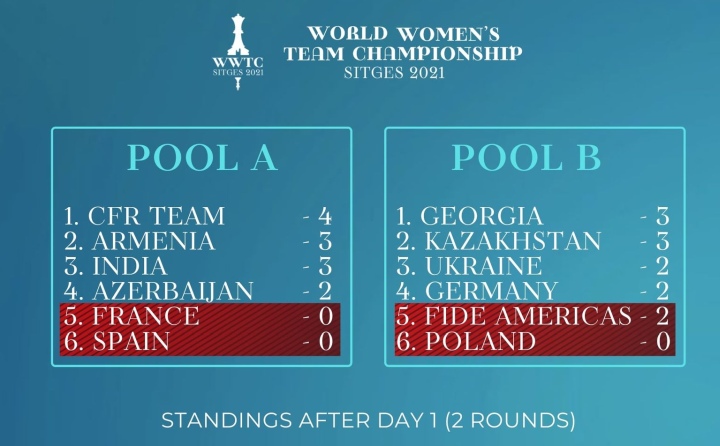
The FIDE Women’s World Team Championship kicked off yesterday in the coastal touristic resort of Sitges, a mere 25 km ride from Barcelona airport. This town is not new to chess: in 1934, it already hosted an international tournament of the first level, with the participation of Tartakower, Spielmann, Lilienthal, and the legendary Spanish champion Ramon Rey Ardid. The local chess club, “Casino Prado”, was founded that very same year and has remained very active during all these decades. In recent times, this tradition found continuation in the Sunway Chess Festival: its 8th edition took place last December, being one of the very first open tournaments being held since the start of the pandemic. The Women’s World Team Championship is played this year under a new format: two pools of six teams each, followed by a knock-out playoff with the eight best teams. The time control has been reduced to 45 minutes + 10 seconds per move, with two games to be played each day. This format allows for the tournament to be played in just 7 days instead of 12, like previous editions, which makes it easier to stage, and more likely to count on the participation of all the top guns. More importantly, it is also expected to raise the interest of the fans, with the knock-out adding some intrigue and excitement. “It is an experimental format, and we are not planning to make it extensive to the Olympiad or other tournaments. After holding this event, and the World Teams one next year, we will carefully weigh the pros and cons. We are aware that breaking is easier than building, so no changes are introduced unless there is strong confidence that they are needed. That was the case with the World Teams, and we hope that the new format will breathe new life into this competition”, said FIDE’s Director General, Emil Sutovsky. One first consequence of these changes became evident during the first day of play for those lucky ones who were present in Sitges: the new format is great for team building. In the break between the two rounds, all the team members gathered together around their respective coaches in the lounge, discussing the strategy for the next match, or simply trying to boost team morale. This created a very nice atmosphere, barely seen on any other chess event before. Team Azerbaijan had a lot to discuss Talking about team morale, the Russian players seem to be highly motivated, and they won their first two matches by storm: 4-0 against Spain and 3½-½ against France. The squad, composed of Kosteniuk, Goryachkina, Lagno, Shuvalova and Kashlinskaya, competes under the denomination “CFR Team”, due to the WADA sanctions against Russia. Athletes from this country cannot wear their flag or use the name “Russia” at any event in the category of World Championship. Fortunately, these restrictions will not apply during the Chess Olympiad next year in Moscow. Different name, but the same formidable team: the Russian ladies only conceded a draw in the game between Aleksandra Goryachkina (who celebrates her birthday today) and Marie Sebag (FRA), and are the clear leaders in their group (A), with two victories and 7½ points. They are followed by India and Armenia, both with one draw and one victory and 4½ board points. Vaishali, for India, and Sargsyan, for Armenia, won both their games on day one. The host team, Spain, will struggle to qualify after having lost both matches. CFR, first, by 4-0, and then India, by 2½-1½. A disappointing start that relegates them to the last position. In group B, no team shows the same dominance as the Russian in the other pool. Georgia and Kazakhstan are on top of the standings with one victory and one draw each. The Georgians lead, with five board points out of eight games. The major surprise was the bad result by the Polish team, that lost both their matches. The winners of a silver medal at the Baku Chess Olympiad 2016 had a bumpy start: one of their top players, Karina Cyfka, had to be replaced at the last minute before travelling to Sitges. Then, they lost both their matches by 1½-2½, first against FIDE Americas and then against Germany. The third round will start today at 15:00 CET. Text: David Llada Photo: Niki Riga Official website: worldwomensteams.fide.com
Carlsen’s lead narrows as pressure rises in Tour Finals
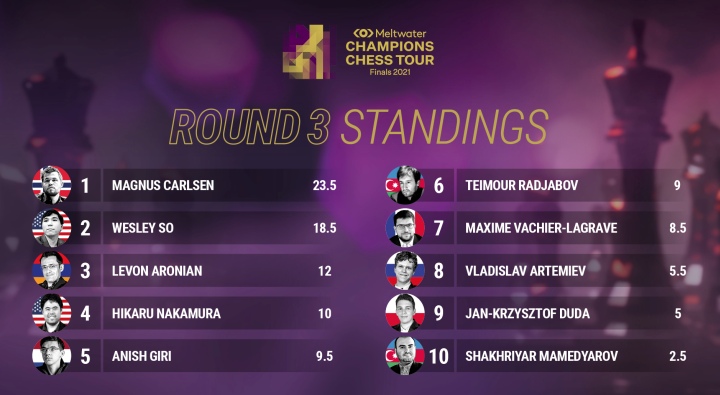
The pressure ramped up in the $300,000 Meltwater Champions Chess Tour Finals today as Magnus Carlsen had a point chipped off his lead. Norway’s World Champion needed a blitz playoff to beat the tricky Frenchman Maxime Vachier-Lagrave, who was dangerous right to the death. Carlsen got pegged back twice in the match and had to settle for two rather than three points. He is, however, one round closer to victory. “I feel very good,” said Carlsen after his win. “ All eyes were also on the leader’s nearest rival, Wesley So, who picked up the maximum in his match against Vladislav Artemiev to keep the pressure up. The American is now 5 points behind Carlsen with six rounds to play – but these two are yet to face each other. So said afterwards that Carlsen had a “huge lead”, but the tournament still had a long way to go. Carlsen had started perfectly with a quickfire win in game 1. Following a draw in game 2, the third was then a game to forget for the champ. Carlsen struggled out of the opening and never recovered. Finding himself in a hopeless position, the 30-year-old was eventually forced to resign. The Frenchman levelled the score. The fourth then ended in a draw as the match headed into tiebreaks. Carlsen crashed through in the first to break MVL’s resistance before a draw in the second handed him the win. America’s blitz king Hikaru Nakamura had a strong return to form as he posted a 3-1 win over Levon Aronian. The loss effectively ends Aronian’s faint hopes of catching Carlsen and So. Meanwhile, Shakrhiyar Mamedyarov and Jan-Krzysztof Duda, two of the tournament’s most exciting players, traded blows in an explosive match that went to tiebreaks. Duda took the first blitz game, and then a draw secured the two-point win. Anish Giri also launched a comeback to level his match 2-2 against the super-solid Teimour Radjabov before turning the screw to win in the tiebreaks. The Finals of the 2021 Meltwater Champions Chess Tour sees the world’s best chess players face off across nine rounds of rapid chess from September 25 to October 4. Tune in on www.chess24.com, YouTube or Twitch starting at 17:00 CET each day. For further information, please contact: Leon Watson, PR for Play Magnus Groupleon@chessable.com+44 7786 078 770
Vojtěch Plát and Karolina Pilsova win Czech Championships
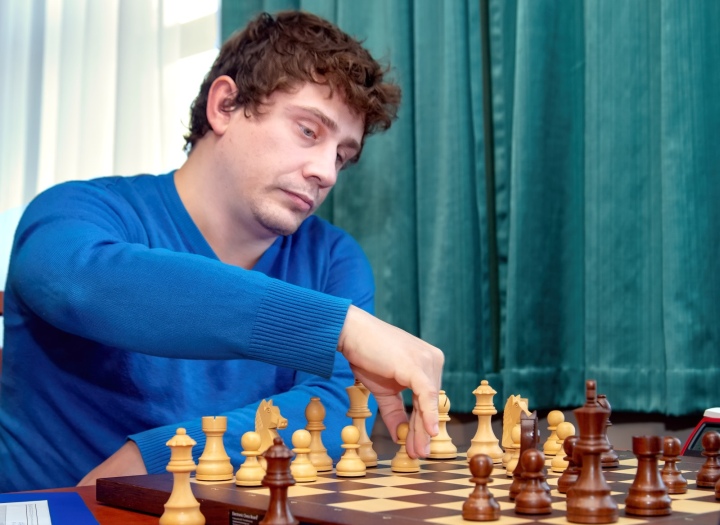
Vojtěch Plát (pictured above) and Karolina Pilsova won the Czech chess championship that took place in Zlin, a city in southeastern Moravia. Both events were ten-player round-robins with classical time control running from September 11-19 (women) and September 17-26 (open). With two top-rated Czech players (David Navara and Viktor Laznicka) missing in the open competition, Vojtěch Plát had a great showing. The 27-year old GM from Prostejov scored 6½ points, earned the second national title in his career and became the only unbeaten participant in the tournament. GMs Štěpán Žilka and Jan Krejčí finished just a half point behind the champion. Žilka who had a slightly better Sonneborn-Berger took silver, whearas Krejčí had to settle for bronze. Final standings open: 1 GM Plat, Vojtech 2536 6½ 2 GM Zilka, Stepan 2570 6 3 GM Krejci, Jan 2539 6 4 GM Babula, Vlastimil 2561 5 5 GM Stocek, Jiri 2584 4½ 6 GM Nguyen Thai Dai Van 2594 4 7 IM Zwardon, Vojtech 2498 4 8 GM Petr, Martin 2508 3½ 9 GM Polak, Tomas 2545 3 10 FM Mladek, Richard 2361 2½ By an odd coincidence, in the women’s tournament, the champion Karolina Pilsova also netted 6½ out of 9 and suffered no defeats either. Karin Nemcova and Magdalena Miturova tied for the second place with the former taking silver thanks to better tiebreaks. Final standings women: 1 WGM Pilsová, Karolína 2280 6½ 2 Němcová, Karin 2137 5½ 3 WIM Miturová, Magdaléna 2219 5½ 4 WGM Petrová, Kristýna 2285 5 5 WIM Richterová, Nataša 2160 5 6 WIM Novosadová, Kristýna 2107 4½ 7 WIM Kaňáková, Natálie 2180 4 8 WGM Kulovaná, Eva 2164 3½ 9 WFM Laurincová, Kristýna 2070 3 10 WGM Sikorová, Olga 2205 2½ Photo: Vladimír Jagr Official website: chess.cz
FIDE and Establishment Labs announce landmark sponsorship agreement for women’s chess

September 27, 2021 – The International Chess Federation (FIDE) announced a landmark partnership agreement with Establishment Labs, a global medical technology company. The partnership is the first-ever corporate sponsorship agreement specifically aimed at supporting women’s chess events. The agreement will continue through 2022, a year that has been designated by FIDE as “The Year of Women in Chess”. Establishment Labs is a global medical technology company dedicated to improving women’s health and wellness, principally in breast aesthetics and reconstruction. The company has developed a comprehensive portfolio of advanced breast products, branded as Motiva®, that include a number of innovative and patented features designed to deliver improved clinical and aesthetic outcomes. Establishment Labs is listed on the NASDAQ exchange under the ticker ESTA and its products are available in over 80 countries around the world. “Establishment Labs has championed women’s health and wellness for over a decade and our partnership with FIDE to promote professional women’s chess is the natural embodiment of all that we stand for as an organization,” said Juan José Chacón Quirós, Founder and CEO of Establishment Labs. “We are proud to support these exceptional women and are continually inspired by their achievements and determination.” Among the events sponsored by Establishment Labs will be the FIDE Women’s Candidates Tournament and the FIDE Women’s World Championship Match. The first event in which Establishment Labs will be a partner is the FIDE Women’s World Team Chess Championship, which kicked off on Sunday, September 26 in Sitges, Spain. “One in eight women will develop breast cancer in her lifetime, and in most of the world, the number of women receiving a breast reconstruction is less than 10% with waiting times as long as eight years,” said Dana Reizniece-Ozola, FIDE’s Managing Director. “Many women undergo mastectomies as part of their treatment. Though lifesaving in many cases, a mastectomy may cause cancer survivors to feel mournful after losing an essential part of their body. Breast reconstruction is not only about repairing physical damage but also about repairing and even preventing psychological trauma. At FIDE, we value Establishment Labs’ commitment to women’s health and wellbeing. The company supports expanded access to breast reconstruction and has been a pioneer in offering technologies that can improve the outcomes for these women. We are grateful for their sponsorship.” Establishment Labs embraces several international sustainability standards in its business practices, including the United Nations Sustainable Development Goals (SDGs) and the Women’s Empowerment Principles to promote gender equality and women’s empowerment. The company also supports breast health programs and quality breast reconstruction initiatives in a number of countries. All of these activities are part of the company’s purpose as a global corporate citizen: “Putting Women First: in health and wellbeing, science and technology, and our communities.” Please visit the Establishment Labs’ website for additional information at www.establishmentlabs.com and motiva.health.
Chess for children with ASD seminar: Registration deadline approaches

The International Chess Federation, together with its Chess in Education Commission, Commission for the Disabled and FIDE Social Commission, is organizing the 2nd FIDE Educational Seminar of Infinite Chess Project’ Chess for children with an autism spectrum disorder. Learn and teach’. The event will take place on October 2-3, 2021, at 15:00 – 18:00 CEST. For registration, please, please fill the form before September 30, 2021. On October 01, all the registered participants will receive the access link to the online seminar. The participants who successfully pass a test will get a certificate of attendance. The seminar will give core knowledge on using chess in educating kids with ASD. Teachers and coaches working with children with an autism spectrum disorder will share their experience, explain their methodology and present the running projects. Among them, a special chess club for children with autism, which opened in Minsk in the FIDE Chess Academy in September 2019, with the support of the Belarusian Chess Federation under the leadership of FIDE Vice-president Anastasia Sorokinа. The two-year-long project was launched under the guidance of an experienced coach, WIM, FIDE Trainer, Natalia Popova. Boys and girls aged between 6 and 12 immersed themselves with great interest in the game of chess. Fifteen pupils divided into four groups have been learning to play chess for nine months. With the help of different teaching methods and memorization techniques, kids were introduced to chessboard and pieces, learned how to play, but more importantly, chess classes had a positive impaсt on their communication abilities, speech, thinking, self-esteem and confidence. “My son wants to continue attending chess classes; he is always looking forward to playing chess on Sundays,” says the mother of Peter Boksha, one of the participants of the project. “Peter is not ready to participate in mini-tournaments yet. Still while studying chess, he improved his visual memory, thinking, he can concentrate attention longer, and tries to solve logic problems for five or six-year-old children”. The classroom equipment of the chess club was designed specifically for children with ASD. Thus, the demonstration board and pieces are made in a special colour scheme: squares on the board are white and dark grey, and the pieces are white and black with contrasting edging so as not to merge with the squares. Every child has his own timer on the table with a smiley indicating the break so that they can see how much time is left until the end of the lesson. Fitball chairs for every child are used during the breaks for relaxation. “Dasha is so enthusiastic about going to chess classes; she worries a lot when we can’t attend them. She learned how to play, understands the logic of chess. Now she feels the desire to win; I didn’t notice it before. She begins to understand when she is being deceived in the game and follows the game’s progress. Still, we need to train her endurance and perseverance,” says the mother of Darya Bashlakova. Presentation of the project (pdf) Seminar presentation (pdf) Apart from the project leader Anastasia Sorokina, FIDE Vice-President and the project supervisor Dana Reizniece-Ozola, FIDE Managing Director, the seminar speakers are: Natalia Popova – WIM, FIDE Trainer, Trainer of the FIDE Chess Academy in Belarus, leader of the two-year-long project teaching chess to children with autistic spectrum disorder (Belarus); Ala Mishchanka – Special needs educational assistant, more than 15 years of experience (Canada); Dr. Anna Charchyan – researcher in Chess Research Institute at ASPU named after Kh.Abovyan, PhD in Pedagogy, Lecturer faculty of Special and Inclusive Education at the Department of Speech Therapy and Occupational Therapy (Armenia); Dr. Lilit Karapetyan – Senior researcher in Chess Research Institute at ASPU named after Kh.Abovyan, PhD in Psychology, Lecturer at the Department of Special Pedagogy and Psychology (Armenia). Dr. Sandra Maria Guisso, Researcher with more than 15 years of experience (Brazil) Luis Blasco de la Cruz, International Arbiter, CEO Madrid Chess Academy, Member of EDU FIDE Commission (Spain). Special guests from the French Chess Federation: Franck Droin, a member of the International Commission of the French Chess Federation and Dr Maurice Bensoussan, President of the French Association of Psychiatry. Moderator of the event: Judit Sztaray, FIDE Arbiter, Developmental Instructor, General Manager of Events and Youth Outreach at Mechanics’ Institute. For more information, please contact: Anastasia Sorokina, FIDE Vice President a.sorokina@fide.com Nadezhda Krauchuk, project coordinatornadzeya.krauchuk@gmail.com