

Carlsen storms 6 points clear in Tour Finals as So beaten
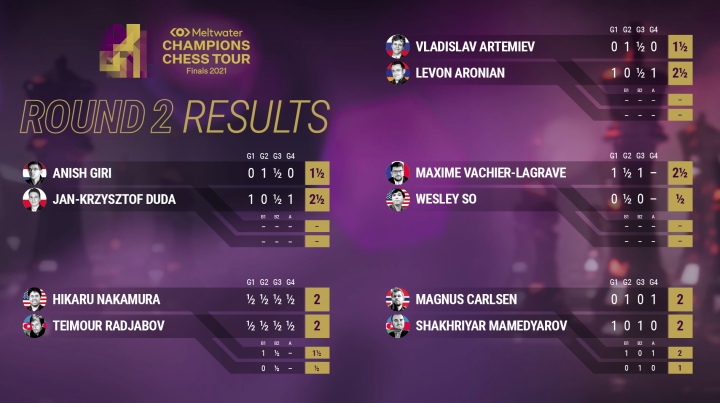
Wesley So’s hopes of catching Magnus Carlsen in the Meltwater Champions Chess Tour Finals took a severe blow today as he crashed to defeat in just three games. The American suffered a painful 2.5-0.5 collapse against France’s top player Maxime Vachier-Lagrave that leaves his challenge teetering on the edge of a precipice. So’s loss was made worse when Carlsen went on to come back twice against the dangerous Azerbaijani Shakrhiyar Mamedyarov before finally prevailing in tiebreaks. It was an epic encounter that left the champ looking thoroughly exhausted afterwards. But Carlsen said he’d have no problems coming back with energy in Round 3 of the $300,000 event. Carlsen had lost the opening game in just 20 minutes and then, after a masterful second game pulled him level, fell behind again. But in a must-win situation for the Norwegian in game 4, Mamedyarov blundered and Carlsen converted. The blitz tiebreaker saw Carlsen win the first game as Mamedyarov fell into a trap. Then, in the second, it was Carlsen who blundered to leave the score 1-1. Carlsen, however, was just too fast against his older opponent in the Armageddon decider. It meant Carlsen banked two vital and hard-fought points that put him six ahead of So. With just seven rounds remaining, the American now has a mountain to climb to overhaul Carlsen. Asked if defeat had scuppered his chances of catching Carlsen, So said: “I just want to take it one round at the time; the tournament is very long.” In the battle for placings, Poland’s World Cup winner Jan Krzysztof Duda bounced back from being humbled by Carlsen yesterday to beat Anish Giri 2.5-0.5. Levon Aronian, playing from St Louis, also came back from a Round 1 defeat against MVL to overcome the Russian Vladislav Artemiev 2.5-0.5. There was also a hint of controversy in the tie between Hikaru Nakamura and Teimour Radjabov as the pair played out four quick draws before settling the match in tiebreaks. Grandmaster David Howell, who was commentating on the action from Play Magnus Group’s Oslo studio, said their safety-first tactics were “disrespectful” to chess fans. Nakamura eventually prevailed in the Armageddon section to pick up 2 points, while Radjabov took 1. The Finals of the 2021 Meltwater Champions Chess Tour sees the world’s best chess players face off across nine rounds of rapid chess from September 25 to October 4. Tune in on www.chess24.com, YouTube or Twitch starting at 17:00 CET each day. For further information, please contact: Leon Watson, PR for Play Magnus Groupleon@chessable.com+44 7786 078 770
Fast-start for Carlsen on first day of Finals
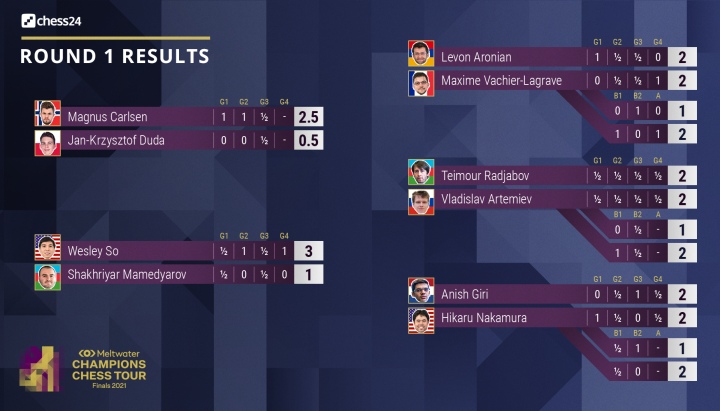
Magnus Carlsen declared he was “quite happy” today after getting his Meltwater Champions Chess Tour Finals campaign off to a perfect start. The World Champion savaged Poland’s World Cup winner Jan-Krzysztof Duda with two wins and draw to end the match with a game to spare. Carlsen began the $300,000 event with a four-point head-start over his closest rival Wesley So as a result of topping the Tour leaderboard over the course of the season. And Carlsen showed no sign of giving up that hefty advantage with a quick-fire win that picked up the maximum three points. The pressure was well and truly piled up on So, who faced a tough opponent in Azerbaijan’s Shakrhiyar Mamedyarov. But the American, who beat Carlsen in two events on the Tour, responded to win 3-1 and stay within touching distance of the lead. “It’s a very long tournament so one match at a time,” So, playing from St Louis, said. So added that he would go for it and that playing catch-up he has nothing to lose and everything to gain. “Someone’s gotta catch Magnus! He is in a comfortable lead and the best player, but someone’s gotta try. I just wanna play good chess.” Carlsen, meanwhile, will himself face Mamedyarov in Round 2. “I don’t think I have played him in a KO match on the Tour, so it should be interesting,” Carlsen said. “I know it won’t be easy.” While Carlsen’s fast-start was an ominous sign for the rest of the field, for Duda it was also a disheartening day to forget. “I’ve played terribly today,” Duda said, who has been a thorn in Carlsen’s side this year. “I was out of form and blundered tactics all the way.” Asked how he would pick himself up for the next round, Duda added: “Hopefully, tomorrow I will forget about this performance.” In the race for placings, all three of the other matches went to tiebreaks. After four draws, Vladislav Artemiev beat Teimour Radjabov in the blitz section while Dutch number 1 Anish Giri scored a win over Hikaru Nakamura. The final match to finish between Levon Aronian and France’s top player Maxime Vachier-Lagrave went to an Armageddon play-off. It ended with a scramble as Aronian, winning on the board, ran out of time to leave MVL the victor. The Finals of the 2021 Meltwater Champions Chess Tour sees the world’s best chess players face off across nine rounds of rapid chess from September 25 to October 4. Tune in on www.chess24.com, YouTube or Twitch starting at 17:00 CET each day. For further information, please contact: Leon Watson, PR for Play Magnus Groupleon@chessable.com+44 7786 078 770
FIDE World Championship 2021: Schedule, hotels, and health & safety measures

In a couple of weeks from now, the website for the FIDE World Championship Match in Dubai will be launched, and tickets for spectators will go on sale shortly after. In the meantime, we would like to share with you the schedule for the games, a list of hotels where visitors and journalists can enjoy preferential rates, and the current health and safety measures that one should take into consideration before visiting Dubai and Expo 2020. SCHEDULE: HOTELS: In the document linked below, you can find a table with the official hotels where you can book a room at preferential rates. In order to get these discounted rates, please book directly with the hotel and mention to them that you are a visitor for “EXPO – FIDE Chess Championship”. Preferential rates at official hotels: HEALTH AND SAFETY: We would also like to share with you the most up-to-date information regarding health and safety measures for all those visiting the FIDE World Championship match, Expo 2020, and Dubai. As of September 15, 2021, all visitors aged 18 years old and above must present a valid vaccination certificate issued by the competent National Authority or present a negative PRC taken within the previous 72 hours in order to enter the Expo site. Proof of vaccination or PCR results must be shown by the visitor at the entry gate. Non-vaccinated ticket-holders who have not been tested within the 72-hour period can benefit from the PCR testing facilities available at and or near the Expo2020 site. EXPO 2020 Covid-19 Guide (pdf) You can find more information on this topic at the Expo 2020 website. MEDIA ACCREDITATION: The accreditation process is a four-step procedure. 1) Please read FIDE’s media accreditation policy. 2) Send an email to press@fide.com, indicating the exact dates you are planning to visit the match and the type of accreditation you will require (A, B, or C). 3) Register to access Tawassul, the media information system at https://media.expo2020dubai.com/. All media, even if they are not yet accredited for Expo, can register for access to Tawassul. Tawassul is an essential operational tool connecting media to important information and updates on facilities and services such as media accreditation and permits for Expo. 4) Once registered for Tawassul, the media will be able to submit an Expo 2020 Media Accreditation expression of interest. Only one Media Accreditation expression of interest is to be submitted per organisation within Tawassul to commence the accreditation process. Typically, you will receive confirmation after 4-5 days. There are no important space limitations at the Expo press center, which is located 350 from the playing hall. However, due to COVID regulations, the place allocated for journalists at the venue itself will be limited. Preference will be given to accredited camera crews and news agencies.
Mednyi Vsadnik and South Ural clinch European Club Cup titles
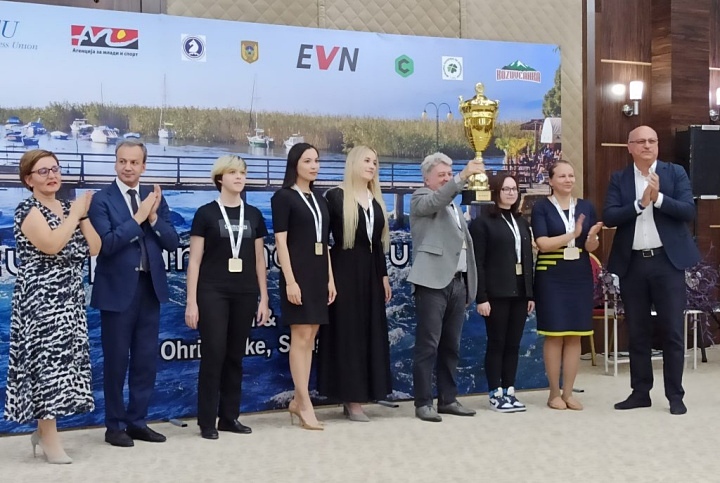
Mednyi Vsadnik (Russia) and South Ural (Russia) are the winners of the European Club Cup and European Women’s Club Cup. The 36th European Club Cup and the 25th European Club took place Struga, Ohrid Lake, North Macedonia from September 17-25 in two different venues: Hotel Drim (Women’s event) and Hotel Izgrev (Open event). The total prize fund of the events amounted to €44,000. The open event attracted 38 competing in the 7-round Swiss tournament. The highest-rated team, Alkaloid lost two matches and finished just 8th, but other favourites and first of all, the eventual champion Mednyi Vsadnik from St-Petersburg (Russia) delivered on the promise. The team headed by Peter Svidler and Andrey Esipenko conceded just one team-point in the match with the runner-up AVE Novy Bor (Czech Republic) and deservedly took the first prize of €10,000 and the title, second in its history. AVE Novy Bor kept pace with the champions for most of the tournament distance, but a tie with Alkaloid in the penultimate round cost them a critical team point that separated them from the first place. Vugar Gashimov was coming into the final round in the sixth position, but the victory over Alkaloid catapulted the Azerbaijani to third place in the final standings. FIDE President Mr Arkady Dvorkovich, ECU President Mr Zurab Azmaiparashvili, ECU Vice President and FIDE Managing Director Mrs Dana Riezniece-Ozola, ECU Secretary-General Mr Theodoros Tsorbatzoglou, President of North Macedonia Chess Federation Mrs Aleksandra Gakidova took part in the awarding ceremony. Final standings: 1 Mednyi Vsadnik RUS 13 2 AVE Novy Bor CZE 12 3 Vugar Gashimov AZE 11 4 KPRF RUS 10 5 Skakfelag Selfoss ISL 10 6 Team XtraCon DEN 10 7 Sloven Ruma SRB 10 8 Alkaloid MKD 9 9 Silla-Valencia Origin of Chess ESP 9 10 Schachgesellschaft Riehen SUI 9 The women’s competition, held in a different format (an 8-team round-robin), was dominated by South Ural (Russia). The Russian team won all the matches and clinched the title and the first prize of €6,000 with a round to spare. Monte-Carlo (pictured above) finished second three points behind the champion, GRECO-Kyiv Chess Federation came third. Final standings: 1 South Ural RUS 14 2 Monte-Carlo MNC 11 3 GRECO – Kyiv Chess Federation UKR 10 4 SK Erste Bank Baden AUT 9 5 Kumanovo MKD 4 6 Tajfun – SK Ljubljana SLO 3 7 Alkaloid MKD 3 8 MSK Centar MKD 2 Photo: europechess.org and official website Official website: europeanchessclubcup2021.com.mk/
Magnus Carlsen: “Ian can be very difficult to play against”

This extensive interview with the World Champion, courtesy of the Chess Federation of Russia (CFR), was recorded just before the closing ceremony of the FIDE World Cup when the long tournament came to an end. Magnus Carlsen talked frankly about various things – from the performance in Sochi and the World Championship match with Ian Nepomniachtchi to chess in the COVID-10 era and the future of our sport. The video version is available on the FIDE YouTube channel. – Magnus, please sum up your performance at the FIDE World Cup. – Overall, I’m satisfied with the performance. The classical part was very, very good, with eight wins and no losses. I think everybody, when playing such a tournament, aims to win it, but it’s very difficult against such opposition in the knockout format, and I have to say that winning six out of seven matches is something to be generally happy with. Winning the World Cup has been a goal of mine for some time, so that goal still hasn’t been achieved, but I guess it’s good to have something to strive for. – This time, you were closer to win it than ever before. What do you think went wrong? – I think there was really only one weak moment, the match against Duda. Obviously, he pressured me a bit with the white pieces, but I think I handled that fairly well in the classical part. Then, that one game was a combination of me losing my nerves, and clearly, he was the one who played the strongest chess among my opponents. So if I were going to lose to somebody, it would be him, but I do think that I would win that match more often than not, obviously. I knew coming in that Duda was not only strong in classical but also very good at rapid and blitz; he was going to be a strong opponent. That’s what happens in this format; sometimes, you lose to strong opponents if you play enough rounds. – Yes, knockout is very cruel. Do you think that the chess world needs more knockout events? – I’ve always been very much in favour of knockout events, I think that, in a way, they are the fairest, so I’m all for that. I think the public also likes it. There’s drama in every round; there’s always going to be a decision. It’s unbelievably cruel for the players… – But still, it’s fair. – But still, that’s the way it is, and I think there’s no particular harm for us in experiencing those emotions. Even though it’s cruel, the good thing about the knockout system is that when you lose, you can just go home. So, it’s cruel to be out, but at least you don’t have to suffer in a bad turn of form for weeks. – Yes, and this time the players also faced other problems. Were the anti-Covid measures here in Sochi a problem for you? – I thought that, in general, people here were pretty relaxed about Covid. Obviously, there was a scare at the start with the positive tests, but I’m happy – as far as I know, everybody is… – Negative. – Yes, everybody is OK now. Personally, I don’t really mind the mask and the testing and everything so much. It’s become a kind of normalised, and I’m just happy that we were able to have this tournament without a lot of problems. – Sometimes, there are comments when you take part in events that are a part of the World Championship cycle. The comments imply that you’re somehow interfering in the qualification system. What can you answer to those who say it? Would you consider playing in the Candidates Tournament if you had such a possibility? – That’s an interesting question. So far, both in the World Cup and the Grand Swiss, I hadn’t reached qualifying spots, but you can say that yes, I knocked out people along the way. I mean, personally, for me, the World Cup is such a prestigious and interesting event, so I’m very happy to take part in it, and I don’t think it’s up to me to decide whether I should be allowed to play or not. I mean, I’m very happy to take part, even though I understand that to some it can be a bit confusing to see the system, but it’s not up for me. – So, if you’re allowed, you’re taking part, right? – In general, yes, I don’t have any ethical problems with it (laughs). – Speaking about the World Championship matches. Since 2013, you have played in four matches. Do you enjoy this type of chess event? Which match was the most difficult for you, and which was the most memorable? – I would say that the most difficult match for me was the one against Karjakin. I started out fairly OK, putting serious pressure. I was winning in both the third and fourth games, but after I failed to win them, I was sort of cut out of rhythm a bit, and I was very, very close to losing the match. I never had a good feeling at all during that match, so that was definitely the most difficult and the most stressful and also the least enjoyable one for me. I guess the most memorable was the first match against Anand, since everything was new, and I was the challenger. But I must say that the most enjoyable for me was the match against Caruana in 2018. – Why? – I just had a different feeling during that match since I felt that Caruana was pretty much equal to me in rating at that point, and I felt that he was a completely equal opponent. That made it easier for me, because I didn’t feel the same way I needed to win the match. I didn’t feel that I was playing someone whom I should beat. So, I would say that the match in London was a
World Chess Championship for People with Disabilities set for November
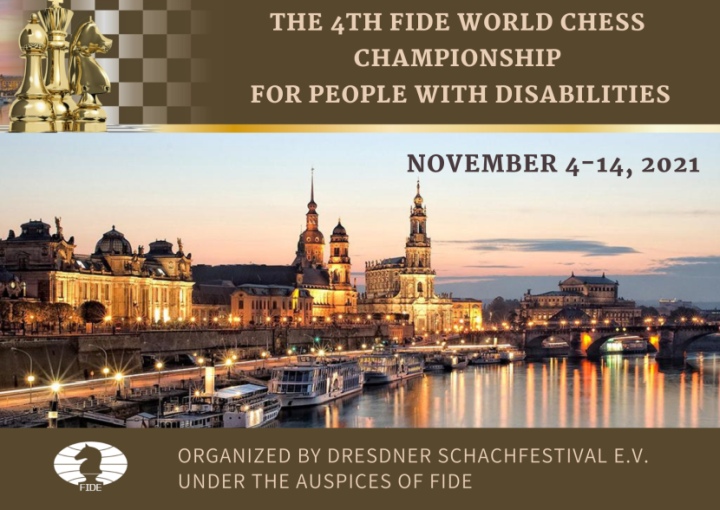
The International Chess Federation is excited to announce the 4th FIDE World Chess Championship for People with Disabilities, to be held from 4-14 November 2021. This year the championship, organized by Dresdner Schachfestival e.V. under the auspices of FIDE, will be held online due to continuous Covid-19 restrictions across the world. The fourth edition of the World Chess Championship for People with Disabilities is expected to bring together around 100 players from 50 countries, satisfying their needs for communication, self-esteem and recognition at a hard time of the pandemic. The 9-round Swiss tournament with 45 minutes + 30 seconds increment per move, starting from move 1, is an individual competition with an additional team ranking. Its winners will earn the titles of “World Chess Champion among Disabled 2021” in the individual ranking and “World Chess Team Champion among Disabled 2021” in the team competition. The first round kicks off on November 05, 2021; the winners will be determined after the last round, played on November 13. The official Closing Ceremony of the event is scheduled for November 14, 2021. Registration of the participants should be completed by November 1, 2021, using the online form. Tournament regulations (pdf) Further Information: Website: www.schachfestival.de worldchess-disabled.com/en/ Photo: Ismael Nieto
FIDE World Cup in Composing 2021: Final results

The final results of the 9th FIDE World Cup in Composing 2021 have been announced by the World Federation of Chess Composition (WFCC). The competition was jointly organized by FIDE and WFCC and run in eight sections from February 1 to September 21, 2021. In each section, only one composition by each author was acceptable, and joint compositions were not allowed. The tournament director Juri Bazlov (Russia), sent all compositions to the judges on the uniform and anonymous diagrams by July 15, 2021. After receiving the entries in anonymous form from the director, the judges considered the submitted compositions, determined their originality, difficulty, esthetic appeal, search for possible anticipations, and ranked them in the section. In each section, compositions in first, second, and third places were determined, as well as the entries receiving honorary mentions and commendations. In each section, the winner will receive a prize of €500, a Cup, a medal, and a certificate. Composers in 2nd and 3rd places will be awarded medals and respective certificates. The certificates for 1st-3rd places will be signed by the FIDE President. The prizes and other distinctions are to be presented to the winners at the closing ceremony of the World Chess Composition Congress 2021 in Rhodes (Greece). Andrey Selivanov, FIDE Chess Composition Director, greeted all the participants of the competition: “Congratulations to all for completing the 9th FIDE World Cup in the planned time frame! Congratulations to all winners and prize-winners! I wish new creative successes to all the participants! And, especially thanks to the director and the judges for their work!” 9th FIDE World Cup in Composing 2021 final results: A-Twomovers B-Threemovers C-Moremovers D-Endgame studies E-Helpmates F-Selfmates G-Fairies H-Retros and Proofgames
Vincent Keymer wins Hou Yifan Challenge

Vincent Keymer won the Hou Yifan Challenge with a round to spare, finishing two points ahead of Christopher Yoo and Praggnanandhaa. It is the second straight Julius Baer Challengers Chess Tour title for the 16-year old German who came out on top of the overall standings. Team Polgar won the team competition and a trip to Dubai during the Carlsen-Nepomniachtchi world championship match. Going into the final day of the competition, five players had a chance of taking first place, but the leader, Vincent Keymer, was considered the main favourite. Awonder Liang and Leon Mendonca dropped out immediately after losing to Volodar Murzin and Leya Garifullina, respectively, but Christopher Yoo and Praggnanandhaa were still in the race. In Round 15, the Indian fell to Pawel Teclaf and, despite his fantastic start of 9 out of 9, had to abandon his quest for the first prize. Christopher Yoo also lost (to Yahli Sokolovsky) and was coming into the penultimate round 1½ behind Keymer, who made a tough draw. In Round 16, the leaders had hopeless positions at some point, but both turned tables on their opponents to score victories. That meant that Vincent Keymer deservedly won the event with a round to spare and topped the Tour standings. The top-eight players in the overall standings qualified for the $40,000 knockout final from October 14-17, with the first prize of $10,000 and a spot on the Meltwater Champions Chess Tour (as a Tour Ambassador) on the line. Graphics: chess24.com Official website: challengerschesstour.com
Arkady Dvorkovich: “We are strongly standing against all types of discrimination”
FIDE President took part in the 2021 Sport Integrity Week with a keynote speech, “Chess: an Enabler of the Social Development Goals”. The Sport Integrity Week™ is aimed at promoting the implementation of the highest integrity standards at all levels and across all areas of Sport. Bringing together relevant industry leaders, decision-makers and top experts, the Sport Integrity Week™ offers a unique, powerful platform to raise awareness about the most critical challenges facing sport and the wider industry, facilitate collective action and pave the way to the necessary reforms. In his speech, FIDE President presented some key benefits that chess can provide to society: “Chess can be instrumental in improving the intellectual capacity of people, especially the young. Chess teaches us how to respect our opponent. Chess teaches us how to take wins and losses with honour and pride. How to analyse your mistakes, improve strategical thinking and memory.” He also elaborated on the role of FIDE: “FIDE is not just about official tournaments or world championships, it is about promoting education among youth, gender equality, fair play values. In chess, we are strongly standing against all types of discrimination. We also do our best to support players with disabilities to be involved in chess activities.” The organisation is facing some challenges and President did not shy away from them: “FIDE must change itself, improve its management capacity and be even more intensive and have better interaction with all its constituencies.” Answering the question about prevention and fight against unscrupulous behaviours that affect the sports industry, including chess, Arkady Dvorkovich described the institutional framework FIDE was putting together, stressed the importance of transparency for the entire organisation and castigated computer cheating: “It is absolutely intolerable from our perspective. We sent a very clear message that we are not going to tolerate it; we are going to fight… We do have means, but we need support from the legal community to establish this [using AI for detecting cheaters] as a streamline process and use it widely in chess.” Full keynote and fireside chat: https://www.youtube.com/watch?v=tuWSpOBEY70 More about the event: https://siga-sport.com/siga-sport-integrity-week-2021/
FIDE World Women’s Team Championship 2021: Preview
At the end of the month, on September 26, the FIDE World Women’s Team Championship 2021 starts in Sitges, the coastal town in Spain’s Catalonia region famous for eight editions of a popular chess open, “Sunway Chess”. The first Women’s World Team Chess Championship was held in Yekaterinburg back in 2007. This city in Central Russia, now famous for the latest Candidates tournament, was a centre of attraction for female chess players at that time as it held a series of top-class round-robin tournaments for women, called “North Urals Cup”. China convincingly won that first-ever championship, crushing eventual silver-medalists Russia 4-0 in one of the early rounds. The victory in Yekaterinburg started a hat trick as the squad led by Hou Yifan claimed gold at the home championship in Ningbo-2009 and the next one in Mardin-2011. The years of Chinese domination ended with the Ukrainian team triumph in Astana-2013 and Georgian victory in Chengdu-2015. At the home championship in Khanty-Mansiysk-2017, one of the permanent favourites and medalists of all previous editions, Russia finally managed to win their first gold. At the latest Astana-2019, China reclaimed the top spot and won their fourth gold, leaving Russia second and Georgia third. 2021 marks the 8th edition of the championship, and this year it is held in a new, more spectator-friendly format. Instead of the usual round-robin, the twelve teams shall be divided into two pools of approximately the same strength. Four top teams from each pool (round-robin event of five rounds) qualify for the knockout playoff. In the knockout, each duel consist of two matches and the tie is broken by blitz matches, much like at the recently concluded Online Olympiad. The time control will be shorter than usual, too, — 45 minutes for the whole game with an increment of 10 seconds per move. The pandemic put most of the over-the-board events on hold in 2020, but luckily that was the year leapfrogged by a bi-annual schedule of the team championship, so there will be no gap in the calendar. However, not so fortunate is that the pandemic restrictions still impact our world significantly and not all the favourites will manage to take part. Most notably, we will not see China and the USA, two top teams of the Asian and American continents. In the absence of China, CFR Team stands as a firm favourite, headed by the world’s #2 Aleksandra Goryachkina (pictured above) and with an excellent lineup of Kateryna Lagno, Alexandra Kosteniuk, Polina Shuvalova, and Alina Kashlinskaya as a reserve player. This is Russia’s best possible roster by standard FIDE rating, showcasing their determination to bring home another gold this autumn, following the triumphal win at the Online Olympiad. Russia’s permanent rival, Georgia, also brings the optimum lineup: Nana Dzagnidze, Nino Batsiashvili (pictured below), Salome Melia, Lela Javakhishvili, and Meri Arabidze. Curiously, when Georgia took gold in Chengdu-2015, four out of five players were the same, and the fifth one was Melia instead of Dzagnidze. Will they be able to repeat their feat six years later? Another regular favourite, Ukraine, is nothing short of top players too. But unlike Russia or Georgia, they’ve got a little more creative approach to the board order, putting Iulija Osmak on a reserve board, behind slightly lower rated Nataliya Buksa. The first two boards naturally belong to powerhouses Anna and Mariya Muzychuk, and team captain Michael Brodsky chose Anna to lead the team. Third board is occupied by Anna Ushenina. These three teams stand out rating-wise and have tremendous experience and a history of medals at the world team championships, so they will likely become top contenders for gold. Traditionally solid Armenia (led by current European Women’s Champion Elina Danielian), Poland (with Zawadzka and Cyfka on top boards), Germany (headed by unchallenged leader Elisabeth Paehtz) and Azerbaijan (led by 21-year-old Gibraltar WGP discovery Gunay Mammadzada) will interfere with the medal distribution and fight for a place on a pedestal. Local heroines led by Ana Matnadze have a very balanced lineup. There is no place like home, so perhaps familiar walls will lead the Spanish team to success. Apart from this rather usual distribution of forces, two teams this year deserve special attention – India and Kazakhstan. It has been a while since India played with their best lineup and the fans’ dream was about to come true in Sitges, but unfortunately, at the last moment, Humpy Koneru was replaced by Mary Ann Gomes. Without the world’s #3 female player, India’s position as one of the tournament’s favourites is shaken and the quest for gold becomes all the more difficult. Harika Dronavalli (pictured below) will have to put on the shoes of a team leader and inspire Vaishali R, Tania Sachdev, and Bhakti Kulkarni to their best performance. “Humpy is one of our best, but we have others who are equally capable of doing well. We are sure our team will notch up a good show in Spain”, said AICF secretary, Bharat Singh Chauhan, to the Times of India that reported on the news. It’s great to see young stars claiming their place next to the recognized masters. 20-year-old CFR’s Polina Shuvalova, 20-year-old Indian Vaishali R, 21-year-old Gunay Mammadzada are here to stay. But the generational shift is especially evident with the team of Kazakhstan – an apparent underdog capable of delivering any surprises. Team leader 21-year-old Zhansaya Abdumalik (pictured below) just crushed Gibraltar WGP this summer, and the third board, 17-year-old Bibisara Assaubayeva, had a fantastic run at the Women’s World Cup. Add to the mix experienced and stable Dinara Saduakassova, Gulmira Dauletova, and one more promising teenager, 16-year-old Meruert Kamalidenova, to complete the picture. It won’t be an easy walk for the teams of France and FIDE Americas, competing with such heavyweights, so advancing from the group stage could definitely be considered a success. In the absence of the USA, FIDE Americas is a mixed team with the players from the continent, nominated by the FIDE President: Deysi Cori (Peru), Carolina Lujan (Argentina), Maritza Arribas (Cuba), Maili-Jade Quellet