

FIDE signs MoU with International School Sport Federation

The International Chess Federation has signed the memorandum of understanding with the International School Sport Federation (ISF), the governing body for school sport, which comprises children between the ages of 13 to 18, on ensuring the development and promotion of chess through school sport. The document was signed by FIDE President Arkady Dvorkovich and ISF President Laurent Petrynka within the framework of the School Sport Forum held in Belgrade, Serbia. Specifically, the partnership will encourage and support youth education through chess sport and culture, contribute to the social and intellectual development of youngsters, and promote chess sport and chess in education on a local and international level. Arkady Dvorkovich said that joint efforts of both federations in organizing school chess events and promoting chess among youngsters across the world is a win-win opportunity for FIDE and ISF. “This memorandum will give a pass to our expanded collaboration in the developing of school sports and chess in particular. We support integrating chess in multi-sport events. We do it all the time, but being at the school level is a special thing for us. It’s our great pleasure to work with your team to bring chess and other sports to countries and regions that are in high demand for educational and sports activities in schools and also creating good examples of sportsmanship and fair play. Looking forward to new ideas and projects! FIDE will be an active part of your school movement. Thanks a lot for your trust, and we will respond the same way!” he stated. “Chess is inside ISF, as the smartness, the intelligence of chess, the fact that chess is the link between people – all these values are the values of school sports as well” – added ISF President Laurent Petrynka. Based in Belgium, the ISF has been organizing international competitions to encourage education through sport and student-athletes since its foundation in 1972. ISF was recognized by the IOC in 1995, and it currently has 113 members competing in 45 different sports disciplines. Many of these sports have their own World Schools Championships every two years, while others are part of the bi-annual Gymnasiade.
Russia takes gold in the 2021 Online Chess Olympiad
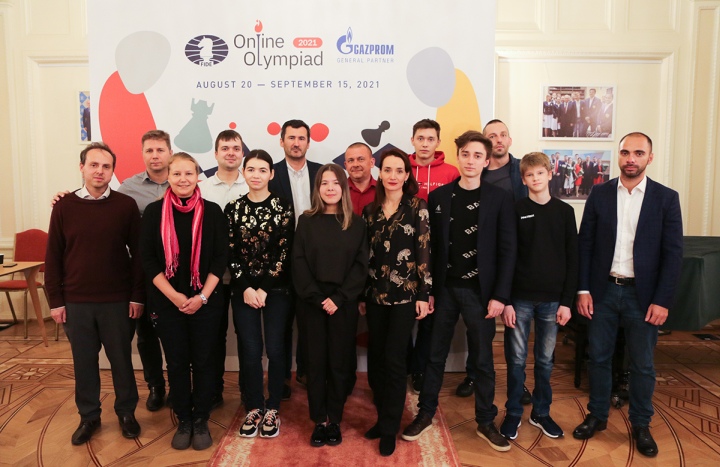
Wednesday, September 15th, 2021 – Team Russia took home the Gold Medal in the FIDE 2021 Online Olympiad after defeating Team USA (silver) by a double 3½-2½ this afternoon on the Chess.com online playing server. As the results display, both matches were tremendously close, showing that these two teams clearly deserved to be in the final. Congratulations to semi-finalists and bronze medals China and India: both teams also played fantastic chess all week. Russia has finally managed to get off their chest last year’s result, when they were declared co-winners, after their opponent in that final – India – experienced important connectivity issues during the second match. Everything ran very smoothly on both sides this year: team Russia playing from the Central Chess Club in Moscow and team USA spread around the American continent. Team Russia in action from the Moscow Central Chess Club Immediately after the match ended, USA captain IM John Donaldson sent a polite sportsmanlike message to the organizers: “Please extend the congratulations of the American captain and players to the Russian team on a match well played”. Although the USA managed to win one game in the first match (Awonder Liang defeated Andrey Episenko in both of their encounters), Russia responded strongly with two victories. Board two Vladislav Artemiev displayed excellent technique to defeat Ray Robson in a rook ending with an extra pawn, while Aleksandra Goryachkina checkmated Irina Krush. Aleksandra Goryachkina won a key game with Black in the first match In the diagram, White has just played 36.Rxd6. Even though her position is beyond repair, Krush missed the best Russian female player’s conclusive reply. Black finished off the game in style with 36…Nf3+ 37.Kh1 Qxh3 mate. The second match was also very close, both teams making some changes in their line-ups. Having lost the first match, the USA was not OK with a 3-3 tie in the second one, and that did seem to influence the final stage of the games: the players needed to take risks for the team. Runners-up and silver medal for the United States of America The first two boards ended in a draw, although Dariusz Swiercz might have missed some chances for the USA in a double-edged middlegame against Artemiev. However, the key game, and possibly one of the best of the whole event, was Alexandra Kosteniuk’s fantastic win against Irina Krush. In the diagram, White has sacrificed a piece but launched a fierce attack. The fireworks start with 22.Ng5! sacrificing the queen and threatening mate on h7. Krush defended with 22…Qc7 (hoping to hold on with rook and two pieces for her queen) but “The Chess Queen” had another idea… 23.Qe5+! – amazing overload – 23…Rg7 and now 24.Rd8! – using overload motif again – 24…Qxd8 25.Rxh7+ Kg8 26.Qxg7 mate. A wonderful combination for a great final. Leya Garifullina sealed the deal with a nice positional win on board six against Thalia Cervantes when only a draw was needed. Pairings of the rounds, live games, PGN files and other useful information can be found on the FIDE Online Olympiad website. Please note that all results and standings remain provisional until the fair play panel submit its daily report. Text: IM Michael Rahal, FIDE Press Officer Email: press@fide.com Photo: Eteri Kublashvili About the tournament: Scheduled to take place from August 20th to September 15th, the 2021 FIDE Online Olympiad is a national teams event in which all federations affiliated to FIDE have the right to participate. Team’s consist of six players with a minimum of three female players and two junior players. Played online on Chess.com, the event features two main stages: the “Divisions stage”, and the Play-offs stage. All games are played with a 15 minutes + 5 seconds increment per move time control. The full schedule can be consulted here. Organisers: International Chess Federation (FIDE) Chess.com as the hosting platform Partners supporting the 2021 FIDE Online Olympiad: Shenzhen Longgang District Culture, Radio, Television, Tourism and Sports Bureau Shenzhen MSU-BIT University Shenzhen Chess Academy Shenzhen Pengcheng Chess Club Shenzhen Longgang District People’s Government Shenzhen Municipal Bureau of Culture, Radio, Television, Tourism and Sports Simaland
USA and Russia square off in the final
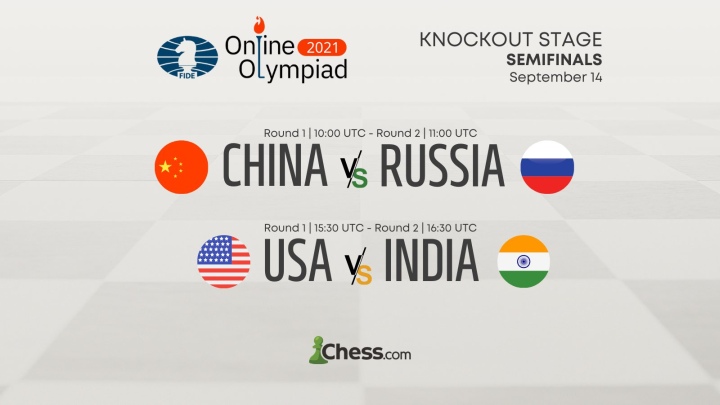
Tuesday, September 14th, 2021 – The teams of the United States of America and Russia will battle it out tomorrow (UTC 16.30) for the gold medals in the 2021 edition of the Online Chess Olympiad. Russia was the first team to advance to the final this afternoon by defeating China in two close six-board matches, while the USA qualified by besting last year’s co-winner India in the tiebreaks, after the two regular matches ended in a win apiece. Both teams arrive in top form after nearly a month of competition, in which teams from 155 countries have played each other in a novel pool-structured system, ending in a knockout playoff. Before the Olympiad began, Russian President Vladimir Putin sent a greetings letter to all the countries participating in FIDE’s most universally recognised chess event. Semi-finals I Team USA advanced to the final after defeating, not without much difficulty, team India in the tiebreaks. The achievement is outstanding: after being crushed 5-1 in the first match, they managed to regain focus and win the second match by 4-2 to prevail in the blitz tiebreaks 4½-1½. In match one, Jeffrey Xiong uncorked an interesting novelty (10…Qa3 instead of 10…Qxc2) against Vishy Anand in a fashionable line of the Caro-Kan. The engines are not impressed, but the American was doing very well until he lost his way in the ending. Meanwhile, on board two, Pentala Harikrishna, with Black, reached the following position against Dariusz Swiercz. The Indian GM played the strong 41…c3! 42.Bxa6 and now the startling 42…Ra1! winning. After 43.Bxc8 Rxb1+ 44.Kg2 Rg1+, White resigned a few moves later. However, in the second match, the Americans made a huge comeback. Xiong took his revenge against Anand in a nice positional game, while Vidit overplayed an equal position with White against Ray Robson and ended up losing. Harika levelled the score by defeating Paikidze with a strong attack, but in the key game, the USA tipped the balance in its favour when Awonder Liang took advantage of a mistake by Praggnanandhaa in the ending to win a pawn and the point. It all went down to the blitz tiebreaks. In a risky move, India decided to replace Anand with Adhiban, a very dangerous blitz player, well known for his attacking skills. Nihan Sarin came in for Praggnanandhaa, the substitution that India had been doing in every match. Meanwhile, the USA fielded the same team as the second match, and their strategy paid off, as they won 4½-1½. Prag and Nihal Sarin kibitzing with “the king” Anand – Photo: Amruta Mokal On board one, Harikrisna went all out against Xiong but fell to the young American’s sharp counterattack. On board two, Ray Robson converted the advantage of two minor pieces against a rook against Adhiban. On board three, Irina Krush defended solidly against Humpy Koneru’s two bishops and took home the point when the Indian missed a tactic and dropped her queen. On board four, Harika chalked up her third straight point but to no avail. India did have some connection problems on board six – Vaishali was clearly winning when her time ran out – but the match was lost in any case. Semi-finals II The other finalist of the day was Russia, who defeated China in both semi-final matches by 3½-2½ and then 4-2. In the first match, the three evenly-rated top boards ended in draws, but Alexandra Kosteniuk – recently crowned Women’s World Cup Champion – won the first of her two games against Ju Wenjun, who up to that moment had performed spectacularly in the event. Team Russian in action – Photo: Eteri Kublashvili – Russian Chess Federation China did miss an opportunity on board two. In the diagram, Yu Yangyi, playing Black, has a queen for a rook and a knight, but his opponent does have drawing chances. The Chinese GM played 30…Bd6 but after 31.Rh8+! Kxh8 32.Ng6+ Kg8 33.Nxe7 a draw was soon agreed. Instead, 30… Qc7 would have kept the game going. The other win for the Russian team came from the U-20 junior board Andrey Episenko who also won both of his games, first against Wang Shixu B (demonstrating great endgame technique) and then against Xu Zhihang. Andrey Esipenko – Photo: Eteri Kublashvili – Russian Chess Federation Episenko is a real find for Russia: although only 19, with his amazing standard rating of 2720, he could have easily defended any of the first two boards. In the second match, China bounced back with a win by Hou Yifan against Aleksandra Goryachkina, in the bout between the world women’s number one and two, but were unable to win the match due to Dubov’s fantastic attacking victory against Ding Liren, along with the previously mentioned victories by Kosteniuk and Episenko. Team China in action – Photo: Liang Ziming Pairings of the rounds, live games, PGN files and other useful information can be found on the FIDE Online Olympiad website. Please note that all results and standings remain provisional until the fair play panel submit its daily report. This stage of the event will run from Monday, September 13th (Quarter-finals) to Wednesday, September 15th (Final). Each duel will consist of two matches, and in the event of a tie (each team wins one of the two matches, or both matches are drawn) the tie shall be broken with one 3/2 blitz match, followed by Armageddon if need be. The games can be followed online on www.chess.com (Events) and on FIDE’s own Youtube channel. Commentators for this stage are GM Daniel Naroditsky, WGM Jen Shahade, WGM Dina Belenkaya, WGM Keti Tsatsalashvili, IM David Pruess and James Canty III. Text: IM Michael Rahal, FIDE Press Officer Email: press@fide.com About the tournament: Scheduled to take place from August 20th to September 15th, the 2021 FIDE Online Olympiad is a national teams event in which all federations affiliated to FIDE have the right to participate. Team’s consist of six players with a minimum of three female players and two junior players. Played online on Chess.com, the event features two main stages: the “Divisions stage”, and the Play-offs stage. All games are played with a 15
Global Chess Festival brings innovators of the future to Budapest

A musician paying tribute to female chess players. An engineer, who researches the “emotional” side of chess. A grandmaster of creativity, who wrote a book about the advantages of thinking like machines. What do they have in common? They will all be there at Global Chess Festival 2021, which will be brought to life in a hybrid, on- and offline form by Judit Polgar, the best female chess player of all time. The Judit Polgar’s Global Chess Festival returns on the 9th of October with a brand new approach, showcasing the multidisciplinary nature of chess through interactive exhibitions, speeches and an all-inclusive educational chess summit. For the first time, visitors can actively participate in the Global Chess Festival both on- and offline: while the Hungarian National Gallery gives home to the local events, those interested can take part in the festival from the comfort of their homes through Youtube Live. Furthermore, online chess enthusiasts can log in to a plethora of interactive digital activities. For the third year, the main sponsor of the event is Morgan Stanley, bringing coding classes for children, chess challenges against the players working at the company and the Morgan Stanley Chess Café to the festival. The main focuses of this year’s festival are creativity and innovation, promoted by revolutionary minds who dare to break conventions and give novel answers to challenges of their fields. Noam Manella – author of the book “Think Like a Machine”, will discuss how we can invoke the creativity within ourselves; Indian engineer Ashwin Subramanian will give us a sneak peek into a brand new experiment he’s been conducting: using biofeedback data, he is trying to determine how and what the chess player’s body responds to during the game, and how it can be utilized during preparation. Where the festival inspires the mind, soothes the spirit, through the unparalleled musical performance of Juga Di Prima, presenting piano performances paying homage to gender equality in chess. According to Judit Polgar, the founder of the Global Chess Festival, “Chess is a language that knows no borders, no age, no nationality – a common language that we all speak, a language that everyone can make his own at the Global Chess Festival. Nothing proves that better than the movement it invoked: chess enthusiasts, speakers, artists, scientists joined from all over the globe. Hence our timeless motto: chess connects us! The focus of 2021’s Global Chess Festival couldn’t be more pressing, as the last year all of our lives have been about pathfinding, innovation and introspection. This year we decided to expand the festival to the digital world, so more of us can be together than ever before.” “Mastering digital competencies and the capability to innovate are requirements that profoundly determine the success of corporations and experts. This also applies to schoolchildren: learning basic informatics, programming languages – the foundations of today’s digital solutions – can be supported with the logic of chess. Morgan Stanley is determined to support students in their endeavours to learn science, technology, engineering and mathematics – better known as STEM – as early as possible; enabling them to flexibly respond to the changes of the workforce market and to become innovators of the future.” – said Norbert Fogarasi, Managing Director of Morgan Stanley Budapest, active chess player and member of the Hungarian Chess Federation. Education is an inherent part of the DNA of the Global Chess Festival, climaxing in the Educational Chess Summit conference, where contemporary thinkers share their take on the connection between chess and education. The Festival is also home to the Judit Polgar Method, which is a practical approach to the application of chess in education; it’s newest element – Chess PE – will make its debut at the Global Chess Festival. Children and parents visiting the Hungarian National Gallery will witness how a chessboard can enhance the kids’ orientational abilities, and try it out in practice. This year’s Global Chess Festival will be more interactive than ever: the usual simultaneous chess exhibitions will be complemented by exciting online games, first of which is the ChessConnectsUs challenge: every single day, two new players join the online game, make their moves and then pass on the helm to two newcomers. Those interested should visit Chess24.com, where contemporary scientists, artists, athletes and politicians can be caught playing chess, and can try to predict what their next move will be in exchange for exciting prizes. Mission of the Global Chess Festival Facebook Website Pictures Twitter The Global Chess Festival promotes the 1000 faces of chess all around the world. We aim to share the beauty of chess with 5 million people by 2025. Chess Connects Us! More Information:Csató Krisztina // krisztina.csato@skyrocketgroup.hu About Morgan Stanley Morgan Stanley is dedicated to providing first-class service to our clients, in a way that reflects our commitment to creating a more sustainable future and fostering stronger communities around the world. In each line of business, we strive to demonstrate our belief in the power of transformative thinking, innovative strategies and leading-edge solutions—and in the ability of capital to work for the benefit of all society. More Information:Laky Zoltán // zoltan.laky@wshungary.hu
Yuri Solodovnichenko clinches title at Imperia Chess Festival
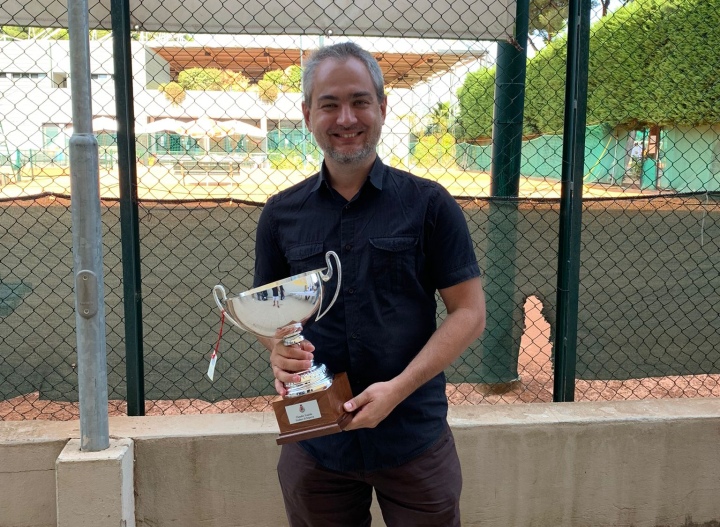
The 63rd edition of the Imperia International Chess Festival took place from September 5-12 at the Palazzetto dello Sport (Imperia, Italy). One of the oldest European chess forums, the Imperia Chess Festival, dates back to 1959, when the maiden edition was held. The Imperia International Chess Festival 2021 became one of 27 events that received financial support from FIDE. The festival attracted 109 participants (including 12 women) from 11 federations competing in Swiss tournaments A, B and C. Before the start, the Imperia Chess Club handed all the participants a bag with local products and some souvenirs with the inscription Festival Scacchistico Imperiese. Thanks to the commitment of the organizers and staff, Fabiano Lagonigro, a quadriplegic person, took part in tournament C, his first-ever OTB chess competition. The main event, Open A, was won by the rating favourite Yuri Solodovnichenko from Ukraine. Despite losing his third-round encounter, he scored 6½ out of 9 points and took the first prize. French IM Pierre Laurent-Paoli netted an equal amount of points but had to settle for second place due to inferior tiebreaks (he suffered defeat in the seventh-round clash with Solodovnichenko). Adrian Gschnitzer from Germany, the only player to defeat the champion, came in third. Final standings: Open A 1 Solodovnichenko, Yuri UKR 2581 6½ 2 Laurent-Paoli, Pierre FRA 2402 6½ 3 Gschnitzer, Adrian GER 2398 6 4 Yankelevich, Lev GER 2416 6 5 Salvador, Roland PHI 2412 6 6 Di Paolo, Raffaele ITA 2321 6 7 Dietmayer-Kraeutler, Marco AUT 2297 6 8 Barseghyan, Harutyun FRA 2444 6 9 Legky Nikolay A FRA 2381 6 10 Wilhelm, Till GER 2305 5½ Open B (under 2000) 1. Alain Wauters (FRA) – 6½2. Antonio Barletta (ITA) – 63. Andrea Zechner (AUT) – 6 Open C (under 1600) 1. Wolfango Rizzi (WLS) – 6½2. Ravihansa Moratumullege Dulmina (ITA) – 63. Andrea De Roberto (ITA) – 6 Official website: http://www.imperiascacchi.it/
Semi-finals set: India-USA and China-Russia
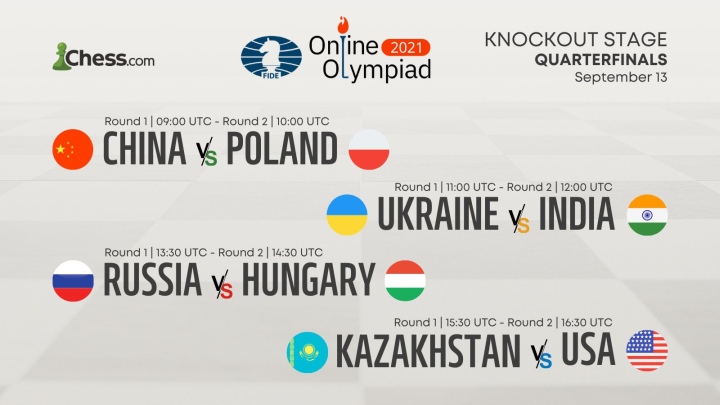
Monday, September 13th, 2021 – The Online Olympiad play-off quarter-finals were held today online on the Chess.com servers. Four fascinating matches, two of which had to be decided by the blitz tiebreaks. Based on today’s results and the knockout stage brackets, the semi-finals – scheduled for tomorrow Tuesday, September 14th – are India vs United States and China vs Russia. It is very hard to predict the outcome of these duels: all four have extremely strong teams. Quarter Final Duel I The most exciting quarter-final match was Kazakstan against the United States of America. The Americans were somewhat stronger on paper on boards one and two, but the reverse could be said of boards three and four. The exception was on board six, where Bibisara Assaubayeva (9/10!) clearly outrated her opponent Thalia Cervantes. Kazakstan took down the first match by 4-2 with important wins by junior Ramazan Zhalmakhanov on board five against Awonder Liang and by the board one Rinat Jumabayev against Jeffery Xiong. Although he is 200 rating points behind, Jumabaev recently eliminated world number 2 Fabiano Caruana from the World Cup: he is a very strong player. One of their two losses in this match came on board two. Denis Makhnev playing for Kazakhstan blundered with 19…0-0-0? and Dariusz Swiercz rapidly jumped on the opportunity with 20.Qxa6! forcing resignation. Indeed, 20…bxa6 21.Rb8 is mate! USA came back in match two with a very close 3½ -2½ win. Xiong got his revenge on board one and although Liang and Cervantes both lost again on boards five and six, Irina krush and Nazi Paikidze saved the day with wins on the female boards. Both teams repeated their line-ups for the exciting tiebreak and USA prevailed by the narrowest of margins: the final score of 4-2. A heartbreaking loss for Kazakstan, who have played fantastically throughout the tournament. Quarter Final Duel II The second match between India and Ukraine was a hard-fought battle in which India eventually prevailed in the blitz tiebreaks. The first match fell 4-2 to the side of the Indian squad thanks to wins on boards five and six. Their main scorer was Nihal Sarin, who has netted six out of six in the competition, including two decisive games today. However, Ukraine bounced back in the second match, winning by a slim margin (3½ -2½ ) and forcing the tiebreaks. The most dramatic game was the 114-move victory by Iulija Osmak against Humpy Koneru in a queen and pawn against queen endgame. Finally, India advanced to the semi-finals with a convincing 5-1 score in the tiebreaker. They played much better in all the games, but luck was also on their side: Platon Galperin on board five lost connection against Nihal Sarin on the move ten and was unable to resume the game. The Indian team after their nerve-wracking match against Ukraine. Photo: A. Mokal Quarter Final Duel III Despite losing both of their matches by a very close 3½ -2½ score and thus being eliminated from the tournament, everyone would agree that Hungary put Russia to the test this afternoon in Duel III. American GM Daniel Naroditsky, an official commentator for the event, summed it up very nicely: “Hungary is going to keep their heads up high. They were significantly outrated, yet they had a lot of bright spots, for example, Erdos beating Dubov and Gledura beating Artemiev, both with the black pieces. A very good effort by Hungary, but at the end, Russia is Russia.” Online chess has its own dynamics, and one of the worse things that can happen to you is a “mouse slip”. Even world-class players suffer this fate every now and again: in the diagram, board one Daniil Dubov played 32.Rd6? and immediately resigned after his opponent replied with 32…Bxd6. The brilliant young Russian was clearly intending 32.Rd7. He might have lost this endgame anyway, but in any case, there’s still a lot of work to do. Russian’s female players are definitely in top form and are one of the reasons that the team is where it is. In the first match, Valentina Gunina won again and increased her performance to 6/6, while Alexandra Kosteniuk and Kateryna Lagno’s 2/2 in the second match allowed their team to advance to the semi-finals. Quarter Final Duel IV Due to different time zones, the first duel of the day to be played was Duel IV, between China and Poland. On paper, a very favourable match-up for the Chinese squad, outrating the Polish team heavily by rating on most of the boards, especially on boards three and four with two best female players against less experienced opponents. The first of the two matches was won clearly by China by a 4½ -1½ score. Board one Ding Liren defeated Jan-Krzysztof Duda in a brilliant attacking game. Black was already in big trouble after 17…Bxc3? instead of 17…hxg5 and after 21.Ng5! it was clear that Ding was going for Duda’s neck. In the following diagram, Black’s king is stranded in the centre and White is going for mate. Ding Liren played the interference tactic 30.R1-b5!! winning on the spot as 30…axb5 31.Qxd5 is mate. Poland’s luck didn’t change much when Monica Socko’s mouse slip gave Ju Wenjun an easy win on board four. Socko obviously intended the exchange of rooks by 17.Rxe8, but unfortunately released her rook on d8 and the game was over. In the second match, Duda got his revenge on board one taking down Ding Liren in a long ending, but the middle section was all China. Yu Yangyi played a wonderful attacking game to defeat Radoslaw Wojtaszek on board two, while Hou Yifan (the top-rated female player in the world) notched up her second straight win against Karina Cyfka. On board four Poland changed players (enter Klaudia Kulon) but Ju Wenjun (9½ out of 10 total score!) struck again for a final 4-2 for China, who advanced to semi-finals. Pairings of the rounds, live games, PGN files and other useful information can be found on the FIDE Online Olympiad website. Please note that all results and standings remain provisional until the fair play panel submit its daily report. This stage of the event will run from Monday, September 13th (Quarter-finals) to Wednesday, September 15th (Final). Each duel will consist of two matches, and in the event of a tie (each team wins one of the two matches, or both matches are drawn) the tie shall be broken with one 3/2 blitz match, followed by Armageddon if need be. The games can be followed online on www.chess.com (Events) and also on FIDE’s own Youtube channel. Commentators for this stage are GM
Anish Giri wins Tolstoy Cup
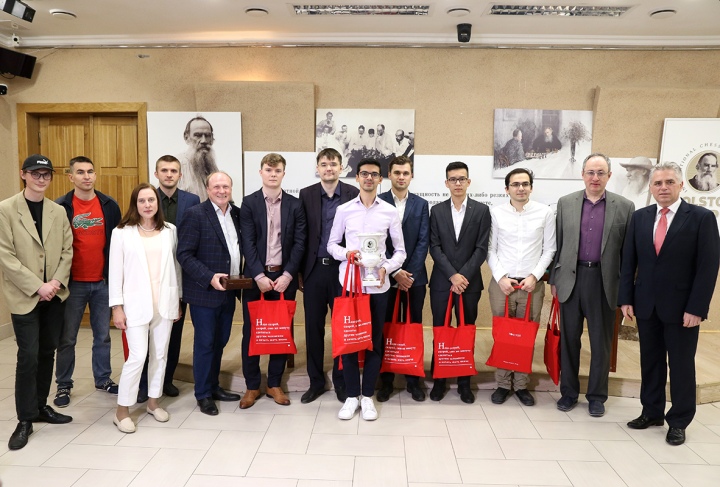
The first international tournament Tolstoy Cup featuring a stellar line-up took place in the State Leo Tolstoy Museum-Estate “Yasnaya Polyana”, the Tula region, from September 9 (the great writer’s birthday) to September 12. The event was organised by the State Leo Tolstoy Museum-Estate “Yasnaya Polyana” and the Chess Federation of Russia and supported by the Elena and Gennady Timchenko Foundation. Given Leo Tolstoy’s devotion to chess, an exhibition featuring various thematic posters was held during the event. The opening ceremony took place on September 9, in presence of Leo Tolstoy’s descendants, FIDE President Akrady Dvorkovich, and other guests of honour. The participants of the Tolstoy Cup competed in a 9-round in an all-play-all rapid chess event with the time control 15 + 10. One of the rating-favorites, Anish Giri of Netherlands, came as a winner with an outstanding result of 8 out of 9, 2½ points ahead of second-prize winner Nodirbek Abdusattorov (Uzbekistan). Boris Gelfand (Israel) scored 5 points and finished third. Anish Giri: “I enjoyed my performance in Yasnaya Polyana. The result proved somewhat too high because on the second day, I definitely did not play at the corresponding level. However, luck sided with me to the extent that nothing could stop. It goes without saying that I am a big fan of Leo Tolstoy’s creative works, and I am very happy that this tournament has been organised. I have not been aware that Tolstoy was a chess fan, but taking part in the sightseeing tour filled this gap. I hope this event will become traditional”. The winner received a cup manufactured at the Imperial Porcelain Factory specifically for this event. The tournament was broadcast online on the FIDE YouTube channel with the commentaries of grandmaster Evgenij Miroshnichenko. Final standings: 1 Giri, Anish NED 2712 8 2 Abdusattorov, Nodirbek UZB 2542 5½ 3 Gelfand, Boris ISR 2631 5 4 Paravyan, David RUS 2676 4½ 5 Andreikin, Dmitry RUS 2705 4½ 6 Korobov, Anton UKR 2740 4 7 Matlakov, Maxim RUS 2663 4 8 Tomashevsky, Evgeny RUS 2635 4 9 Alekseenko, Kirill RUS 2656 3½ 10 Vitiugov, Nikita RUS 2619 2 In addition to the main event, an extensive program of the Leo Tolstoy Cup included a 100-board simul by the GMs participating in the tournament, a mass blitz tournament for children, a lecture and a quiz by the curator of the CFR Chess Museum Dmitry Oleikniov. The Cultural Centre Yasnaya Polyana that hosted the tournament displayed the themed posters, and unique chess sets Staunton and Regence. Text: Chess Federation of Russia Photo: Etery Kublashvili
Leinier Dominguez wins 2021 Champions Showdown
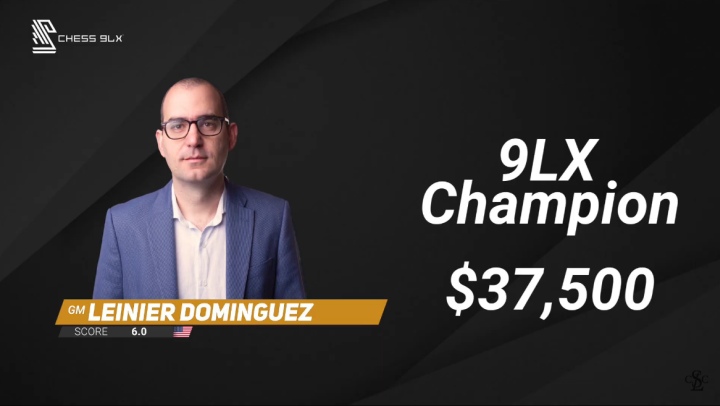
Leinier Dominguez secured victory in the 2021 Champions Showdown: Chess 9LX after winning a dramatic final round game against Levon Aronian and ending with 6.0/9 points. Finishing in second place were Wesley So, Maxime Vachier-Lagrave, and Sam Shankland, all on 5.5/9, while former World Champion Garry Kasparov concluded an impressive performance with 5.0/9. The time control for the event is 20 minutes per side with a 5-second increment starting from move one. Before each round, the players were shown the unique starting position 15 minutes ahead of time and are allowed to prepare using the physical boards. Round 7 Starting position – Round 7 Despite entering the final day as the clear leader, Dominguez suffered a shock in the first round, losing to Shankland after blundering in the late middlegame and going into a bad endgame. 20.Rxb5! left Shankland with an extra pawn in the rook endgame, which he managed to convert smoothly. | 1-0, 56 moves The result allowed Shankland to catch Dominguez in the standings, as did Kasparov, who continued his excellent play from yesterday to defeat Svidler in a trademark attacking style. 20…Nxc4! gave Kasparov a winning attack, with a huge advantage after 21.bxc4 g5! | 0-1, 26 moves The 13th World Champion finished with a highly respectable 5.0/9 Round 8 Starting Position – Round 8 The penultimate round saw the standings get shaken up even further, as draws by Shankland, Dominguez, and Kasparov allowed So to catch up to the leaders with his win over Svidler. 14.Rc1! won a full piece for So, as the knight on c6 was impossible to defend. | 1-0, 21 moves This meant that going into the final round there would be four leaders on 5.0/8 – So, Dominguez, Kasparov, and Shankland; with Vachier-Lagrave just a half-point out of first place. The current Chess 960 World Champion started off the final day with two wins Round 9 Starting Position – Round 9 The final round was the most dramatic of all, with all four leaders facing different players, making numerous playoff possibilities feasible. Both Shankland and So had chances at various points, but could only draw against Caruana and Nakamura, respectively; while Kasparov got in trouble against Vachier-Lagrave and ended up with a losing position. Only Dominguez could manage to win, taking advantage of a slip by Aronian to collect the full point and ultimately clinch first place. 20…Nb3! secured a powerful initiative for Dominguez, as he followed up with Be6 and Rad8 to win a critical game. | 0-1, 58 moves Leinier Dominguez turned in a fantastic performance, winning four games in a row earlier in the event. Coming up next in Saint Louis will be the 2021 U.S. Chess and U.S. Women’s Chess Championships, taking place October 5 – 19 and featuring 24 of America’s top players battling it out for two national titles. Fans can learn more and watch the action live on uschesschamps.com. Coming up next in Saint Louis will be the 2021 U.S. Chess and U.S. Women’s Chess Championships, taking place October 5 – 19 and featuring 24 of America’s top players battling it out for two national titles. Fans can learn more and watch the action live on uschesschamps.com. Text: IM Kostya Kavutskiy Photo: Courtesy of Saint Louis Chess Club, Crystal Fuller Dates & Location: September 8 – September 10, 2021Saint Louis Chess Club Livestream:USChessChamps.Com Web: uschesschamps.com | Twitter: @STLChessClubInstagram: @STLChessClub | Facebook: @STLChessClubYouTube: @STLChessClub | Twitch.tv: @STLChessClub#ChampionsShowdown #Chess9LX #STLChessClub Press Contact:Rebecca Buffingtonrbuffington@saintlouischessclub.org Photo Credits:Photos and appropriate credits available on Flickr Saint Louis Chess Club | Building Champions 4657 Maryland Avenue, Saint Louis, MO 63108 | (314) 361.CHESS (2437)
Russia advances to the playoffs with a perfect score

Thursday, September 9th, 2021 – The Top Division of the Online Olympiad finished today after three days of intense top-level chess. A total of 1717 players, playing from 150 countries all over the world, with 888 titled players, including 209 Grand Masters and 244 International Masters. Three weeks after the tournament began, we are closing in on the event’s final stage: the Play-Off by Knock-Out. No more groups, no more comebacks: if you lose, you’re out! This stage will run from Monday, September 13th (Quarter-finals) to Wednesday, September 15th (Final). Each duel will consist of two matches, and in the event of a tie (each team wins one of the two matches, or both matches are drawn) it shall be broken with one 3/2 blitz match, followed by Armageddon if needed. After today’s results, the pairings are: Duel 1: Kazakhstan vs USA Duel 2: Ukraine vs India Duel 3: Russia vs Hungary Duel 4: China vs Poland *Fair-play panel confirmation is pending Top Division – Pool A An unfortunate last round loss against Armenia by 2-4 relegated China (14/18) to second place in group A and allowed Kazakhstan to win the group outright with 16/18 points. A round earlier, Iran, who had lost most of its chances to qualify by tying with Greece, had defeated Kazakhstan, and it looked as if China would prevail; they were leading on tiebreak by quite a substantial margin. China getting ready to face Romania. Photo: Liang Ziming But you can never count out a country with such a chess tradition as Armenia. Although out-rated on all boards by a considerable margin, they overcame the ELO difference with strong play. The two main surprise results were WIM Siranush Ghukasyan defeating WGM Qian Huangon on board four while WFM Mariam Mkrtchyan defeated WGM Jiner Zhu on board six. With these results, A1 winner Kazakhstan will face D2 runner-up United States of America and A2 runner-up China will play against D1 winner Poland in the quarterfinals. IM Bibisara Assaubayeva (Kazakhstan) finished the event with an impressive 7/7 on board six. However, GM Ju Wenjun (China) scored 7½ /8 on board four for a superior final result. Iran’s GM M.Amin Tabatabaei finished the tournament with an undefeated score of 7½ /9 on board five while his teammate IM Sarasadat Khademalsharieh lost one of her last day for 7/9. Top Division – Pool B Logic prevailed this afternoon in group B. India defeated Hungary by 4-2 in the first round of the day and consolidated their lead. A 5-1 win over Moldova, followed by an exciting last-round draw against Slovenia (already as group winners), gave the Indian team a 16/18 score and first place. Hungary will join them in second place with 15/18, three points ahead of Azerbaijan. Although they conceded the top position to India in the first round of the day, they continued to play strong and defeated Sweden and Moldova. Shenzhen China also did very well and with wins over Egypt, France and Sweden edged out these teams (Slovenia for Sweden) on tiebreak for fourth place. The quarterfinal pairings will be B1 winner India against C2 runner-up Ukraine and B2 runner-up Hungary against C1 winner Russia. India’s U-18 GM Nihal Sarin and legend GM Vishy Anand. Photo: Amruta Mokal One of India’s secrets has been sharing the burden of the effort through all the players. Each of them has participated at least three times – most of them have played five – and only board six WGM Vaishali R. has played her sixth game, scoring an undefeated 4½ /6. Hungary has also used all their players, ranging from two games to six, with strong performances by WIM Bianka Havanecz (reserve second female) with 5/6 and main junior board GM Adam Kozak with 5½ /6. However, the best score of the group has been GM Zhao Xue from Shenzhen China on board three, with an outstanding undefeated 8/9 score. She pulled away from Marie Sebag (France) by winning their head-to-head encounter. In the diagram, the position is quite complex. Black has just played 30…Ng5 attacking the rook on e6. Of course, 31.Bxg5 seems fine, but Zhao Xue chose another option. 31.Bxe5!? Nxe6 and now the computer suggests 32. Bxd6! Ng5 and 33.Be7! with the idea d6-d7, although it’s still very complicated. Zhao chose 32.dxe6 and after 32…dxe5 33.Bxb7 got enough compensation for the exchange and went on to win. Top Division – Pool C The undisputed winner of group C is the team from Russia. Their final score, 18/18, has left no doubt about the strength of the squad: the icing on the cake was a 6-0 last round win against Latvia, having already secured first place. They have spread the task fairly between most of the team members and have only lost 4 in 54 games (2 of them by GM Alexander Grischuk). An incredible feat! Even more outstanding is that their six female players have not lost even a single game of the 27 they have played! The G-factor: WGM Keya Garifullina and GM Valentina Gunina scored 5/5 each! Ukraine took the second qualifying spot with 15/18, in good measure due to a very close 3½ -2½ win against Spain in the last round. The Spaniards had just lost all their chances to qualify by losing to Russia by a tight 4-2 (the “best” result by any of Russia’s opponents) but even so they put up a show until the end. Spains’s U-18 Maria Eizaguerri won the 2021 Spanish mixed U-18 Championship Germany came very close to qualification (14/18), winning their last three matches, but did not manage to come back from Day One’s bad performance. The German team came very close to qualification The final standings of the group offer the following quarterfinal pairings: C1 winner Russia against B2 runner-up Hungary and C2 runner-up Ukraine against B1 winner India. GM Andrey Esipenko’s 6½ /7 result on the U-20 board five was Russia’s top score, but also very impressive were reserve female players GM Valentina Gunina and WGM Leya Garifullina scoring 5/5 100% results apiece. Italy’s Luca Moroni Jr. also turned in an excellent performance with an undefeated 6/7 score on board two. Top Division – Pool D Poland and USA converted their rating advantage into qualification, dominating this group from start to finish. Both teams finished
Day 02: Dominguez surges to the top

Leinier Dominguez surged to the top of the standings after winning all three of his games today, finishing with a total score of 4.5/6. Yesterday’s leader, Caruana, could only score 1.5/3 and ended the day in clear second place with 4.0/6. Meanwhile, former World Champion Garry Kasparov bounced back from a rocky start to score 2.5/3 in today’s games, with wins over Shankland and Aronian. Along with Kasparov, both Vachier-Lagrave and Shankland are currently on 3.5/6, a point out of first place. And with three rounds left to play, everything will be on the line during tomorrow’s final day. The time control for the event is 20 minutes per side with a 5-second increment starting from move one. Before each round, the players are shown the unique starting position 15 minutes ahead of time and are allowed to prepare using the physical boards. Round 4 Starting position – Round 4 The first round of the day saw the standings get blown wide open as Caruana misplayed a winning position against Nakamura, at one point missing a beautiful forced win. Instead, he allowed counterplay for Hikaru, who soon sacrificed his queen for a rook and two pieces, with a decisive advantage. 24…Qe5!! would have won the game for Caruana, as 25.Rxe5 loses to 25…Rd1+ 26.Kc2 Rc1 mate. Instead 24…Qa5 was played, and Naka turned the tables with 25.Bxg4! Bd3+ 26.Qxd3 Rxd3 27.Rxe6+- | 1-0, 41 moves Nakamura could have started 0-4 but instead took down the leader Caruana’s loss allowed So, MVL, and Dominguez to all catch up with 2.5/4, while Kasparov scored his first win of the event, defeating Shankland in his classic attacking style. 13.0-0! secured an enormous advantage for Kasparov, who went on to decimate Black’s queenside. | 1-0, 24 moves Round 5 Starting Position – Round 5 The fifth round saw Caruana defeat MVL and Dominguez beat Mamedyarov to both stay in the lead, while So lost to Shankland. 12…Ndf4+! was a nice tactic for Dominguez, winning the exchange after 13.gxf4 Qg2+ | 0-1, 23 moves With a bit of fortune, Kasparov was able to win his second game in a row, taking advantage of a sacrificial blunder by Aronian, who ended up down an exchange and lost in the endgame. Aronian had sacrificed his exchange to get the c-pawn running, but here 36…d4+! turned the tables for Kasparov. Both 37.Kxd4 Rc2! and 37.Kxb3 Rxg3+/Rc3 are winning for Black. | 0-1, 67 moves The 13th World Champion showed great form today, scoring 2.5/3 Round 6 Starting Position – Round 6 In the sixth round Dominguez continued his fantastic streak, beating Nakamura to win his fourth game in a row, while Caruana was held to a draw by Kasparov, despite having an extra exchange. Vachier-Lagrave managed to defeat Svidler, winning a nice endgame with a rook versus two knights. 30.Qa6! was a killer move from Dominguez. | 1-0, 47 moves After starting with 0.5/2, Dominguez has won four straight games Day 3 of the 2021 Champions Showdown: Chess 9LX will take place Wednesday, September 10, with all of the action covered live by commentators GM Alejandro Ramirez and GM Maurice Ashley starting at 1:30 PM CDT. Fans can watch the action live at uschesschamps.com and on the Saint Louis Chess Club’s YouTube and Twitch.tv channels. Text: IM Kostya Kavutskiy Photo: Courtesy of Saint Louis Chess Club, Crystal Fuller Dates & Location: September 8 – September 10, 2021Saint Louis Chess Club Livestream:USChessChamps.Com Web: uschesschamps.com | Twitter: @STLChessClubInstagram: @STLChessClub | Facebook: @STLChessClubYouTube: @STLChessClub | Twitch.tv: @STLChessClub#ChampionsShowdown #Chess9LX #STLChessClub Press Contact:Rebecca Buffingtonrbuffington@saintlouischessclub.org Photo Credits:Photos and appropriate credits available on Flickr Saint Louis Chess Club | Building Champions 4657 Maryland Avenue, Saint Louis, MO 63108 | (314) 361.CHESS (2437)