

Semi-finals set: India-USA and China-Russia
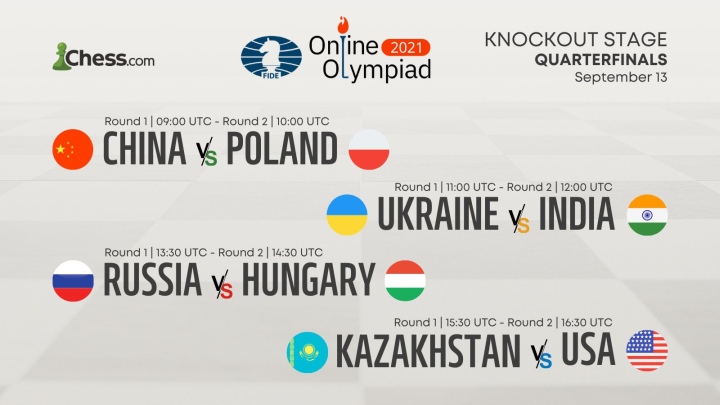
Monday, September 13th, 2021 – The Online Olympiad play-off quarter-finals were held today online on the Chess.com servers. Four fascinating matches, two of which had to be decided by the blitz tiebreaks. Based on today’s results and the knockout stage brackets, the semi-finals – scheduled for tomorrow Tuesday, September 14th – are India vs United States and China vs Russia. It is very hard to predict the outcome of these duels: all four have extremely strong teams. Quarter Final Duel I The most exciting quarter-final match was Kazakstan against the United States of America. The Americans were somewhat stronger on paper on boards one and two, but the reverse could be said of boards three and four. The exception was on board six, where Bibisara Assaubayeva (9/10!) clearly outrated her opponent Thalia Cervantes. Kazakstan took down the first match by 4-2 with important wins by junior Ramazan Zhalmakhanov on board five against Awonder Liang and by the board one Rinat Jumabayev against Jeffery Xiong. Although he is 200 rating points behind, Jumabaev recently eliminated world number 2 Fabiano Caruana from the World Cup: he is a very strong player. One of their two losses in this match came on board two. Denis Makhnev playing for Kazakhstan blundered with 19…0-0-0? and Dariusz Swiercz rapidly jumped on the opportunity with 20.Qxa6! forcing resignation. Indeed, 20…bxa6 21.Rb8 is mate! USA came back in match two with a very close 3½ -2½ win. Xiong got his revenge on board one and although Liang and Cervantes both lost again on boards five and six, Irina krush and Nazi Paikidze saved the day with wins on the female boards. Both teams repeated their line-ups for the exciting tiebreak and USA prevailed by the narrowest of margins: the final score of 4-2. A heartbreaking loss for Kazakstan, who have played fantastically throughout the tournament. Quarter Final Duel II The second match between India and Ukraine was a hard-fought battle in which India eventually prevailed in the blitz tiebreaks. The first match fell 4-2 to the side of the Indian squad thanks to wins on boards five and six. Their main scorer was Nihal Sarin, who has netted six out of six in the competition, including two decisive games today. However, Ukraine bounced back in the second match, winning by a slim margin (3½ -2½ ) and forcing the tiebreaks. The most dramatic game was the 114-move victory by Iulija Osmak against Humpy Koneru in a queen and pawn against queen endgame. Finally, India advanced to the semi-finals with a convincing 5-1 score in the tiebreaker. They played much better in all the games, but luck was also on their side: Platon Galperin on board five lost connection against Nihal Sarin on the move ten and was unable to resume the game. The Indian team after their nerve-wracking match against Ukraine. Photo: A. Mokal Quarter Final Duel III Despite losing both of their matches by a very close 3½ -2½ score and thus being eliminated from the tournament, everyone would agree that Hungary put Russia to the test this afternoon in Duel III. American GM Daniel Naroditsky, an official commentator for the event, summed it up very nicely: “Hungary is going to keep their heads up high. They were significantly outrated, yet they had a lot of bright spots, for example, Erdos beating Dubov and Gledura beating Artemiev, both with the black pieces. A very good effort by Hungary, but at the end, Russia is Russia.” Online chess has its own dynamics, and one of the worse things that can happen to you is a “mouse slip”. Even world-class players suffer this fate every now and again: in the diagram, board one Daniil Dubov played 32.Rd6? and immediately resigned after his opponent replied with 32…Bxd6. The brilliant young Russian was clearly intending 32.Rd7. He might have lost this endgame anyway, but in any case, there’s still a lot of work to do. Russian’s female players are definitely in top form and are one of the reasons that the team is where it is. In the first match, Valentina Gunina won again and increased her performance to 6/6, while Alexandra Kosteniuk and Kateryna Lagno’s 2/2 in the second match allowed their team to advance to the semi-finals. Quarter Final Duel IV Due to different time zones, the first duel of the day to be played was Duel IV, between China and Poland. On paper, a very favourable match-up for the Chinese squad, outrating the Polish team heavily by rating on most of the boards, especially on boards three and four with two best female players against less experienced opponents. The first of the two matches was won clearly by China by a 4½ -1½ score. Board one Ding Liren defeated Jan-Krzysztof Duda in a brilliant attacking game. Black was already in big trouble after 17…Bxc3? instead of 17…hxg5 and after 21.Ng5! it was clear that Ding was going for Duda’s neck. In the following diagram, Black’s king is stranded in the centre and White is going for mate. Ding Liren played the interference tactic 30.R1-b5!! winning on the spot as 30…axb5 31.Qxd5 is mate. Poland’s luck didn’t change much when Monica Socko’s mouse slip gave Ju Wenjun an easy win on board four. Socko obviously intended the exchange of rooks by 17.Rxe8, but unfortunately released her rook on d8 and the game was over. In the second match, Duda got his revenge on board one taking down Ding Liren in a long ending, but the middle section was all China. Yu Yangyi played a wonderful attacking game to defeat Radoslaw Wojtaszek on board two, while Hou Yifan (the top-rated female player in the world) notched up her second straight win against Karina Cyfka. On board four Poland changed players (enter Klaudia Kulon) but Ju Wenjun (9½ out of 10 total score!) struck again for a final 4-2 for China, who advanced to semi-finals. Pairings of the rounds, live games, PGN files and other useful information can be found on the FIDE Online Olympiad website. Please note that all results and standings remain provisional until the fair play panel submit its daily report. This stage of the event will run from Monday, September 13th (Quarter-finals) to Wednesday, September 15th (Final). Each duel will consist of two matches, and in the event of a tie (each team wins one of the two matches, or both matches are drawn) the tie shall be broken with one 3/2 blitz match, followed by Armageddon if need be. The games can be followed online on www.chess.com (Events) and also on FIDE’s own Youtube channel. Commentators for this stage are GM
Anish Giri wins Tolstoy Cup
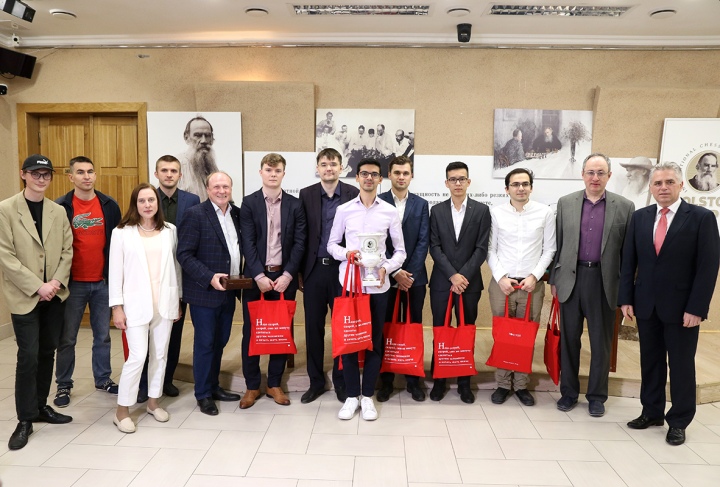
The first international tournament Tolstoy Cup featuring a stellar line-up took place in the State Leo Tolstoy Museum-Estate “Yasnaya Polyana”, the Tula region, from September 9 (the great writer’s birthday) to September 12. The event was organised by the State Leo Tolstoy Museum-Estate “Yasnaya Polyana” and the Chess Federation of Russia and supported by the Elena and Gennady Timchenko Foundation. Given Leo Tolstoy’s devotion to chess, an exhibition featuring various thematic posters was held during the event. The opening ceremony took place on September 9, in presence of Leo Tolstoy’s descendants, FIDE President Akrady Dvorkovich, and other guests of honour. The participants of the Tolstoy Cup competed in a 9-round in an all-play-all rapid chess event with the time control 15 + 10. One of the rating-favorites, Anish Giri of Netherlands, came as a winner with an outstanding result of 8 out of 9, 2½ points ahead of second-prize winner Nodirbek Abdusattorov (Uzbekistan). Boris Gelfand (Israel) scored 5 points and finished third. Anish Giri: “I enjoyed my performance in Yasnaya Polyana. The result proved somewhat too high because on the second day, I definitely did not play at the corresponding level. However, luck sided with me to the extent that nothing could stop. It goes without saying that I am a big fan of Leo Tolstoy’s creative works, and I am very happy that this tournament has been organised. I have not been aware that Tolstoy was a chess fan, but taking part in the sightseeing tour filled this gap. I hope this event will become traditional”. The winner received a cup manufactured at the Imperial Porcelain Factory specifically for this event. The tournament was broadcast online on the FIDE YouTube channel with the commentaries of grandmaster Evgenij Miroshnichenko. Final standings: 1 Giri, Anish NED 2712 8 2 Abdusattorov, Nodirbek UZB 2542 5½ 3 Gelfand, Boris ISR 2631 5 4 Paravyan, David RUS 2676 4½ 5 Andreikin, Dmitry RUS 2705 4½ 6 Korobov, Anton UKR 2740 4 7 Matlakov, Maxim RUS 2663 4 8 Tomashevsky, Evgeny RUS 2635 4 9 Alekseenko, Kirill RUS 2656 3½ 10 Vitiugov, Nikita RUS 2619 2 In addition to the main event, an extensive program of the Leo Tolstoy Cup included a 100-board simul by the GMs participating in the tournament, a mass blitz tournament for children, a lecture and a quiz by the curator of the CFR Chess Museum Dmitry Oleikniov. The Cultural Centre Yasnaya Polyana that hosted the tournament displayed the themed posters, and unique chess sets Staunton and Regence. Text: Chess Federation of Russia Photo: Etery Kublashvili
Leinier Dominguez wins 2021 Champions Showdown
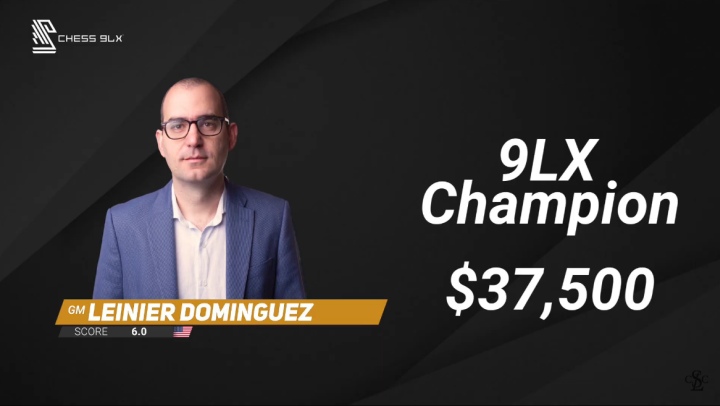
Leinier Dominguez secured victory in the 2021 Champions Showdown: Chess 9LX after winning a dramatic final round game against Levon Aronian and ending with 6.0/9 points. Finishing in second place were Wesley So, Maxime Vachier-Lagrave, and Sam Shankland, all on 5.5/9, while former World Champion Garry Kasparov concluded an impressive performance with 5.0/9. The time control for the event is 20 minutes per side with a 5-second increment starting from move one. Before each round, the players were shown the unique starting position 15 minutes ahead of time and are allowed to prepare using the physical boards. Round 7 Starting position – Round 7 Despite entering the final day as the clear leader, Dominguez suffered a shock in the first round, losing to Shankland after blundering in the late middlegame and going into a bad endgame. 20.Rxb5! left Shankland with an extra pawn in the rook endgame, which he managed to convert smoothly. | 1-0, 56 moves The result allowed Shankland to catch Dominguez in the standings, as did Kasparov, who continued his excellent play from yesterday to defeat Svidler in a trademark attacking style. 20…Nxc4! gave Kasparov a winning attack, with a huge advantage after 21.bxc4 g5! | 0-1, 26 moves The 13th World Champion finished with a highly respectable 5.0/9 Round 8 Starting Position – Round 8 The penultimate round saw the standings get shaken up even further, as draws by Shankland, Dominguez, and Kasparov allowed So to catch up to the leaders with his win over Svidler. 14.Rc1! won a full piece for So, as the knight on c6 was impossible to defend. | 1-0, 21 moves This meant that going into the final round there would be four leaders on 5.0/8 – So, Dominguez, Kasparov, and Shankland; with Vachier-Lagrave just a half-point out of first place. The current Chess 960 World Champion started off the final day with two wins Round 9 Starting Position – Round 9 The final round was the most dramatic of all, with all four leaders facing different players, making numerous playoff possibilities feasible. Both Shankland and So had chances at various points, but could only draw against Caruana and Nakamura, respectively; while Kasparov got in trouble against Vachier-Lagrave and ended up with a losing position. Only Dominguez could manage to win, taking advantage of a slip by Aronian to collect the full point and ultimately clinch first place. 20…Nb3! secured a powerful initiative for Dominguez, as he followed up with Be6 and Rad8 to win a critical game. | 0-1, 58 moves Leinier Dominguez turned in a fantastic performance, winning four games in a row earlier in the event. Coming up next in Saint Louis will be the 2021 U.S. Chess and U.S. Women’s Chess Championships, taking place October 5 – 19 and featuring 24 of America’s top players battling it out for two national titles. Fans can learn more and watch the action live on uschesschamps.com. Coming up next in Saint Louis will be the 2021 U.S. Chess and U.S. Women’s Chess Championships, taking place October 5 – 19 and featuring 24 of America’s top players battling it out for two national titles. Fans can learn more and watch the action live on uschesschamps.com. Text: IM Kostya Kavutskiy Photo: Courtesy of Saint Louis Chess Club, Crystal Fuller Dates & Location: September 8 – September 10, 2021Saint Louis Chess Club Livestream:USChessChamps.Com Web: uschesschamps.com | Twitter: @STLChessClubInstagram: @STLChessClub | Facebook: @STLChessClubYouTube: @STLChessClub | Twitch.tv: @STLChessClub#ChampionsShowdown #Chess9LX #STLChessClub Press Contact:Rebecca Buffingtonrbuffington@saintlouischessclub.org Photo Credits:Photos and appropriate credits available on Flickr Saint Louis Chess Club | Building Champions 4657 Maryland Avenue, Saint Louis, MO 63108 | (314) 361.CHESS (2437)
Russia advances to the playoffs with a perfect score

Thursday, September 9th, 2021 – The Top Division of the Online Olympiad finished today after three days of intense top-level chess. A total of 1717 players, playing from 150 countries all over the world, with 888 titled players, including 209 Grand Masters and 244 International Masters. Three weeks after the tournament began, we are closing in on the event’s final stage: the Play-Off by Knock-Out. No more groups, no more comebacks: if you lose, you’re out! This stage will run from Monday, September 13th (Quarter-finals) to Wednesday, September 15th (Final). Each duel will consist of two matches, and in the event of a tie (each team wins one of the two matches, or both matches are drawn) it shall be broken with one 3/2 blitz match, followed by Armageddon if needed. After today’s results, the pairings are: Duel 1: Kazakhstan vs USA Duel 2: Ukraine vs India Duel 3: Russia vs Hungary Duel 4: China vs Poland *Fair-play panel confirmation is pending Top Division – Pool A An unfortunate last round loss against Armenia by 2-4 relegated China (14/18) to second place in group A and allowed Kazakhstan to win the group outright with 16/18 points. A round earlier, Iran, who had lost most of its chances to qualify by tying with Greece, had defeated Kazakhstan, and it looked as if China would prevail; they were leading on tiebreak by quite a substantial margin. China getting ready to face Romania. Photo: Liang Ziming But you can never count out a country with such a chess tradition as Armenia. Although out-rated on all boards by a considerable margin, they overcame the ELO difference with strong play. The two main surprise results were WIM Siranush Ghukasyan defeating WGM Qian Huangon on board four while WFM Mariam Mkrtchyan defeated WGM Jiner Zhu on board six. With these results, A1 winner Kazakhstan will face D2 runner-up United States of America and A2 runner-up China will play against D1 winner Poland in the quarterfinals. IM Bibisara Assaubayeva (Kazakhstan) finished the event with an impressive 7/7 on board six. However, GM Ju Wenjun (China) scored 7½ /8 on board four for a superior final result. Iran’s GM M.Amin Tabatabaei finished the tournament with an undefeated score of 7½ /9 on board five while his teammate IM Sarasadat Khademalsharieh lost one of her last day for 7/9. Top Division – Pool B Logic prevailed this afternoon in group B. India defeated Hungary by 4-2 in the first round of the day and consolidated their lead. A 5-1 win over Moldova, followed by an exciting last-round draw against Slovenia (already as group winners), gave the Indian team a 16/18 score and first place. Hungary will join them in second place with 15/18, three points ahead of Azerbaijan. Although they conceded the top position to India in the first round of the day, they continued to play strong and defeated Sweden and Moldova. Shenzhen China also did very well and with wins over Egypt, France and Sweden edged out these teams (Slovenia for Sweden) on tiebreak for fourth place. The quarterfinal pairings will be B1 winner India against C2 runner-up Ukraine and B2 runner-up Hungary against C1 winner Russia. India’s U-18 GM Nihal Sarin and legend GM Vishy Anand. Photo: Amruta Mokal One of India’s secrets has been sharing the burden of the effort through all the players. Each of them has participated at least three times – most of them have played five – and only board six WGM Vaishali R. has played her sixth game, scoring an undefeated 4½ /6. Hungary has also used all their players, ranging from two games to six, with strong performances by WIM Bianka Havanecz (reserve second female) with 5/6 and main junior board GM Adam Kozak with 5½ /6. However, the best score of the group has been GM Zhao Xue from Shenzhen China on board three, with an outstanding undefeated 8/9 score. She pulled away from Marie Sebag (France) by winning their head-to-head encounter. In the diagram, the position is quite complex. Black has just played 30…Ng5 attacking the rook on e6. Of course, 31.Bxg5 seems fine, but Zhao Xue chose another option. 31.Bxe5!? Nxe6 and now the computer suggests 32. Bxd6! Ng5 and 33.Be7! with the idea d6-d7, although it’s still very complicated. Zhao chose 32.dxe6 and after 32…dxe5 33.Bxb7 got enough compensation for the exchange and went on to win. Top Division – Pool C The undisputed winner of group C is the team from Russia. Their final score, 18/18, has left no doubt about the strength of the squad: the icing on the cake was a 6-0 last round win against Latvia, having already secured first place. They have spread the task fairly between most of the team members and have only lost 4 in 54 games (2 of them by GM Alexander Grischuk). An incredible feat! Even more outstanding is that their six female players have not lost even a single game of the 27 they have played! The G-factor: WGM Keya Garifullina and GM Valentina Gunina scored 5/5 each! Ukraine took the second qualifying spot with 15/18, in good measure due to a very close 3½ -2½ win against Spain in the last round. The Spaniards had just lost all their chances to qualify by losing to Russia by a tight 4-2 (the “best” result by any of Russia’s opponents) but even so they put up a show until the end. Spains’s U-18 Maria Eizaguerri won the 2021 Spanish mixed U-18 Championship Germany came very close to qualification (14/18), winning their last three matches, but did not manage to come back from Day One’s bad performance. The German team came very close to qualification The final standings of the group offer the following quarterfinal pairings: C1 winner Russia against B2 runner-up Hungary and C2 runner-up Ukraine against B1 winner India. GM Andrey Esipenko’s 6½ /7 result on the U-20 board five was Russia’s top score, but also very impressive were reserve female players GM Valentina Gunina and WGM Leya Garifullina scoring 5/5 100% results apiece. Italy’s Luca Moroni Jr. also turned in an excellent performance with an undefeated 6/7 score on board two. Top Division – Pool D Poland and USA converted their rating advantage into qualification, dominating this group from start to finish. Both teams finished
Day 02: Dominguez surges to the top

Leinier Dominguez surged to the top of the standings after winning all three of his games today, finishing with a total score of 4.5/6. Yesterday’s leader, Caruana, could only score 1.5/3 and ended the day in clear second place with 4.0/6. Meanwhile, former World Champion Garry Kasparov bounced back from a rocky start to score 2.5/3 in today’s games, with wins over Shankland and Aronian. Along with Kasparov, both Vachier-Lagrave and Shankland are currently on 3.5/6, a point out of first place. And with three rounds left to play, everything will be on the line during tomorrow’s final day. The time control for the event is 20 minutes per side with a 5-second increment starting from move one. Before each round, the players are shown the unique starting position 15 minutes ahead of time and are allowed to prepare using the physical boards. Round 4 Starting position – Round 4 The first round of the day saw the standings get blown wide open as Caruana misplayed a winning position against Nakamura, at one point missing a beautiful forced win. Instead, he allowed counterplay for Hikaru, who soon sacrificed his queen for a rook and two pieces, with a decisive advantage. 24…Qe5!! would have won the game for Caruana, as 25.Rxe5 loses to 25…Rd1+ 26.Kc2 Rc1 mate. Instead 24…Qa5 was played, and Naka turned the tables with 25.Bxg4! Bd3+ 26.Qxd3 Rxd3 27.Rxe6+- | 1-0, 41 moves Nakamura could have started 0-4 but instead took down the leader Caruana’s loss allowed So, MVL, and Dominguez to all catch up with 2.5/4, while Kasparov scored his first win of the event, defeating Shankland in his classic attacking style. 13.0-0! secured an enormous advantage for Kasparov, who went on to decimate Black’s queenside. | 1-0, 24 moves Round 5 Starting Position – Round 5 The fifth round saw Caruana defeat MVL and Dominguez beat Mamedyarov to both stay in the lead, while So lost to Shankland. 12…Ndf4+! was a nice tactic for Dominguez, winning the exchange after 13.gxf4 Qg2+ | 0-1, 23 moves With a bit of fortune, Kasparov was able to win his second game in a row, taking advantage of a sacrificial blunder by Aronian, who ended up down an exchange and lost in the endgame. Aronian had sacrificed his exchange to get the c-pawn running, but here 36…d4+! turned the tables for Kasparov. Both 37.Kxd4 Rc2! and 37.Kxb3 Rxg3+/Rc3 are winning for Black. | 0-1, 67 moves The 13th World Champion showed great form today, scoring 2.5/3 Round 6 Starting Position – Round 6 In the sixth round Dominguez continued his fantastic streak, beating Nakamura to win his fourth game in a row, while Caruana was held to a draw by Kasparov, despite having an extra exchange. Vachier-Lagrave managed to defeat Svidler, winning a nice endgame with a rook versus two knights. 30.Qa6! was a killer move from Dominguez. | 1-0, 47 moves After starting with 0.5/2, Dominguez has won four straight games Day 3 of the 2021 Champions Showdown: Chess 9LX will take place Wednesday, September 10, with all of the action covered live by commentators GM Alejandro Ramirez and GM Maurice Ashley starting at 1:30 PM CDT. Fans can watch the action live at uschesschamps.com and on the Saint Louis Chess Club’s YouTube and Twitch.tv channels. Text: IM Kostya Kavutskiy Photo: Courtesy of Saint Louis Chess Club, Crystal Fuller Dates & Location: September 8 – September 10, 2021Saint Louis Chess Club Livestream:USChessChamps.Com Web: uschesschamps.com | Twitter: @STLChessClubInstagram: @STLChessClub | Facebook: @STLChessClubYouTube: @STLChessClub | Twitch.tv: @STLChessClub#ChampionsShowdown #Chess9LX #STLChessClub Press Contact:Rebecca Buffingtonrbuffington@saintlouischessclub.org Photo Credits:Photos and appropriate credits available on Flickr Saint Louis Chess Club | Building Champions 4657 Maryland Avenue, Saint Louis, MO 63108 | (314) 361.CHESS (2437)
Invitation to support FIDE’s initiatives of social value

For the International Chess Federation, organizing chess competitions is not the only mission. The competitive aspects are just a means to achieve higher goals. Sharing the values of the Olympic Movement of which FIDE is a proud member, its mission must go beyond that. Chess can make a huge impact on people lives: to develop their intellectual skills; prevent cognitive ageing and general brain decline of our senior citizens; provide people with disabilities with an activity to compete on absolutely equal terms; work as a great equalizer helping every child to reach their full potential, regardless of their background, etc. The FIDE Social Commission (SOC) has been working tirelessly to fulfil its objectives, and in recent months, FIDE has launched multiple projects of high social value that should make us all proud. In April, the first seminar on chess and autism became a resounding success. In May, the Chess for Freedom project kicked off with an online conference and an exhibition tournament followed this October by the first Intercontinental Online Chess Championship for Prisoners. More recently, FIDE has also launched the Chess for Protection project at the Kakuma refugee camp in Kenya, the first of several initiatives that we plan to develop at refugee camps in different parts of the world. The next step of the roadmap is to encourage and support our member federations and the whole chess community so that these initiatives resonate in your respective countries. In order to identify and support already existing (or planned) initiatives of social value, our member federations kindly ask you to fill out the survey developed by FIDE Social Commission and designate a contact person within every federation for dialogue and possible cooperation with the FIDE Social Commission. The initiative was supported by FIDE President Arkady Dvorkovich, who sent a letter to all member federations asking to support FIDE’s initiatives of social value. “Diversity, equality, and inclusion are values rooted in our organization. This is clearly stated in the new FIDE Charter that came into effect in 2020, as well as in our Corporate Social Responsibility guidelines that were approved at the beginning of the current year. It is a priority for FIDE to increase the activity level of chess initiatives with social value, and we will be there to help all the way, in whatever capacity we can.“ the letter says. But it’s not only federations that could help FIDE to achieve these goals. We ask everyone aware or involved in organizing any social chess project – whether teaching or playing chess in prisons, refugee camps, homes for the elderly, etc. – to approach FIDE Social Commission via socialchess@fide.com. Your support, advice or experience will be highly appreciated and help us create networking and collaborative spirit for SOC projects. We strongly believe that chess changes people’s lives. Joining our forces and promoting the game to those in vulnerable situations can make the world a better place.
Kazakhstan, Russia and USA on 100% heading into the last three rounds

Thursday, September 9th, 2021 – Day 2 of the Top Division was played today with no major incidents to speak of. Teams are split into four pools which play a Round Robin all-play-all format for three days and the two top teams advance to the quarterfinals. Top Division – Pool A With a 3½-2½ win over China in the first round of the day, Kazakhstan took the lead in group A. The team won all six matches and with 12/12 stands an excellent chance of qualifying for the quarterfinals. The key game of the match was GM Zhansaya Abdumalik (Kazakhstan) vs GM Hou Yifan (China) on board three. In the diagram, it’s clear that White is already doing very well and the win is near. Abdumalik missed a chance to win on the spot by 32.Nxc5+ but the sequence she opted for 32.Rxe5 Nxe5 33.Qxe5 gave her two pieces for a rook and a comfortable victory. China is now in second place with 10/12, just one point ahead of Iran (9/12). However, China did defeat Iran 3½-2½ in the last round of the day. In this situation, with all other things being equal, tomorrow’s Round 8 match between Kazakhstan and Iran will probably decide which of these three teams advances to the next stage. The Chinese team in action – Photo: Liang Ziming The rest of the teams are already too far behind to be in contention, but they could eventually participate indirectly: Armenia (in fourth place) still has to play with China. The top scorers in this group are IM Bibisara Assaubayeva (Kazakhstan) with an impressive 6/6 on board six and GM Ju Wenjun (China) with an equally remarkable 5½/6 on board four. Also performing very well are the players from Iran: GM M.Amin Tabatabaei is on 5½/6 on board five, while his teammates GM Poya Idani and IM Sarasadat Khademalsharieh are both on 5/6. Top Division – Pool B Day 2 ended in a two-way tie between India and Hungary at the top of the leader board with 11/12. Today it was Hungary’s turn to drop a match point against ninth-placed Belarus, which allowed India to overtake them on tiebreaks. They will face each other tomorrow in the first round of the afternoon. Whoever wins will most definitely be the winner of the group while the loser will still have to finish strong, as France (8/12) is just behind them, waiting for an opportunity to push through. Another key match for tomorrow might be the ninth-round clash between France and Azerbaijan, who currently stand fourth with 7/12. It would definitely be a long shot, but they could still have an outside chance to qualify with the right results. The top scorer for the Indian Team is board six WGM Vaishali R. She is the only player of the team who has been selected to play on five occasions and she has scored an undefeated 4/5. Former World Champion GM Vishy Anand holds the team’s first board with a solid undefeated 3/4. Vishy Anand gets some technical advice before the game – Photo: Amruta Mokal However, the best score of the group for the moment is shared between GM Marie Sebag from France and GM Zhao Xue from Shenzhen China. Both are playing on board three and have performed at a very high level with 5½/6. In the next diagram, the position is more or less equal, although many players would prefer Black because of the attacking potential. A move like 30.a4 would have been fine, and the game continues. However, White lashed out with the very risky 30.g4? and was duly punished after 30…fxg4 31.Rxg4 Rxd4! (maybe White missed this idea) 32.Qxc6 Rd2+ 33.Kg3 Rxg4+ 34.Kxg4 Qg6+ 35.Kh4 h6! 36.Rf1 Rg2 mating. Top Division – Pool C In group C, Russia continued its streak of crushing victories and with 12/12 they are just a step away from claiming first place and mathematical qualification to the quarterfinals. Today they took down Paraguay (4½-1½), Israel (5-1) and Argentina (6-0). The depth of the team is unbelievable: no less than six of the twelve players are on 100% scores with 3/3. The Russian Team at the Moscow Central Chess Club – Photos: V.Barsky Precisely Argentina had one of those days which you want to forget as soon as possible. After finishing day one in second place, three straight defeats have relegated them to seventh place in the standings, with no chance to make a comeback. Ukraine, now on 10/12, won their three matches and have climbed to second place, while Germany (8/10) have also made a comeback and have edged out Spain from third to fourth. German FM Lara Schulze has a great online gaming setup There are still direct encounters between these team’s tomorrow, the most important clearly is Ukraine-Spain. One of these three will accompany Russia to the next stage and tomorrow it will be a moment of truth. GM Andrey Esipenko’s 4½/5 on board five is the best score for the Russian team at the moment. Also performing very well is IM Ana Matnadze, who always shines at team events. She is on 4½/5 defending Spain’s board four. Top Division – Pool D Qualifying in Group D is definitely going to be a huge challenge. After six rounds, USA is in the lead with a clean score of 12/12, followed by Poland (11/12) and Canada (10/12). One of these three teams will NOT make it through to the quarterfinals. The most solid of the three is USA. They are scoring at least four points in each and every match and the eight players in the team have all played between four and six games. However, they still have to face Poland tomorrow (and Cuba), so the first place is not a lock. Netherlands board 12 Machteld Van Foreest fully concentrated Poland is also performing very well. They convincingly won their three matches this afternoon, especially the 5½-1½ against Peru (a tough day in the office for them, with 0/6). Recent World Cup winner Duda is on a roll with 5½/6 on the very tough first board. Canada is the third team in contention, hanging in there with three rounds to go. They have direct clashes with Poland Cuba and Peru, so it’s all in their hands to grab one of the two
Caruana gets in front after Day 1

American Grandmaster Fabiano Caruana emerged as the clear leader after Day 1 of the 2021 Champions Showdown, scoring two wins and one draw in the exciting Chess 9LX rapid format. Tied for second place with 2.0/3 are Maxime Vachier-Lagrave, Shakhriyar Mamedyarov, and Sam Shankland, each of whom lost a game in addition to scoring two wins. Fabiano Caruana moved into the sole lead after Day 1 Legendary World Champion Garry Kasparov started off the event with two draws, missing a big chance to win in Round 2 against Wesley So, before losing his third-round game against Mamedyarov to finish the day on 1.0/3. Round 1 Starting position – Round 1 The unique starting position for each round was announced 15 minutes before the start of the games, giving the players a bit of time to break into groups and analyze the position as much as they could. So, Nakamura, and Shankland are all analyzing the first round’s starting position Round 1 featured three decisive outcomes, including an early frontrunner for the best game of the event, as So defeated Maxime Vachier-Lagrave in brilliant fashion, first sacrificing an exchange, and then a full piece in order to launch a decisive attack: So’s 10.Nf6+!! was an absolute stunner, as after 10…gxf6 11.Qh6+- Black had no good defence to the threats of Bc2 and Bc3. | 1-0, 35 moves Shankland defeated Svidler after an exchange sacrifice didn’t lead to enough compensation for the 8-time Russian champion, while Mamedyarov ground out a long bishop endgame to win against Nakamura. Two other games were drawn. Round 2 Starting Position – Round 2 Round 2 saw even more decisive action, with four games ending in victory. Taking an early lead with 2/2 was Shankland, who shocked Nakamura with a nice trick that ended the game after 15 moves: Here Shankland spotted the excellent 15…Qxe5!, with the point 16.dxe5 16…Ne2+ 17.Kc2 Bg6+ and mate next move. Having lost a full rook, White resigned. Other notable results included Caruana scoring his first win by defeating Dominguez, while Kasparov missed a golden opportunity to defeat So, having obtained a strategically winning position. Despite missing some chances earlier, Kasparov could have still won the game here with 37.e6! followed by Qe5, with a winning queen endgame for White. | ½-½, 40 moves The former World Champion had his chances but failed to convert Round 3 Starting Position – Round 3 Round three produced decisive outcomes in all five games. Maxime Vachier-Lagrave took down the leader Shankland, gaining a quick lead in development and transforming it into a devastating attack, as White’s pieces never got out. This gave Caruana a chance to grab the lead, as he took advantage of a misplayed rook endgame to score the full point against Svidler. Levon Aronian also won, his first victory in the event, ending with an incredible final position against Nakamura: After 35.Qc5, Black was completely paralyzed and soon to get mated | 1-0, 35 moves Day 2 of the 2021 Champions Showdown: Chess 9LX will take place Thursday, September 9, with all of the action covered live by commentators GM Alejandro Ramirez and GM Maurice Ashley starting at 1:30 PM CDT. Fans can watch the action live at uschesschamps.com and on the Saint Louis Chess Club’s YouTube and Twitch.tv channels. Text: IM Kostya Kavutskiy Photo: Courtesy of Saint Louis Chess Club, Crystal Fuller Dates & Location: September 8 – September 10, 2021Saint Louis Chess Club Livestream:USChessChamps.Com Web: uschesschamps.com | Twitter: @STLChessClubInstagram: @STLChessClub | Facebook: @STLChessClubYouTube: @STLChessClub | Twitch.tv: @STLChessClub#ChampionsShowdown #Chess9LX #STLChessClub Press Contact:Rebecca Buffingtonrbuffington@saintlouischessclub.org Photo Credits:Photos and appropriate credits available on Flickr Saint Louis Chess Club | Building Champions 4657 Maryland Avenue, Saint Louis, MO 63108 | (314) 361.CHESS (2437)
“Chess for children with ASD” seminar announced

The International Chess Federation, together with its Chess in Education Commission, Commission for the Disabled and FIDE Social Commission, is pleased to announce the 2nd FIDE Educational Seminar “Chess for children with an autism spectrum disorder. Learn & teach”. Following the success of the 1st seminar held earlier this year, the event will take place on October 2-3, 2021 at 15:00 – 18:00 CEST. It aims to give core knowledge to potential chess teachers/coaches on opportunities for using chess in educating kids with autistic spectrum disorder, to present a special programme developed by speakers over the year 2021 and to provide the necessary training of teachers as well as support for project development. Presentation of the seminar (pdf) Teaching chess to children with autism spectrum disorder has a positive impaсt on their communication abilities, speech, thinking, self-esteem and confidence. Speakers of the seminar will talk about the ways of teaching chess to children with autism spectrum disorder and explain their methodology covering the following topics: • What is autism spectrum disorder? • How to teach chess to children with autism? • How to prepare the classroom? What else to pay attention to? Apart from the project leaders Anastasia Sorokina, FIDE Vice-President and Dana Reizniece-Ozola, FIDE Managing Director, the list of speakers includes: Natalia Popova – WIM, FIDE Trainer, Trainer of the FIDE Chess Academy in Belarus, leader of the 2 years long project teaching chess to children with autistic spectrum disorder (Belarus); Ala Mishchanka – Special needs educational assistant, more than 15 years of experience (Canada); Dr. Anna Charchyan – researcher in Chess Research Institute at ASPU of a name Kh.Abovyan, PhD in Pedagogy, Lecturer faculty of Special and Inclusive Education at the Department of Speech Therapy and Occupational Therap (Armenia); Dr. Lilit Karapetyan – Senior researcher in Chess Research Institute at ASPU of a name Kh.Abovyan, PhD in Psychology, Lecturer at the Department of Special Pedagogy and Psychology (Armenia). Dr. Sandra Maria Guisso, Researcher with more than 15 years of experience (Brazil) and Luis Blasco de la Cruz, International Arbiter, CEO Madrid Chess Academy, Member of EDU FIDE Commission (Spain). How to register:For registration, please, please fill the form: https://cutt.ly/aWPwoHj before September 30, 2021. On October 01 all the registered participants will receive the access link to the online seminar. All participants who successfully pass a test will get a certificate of attendance. For further inquiries please contact: Anastasia Sorokina, FIDE Vice President a.sorokina@fide.com.
Top Division: China and Russia lead

Wednesday, September 8th, 2021 – The Online Olympiad Top Division began today. For three days, forty of the best teams in the world will battle it out on the Chess.com servers, to decide who will succeed last year’s co-winners India and Russia as the 2021 Online Olympiad winner. The teams are split into four pools which will play an all-play-all format for three days. The two top teams will advance to the KO quarter-finals. Most of the players connect from their own homes spread around their countries. However, some of the best teams such as India, China and Russia have enjoyed a specific training stage and play from a club or federation premises, with strong Internet connectivity and added team spirit. Top Division – Pool A China is definitely the big favourite in this group. Averaging 2592, the team captained by Ni Hua is headed by GM Ding Liren and GM Wei Yi as main top boards, with the current Women’s World Champion GM Ju Wenjun on board three. Reserve boards include GM Yu Yangyi and GM Bu Xiangzhi. An unbelievably strong squad on all boards. Team China in Hangzhou. Photo: Liang Ziming With such a line-up, it seems highly unlikely that they will fall short of the two qualifying spots, but anything can happen here as we have seen each weak. Nonetheless, they have started the event very strongly and lead the group with undisputed wins over Indonesia, Mongolia and Australia. Tied with China for first place are Kazakhstan, also on 6/6. Three wins over Romania, Indonesia and Georgia has propelled the team headed by GM Rinat Jumabaev into an excellent position going into day two. Their rating average is 2446, lower than some of the other teams but very well spread over the boards. GM Zhansaya Abdumalik and IM Dinara Saduakassova play on main female boards three and four, and their junior female is Bibisara Assaubayeva: all three are very strong players. In third place, with 5/6 stands Iran, who dropped one match point against Romania. First board GM Parham Maghsoodloo didn’t have his day, losing both of his games, but second board GM Pouya Idani made up for him by winning all three. A fun stat is the “low” 2381 rapid rating of junior board five, GM M. Amin Tabatabaei, a very strong +2600 GM! He also won his three games! The other main contender in this group is Armenia, currently fifth in the standings. They didn’t get off to a good start, but their team has a huge potential and could easily make a comeback in future rounds. Tomorrow’s round four will be very exciting, as China and Kazakstan face-off in the first match of the day. Top Division – Pool B Hungary (6/6), one of the group favourites, took the early lead in group B thanks to wins over Shenzhen China, Slovenia and Azerbaijan,. They have a very solid team, combining strength and youth, headed by seasoned GM’s Viktor Erdos and Tamas Banusz, with top GM Benjamin Gledura as the first reserve. Nevertheless, the main favourite of the group is team India (5/6), who have also started off very strong although they did drop one match point against third-placed France. India is one of the teams that are playing all together from the luxury Taj Coromandel hotel in Chennai. The team is sponsored by Microsense, which among other things, guarantees great Internet connectivity. Team India in Chennai. Photo: Amruta Mokal Chessbase India Their top board is former World Champion and chess legend GM Anand Viswanathan, but GM Vidit Santosh Gujrathi on board two is by no means any weaker! The female players, GM Koneru Humpy and GM Harika Dronavalli, are boards three and four, while GM Nihal Sarin defends the main junior board. All the reserve boards are also world-class players: India has come to win! In his game against Egypt’s board one Ahmed Adly, Anand is a rook up, but his king is under serious pressure. Did he calculate correctly? Of course! Black played 42…Rxg2+ 43.Ke3 Qh7! (threatening Qd3 mate) 44.Rad1 Qc2! (threatening with checkmate on f2) 45.Qf7+ Kd8 46.Kf4! and White escaped with his king and won the game. Tied for third and fourth are France and Moldova, one of the teams qualified from the previous stage. For now, France has only played with six of their twelve players, including GM’s Etienne Bacrot and Marie Sebag, and it remains to be seen if they will field the rest of the players tomorrow. Their junior player is IM Marc Andria Maurizzi: his 2186 rapid rating shouldn’t mislead: He is a GM-elect, with a standard 2488 rating! 14-years-old GM-elect Marc Andria Maurizzi This is a tough group with many players yet to get into action: teams such as Azerbaijan, Slovenia and quite a few others can easily win a couple of rounds and get back into the mix. Top Division – Pool C Group C has a clear favourite right off the bat: Russia (6/6). Co-winner (with India) of last year’s edition of the Online Olympiad, the Russian team is also playing in full from the Central Chess Club in Moscow. In the first three rounds, they have already defeated Czech Republic, Ukraine, and Germany (by a 6-0! score) and undisputedly lead the group. The Russian team in action from the Moscow Central Club Their main team includes world-class GM’s Alexander Grischuk, Danil Dubov as top two boards, Aleksandra Goryachkina and Alexandra Kosteniuk on boards three and four and Andrey Esipenko (3/3 this afternoon) and Polina Shuvalova as junior boards. Already a team that inspires fear and awe! However, their “reserve” boards are Artemiev, Fedoseev, Lagno, Gunina…. And on it goes. A very tough squad captained by GM Alexander Motylev. The following diagram is from the game between German FM Frederik Svane and Russian GM Andrey Episenko. White is in dire straits but tried his last chance 40.Nd7 with a double attack on the rook and the c-pawn. Low on time, Episenko was still outstanding in his calculations. Andrey played 40…cxd4! 41.Nxf8 d3 42.Kf3 and now 42…g4+! After 43.Ke3 g3! the king and the knight can’t stop the two passers. Nonetheless,