

Day 5: Vachier-Lagrave bounces back, Caruana stumbles

What started off as a slow day with three draws quickly turned dramatic as Maxime Vachier-Lagrave bounced back in today’s round to defeat Darius Swiercz, while Jeffery Xiong took advantage of a time-trouble blunder by Fabiano Caruana to upset the World No. 2 in stunning fashion. With the win, Vachier-Lagrave propelled himself back into a tie for first place with 3.5/5, where he shares the lead with both Wesley So and Leinier Dominguez heading into the rest day tomorrow. So – Rapport | ½-½, 17 moves A surprise quick draw in the Berlin ended this game in less than 40 minutes into the round. In the post-game interview afterwards, So admitted he was not feeling well due to “a lack of sleep” from drinking too much coffee in the days prior. The draw also gets Wesley one step closer to clinching first place in the overall GCT standings. Svidler – Shankland | ½-½, 24 moves Peter Svidler opted for the rare 6.Bd3 against the Najdorf as the players quickly left charted waters and were on their own in a thematic Sicilian structure. The game stayed even the whole time, with both sides having weaknesses that balanced each other out. After an exchange of knights, the players soon repeated moves in an otherwise equal position. Mamedyarov – Dominguez | ½-½, 38 moves Using the rare move 7.Re1 in the Classical Queen’s Gambit Accepted, Mamedyarov prepared a sharp pawn sacrifice that gave him long-term compensation in the form of piece activity. However, Dominguez defended well, and after a series of exchanges, the players found themselves in a dead-equal rook endgame, where they immediately repeated moves. Vachier-Lagrave – Swiercz | 1-0, 47 moves Although Swiercz was able to get in some nice preparation in a topical line of the Italian Game, Vachier-Lagrave reacted well and still found a way to pose problems for his opponent. One wrong decision by Black gave MVL the opportunity to seize the initiative, as he found a dynamic way to activate his pieces and secure a significant advantage. Further precise technique by the Frenchman allowed him to reach a rook endgame with two pawns up, which he converted smoothly. Xiong – Caruana | 1-0, 36 moves Things looked a bit dangerous for Xiong as he quickly fell worse as White in a Reti Opening, due to Black’s space advantage in the center. However, one wrong move by Caruana turned the tables, as Xiong was able to activate his entire position thanks to a strong knight maneuver. In mutual time-trouble, it seemed like Caruana had managed to escape into an equal endgame, but a further blunder by Fabiano gave Xiong the opportunity to win a full minor piece, which he immediately spotted. Not seeing a way out, Caruana then flagged in a lost position, earning the 20-year-old Xiong one of the biggest scalps of his career. After Black’s last move 23…Nc6-d8, Xiong found the strong reply 24.Nb4!, looking to plant the knight on the excellent d5-square. Round 6 of the 2021 Sinquefield Cup takes place on Monday, August 23, starting at 2:50 PM CDT, with all the action covered live by commentators GM Yasser Seirawan, GM Alejandro Ramirez, and GM Maurice Ashley. Watch live on grandchesstour.org as well as twitch.tv/kasparovchess. Text: IM Kostya Kavutskiy Photo: Lennart Ootes and Austin Fuller Further Information:Web: GrandChessTour.org | Twitter: @GrandChessTourInstagram: @GrandChessTour | Facebook: @GrandChessTour#GrandChessTour#STLRapidBlitz Venue: Saint Louis Chess Club, USAAugust 10- August 16, 2021 Press Contact:press@grandchesstour.org Photos: Courtesy of Grand Chess Tour and Spectrum Studios Credits available on Flickr. Livestream:Grandchesstour.orgKasparovchess.com
Everything on the line after Day 2
Saturday, August 21st 2021 – Sixty federation teams battled it out today on Chess.com’s online servers for the sixteen qualification spots that advance to the next stage of the Olympiad. Pool A started very early – 0800 UTC – and Pool E closed the playing day at 20.00 UTC, for more than twelve hours of official online chess: rounds 4-7 are now in the books! Things are starting to look very good for Hong Kong, who are leading Pool A with 13/14. They finished today’s session with three match wins and one draw against Nepal, who are just behind in the standings with 12/14. Lebanon also had a great session, overtaking Maldives (now 4th), completing the three direct qualification spots, pending tomorrow’s four final rounds. There are still quite a few direct matches between these four contenders, so anything can happen. Even Fiji and Oman (5th and 6th) have an outside chance of getting in, but they must be very fortunate. Kenya had a huge chess afternoon, pulling ahead in Pool B. After two wins against direct competitors Malawi and Palestine (both on 12/12), they now lead the group with 14/14, and it seems very unlikely that they will miss a qualifying spot. Sharing second and third place, Malawi and Palestine still have to face each other tomorrow and both of them also will play against Lesotho, who might still have a chance to qualify. Meanwhile, Namibia (on 10/14) will try to finish strong and take advantage of any setbacks at the top of the standings. There was a five-way tie after the first three rounds yesterday afternoon in Pool C but we did mention that there were still some direct clashes ahead. Only two teams finished the day unscathed: both Angola and Cyprus now share the lead with a clean 14/14 result, after scoring very heavily against the bottom part of the table. However, Jersey is right behind them on 13/14, and they all have to play each other tomorrow in the final four rounds. Although unlikely, even Ethiopia and Sudan (both on 10/14) might have a chance for third place if they can take down the top scorers. One of the most important matches in Pool C was the round seven clash between top contenders Ethiopia and Cyprus, which eventually ended 2-4. The game diagram corresponds to board three, where Alice Ioannides Liu was able to win the point for Cyprus against her Ethiopian opponent Lidet Abate Haile. Ioannides Liu – playing Black – had been pressing for a while, but White was defending well. Disaster struck here when Abate Haile played 38.Kg1? (instead of blocking the check with 38.Bf3 and the game goes on). Black capitalized quickly with 38…Qc1+! 39.Qf1 Qe3+! winning the bishop. Note that the pawn on g3 does a great job creating mating threats and taking away defensive squares for the white king. In Pool D the team from Suriname are on a roll. Not only have they have won all their matches (14/14): they are crushing the field, scoring 5 and 6 points in each encounter. In second place, and also very likely to qualify, stands Aruba (12/14), who are also scoring heavily. However, they were overtaken in the last round of the day after losing the key match to Suriname by a score of 4.5-1.5. The following position emerged on board four of the match: Alexandra Kaslan (Suriname) is playing White against Lesley Cielo from Aruba. If you want to improve your endgame calculation, try and solve it before checking out the solution! Should White exchange the minor piece and go into the pawn ending? Yes of course! The game continued 38.Bxg6! Kxg6 39.Ke5 Kg5 40.Kd6 Kh4 41.Kxc5 Kxh3 42.Kxc6 Kxg4 43.Kb6 h5 44.c5 h4 45.c6 h3 46.c7 h2 47.c8=Q+ and White got there first! Black resigned soon after. The third qualification spot will be heavily contested in tomorrow’s four final rounds. Ghana (10/14) has an extra point over three teams on 9/14: Cape Verde, Cameroon and Sao Tome and Principe. Puerto Rico has a lock on Pool E. With a clean 14/14 score, nothing short of a disaster would prevent them from winning the group and qualifying to the third division. Scoring 5-1 and 6-0 respectively against second and third place contenders Trinidad &Tobago (12/14) and Haiti (12/14) has left no doubt about the practical strength of the squad. With a 1943 ELO medium rating, the team headed by captain Francisco Cruz Arce is clearly one of the strongest in balanced in the entire division. The squad only lost 2 games out of 42 and with several players on 100%. Having to play with the first three teams, Cayman Islands (9/12) still has a chance to achieve direct qualification, but they would need to win at least two of the three matches. Definitely, a team to watch out for in the final four rounds in this pool. Division 4 will finish tomorrow, Sunday 22nd, with the final four rounds (8-11). The games will begin at 08.00 UTC in Pool A and end at 20.00 UTC in Pool E. The first three teams of each pool advance to the next stage, and, owing to Afghanistan’s withdrawal, the best of the five 4th-placed teams in Division 4, ranked according to the pool tie-breaks, will also be invited to participate in Division 3. Pairings of the rounds, live games, PGN files and other useful information can be found on the FIDE Online Olympiad website. Please note that all results and standings remain provisional until the fair play panel submit its daily report. The games can be followed online on www.chess.com (Events), presented by Wouter Bik, with expert analysis by WFM Alessia Santeramo, GM Roeland Pruijssers, WGM Jen Shahade and WGM Keti Tsatsalashvili. Commentary can also be followed on FIDE’s own Youtube channel. Text: IM Michael Rahal, FIDE Press Officer About the tournament: Scheduled to take place from August 20th to September 15th, the 2021 FIDE Online Olympiad is a national teams event in which all federations affiliated with FIDE have the right to participate. Team’s consist of six players with a minimum of three female players and two junior players. Played online on Chess.com, the event features two main stages: the “Divisions stage”, and the Play-offs stage. All games are played with a 15 minutes + 5 seconds increment per move time control. The full schedule can be consulted here. Organisers: International Chess Federation (FIDE) Chess.com as the hosting platform Partners supporting the 2021 FIDE Online Olympiad: Shenzhen Longgang District Culture, Radio, Television, Tourism
FIDE Chess.com Grand Swiss and Women’s Grand Swiss 2021: participant contracts
Dear players, Herewith we publish the official contracts of participants in FIDE Chess.com Grand Swiss 2021 and FIDE Chess.com Women’s Grand Swiss 2021. To confirm your participation, you should sign and send the contract to the FIDE Secretariat (office@fide.com) no later than 12.00 CEST on August 30, 2021. Participant contract – FIDE Chess.com Grand Swiss 2021 (pdf) (doc) Participant contract – FIDE Chess.com Women’s Grand Swiss 2021 (pdf) (doc) After the specified period, reserve players will be entitled to sign a contract (no later than 12.00 CEST on September 6, 2021). If you have decided not to participate in the tournament, we ask you to inform us about this decision so that we can invite a reserve player in advance. We would like to note that the current rules of Latvia for recognised sports competitions do not contain a requirement for quarantine upon entry into the country. However, as usual, it will be necessary to provide evidence of vaccination or present a fresh PCR test. At the time of writing, there are no requirements for playing in masks. However, the current state regulations may impose additional restrictions on people who do not have an official vaccination when visiting public places (this does not apply to the hotel or the playing area). In this regard, we would ask the participants who have been vaccinated with officially approved vaccines from the European Union — Pfizer, Moderna, AstraZeneca and Johnson & Johnson — to report this fact to the Organising Committee for the correct planning of its work.
Day 4: Dominguez catches up with the leaders
It was another exciting round as Leinier Dominguez joined the leaders thanks to a spectacular victory over Maxime Vachier-Lagrave, while Fabiano Caruana and Wesley So drew their game to remain on a ‘plus two’ score. Meanwhile, Darius Swiercz scored his first victory in the event, defeating Jeffery Xiong, as did both Sam Shankland and Richard Rapport, bouncing back from yesterday’s losses with nice wins over Shakhriyar Mamedyarov and Peter Svidler. Dominguez – Vachier-Lagrave | 1-0, 33 moves A theoretical battle in the Najdorf turned into a brilliant victory for Dominguez, who found several exceptionally precise maneuvers to generate a decisive attack on the kingside. Vachier-Lagrave tried to put up some resistance, but it simply wasn’t enough as White’s pieces soon crashed through to deliver a forced mate. 31.Qe1! was the killer blow, threatening Qe6+ as well as ideas on the h-file. After 31…Bf6 32.Rh6!+- it was all over. Rapport – Svidler | 1-0, 36 moves After starting with 1.g3 Rapport managed to achieve a complex middlegame, gaining the pair of bishops early on and slowly building up pressure in the center. Although Svidler’s position was tenable, he didn’t react correctly to White’s advances on the kingside and soon found himself under an irresistible attack. Rapport was accurate until the end and forced resignation after his attack netted him a whole piece. 30.f5! gave White a crushing attack on the kingside. After 30…Ra6 31.f6 White followed up with Qxg3 and Qh4, with a decisive advantage. Shankland – Mamedyarov | 1-0, 44 moves Mamedyarov’s surprising treatment of the Berlin Defense caught Shankland off-guard in the opening, but it wasn’t the end of the world as Sam reached a fairly equal endgame with two knights and a better structure against Black’s two bishops. Although the game remained balanced for some time, Mamedyarov misplayed the position and all of a sudden fell worse when he could no longer sufficiently defend his weaknesses. This allowed Shankland to win a pawn, and then another, before smoothly converting the material advantage to win his first game of the event. Caruana – So | ½-½, 53 moves In the critical match-up between the leaders, Caruana did not get much out of the opening, a Symmetrical English, but did obtain a structural advantage in the middlegame after saddling Black with an isolated queen pawn. Unfortunately for Caruana, he wasn’t able to increase his advantage, and So held the draw with some patient defence. Swiercz – Xiong | 1-0, 54 moves Despite losing his first three games of the event, Swiercz continued to play principled chess and was rewarded for it, winning after a sharp struggle in a 6.Bg5 Najdorf. The game quickly reached a boiling point in the middlegame after a risky decision by Xiong to castle queenside, giving White huge attacking chances against Black’s king. Swiercz seized the opportunity and opened up the queenside to start a furious attack but was unable to land the knockout blow because of Xiong’s stubborn defence. Once the players reached the time control, Swiercz found himself up an exchange and won in style after Xiong missed the only saving defence. 53.b4! was the final winning shot, as 53…Kxb4 54.Qe7 leads to a winning king and pawn endgame, as does 53…Qxb4 54.Qa2+, followed by Qxb2 where White’s f-pawn will decide. Round 5 of the 2021 Sinquefield Cup takes place on Saturday, August 21, starting at 2:50 PM CDT, with all the action covered live by commentators GM Yasser Seirawan, GM Alejandro Ramirez, and GM Maurice Ashley. Watch live on grandchesstour.org as well as twitch.tv/kasparovchess. Text: IM Kostya Kavutskiy Photo: Lennart Ootes and Austin Fuller Further Information:Web: GrandChessTour.org | Twitter: @GrandChessTourInstagram: @GrandChessTour | Facebook: @GrandChessTour#GrandChessTour#STLRapidBlitz Venue: Saint Louis Chess Club, USAAugust 10- August 16, 2021 Press Contact:press@grandchesstour.org Photos: Courtesy of Grand Chess Tour and Spectrum Studios Credits available on Flickr. Livestream:Grandchesstour.orgKasparovchess.com
Elina Danielian wins European Women’s Championship

GM Elina Danielian (Armenia) came out on top at the European Women’s Championship. It is the greatest success in Elina’s distinguished career. The 11-round over-the-board Swiss tournament took place in Iasi (Romania), known as the country’s cultural capital. Danielian was coming into the final round, sharing first place with IM Iulija Osmak (Ukraine). Both leading contenders for the title had white pieces and pushed hard for the victory, but only the Armenian GM succeeded after defeating WIM Narva Mai and finished clear first with 9 points. Osmak made a valiant effort against Bela Khotenashvili (Georgia) but failed to find a crushing 33.g4!! (suggested by Stockfish) and eventually had settle for a draw and a silver medal. Olivia Kiolbasa (Poland) and Nataliya Buksa (Ukraine) tied for third place, scoring 8 points each, with the former taking bronze thanks to better tiebreaks. Final standings: 1 GM Danielian, Elina ARM 2407 9 2 IM Osmak, Iulija UKR 2418 8½ 3 WIM Kiolbasa, Oliwia POL 2288 8 4 IM Buksa, Nataliya UKR 2413 8 5 WGM Sargsyan, Anna M. ARM 2388 7½ 6 IM Mammadova, Gulnar AZE 2385 7½ 7 GM Khotenashvili, Bela GEO 2471 7½ 8 WIM Narva, Mai EST 2276 7½ 9 IM Arabidze, Meri GEO 2438 7½ 10 WGM Garifullina, Leya RUS 2385 7½ According to ECU Board decision and FIDE regulations, the top 10 finishers qualified for the FIDE Women’s World Cup 20222. Following the decision of the ECU Board, the best player U20, Anna Sargsyan (Armenia), earned a spot in the FIDE Women’s Grand Swiss 2021.
Huge participation at the FIDE Online Chess Olympiad

Friday, August 20th 2021 – Day one of the 2021 FIDE Online Olympiad took place today on the Chess.com’s online servers. A total of 153 teams from all over the world have signed up for the event, meaning that more than 1,000 players will participate over the next three weeks. The tournament is structured in two stages: the “Divisions stage”, in which teams are seeded into each Round-Robin Pool, based on their previous results at the OTB Batumi Chess Olympiad in 2018 and in the last year’s Online Olympiad. The winners of each division advance progressively to the next stage, where they are joined by the stronger teams, until they eventually reach the Top Division, where the best teams in the world are seeded. The top qualifiers will then battle it out in a knock-out Play-Off to decide who will succeed last year’s co-winners India and Russia. The following graphic summarizes the structure of the Division Stage. All games are played on the chess.com game server with a 15 minutes + 5 seconds increment per move time control. The team structure is all-inclusive: each squad must have six players, with a minimum of three female players and two junior players. More specifically, each team must include at least one U-20 player, at least two women and at least one U-20 female: a huge challenge to meet for many of the smaller federations. Six reserves and a team captain make up the full roster of each squad. Day 1 of the event featured the first three rounds of Division Four’s five pools (12-team Round-Robins). Most of these teams come from smaller federations and therefore, some defaults were to be expected: not only fulfilling the team criteria is a big challenge, but connection issues also have to be taken into account. Even so, the turn-out was enormous and more than 400 official Olympiad games were played. The following cool graphic gives a great idea of the event’s international representation. The schedule for this Division is as follows: rounds 1-2-3 are already in the books having been played today, while rounds 4-7 will be disputed tomorrow Saturday 21st. The final four rounds (8-11) will be played on Sunday 22nd. Games start at 08.00 UTC in Pool A and finish at 18.00 UTC in Pool E. The first three teams of each pool plus the best fourth qualifier will advance to Division Three. After three rounds in Pool A, the teams of Hong Kong and Nepal are in the lead with three clear victories. Maldives Islands is close behind with two wins and a draw. Pre-event favourite Lebanon suffered a very close loss against Nepal by 3.5-2.5 and stands in fourth place with everything to be played for in the following rounds. Three teams are tied for first place on 100% in Pool B, Malawi, Kenya and Palestine. Standings are very tight in this group, with quite a few 3.5-2.5 and 4-2 results. Many of the stronger teams are rated very similarly, around 1600 medium ELO, so we can expect a close finish. Pool C has been quickly polarized between the top and bottom teams: none less than five federations are on 100% after having played with the bottom portion of the group. In tomorrow’s rounds, all of these teams will face each other. For now, Angola, Ethiopia, Jersey, Malta and Cyprus lead the pack. Precisely from this group come two of today’s interesting chess moments. The following diagram is from the game between Albert Njau (Tanzania) against IM David Silva, Angola’s first board. White has just played 33.fxg6? and Black quickly took advantage of his opponent’s weak king by lashing out 33…e5! hitting both the rook on d4 and the pawn on h4. After 34.dxe6 Qxh4+ 35.Kg1 Rxg6! he was already winning, the main point being 36.Rg2 Qe1+ 37.Kh2 Rh6 mate. The second diagram features Jem Gurner, representing the island of Jersey, against Mohamed Khidir Abadamek, from Sudan. Black’s kingside has been seriously weakened and White launches a decisive attack. After 17.e5! fxe5 18.dxe5 the threat of Nf6-Qh7 is not easy to parry at all. Black tried 18…Qh4 but White brought in the reserves with 19.Rd4! Kg7 20.Nf6, hitting the queen. 20…Qh6 was met with 21.g3! preparing the decisive Rh4. The game finished after 21…Kh8 22.Rh4 Qg6 23.Rxh7 and mate. Only two teams have won the first three rounds outright in Pool D, namely Aruba and Suriname. Cape Verde is just slightly behind with two wins and a draw, and there are no less than three teams with four points, ready to strike back in future rounds. The strongest player of the whole division is in this group: IM Mariano Ortega Amarelle, playing for Cape Verde, boasts a huge 2482 rating, in a Division where most of the players are rated under 2000. Finally, the three top spots in Pool E will be closely contested. Puerto Rico, Haiti, Trinidad Tobago and Guyana are all on 100% after the first three rounds, scoring heavily with many 6-0 and 5-1 results. Surely, all of the world’s chess fans will be cheering on the team from Haiti: after last week’s devastating 7.2 earthquake a withdrawal would have been fully understood, but the team, headed by captain Jacques Muller Luxama, deserves praise for its fighting spirit. Pairings of the rounds, live games, PGN files and other useful information can be found on the FIDE Online Olympiad. Standings and results remain provisional until the fair play panel has submitted their daily reports. The games can be followed online on www.chess.com (Events) and @chesscom will be hosting daily commentary, anchored by Wouter Bik, with expert analysis by @AlessiaSantera1, @monkey_chess, @JenShahade and @keti_chess. Commentary can also be followed on FIDE’s own Youtube channel. Text: Michael Rahal, FIDE Press Officer Email: press@fide.com About the tournament: Scheduled to take place from August 20th to September 15th, the 2021 FIDE Online Olympiad is a national teams event in which all federations affiliated with FIDE have the right to participate. Team’s consist of six players with a minimum of three female players and two junior players. Played online on Chess.com, the event features two main stages: the “Divisions stage”, and the Play-offs stage. All games are played with a 15 minutes + 5 seconds increment per move time control. The full schedule can be consulted here. Organisers: International Chess Federation (FIDE) Chess.com as the hosting platform Partners supporting the 2021 FIDE Online Olympiad: Shenzhen Longgang District Culture,
Day 3: Caruana, So and Vachier-Lagrave forge ahead
It was a bloody day in Saint Louis as four players won their games today, with Caruana, So, and Vachier-Lagrave remaining in the lead with 2.5/3 so far. Bringing his score to 2.0/3 was Mamedyarov, who defeated Rapport in an incredibly action-packed game. Xiong – Dominguez | ½-½, 34 moves The only draw of the day was the first one to finish as Xiong essayed the Four Knights Scotch but was unable to generate much imbalance against the solid play of Dominguez. A balanced middlegame saw the players trade everything off before ending up in a dead drawn rook endgame. So – Svidler | 1-0, 28 moves It was a difficult game for the eight-time Russian champion, who fell worse in a Symmetrical English after So executed the thematic queenside break of b2-b4. Things rapidly turned sour for Svidler, as White’s pressure on the queenside and center soon reached a breaking point, causing Black’s position to collapse under the stress. 28.Ne4! forced resignation from Svidler, as 28…Be5 runs into 29.Rxd6! and Black can’t take back in view of Nef6+, winning the queen. Caruana – Swiercz | 1-0, 47 moves After starting the tournament with two losses, Darius Swiercz had the unpleasant task of facing Caruana today as Black. Unfortunately for Swiercz, Caruana showed up in excellent form, outplaying the former World Junior Champion in a dynamic Open Sicilian. Thanks to some powerful play in the middlegame, Caruana obtained two powerful passed pawns in the center, which allowed him to quickly steamroll his opponent soon thereafter. 30.b4! gave Caruana two unstoppable pawns in the center, leading to a crushing victory. Vachier-Lagrave – Shankland | 1-0, 47 moves Good preparation by Shankland allowed him to seize the initiative on the Black side of an Italian Game, but after castling queenside he did not find the most accurate way to proceed and allowed Vachier-Lagrave good counterplay. After the ensuing complications, the players ended up in a knight endgame that was objectively drawn, but a blunder by Shankland gave MVL the chance to go into a winning king and pawn endgame, which he promptly seized and eventually converted. Mamedyarov – Rapport | 1-0, 54 moves In the most exciting game of the day, Mamedyarov and Rapport squared off in the ultra-sharp Meran Variation of the Semi-Slav. In a dynamic middlegame with chances for both sides, Mamedyarov got the better of his opponent in a hectic time scramble, as Rapport ended up blundering on the 40th move. Upon reaching the time control, Mamedyarov accurately calculated his way to victory, finding several only moves to finish off the game. 44.Qe5! was the only winning move in the position, with the point that 44…Rg2 45.Ne4!+- is winning for White, as pointed out by Mamedyarov after the game. Round 3 of the 2021 Sinquefield Cup takes place on Friday, August 20, starting at 2:50 PM CDT, with all the action covered live by commentators GM Yasser Seirawan, GM Alejandro Ramirez, and GM Maurice Ashley. Watch live on grandchesstour.org as well as twitch.tv/kasparovchess. Text: IM Kostya Kavutskiy Photo: Lennart Ootes and Austin Fuller Further Information:Web: GrandChessTour.org | Twitter: @GrandChessTourInstagram: @GrandChessTour | Facebook: @GrandChessTour#GrandChessTour#STLRapidBlitz Venue: Saint Louis Chess Club, USAAugust 10- August 16, 2021 Press Contact:press@grandchesstour.org Photos: Courtesy of Grand Chess Tour and Spectrum Studios Credits available on Flickr. Livestream:Grandchesstour.orgKasparovchess.com
FIDE Online Olympiad kicks off on August 20
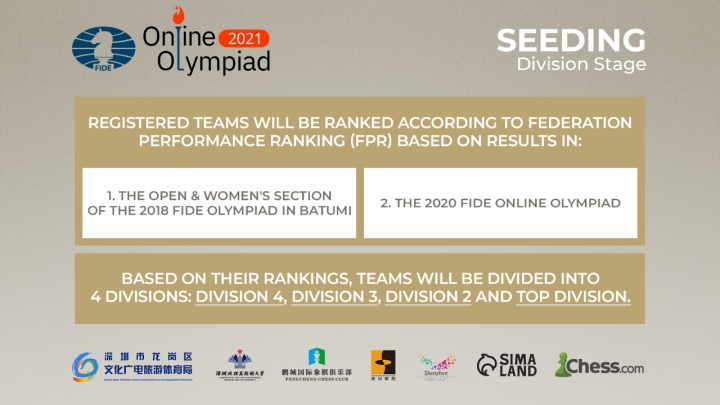
The 2021 FIDE Online Chess Olympiad kicks off tomorrow, August 20, with Division 4 and will last until September 15. 155 registered teams are ranked according to their Federation Performance Ranking (FPR) based on their results in the open and women’s section of the 2018 FIDE Olympiad in Batumi and the 2020 FIDE Online Olympiad. Based on their rankings, teams are divided into four divisions, from Division 4 to Top Division. Like the regular, biannual event, the Online Olympiad is a competition for teams representing their national chess federations. All federations affiliated to FIDE have the right to participate. However, in the online version, each team consists of 6 players and must include at least two women, one player U20 and one female U20. 60 teams, broken up into 5 pools of 12, will battle in Division 4. Each pool will play a round-robin of eleven rounds, with the top three teams from each pool (15 total) qualifying for Division 3. This will be followed by Division 3 (50 teams), Division 2 (50 teams), and finally Division 1 (40 teams), the winners of which will join the seeded teams in the play-off stage. The second edition of the Online Olympiad is supported and sponsored by the Shenzhen authorities, including the Shenzhen Longgang District Culture and Sports Bureau, the Shenzhen MSU-BIT University, Shenzhen Chess Academy, Shenzhen Pengcheng Chess Club. Simaland, the Russian wholesale online store and proud sponsor of the Candidates tournament 2020-21, is also a partner for the Online Olympiad 2021. Find more about the teams and their players here.Check out the crosstable of Division 4, team line-ups, pairings and results here. About the tournament: Scheduled to take place from August 20th to September 15th, the 2021 FIDE Online Olympiad is a national teams event in which all federations affiliated with FIDE have the right to participate. Team’s consist of six players with a minimum of three female players and two junior players. Played online on Chess.com, the event features two main stages: the “Divisions stage”, and the Play-offs stage. All games are played with a 15 minutes + 5 seconds increment per move time control. The full schedule can be consulted here. Organisers: International Chess Federation (FIDE) Chess.com as the hosting platform Partners supporting the 2021 FIDE Online Olympiad: Shenzhen Longgang District Culture, Radio, Television, Tourism and Sports Bureau Shenzhen MSU-BIT University Shenzhen Chess Academy Shenzhen Pengcheng Chess Club Shenzhen Longgang District People’s Government Shenzhen Municipal Bureau of Culture, Radio, Television, Tourism and Sports Simaland
Day 2: Wesley So joins leaders
Wesley So was the sole winner of Day 2, after managing to trick Dariusz Swiercz in a difficult rook endgame to earn the full point as Black. Meanwhile, the co-leaders Lenier Dominguez and Fabiano Caruana drew a complicated game, while Maxime Vachier-Lagrave held against Richard Rapport to maintain the lead with 1.5/2. Swiercz – So | 0-1, 45 moves Despite being well prepared against So’s Berlin Defense, Swiercz burned lots of time in the well-known ‘Berlin endgame’ and could not fight for any tangible advantage. Instead, he fell under pressure in an equal rook endgame and soon had to defend a worse position while also in heavy time trouble. Facing a difficult decision to go into a king and pawn endgame with just two minutes left on the clock, Swiercz chose wrong, missing the precise path to hold the endgame. Instead, he opted to keep the rooks on the board but was simply lost, as So promptly converted his extra pawn into a victory. 36…Rc6! gave White a difficult choice in time-trouble, as 37.Rxc6 had to be followed with computer-like precision to draw in the king + pawn endgame, while 37.Ra5 led to a lost rook ending after 37…Rc3+ and a quick …Kg5 Svidler – Mamedyarov | ½-½, 46 moves Svidler fell into trouble early on as he walked into an unfamiliar line of the Italian Game and soon lost a pawn out of the opening. Mamedyarov managed to trade down into a rook ending, but accurate defence from Svidler allowed him to save the endgame without too much difficulty. Rapport – Vachier-Lagrave | ½-½, 36 moves A symmetrical English saw the players reach a balanced position in the middlegame, with Rapport having a bit of a space advantage while MVL secured a nice outpost on d4 for his knight. With neither player able to do much in the position, a repetition was found and the Game was drawn shortly before the first time control. Dominguez – Caruana | ½-½, 51 moves In what was an interesting struggle Caruana sacrificed a pawn in a topical line of the Italian, looking for long-term compensation in the form of active pieces aimed at White’s kingside. Dominguez played well to neutralize Black’s initiative, but ultimately couldn’t find the most incisive route to keep his advantage. Instead, Caruana earned enough activity to force White to give back the pawn, and the players soon simplified into a drawn queen and pawn endgame. Shankland – Xiong | ½-½, 63 moves The longest encounter of the day saw an incredibly sharp opening as Shankland castled queenside in a Maroczy Bind and seemed to achieve a considerable advantage. However, Xiong created serious counterplay on the queenside, soon forcing Shankland to trade down into an equal endgame. Despite pushing for several hours, Shankland was unable to generate any real winning chances, and the players eventually traded everything down to bare kings to force a draw. Round 3 of the 2021 Sinquefield Cup takes place on Thursday, August 19, starting at 2:50 PM CDT with all of the action covered live by commentators GM Yasser Seirawan, GM Alejandro Ramirez, and GM Maurice Ashley. Watch live on grandchesstour.org as well as twitch.tv/kasparovchess. Text: IM Kostya Kavutskiy Photo: Lennart Ootes and Austin Fuller Further Information:Web: GrandChessTour.org | Twitter: @GrandChessTourInstagram: @GrandChessTour | Facebook: @GrandChessTour#GrandChessTour#STLRapidBlitz Venue: Saint Louis Chess Club, USAAugust 10- August 16, 2021 Press Contact:press@grandchesstour.org Photos: Courtesy of Grand Chess Tour and Spectrum Studios Credits available on Flickr. Livestream:Grandchesstour.orgKasparovchess.com
Evgeny Sveshnikov (1950-2021)
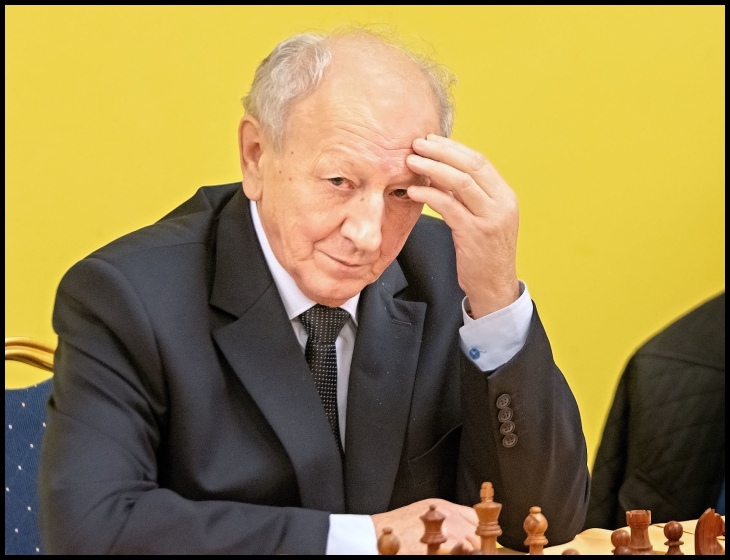
With the most profound sadness, we learned about the passing of GM Evgeny Sveshikov at 71. Born in Chelyabinsk in 1950, Sveshinkov became a master at the age of 17. Six years later, he won the USSR Junior Master Candidate Championship and qualified for the USSR Championship 1974 (one of the strongest tournaments in chess history). Overall he participated in nine USSR championships. His impressive tournament record includes the victories at Decin 1974, Sochi 1976 (both jointly), Le Havre 1977 and Cienfuegos 1979. He also tied for third place in Wijk aan Zee in 1981. Sveshnikov won the Latvian Chess Championship in 2003 and 2010. In 2017, he emerged as the winner of the 65+ section of the World Senior Chess Championship. In team competitions, he played on the gold medal-winning Soviet team in the 1976 World Student Team Chess Championship. Sveshnikov was a reserve for the USSR team participating at the European Team Chess Championship (Moscow, 1977). Although only an international master at the time, he scored an impressive 80%, winning individual and team gold medals. He represented Latvia at the Olympiads of 2004, 2006, 2008, and 2010 and the European Team Championship in 2011. In 2016 he played on the top board of the gold medal-winning Russian team in the 65+ section of the World Senior Team Championship. As a coach and a second, he productively worked with Anatoly Karpov, Lev Polugaevsky, Alexei Shirov and Alexandra Kosteniuk and coached the national teams of several countries. His contribution to the theory of openings is immense. At a very young age, he developed the Sveshnikov Sicilian – one of the most popular systems nowadays. Sveshnikov also pioneered the extensive development of the Advance Variation of the French Defence and the Alapin Variation of the Sicilian Defence. FIDE extends its sincere condolences to Evgeny’s family, friends, and loved ones.