

Big guns storm into semis
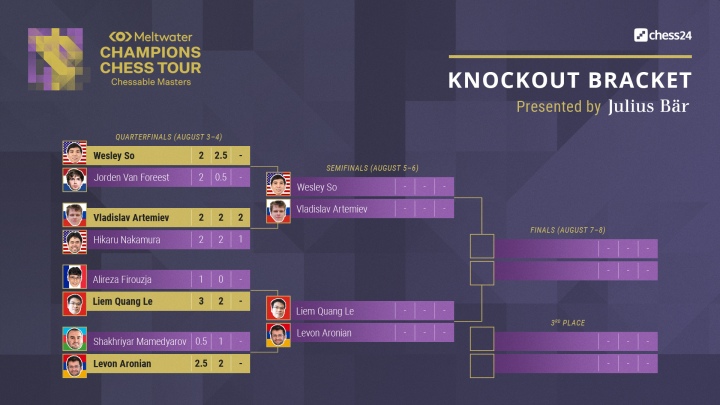
Wesley So fended off Jorden Van Foreest‘s spirited challenge today to move safely in the Chessable Masters semis. The US Champion overcame his Dutch opponent with two wins and a draw to set up a mouth-watering match against the Russian Vladislav Artemiev. But it took a marked step up in form and a lucky break in the third game for So to manage it. Van Foreest was crushed on Day 2, but he battled hard and had chances. So congratulated his opponent afterwards and acknowledged 22-year-old Van Foreest could have won the last game. So, however, now goes into another semi-final and can entertain serious thoughts of overhauling World Champion Magnus Carlsen’s overall lead in the Meltwater Champions Chess Tour. So is the only player who can stop Carlsen and needs to win this event and better Carlsen in the next. Meanwhile, as So looked imperious so did Levon Aronian, the winner of the Goldmoney Asian Rapid. Aronian battered Azerbaijan’s number 1 Shakrhiyar Mamedyarov over the two quarter-final matches and went through today 2-1. Aronian was still not happy. The 38-year-old said his first two games were “very sloppy” but his third “worked out nicely”. He added: “Sometimes I feel like I’m a complete patzer and then I think, if I am a complete patzer then what do some guys who are not very good at chess think?” Vietnam’s Liem Quang Le was the first player through to the semis when he knocked out 18-year-old Alireza Firouzja with two games to spare. Liem, a former World Blitz Champion, steamrollered Firouzja 2-0 to book a spot in a Tour semi-final for the first time. He will face Aronian for a place in the final. The final match to finish was Artemiev’s tight tussle with the American speed demon Hikaru Nakamura. The pair were neck-and-neck going into the final game having drawn all four encounters yesterday. Artemiev took control but Nakamura hung on to take the match to tiebreaks. After the pair traded wins in the blitz section, the quarter-final went down to a tense armageddon shootout. It was Artemiev who held his nerve to claim a big scalp and knock out the American. Tomorrow’s first semi-final matches kick off at 17:00 CEST. For further information, please contact: Leon Watson, PR for Play Magnus Groupleon@chessable.com+44 7786 078 770
Carlsen in sacrifice mode crushes Fedoseev
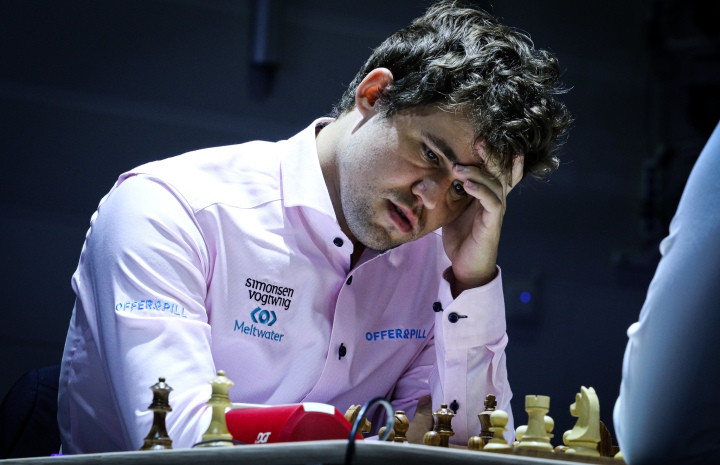
Karjakin and Duda draw an uneventful first game Wednesday, August 4th, 2021 – Norwegian World Champion GM Magnus Carlsen (2847) was highly motivated today. Eliminated from the World Cup final in the tiebreaks yesterday afternoon, but still undefeated in classical games – boasting a +5 rating improvement – a win over Russian GM Vladimir Fedoseev (2696) would definitely bring back his edge. His opening choice – the King’s Indian defence – was already a statement: he was going for the kill. Fedoseev didn’t back down at all: his third move 3.h4! clearly put Magnus off-balance. “A very good choice” said Carlsen after the game. Carlsen went into deep thought and after sixteen minutes chose one of the most principal continuations, deviating from a previous Fedoseev game which went 5…Na6. The fight was on. “My ideas today were generally connected with sacrifices” was the Norwegian’s mentality. The key moment of the game came on move sixteen: Vladimir Fedoseev – Magnus Carlsen in a typical King’s Indian middlegame, Carlsen decided to unbalance the position. The fantastic sacrifice idea 16…f4! followed by 17.Bxf4 Bd7 18.Nd1 Rxf4! reminded World Cup commentator GM Nigel Short of some of Tigran Petrosian’s games: the exchange sacrifice was one of his trademark positional gems. Fedoseev accepted the gauntlet and began to defend. However, even an exchange and a pawn up, his position was very hard to play: all his pieces were bottled up on the kingside and Carlsen was dominating the dark squares. The Russian grandmaster tried to give back the exchange but Carlsen kept declining: his bishop was much stronger than the rook. You don’t often see a zugzwang position with so many pieces on the board. Finally, on move forty Carlsen recovered the sacrificed material, at the same time keeping all his positional advantages and Fedoseev gave up his hopeless position immediately. Carsen will play White tomorrow in the second game. A very content World Champion gave us his thoughts in a brief post-game interview. Former 2015 World Cup winner GM Sergey Karjakin (2757), representing Russia, opened the game with 1.d4 and his opponent in the final GM Jan-Krzysztof Duda (2738) from Poland, defended with the Vienna system, which has brought him quite a lot of success in this event. Karjakin followed the steps of a previous game between Magnus Carlsen and Jan-Krzysztof Dua, from the Tata Steel event in 2019, introducing a novelty on move 11.Rd1. Duda didn’t seem very impressed and quickly defended his extra pawn with 11…Bd7. Even though Duda’s move is very logical, it might have caught Karjakin by surprise, because he thought for seventeen minutes before going for a three-fold move repetition. We caught up with him after the game and he was kind enough to explain his thought process. Obviously, Duda was very happy with the outcome of the game: a draw with Black at this level is generally a very positive result, especially taking into account that his opponent had an extra day to prepare for the game. In his post-game interview, he mentioned that he was surprised by his opponent’s opening choice. He will play the second game tomorrow with White. Text: Michael Rahal, FIDE Press Officer press@fide.com Photo: David Llada and Eteri Kublashvili About the tournament: Scheduled to take place from July12th (Round 1) to August 6th (finals), the 2021 FIDE World Cup will gather together in Sochi (Russia) 309 of the world’s best chess players, with 206 of them playing in the Open World Cup (and 103 participants in the first-ever Women’s World Cup. The top two finishers in the tournament, aside from World Champion Magnus Carlsen who is also participating, will qualify for the 2022 Candidates Tournament, in addition to winning the 110.000 USD first prize (80.000 USD for the runner-up). The full tournament tree, live games and PGN files can be found on the World Cup website alongside a great amount of other interesting information such as daily videos, a complete photo collection and other useful data. Organisers: International Chess Federation (FIDE), Chess Federation of Russia, Russian Ministry of Sports, and Government of Krasnodar Krai. Partners: Gazprom – general partner Nornickel – general partner PhosAgro – general partner Chessable – event’s partner Aeroflot – CFR’s partner Educational centre “Sirius”
Van Foreest shocks So but American hits back

Dutch destroyer Jorden Van Foreest came close to felling top seed Wesley So in a start to the knockouts that came full of fire. The 22-year-old threw everything at his American opponent and inflicted a crushing 19-move win over him in Game 2. But it was not enough to take the lead as the super-solid So hit back and then kept Van Foreest at bay in the final game – just – to escape Day 1 with a 2-2 draw. Van Foreest and So will go into battle again with everything resting on a one-match shootout and tiebreaks if necessary. So said afterwards: “It was really a very bad day for me, or maybe Jorden just played really very well.” In the other quarters, Armenia’s Levon Aronian wrestled the advantage from Azerbaijan’s Shakrhiyar Mamedyarov with a classy 2.5-0.5 win with a game to spare. Aronian must now be considered the hot favourite to progress today. Vietnam’s Liem Quang Le won two games to take the first match against 18-year-old hotshot Alireza Firouzja. The youngster will fire back today. Liem said he was better prepared for the Tour after coming into this event “fresh and ready for the fight”. The match between speed demon Hikaru Nakamura and Vladislav Artemiev, the runner-up in the Goldmoney Asian Rapid, ended in four draws. Nakamura had a big chance to get a win in Game 3 but missed it. They resume with everything resting on a simple shootout today. The knockouts continue tomorrow. Kick-off is at 17:00 CEST. All matches in the Chessable Masters are hosted in chess24.com’s playzone and available to watch on the platform’s Twitch and YouTube channels for free. The Chessable Masters is the penultimate leg of the Meltwater Champions Chess Tour before the Finals event in San Francisco, where the ultimate winner will be crowned the world’s best online chess player. For further information, please contact: Leon Watson, PR for Play Magnus Groupleon@chessable.com+44 7786 078 770
Luis Engel Hanna Marie Klek win German Masters 2021
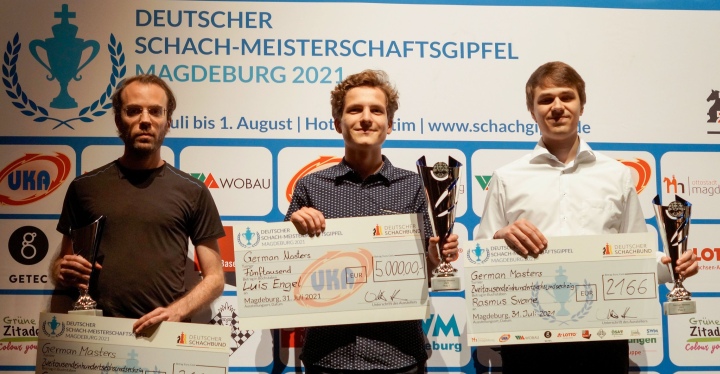
Luis Engel and Hanna Marie Klek came as winners of the German Masters 2021. The chess forum in Magdeburg brought together hundreds of local players competing in various tournaments from July 23 to July 31: German Championships, German Women’s championships, German Senior championships (+ 50 / + 65), German Blitz Championships, German Women’s Blitz Championships, German Senior Blitz Championships (+ 50 / + 65), German Senior Rapid Championships, German Cup Championships and the most prestigious German Masters (open and women). Photo: Official website The ninth-rated resident of Hamburg, Luis Engel caused a minor sensation convincingly winning the 10-player round-robin German Masters with a round to spare. Rasmus Svane, Georg Meier and Andreas Heimann (the only unbeaten participant who, nevertheless, did not make it to the podium due to inferior tiebreaks) finished 1.5 points behind the winner and tied for second place. Final standings 1 GM Engel Luis 6½ 2 GM Svane Rasmus 5 3 GM Meier Georg 5 4 GM Heimann Andreas 5 5 GM Kollars Dmitrij 4½ 6 GM Fridman Daniel 4½ 7 GM Blübaum Matthias 4½ 8 GM Graf Alexander 3½ 9 IM Parvanyan Ashot 3½ 10 GM Braun Arik 3 Photo: Arne Jachmann In the Women’s Masters, Hanna Marie Klek (pictured above) was coming to the final round a full point lead over Carmen Voicu-Jagodzinsky and sealed the deal finishing 1.5 points ahead of her main competitor who settled for silver. Five players tied for second place with Melanie Lubbe taking bronze thanks for better tiebreaks. Final standings: 1 WGM Klek Hanna Marie 7 2 WGM Voicu-Jagodzinsky Carmen 5½ 3 WGM Lubbe Melanie 5 4 WIM Mütsch Annmarie 5 5 WFM Ziegenfuß Antonia 5 6 WIM Sieber Fiona 5 7 IM Kachiani-Gersinska Ketino 4 8 WGM Michna Marta 3½ 9 FM Schneider Jana 3 10 FM Schulze Lara 2 Meanwhile, Jonas Rosner (pictured below) came out on top in the German championship and earned his spot in German Masters 2022. Photo: Frank Hoppe Check out the full results on the official website.
Jan-Krzysztof Duda defeats WC Magnus Carlsen
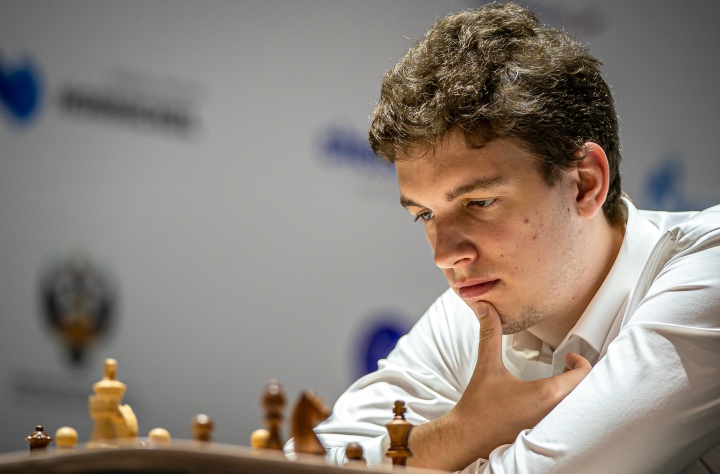
He will face local hero Sergey Karjakin in the World Cup final Tuesday, August 3rd, 2021 – The tie-break between GM Magnus Carlsen (2847) and GM Jan-Krzysztof Duda (2738) began at 3 pm sharp with the first move ceremony, played by Alexander Vlasov, the Vice-Governor of the Krasnodar Region. Almost 8000 students in 35 municipalities of the region are involved in chess training and the World Cup is a huge boost to this program. Duda won the toss and opened the first 25/10 game with 1.e4. Carlsen replied with 1…e5, as in all of his games here, but went for the Berlin Wall variation with 3…Nf6 for the first time in the World Cup. Play developed slowly, following a 2007 game between Hou Yifan and Krisnan Saskiran. Carlsen deviated with 13…c5 and after a few exchanges equalised the position completely. According to the engine, 19.c4 instead of 19.Qb1 might be an improvement but it still doesn’t seem very much. The position remained balanced, although Magnus did have a small advantage on the clock. However, further exchanges left both players with no chance of fighting for a win and the draw seemed to be the most likely result. However, Carlsen is a tricky player and he tried 27…Qc2 followed by 28…Qb3, sacrificing the c5 pawn for some fun tactics, just when both players were approaching the 5-minute barrier on the clock. But Duda found the solid solution (30.Re3!) and a draw was agreed by three-fold move repetition immediately afterwards. In the second 25/10 game, Carlsen opted for the 3.Bb5+ side-line against Duda’s Sicilian defence. The opening soon transposed into a French-type pawn structure in which Black is generally fine, having exchanged light-squared bishops. Duda tried out the relatively new 12…Bb4 novelty instead of the usual 12…Be7, but it’s not a big deal as long as White doesn’t exchange minor pieces. Both players began to manoeuvre on the queenside until Duda proposed the exchange of queen’s with 21…Qb5! which Carlsen declined. Meanwhile, Carlsen had started to expand on the kingside but it did seem a bit slow. Finally, Duda went for light-square domination, starting with 27…Na7! and gradually out-played the World Champion by forcing the correct exchanges. With both of the players very low on time, the bishop ending was madness: the engine’s evaluation was going up and down on every move but it was always Duda who was pressing, due to Carlsen’s bad bishop combined with his pawn structure. With hardly any time left, Carlsen made the final mistake by playing 62.Bc1? allowing Duda to force the zugzwang position. When the a-pawn was lost it was clear that Carlsen was in the ropes. A few moves later he resigned and an ecstatic Duda advanced to the final, in addition to securing a spot in the 2022 Candidates tournament. He was kind enough to come along to the press center and give his thoughts on the match. After two draws in the classical games, the tiebreak match for third and fourth place in the women’s group was also held today. Ukraine GM Anna Muzychuk (2527) won the toss and played with White in the first game. Her opponent, Chinese GM Tan Zhongyi (2511) defended with the Petroff, her pet defence in this event. Muzychuk went for the fashionable 5.Nc3 option, leading to a position with opposite-side castled kings. By means of 12.h4-h5 she launched a vicious attack on Tan’s king, sacrificing a pawn for the attack. But Zhongyi Tan kept her calm, drove back the attack and gradually finished her development. The turning point was White’s 23.Qh2? (instead, 23.Bg5 was better, with a probable ¡draw by move repetition), and from there on it looked like Black’s attack on the queenside was stronger. Muzychuk had already spent most of her time and was under serious pressure, both on the board and on the clock – at some point, Tan had seventeen minutes left against Muzychuk’s thirty seconds. After stabilizing the position and netting a second pawn, the Chinese GM started pushing her h-pawn passer. By a strange twist of fate, it was game over. In a must-win situation, Muzychuk went for the double-edged Albin Counter Gambit in the second game. Her third move 3…Ne7 (instead of the regular 3…d4) is a blitz idea played by GM Aleksandr Shimanov – one of the World Cup commentators. However, 9….b5? was definitely a blunder and after a few moves, Muzychuk was already in trouble. On move twelve, with 12.Qxa7! she was already clearly winning, as Black loses too much material if the queen is captured. Zhongyi Tan could have gone for the brilliancy prize if she had found 15.Ne5!! but her move repetition in a winning position was more than enough to seal the deal and win the third prize trophy in addition to direct qualification to the 2022 Women’s Candidates tournament. The prize-giving for the Women’s World Cup took place after the end the round, with the presence of FIDE President Arkady Dvorkovich, the Deputy Head of the City of Sochi, Vladimir Morozov, the Executive Director of the Russian Chess Federation, Mark Glukhovsky and the main arbiter of the tournament Laurent Freyd. Alexandra Kosteniuk, Aleksandra Goryachkina and Tan Zhongyi (winner, runner-up and third place finisher) received their awards along with some other delightful presents from the tournament sponsors. The full tournament tree, live games and PGN files can be found on the World Cup website alongside a great amount of other interesting information such as daily videos, a complete photo collection and other useful data. Text: Michael Rahal, FIDE Press Officer press@fide.com Photo: Eric Rosen and Anastasiia Korolkova About the tournament: Scheduled to take place from July 12th (Round 1) to August 6th (finals), the 2021 FIDE World Cup will gather together in Sochi (Russia) 309 of the world’s best chess players, with 206 of them playing in the Open World Cup (and 103 participants in the first-ever Women’s World Cup. The top two finishers in the tournament, aside from World Champion Magnus Carlsen who is also participating, will qualify for the 2022 Candidates Tournament, in addition to winning the 110.000 USD first prize (80.000 USD for the runner-up). Organisers: International Chess Federation (FIDE), Chess Federation of
Historic win for Mishra as Wesley So smashes score record
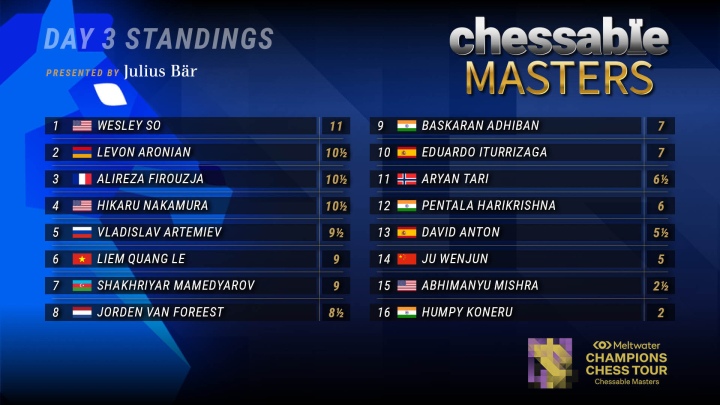
A dramatic end to the Chessable Masters prelim stage saw boy wonder Abhimanyu Mishra score a historic win and US star Wesley So break the event’s score record. Twelve-year-old Mishra, the world’s youngest Grandmaster, shocked the field by toppling Pentala Harikrishna. It was Mishra’s first win over a Super GM and first win of the event. The youngster and Harikrishna are separated by 595 places in the world rankings, 23 years in age and an ocean of experience. In a frantic endgame in Round 14, Mishra needed to hold his nerve with just seconds left on his clock to seal the win. When it was finally over, Mishra, who is ranked 616 in the world, rocked back on his chair in relief. Harikrishna looked stunned. “It was a dream come true to play in this event, against these players,” Mishra said afterwards. “It was amazing, it was full of ups and downs and at the end I was able to win.” Meanwhile, Mishra’s fellow American So continued his incredible dominance of this event by extending his unbeaten streak to 15 games. In the process, he broke the $1.6 million Meltwater Champions Chess Tour prelim stage score record with a stunning 11/15. So said he was “inspired” by the absence of World Champion Magnus Carlsen who he is chasing in the overall Tour table. “I figured I should try and score as many points when he is not here,” he added. So took a draw with the Dutchman Jorden Van Foreest in the final round as both went through to the knockouts. For Van Foreest, it was a big achievement. He made the cut for the first time along with Vietnam’s Liem Quang Le. While So was dominant, close behind were a pack of three led by the other young hotshot in the field, Alireza Firouzja. The Iranian-born teenager beat Misha in the final round to finish joint-second on 10.5/15 and clearly justify the hype around him. Level with Firouzja were the two heavyweights, speed demon Hikaru Nakamura and Armenia’s Levon Aronian. Making up the top eight were Goldmoney Asian Rapid finalist Vladislav Artemiev and Shakrhiyar Mamedyarov. However, in the scramble for places in the top eight the bottom eight players were eliminated. The exciting Indian Adhiban Baskaran came the closest, just missing out. The knockouts start tomorrow. The kick-off is at 17:00 CEST. All matches in the Chessable Masters are hosted in chess24.com’s playzone and available to watch on the platform’s Twitch and YouTube channels for free. The Chessable Masters is the penultimate leg of the Meltwater Champions Chess Tour before the Finals event in San Francisco, where the ultimate winner will be crowned the world’s best online chess player. For further information, please contact: Leon Watson, PR for Play Magnus Groupleon@chessable.com+44 7786 078 770
Alexandra Kosteniuk, Women’s World Cup Champion!
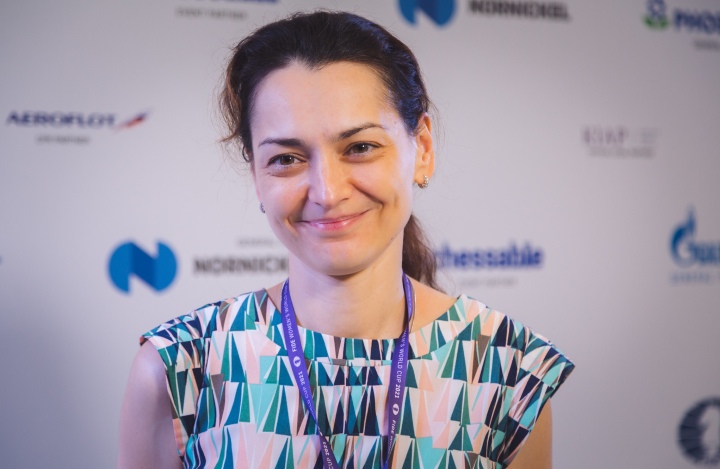
Sergey Karjakin first finalist: Carlsen and Duda will tie-break tomorrow Monday, August 2nd 2021 – Afternoon’s such as today are a joy for chess fans. Aggressive openings, hard-fought middlegames, great endgame technique and of course amiable companionship. So interesting that FIDE President Arkady Dvorkovich keenly followed the games at the start of the round, before returning to his duties at the important FIDE Council Meeting, which is also being held these days in Sochi. In the first semi-final between GM Jan-Krzysztof Duda (2738) and GM Magnus Carlsen (2847), Poland’s number one opened with 1.e4 and the World Champion went for an open game. Soon the game evolved into one of the many anti-Marshall variations of the Ruy Lopez with 8.a4, which Carlsen had already faced a few days ago in his game against Bacrot. Possibly fearing some dangerous home preparation, Carlsen deviated with the less common 8…Rb8 (instead of 8…Bb7), which Duda was definitely not expecting, as he took nearly ten minutes for his next move. The game spiced up when Carlsen went for 9…d5, going for a Marshall Gambit type of position. Duda picked up the gauntlet and captured the pawn. After 17…g5 it was obvious to everybody that Carlsen had it all worked out: he was playing very fast and Duda was falling behind on the clock. Prudently, Duda decided to exchange queens and the game transitioned into an equal endgame, with an extra pawn for White compensated by Black’s bishop pair and development. Although we were not able to find any games with the actual position, this type of endgame normally ends in a draw. White generally gives back the pawn to keep the balance, or opposite-colored bishop endgames often appear. However, unexpectedly in pure Marshall spirit, Duda sacrificed his rook for a knight and a pawn. With two pawns for the exchange, it was clear that Duda couldn’t be worse but did he have the advantage? Magnus demonstrated that the draw was always there. A hard-fought game, but nevertheless both of them will return tomorrow to battle it out in what will be a very exciting tie-break. In the second semi-final, between Russian top players GM Sergey Karjakin (2757) and GM Vladimir Fedoseev (2696), the opening was also the Ruy Lopez, although in this case, Fedoseev chose the solid Zaitsev variation, quite content with the famous draw by repetition that occurs after 11.Ng5 Rf8 12.Nf3 Re8. However, no one expected Karjakin to back down so early, and therefore 11.Nb-d2 was the main continuation. The turning point in the opening was move thirteen, when Fedoseev chose 13…d5 – played several times by Alexander Morozevich – instead of the main line 13…Nb8. Both players were blitzing out their moves until Fedoseev pushed 19…f5. Karjakin went into the tank and after twenty-five minutes of deep thought came up with the novelty 20.h4, trying to improve on the games between Tari-Vidit (2018) and Oparin-Morazevich (2015). The idea is to control Black’s kingside expansion. This might have taken Fedoseev by surprise, as soon after he blundered with 21…Rf8? allowing White to take the initiative with 24.e6!, which vacates the e5 square for a minor piece. Fedoseev didn’t react in the best way and soon he was under serious pressure, the main threat being f3!, expelling the knight from the center and activating White’s hidden bishop on c2. In desperado mode, Fedoseev initiated a series of exchanges beginning with a knight sacrifice on f2, but Karjakin had it all under control. After 31.d5 it became clear that Karjakin would be playing his second World Cup final: he won the title on Baku in 2015. After the game, Karjakin was kind enough to give us his views on the game and who he prefers in the final: Duda or Carlsen? After yesterday’s defeat, GM Aleksandra Goryachkina (2596) was in a must-win situation. Although she lost with the French Defence against GM Alexandra Kosteniuk (2472) in 2018, she decided to give it a second chance today. Kosteniuk deviated from that previous game with 3.Nd2 and Goryachkina went for 3…c5, her main weapon against the Tarrasch variation. On move nine, Goryachkina tried 9…b6, instead of 9…Nc5, which was her choice against Kashlinskaya in 2019, a game which she went on to win. She had prepared this move having seen an even older game which Kosteniuk played in 2013 against Jovana Rapport in the European Championship. Did Kosteniuk recall the game? Hard to know. One can only speculate on such things. In any case, 12…Rc8 was Goryachkina’s novelty and after a few moves the game was totally unbalanced: Black’s development was decent, but her king would have to stay in the center for the rest of the game. Obviously, this kind of unbalanced middlegame would clearly favour Goryachkina. Kosteniuk had a lot on the line. She prudently decided to play it safe, avoiding unnecessary risks, and timely exchange of queen’s and rook’s nipped Goryachkina’s counterplay in the bud. The endgame was academic: opposite-side coloured bishops and equal pawns. The game was heading to a draw but Goryachkina over-pressed and ended up in a clearly lost queen ending. However, Kosteniuk graciously offered a draw, which her opponent accepted. In the final women’s World Cup interview, a very happy Alexandra Kosteniuk gave us her thoughts on the match and her overall tournament success. In the match for the third and fourth place in the Women’s World Cup, China’s GM Tan Zhongyi (2511) repeated the Petroff Defence and GM Anna Muzychuk (2527), representing Ukraine, went for the unambitious 5.Bd3 side-line. White could have obtained the bishop pair with 12.Nxe7+ but she decided that Black’s development was more than enough compensation. After twenty moves the position was equal and resembled more an exchange French defence than a Petroff. White had the two bishops but Black’s strong knight on e4 was impressive. Slightly worse, Muzychuk offered a move repetition on move twenty-seven with 27.Bd1 and 28.Bc2. However, Tan Zhongyi declined and waited for a better moment to force the simplification. The ending was clearly better for the Chinese player – her minor pieces were clearly better – but Muzychuk defended tenaciously and a draw was agreed on move forty-nine. Tomorrow’s tie-break
FIDE deploys Chess for Protection project for refugees

The International Chess Federation with the support of UNHCR, the UN Refugee Agency, Lutheran World Federation (LWF), Kenya Chess Federation and Kakuma Chess Club has launched a Chess for Protection project, aiming to consolidate and develop chess practice in Kakuma refugee camp and Kalobeyei settlement in Kenya. The name of the project is “Chess for Kakuma and Kalobeyei People”. The project started today, on 2 August, with the online opening ceremony and simultaneous exhibition played between FIDE Managing Director Dana Reizniece-Ozola and members of Kakuma Chess Club. The kick-off event also featured UNHCR Head of Sub-Office Kahin Ismail, UNHCR Kenya Country Representative Fathiaa Abdalla, FIDE President Arkady Dvorkovich, Chess Kenya President Benard Wanjala, FIDE Vice President Anastasia Sorokina and other officials. “Over 55% of the refugee population in Kakuma are children and adolescents. The importance of engaging youth in extra-curriculum activities cannot be overestimated. This initiative will no doubt contribute to the wellbeing of youth, their psychological needs and their development. We are very glad to launch this project with all our partners – FIDE, LWF, Kenya Chess Federation, chess clubs in Kakuma. We are looking forward to nurturing and supporting this very important activity as an additional element in which our youth will partake, and I am sure will excel as we see them do in many other sport and cultural activities,” said Kahin Ismail, UNHCR Head of Sub-Office in Kakuma. “The Chess for Kakuma and Kalobeyei project is an excellent initiative to engage refugee youth in productive and engaging social activities. Chess is becoming increasingly popular among the youth in Kakuma and Kalobeyei. Our young boys and girls, women and men are joining many chess clubs. It will allow youth to bring the solidarity, enthusiasm, inspiration and energy to act as agents of positive change in their communities. I wish to thank FIDE and LWF for providing innovative and productive solutions to address some of the challenges faced by refugee youth in Kakuma and Kalobeyei,” Fathiaa Abdalla, UNHCR Kenya Country Representative emphasized. FIDE President Arkady Dvorkovich: “In FIDE we really believe in inclusive sports and inclusive chess. We are happy that our joint initiative with UNHCR, LWF and Chess Kenya has attracted so much attention. We have to promote chess not just as a sport but as a tool to improve our society, to promote healthy habits and inspire self-improvement and self-growth in many people. A big part of our mission is to promote chess as an instrument to improve the social environment for thousands or millions of people. We have been doing quite a few things already including projects like Chess for Freedom, Chess for Children with Autistic Spectrum Disorder, we ran the Online Olympiad for people with disabilities with 400 people participating. Now we are launching this huge project for refugees. We welcome all of you to our chess family! Yesterday we discussed the possibility of having a team of refugees at the next Chess Olympiad in Moscow. Hopefully, some of you can come to Moscow next year to participate in this event along with 200 other national federations.” LWF representative Julius Arawan: “I’d like to say that I appreciate what was done by FIDE and UNHCR to support youth in Kakuma and engage it in chess activities. We know that playing chess is very important for youth, for developing critical thinking and for future careers. We will continue to work with FIDE and UNHCR to ensure that this activity is realized and youth is involved in it.” Chess Kenya President Benard Wanjala: “I am very happy to be a part of this historic launch of the Chess for Protection project. Kenya has the second biggest refugee camp and the third biggest slum in the world. This creates very uncomfortable living conditions for youth and children who lack resources and opportunities to follow their life dreams. This is not just about chess, it’s about giving dreams to children. Chess Kenya is very proud to be a part of this initiative.” FIDE Managing Director Dana Reizniece-Ozola: “I hope that this project will bring fruits not only to refugees themselves but will also be a great satisfaction for us, the people involved in it. There’s strong evidence that chess structures the brains of people. If they regularly go for it, it increases their analytical skills, self-esteem and the understanding between the cause and the consequence. That is something that is instrumental in the lives of all human beings, but probably particularly in the lives of people in vulnerable situations. We will start with training the youth and kids in approximately 40 schools. In parallel, we will focus on the empowerment of young females and girls. Life skills training program will be carried out in the schools for girls where they will have chances to meet inspirational chess players and ladies representing other professions. They will be sharing their experiences and life stories and giving examples of how to reach success even if your starting point is not the best.” FIDE Vice President and the mastermind of Chess for Protection project Anastasia Sorokina: “I kept an idea of this project for a long time as I believe with all my heart that chess gives a lot of extra opportunities in your life. Chess also gives you extra skills, it teaches you not only how to win, but also how to survive when you lose. All of them are really life skills. That’s why I think this project is especially important for people who lost their homes or are living in new places where they are trying to adopt and live in a new community. Chess makes people united. I shared this idea with FIDE Managing Director Dana Reizniece-Ozola, and I am happy she supported it. I would like to thak all the UNHCR team for their support, we are very happy to work together and to get this project on board.” The official ceremony was followed by a simultaneous exhibition by FIDE Managing Director Dana Reizniece-Ozola for four members of Kakuma Chess Club. One of the
Winners crowned at Rudaga-Kaissa 2021 Festival
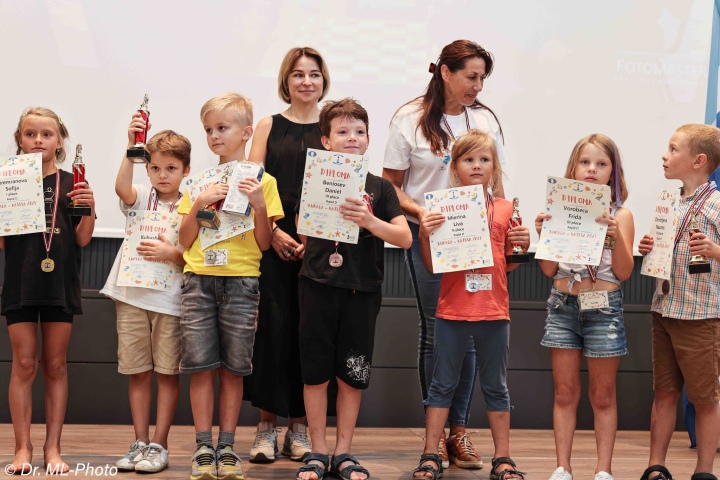
The Rudaga-Kaissa 2021 International Festival that brought together over 400 participants came to an end in Jurmala. For the first time, the event was held in the festival format and under the auspices of FIDE. Apart from online and over-the-board tournaments, the festival included masterclasses, meetings, simultaneous exhibitions, and other chess activities. We are happy to announce the winners of the over-the-board tournaments in different categories. Naturally, there were many top-finishers from the host country, but guests from other parts of Europe proved to be very serious competitors. Congratulations to all! Standard Open: 1. Shturman Arseniy (RUS)2. Strods Kristaps Reinis (LAT)3. Tabors Emils (LAT) Standard Girls: 1. Kuznecova Marija (LAT)2. Daineko Jevgenija (LAT)3. Locmele Valerija (LAT) U14 Open: 1. Jaakkola Niklas (FIN)2. Testelecs Ilja (LAT)3. Sokolovskis Pavels (LAT) U14 Girls:1. Maklakova Naomi (LAT)2. Maklakova Dafne (LAT)3. Kirijanova Sintija-Lina (LAT) 10 Boys:1. Jeronovics Toms (LAT)2. Platonovs Nikolajs (LAT)3. Kakurin Artem (RUS) U 10 Girls: 1. Gurevich Alexandra (ENG) 2. Teremranova Sofija (LAT)3. Sirajeva Anna Mira (LAT) The youngest boy and girl in the festival, the best boy and girl in rapid group C (born after 2009) and group D (born after 2013), the best boy and girl in blitz born after 2009, and the best boy and girl in standard chess born after 2009, all received Gold Participant certificates from ChessKid.com. The winners of the standard chess event, Arseniy Shturman (RUS) and Marija Kuznecova (LAT) received the main prize of the festival – accreditation to the 2022 World Chess Olympiad, tickets to the opening ceremony, and accommodation for two nights at the official hotel of the Olympiad. During the closing ceremony, FIDE Vice President Anastasia Sorokina thanked the participants, parents and organizers – public organization “Rudaga plus”, Jurmala City Council, Rudaga Children and Youth School of Education and Creativity (Jurmala, Latvia), KAISSA (Riga, Latvia), Semarah hotel Lielupe. She expressed hope that this festival under the auspices of FIDE will become an annual event. Tournament Director Inessa Testelec thanked FIDE for its support and presented a memorable gift for the FIDE President.
Round 7 Game 01: Kosteniuk pulls ahead in the Women’s final
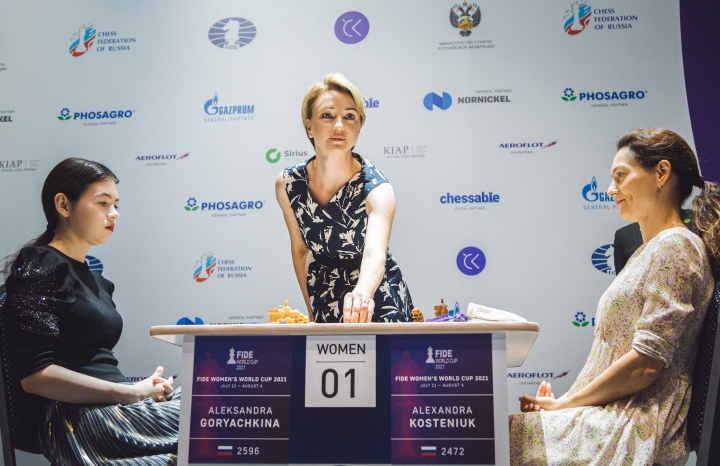
Solid draws in Carlsen-Duda and Fedoseev-Karjakin Sunday, August 1st 2021 – After a well-deserved free day, the eight remaining players returned to the venue this afternoon to continue the fight for the 2021 World Chess Cup. They were joined on the stage by Polina Lion, Chief Sustainability Officer of ROSATOM, the largest producer of electricity in Russia, who played the first move in the women’s final. On board one in the open group, Norwegian World Champion GM Magnus Carlsen (2847), opened with 1.d4, and his opponent, Polish GM Jan-Krzysztof Duda (2738) opted for the Queen’s Gambit declined, starting with the 1…Nf6 move order. In other games here, Carlsen has preferred the Catalan opening but today he went for 4.Nc3 allowing 4…dxc4, transposing directly into a fashionable variation of the Queen’s Gambit Accepted, in which White sacrifices a pawn for development. Nothing new under the sun, of course: both players had already tested this line in the 2019 Tata Steel tournament. In that game, Carlsen emerged victorious. However, today he brought a new, and rather less-known, idea to the table. Duda decided to play it safe by giving the pawn back in order to reach an equal position albeit with an imbalance in the pawn structure and minor piece (knight against bishop). Although Carlsen tried his best to push for a win in the rook ending, Duda played with great precision and a draw was agreed just after move thirty. Before he left the venue to prepare for tomorrow’s game, Jan-Krzysztof gave us his thoughts in a brief interview. A fun fact occurred in the other all-Russian semi-final between GM Vladimir Fedoseev (2696) and GM Sergey Karjakin (2757). The former 2015 World Cup winner chose a very solid side-line in the Queen’s Gambit Semi-Tarrasch variation. Funnily enough, the same opening was being played a few metres away in the Women’s third-fourth place match! As luck would have it, both games deviated on move thirteen. The position remained equal for most of the game: neither player wanted to risk being essentially eliminated in the first game due to an unforced blunder. Soon enough, all the minor pieces were exchanged and some lengthy manoeuvring with the queen and rooks began. After more exchanges, Karjakin voluntarily went into a rook ending a pawn down, but in any case, a clear draw due to his passer. As top Russian GM Peter Svidler put it “Karjakin doesn’t lose many of these”. A draw was agreed on move sixty-nine. In his post-game interview, Fedoseev considered that he was pressing most of the game and that some of these rook endings can be won. In the all-Russian women’s final, between GM Aleksandra Goryachkina (2596) and GM Alexandra Kosteniuk (2472), the rules stipulated that Goryachkina would play with White in the first game. She opened with 1.d4 and soon the game followed the theory of the Catalan opening, one of her favourite set-ups. On move seven, 7.Be3 was definitely a surprise for Kosteniuk – 7.Bg5 and above all 7.e3 are by far the main moves – and she thought for nearly ten minutes before replying with the sensible 7…Nd5. She was able to keep the balance, in which her two bishops and optimal pawn structure compensated White’s extra space in the centre. However, fate struck hard on move twenty as 20…e5? was a big mistake. Obviously, 21.dxe5 would just return the blunder due to 21…Rd3 winning, but 21.b4! (after only two minutes of thinking time) was the perfect response. Goryachkina won a pawn and was clearly in the driving seat. She gradually increased her advantage and could have sealed the deal on move thirty-six if she had played 36.Rd1 intending Rd6 or Rd7, and Black is in big trouble. However, low on time, Goryachkina missed the win. With both players approaching move forty, huge complications commenced and this time Kosteniuk came out on top. Goryachkina – Kosteniuk Unfortunately for Kosteniuk, she threw away most of her advantage with 41…Qd4? (instead of either 41…c2 or 41…Qe3 which are both winning), but was lucky enough to get a second chance a few moves later when Goryachkina misplayed the ending, and this time she scored the win. In the match for third place between China’s GM Tan Zhongyi (2511) and GM Anna Muzychuk (2527), representing Ukraine, the Semi-Tarrasch variation of the Queen’s Gambit declined was played, just as in the men’s second semi-final. However, White’s 13.Bxf6 followed by 14.Nxd5 just didn’t have enough punch to achieve a serious advantage. After a few exchanges, Muzychuk spotted from afar the neat trick with 25…Nd4! and held the queen ending to a draw with no trouble at all. A good result for Muzychuk, who will now enjoy the white pieces in the second game tomorrow. Pairings of the rounds, live games and PGN files can be found on the World Cup website alongside a great amount of other interesting information such as daily videos, a complete photo collection and other useful data. Text: Michael Rahal, FIDE Press Officer press@fide.com Photo: Eric Rosen and Anastasiia Korolkova About the tournament: Scheduled to take place from July 12th (Round 1) to August 6th (finals), the 2021 FIDE World Cup will gather together in Sochi (Russia) 309 of the world’s best chess players, with 206 of them playing in the Open World Cup (and 103 participants in the first-ever Women’s World Cup. The top two finishers in the tournament, aside from World Champion Magnus Carlsen who is also participating, will qualify for the 2022 Candidates Tournament, in addition to winning the 110.000 USD first prize (80.000 USD for the runner-up). Organisers: International Chess Federation (FIDE), Chess Federation of Russia, Russian Ministry of Sports, and Government of Krasnodar Krai. Partners: Gazprom – general partner Nornickel – general partner PhosAgro – general partner Chessable – event’s partner Aeroflot – CFR’s partner Educational centre “Sirius”