

PhosAgro and FIDE sign strategic partnership

Moscow, June 09, 2021 PhosAgro, one of the world’s leading vertically integrated phosphate-based fertilizer producers, and the International Chess Federation (FIDE) have signed a strategic partnership. The contract was signed by the President of the International Chess Federation (FIDE), chairman of the Skolkovo Foundation Arkady Dvorkovich and PhosAgro CEO Andrey Guryev in the Mikhail Botvinnik Central Chess Club in Moscow. Photo credits: Eteri Kublashvili, Chess Federation of Russia President of the International Chess Federation (FIDE), chairman of the Skolkovo Foundation Arkady Dvorkovich thanked PhosAgro for the long-term partnership, stressing that the company uses an integrated approach to popularizing chess as a sport: “First of all, I would like to once again congratulate PhosAgro on its 20th anniversary. We can no longer imagine the World Championship Match without such a partner as PhosAgro, and I am glad that this year the company is again a partner of the World Championship Match and, no less important, FIDE World Cups, which will be held in July-August in Sochi. I believe that this is another proof of the company’s commitment to chess, its support of the Russian school and the development of chess in the world. The partnership promises to be fruitful in terms of supporting the younger generation of chess players, both in Russia and around the world. This time, the World Championship Match will be held in Dubai as a part of the World EXPO, which will bring together the best minds not only of the chess world but also of politics, business, and technology. I think this is fully consistent with the values and the expertise that the International Chess Federation and PhosAgro both possess.” The partnership between International Chess Federation (FIDE) and PhosAgro includes such major FIDE events as the WorldChampionship Match in Dubai and FIDE World Cups in Sochi. Photo credits: Eteri Kublashvili, Chess Federation of Russia “Chess has become a traditional corporate game for us, a part of our corporate culture. This year the company celebrates its 20th anniversary, and for 11 years we have been supporting the Chess Federation of Russia. We are also sponsoring the World Chess Championships and the qualifying tournaments for them. This signing ceremony has become traditional: chess is gaining popularity in our country and around the world and requires proper support from business. Chess and PhosAgro have a lot in common: we always think one move ahead, or rather two or three moves, to outperform our competitors. It is important for PhosAgro to support Russian chess and Russian chess players, and our main goal is to bring the world chess crown back to Russia.” emphasized PhosAgro CEO Andrey Guryev. About PhosAgro: PhosAgro Group is the undisputed leader in the supply of fertilizers to the Russian market and is one of the three largest producers of phosphate-based fertilizers in the world. PhosAgro’s main products include phosphate rock, 39 grades of fertilizers, feed phosphates, ammonia and sodium tripolyphosphate, which are used by customers in 102 countries across all inhabited continents of the world. The Company’s priority markets outside of Russia and the CIS are Latin America, Europe and Asia. The Company has been the general partner of the Chess Federation of Russia (CFR) since 2010. PhosAgro CEO Andrey Guryev is a Vice-President of the CFR and a member of its Board of Trustees. PhosAgro is also a strategic partner of the International Chess Federation (FIDE) in the Grand Prix series of the World Chess Championship in 2019−2020. PhosAgro has sponsored the matches for the World Chess Champion title in Sochi, New York and London, as well as the qualifying stages of the world championship cycle – Candidates Tournament in Berlin (2018) and Yekaterinburg (2020-2021) and the Grand Prix in Moscow (2017). At the same time, PhosAgro continues to promote chess in the regions where it operates by opening chess classes in Company-supported schools and kindergartens and funding the training of specialised teachers. Official site: phosagro.com
2021 Superbet Chess Classic – Day 4 Recap
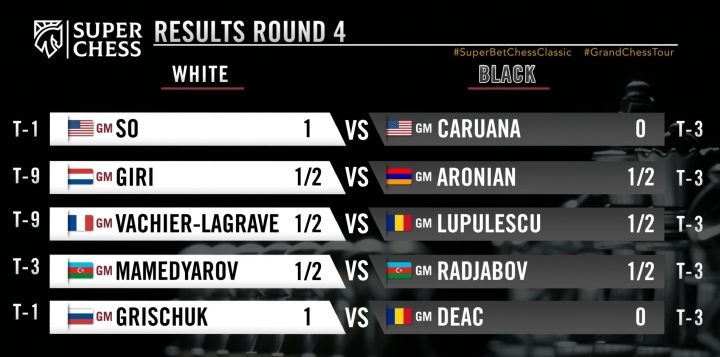
Round 4 of the 2021 Superbet Chess Classic saw two new leaders emerge, as Wesley So and Alexander Grischuk both won their games against the previous day’s leaders, Fabiano Caruana and Bogdan-Daniel Deac. With the three other games drawn, So and Grischuk now lead the field with 2.5/4, heading into the halfway mark of the tournament. Mamedyarov – Radjabov The first game of the round to finish, a quick draw in the Fianchetto Grunfeld, which was not much of a surprise as the two Olympic teammates have drawn almost all of their games at the top level. After the game, Radjabov expressed a lack of energy to come up with new ideas in the opening, citing his busy schedule and preference to minimize risk. Vachier-Lagrave – Lupulescu A critical variation of the French Defense put Lupulescu’s preparation to the test, but the Romanian No. 1 managed to defend accurately, reaching an equal endgame soon out of the opening. The Frenchman tried to press, even sacrificing a pawn for some play but was ultimately not able to pose real problems, and the game was drawn in an equal knight vs. bishop ending. Giri – Aronian After misplaying the Black side of a Catalan, Levon Aronian was under some serious pressure in a thematic endgame, with Giri’s pieces dominating Black’s queenside. But Giri was not able to maximize his advantage, allowing Aronian to equalize with passive but solid defense, eventually holding the draw. So – Caruana In one of the best games of the tournament thus far, Wesley So found a creative pawn sacrifice to greatly restrict several of Black’s pieces. While Caruana’s position was tenable, it was difficult to defend from a practical point of view, and the U.S. No. 1 quickly fell into a strategically lost position. Good technique by Wesley took matters into the endgame, with an extra pawn and overwhelming positional advantage, allowing So to win his first game of the event. Grischuk – Deac Also scoring his first win of the event was Grischuk, who nursed a small edge out of the opening against the talented Romanian junior. With both players in severe time trouble, Grischuk managed to win a pawn in a heavy-piece endgame and was able to convert in excellent technical style. After 59.Qf8! Rf4 60.Rxf4 gxf4 61.Qa8! Alexander secured a decisive advantage The coverage of the 2021 Superbet Chess Classic continues tomorrow, June 9, at 7:00 AM CDT with live coverage from GMs Alejandro Ramirez, Yasser Seirawan, and Maurice Ashley on grandchesstour.org/live. Text: IM Kostya Kavutskiy Photo: Grand Chess Tour, Lennart Ootes Official website: grandchesstour.org/
Ehsan Ghaem Maghami wins Zone 3.1 Championship
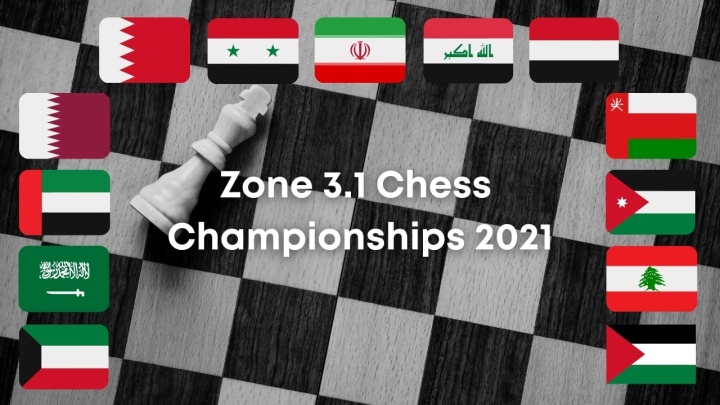
Ehsan Ghaem Maghami (pictured below) became the winner of Zone 3.1 Championship and secured his spot in FIDE World Cup 2021. Ehsan scored 6 out of 7 possible points and tied for first place with his countryman Aryan Gholami but came out on top thanks to better tiebreaks (higher average rating of his opponents). Photo: David Llada The 7-round Swiss tournament brought together 23 players from Iran, Iraq, Syria, Jordan, United Arab Emirates, Kuwait, Oman and Palestina and was played online on Tornelo platform. The competition was dominated by the representatives of Iran, who took three top spots in the final standings. Final standings: 1 GM Ghaem Maghami, Ehsan IRI 2547 6 2 GM Gholami, Aryan IRI 2513 6 3 GM Idani, Pouya IRI 2614 5½ 4 FM Salih Akar Ali, Salih IRQ 2274 4½ 5 FM Koniahli, Malek SYR 2255 4½ 6 IM Mansour, Sameer JOR 2308 4 7 FM Ahmed Ali Layth, Ahmed IRQ 2253 4 8 Chekh Adm Khedr, Aram SYR 2147 4 9 CM Ismael Namir Mohammed IRQ 2122 4 10 IM Al Hosani, Omran UAE 2197 4
2021 Superbet Chess Classic – Day 3 Recap
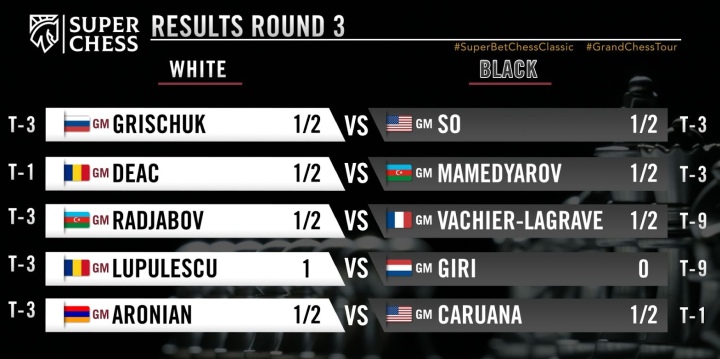
Despite a quiet start to the round with two short draws, the action quickly heated up as Levon Aronian secured an edge against Fabiano Caruana and Anish Giri looked to be on the initiative against Lupulescu. Aronian’s advantage was eventually liquidated, while Giri ended up overpressing the attack, and soon blundered into a vicious counterattack from the Romanian No 1. After three rounds, Caruana and Deac remain tied for first with 2.0/3, with six rounds left to play. Radjabov – Vachier-Lagrave In a repeat of Grischuk – Vachier-Lagrave from Round 1, Radjabov utilized the same drawish line in the 8.Rb1 Grunfeld to force a draw by repetition against MVL. This caused some dissatisfaction among fans, though it was mentioned on the broadcast that Radjabov was not feeling well during today’s round. Grischuk – So A rare move (14.g5) by Grischuk put Wesley So under some pressure in the Berlin Endgame, but So kept his cool and found a precise path to equalize. Having no advantage, Grischuk repeated moves, and the game was soon drawn. Aronian – Caruana Aronian was able to outplay Caruana in a Queen’s Gambit Accepted, securing a strategic advantage thanks to his powerful bishop on d5. Although according to Caruana his position was “sad”, he was able to slowly neutralize White’s pressure with correct exchanges, eventually trading down into a drawn queen and rook endgame. Deac – Mamedyarov A solid game for the Romanian junior, who held a bit of an edge in an endgame arising from the Catalan, with a slightly superior bishop against Mamedyarov’s knight. However, Mamedyarov defended well and didn’t give any chances to Deac, who notably defeated MVL the day before. The game was drawn shortly after the first time control. Lupulescu – Giri In the only decisive game of the day, it was at first Anish Giri who was playing for the advantage in the middlegame, having given up the bishop pair in exchange for good control over the central light squares. While Giri’s attack looked promising, Constantin Lupulescu was able to defend with high accuracy, not giving Anish any chances on the kingside. After some exchanges, it was Giri who ended up worse, with his heavy pieces misplaced and unprepared for White’s play in the center. A further blunder in time-trouble gave Lupulescu a golden opportunity for a decisive attack against Black’s king, which he quickly pounced on, winning the game. Lupulescu played 33.Re8!, with forced mate against Black’s king The coverage of the 2021 Superbet Chess Classic continues tomorrow, June 8, at 7:00 AM CDT with live coverage from GMs Alejandro Ramirez, Yasser Seirawan, and Maurice Ashley on grandchesstour.org/live. Text: IM Kostya Kavutskiy Photo: Grand Chess Tour, Lennart Ootes Official website: grandchesstour.org/
Chess in Schools Survey 2020: First conclusions and takeaways

In the summer of 2020, FIDE and the ECU joined forces to take a survey on what Chess in Schools (CiS) looks like in the world. The information gathered would inform the next step, that of suggesting an operational, marketing, and financial plan for FIDE for Chess in Schools for 2021-2025. The group working with the survey, people from FIDE, ECU, and the Armenian Institute, chose the broader definition of Chess in Schools: chess in a school environment. All 190 federations under the umbrella of FIDE were contacted, as well as major CiS – organisations, and asked to complete a survey of 17 questions in Survey Monkey to get a statistical foundation. The next steps were to structure the statistics, make a report, select especially interesting countries and projects, and make interviews with those involved to get a deeper understanding. This final report will be presented in a seminar that includes the supervisory group of the project as well as members of FIDE EDU and ECU EDU. After that, the survey report will be given to a group responsible for creating the strategic plan for FIDE EDU for 2021-2025. This survey is likely the largest of its kind with 196 respondents, out of which were 135 federations, 39 CiS-organisations, and 22 private and public schools. According to the survey, currently, there are 25,600,000 children participating in chess activities in a school environment. Of that number, 15,000,000 of them are children in India, 5,000,000 in China, and 5,600,000 from the rest of the world. There are 92,550 schoolteachers and 145,690 instructors from outside the school providing chess instruction and programming around the world. Overview of Responses Number of Responses 196 Number of Countries Responding 152 Number of Federations/Countries Not Responding 42 Number of Students Participating in Some Form of Chess Activity in a School Setting About 25,373,339* Number of Countries with More Than 10000 Children Participating in Some Form of Chess Activity in a School Setting 37 Number of Teachers About 92,550 Number of Chess Coaches About 145,690 Number of Countries Using Software 98 Number of Countries with Qualifications for Teaching Chess in Schools 78 Number of Countries That Used Official Data to Estimate the Facts They Provided in This Survey 44 Number of Countries That Used Data from Research to Estimate the Facts They Provided in This Survey 20 * We should take into account that the vast majority of children participating in chess instruction in school are from India and China. 15,000,000 according to the survey response from India. 5,000,000 according to the survey response from China. It is important to note that the data collected is not precise from the standpoint of a researcher conducting a rigorous scientific study. Responders to the survey often offered their best guesses as to the state of chess in education in their country. Many of these estimates are likely to be underestimated while a few may be inflated. Still, the survey does represent a good first glimpse of the worldwide state of chess in schools. Based on the data obtained, the respondents consider FIDE as the main sponsor for the development of the chess education model. For Institutionalized (centralized with support and recognition from the government, often compulsory, with a national curriculum) and Diversity (decentralized with a variety of ways in how chess is used and how chess instruction is given ) models, FIDE’s potential for helping with the development of chess education is considered in the area of the development of support for teachers’ training. This help may include the following: Provision of feedback to teachers Identification of teachers’ needs and suggestions, for example, organizing a forum for the exchange of ideas between schoolteachers Promotion of outstanding teachers of the world and their involvement in the process of introducing educational chess Introduction of preschool chess education Identification of reference schools with good chess teaching practices and disseminating their experience Distribution of training materials, advertising brochures, videos in different languages Respondents pointed out the need to work with national governments to spread chess education and sponsor teacher training as well as to build bridges between educational and sport chess. The issue of the necessity for certification was perceived ambiguously by different respondents. The issue of certification, in the opinion of some respondents, should be assigned to the national Ministries of Education. In some cases, there was a proposal of the necessity for additional interaction between FIDE and local state bodies in order to avoid conflicts that could hinder the development of chess education (Singapore). The Diversity Model was characterized by an emphasis on material assistance, for example, in sponsoring technical means to conduct online classes with outstanding teachers (India). Helping disadvantaged Asian and African countries, as well as a desire for help in transferring educational excellence, was noted in China. For the Less Institutionalized Model (the countries with either underdeveloped chess in schools’ movements struggling with little or no funding or no federation involvement or centralization), the following suggestions were more relevant: Lobbying the government to recognize chess as a school subject (including at the European Union level) Accreditation of training courses Development of publicly available training programs Provision of training courses online Help in popularizing chess, advertising for teachers, schools, politicians Holding a conference with UNESCO for politicians, educators’ organizations and others Financial support Model of Chess Education in Countries That Participated in Follow-up Interviews Institutionalized Model Diversity Model Less Institutionalized Model* Andalusia (Spain) Buenos Aires, (Argentina) Finland Aragon (Spain) San Luis (Argentina) France Armenia Andorra England Catalonia (Spain) India USA Santa Fe (Argentina) China Zambia Uruguay Singapore Iceland Sweden FIDE-ECU CiS Survey Final Report (pdf)
FIDE’s EDU accelerates provision of training for lecturers and teachers

The Preparation of Lecturers course leads to the diploma of Chess in Education Lecturer and is intended primarily for those who will lecture to teachers in order to swell the number of teachers in the world who can teach educational chess. The course hones their existing skills and opens new vistas for those from the chess world without educational background. The second course for lecturers will be held online from 18-20 June. Would-be lecturers are invited to complete and return the registration form. There are limited places, distributed on a first-come, first-served basis, but over subscribers are placed on the waiting list for the next course. The Preparation of Teachers course leads to the FIDE title of School Instructor. This course is intended for those at the sharp end of teaching chess in an educational way. The next course, also the second, will be held at the beginning of July (2-4). Those who would like to develop new skills in this area and gain the title are invited to complete and return the registration form. This course is limited to 30 places, distributed on a first-come, first-served basis, but over subscribers are placed on the waiting list for withdrawals or the next course. All courses are in English (other languages will be added soon) and currently run Friday-Sunday inclusive 15:00-20:00 CET. Our dedicated Chess in Education website has further details.
Cori and Gunina qualify for Main Event

GM Valentina Gunina (RUS) defeated IM Meri Arabidze (GEO) in Qualifier VIII (3+1) for the 2021 Women’s Speed Chess Championship. Valentina’s grit and determination paid off as she secured the last spot in the main event after playing for more than nine hours straight – she lost in the final of Qualifier VII (1+1), which took earlier in the day and saw the victory of WGM Deysi Cori from Peru. “It was fun. I feel really exhausted but it was fun. I could not control my nerves in the first qualifier, and I did not make it then… And now I am going to sleep” said Valentina in a short interview after her marathon playing session. Now the qualifiers will be joined by eight invited players to compete in the 2021 Women’s Speed Chess Championship Main Event. The round of 16 starts on June 10. The FIDE Chess.com 2021 Women’s Speed Chess Championship is an online competition for titled female players. The qualifiers for the event will happen from May 28-June 6, while the main event runs from June 10 to July 3. Players will battle for their share of a total prize fund of $66,000. Fans can follow the FIDE Chess.com Women’s Speed Chess Championship by watching the live broadcast with expert commentary on Chess.com/TV and Chess.com’s Twitch channel. They will also be able to enjoy the event through Chess.com’s Events page (https://www.chess.com/events). More info and a full schedule of the FIDE Chess.com Women’s Speed Chess Championship can be found here.
2021 Superbet Chess Classic – Day 2 Recap
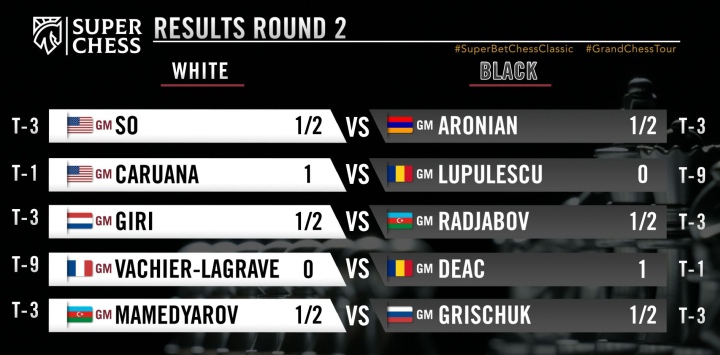
Round 2 saw some exciting action in Bucharest as World No. 2 Fabiano Caruana won a clean game against the local GM Constantin Lupulescu, while tournament newcomer GM Bogdan-Daniel Deac managed to score a stunning upset over Maxime Vachier-Lagrave, joining Caruana at the top of the leaderboard with 1.5/2. The other three games in the round (So-Aronian, Giri-Radjabov, & Mamedyarov-Grischuk) were all drawn shortly before the first time control. So – Aronian Facing Aronian’s solid Ragozin Defense, So decided to ambitiously castle queenside, but with only one open file on the board, most of the heavy pieces were quickly traded off and the game was drawn by repetition on move 30. Giri – Radjabov Giri utilized the Catalan Opening to create some strategic pressure, but Radjabov was able to keep White’s edge minimal and equalized without too many issues. After the game, Radjabov admitted that he was still getting used to playing over-the-board again, after over a year of playing exclusively online. Mamedyarov – Grischuk This game featured some imbalance, as a somewhat rare line of the Open Sicilian (transposed to from an English Opening) eventually led to a middlegame where Mamedyarov had the advantage of the two bishops but a worse pawn structure. Simplifications in the center led to a completely equal double-rook endgame, which the players quickly drew. Caruana – Lupulescu Despite being a bit surprised by Lupulescu’s choice of the French, Caruana was able to navigate to a sharp middlegame and created some play by attacking his opponent’s kingside on the light-squares. Lupulescu then erred in the complications, going into an endgame with equal material but much worse activity. Caruana was then able to use the power of his more active rook, knight, and king to force resignation on move 28. Black resigned facing White’s eventual queenside expansion Vachier-Lagrave – Deac In what was the sharpest game of the round, it first looked like MVL would be the one to win, after sacrificing a pawn for the initiative and finding the fantastic shot 25.g4, placing Black’s kingside defenses under great stress. With the presence of opposite-colored bishops favoring the attacker, it seemed like MVL was in great shape, but an unfortunate blunder allowed Deac to overtake the initiative and retain an extra pawn in the endgame. From there MVL ended up losing another pawn and found himself in a lost ending, where the opposite-colored bishops offered no real saving chances and Deac ended up scoring the full point. The coverage of the 2021 Superbet Chess Classic continues tomorrow, June 7, at 7:00 AM CDT with live coverage from GMs Alejandro Ramirez, Yasser Seirawan, and Maurice Ashley on grandchesstour.org/live. Text: IM Kostya Kavutskiy Photo: Grand Chess Tour, Lennart Ootes Official website: grandchesstour.org/
2021 Superbet Chess Classic – Day 1 Recap
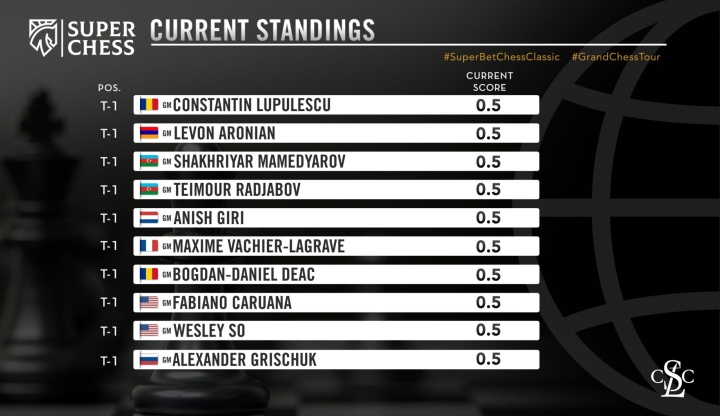
All five games were drawn today as the 2021 Grand Chess Tour kicked off with its first event of the year, the 2021 Superbet Chess Classic, a 10-player classical round-robin taking place in Bucharest, Romania. While three of the games were drawn after just an hour of play, all eyes were on local favourite GM Bogdan-Daniel Deac, who missed a serious chance to upset one of the tournament favourites, GM Anish Giri. Garry Kasparov makes the first move of the game Radjabov – Caruana Grischuk – Vachier-Lagrave A theoretical Grunfeld in which MVL was able to rely on his home preparation to equalize comfortably and draw the game without any particular issues. After the game, Grischuk admitted, “there is nothing to analyze, it’s just a draw”. Lupulescu – Aronian Making his Grand Chess Tour debut, the Romanian No. 1 GM Constantin Lupulescu essayed a solid line (4.Qc2) against Aronian’s Nimzo-Indian defence. Despite facing a somewhat rare move in 18.Qe3, Aronian was able to neutralize White’s pressure and the game soon ended in a repetition. Radjabov – Caruana Another relatively quick draw took place in this match-up, as Radjabov, possibly surprised by Caruana’s use of the Ragozin Defense, opted for an ultra-drawish line, resulting in another repetition to end the game peacefully. Mamedyarov – So World No. 8 Shakhriyar Mamedyarov chose the solid but testing Exchange Variation of the Queen’s Gambit Accepted, opting for a queenless middlegame against Wesley So. Despite attempts from both sides, neither player was able to pose any particular problems for the opponent, and the game was drawn shortly after the time control. Deac – Giri In what was undoubtedly the game of the day, local hero GM Deac (who replaced Richard Rapport at the last moment) chose the sharp 5.Bg5 variation against Anish Giri’s Semi-Slav Defense, from where the players quickly reached a complex position with opposite sides castling. After a promising exchange sacrifice, Giri almost immediately faltered, allowing his opponent’s rooks to dominate the center. But at the critical moment, Deac slipped, missing a powerful continuation (29.Re5) and instead allowed his opponent to escape into a drawish endgame. The game was then drawn soon thereafter. The coverage of the 2021 Superbet Chess Classic continues tomorrow, June 6, at 7:00 AM CDT with live comments by GMs Alejandro Ramirez, Yasser Seirawan, and Maurice Ashley on grandchesstour.org/live. Text: IM Kostya Kavutskiy Photo: Lennart Ootes Official website: grandchesstour.org/
Gulnar Mammadova wins Qualifier VI
IM Gulnar Mammadova (AZE) defeated WIM Ashritha Eswaran (USA) to win Qualifier VI and move on to the main event of the 2021 Women’s Speed Chess Championship. The Qualifier VI was a 13-round Swiss tournament (3+1 time control), with the top eight finishers advancing to the knockout playoff stage. In the semifinals, Ashritha Eswaran whitewashed Darya Belenkaya (RUS), whereas Gulnar Mammadova and Monica Socko (POL) exchanged blows and decided the winner in the sudden death game. The newly-minted Azerbaijani Women’s Champion won this critical encounter and advanced to the final. After an eventful draw in the first game of the final Gulnar prevailed in the second encounter with black pieces and deservedly earned her spot in the 2021 Women’s Speed Chess Championship. Qualifier VII will start on Sunday, June 6, at 10 a.m. Pacific / 19:00 Central Europe and will be followed by Qualifier VIII. The FIDE Chess.com 2021 Women’s Speed Chess Championship is an online competition for titled female players. The qualifiers for the event will happen from May 28-June 6, while the main event runs from June 10 to July 3. Players will battle for their share of a total prize fund of $66,000. One player from each playoff qualifier will move on to the main event. There they will be joined by eight invited players: GM Humpy Koneru (IND), GM Alexandra Kosteniuk (RUS), GM Antoaneta Stefanova (BUL), GM Anna Muzychuk (UKR), GM Irina Krush (USA), GM Kateryna Lagno (RUS), GM Lei Tingjie (CHN). Fans can follow the FIDE Chess.com Women’s Speed Chess Championship by watching the live broadcast with expert commentary on Chess.com/TV and Chess.com’s Twitch channel. They will also be able to enjoy the event through Chess.com’s Events page (https://www.chess.com/events). More info and a full schedule of the FIDE Chess.com Women’s Speed Chess Championship can be found here.