

FIDE Women’s Grand Prix Gibraltar: New dates announced
The Women’s FIDE Grand Prix Gibraltar postponed due to COVID-19 restrictions in the British Oversea Territory will take place from May 22 to June 2, 2021. Hosting this prestigious event opens a new chapter in Gibraltar’s continued tradition of supporting chess, in general, and the best female chess players, in particular. Since the inception of the Gibraltar Chess Festival in 2003, almost all the world’s top female players have taken part, including the greatest woman player of all time, Judit Polgar, as well as a total of seven Women’s World Champions. The fourth and final leg of the FIDE Women’s Grand Prix will be hosted by Caleta Hotel. As usual, twelve players will compete in a round-robin tournament. The list of participants: 1 IM Gunay Mammadzada 2443 AZE 2 IM Irina Bulmaga 2440 ROU 3 IM Zhansaya Abdumalik 2472 KAZ 4 GM Mariya Muzychuk 2544 UKR 5 GM Nana Dzagnidze 2524 GEO 6 IM Alina Kashlinskaya 2494 RUS 7 GM Valentina Gunina 2421 RUS 8 GM Kateryna Lagno 2546 RUS 9 GM Anna Muzychuk 2535 UKR 10 IM Dinara Saduakassova 2500 KAZ 11 IM Elisabeth Paehtz 2467 GER 12 GM Antoaneta Stefanova 2470 BUL FULL PAIRINGS: Round 1 on 2021/05/22 IM Gunay Mammadzada (2443) – GM Antoaneta Stefanova (2470)IM Irina Bulmaga (2440) – IM Elisabeth Paehtz (2467)IM Zhansaya Abdumalik (2472) – IM Dinara Saduakassova (2500)GM Mariya Muzychuk (2544) – GM Anna Muzychuk (2535)GM Nana Dzagnidze (2524) – GM Kateryna Lagno (2546)IM Alina Kashlinskaya (2494) – GM Valentina Gunina (2421) Round 2 on 2021/05/23 GM Antoaneta Stefanova (2470) – GM Valentina Gunina (2421) GM Kateryna Lagno (2546) – IM Alina Kashlinskaya (2494) GM Anna Muzychuk (2535) – GM Nana Dzagnidze (2524) IM Dinara Saduakassova (2500) – GM Mariya Muzychuk 2544 IM Elisabeth Paehtz (2467) – IM Zhansaya Abdumalik (2472) IM Gunay Mammadzada (2443) – IM Irina Bulmaga (2440) Round 3 on 2021/05/24 IM Irina Bulmaga (2440) – GM Antoaneta Stefanova (2470) IM Zhansaya Abdumalik (2472) – IM Gunay Mammadzada (2443) GM Mariya Muzychuk 2544 – IM Elisabeth Paehtz (2467) GM Nana Dzagnidze (2524) – IM Dinara Saduakassova (2500) IM Alina Kashlinskaya (2494) – GM Anna Muzychuk (2535) GM Valentina Gunina (2421) – GM Kateryna Lagno (2546) Round 4 on 2021/05/25 GM Antoaneta Stefanova (2470) – GM Kateryna Lagno (2546) GM Anna Muzychuk (2535) – GM Valentina Gunina (2421) IM Dinara Saduakassova (2500) – IM Alina Kashlinskaya (2494) IM Elisabeth Paehtz (2467) – GM Nana Dzagnidze (2524) IM Gunay Mammadzada (2443) – GM Mariya Muzychuk 2544 IM Irina Bulmaga (2440) – IM Zhansaya Abdumalik (2472) Round 5 on 2021/05/26 IM Zhansaya Abdumalik (2472) – GM Antoaneta Stefanova (2470) GM Mariya Muzychuk 2544 – IM Irina Bulmaga (2440) GM Nana Dzagnidze (2524) – IM Gunay Mammadzada (2443) IM Alina Kashlinskaya (2494) – IM Elisabeth Paehtz (2467) GM Valentina Gunina (2421) – IM Dinara Saduakassova (2500) GM Kateryna Lagno (2546) – GM Anna Muzychuk (2535) Round 6 on 2021/05/27 GM Antoaneta Stefanova (2470) – GM Anna Muzychuk (2535) IM Dinara Saduakassova (2500) – GM Kateryna Lagno (2546) IM Elisabeth Paehtz (2467) – GM Valentina Gunina (2421) IM Gunay Mammadzada (2443) – IM Alina Kashlinskaya (2494) IM Irina Bulmaga (2440) – GM Nana Dzagnidze (2524) IM Zhansaya Abdumalik (2472) – GM Mariya Muzychuk (2544) Round 7 on 2021/05/29 GM Mariya Muzychuk 2544 – GM Antoaneta Stefanova (2470) GM Nana Dzagnidze (2524) – IM Zhansaya Abdumalik (2472) IM Alina Kashlinskaya (2494) – IM Irina Bulmaga (2440) GM Valentina Gunina (2421) – IM Gunay Mammadzada (2443) GM Kateryna Lagno (2546) – IM Elisabeth Paehtz (2467) GM Anna Muzychuk (2535) – IM Dinara Saduakassova (2500) Round 8 on 2021/05/30 GM Antoaneta Stefanova (2470) – IM Dinara Saduakassova (2500) IM Elisabeth Paehtz (2467) – GM Anna Muzychuk (2535) IM Gunay Mammadzada (2443) – GM Kateryna Lagno (2546) IM Irina Bulmaga (2440) – GM Valentina Gunina (2421) IM Zhansaya Abdumalik (2472) – IM Alina Kashlinskaya (2494) GM Mariya Muzychuk 2544 – GM Nana Dzagnidze (2524) Round 9 on 2021/05/31 GM Nana Dzagnidze (2524) – GM Antoaneta Stefanova (2470) IM Alina Kashlinskaya (2494) – GM Mariya Muzychuk 2544 GM Valentina Gunina (2421) – IM Zhansaya Abdumalik (2472) GM Kateryna Lagno (2546) – IM Irina Bulmaga (2440) GM Anna Muzychuk (2535) – IM Gunay Mammadzada (2443) IM Dinara Saduakassova (2500) – IM Elisabeth Paehtz (2467) Round 10 on 2021/06/01 GM Antoaneta Stefanova (2470) – IM Elisabeth Paehtz (2467) IM Gunay Mammadzada (2443) – IM Dinara Saduakassova (2500) IM Irina Bulmaga (2440) – GM Anna Muzychuk (2535) IM Zhansaya Abdumalik (2472) – GM Kateryna Lagno (2546) GM Mariya Muzychuk 2544 – GM Valentina Gunina (2421) GM Nana Dzagnidze (2524) – IM Alina Kashlinskaya (2494) Round 11 on 2021/06/02 IM Alina Kashlinskaya (2494) – GM Antoaneta Stefanova (2470) GM Valentina Gunina (2421) – GM Nana Dzagnidze (2524) GM Kateryna Lagno (2546) – GM Mariya Muzychuk 2544 GM Anna Muzychuk (2535) – IM Zhansaya Abdumalik (2472) IM Dinara Saduakassova (2500) – IM Irina Bulmaga (2440) IM Elisabeth Paehtz (2467) – IM Gunay Mammadzada (2443)
Anish Giri defeats Ding Liren in pursuit of Nepomniachtchi
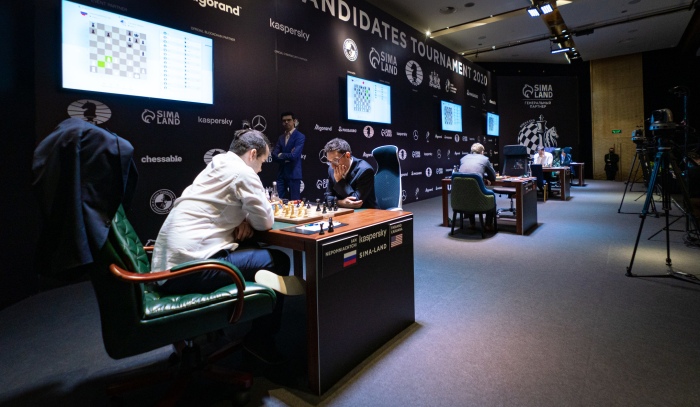
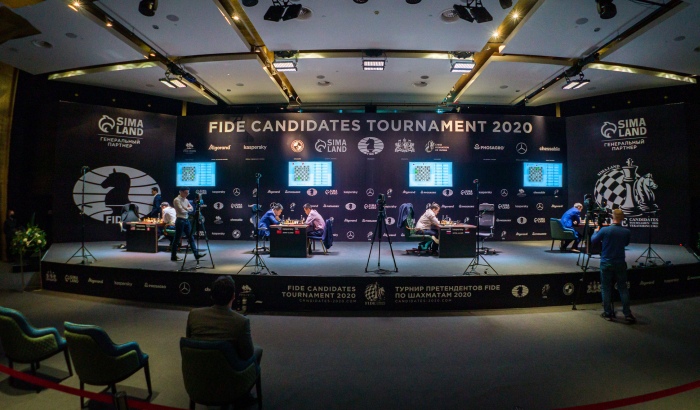
Anish Giri scores his second victory in the second part of the FIDE Candidates Tournament and narrows the gap to half a point with the leader Ian Nepomniachtchi. A complicated battle between Anish Giri and Ding Liren saw a very spectacular finale. The Chinese grandmaster seized the initiative in the middlegame, but then miscalculated at the critical moment and fell under a crushing attack. The leader of the tournament, Ian Nepomniachtchi, chose a “safe mode” in the game against one of his main rivals Fabiano Caruana. After passing the first time control players signed an expected peace. In the most exciting game of the round, Alexander Grischuk sacrificed a pawn and then a whole rook to launch an attack along the open h-file. Maxime Vachier-Lagrave missed several opportunities to escape – the last one right after passing the time control – and suffered his second defeat in the tournament. Wang Hao’s position in his game with Kirill Alekseenko looked quite promising at some point but the Russian grandmaster managed to hold a draw. After Round 11 Ian Nepomniachtchi is leading with 7 points out of 11 (+3); Anish Giri is trailing the leader by a half-point (6½). Fabiano Caruana is sitting on 6 points (+1). Ian Nepomniachtchi – Fabiano Caruana (½ : ½) The leader of the competition, Ian Nepomniachtchi, playing with white against one of his closest pursuers, opted for the line 4.d4 in the Four Knights Opening known for its drawing tendencies. The tournament commentator Daniil Dubov predicted such a scenario: “Mathematically speaking, it’s a very simple decision for both. Ian has to play something drawish and that’s what he does. But I think also for Fabi it is not time yet to go into the kamikaze mood.” Fabiano Caruana tried to complicate things, but objectively Black did not have many opportunities to do it. In a balanced, approximately equal position, the American Grandmaster rushed to exchange queens, which caused some problems for him. However, he managed to keep the balance with an accurate play, and immediately after passing the first time control a draw, the opponents split the point. Fabiano Caruana: “I thought Ian might have two approaches – one to get a complicated fight and another to play a more or less safe position with some minor chances that I mess this position up, but like 99% of the time this line will turn into a draw.” “It’s still three rounds to go, I thought why I would burn my bridges,” said Fabiano Caruana, answering the question of whether he could go for something more double-edged in the opening. Anish Giri – Ding Liren (1 : 0) The grandmasters tested one of the lines of the exchange variation in the Ruy Lopez, where White trades his light-squared bishop for the c6-knight only after Black develops his other knight to f6. It is believed that with this sort of pawn structure the knight is not very well positioned on f6, but the subsequent game did uphold this theory. In a position with opposite-side castling (the white king went to the kingside, the black one to the queenside), Anish placed his knight on a5, trying to exert some pressure on the queenside. According to Giri, he did not expect the idea of Black with c7-c6 followed by the bishop transfer to c7, but most likely, it was a very strong plan. White’s attack temporarily came to a standstill as he had to retreat his advanced knight. The f7-f5 breakthrough was also unpleasant for White. But then Black got carried away with a pawn thrust (20…g4) but missed the moves 21.Ng5 and 22.h4. After regaining the initiative, the Dutch grandmaster played with inspiration: he sacrificed his dark-squared bishop and pounced on the opponent’s king. Black’s barricades collapsed unexpectedly quickly and on move 29 Ding Liren threw in the towel. Anish Giri: “A few people have already told me it was a great game but I don’t think it was that great as it looked in the end. At some point, he was the one who had all the play, he was dictating the course of the game.” Alexander Grischuk – Maxime Vachier-Lagrave (1 : 0) In response to Maxime’s pet Sicilian Defence, Alexander played an original system introduced by the world champion Magnus Carlsen. Already on the 4th move, the white queen jumped out to the center and then retreated to d2, blocking the way for its bishop. However, pretty soon White’s pieces achieved harmony: his dark-squared bishop moved to the big diagonal and the king hid on the queenside. Black, on the other hand, castled in the opposite direction which meant a sharp battle with all three possible outcomes. On move 9, Grischuk introduced the new line and soon sacrificed a pawn to open the h-file. “9.Nge2 is a novelty. The computer is laughing, there are ten good ways but also he has twenty bad ways. So I thought I will give it a try,” Alexander Grischuk explained his preparation. “I spent the whole morning and yesterday trying to remember all the lines and still filed.” Black responded by putting pressure on the opposite side wing but did it belatedly. On move 19, the French grandmaster faced a difficult choice – where to move his attacked knight. He chose a seemingly reliable continuation which helped him to block the dangerous file but ended up in an inferior passive position with paralyzed dark-squared bishop. “ Later Grischuk sacrificed a whole rook to create mating threats to the opponent’s king, however, by his own admission, he overlooked two strong defensive ideas. In the mutual time scramble Vachier-Lagrave fought off all the direct threats and leveled the position, but immediately faltered. Right after passing the time control, Black had an unexpected chance to make a draw but Maxime immediately made a losing move. According to Aleksander Grischuk, he didn’t go to smoke at move 40 as he usually does, to try and induce MVL to play fast 42…Rc2 and not play 42…Ba3! “It was my trick!” added Sasha at the
Nepomniachtchi beats Alekseenko to stretch his lead
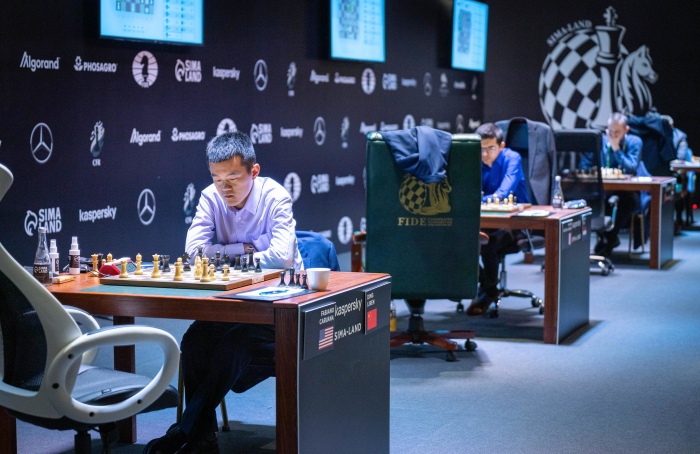
Russian Ian Nepomniachtchi increased his lead at the 2020 Candidates to a full point after defeating his compatriot Kirill Alekseenko. It turned out, Nepomniachtchi made a wise opening choice since Kirill Alekseenko seems to be unfamiliar with the subtleties of the position. After Black went astray on move 8 White grabbed the initiative with the most natural moves and scored a well-deserved victory. Before the rest day, Nepomniachtchi has 6,5 points after 10 rounds and with 4 rounds to go the Russian GM is a strong favourite to win the tournament. “He’s someone who can outplay me… it’s always been an interesting clash of styles!” said the Wordl Champion Magnus Carlsen on Ian Nepomniachtchi today. As three other games were drawn the gap between the leader and the runner-ups has increased. Maxime Vachier-Lagrave, Fabiano Caruana, and Anish Giri are still tied for second place with 5,5 points out of 10. The most remarkable of three draws was an incredibly sharp duel Wang Hao – Grischuk, where at first Black spent on one of the opening moves 72 (!) minutes, and then White sacrificed the queen for two minor pieces. Ian Nepomniachtchi – Kirill Alekseenko (1-0) 1.c4 was played for the first time in the second stage of the Candidates Tournament, but it hardly came as a surprise for Alekseenko, since this is one of Nepomniachtchi’s favourite moves. Soon, one of the lines of the English opening appeared on the board, which is informally called “semi-Catalan”. White fianchettoed his king’s bishop, but his d-pawn remained in its original position, keeping both options d2-d4 and d2-d3. As Kirill admitted, he did not remember that line very well and made a serious inaccuracy already on the 8th move, and later on, did not play his best chess. “It’s quite a common mistake that you prepare all the main lines and you kind of spend less time looking at some sidelines and tricky move orders. So 1. c4 Nf6 2. g3 is not exactly what worries you most.” expressed his opinion commentator Daniil Dubov. Ian confirmed that instead of 8… Be7, Black should have played 8… Qc7 with the idea of placing the pawn on b6 and bringing the bishop to b7, as his main task in this line is to develop his queenside. Ian Nepomniachtchi: “It was optically very easy, but in fact, I think it was not. I guess I was lucky that in the opening Kirill quickly got into some position he’s not familiar with.” White seized the opportunity and with 10. d4 got a very good version of the Catalan opening. Ian quickly developed his pieces increasing the pressure on the black’s queenside. To complete development, Black had to exchange his c8-bishop for his opponent’s knight but seriously weakened the white squares in his camp. Alekseenko tried to muddle the waters, but Nepomniachtchi was merciless and finished off his opponent on move 31. Ian Nepomnaichtchi: “The point is that everyone has like seven finals here. Seven finals in a row, that’s my take on this. It’s better to have +3 than +1 or something, but it’s too early to make any conclusions.” Maxime Vachier-Lagrave – Anish Giri (½ : ½) For the second time in three days, Anish had to defend in Sveshnikov variation of the Sicilian. Maxim opted for a popular 7.Nd5 plan, which was extensively tested in the last world championship match between Fabiano Caruana and Magnus Carlsen (London 2018). After the exchange on d5, the world champion retreated his knight to e7, which leads to double-edged positions. Giri, on the other hand, opted for a calmer move 8… Nb8. Of course, the French grandmaster did not come to the game empty-handed: he immediately made a breakthrough c2-c4-c5, which was considered innocuous five years ago. Anish Giri could not recall all the details of his analysis and faced some problems as a result. By sacrificing a pawn, Anish blocked the opponent’s dangerous passer and got a good counterplay. Soon Black cleared a big diagonal for his bishop and forced massive exchanges. White’s initiative petered out and after reaching the 40th move, the opponents shook hands. Fabiano Caruana – Ding Liren (½ : ½) Fabiano Caruana used a positional pawn sacrifice in the so-called “anti-Marshall” variation of the Ruy Lopez and put some pressure on Black’s queenside. White’s position looked very promising, but a pawn clash in the center, the American grandmaster did not play optimally and found himself on the defending side: Ding Liren had an extra pawn, albeit a doubled one. To avoid passive defence, Caruana bravely pushed his pawns from the king to prompt a crisis. After massive exchanges, the opponents eliminated the weak pawns and ended up in an endgame with rooks and knights. It seemed that Black still had some chances to play for a win, but Ding Liren, evidently, considered them insufficient and immediately agreed to a draw. Speaking about his chances to catch up with the leader, Fabiano Caruana was not overly pessimistic: “A one-point lead isn’t insurmountable.” Wang Hao (China) – Alexander Grischuk (½ : ½) It was the most exciting game of the day that kept the audience on the edge of their seat until the very end. The opponents had a discussion in an old system of the French Defence, which was used by the first world champion Wilhelm Steinitz at the end of the 19th century. White’s idea is to firmly “cement” his pawn chain in the center at the cost of falling slightly behind in development. The first critical position arose after White’s 11th move. Black had to go for complications, otherwise White, having completed development, would have achieved a stable advantage. Grischuk knew that the move 11.Qd2 (instead of the main theoretical continuation 11.Qb3) was not dangerous for Black forgot his analysis. Wang Hao admitted that he simply mixed things up and was preparing a completely different line. As a result, Alexander spent 72 minutes (“This is not a record to be proud of,” the Russian grandmaster admitted) to calculate all the variations. During the
Anish Giri defeats Wang Hao, tied for second in Candidates
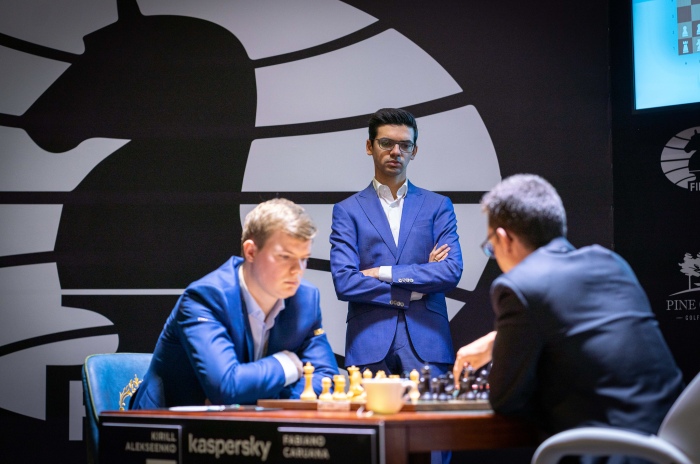
Anish Giri scores an all-important win in the 9th round against Wang Hao, keeping chances to fight for the victory in the tournament alive. Alexander Grischuk “plays roulette”, takes some risks but can not beat the tournament leader Ian Nepomniachtchi. As a result, Ian preserves his pole position in the Candidates Tournament a half-point ahead of three competitors. Maxime Vachier-Lagrave miraculously saves an extremely tough position against Ding Liren, Fabiano Caruana fights to the bare kings, but his game with Kirill Alekseenko also ends in a draw. Three players: Fabiano Caruana, Maxime Vachier-Lagrave, and Anish Giri share second place after the nine games, ready to chase the leader in the next rounds. Alexander Grischuk – Ian Nepomniachtchi (½ – ½) In the Russian derby between Alexander Grischuk and Ian Nepomniachtchi, the leader used his main weapon, the Grunfeld Defense, in response to 1.d4. Alexander has prepared a surprise – a seemingly modest but poisonous continuation 9.h3!?, which has never been seen at a high level. On the next move, White sacrificed a pawn, giving his opponent a wide range of options. It was clear that Grischuk analyzed the emerging complications at home, while Ian had to sort them out over the board. Ian accepted the sacrifice but immediately offered to restore material balance at the cost of simplifying the position. Alexander did not like this scenario – after yesterday’s defeat, he was eager to complicate matters. However, Ian played solidly and soon a roughly equal ending emerged on the board. Grischuk tried to use a small space advantage and was in no hurry to win back the sacrificed pawn. Nepomniachtchi, in his turn, completed his development and even attempted to grab the initiative. Grischuk could have reached equality in different ways, but, as Alexander said at a press conference, he decided that it was a moment to “play roulette” and went for an exchange sacrifice. Ian thought for a long time and refused to accept this “gift”. A series of exchanges followed and after White’s 41st move the grandmasters agreed to a draw. According to the FIDE Candidates regulations, players have no right to start peace negotiations before the 40th move. Anish Giri – Wang Hao (1-0) In the game between Anish Giri and Wang Hao saw a classic version of the Catalan. White put some pressure on the opponent’s position, but Wang Hao was defending creatively sending his queen to the a8-square. Nevertheless, Black did not manage to engineer a real counterplay. At a press conference right after the game, it became clear that the grandmasters differed in their evaluation of the position that emerged after the opening: Giri believed that he had only a minimal advantage, while Wang Hao did not see good continuations for himself. According to chess engines, the truth was somewhere in between, but pessimism played a cruel joke on the Chinese grandmaster. He carelessly weakened his kingside and soon found himself under an extremely unpleasant pin on the long diagonal. In the final portion of the game, the Dutch grandmaster made a series of precise moves, shattered Black’s defence, and scored a full point on move 39. “A very, very good game. He managed to showcase all his strengths here, both in terms of planning and a little idea in the opening with h3”, said the world champion Magnus Carlsen, who is doing live commentary of the games on his own online platform. Kirill Alekseenko – Fabiano Caruana (½ – ½) Young Russian Grandmaster Kirill Alekseenko started the second part of the Candidates Tournament having white pieces in two straight games. As in the victorious game versus Grischuk, he opened with the same move e4. Soon a calm position, typical for the Italian, appeared on the board. In the old days, this variation was called Giuoco Piano, meaning a “calm play”. However, Alekseenko did not agree with such an assessment of the situation and introduced an interesting idea, ready the sacrifice of two pawns. The 2018 world championship challenger proceeded with reasonable caution as he took only one of the pawns, and even returned it two moves later. Later at the press conference, Kirill admitted that he underestimated the move 14…c2. Fabiano was not even considering the capture on b2 – the position that arises in this case, similar to the Northern Gambit, seemed too dangerous for him. “I tried to stabilize the position; it looked dangerous for black, but white also had his own problems,” Fabiano noted. Alekseenko rushed to restore material balance but overlooked some tactics, which helped Caruana to successfully regroup his pieces. The American seized the initiative, but Kirill once again proved that he has a perfect feeling of dynamical resources of the position. He gave up both pawns on the queenside while activating his pieces. Caruana refused to repeat the moves first but eventually went for an equal rook endgame. The grandmasters played almost to bare kings and agreed to a draw on move 59. Ding Liren – Maxime Vachier-Lagrave (½ – ½) The most exciting opening duel happened in the game between Ding Liren and Maxime Vachier-Lagrave. The French Grandmaster had to play two games with Black at the start of the second half of the event, and in both of them, he faced powerful home preparation of his opponents. Maxim is known for his love for the Grunfeld Defense in response to 1.d4, but it didn’t come to that this time – as soon as Black played g6, White’s h-pawn darted to an assault: 3.h2-h4!? This opening does not have an official name yet, but it has become quite trendy in recent years, influenced by AlphaZero neural network. Vachier-Lagrave chose a rather ambitious plan: he exchanged his g7-bishop bishop for the c3-knight and placed his pawns on the dark squares, creating a powerful outpost for his knights on the central e5-square. Judging by the speed Ding Liren made his opening moves, it did not surprise him. He spent only two minutes before sacrificing a knight, placing it under a direct attack of the enemy’s pawn. Maxim accepted the sacrifice and immediately returned
Caruana takes down MVL, Nepomniachtchi emerges as a sole leader
The Candidates Tournament resumed with a “bang”, as the latest challenger to the world championship title, Fabiano Caruana from the US, took down the leader of the tournament, Maxime Vachier-Lagrave. The American won in great style, sacrificing material in the opening to create a very sharp and double-edged position. The French Grandmaster fell in Caruana’s opening preparation, but he defended remarkably well in what seemed a minefield. “Horror. Pure horror”, is what a top player feels when he walks straight into his opponent’s preparation, according to Magnus Carlsen, who commentated the first round for Chess24. However, the effort took its toll: after six hours of play, and when the worst seemed to be already behind, the tournament leader bit the dust in a tricky ending. This was the most exciting game of the tournament so far, and one to be remembered for decades to come, where both players demonstrated an excellent level. This result allows Ian Nepomniachtchi to emerge as the sole leader since his game against Anish Giri was drawn. Kirill Alekseenko beat his compatriot Alexander Grischuk, while the Chinese derby between Ding Liren and Wang Hao ended in a draw. Caruana – Vachier-Lagrave Fabiano Caruana and Maxime Vachier-Lagrave played the so-called “Poisoned Pawn Variation” in the Najdorf variation in Sicilian Defense (7…Qb6), favoured by the legendary world champion Robert Fischer. At the very beginning of the game, Black bravely takes the b2-pawn (8…Qxb2) but falls under a dangerous attack. At the same time, boundless complications arise on the board. There are so many options here that even with the help of powerful modern computers it has not yet been possible to determine an accurate assessment of the position. As chess players joke, the winner here is the one who makes the penultimate mistake. Caruana and Vachier-Lagrave are both famous for their extremely deep opening preparation, but the American grandmaster was better prepared for this game – his second, former FIDE world champion Rustam Kasimdzhanov, found a very dangerous idea. Already around the 15th move, Maxim began to spend a lot of time on every decision, while Fabiano was replying instantly. On the move 18, the American introduced a stunning novelty 18.Bc4 sacrificing a bishop in addition to tree pawns. Until the 25th move Black, according to the “electronic mind”, defended very well, but eventually, the Frenchman took a questionable decision to go for an endgame without an exchange for two pawns – White’s pieces sprang into action. After massive exchanges, the game transposed into the ending with pawn and rook vs pawn and knight and, to the surprise of most experts, an unbreakable fortress appeared on the board. However, the World Champion Magnus Carlsen, admitted that he was not sure of his ability to keep this position for Black – so difficult are the problems the weaker side is facing. Maxime Vachier-Lagrave also failed to cope with this task, although he was holding his ground for quite a long time. But then he didn’t find the precise setup, misplaced his knight and allowed the white king to break into his camp via h5-square. On move 74 Black had to resign. Alekseenko – Grischuk Alexander Grischuk seems to have surprised his opponent in the opening by choosing the French Defense, which is a rare guest in his long professional career. Ironically, in this game, just like in the encounter Caruana – Vachier-Lagrave, the black queen hunted out for the b2-pawn. By using an opened b-file, the white rook soon entered the opponent’s camp, but then Kirill Alekseenko chose not to go for the most principled line and steered the game into a calm, approximately equal ending. Around move 30, the grandmasters got into time trouble and White missed a small tactical blow. Even though Alexander won an exchange for a pawn, Kirill got enough compensation in form of active pieces and a strong passed pawn. Both grandmasters were quite optimistic about their positions; however, Kirill Alekseenko’s assessment turned out to be more accurate. Grischuk could have given his material back to get an equal rook endgame but avoided drawing variations and overpressed at the end. Black’s counterplay on the kingside turned out to be ineffective while White’s e-pawn triumphantly marched to the eighth rank. The debutant of the Candidates Tournament and the youngest participant of the event Alekseenko won his first game, also on move 74. Nepomniachtchi – Giri After the game, Ian said that he had prepared for many openings which Anish often uses, but yet he was surprised by the choice of his opponent. “Sometimes a whole year is not enough to prepare for seven games,” Ian smiled. Anish Giri: “I chose the Sveshnikov system which gives my opponent a choice: either to go for a double-edged fight with mutual chances or to play solidly, but then Black, in my opinion, has no problems.” The Russian grandmaster chose the first path but admitted that he had played inaccurately. As a result, Anish Giri quickly equalized and on move 25 White began to repeat moves, insistently proposing to trade the light-squared bishops. Black could not afford this exchange, as in this case his position worsened significantly, so a draw was soon agreed due to the threefold repetition. Ian Nepomniachtchi: “I got sick by the end of the first half of the tournament and lost the last game, so, of course, I was not upset that the tournament was interrupted… When you often travel to tournaments, the happiest time is in between trips, but usually, it’s only a week. When the pandemic hit, I realized that there is nothing wrong with having more rest and not going anywhere. Generally, like Hachiko, I have been waiting for the Candidates Tournament for the entire 2020”. Anish Giri: “Recently I played over the board in Wijk aan Zee, so I didn’t forget how to put on a suit for the game. But I completely forgot how to pack my suitcase, since I hadn’t flown anywhere for more than a year. And, of course, completely unusual sensations arose in the lounge in Moscow airport, when
Castillo Pena wins Dominican Republic Women’s Championship
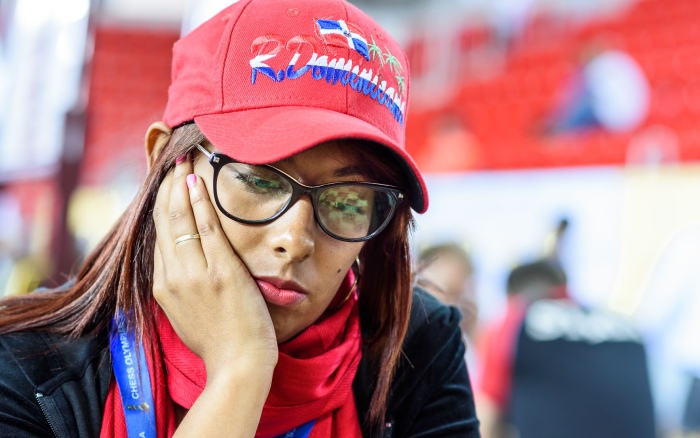
Patricia Evarista Castillo Pena. Photo: Alina L’Ami The Dominican Chess Federation has expressed its gratitude to the Minister of Higher Education, Science and Technology (MESCYT), Dr. Franklin García Firmin, who announced during the opening of the LXIII National Championships of the Dominican Republic, that the first-prize winners will be awarded national or international scholarships, to continue expanding their knowledge and professionalism is at the highest level. “Chess, called a science game, has proven for years that it greatly benefits those who participate in this fundamental practice,” said Franklin Garcia Fermin in his speech. Photo: amicohoops.net The country’s national women’s championship, an 8-round Swiss tournament, brought together 24 female players from 13 provinces of the country. The opening ceremony was led by the President of the Dominican Chess Federation (FDA), Pedro Dominguez Preto, along with the president of the Dominican Olympic Committee (COD), Antonio Acosta, at Albergue Olímpico Dominicano. The event was a close race of three rating favourites with the third-rated Patricia Evarista Castillo Pena coming out on top, just a half-point ahead of Wilsaida Pieranlly Diaz Cesar and Doribel Munoz Santana who tied for second place. Thanks to better tiebreaks Diaz Cesar took silver whereas Doribel Munoz Santana settled for bronze. Final standings: 1. Castillo Pena Patricia Evarista – 6½2. Diaz Cesar Wilsaida Pieranlly – 6 3. Munoz Santana Doribel – 64. Moronta Ramos Dianelva – 5½5. Hazim Gonzalez Elizabeth – 56. Ramirez Luzon Franchesca – 57. Joaquin Salcedo Candida – 58. Martinez Jimenez Manyely – 59. Sanchez Jaspez Rosangel – 510. Cabreja Lora Suzette – 4½ Text: Izer Hector (amicohoops.net/)
FIDE enters partnership with Chessable and chess24

Monday, April 19th, 2021 FIDE has signed a historic global partnership agreement with Chessable, making it one of the sponsors for the World Chess Championship cycle, the Olympiad, and the World Rapid and Blitz. Sister company chess24 acquires broadcast rights for top FIDE events from 2021 until 2026. The International Chess Federation has entered into a six-year commercial agreement with Chessable, the world’s leading chess E-learning platform. By becoming a sponsor of the chess world championship cycle, Chessable strengthens its brand’s position as the preferred E-learning choice among chess fans and top players alike. The agreement covers different areas, including youth programs, professional chess, and broadcast rights for top events, but also education and social activities. Chessable CEO David Kramaley: “We see great potential in helping to realize the chess world championship cycle for the hundreds of millions of chess fans in the world. Since 2015, Chessable has communicated a love of science-backed learning, celebrating chess education and curiosity. The chess world championship cycle is the perfect fit for this concept, as it showcases the world’s best players, many of whom are already published Chessable authors, playing for the ultimate title, showing what they know.” In addition to sponsoring the chess world championship cycle, Chessable will partner with FIDE for a new chess talent development program, the FIDE Chessable Youth Development Fund, to which it will contribute $150,000 annually. The agreement is part of Chessable’s global growth strategy and another step in its mission to make chess a sustainable career choice for all. FIDE President Arkady Dvorkovich: “We are extremely proud to be able to create new opportunities for the chess youth of the world through this new talent development program in partnership with Chessable. We hope it will help foster many new champions and attract many new young people to the game.” “Such a long-term partnership shows a strong commitment and a shared vision between both parties. The agreement will allow FIDE to grow and plan for the future, strengthening different areas. It contributes to consolidate our top events even further, and many social projects, as well as the chess in schools programs are about to take off. Chess is a great game to learn for any child, and has a proven track record of improving children’s cognitive and educational skills.” Since launching in 2014, chess24 has demonstrated its continued commitment to promoting chess. It was the first international chess company to take chess broadcasting to a worldwide audience and it continues to innovate in this field. With this agreement, chess24 will become one of the broadcast partners for the world chess championship cycle as well as major FIDE events such as the World Rapid & Blitz, World Cup and Chess Olympiad. Chess24 CEO Gerald Tan: “Broadcasting and commentating on chess tournaments have always been core to our activities and passion at chess24. Over the last year, we have made significant strides in developing new ways to bring chess to a wider audience with our Champions Chess Tour broadcasts and are excited to apply our insights to the World Chess Championship broadcast in 2021 and beyond.” The partnership becomes effective immediately, and this means Chessable is one of the sponsors of the Candidates Tournament that resumes today in Yekaterinburg. About Chessable Chessable is the world’s leading chess E-learning platform and largest digital chess library in the world. Chessable’s mission is to make learning chess as fun and efficient as possible. It has published interactive video courses by a wide range of presenters and authors, including many of the world’s top players such as current World Chess Champion Magnus Carlsen. The company was co-founded in 2015 by David Kramaley and International Master John Bartholomew. Chessable’s team consists of expert content creators, scientists, developers and chess grandmasters all working together to create the best chess learning platform in the world.
Press conference before the resumption of FIDE Candidates Tournament
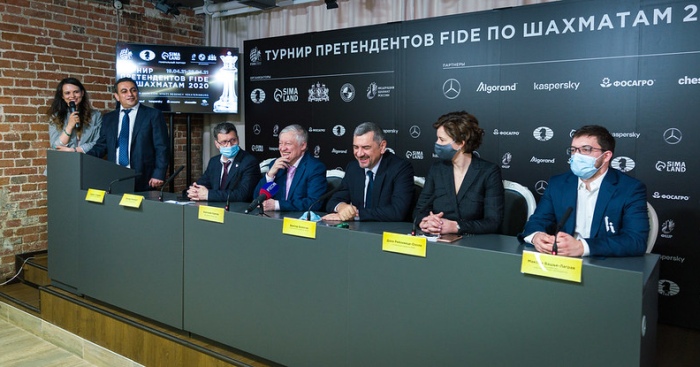
A press conference dedicated to the FIDE Candidates Tournament, which resumes tomorrow on 19th of April in Yekaterinburg, was carried out today at the building of the Sverdlovsk union of journalists. The press conference was attended by Anatoly Karpov, 12th World Chess Champion, Deputy of Russian State Duma, Chairman of the Board of Trustees of Chess Federation of the Sverdlovsk Region; Leonid Rapoport, Minister of Physical Culture and Sports of the Sverdlovsk Region; Dana Reizniece-Ozola, FIDE Managing Director; Victor Bologan, FIDE Executive Director; Albert Stepanyan, Director of the Candidates Tournament, Executive Director of the Sverdlovsk Region Chess Federation; and Maxime Vachier-Lagrave, Grandmaster, one of the leaders of the Candidates Tournament in Yekaterinburg. Leonid Rapoport, Minister of Physical Culture and Sports of the Sverdlovsk Region:“Generally speaking, today, we are resuming one of the largest post-pandemic international sports tournaments in this country and the whole world. In the Sverdlovsk region, chess is developing very fast, and many people play chess. One of the positive outcomes of holding the major chess competitions in the region is that over the past year, the number of people involved in chess and participating in chess tournaments has increased by 3 thousand people. I also cannot but say that today our Ural chess king, Naum Nikolaevich Rashkovsky, celebrates his 75th birthday.” Anatoly Karpov, 12th World Chess Champion, Deputy of Russian State Duma, Chairman of the Board of Trustees of Chess Federation of the Sverdlovsk Region:“I am glad that this wonderful day when the Candidates Tournament can be resumed has finally come. I want to remind you that we were the last to stop the offline competitions, and only the threat of air traffic closure forced us to suspend the tournament. The pause lasted more than a year – this has never happened before in the history of chess or other sports. We were always ready to resume the tournament, but there were difficulties with the arrival of the participants. The situation was not easy, there were attempts to transfer the second part of the event to another location, but thanks to the organisers’ determination, we have the opportunity to define the contender of the chess world champion here, in Yekaterinburg.” Dana Reizniece-Ozola, FIDE Managing Director:“Those who play chess know what an adjourned game is. Last year, an unexpected arbiter appeared at the tournament – the coronavirus, which forced everyone to postpone their games without informing when the games could be finished. In such a situation, the players and organisers needed strength, courage and flexibility to play this so important tournament to the end. I am grateful to them for their determination and the fact that this celebration of chess will take place after all. The FIDE Presidential Board will be held at the same time as the Candidates Tournament in Yekaterinburg. For the first time, we will try to conduct it in a hybrid format. Our FIDE President Arkady Vladimirovich Dvorkovich will arrive soon, some of our colleagues will be here, and some will be in a remote format “. She also confirmed to the journalists that “all the players are here, not only Maxime, and they ready to fight for the chess crown.” Victor Bologan, FIDE Executive Director:“A year has passed, and the tournament is resuming. Oddly enough, this difficult year for the world turned out to be a very successful one for chess and FIDE. We all enjoyed watching the series “The Queen’s Gambit”, which popularised chess; many children, and especially girls, were drawn to the chess clubs. FIDE took advantage of the fact that chess is the only sport in which official competitions can be held online. We hosted the Chess Olympiad, the World Championship and even the Corporate World Championship. All of them were very successful. Still, playing over the board is always more interesting, so we are happy that Russia and Yekaterinburg provided us with this opportunity – to hold the first major offline tournament. We appreciate the efforts that have been taken by the organisers, FIDE, sponsors and partners to conduct this competition and to make it as safe as possible.” Maxime Vachier-Lagrave, one of the leaders of the Candidates Tournament in Yekaterinburg:“I am very glad to be here again, and I can say on behalf of all the participants of the Candidates Tournament that we were all looking forward to its resumption. We are all ready to play, and we are grateful to the organizers for putting this event together. I am ready to play and win the tournament, like the rest of the participants who are ready to fight with all their strength. We had a lot of time to prepare, so the games promise to be very interesting. A year ago, I was ready for the fact that the tournament would be stopped at any moment since the situation in the world was already tense. Although the break took much longer than expected, I used the forced break to concentrate on my preparation for the tournament.” Albert Stepanyan, Director of the Candidates Tournament, Executive Director of the Sverdlovsk Region Chess Federation welcomed all speakers and also passed good wishes from Andrey Simanovsky, President of Chess Federation of the Sverdlovsk Region, who could not be present at the press conference. “We are happy the tournament is going to start tomorrow and we are absolutely ready to host the event on the highest level. Our technical facilities are of the upper class and for the first time the wireless chess boards will be used during FIDE chess tournament.” Standings after Round 7: 1 Maxime Vachier-Lagrave (2758) 4½ 2 Ian Nepomniachtchi (2789) 4½ 3 Fabiano Caruana (2820) 3½ 4 Anish Giri (2776) 3½ 5 Wang Hao (2763) 3½ 6 Alexander Grischuk (2777) 3½ 7 Ding Liren (2791) 2½ 8 Kirill Alekseenko (2696) 2½ Pairings for Round 8: Fabiano Caruana – Maxime Vachier-LagraveWang Hao – Ding LirenIan Nepomniachtchi – Anish GiriKirill Alekseenko – Alexander Grischuk Media accreditation for the FIDE Candidates Tournament in Yekaterinburg is carried out on the official website of the tournament: https://candidates-2020.com/accreditation and tel. +7 962 385-05-61. Contact: press@fide.com Photo: Lennart
A film to watch: Glory to the Queen

This year, two Georgian superstars – Nona Gaprindashvili and Maia Chiburdanidze – are celebrating remarkable anniversaries. Nona will turn 80 on May 3 and Maia has already turned 60 on January 17. One of the early presents, not only to them but to all of us, is the documentary GLORY TO THE QUEEN, by Tatia Skhirtladze, that premiered at CineDoc Tbilisi on September 04, 2020. Leading us to Tbilisi, Georgia, the film reveals the interwoven biographies of the world chess heroes Nona Gaprindashvili, Nana Alexandria, Maia Chiburdanidze and Nana Ioseliani, narrated by Serbian chess star Milunka Lazarević. As top players, they dominated the chess scene from the beginning of the 1960s to the collapse of the Soviet Union in the early 1990s and brought the world championship title to Georgia ten times in a row. Nona Gaprindashvili won the chess crown in 1962 and became the first woman to get the title of grandmaster. She remained world champion for 15 years and then the unexpected happened: Maia Chiburdanidze, aged only 17, dethroned her. Nana Alexandria and Nana Ioselliani were always on their heels and the four of them were practically unbeatable. Glory to the Queen gives them the monument they deserve with a film about victory and defeat on the chessboard and in life. Since the premiere, the film has been screened in a number of festivals and won the Audience Award at the Serbian FreeZone Festival. In April and May, continue touring around the world, it will be shown at five more festivals in the USA, Italy, Germany, and South Korea. You can find updates about the screenings and all the news on the official film page and the dedicated Facebook page: Glory to the Queen.
Vivendi and Garry Kasparov team up to launch online platform
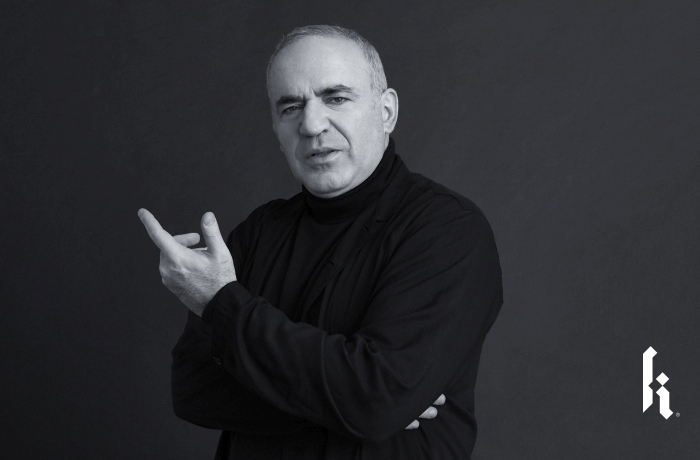
Interactive Chess Community and Content Platform KASPAROVCHESS.COM Features Online Chess Lessons, Matches, Documentaries, and an Upcoming Exclusive Masterclass with Garry Kasparov. PARIS – (April 15, 2021) – Former World Chess Champion Garry Kasparov and global media company Vivendi announced today the launch of Kasparovchess.com. The site is a new multimedia content platform for chess lovers of all skill levels launched by Vivendi, through its subsidiary Keysquare. Built to offer features for all players, whether they are enthusiasts or beginners, including thousands of chess puzzles, online matches, in-depth tutorials, articles, documentaries, and even an exclusive masterclass with Kasparov himself. The platform was built as a way for chess lovers and beginners to get immersed in the world of chess and create their own chess legacy by experiencing chess life through the lens of one of the greatest players of all time. It provides the building blocks for casual players to become more confident while also providing top tier content for the most dedicated pros looking to perfect their game. “Chess is entering a renaissance in pop culture and is becoming a fabric of the mainstream,” said Louis Germain, CEO Keysquare. “Our goal is to present Garry Kasparov’s legacy in a way that can inspire others and equip them with the tools they need to build their own legacy.” Kasparovchess offers a wealth of free content and a subscription-based platform that provides a wide breadth of content to the community of chess beginners and pros for a modest monthly fee. Subscription features include articles, documentaries, online matches against masters, lessons, puzzles, and an in-depth post-game analysis tool. There are also many free features, including an exclusive podcast series by Garry Kasparov that includes a deep dive on The Queen’s Gambit, for which Kasparov consulted, and many anecdotes from Kasparov’s own career highlights. Premium features such as the soon-to-be-released Kasparov masterclass will also be available for purchase as stand-alone content. “We are showing the world that there is so much more to chess than strategy and tactics,” said Garry Kasparov. “It is a way of life and a way of looking at the world. I hope to bring all people into this experience, even if they’ve never played before because chess can help them become everything that they want to be.” The platform is now open for early subscribers at Kasparovchess.com and will launch for the rest of the public at the end of April, 2021. About Kasparovchess is a world-class chess community and platform for beginners, enthusiasts and experts alike that offers exclusive access to chess lessons, matches, articles, in-depth videos and documentaries as well as an invaluable masterclass with the 13th World Chess Champion Garry Kasparov. The platform is designed to make chess accessible and life-changing in a way that only Garry Kasparov can—by giving audiences unparalleled access to the world of chess. Go to Kasparovchess.com to participate. Contact(s): Mark HavennerThe Pollack Group310-556-4443mark@pollackgroup.com