

“Chess for Freedom” program launched

As we always stress, promoting chess as a tool for education is one of FIDE’s top priorities. However, the scope of work in this field is not limited to chess in school programs, and there are many other opportunities. In recent years we have witnessed the successful introduction of chess in prisons, through different educative programs in Russia, England, the USA, Brazil, Italy and Spain, with very positive outcomes. These experiences show that chess improves behaviour, helping to reduce inmate violence and developing communication skills while promoting positive use of leisure time. Chess also drastically improves the decision-making capabilities of a group of people that, very often, due to the lack of opportunities and access to proper education, has ended up in jail after making a wrong choice in life. Besides, the game has a positive impact on the inmates’ overall health, fighting depression, stress and anxiety, and motivating them to change for the better. As a result, chess greatly contributes to efforts towards rehabilitation, and some studies have already proven it to reduce reoffending. It can be potentially life-changing, as many testimonies show. In prisons, just as in wider society, the impact of sport and games can be far-reaching. Aiming to support and promote this line of work, FIDE and the Cook County Sheriff’s Office (Chicago, USA) have signed a cooperation agreement, and together we are launching the “Chess for Freedom” program. This project, under the patronage of the 12th world champion Anatoly Karpov, will kick off with an online conference and an exhibition tournament with four participant countries, scheduled for May 11th. The conference will feature FIDE President Arkady Dvorkovich, the 12th World Chess Champion Grandmaster Anatoly Karpov, and Tom Dart, Cook County Sheriff, among other distinguished guest speakers. Starting at 4:00 pm CET (9:00 am US Central Time), it will be broadcast on the FIDE YouTube Channel. To take part in this conference, please fill out the registration form. If any of our readers know about any chess in prisons initiative or is willing to volunteer and start one, please get in touch with the FIDE Social Commission: socialchess@fide.com. We would like to hear about your experience, offer guidance and support where needed, and stimulate more research and papers being published on this topic.
Candidates 1956: Smyslov again!
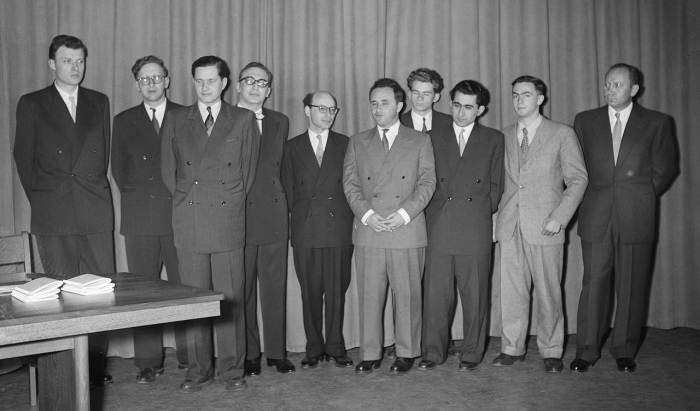
The third Candidates tournament held in the Netherlands was from March 27 to April 30 of 1956, where ten players competed for the right to challenge the World Champion. In comparison to the previous event, (Zurich, 1953), FIDE reduced the number of participants from 15 to 10. The challenger of the previous World Championship match, Vasily Smyslov, was seeded directly, and the other participants qualified from the Gothenburg Interzonal (1955). The opening ceremony took place on 26 March in Vossius Gymnasium, Amsterdam where the chairman of the Dutch Chess Federation, Hendrik Jan van Steenis, and FIDE President, Folke Rogard, held welcoming speeches. The fifth World Champion (1935-1937), Max Euwe, conducted the drawing of lots. All the rounds except the tenth and eleventh (that were held in Leeuwarden) were played in Amsterdam. Unlike the Candidates in Zurich, which turned into a close duel between Smyslov and Reshevsky, this time around it was wide open almost until the very end as at least four grandmasters had a fair chance to challenge Botvinnik. After the first part of the event, Efim Geller was leading the field with 6 points (+3) followed by Paul Keres and David Bronstein with 5.5 points (+2). The winner of the Candidates in Zurich (1953) Vasily Smyslov was sitting on 5 points after spoiling an overwhelming position and losing to young Spassky in Round 9. Round 10 complicated matters even more, as Petrosian defeated Geller, whereas Keres went through a lost position against Bronstein, scored a very important victory and reached the +3 mark. The ex-leader’s problems did not end there – in the next round, Geller fell to Smyslov. To his credit, he managed to rebound in Round 11, then beat Filip with Black and caught up with Keres. In Round 14 Smyslov scored his fourth victory in the event and joined this duo. The culmination of the entire tournament came in Round 16 when Smyslov faced Bronstein who was just a half-point behind after prevailing over Geller the day before. Both opponents were pushing hard but it was Smyslov who came out on top. Later on, the seventh World Champion included this victory in all his best games collections. Smyslov – Bronstein Black has just played a natural 31…Bg5-d2? Which turned out to be a decisive mistake 32.e6! Bg5 (32…fxe6 33. Rf3+) 33.h4 fxe6 34.Bh3 Bd7 35.Rxa7 exd5 36.Rxd7 and White won on move 57. Smyslov made a strong claim for the first place as Bronstein dropped out of the race, but Keres was hard on his heels. The oldest participant (Paul was 41) tried a new energy-saving strategy in Amsterdam: if Keres did not manage to obtain a promising position after the opening he offered a draw. In the penultimate round, Keres achieved a won position against Filip and got a real chance to catch up with Smyslov. Keres – Filip An obvious 38.Qf6 was winning easily (38…Nxe5 39.Qxe5 Re8 40.Qc7), but Keres played an overly “accurate” move 38.Kh2?? which was met with 38…Rc4! – Black got a defensive idea of Qf4+. After 39.Qf6 Nxe5! Keres opted to play a piece down but resigned on move 91 after a stubborn but hopeless defense. It is worth noting though that even in the case of Keres’ victory, Smyslov had a much better chance for the first place as in the last round he faced a “weak link” Herman Pilnik with White whereas his main rival took on Petrosian with Black. Still, it would have been an exciting final round but it was not meant to be. Source: Wikipedia Smyslov took well-deserved first place winning his second Candidates tournament in a row, whereas Keres eventually finished second and secured a spot in the next Candidates tournament. A big group of participants tied for third place, but their paths were quite different. The leader after the first part of the event, Efim Geller, scored as many victories as Smyslov but suffered five defeats (two of them at the hands of the eventual winner). The last one, in the final round with White against Laszlo Szabo, was particularly vexing as a draw would have allowed him to tie for second with Keres. Unlike Geller, Szabo did not have a chance for first place at any point, but this victory catapulted him to the third position in the final standings. The winner of the Gothenburg Interzonal, David Bronstein, was not in his best form but remained in the contest for first place until Round 16. All in all, despite receiving a “gift” from Petrosian he lost two crucial games to his main competitors (Keres and Smyslov). Tigran Petrosian was hardly content with his result as arguably he became the main underperformer of the tournament – take for example two won positions the future ninth World Champion achieved in the games versus Bronstein and Smyslov in which he netted zero points. The first defeat was particularly bitter: Petrosian – Bronstein White is in total control but Petrosian played 36.Ng5?? ignoring the only Black’s treat and after 36…Kxd6 resigned immediately, although Bronstein had just a few seconds left on his clock. Nevertheless, it became evident for many that Petrosian would be one of the main contenders in the future Candidates tournaments. Indeed, six years later he won a marathon competition in Curacao (1962) and eventually became the ninth World Champion. The youngest participant of the event, 19-year old World Junior Champion Boris Spassky, also scored a decent +1. Just like Petrosian, he did not compete for first place, but beat the eventual winner, Smyslov, and Bronstein along the way and showed great potential. Who could ever imagine back then that it would be his first and last Candidates tournament? But that is exactly what happened – Spassky missed the next two cycles failing to qualify for Interzonals (it is just another piece of evidence attesting the high level of USSR championships) and later on played only Candidates matches. Miroslav Filip and Oscar Panno had their bright moments in the event but their level was not high enough to hold out against the top Soviet grandmasters. The event in Amsterdam (1956) showcased Smyslov’s dominance throughout the 1950s. Indeed, during this decade he won two Candidates tournaments, played three
#29
“Chess for Freedom” Chess in prisons (1): the Cook County case Workshop: “Equal Opportunities” Brief news from National Federations Celebrating Bob Wade Birthdays: Joel Lautier READ NEWSLETTER
Rameshbabu Praggnanandhaa wins Polgar Challenge
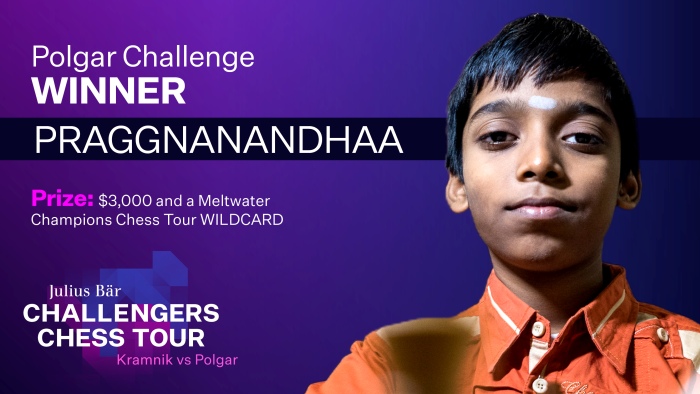
Indian prodigy Rameshbabu Praggnanandhaa booked himself a chance to take on the very best in chess with a stunning victory in the Polgar Challenge. The 15-year-old from Chennai secured the first online title in the Julius Baer Challengers Chess Tour and a $3,000 top prize with a round to spare on Sunday. Pragg wins not just the cash purse but a golden ticket to the next event in the elite Meltwater Champions Chess Tour on April 24 where he can test himself against the best. With just four games finishing off the tournament today, a hotly-anticipated final round decider against top seed Nodirbek Abdusattorov was on the cards. But that clash of the top two title-chasers overnight became irrelevant as Pragg simply won his first three games and therefore couldn’t be stopped. Chess legend Judit Polgar, a former top 10 player and the strongest female player in the game’s history, said the youngster’s win was “fully deserved and extremely convincing”. Pragg’s coach for the tour, former World Champion Vladimir Kramnik, said it’s not unrealistic to predict he will play a match for the World Championship someday: “His talent is on the scale of the guys who we all know!” Kramnik added: “He reminds me so much of a young Vishy (Anand), in every way.” The Julius Baer Challengers Chess Tour returns on June 10 for the Gelfand Challenge when the two teams of players will be competing for a $15,000 prize pot and another wildcard entry into the Meltwater Champions Chess Tour. You can see the full results in detail and the games on chess24’s website here. For further information, please contact: Leon Watson, PR for Champions Chess Tourleon@chessable.com+44 7786 078 770 About the Tour: Fronted by the strongest female player of all time, Judit Polgar, and former World Champion Vladimir Kramnik, the Julius Baer Challengers Chess Tour will run alongside the hugely popular Meltwater Champions Chess Tour. The Tour is organised by the Play Magnus Group and is designed to tackle head-on the lack of female role models competing in top events and promote emerging talent. More information here. Team Kramnik:Nodirbek Abdusattorov (aged, 16, Uzbekistan); Rameshbabu Praggnanandhaa (15, India); Dinara Saduakassova (24, Kazakhstan); Jonas Bjerre (16, Denmark); Leon Mendonca (15, India); Lei Tingjie (24, China); Christopher Yoo (14, United States); Olga Badelka (18, Belarus); Carissa Yip (17, United States); Nurgyul Salimova (17, Bulgaria) Team Polgar:Nihal Sarin (aged 16, India); Awonder Liang (17, United States); Vincent Keymer (16, Germany); Gukesh D (14, India); Sarasadat Khademalsharieh (24, Iran); Volodar Murzin (14, Russia); Polina Shuvalova (20, Russia); Zhansaya Abdumalik (21, Kazakhstan); Jiner Zhu (18, China); Gunay Mammadzada (20, Azerbaijan)
Celebrating Bob Wade
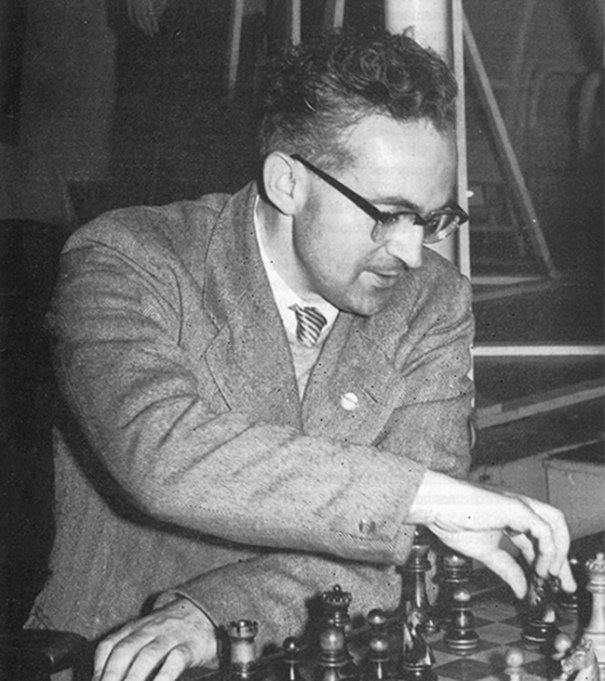
This weekend would have been Robert Graham Wade‘s 100th birthday. Born on April 10, 1921, in Dunedin (NZ), he was New Zealand champion three times, British champion twice, and played in seven Chess Olympiads and one Interzonal tournament. When Bob passed away in 2008, chess websites were flooded with eulogies and messages from his chess colleagues. He was an uncontroversial, well-loved and generous personality, who left a mark on all those he encountered. Wade won two New Zealand Championships in a row, in Wellington 1943-44 and Auckland 1944-45, and then again in his hometown of Dunedin, in 1947-48. In order to pursue a career as a chess player he wanted to face stronger opposition, so he moved to Europe shortly after that, where international chess was coming back to life after the long hiatus caused by World War II. Following a couple of very active years, Bob achieved the International Master title thanks to his shared 5–7th place in the super-strong tournament of Venice 1950, won by Kotov. In 1950 he settled in England, and in 1958 he earned the title of International Arbiter. He made much of his living as a writer, arbiter, coach, and promoter, and wearing all these different hats he earned the respect of his peers and the chess community. “After he retired from professional play, Wade authored many books and was a key part of the ‘English Chess Explosion’ that began after the Fischer-Spassky match in 1972. Wade’s enormous library was consulted by many aspiring young players, as well as by established GMs such as Tony Miles. Even Bobby Fischer sought his assistance when preparing for Boris Spassky”, writes Malcolm Pein in his column today for The Telegraph. Indeed, in the days before computer databases, Bob’s library at his house in South London, constantly enlarged by Batsford’s publications (to which he served as chess editor), magazines, and tournament bulletins, was often used by British and foreign players in preparation for tournaments. Wade made use of all this material to create a file on Boris Spassky and help Bobby Fischer prepare for his 1972 World Championship match. “He was one of the most influential figures in the English Chess Explosion and the nicest person you could ever meet”, wrote Malcolm Pein on Twitter. “He did so much for English chess without courting recognition. He occasionally offered me stern but sympathetic advice – and was usually right”, added Daniel King. “Bob helped in establishing the TWIC (The Week in Chess) database, the leading source of online chess news; was an arbiter at the Kasparov v Nigel Short 1993 world title series and at the annual Oxford v Cambridge match; and continued to encourage young talent. He helped many future GMs from Jonathan Speelman to David Howell, and his sharp wit, kindness and generosity made him probably the most liked personality in English chess”, remembers Leonard Barden. Bob has an opening line named after him, which is probably one of the highest forms of recognition a chess player can get. After playing 1.d4 d6 2.Nf3 Bg4 for decades, this is known now as the Wade Defence. But this is by no means the only tribute he has received: in 1979 he was awarded the title of Officer of the Most Excellent Order of the British Empire, usually known by its acronym, OBE. A memorial tournament in his honour was held this weekend in Auckland, New Zealand, with the victory by Gawain Jones. Photo Credit: British Chess Magazine
Praggnanandhaa in pole position to win Polgar Challenge
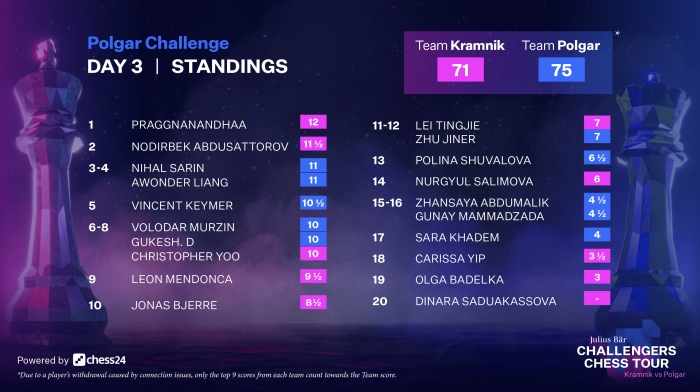
Indian prodigy Rameshbabu Praggnanandhaa is in pole position to win the Polgar Challenge as the online chess event enters its final day. The 15-year-old from Chennai won three in a row before being held to a draw against fellow Indian D Gukesh. A final-round loss against Germany’s Vincent Keymer was the only blemish on his copybook. With just four rounds left to play on Sunday, Team Kramnik star Pragg is on 12/15 with top seed Nodirbek Abdusattorov is just a half-point behind. Nihal Sarin, another Indian talent, and Awonder Liang are another half-point behind on 11/15 but it is Pragg and Abdusattorov who are the hot favourites. The two leaders are due to face each other in a mouth-watering Round 19 game that could decide the winner of the first Julius Baer Challengers Chess Tour event. At stake is a chance to play in an elite Meltwater Champions Chess Tour tournament and face World Champion Magnus Carlsen. In the team battle, Team Polgar edged ahead with 75 points to Team Kramnik’s 71, despite Pragg and Abdusattorov both representing the second team. Before the start of play, it was announced that due to connection problems IM Dinara Saduakassova, from Uzbekistan, had pulled out of the tournament. Play Magnus Group, the Tour organiser, made the following statement on how the event would proceed without her: Four more rounds will follow on Sunday as the first leg of the new $100,000 Julius Baer Challengers Chess Tour reaches its climax. The 20 young talents on show are divided into two teams, Team Kramnik and Team Polgar. The overall day 1 score finished 25-25. The young stars of chess represent 12 nations and are competing for a prize pot totalling $100,000 and places on the Meltwater Champions Chess Tour. They are receiving coaching and support from teams of coaches, which include world champions and legends of the game. The Polgar Challenge, named after Judit Polgar, is the first of four tournaments before a tour final in September organised by the Play Magnus Group. The team that wins the Julius Baer Challengers Chess Tour overall will also get a trip to this year’s World Chess Championship in Dubai. You can see the full results in detail and the games on chess24’s website here. For further information, please contact: Leon Watson, PR for Champions Chess Tourleon@chessable.com+44 7786 078 770 About the Tour: Fronted by the strongest female player of all time, Judit Polgar, and former World Champion Vladimir Kramnik, the Julius Baer Challengers Chess Tour will run alongside the hugely popular Meltwater Champions Chess Tour. The Tour is organised by the Play Magnus Group and is designed to tackle head-on the lack of female role models competing in top events and promote emerging talent. More information here. Team Kramnik:Nodirbek Abdusattorov (aged, 16, Uzbekistan); Rameshbabu Praggnanandhaa (15, India); Dinara Saduakassova (24, Kazakhstan); Jonas Bjerre (16, Denmark); Leon Mendonca (15, India); Lei Tingjie (24, China); Christopher Yoo (14, United States); Olga Badelka (18, Belarus); Carissa Yip (17, United States); Nurgyul Salimova (17, Bulgaria) Team Polgar:Nihal Sarin (aged 16, India); Awonder Liang (17, United States); Vincent Keymer (16, Germany); Gukesh D (14, India); Sarasadat Khademalsharieh (24, Iran); Volodar Murzin (14, Russia); Polina Shuvalova (20, Russia); Zhansaya Abdumalik (21, Kazakhstan); Jiner Zhu (18, China); Gunay Mammadzada (20, Azerbaijan)
News from Member Federations

We would like to remind you that we have at your disposal the email socialmedia@fide.com so you can share with us any relevant news. “Dear Member Federations: Over the past couple of years, FIDE has worked diligently to improve its outreach. Our website receives every day more than 50k visits (unique users), but it is our social media channels that are growing at a really fast pace, with 103k followers on Twitter, 85k on Facebook, and 96k on Instagram. Last year, we have successfully launched a bi-weekly Newsletter, which has now 7,000 subscribers, and a new VKontakte page, for the Russian-speaking fan base. More importantly, during this time we have also established a regular relationship with many members of the media, and FIDE’s media database contains now the contact details of approximately 1,700 journalists in different fields, from all over the world. We would like to remind you that these channels are at your disposal, to give visibility to your activities. Your sponsors, partners, and supporters will surely appreciate getting some international publicity. For obvious reasons, we can’t possibly publicize all your activities, but as per policy we will always report about: National Championships (both in open and women’s categories) National Team Championships The appointment of a new President to the National Federation. Secondarily, we routinely publish about: Promotional activities involving high authorities, sponsors, or celebrities Important news about chess in education (i.e.: the launching of a national or regional program for chess in schools). Social projects related to chess. Additionally, in social media, we can always make room for interesting or original activities, particularly if these stories are accompanied by nice audiovisual materials. It is important that the photos or videos are of good quality. We would really appreciate your cooperation in this regard. As they say, please “help us to help you”. We have a contact email, socialmedia@fide.com, dedicated to receiving this kind of news, and we kindly request you to send us a brief report about your main events and more relevant activities. Please give us a heads up when your national championship is about to start, and send us a few photos whenever you organize a social event. We cannot do this without your cooperation! Apart from the aforementioned contact email, please feel free to reach out to me directly (david.llada@fide.com / +34 623 021 120), if you have any questions or you need my assistance. We are at your disposal. Best regards,David Llada FIDE – Chief Marketing and Communications Officer” EXAMPLES
Day 2: Praggnanandhaa scores eight wins in a row
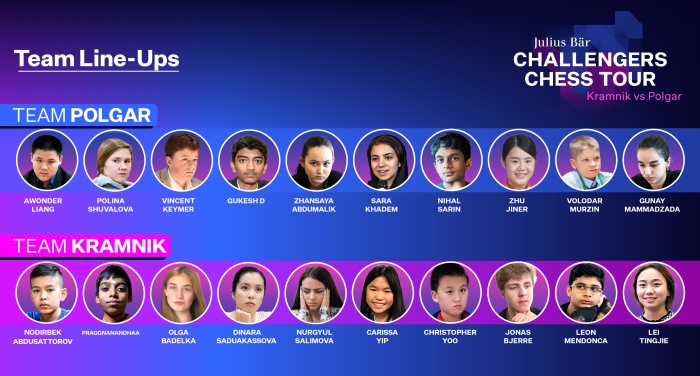
Indian prodigy R Praggnanandhaa took his winning run to an incredible eight in a row today as he emerged the clear leader of the Polgar Challenge online chess event. The 15-year-old, playing for Team Kramnik, dominated his opening two games against America’s top female player Carissa Yip and Jiner Zhu, of China. Two wins in those games added to Pragg’s four back-to-back victories yesterday – and then he benefited from some luck to just storm on from there finishing on 8.5/10. Incredibly, after being tied 25-25 overnight, Team Kramnik and Team Polgar are still locked on 50-50 – although the top three on the individual leaderboard all represent Team Kramnik. Pragg did not have it all his own way, however. His run was nearly derailed in Round 8 by Bulgaria’s Nurgyul Salimova, 17, who missed a chance to win on the spot and then nearly saved a draw against him. Pragg was too strong and a slip in the endgame from Salimova allowed the teenager from Chennai to force a seventh win. Meanwhile, there was disappointment for Kazakhstan’s Dinara Saduakassova who was forced to forfeit all her remaining games after Round 8 because of a bad internet connection. Saduakassova’s departure handed Pragg another win in Round 9 – albeit without playing – to make it eight full points in a row after losing his first game in the tournament. It also gifted Pragg a rest going into the final round of the day. He ended the day with a draw against US teen Awonder Liang, who was celebrating his 18th birthday. Top seed Nodirbek Abdusattorov, 16, had kept pace until he suffered his first loss in Round 8 against another Indian prospect, Goa’s Leon Mendonca. Both Abdusattorov, from Tashkent, Uzbekistan, and American Christopher Yoo had been level with Pragg overnight but fell back today. The two chasers did however pullback in Round 10 to finish just half a point behind Pragg on 8/10. Yoo remains unbeaten and faces Pragg in Round 11 tomorrow. A win in that and he will take the lead. Five more rounds will follow tomorrow before the first event of the new $100,000 Julius Baer Challengers Chess Tour reaches its climax on Sunday. The young stars of chess represent 12 nations and are competing for a prize pot totalling $100,000 and places. They are receiving coaching and support from teams of coaches, which include world champions and legends of the game. The Polgar Challenge, named after Judit Polgar, is the first of four tournaments before a tour final in September organised by the Play Magnus Group. The team that wins the Julius Baer Challengers Chess Tour overall will also get a trip to this year’s World Chess Championship in Dubai. For further information, please contact: Leon Watson, PR for Champions Chess Tourleon@chessable.com+44 7786 078 770 About the Tour: Fronted by the strongest female player of all time, Judit Polgar, and former World Champion Vladimir Kramnik, the Julius Baer Challengers Chess Tour will run alongside the hugely popular Meltwater Champions Chess Tour. The Tour is organised by the Play Magnus Group and is designed to tackle head-on the lack of female role models competing in top events and promote emerging talent. More information here. Team Kramnik:Nodirbek Abdusattorov (aged, 16, Uzbekistan); Rameshbabu Praggnanandhaa (15, India); Dinara Saduakassova (24, Kazakhstan); Jonas Bjerre (16, Denmark); Leon Mendonca (15, India); Lei Tingjie (24, China); Christopher Yoo (14, United States); Olga Badelka (18, Belarus); Carissa Yip (17, United States); Nurgyul Salimova (17, Bulgaria) Team Polgar:Nihal Sarin (aged 16, India); Awonder Liang (17, United States); Vincent Keymer (16, Germany); Gukesh D (14, India); Sarasadat Khademalsharieh (24, Iran); Volodar Murzin (14, Russia); Polina Shuvalova (20, Russia); Zhansaya Abdumalik (21, Kazakhstan); Jiner Zhu (18, China); Gunay Mammadzada (20, Azerbaijan)
Three-way tie for the lead after Day 1
The Polgar Challenge, the first event of the new $100,000 Julius Baer Challengers Chess Tour, got underway today with a series of fighting games that ended in a three-way tie for the lead. Top seed Nodirbek Abdusattorov grabbed the first win of the five-month tour with a convincing victory over Bulgarian teen Nurgyul Salimova. Abdusattorov, from Tashkent, Uzbekistan, famously beat two Grandmasters in a tournament when aged only nine. The ambitious 16-year-old aims to be World Champion one day and showed his class by finishing joint-top of the table on day one of four after scoring an unbeaten 4/5. Abdusattorov shares the lead with India’s exciting prodigy R Praggnanandhaa and the youngest International Master in American history, 14-year-old Christopher Yoo. Round 1 finished with eight decisive outcomes and only two draws. Round 2 followed the pattern with only two more draws. In total, there were only 14 draws in 50 games played over the first five rounds – a stat that demonstrated the fighting chess on display. The 20 young talents on the show are divided into two teams, Team Kramnik and Team Polgar. The overall day 1 score is 25-25. Going into the final round of the day China’s Lei Tingjie was the leader after beating America’s top-ranked female player, 17-year-old Carissa Yip. However, Lei was caught by Abdusattorov after a final-round loss to Praggnanandhaa that allowed both of them to leap-frog her. The young stars of chess represent 12 nations and are competing for a prize pot totalling $100,000 and places on the Meltwater Champions Chess Tour. They are receiving coaching and support from teams of coaches, which include world champions and legends of the game. The Polgar Challenge, named after Judit Polgar, is the first of four tournaments before a tour final in September organised by the Play Magnus Group. The team that wins the Julius Baer Challengers Chess Tour overall will also get a trip to this year’s World Chess Championship in Dubai. For further information, please contact: Leon Watson, PR for Champions Chess Tourleon@chessable.com+44 7786 078 770 About the Tour: Fronted by the strongest female player of all time, Judit Polgar, and former World Champion Vladimir Kramnik, the Julius Baer Challengers Chess Tour will run alongside the hugely popular Meltwater Champions Chess Tour. The Tour is organised by the Play Magnus Group and is designed to tackle head-on the lack of female role models competing in top events and promote emerging talent. More information here. Team Kramnik:Nodirbek Abdusattorov (aged, 16, Uzbekistan); Rameshbabu Praggnanandhaa (15, India); Dinara Saduakassova (24, Kazakhstan); Jonas Bjerre (16, Denmark); Leon Mendonca (15, India); Lei Tingjie (24, China); Christopher Yoo (14, United States); Olga Badelka (18, Belarus); Carissa Yip (17, United States); Nurgyul Salimova (17, Bulgaria) Team Polgar:Nihal Sarin (aged 16, India); Awonder Liang (17, United States); Vincent Keymer (16, Germany); Gukesh D (14, India); Sarasadat Khademalsharieh (24, Iran); Volodar Murzin (14, Russia); Polina Shuvalova (20, Russia); Zhansaya Abdumalik (21, Kazakhstan); Jiner Zhu (18, China); Gunay Mammadzada (20, Azerbaijan)
Alireza Firouzja wins 2021 Bullet Chess Championship
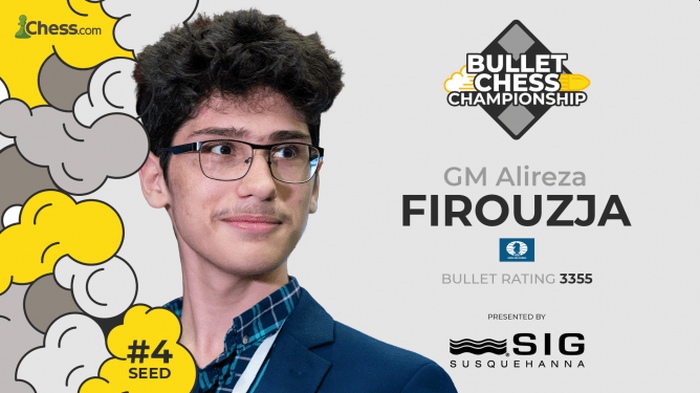
GM Alireza Firouzja won the 2021 Bullet Chess Championship presented by SIG. The Iran-born super-GM first eliminated top favourite GM Hikaru Nakamura in the semifinals and then was too strong for GM Andrew Tang in the final. The Bullet Chess Championship presented by SIG ran April 5-7, 2021 on Chess.com among the very best bullet players on the planet. Only World Champion Magnus Carlsen was missing from an otherwise star-studded field. Firouzja earned $10,000 for his victory. Semifinals In the semifinals, the action started with GM Daniel Naroditsky, making his first moves in the championship, against Tang. Because GM Eric Hansen had to withdraw at the last moment, Naroditsky reached the semis without playing. Charlotte resident Naroditsky didn’t need much of a warmup as he took a 4-3 lead before the half-time break and later increased it to 6-4. Tang, however, levelled the score to 6-6 with incredibly fast play. As 7-7 was on the scoreboard with three minutes left, Tang convincingly won two games in a row to secure a place in the final. Right after, the much-anticipated match between Firouzja and Nakamura started. It was a repeat of the final of the Bullet Open Championship from the end of 2020 and also of the 2019 quarterfinal when both times Nakamura emerged victoriously. The American GM was definitely the slight favourite again, also because he had just beaten GM Arjun Erigaisi 13-3 the other day. Nakamura had an excellent start and was about to go 3-0 when he blundered a piece and it was 2-1 instead. He still reached 4-1 anyway, winning game five in the nick of time. With Nakamura leading 6-3 at halftime, few would have predicted Firouzja to win this match. However, the second half saw a completely different picture with the Iran-born prodigy winning that second “set,” also nine games, 7-2 to take the match 10-8. “[During the break] I thought I had to play more relaxed and play more like I’m playing every day against Naroditsky or like this,” Firouzja explained his comeback. “That way I could have a chance, at least.” The end was an absolute nailbiter, with Nakamura winning a must-win game to make 8-9 with 21 seconds left on the match clock. Having double the amount of time (22 seconds vs. 11 for Firouzja) he seemed on his way to flag his opponent, make 9-9 and force a playoff. He also could have won a piece there but instead, he blundered his own rook. “It was a bit of luck I guess, but overall I think I played good chess against Hikaru,” Firouzja would later say. “The first games were a bit shaky but after that, it was pretty decent.” Final Having taken such a huge hurdle, Firouzja then dominated the final against Tang. He won the first five games before Tang, who was sporting his Cloud9 jersey, could do something back. Now known for his slow starts, Tang had come back from being down 5-1 the day before. This time, it wasn’t going to happen as he simply couldn’t get into top form while Firouzja is simply on fire these days – he also won the last two Titled Tuesdays. By winning the last two games, Tang could at least set an “acceptable” final score but the 11-6 didn’t leave any doubts. Firouzja took the $10,000 first prize while Tang earned $6,000. Both Nakamura and Naroditsky won $2,500. Firouzja definitely had his share of winner’s luck as GM Vladislav Artemiev had him on the ropes in the quarterfinals and only needed to let the match clock run down for nine more seconds to win their match. Instead, the Russian GM resigned, allowing another game after which Firouzja eventually won. Speaking after the final, Firouzka called that quarterfinal match “a miracle,” adding: “I should have lost that, a 100%. I got lucky, I guess.” The 2021 Bullet Chess Championship is presented by Susquehanna International Group, LLP (SIG). SIG is a global quantitative trading firm founded with a growth mindset and an analytical approach to decision-making. As one of the largest proprietary trading firms in the world, SIG benefits the financial markets by providing liquidity and ensuring competitive prices for buyers and sellers. SIG brings together the brightest minds, the best technology, and an expansive library of industry data to design and implement qualitative trading strategies that make it leaders in the financial markets. Beyond trading, SIG is active in global private equity, structured capital, and institutional brokerage. Text: Peter Doggers (chess.com) Photo: Chess.com