

Gabuzyan and Gaboyan win Armenian championship
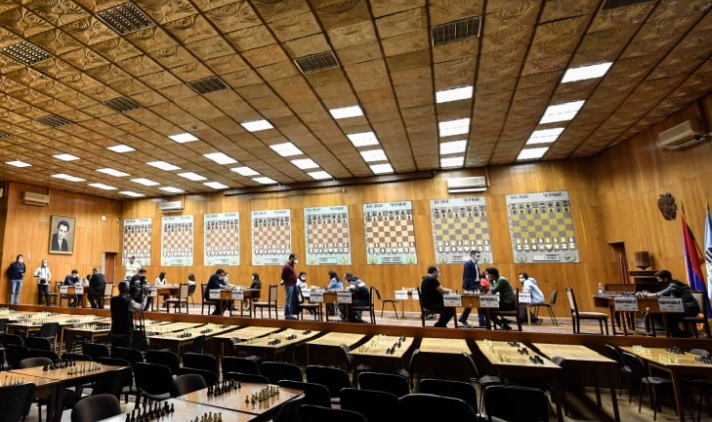
GM Hovhannes Gabuzyan and WIM Susanna Gaboyan are the new champions of Armenia. The Armenian Championship (so-called the Highest League) took place from 16-28 February 2021 in the Tigran Petrosyan Chess House (Yerevan). Although the top-5 rated Armenian did not participate in the open section, the round-robin brought together eleven grandmasters and one IM. The two highest-rated players Robert Hovhannisyan (2642) and Samvel Ter-Sahakyan (2640) entered the tournament as main favorites but it was 9th rated Hovhannes Gabuzyan (pictured below) who called the shots in this competition. The Yerevan-born GM grabbed the lead in Round 4 and never looked back, finishing with an excellent score 8½ out of 11, 1½ points ahead of Arman Pashikian. GM Samvel Ter-Sahakyan tied for second but had to settle for bronze due to inferior tiebreaks. This is Gabuzyan’s second title after the victory in 2017. The champion had a couple of dubious positions along the way but routinely outplayed his opponents in complications and suffered his only defeat in the penultimate round after already sealing the title. Final standings: 1. Hovhannes Gabuzyan (2557) – 8½2. Arman Pashikian (2606) – 73. Samvel Ter-Sahakyan (2640) – 74. Manuel Petrosyan (2628) – 65. Shant Sargsyan (2596) – 66. Haik Martirosyan (2622) – 67. Tigran Harutyunian (2549) – 68. Robert Hovhannisyan (2642) – 5½9. Mamikon Gharibyan (2423) – 5½10. Zaven Andriasian (2606) – 3½11. Levon Babujian (2455) – 312. Tigran Petrosian (2601) – 2 One of the rating favourites of the 10-player round-robin tournament in the women’s section, along with defending champion WGM Maria Gevorgyan and WIM Siranush Ghukasyan, Gaboyan had a solid start with three wins and three draws in six rounds, but her loss in round seven complicated the tournament situation. It all came down to the last round – the leader Gevorgyan lost to Ghukasyan, while Gaboyan won the last two games and finished clear first with 6½ out of 9. WFM Mariam Mkrtchyan and WGM Maria Gevorgyan shared for second place, with tiebreaks putting Mkrtchyan higher. Final standings: 1. Susanna Gaboyan (2211) – 6½2. Mariam Mkrtchyan (2075) – 63. Maria Gevorgyan (2228) – 64. Siranush Ghukasyan (2222) – 55. Astghik Hakobyan (1820) – 4½6. Veronika Khachatryan (1767) – 4½7. Nare Arakelyan (1953) – 48. Mariam Avetisyan (2092) – 3½9. Anna Khachatryan (2086) – 310. Arpine Grigoryan (2091) – 2 Photo: Gevorg Perkuperkayn (ARMENPRESS)
Chess as a tool to fight Attention Deficit Hyperactivity Disorder
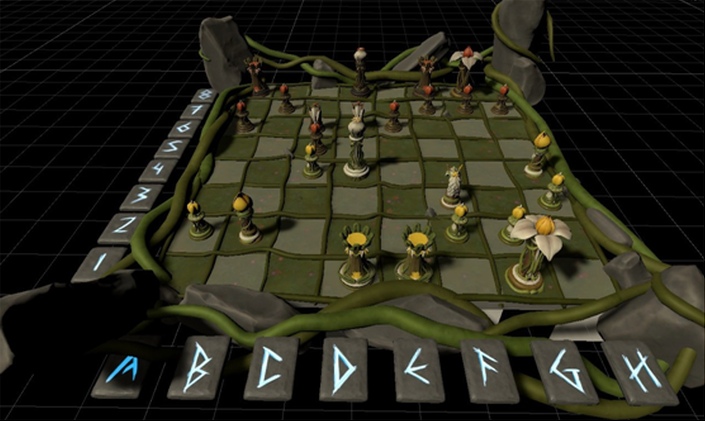
Last month, a new clinical trial was conducted among 105 teenagers to test the effectiveness of a chess-based videogame to treat the cognitive training of patients diagnosed with Attention Deficit Hyperactivity Disorder (ADHD). It is estimated that this neurodevelopmental disorder has a worldwide prevalence between 4% and 7%. ADHD is characterised by attention dysfunction and/or symptoms of hyperactivity and impulsivity, that can affect people in their daily life to a greater or lesser extent. María Rodrigo Yanguas, WFM and President of the Spanish Chess Federation Commission for Women in Chess, is also a sports psychologist. She has been part of the team that has developed this virtual reality video game, and she sent us the following article. “The Secret Trail of Moon” “The Secret Trail of Moon” (TSTM) is a serious virtual reality (VR) video game designed for the cognitive training of patients diagnosed with Attention Deficit Hyperactivity Disorder (ADHD). The gamification of chess is core to the development of TSTM. TSTM has been developed by a multidisciplinary team: 1) a video game company Gammera Nest [Daniel Sánchez Mateos (CEO of the company), Miguel Ruiz Domínguez (Lead programmer) and Marina Martín Moratinos (psychologist)]; 2) an expert on gamificiation:, Carlos González Tardón (psychologist and Professor at Tecnocampus-UPF); and a clinical and research group at the Hospital Universitario Puerta de Hierro [Hilario Blasco Fontecilla (psychiatrist) and her PhD student, María Rodrigo Yanguas, a sports psychologist specialized in chess]. ADHD is a neurodevelopmental disorder with a worldwide prevalence between 4-7%. Heritability is estimated at 70%. ADHD is characterized by attention dysfunction and/or symptoms of hyperactivity and impulsivity in two or more different areas with interference in daily life. The best treatment is multimodal treatment: pharmacological treatment, psychoeducation for parents and teachers, and cognitive-behavioral treatment. Unfortunately, cognitive-behavior psychotherapy is usually expensive and can be boring for some children and adolescents. Accordingly, some patients affected by ADHD cannot be benefited from this treatment. This was a major reason for TSTM to be created. TSTM, compared to other treatments, is innovative, enjoyable, and will be cheap when commercialized. TSTM uses a video game engine Unity 2020.1.1f0 in the development for PlayStation 4, PlayStation 5 and PlayStation VR. It is composed of 5 mechanics of game aimed to cognitive training of the most deficient areas from ADHD patients: attention, working memory, planning, visuospatial ability, and reasoning. It also works on other skills such as impulsive behavior, cognitive flexibility, or processing speed. Chess elements appear both in the story and in the mechanic of games. In fact, TSTM includes a complete mechanic of chess where the patient learns to play chess from the most basic level (knowledge of the board and pieces) to being able to perform checkmate exercises in 1 move. For this reason, we have created our own chess pieces incorporating them with the narrative story. Chess is core to TSTM because we incorporated all the experience gained in different settings using chess during the last decade. In 2016, Hilario Blasco-Fontecilla published the results of a pilot study conducted with 44 children diagnosed with ADHD with and without pharmacological treatment using an add-on strategy with chess. These children performed cognitive training using chess for 3 months (https://pubmed.ncbi.nlm.nih.gov/25911280/). Most of the children benefited, independently of whether they were or not under drug treatment. Furthermore, gifted ADHD children were the most benefited by using chess. In a second step, we gained an i-PFIS contract (www.isciii.es) for: 1) developing a serious chess-based video game. 2) testing its effectiveness using a clinical trial (see below). We merged our project with another ongoing project (lead by Gammera nest) using VR to treat ADHD, and this settled the basis for TSTM. In November 2020 we published our first scientific article explaining the scientific basis underlying the use of TSTM (http://ceur-ws.org/Vol-2719/paper20.pdf). Currently, several other papers related to this scientific and industrial project are under consideration for publication. On January 26th, 2021, we finished a clinical trial aimed at testing the effectiveness of TSTM to ameliorate ADHD symptoms (https://clinicaltrials.gov/ct2/show/NCT04355065). The clinical trial was randomized, non-blinded, with the control group and pre-post evaluation. We recruited 105 patients aged 12 to 22 diagnosed with ADHD and under pharmacological treatment. All patients were randomized into one of these three groups: TSTM group: 12 sessions (1 session/week) of cognitive training with the video game Online chess group: 12 sessions (1 session/week) of online chess cognitive training. Control Group: 12 weekly follow-ups without any cognitive training. All participants were evaluated before and after 3 months. We retrieved clinical information from both the patients and their parents and used several questionnaires and objective measures (CPT-3) to evaluate ADHD symptoms and executive functions pre and post-treatment. The major hypothesis is that the use of either online chess or TSTM may help to improve ADHD symptoms in clinically stable drug-treated patients. Currently, we are analysing our data in order to get published our results. Lately, we have begun the second phase of TSTM development aimed at getting TSTM commercialized.
ECU to hold Hybrid Qualification for FIDE World Cup 2021

In the course of the 2nd ECU Board meeting on February 20, 2021, several important decisions regarding the European Qualification system for the World Championship Cycle have been made. European Championship 2021 will be held in Reykjavik between August and September 2021, being a part of the next World Championship Cycle (FIDE World Cup 2023). The exact dates will be announced by the Icelandic Chess Federation the following days. The European Open Chess Championship 2022 will be organized in Podčetrtek, Slovenia from March 27th (arrival) to April 9th (departure) 2022 and is a part of the World Championship cycle. The Romanian Chess Federation confirmed the European Women Chess Championship 2021 in Iasi, Romania. The event is scheduled for the first half of June but may be rescheduled for later in the summer with a new announcement in March. Concerning the qualification stage for FIDE World Cup 2021, the European Chess Union Board taking into account: a) The existing health conditions, and travel restrictions in Europeb) The re-confirmation by FIDE that World Cup 2021 will be organized in Russia starting in the first half of July and so the continentals qualification stages shall be completed by May 2021.c) The quality of the European representationd) The main principle that qualification to FIDE World Cup shall not be restricted by any criteria of nominations or further geographical distribution that will exclude in advance a big number of European players made the following decisions: Forty (40) additional spots were set for the European players for FIDE World Cup 2021. ECU Board on its meeting on January 2020 in Larnaca, Cyprus decided not to keep 50% of these additional spots for the European qualification stages but to be distributed to forty (40) European federations. This decision ensured the wide geographicalfederations representation at the FIDE World Cup. Additionally, one (1) spot was awarded to the 10 federations of European Small nations (Zone 10.1) that do not get any of these 40 spots. Ten (10) spots will be awarded to the highest European rated players (average rating 1st July 2020 – 1st June 2021) after the 13 top FIDE rated players, World Champion, and World Cup 2019 four (4) finalists spots will be calculated and announced by FIDE. Thirty-six (36) spots will be awarded through a European Hybrid Qualification event that will be organized in 9 rounds from May 22-30. This decision ensures, under the current conditions the access to qualification to hundreds of players and many more through the national pre-qualification events. The exact regulations for the European Hybrid Qualification event will be finalized and announced by the mid of March. The hybrid event will have a 30,000 euros prize fund supported by the FIDE Continental Development fund. Full text of ECU Circular Letter Official website: https://www.europechess.org
Daniil Dubov gives masterclass at Lighthouse Children’s Hospice
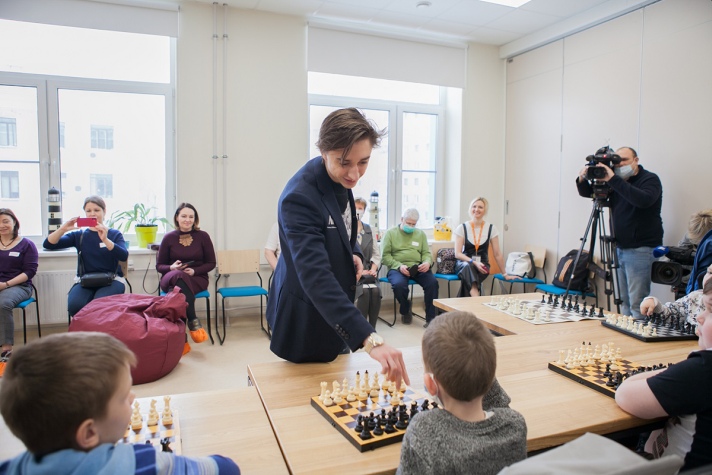
On February 21, Daniil Dubov gave a masterclass for the residents of the Lighthouse Children’s Hospice (Moscow). Seventeen kids participated in a simultaneous exhibition by the popular grandmaster. The event was timed to the first online corporate charity chess championship “I Fight to the End!”. Maria Saushkina, a correspondent and presenter at the Russia TV channel, sang children’s songs at the opening ceremony. Svetlana Terekhina, an event manager of the Lighthouse Charity Foundation, Konstantin Bazarov, FIDE master, and Olesya Temerova, head of the Internal Communications Centre project of the Communications and Marketing Department of Gazprombank, greeted the participants. Camera crews from the Channel One and Match TV covered the story for national television. Several children managed to drew their games with Daniil Dubov. The grandmaster praised Roman Kurbanov’s play, calling him a strong opponent. All the children were presented with diplomas and souvenirs from Gazprombank. Text: ruchess.ru Photo: Lilia Demina
EDU Commission launches a new training program

Dear Member Federations: The FIDE Commission for Chess in Education has launched a new training program. This program takes into consideration the current circumstances, where the majority of seminars are expected to be held online. The program is divided into two stages: first, the EDU Commission will prepare and certify lecturers. Then, in turn, these lecturers will run seminars to prepare teachers. Preparation of Chess in Education Lecturers (CEL) Lecturers will be experts in educational chess, not necessarily experts in competitive chess (please check this explanatory document if you are unsure about the difference between these two concepts). They will be trained by the EDU Commission, thought an online capacitation course of 15 hours, with some offline extras. This training has a cost of €75, which covers both access to materials and preparation, and the exam. Those who successfully pass the exam will receive the diploma of Certified FIDE Chess in Education Lecturer (CEL). This diploma is valid for three years, and it implies an administrative fee of €50. This qualification will be mandatory in order to be appointed as a lecturer for the FIDE School Instructor seminars. Lecturers will be responsible for running the seminars for teachers (2 lecturers per seminar), and they receive 50% of the total income generated by the seminars they lead. A pilot course was conducted recently with the participation of several experts in chess in education. “This kind of course is a very good idea”, said Leontxo Garcia, who was one of the attendees. “I learned a lot”, added the International Master Eva Repkova, of the FIDE Women’s Commission. Other experts, such as FM Vlad Ungureanu, national coordinator of Romania chess in schools program, also had the chance to attend and provide valuable feedback, that will be implemented in the coming capacitation courses. Following this pilot experience, the first course for aspiring lecturers will be held 12-14 March, online 14:00-19:00 CET (Central European time). Applications are open now and will close on 9 March. If you want to apply, please fill in the registration form for “Preparation of Lecturers” and include a resume describing your background. This resume should pay special attention to your relevant experience in “educational chess” (rather than “sport chess”, as explained above). The course is limited to a maximum of 20 people, on a first-come, first-served basis. Applicants who cannot be given an assured place will be placed on the waiting list for the subsequent course. This first course will be entirely in English, but later on, we will incorporate some courses in Spanish and French as well. School Instructor Seminars for teachers (SI) These seminars will be organized by FIDE, sometimes in cooperation with National Federations or certified FIDE academies. The FIDE Commission for Chess in Education will decide on lecturers, content, et cetera. The newly revised seminars for teachers will be given by Certified Lecturers (CEL), two per group. They will also have a duration of 15 hours, and those who pass the exam will receive the title of School Instructor (SI). The fee for taking part in these seminars is €100, including access to materials, seminar and exam. Those who successfully pass the exam will have to pay €50 for the School Instructor title. The dates for the first School Instructor seminars will be announced at the conclusion of the first seminar for capacitation of lecturers.
GRENKE Bank, crowned World Corporate Chess Champion
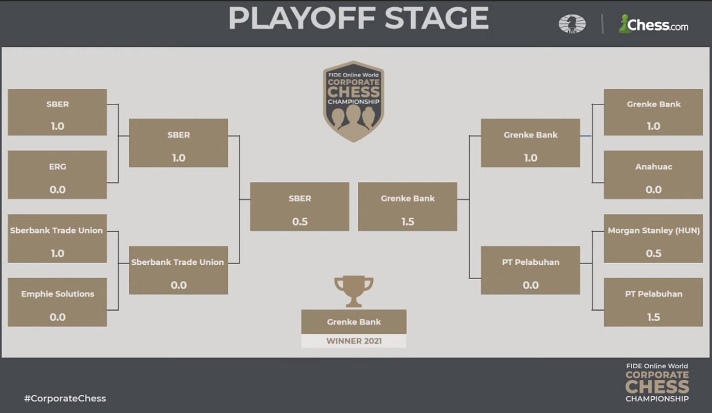
GRENKE Bank became the winner of the inaugural FIDE Online World Corporate Championship. In the final, the German team defeated Russian SBER, headed by the world’s #4 Ian Nepomniachtchi. It is noteworthy that the leader of the winners, one of the top German grandmasters Georg Meier is a current employee of GRENKE Bank. “I am no ‘legionary’, just an employee of GRENKE Bank who likes to play chess in his spare time!” tweeted Meier correcting an inaccuracy in our introductory article. Another distinguishing feature of the champions is the 75% female roster. Quoting Meier again: “Lucky me to play alongside three fabulous women – Alina Kashlinskaya, Hanna Marie Klek, and Inna Agrest! Deep down I was convinced that we will win if I survive one game!” Indeed, Meier held his ground in the key match whereas WIM Inna Agrest scored a decisive point by defeating Maria Komiagina with all other boards tied. On the final day of the event, with eight teams vying for the main title, lady luck favoured GRENKE Bank slightly than other squads. After convincingly winning their East B group, the eventual champions faced off against West A’s Anahuac (MEX) in the quarterfinals. The German team did not make their fans sweat, although scored a victory by a minimal margin. Another team from the Western pool PT Pelabuhan Tanjung Priok (INA) beat Morgan Stanley (HUN) in the only blitz-match tiebreak of the final day. The Indonesians could have avoided this tiebreaker and advanced straight into semis hadn’t Chelsie Sihite blundered a checkmate in one in an equal rook ending with only two pawns left on the board. In the other two quarterfinals, SBER (RUS) crushed ERG (KAZ) 3:1 whereas Sberbank Trade Union (RUS) beat Emphie Solutions (POL) by a minimal score thanks to another victory by Anton Korobov (#5 in the rapid rating list) on the first board. Two Russian teams, the divisions of the same banking and financial services company, were pitted against one another in the semifinals. SBER turned in a dominating performance routing their compatriots 3½:½. Anton Korobov, who had previously scored 5½ out of 7, suffered his first defeat at hands of Ian Nepomniachtchi. GRENKE Bank played a much closer semifinal against PT Pelabuhan Tanjung Priok and pulled out a victory by minimal score thanks to a little help from the opponents: Farid Firmansyah had a great chance to beat Alina Kashlinskaya, but hesitated at the key moment and the game ended in a draw. Ironically, after three days of almost twenty-four-hour battles among 288 teams, full of mutual mistakes, lucky escapes, and unexpected outcomes, two rating-favorites – SBER (RUS) and Grenke Bank (GER) – locked horns in the two-set final. Both sets were close and hard-fought battles. The first one ended in a draw after the rivals exchanged blows on the first and third boards. Ian Nepomniachtchi who got the best of Georg Meier and scored his eighth victory in the championship has every right to be called the best player of the tournament. The second match was just as tense. IM Maxim Lavrov quickly took revenge on WGM Hanna Marie Klek and put SBER on board. IM Alina Kashlinskaya defeated FM Alexander Kadatsky who had not lost a single game before and levelled the match. After a draw on the first board, all eyes were on the last board game between WIM Inna Agrest and WIM Maria Komiagina. The engines showed Black’s substantial advantage, although in a practical game with time running out, the outcome was not so clear. In the heat of the battle, Inna Agrest was more cool-headed out of two. A terrible mistake made by Maria Komiagina cost her and her team the game, and, as it turned out, the title. Founded in 1978 in Baden-Baden, Grenke is not only successful in chess, but also in three different business areas: leasing, banking, and factoring. The bank operates now in 32 countries, with 1,700 employees worldwide. There are many reasons to celebrate this victory: the first one is that @Grenke_AG has been a loyal supporter of chess, and every year since 2013 they have sponsored the “Grenke Chess Classic”, an elite tournament held in the German cities of Karlsruhe and Baden-Baden. In parallel with the “Classic”, @Grenke_AG also organizes the largest chess open in Europe, with approximately 2,000 participants. Unfortunately, both events had to be canceled in 2020, for obvious reasons. But we can’t wait to have them back! Besides, Grenke was the only team competing with three women players: Alina Kashlinskaya (invited player), Hanna Marie Klek (Deputy team leader operational banking), and Inna Agrest (Project manager), along with Georg Meier (Risk Controller) and Sven Noppes (Member of the board). The victory of @Grenke_AG is also a nice tribute to Wolfgang Grenke, who recently celebrated his 70th birthday. In 2014, Mr. Grenke established the GRENKE Foundation for the promotion of sport, art, architecture, and cultural heritage management. We would like to encourage all participant companies, their employees, and chess fans in general, to support FIDE social projects Chess in Education, Chess for People with Disabilities and Chess for Vetarans Support Program. You can make a donation using the following link: https://give.softgiving.com/FIDE
Wine-and-chess set for World’s #1 Corporate Chess Team
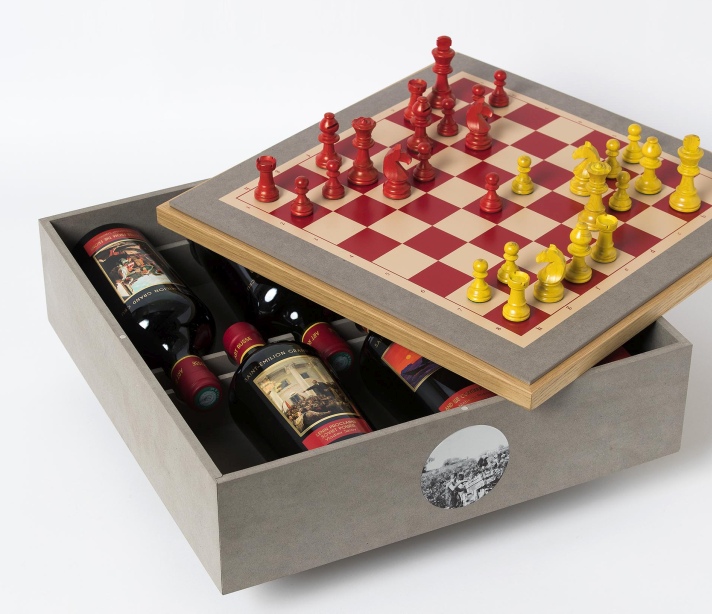
A wine-and-chess set ‘Chateau La Grace Dieu des Prieurs, Saint-Emilion Grand Cru, Art Russe Collection’ has become a special prize for the winner of the FIDE World Corporate Chess Championship. @art_russe_wine The special prize was established at the initiative of the Russian Chess Federation. Six bottles of the unique wine from Saint-Emilion, with Russian art on the labels, contained in a special-edition chess box with a set of chess pieces and a chessboard lid, will be shipped to Germany as the team of Grenke Bank (part of the Grenke Group, one of the leading players in the finance sector) became the winner of the Championship. Chateau La Grace Dieu des Prieurs is a winery in the Bordeaux region. The Chateau released its first wine-and-chess set in 2014. The Chateau winemaker Louis Mitjavile is one of the world’s top experts on Merlot, descending from a famous family of Bordeaux winemakers. The Chateau produces one wine a year. The bottles are decorated with reproductions of paintings by Russian artists of the 19th-20th centuries. A wine collection with 12 reproductions (plus one reproduction for the 1.5 l magnum) is released every year. All artworks reproduced on the wine labels are part of the collection of the Art Russe Foundation and are made available to Chateau La Grace Dieu des Prieurs under a cooperation agreement.
Day 2 Recap
Update! (Feb 21, 05:30 UTC) Pairings for 1st FIDE Online World Corporate Chess Championship Quarterfinals (Feb 21, 15:00 UTC): SBER – ERGSberbank Trade Union – Emphie SolutionsGrenke Bank – AnahuacMorgan Stanley (HUN) – PT Pelabuhan Tanjung Priok Those who like sensations are likely to be disappointed by the outcome in most of the Eastern pools, but the good thing about chess is that the strongest players have plenty of opportunities to prove their superiority, whereas some accidental results rarely change the course of events. East A The fight for first place ended already in Round 4 after SBER whitewashed RIVC-Pulkovo. In Rounds 5 and 6 SBER didn’t concede even a half-point to their rivals either, although in the final round Maria Komyagina, playing on the fourth board was down 3 (!) pawns in a rook endgame. The main favourite finished the group stage with a record score of 22½ out of 24. The RIVC-Pulkovo had bad luck with the draw as in any other pool this team would have been a strong candidate for first place and qualifying for playoffs. Final standings East B It all came down to the confrontation between Grenke Bank and Yandex in this pool. The teams advanced on parallel courses and eventually clashed in Round 5. Grenke Bank won by a minimal margin – Georg Meier held Yandex’s IT specialist Dmitry Jakovenko to a draw on the first board, while Alina Kashlinskaya and Hanna Marie Klek scored victories on the second and third boards secured a playoff berth for the German team. Yandex chess players were so upset by this defeat that they also lost the last round match. As a result, Samsung Electronics (POL) which stayed below the radar throughout the event finished second. A strong performance by VOZP (CZE) and Khareba (GEO) is also noteworthy. Final standings East C The battle for the top spot in East C resembled desperate attempts of the wind to topple a mountain by attacking it from different directions. The Morgan Stanley (HUN) team acted as this mountain. Every round one of the pursuers came close to the Hungarian financiers, but they were thrown back after head-to-head matches time and again. Anish Giri and his Optiver teammates made the final attempt to rob Morgan Stanley of the quarterfinal spot – unfortunately only the Dutch team’s leader managed to deliver in this battle. The Hungarian team won all their matches, claiming first place in the pool 2½ ahead of Gazprom (second place). Final standings East D In the East D pool, Sberbank Trade Union was unstoppable and deservedly took the qualification spot. The international squad of GM Anton Korobov (UKR), FM Evgenij Kretov (RUS), FM Fedor Myshakov (UKR), and WFM Elena Homyakova (BLR) won all the matches and dropped just 4½ game points on the way to the quarterfinals. The pool winners started eliminating their rivals on day one, crushing Paypal (BUL) and did not stop on day two, defeating Slav Group and Dassault Systemes. Final standings East E With just two rounds to go, it looked like CSOB (CZE) was bound to win the East E pool, given that the rating favourites BCG Gamma were not living up to expectations. CSOB topped the standings throughout the event up to the point of squaring off against ERG (KAZ) which obviously had another agenda. Originally seeded #3, the team headed by GM Anuar Ismagambetov started the tournament with a draw in the very first round but gradually gained momentum and crushed the leaders in the penultimate-round match. In Round 6, the Kazakhstani players consolidated their position by defeating Gordic 3:1, leaving CSOB 1½ game points behind. Final standings East F The East F pool turned into a race between the rating favourites Emphie Solutions (POL) and State Bank of Mongolia. The two teams faced off in Round 4 but did not determine the winner. GM Batchuluun Tsegmid on the first board and WFM Munkhzul Davaakhuu on board four won their games for the Mongolian team (they went on to win all their games in the tournament). The Polish team bounced back on boards two and three with the victory of rating underdog Wojciech Reza over IM Batkhuyag Munguntuul being especially valuable. Entering the final round, Emphie Solutions trailed State Bank of Mongolia by one point. Poles managed to make the most of their match, whitewashing Czech National Bank 4:0. State Bank of Mongolia had an arguably tougher opponent, RFSO Lokomotiv (RUS) headed by IM Polina Shuvalova. Putting a much weaker player on board two to score points on boards three and four was a strategy that worked well for the Mongolian team as long as IM Batkhuyag Munguntuul would sweep through the field on board three, but this did not work out in the end. The Mongolians conceded 1½ precious game points in the last round match (a defeat on board two and a draw on board three) and let Emphie Solutions leapfrog them by a mere half-point! Final standings West A After the main favourites of Pool West A Microsoft Redmond (USA) and Anahuac (MEX) drew their match in Round 3, it became clear that one mistake, made by one of the leaders in the encounters with less strong teams would be decisive. Unfortunately, Microsoft messed up not just a single game, but the entire match – in Round 5 the team lost to Goldman Sachs 1:3, with their leader Francesco Rambaldi simply leaving his queen en prize as a result of some kind of hallucination. After that defeat, it was all in the hands of the Mexican team. Anahuac did not miss this opportunity and punched the ticket into the playoff. Final standings West B Unlike West A, in West B the key match between the leaders American Express (USA) and PT Pelabuhan Tanjung Priok (INA) was played on the second day, in Round 4. Alas, it was a lopsided battle – the Indonesian team was much stronger. As a result, the fate of a spot in the quarterfinals was sealed with two rounds to go. The winners played some nice games, although Ali Muhammad Lutfi, the leader of PT Pelabuhan Tanjung Priok acted as a co-author in the most
Day 1 Recap
Day 1 in the Eastern pool of the FIDE Online World Corporate Championship is in the books. After three rounds of play, we have the potential candidates for first place in all six groups – only the teams taking the top spots advance play-off. Such a strict qualifying formula is applied due to an unprecedented number of teams taking part in the tournament. Indeed, 288 companies assembled squads for this competition. Team SBER, headed by one of the leaders of the Candidate Tournament Ian Nepominachtchi, is a heavy favourite not only in the group East A but also in the entire tournament. Although the Russian GM won all three games on the first board SBER is just second a half-point behind a “hell-raiser”, another Russian team RIVC-Pulkovo. The match between the leaders in Round 4 most likely will decide which team gets through to the next stage. Standings after Round 3 It was easy to predict that in the group East B Grenke Bank with Georg Meier and Alina Kashlinskaya and Yandex with GM Dmitry Yakovnko in the line-up (he actually works for the Russian IT-giant) would be the main contenders for the top spot. However, after two rounds two different teams – Khareba (Georgia) and VOZP (Czech Republic) – were in the lead. After the leaders drew their match in Round 3 the favourites caught up with them and now four squads are sharing first place with 10 points out of 12 each. It is almost certain that the ticket to the quarterfinals will go to one of the teams from this “magnificent four”. Standings after Round 3 East C saw the toughest competition in the Eastern pool. Whitewashing 4-0 defeats, so popular in other groups were very rare here. Only two teams, Morgan Stanley (HUN) and Gazprom managed to win all three matches. Their fourth-round clash is going to be crucial, although the Optiver team led by Anish Giri (who conceded a half in his first-round encounter with Nihal Sarin) and the Rosseti Volga have not yet said their last word in this pool. Standings after Round 3 Sberbank Trade Union has confirmed its status as a rating-favourite in East D. The team, led by Anton Korobov, played the key match in Round 2, beating the number two seed Paypal Bulgaria. Evgenij Kretov definitely deserved a bonus for the crucial victory over former world champion Antoaneta Stefanova. Although Sberbank Trade Union lost only one point in three rounds, it is way too early to relax – Israeli Slav Group with Ilya Smirin on the first board is hard on their heels. Their head-to-head match in Round 4 most likely will be decisive. Standings after Round 3 The East E bracket favourites, BCG Gamma headed by the sixth rated female player in the world Maria Muzychuk, and CSOB faced off in Round 3. The Czech team can’t boast of big names but relies on a very balanced lineup with titled players on all the boards. In this important match, CSOB scored a very important victory: IM Jiri Jirka prevailed over IM Daniel Schlecht whereas WGM Karolina Olsarova got the best of FM Marti Mayo. The leader is facing a new challenge in Round 4 – Tata Consultancy Services Chennai, whose 15-year-old grandmaster Praggnanandhaa has crushed his opponents so far. Standings after Round 3 Many thought that in the group East F we would see a race between the rating favourites Emphie Solutions and Alkaloid, but the Macedonian company, known for its support of chess (chess club Alkaloid was European champion!) suddenly stalled. Two points lost on the first board and one more on the fourth resulted in a 2½-point trailing behind the leader, almost a whole match distance! Emphie Solutions conceded only two points but still fell behind an unexpected leader, State Bank of Mongolia. GM Batchuluun Tsegmid and one of the strongest female players of Asia, IM Batkhuyag Munguntuul, inspired their less experienced teammates to put in the best effort. If State Bank of Mongolia beats Emphie Solutions in the fourth round, the former will almost certainly clinch a playoff berth. Standings after Round 3 When the Eastern pool participants were long asleep, two groups of Western Pool entered the competition. The average level of the teams in the Western Hemisphere is slightly lower, but even in these groups, several squads are headed by strong GMs and IMs. In West A, we will see a close battle for a single playoff berth until the last round. That became evident after a Round 3 match between two favourites Redmond (USA) and Anahuac (MEX) ended in a draw (2-2). As a result, Microsoft Redmond is leading by a minimal margin with 9½ points, followed by four teams with 9 points each – alongside Anahuac, Goldman Sachs (USA) and Telus (CAN), and Farber Group (CAN), led by FIDE Website and Social Media Manager Anna Burtasova won all their matches. Anna scored 3 out of 3 on her birthday, but in Round 2, she was really fortunate as her opponent forfeited on time in a roughly equal ending. Standings after Round 3 In the West B group American Express, headed by the hope of American women’s chess Carissa Yip, immediately grabbed the lead. Although Carissa suffered an unexpected defeat in Round 3, her teammates won all their games. American Express is leading after the first day with 11 points out of 12 but a coveted playoff spot is not guaranteed. The rating favourite West B of PT Pelabuhan Tanjung Priok (Indonesia) played the sidekick on the first day but with 10 points out of 12 (second place) the team led by two IMs still has a good chance to win the pool. In order to do that the Indonesians should defeat their main and probably the only rivals from American Express in Round 4. Standings after Round 3 Three more rounds will be played tonight. In Eastern pools, the participants will start at 15:00 UTC; in the Western Hemisphere, play is resumed at 01:30 UTC. We would like to encourage all participant companies, their employees, and chess fans in general, to support FIDE social projects Chess in Education, Chess for People with Disabilities and Chess for Vetarans
AAOIOCC 2021: Arab and African Chess Federations join forces

Based on the role of the Arab and African Chess Federations in exercising their missions: Raising the level of the Arab and African players Continuity of work to improve the game of chess Competitive activity and development of skills in practicing the game Communication between member players of the two regions Cooperation between the Arab Chess Federation and the African Chess Confederation It has been agreed to establish an open championship that brings together Arab and African players. Following the success of the Africa Online Individual Chess Championship (AOICC) 2021, the Arab Chess Federation and the Africa Chess Confederation partnered to stage the Arab-African Online Individual Open Chess Championships (AAOIOCC). The event will be held online on lichess.org from February 25-27 in four stages: Preliminary Stage (February 25) Men’s Semifinal (February 26) Women’s Final (February 26) Men’s Final (February 27) All the games are played with the time control of 3+2. All final-stage players will be monitored via the Zoom platform, so all finalists are required to enter the Zoom platform and share the camera, sound, and screen, and all participants must enter the Zoom meeting on the player’s name as it is registered on the FIDE website. And they must enter the Zoom link half an hour before the start of the championship. The championship is monitored by the arbiters, the Anti-cheating Committee, and the management of the championship. Regulations for the AAOIOCC 2021 (pdf)