

Vladimir Trkaljanov wins Gazprom Brilliancy Prize
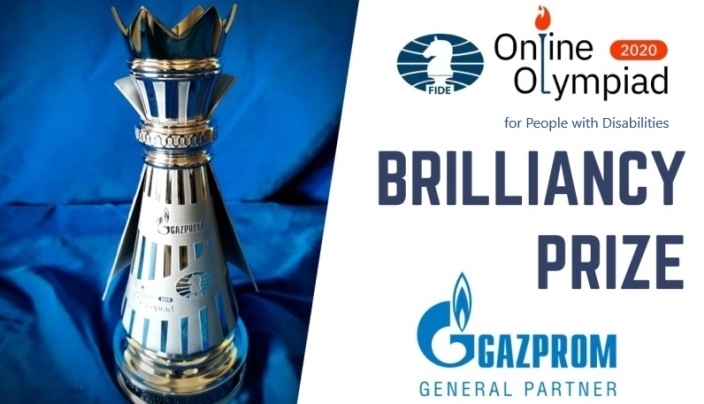
Vladimir Trkaljanov (North Macedonia) has been declared the winner of the Gazprom Brilliancy Prize for the best game played at the Online Chess Olympiad for people with Disabilities. Six out of thirteen judges gave their votes for his victory over Irina Ostry in the match North Macedonia – Kyrgyzstan. In a sharp line of the Sicilian, Vladimir sacrificed a rook, chased down the opponent’s king from e8 to g3, and delivered an elegant checkmate. Here you can find the game, analyzed by those judges who picked it as the winner: Daniel King (ENG): https://youtu.be/09kl7LEOiGc Bassem Amin (ENG): https://youtu.be/sRo0Vp6fFd0 Elisabeth Paehtz (ENG): https://youtu.be/IeqT1iLr1QM David Martinez (ESP): https://youtu.be/_la4mb4VTFw Michael Rahal (ESP): https://youtu.be/ynnMIdh9N24 Georgios Souleidis (GER): https://youtu.be/91BlqTslk_c
USA dominates medal tally
The final knockout stage of the FIDE World Cadets & Youth Rapid Championships came to the end on December 22. The event held on Tornelo online platform, comprised five different age groups (U10, U12, U14, U16, and U18) with participants competing in two sections: girls and open. The USA dominated medal tally earning 8 medals (4 gold); India won 4 medals (2 gold); Russia also took 4 medals, but somewhat surprisingly no gold (1 silver and 3 bronze). During the online closing ceremony conducted by Kema Goryaeva, the participants of the FIDE World Cadets & Youth Rapid Championships were greeted by FIDE Vice President Akaki Iashvili and FIDE Director General and former World Junior Champion (1996) Emil Sutovsky. Akaki Iashvili: “Youth chess is a priority of FIDE. On behalf of FIDE and the Georgian Chess Federation, I would like to welcome all the participants and congratulate the winners. They demonstrated exceptional skills. I am confident that this tournament will stand out in our minds for years.” Many participants sent video messages in which they shared holiday vibes and wished a happy New Year to all. Final standings: Open U10 1. Movahed Sina (IRI)2. Vaclav Finek (CZE)3. Rajkhowa Mrinmoy (IND) Movahed Sina Photo: https://medu.ir/ Girls U10 1. Omya Vidyarthi (USA)2. Elnaz Kaliakhmet (KAZ)3. Diana Preobrazhenskaya (RUS) Omya Vidyarthi Photo: https://news.harker.org/ Open U12 1. Dimitar Mardov (USA)2. Ihor Samunenkov (UKR)3. Ngo Bach (USA) Dimitar Mardov Photo: US Chess Federation Twitter Girls U12 1. Alice Lee (USA)2. Tang Zoey (USA)3. Valeria Kleymenova (RUS) Alice Lee Photo: US Chess Federation Facebook Open U14 1. Gukesh D (IND)2. Volodar Murzin (RUS)3. Christopher Woojin Yoo (USA) Gukesh D Photo: John Saunders Girls U14 1. Eline Roebers (NED)2. Zsoka Gaal (HUN)3. Laysa Latifah (INA) Eline Roebers Photo: Harry Gielen Open U16 1. Frederik Svane (GER)2. Agha Bala Amirreza Pour (IRI)3. Jose Gabriel Cardoso Cardoso (COL) Frederik Svane Photo: Skanderborg Skakklub Girls U16 1. Rakshitta Ravi (IND)2. Song Yuxin (CHN)3. Bibisara Assaubayeva (KAZ) Rakshitta Ravi Photo: Frans Peeters Open U18 1. Nihal Sarin (IND)2. Shant Sargsyan (ARM)3. Francesco Sonis (ITA) Nihal Sarin Photo: Kirill Merkuryev Girls U18 1. Carissa Yip (USA)2. Thalia Cervantes Landeiro (USA)3. Elizaveta Solozhenkina (RUS) Carissa Yip Photo: Lennart Ootes
British Online Championships get underway

The Caplin British Online Championships kicked off on the Chess.com platform. The event stretches over two weeks from 18th December 2020 to 3rd January 2021. The Championships are being run by the English Chess Federation in collaboration with the Welsh, Scottish, Irish, Ulster, Jersey, Guernsey, and Isle of Man Chess Federations/Unions. The British Online includes separate Championships – Open, Women’s, Junior, Senior, and Rating Limited. The format is based on one week of qualifier events followed by a week of finals for each Championship. Each Championship consists of a qualifier and finals stage with a number of separate events at four different time controls (Standard, Rapid, Blitz, and Bullet) as shown in the table below. Players may take part in one or more championships for which they are eligible (e.g. Open, Women’s, Junior, etc), and one or more events within their selected championship(s) (e.g. Standard, Rapid, Blitz, etc), subject to the entry conditions and playing schedule. All standard play events will be based on a game a day with 7 rounds of qualifiers and 9 rounds of finals each in Swiss format. Standard play games will be based on direct challenge matches on Chess.com, started by an arbiter. Faster time controls (Rapidplay, Blitz, and Bullet) will be run as platform Swiss tournaments. The Open tournament brought together 37 players (7 GMs). In the Women’s tournament 20 participants, including GM Ketavan Arakhamia-Grant, are vying for the title. Official website: https://www.englishchess.org.uk/british-online-chess-championships/
ChessTech 2020 goes big
Running parallel to the FIDE Congress was ChessTech2020, the online conference on chess and technology, which drew 526 registrations from more than 70 countries. Following a welcome to the two-day-meeting from Zurab Azmaiparashvili, President of ECU, the FIDE President Arkady Dvorkovich gave a keynote address Chess: Driving Technological Innovations in the 21st Century and answered a wide range of questions afterwards. The event, the 8th in the sequence of the London Chess Conferences, was directed by John Foley from ChessPlus Limited, a London-based training, and education company, with a programme developed by Stefan Löffler of ChesstechNews. FIDE was a foundation sponsor through its continental funding of the ECU. Commercial sponsors of the event included Tornelo, Chessable, DGT, LearningChess, ChessKid, ChessLang, SzuperChess, GameAhead Consulting, and ChessStars. The Zoom-based conference comprised 44 sessions with 122 contributors. The conference was very well received with an average satisfaction star rating of 4.3/5. According to the post-conference survey, the three most frequent descriptions of the conference were “interesting”, “informative” and “inspiring”. There were many memorable sessions. One of the most important topics was anti-cheating on which there were three in-depth sessions examining different perspectives. Many attendees were impressed by Chris Callahan’s overview of the free platform Lichess. The book presentations from David Smerdon (The Complete Chess Swindler) and Noam Manella (Think Like a Machine) provided deep insights into cognitive psychology. Daniel King’s honest account of how he built up his YouTube channel PowerPlayChess attracted many admirers. Another session on streaming chess gave advice from setting up Twitch to running a successful channel. The clear presentation by Shohreh Bayat and Judit Sztaray on online arbitration was praised by the arbiter community. Many chess teachers valued the presentations from a range of education companies including LearningChess, ChessKid, Chesser, AcornChess, and ChessLang. Chessable made a major announcement about the provision of free software to schools. The session on sponsorship was excellent. The gender issues from the previous conference were revisited in a lively international forum. There were three sessions on Erasmus projects: Castle, CGS, and 8by8; and one session featuring the European Research Council funded Digital Ludeme Project. There were several panels such as “Is Chess an Esport?” and “How to Make Chess Greener?” Many people praised the session on new formats for chess journalism. There was a competition for the best chess startup in 2020. This was won by Chessvision.ai by Pawel Kacprzak from Poland. Lecture by Dr. Alexey Root In addition to the above sessions in English, there were also segments of the conference conducted in French, Spanish, and German which were reported to be highly satisfactory. The conference also comprised a social networking “Chess Café” where it was possible to meet with other attendees in an informal atmosphere. For those who did not attend the conference, these are available in three categories. Some are available to the general public and are being released one-by-one with social media notifications. A second category is for those people who registered for the conference and may not have been able to get into some popular sessions. The third category is reserved for those with professional tickets. Access to categories two and three is available for a modest fee. Earlier conference report on ChessTechNews
Gawain Jones takes the title
On the final day of the European Online Blitz Championship, both semi-finals went to Armageddon: Gawain Jones (ENG) won over David Navara (CZE) while Alexei Shirov (ESP) beat Matthias Bluebaum (GER). In the final Jones convincingly defeated Shirov 2½:½. After losing the second game with white pieces (the first encounter was drawn) Alexei opted for a risky line in the third game but fell under a crushing attack. In the match for third place, Navara missed his chances in a won rook endgame that emerged in the first game and eventually lost. In the next two games, the German player scored 1½ points and took bronze. The medalists got trophies, medals, and invitations for the upcoming European Rapid & Blitz 2021, which will be held in Katowice, Poland. All the top-16 qualifiers got prizes. The players ranked from the 5th-8th place received a prize of €500 players from the 9th-16th place – a prize of €300, while the players ranked 17th-20th received the invitations for 2021. Special prizes were established for the best 3 female players: AntoanetaStefanova (BUL), Anna Sargsyan (ARM), and MonikaSocko (POL) received €200 each. Three best senior players – AvigdorBykhovsky (RUS), Igor Efimov (MNC), Leon Mazi (SLO) – and three best junior players – Bogdan-Daniel Deac (ROU), Kanan Garayev (AZE), and Nikolozi Kacharava (GEO) – are invited to the 2021 European Rapid & Blitz Chess Championship. A large number of spectators followed the live commentary in English by WGM Keti Tsatsalashvili, GM Marcin Tazbir, and WFM Maria Leks at the Polish national channel on Twitch TVP_Sports and the commentary in Polish provided by Infoszach. The organization of the championship was supported by the city of Katowice, the Ministry of Sport of the Republic of Poland, and Mokate. About Katowice: Katowice is one of the fastest-growing Polish cities which passed a deep restructuring in a short time. For the first time, the European Rapid Chess Championship in Katowice took place in 2017 and was certainly one of the greatest events in the history of the European Chess Union. The great organization of the competition back in 2017 made it possible for Katowice to receive the right to host the participants of the European Rapid Chess Championships in 2020 and 2021. Official website: https://www.katowice2020.eu/ Email: office@katowice2020.eu Social media: Facebook / Twitch
#21
Belgian Chess Federation turns 100 Field announced for Wijk aan Zee and Gibraltar WGP ‘Nepo’and Goryachkina, 2020 Russian Champions Brief news from National Federations ChessTech Conference 2020 Anniversaries READ NEWSLETTER
Kazhgaleyev and Abdumalik win Kazakhstan Cup 2020
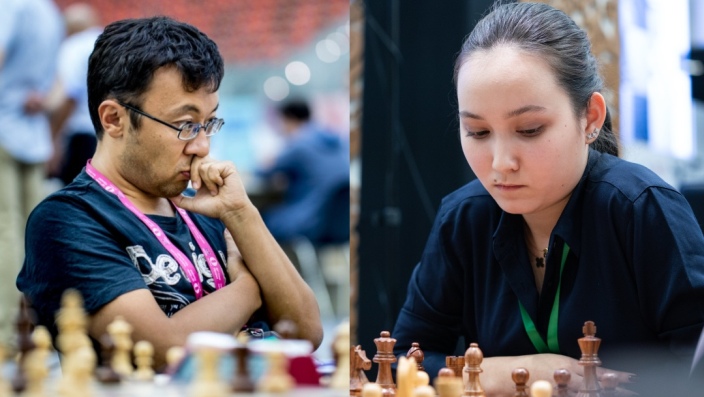
Murtas Kazhgaleyev and Zhansaya Abdumalik won the 2020 Kazakhstan Championship in the open and women sections. Both championships were round robins that brought together the best Kazakhstani players. Murtas turned in a very solid performance in the open competition scoring 7½ out of 11 points. The champion lost just one game but compensated for it with five victories and finished a half-point ahead of Aslan Aitbayev. It is the third national title in Kazhgaleyev’s career. Aitbayev had a very good tournament as well – after reeling off three straight victories at the finish he took silver. The highest-rated participant of the event Rinat Jumabayev ended up in the third position. Photo: David Llada Final standings open: 1. GM Murtas Kazhgaleyev (2569) – 7½2. IM Aslan Aitbayev (2457) – 73. GM Rinat Jumabayev (2654) – 6½4. GM Petr Kostenko (2429) – 5½5. FM Ramazan Zhalmakhanov (2393) – 5½6. GM Anuar Ismagambetov (2528) – 5½7. IM Agmanov Zhandos (2407) – 58. Azamat Utegaliyev (2496) – 59. GM Rustam Khusnutdinov (2491) – 510. IM Ayan Akhmetov (2438) – 511. IM Denis Makhnev (2486) – 512. GM Nurlan Ibrayev (2395) – 3½ In the women’s tournament, the excitement was there until the final moves. In the penultimate round, IM Guliskhan Nakhbayeva defeated Abdumalik and gained a half-point lead going into the last round. However, on the final day, the leader lost to WFM Amina Kairbekova, while Abdumalik showed her mettle (it is not for nothing that boxing is her hobby!), won over Laura Abdildayeva, and leapfrogged Nakhbayeva to claim the title. Nakhbayeva finished second, Kairbekova took bronze. Final standings women: 1. IM Zhansaya Abdumalik (2478) – 72. IM Guliskhan Nakhbayeva (2328) – 6½3. WFM Amina Kairbekova (2065) – 54. Liya Kurmangaliyeva (1974) – 55. WIM Assel Serikbay (2247) – 4½6. WGM Gulmira Dauletova (2319) – 4½7. WFM Xeniya Balabayeva (2146) – 4½8. WFM Meruert Kamalidenova (2231) – 3½9. WFM Alua Nurmanova (2026) – 2½10. Laura Abdildayeva (1845) – 2
Top-16 playoff: Day 2 recap
The Round of 16 and Quarterfinals were played on the second day of the European Online Blitz Chess Championship. The pairing was determined by the final standings in the qualifying stage. The participants battled it out in four-game matches with the time control 3’+2” followed by an Armageddon if needed. The Round of 16 saw many tightly contested matches. Georg Meier (GER) (pictured below) advanced to the next stage after winning a very tense Armageddon game against Radoslaw Wojtaszek (POL) (3:2). Alexei Shirov (ESP) eliminated Mikhail Demidov (RUS) (3:2), whereas Levan Pantsulaia (GEO) beat Mustafa Yilmaz (TUR) (3:2). In the Armenian derby between Manuel Petrosyan and Robert Hovhannisyan, the former also prevailed in the Armageddon game (3:2). Photo: John Saunders Aleksandar Indjic (SRB) secured his slot at the Quarterfinals after winning 3 games in a row against Deniz Ozen (TUR), the only IM at this stage. Matthias Bluebaum (GER) took down Vladimir Onischuk (UKR) (2½:1½). David Navara (CZE) (pictured below), a member of the Wasko HETMAN GKS Katowice, bested Eltaj Safarli (AZB) (3:1), while Gawain Jones (ENG) knocked out Deac Bogdan Daniel (ROU) (2½:1½). Photo: Niki Riga In the Quarterfinals, David Navara, Gawain Jones, Alexei Shirov, and Matthias Bluebaum prevailed over Levan Pantsulaia, Manuel Petrosyan, Georg Meier, and Aleksandar Indjic respectively, and progressed to the semis. The semi-finals and final are played today (20th Dec); Alexei Shirov takes on Matthias Bluebaum while David Navara squares off with Gawain Jones. The spectators can follow the games live with English commentary provided by WGM Keti Tsatsalashvili, GM Marcin Tazbir, and WFM Maria Leks and Polish commentary provided by Infoszach. For more information please contact office@katowice2020.eu Official website: https://www.katowice2020.eu/Social media : Facebook / Twitch #katowice2020
Royal Belgian Chess Federation – 100th anniversary
Chess tradition in Belgium started long before the creation of the national chess association. Like all the major cities, Brussels already had a chess café in the 19th century, the Café de l’Europe, which housed a chess club in 1815, and the chess enthusiast will have analyzed the games played during the several tournaments of Ostend at the beginning of the 20th century. Roughly a hundred years ago, on 17 December 1920, representatives of the leading clubs in the country, namely from Antwerp, Ghent, Liège, and Brussels gathered in the ‘Cercle des Échecs Bruxelles’ for a special occasion. They signed the statute establishing the Belgian Chess Federation! The first secretary of the newly born chess federation, Edmond Lancel, would later publish the famous Belgian chess magazine ‘L’Échiquier’ with regular contributions from Alekhine, Réti, and Tartakower (1925–1939). The foundation of the Belgian Chess Federation in 1920 also proved beneficial for the inception of FIDE four years later. The Belgian representative Léon Weltjens became a co-signatory of the FIDE Statute in Paris in 1924, and the Belgian chess champion, Edgard Colle, impressed with a third place in the first amateur world championship. Colle (right) against Alekhine in 1925 Photo: Agence de presse Meurisse – Bibliothèque nationale de France Colle would also become a regular fixture in international professional tournaments, but his premature death in 1932 prevented him from putting Belgium among the leading chess nations in Europe. Belgian chess history has been characterized by three main aspects: First, our enormous flexibility and adaptability. In our small country, the political situation has never been simple and when the country was split into three language communities in 1970, this naturally also had an impact on chess. Three regional federations were founded under the national federation, each of which must abide by regional rules and decisions. Chess is for example only recognized as a sport in the German-speaking community, not in the other ones and, for some years now, the Ministry of Education in the French-speaking community has allocated a considerable amount of money to the development of chess in schools, but again, not the Ministries of Education in the other communities. Difficult, of course, to plan a national policy under those circumstances. Secondly, our entrepreneurial spirit. It is no surprise that Belgians are keen to make an international contribution, such as Willy Iclicki (Chief Operating Officer at FIDE), Patrick Van Hoolandt (president of the A.I.D.E.F., the international French-speaking chess association) and other Belgians who promote chess in the various commissions of FIDE and ECU. And what about other Belgian ‘products’: Houdini, the chess program, and Thinkers Publishing, one of the best chess editors in the world. Is it therefore a surprise that – even without having real top players – we also manage to organize big tournaments: Spa 1926, Liège 1930, Antwerp 1932 and Ostend, again, in 1936–1937? In the less distant past, the top elite in chess came to play in the Lost Boys (Antwerp), the Swift tournaments (Brussels), and the Grand Chess Tour (Leuven). And even the youth can play in ideal conditions: the organizers of the Belgian Youth Chess Champions make use of about 120 electronic chess boards. Our Burgundian lifestyle is certainly a third element that reflects in our world of chess. The habit of offering something to drink before a game (and more than one drink after it) is something that surprises players coming from abroad. And our tournaments are not only for chess lovers but also for life lovers. Why not play the tournament of Ghent during the festivities in the city, or Bruges with its beautiful decor, or Charleroi with its relaxed atmosphere? Brasschaat offers its conviviality and Liège its warm hospitality. Is it our lifestyle that made a lot of players settle in Belgium? Victor Soultanbeieff and Georges Lalevitch, the unfortunate Akiba Rubinstein, and later, top trainer Vladimir Chuchelov and Michail Gurevich came to Belgium and even Magnus Carlsen went to an international school in Belgium when he was 7. Did he develop some necessary skills to become World Champion here? Our contribution at the chessboard may not be underestimated either: we mentioned Colle already, who gave his name to a rock-solid opening, and Jadoul gave his name to a variation in the Scandinavian, but Belgians are also known for their problemists. And did you know we even have a world champion? Indeed, in 2017 Daniel Dardha (pictured below)has become the U14 world champion blitz, and two years later, he even became the youngest national champion at the age of 13 years… Photo: Gazet van Antwerpen (gva.be) In short, the Belgian chess federation is 100 years old, but still alive and kicking. Text: Philippe Vukojevic, RBCF Board Member
Qualifying stage – Day 1 recap
The European Online Blitz Chess Championship 2020 started with the welcoming words from the President of the European Chess Union Zurab Azmaiparashvili. 353 players from 40 European federations, including 134 Grandmasters and 100 International Masters, took part in the first qualifying stage. The 11-round Swiss tournament with time control 3+2 kicked off at 6 pm CET. The best 16 players (after the anti-cheating check is completed) qualify for the play-off which will take place today (19th Dec), starting at 8 pm CET. Five players scored 9 out of 11 points: Radoslaw Wojtaszek (POL) (pictured below), Robert Hovhannisyan (ARM), Levan Pantsulaia (GEO), Vladimir Onischuk (UKR), and Aleksandar Indjic (SRB). Photo: PAP/Andrzej Grygiel David Navara (CZE), GM Gawain Jones (ENG), Mikhail Demidov (RUS), Alexei Shirov (ESP), Bogdan-Daniel Deac (ROU), Eltaj Safarli (AZE) netted 8½ points each, followed by Deniz Ozen (TUR), Matthias Bluebaum (GER), Mustafa Yilmaz (TUR), Manuel Petrosyan (ARM) and Georg Meier (GER) with 8 points out of 11. Antoaneta Stefanova (BUL) (pictured below) scored 7 points and showed the best result among female players. She is followed by Anna Sargsyan (ARM) – 6 ½ points and Monika Socko (POL) with 6 points. Photo: David Llada Apart from the women prizes (200 EUR each), special prizes are established for the three best senior players and boys and girls U18 and U20. Among the seniors, the best player is Avigdor Bykhovsky (RUS) with 5 ½ points, followed by Igor Efimov (MNC) and Leon Mazi (SLO) – with 5 points. All three received an invitation for the OTB European Rapid & Blitz Chess Championship 2021. In the junior category, Bogdan-Daniel Deac (ROU), Kanan Garayev (AZE), IM Nikolozi Kacharava (GEO), and Anna Sargsyan (ARM) secured their invitations to 2021. Chess enthusiasts and the chess community have an opportunity to follow the games live with English commentary provided by WGM Keti Tsatsalashvili, GM Marcin Tazo, and WFM Maria Leks and Polish commentary provided by Infoszach. The organization of the championship is supported by the city of Katowice, the Ministry of Sport of the Republic of Poland, and Mokate. For more information please contact office@katowice2020.eu Official website: https://www.katowice2020.eu/Social media : Facebook / Twitch #katowice2020 Text: Bojana Bejatovic FIDE Fair Play Commission ACP Board Member & Social media manager