

FIDE Online General Assembly 2020: Final List of Delegates

FIDE is publishing the final list of the delegates for the FIDE Online General Assembly. FINAL LIST OF DELEGATES (pdf)
Where there’s a will, there’s a way
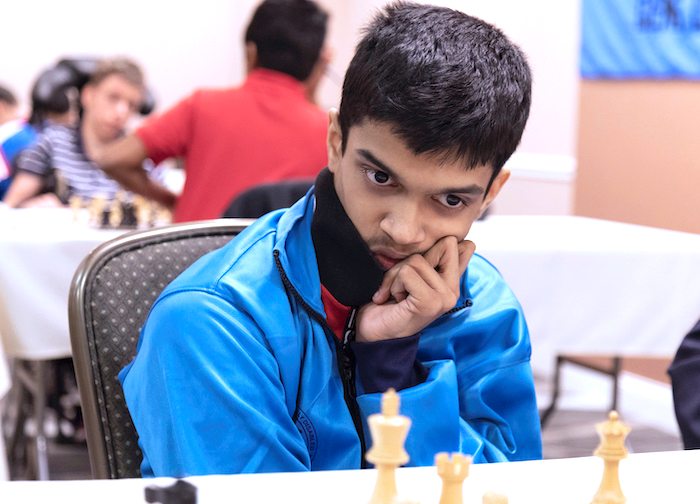
In conversation with CM Samarth J Rao and his father, Jagadish Rao Basrur Shankar Written by Dora Martinez (dora@lensethics.org)Contributor: Seçkin SerpilPhoto courtesy of Jagadish Rao There is a way. We can plan out our lives as much as we’d like but, life more often than not, alters our path. As a parent of a son with a disability, I know what it means to push against the current, to not conform, to fight against the place society wants to carve out for people with disabilities. How do we create a path that honors us? In this edition, we connect again via Zoom and have a conversation with Samarth and his father Jagadish. When Samarth was a young boy, his mother saw that he was left out from playing on the school’s playground and introduced him to chess. This introduction to chess changed everything for Samarth. Samarth, you’ve had many challenges but, this has not stopped you from setting goals and trying to achieve them. How do you overcome wins and losses on and off the board? If I have a challenge against a player, I want to win. I am not worried about the loss because I see this as a challenge to try to win again. Whether I win, lose or draw, this is not a concern, it is yet another challenge to try to overcome and stay focused on my goals. Samarth is representing India in the Online Chess Olympiad for People with Disabilities. What do you think about playing in this event? This event is a good opportunity for players with physical disabilities because this allows them to play from home, which is more comfortable. Samarth doesn’t require assistance and does not use adaptive devices, just a normal laptop. How did you prepare for this event? He is taking lessons from several chess coaches, Mr. Ajith M P of Mysuru and team coach, Mr. Durgaprasad V. He has improved a lot because of this. Samarth also played in a practice match with WIM Jennitha Anto K from India, a 6-time World Champion in IPCA and he won this practice game against her. This made him very happy. Samarth, you are 21 years old now. How old were you when you played in your first chess tournament? What is it about chess that motivates you to continue? I played in my first chess tournament at 13 years. I want chess to be my career and one of my goals is to become a GM like Anand, this motivates me. I was very happy to be honored by Anand in Chennai and my favorite Anand game is one he played against Kasparov. Anand and Samarth Samarth is also studying in university. How are his studies going? Samarth has been focusing on chess and his university studies. He is very active! He is in his final year and will earn a Bachelor’s Degree in Commerce. What has been the most rewarding experience in your chess career? Visiting the USA for the first time for the World Junior Chess Championship for Players with Disabilities and earning a medal made me very happy. How do you pick the tournaments you want to play in? Right now, due to the pandemic, he is playing a lot of online games. Taking this opportunity to expand his knowledge in chess with high rated players, maximizing his time and focusing on chess only. He studies and plays chess 12-13 hours a day. Do you prefer chess online or in person? In person, over the board. Who is your favorite chessplayer, living or in history? I love Fischer because he is an attacking player. As Samarth’s father, you have always believed in him, always supported him. What words of encouragement and motivation do you tell Samarth right before his games? I tell him to do his best. Don’t worry about your opponent’s rating. You play your game only. Everyone makes mistakes. If they make a mistake, take advantage of that, punish the mistake and then you can win the match. He has taken this advice and I think this is why he is at this level. I am happy and very proud of him. Samarth is unable to stand or walk independently and you assist him in every way you can. Having dedicated and supportive parents is very important. What is the most challenging thing about parenting? Where there’s a will, there’s a way! I have the will to do something about Samarth, so I took this as a challenge for me. I travel with him everywhere and as far as possible. At some point, I won’t be able to carry him because of my age. While I have the strength to hold and carry him, I will try to support him as much as possible in his goal of becoming a GM. He wanted to win the World Junior Championship for Players with Disabilities in New Jersey, USA but, because of a slight mistake in his game against Ilia Lipilin from Russia, he missed this opportunity. You’ve traveled to many countries, which is your favorite? USA and Czech Republic. What do you look forward to the most once this pandemic is over? I want to play online and offline as much as possible and start to play in over the board tournaments so that I can increase my rating to over 2000. I want my rating to be over 2000 because in the next Chess Olympiad for People with Disabilities, a goal I have set for myself is to be in India Team 1. Also, I would like to go back to the USA so if you organize a World Youth Championship for Under 25, I can take on this challenge and try to win a tournament in the USA. You are a big inspiration Samarth. Anything you’d like to say to people who might have a difficult time achieving their goals? Anybody can achieve anything! Wishing you the very best Samarth! Until next time…play on!
Russian Championships Superfinals kick off in Moscow
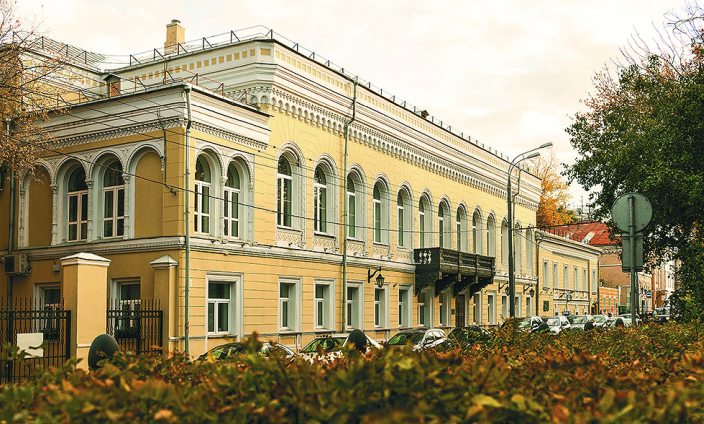
The Superfinals of the 73rd Russian championship and the 70th Russian women’s championship are held from the 4th of December (arrival) to the 17th of December (departure) in the Central Chess Club in Moscow. The tournaments are a part of the Chess in Museums program, which has been carried out by the Chess Federation of Russia and the Elena and Gennady Foundation since 2012. The main event of the Russian chess calendar features stellar lineups. Men: Ian Nepomniachtchi (2784), Sergey Karjakin (2752), Peter Svidler (2723), Nikita Vitiugov (2720), Vladislav Artemiev (2711), Daniil Dubov (2702), Maxim Matlakov (2698), Andrey Esipenko (2686), Vladimir Fedoseev (2674), Maksim Chigaev (2619), Mikhail Antipov (2611), and Aleksey Goganov (2594). Ian Nepomniachtchi Photo: Maria Emelianova Women: Aleksandra Goryachkina (2593), Alina Kashlinskaya (2494), Natalija Pogonina (2474), Alexandra Kosteniuk (2471), Olga Girya (2464), Polina Shuvalova (2456), Valentina Gunina (2451), Alisa Galliamova (2438), Marina Guseva (2359), Leya Garifullina (2348), Tatyana Getman (2302), and Yulia Grigorieva (2290). Aleksandra Goryachkina Photo: David Llada The events are 11-round all-play-all tournaments. The playing days are December 5-10 and 12-16. December 11 is a rest day. All rounds begin at 3 PM (Moscow time). In case of a tie for 1st place by two or more participants, an additional rapid tiebreak is played to determine the winner. The total prize fund of the event is 10 million rubles (approximately $133,000). The organizers are the Chess Federation of Russia (CFR)and the Timchenko Foundation. The tournaments are supported by the Russian Ministry of Sports. The general sponsor of the Russian national teams is the Federal Grid Company Unified Energy System (FGC UES). The CFR general partner is PhosAgro.
Vachier-Lagrave beats Aronian in close quarterfinal match
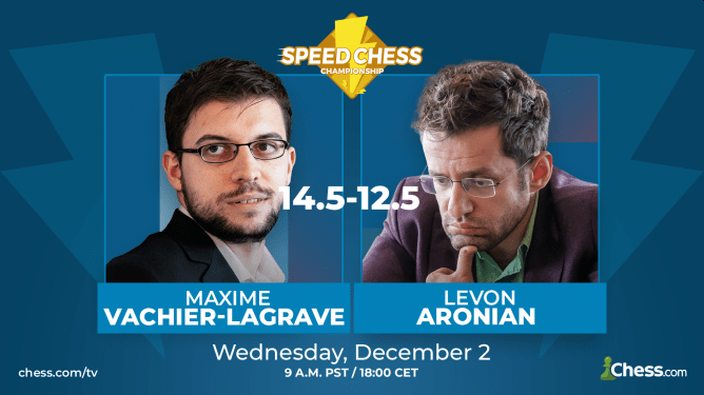
GM Maxime Vachier-Lagrave (@Lyonbeast) defeated GM Levon Aronian (@LevonAronian) 14.5-12.5 in Wednesday’s quarterfinal of the Speed Chess Championship. The next match is Magnus Carlsen vs. Vladislav Artemiev on December 3 at 5 a.m. Pacific / 14:00 CET. Aronian and Vachier-Lagrave had played many times before but never in a Speed Chess Championship. In faster time controls, the Frenchman had a 20-9 plus score with 21 draws in over-the-board chess. He was the slight favorite and lived up to the expectations, but the match was really close. The match started with a draw, but not without one big moment that must have woken up both players if they weren’t fully awake just yet. Somewhere in the endgame, Vachier-Lagrave dropped his rook on a forbidden square but both players noticed it too late. Aronian, after the match: “The first game was of course a highlight. Maxime played a move that I would play, 30.Rc7, and then I didn’t take it through!” It was the French GM who took the early lead in game two after Aronian had surprisingly started the game with 1.b3. “It was not a good idea but I thought it was good to mix it up in blitz,” Aronian would later say. While he was piling up his pieces towards the black king, Maxime defended everything and let his c-pawn become the hero of the game. After three draws, Aronian leveled the score with a fine, positional game against Vachier-Lagrave’s Sicilian. The Frenchman did win the five-minute segment as he won the last game in that time control as Black. Vachier-Lagrave increased his lead to three points early in the three-minute portion. His 29.Nxe5+ in the third game (game 11 of the match) was impressive. However, before the bullet, the score was equal again as Aronian had a great comeback. He won his last three white games at the 3+1 time control. Vachier-Lagrave took a two-point lead straight away early in the bullet session and Aronian never managed to tie anymore. In the penultimate game, Aronian missed a huge chance to decrease the margin to just one point, thereby keeping hopes for a playoff. Instead, he lost the game and the match as the match clock allowed for just one more game. Aronian said afterward: “Generally I thought that I was playing slowly out of the gates and that proved to be a decisive factor in the bullet. But I thought it was a close match, it was fun.” “I thought I should be the favorite in bullet, clearly, but at the same time, I saw that Levon played extremely well in the bullet portion against Ian [Nepomniachtchi], said Vachier-Lagrave. The 2020 Speed Chess Championship Main Event is a knockout tournament among 16 of the best grandmasters in the world who will play for a $100,000 prize fund, double the amount of last year. The tournament runs from November 1 to December 13, 2020 on Chess.com. Each individual match will feature 90 minutes of 5+1 blitz, 60 minutes of 3+1 blitz, and 30 minutes of 1+1 bullet chess. Text: Peter Doggers (chess.com)
Poland wins the first Chess Olympiad for the Disabled
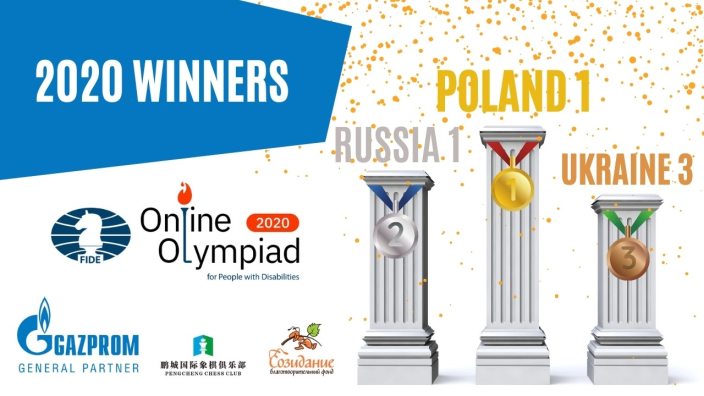
As the world celebrates the International Day of Persons with Disabilities, the first-ever Online Chess Olympiad for players with disabilities came to an end with the victory of Poland, over a field of 61 teams from 45 different countries. The final between Poland and Russia was a thrilling affair, since the Russian squad won the first round by 2½:1½ (two victories, one draw, and one defeat). However, the Polish players bounced back and, on the second day of play, they pulled off a brilliant victory by 3-1 (three victories, one loss) that turned the tables in their favor. GM Marcin Tazbir (pictured below) set the right tone by defeating Stanislav Babarykin on the first board after the Russian FM made a grave mistake in a roughly equal position. Marcin Molenda did his part on board 2 by gradually outplaying Marina Kaydanovich. Photo: Robert Pawlikowski Russia retaliated on board 3 as Alexey Smirnov crushed FM Lukasz Nowak after his opponent snatched a poisoned rook and scored a very important point. A real drama unfolded on board 4 where Denis Palin obtained an overwhelming position in his game Anna Stolarczyk. A victory would have secured Russia 1 the champion title but it was not meant to be. After missing several winning opportunities the Russian player pushed too far in a roughly equal position and suffered a debacle. “We knew that we had already secured the silver medal by reaching the final, so I believe that allowed us to shake off the pressure a little bit, and focus on fighting for the gold”, explains Marcin Tazbir, who defends the first board for Poland. “After losing the first match, we knew that we would need to win the second for at least 3-1. Achieving such a result against a very strong team like Russia is really difficult, but we managed to do it. Luck was on our side, to a certain extent, but I believe it was a deserved victory. I am really proud of our team and would also like to thank all participants, and especially, our team captain Michał Bartel, who was really supportive during the whole event.” “I really appreciate that FIDE has managed to organize this event for disabled players even despite the added difficulties caused by the pandemic. This Olympiad allowed many people with disabilities to feel and enjoy the atmosphere of a big sporting event”, added Marcin. There were two interesting guests in the virtual studio on the final day of the competition. European snowboard Champion Alena Alekhina recounted how she went through a difficult period of her life caused by a terrible injury back in 2013. FIDE Executive Director Victor Bologan told how FIDE had adjusted to challenging times and elaborated on the prospect of chess to be included in the Olympic program. In a duel for third place, Ukraine 3 beat Poland 3 again this time by a score of 3-1 and took bronze. Final standings: 1. Poland 12. Russia 13. Ukraine 3
The Color of Darkness is White

In conversation with Dr. Kerim Altinok and Dr. Selim Altinok Written by Dora Martinez (dora@lensethics.org)Contributor: Seçkin SerpilPhotos courtesy of Kerim and Selim Altinok Where would the color of darkness fall on Sir Isaac Newton’s color wheel? Color does not exist outside of our minds and our perception of color is certainly personal and subjective, usually shaped by our experience and even culture. But, what if — we lost our sight? I spent most of my childhood seeing from the perspective of a child whose mother had lost her vision, interpreting my world through light, shadows, whites, greys, hues, and contrasts. The loss of vision was not my own but, that didn’t matter — in my young mind, even smells were assigned a color. Creative people like to challenge the status quo, we don’t accept the hand we are dealt. Instead, we carve a path for ourselves, shaping the world around us, one move at a time. Meet Dr. Kerim Altinok and Dr. Selim Altinok, they are identical twins, doctors, musicians, writers, lawyers, and yes…chessplayers. Kerim and Selim are both participating in the first FIDE Online Chess Olympiad for People with Disabilities as part of a team from Turkey. We sat down for a chat, much in the same way we are all communicating during the pandemic — with a Zoom call. When did you both start to play chess? We started playing chess when we were 14 years old. During a visit to our grandparents’ home, we saw a wooden chess set and we were drawn to it. Our grandfather taught us how to play and gave us a chess book. After learning and playing for 6 months, we won against our grandfather and after that, he never won again. What do you think about playing in the first Online Chess Olympiad for People with Disabilities? We are excited to participate in this tournament. Especially because there are many strong young players. We have been playing online for a very long time and have even created a guide for players with visual impairments on how to use the accessibility features on LiChess which is on YouTube. Playing independently is very important for us but, for this tournament, we have to play with the help of an assistant. This is not so ideal because we have to say our move, wait for the assistant and this is not so good for concentration. We hope that for the next online Chess Olympiad for People with Disabilities, Tornelo’s platform will be accessible for people with a total loss of vision. Other than that, we are very happy to be participating in the event. You lost your vision completely at the age of 18. At that time, you had already been playing chess for 4 years. Having lost your vision gradually, did this in a way give you some time to figure out how to adapt to the changes that were coming? What were the challenges you faced in securing chess equipment as players with a visual impairment? At 14, we started to play chess on a normal board. As our vision worsened, we tried to play chess near the window to use the natural light. Before we lost our vision completely, there was no internet, so we found a carpenter that could make a chessboard and pieces the way we wanted. This board was not so practical because it was so big. Now, we have boards that are more practical and easier to travel with. The carpenter that made the chessboard for us was blind. He has since passed away but, we have the board he made for us and he lives in our mind. How has chess impacted your life? Like art and mathematics, chess is like a mirror of life. In life and chess, you might have a hopeless position but, it can be changed. With chess, you can change the situation because in another game, with a good fight, you might change the result. If chess is like life, how do you overcome wins and losses on and off the board? After a long chess game, losing the game is not easy. But, we know that our worst games teach us a lot of things, much more than our wins. If I lose a game, I feel happy if there is a good position because I played my best. Art can be therapeutic when dealing with the challenges in our lives. I think chess has the power to do the same. Does chess provide that for you? There are similarities between life and chess. But, life is stronger than chess and can be a heavy burden. If I want to leave my home, there are many obstacles. When life gets challenging, playing chess provides some release from the challenges because it requires deep concentration. You are lawyers and you advocate for the rights of people with disabilities. Can you give us an example of the work you’ve done in this field? Making laws is good but, without education, laws are not enough. For us, education is more important because sometimes laws are not enforced. We focus on education because education has the power to touch people, and laws don’t always touch people. Our work in education is very important to us. We have written a chess guide in braille and have created many audio chess books for the visually impaired. We would like to make these books accessible to as many visually impaired people as possible. In addition to the chess books we have written, we have also written an autobiography called, “The Color of Darkness is White”. How did you come up with the title for your autobiography? We had many talks about what the title should be. We decided on this name because when people think of darkness, the color that comes to mind is black. But, if we accept that darkness is black, we accept a hopeless situation. When we say that the color of darkness is white, this is our perspective
Nigel Short to visit Vanuatu in 2021
Have you ever dreamed of playing chess face to face against a Grandmaster? Nigel Short, the best British chess player of all time, is visiting Vanuatu in 2021 (exact dates to be confirmed), as part of a wider tour to promote chess in Polynesia. Twenty chess fans from the island will have the unique opportunity to play against him. Nigel will take on all opponents at once, board to board, move by move, in what is called “a simul exhibition”. This event is sponsored by the International Chess Federation (FIDE), and participation is completely FREE. The seats will be assigned by strict order of registration. If you want to take part, just send us an email to office@fide.com with the word “VANUATU” in the subject line. Please tell us in the email what is your full name, age, and sex, since there is a minimum of seats reserved for juniors and girls. It is convenient if you also include a phone number, so we can reach out to you once the exact dates and venue are confirmed. Nigel Short is a Vice-President of FIDE. A former chess prodigy, he was ranked third in the world, and in 1993 he defeated Anatoly Karpov to become the first English player to play a World Chess Championship match. He was defeated by Garry Kasparov in the final. During his stay in Vanuatu Nigel will also host a roundtable where he will answer questions from the media and local chess fans. This is your chance to ask a Grandmaster how does it feel to play for the world championship title in chess, one of the longest and most prestigious traditions in the world of sports.
Wesley So wins Skilling Open
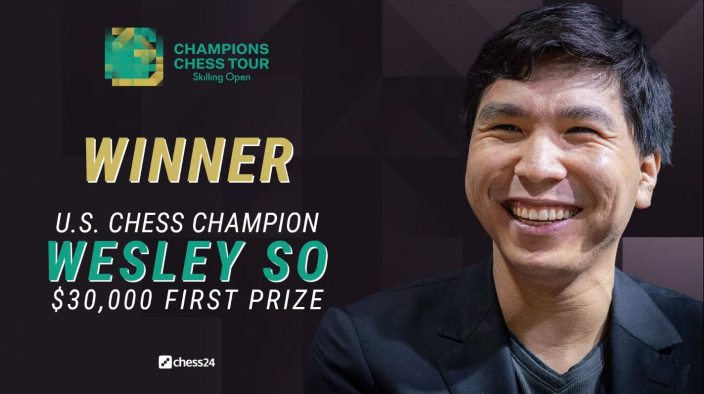
“I have to apologize to Magnus for semi-ruining his birthday!” said Wesley So after winning a blitz playoff to clinch 1st place and the $30,000 top prize in the Skilling Open, the first event on the $1.5 million Champions Chess Tour. The World Champion’s 30th birthday seemed to be going perfectly when he won the 1st game of the day with the black pieces, but Wesley hit back in Game 2 and survived a wild 3rd game. Magnus repeated his World Championship match trick of taking a quick draw to reach a playoff, but for once he fell short. Wesley So did what no-one had managed in a final of the Magnus Carlsen Chess Tour and thwarted the World Champion. Not only that, Wesley had done it the hard way, coming from behind against Teimour Radjabov in the semi-final and then beating the 2nd favorite, Hikaru Nakamura, in the semifinals. That means Wesley So now leads the $1.5 million Champions Chess Tour with 46 points (40 for winning the final and 6 for finishing 3rd in the preliminary stage). Magnus gets 30 points (20 for finishing 2nd and 10 for winning the prelims). Here are the full standings: The next event on the tour is the first major, where everything is doubled – the prize fund is a $200,000 prize fund, with up to 100 points available to each player. That starts on December 26th, with So, Carlsen, Nakamura, Nepomniachtchi, Aronian, Radjabov, Vachier-Lagrave, and Giri already qualified for finishing in the Top 8 in the prelims. They’ll be joined by David Anton, who was voted back in, and three more players, to be announced in the coming weeks. Text and photo: chess.24.com
Jukšta and Baginskaitė claim 2020 Lithuanian Championship titles
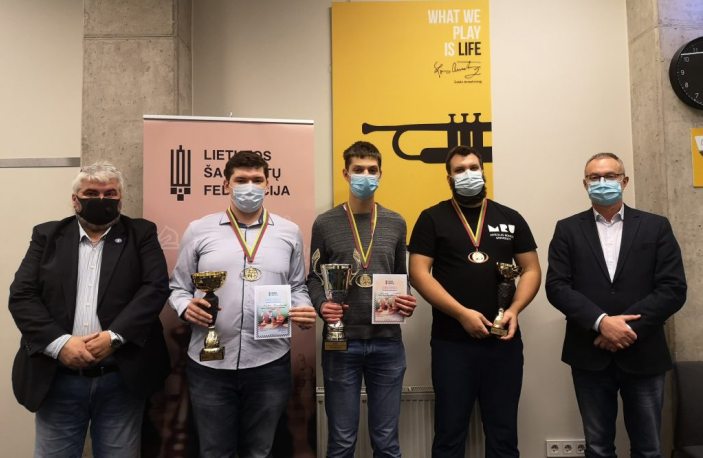
Karolis Jukšta and Kamilė Baginskaitė became the 2020 Lithuanian Champions. In the open section, 10 players competed for the title in a round-robin tournament. As the tournament fate had it two leaders Karolis Jukšta and Tomas Laurusas having equal amounts of points met in the final round. Jukšta won this crucial encounter and came out on top, whereas his opponent was thrown back to third place. Valery Kazakouski claimed silver despite having a poor start in the tournament. It is worth mentioning that 17-year old Jukšta became the second-youngest winner of the Lithuanian championship. The record still belongs to GM Viktorija Čmilyte-Nielsen, who triumphed in the Lithuanian Chess Championship for the first time in 2000, when she was 16 years, 7 months, and 28 days old. Final standings open: 1. Karolis Jukšta (2389) – 72. Valery Kazakouski (2473) – 63. Thomas Laurus (2506) – 64. Eduardas Rozentalis (2538) – 5.55. Paulius Pultinevičius (2512) – 56. Vidmantas Mališauskas (2410) – 5 In the women’s section, a five-round Swiss tournament brought together 12 female players. Kamilė Baginskaitė, who returned to Lithuania after living in the US, won her second national title won the women’s title after a 28- year break. The Kamilė scored 5 points out of 6, tied for first with the defending champion Marija Šibajeva and seized the title thanks to better tiebreaks. Evelina Ravluševič finished clear third. Final standings women: 1. WGM Kamilė Baginskaitė (2141) – 52. WFM Marija Šibajeva (1910) – 53. Evelina Ravluševič (1581) – 4.54. Rita Bajoraitė (1741) – 3.55. Skaistė Šaumanaitė (2033) – 3.56. Barbora Mačiulaitytė (1696) – 3 Photo: Official website of Lithuanian Chess Federation
Russia 1 pulls ahead in final

UPDATE 01-12-2020 Russia 1 grabbed the lead in the final of the first FIDE Online Chess Olympiad for People with Disabilities. In the first match, the Russian squad beat Poland 1 by a narrow margin of 2½-1½. Poland 1 did a great job on top boards: GM Marcin Tazbir made a quick draw with IM Stanislav Babarykin playing with Black, whereas his namesake and teammate FM Marcin Molenda confidently converted his positional advantage into a full point against Marina Kaydanovich. However, Russia 1 stroke back with its “tail” as Ilya Smirnov and Denis Palin prevailed over FM Lukasz Nowak and WCM Anna Stolarczyk respectively on boards 3 and 4. In the first match for third, Ukraine 3 pulled out a tough victory over Poland 3 (2½-1½) thanks to the wins on boards 2 and 3. GM Ernesto Inarkiev joined the livestream and commented on the most important games of the day. The virtual studio had another interesting guest, FIDE Director General Emil Sutovsky who among other things shared his impression about the FIDE Online Chess Olympiad for People with Disabilities: “This tournament has been a success in terms of involvement and engagement of people. It is the biggest ever event for people with disabilities. I think not only the quantity but also the quality of the games has been quite high. We get positive feedback from all over the place and I am very happy about that.” The return matches on December 2 will decide the fate of the medals. UPDATE 30-11-2020 Poland 1 and Russia 1, numbers 1 and 6 in the team starting-rank list will square off in the final of the FIDE Online Olympiad for People with Disabilities. In the second semifinal match Poland 1, headed by GM Marcin Tazbir repeated their yesterday’s success and dispatched Ukraine 3 again (3½-½) scoring victories on boards 2, 3, and 4. After a draw in the first match, Russia 1 braced up and delivered in the second one convincingly defeating Poland 3 (3-1). Alexey Smirnov and Denis Palin outclassed their opponents Szymon Kasperczyk and Malwina Szewczyk on boards 3 and 4, whereas Stanislav Babarykin skillfully held Pawel Piekielny to a draw. Maciej Szalko reached an overwhelming position against Marina Kaydanovich, but after missing several winning moves had to settle for a half-point. Alongside the main battle for gold between Russia 1 and Poland 1, Ukraine 3 and Poland 3 will play a match for third place. Second semifinal matches: Russia 1 3-1 Poland 3Poland 1 3½-½ Ukraine 3 UPDATE 29-11-2020 On the first day of the semifinals at FIDE Online Olympiad for People with Disabilities Russia 1 tied with Poland 3 (2-2) whereas Poland 1 steamrolled Ukraine 3 (3½-½). Russia 1 came very close to the match victory after taking the lead, but IM Andrei Obodchuk mishandled a drawn endgame and allowed his opponent Pawel Piekielny to score a full point and even the score. IM Igor Yarmonov held GM Marcin Tazbir to a draw but was the only good thing that happened with Ukraine 3 in the first duel with Poland 1. The latter swept through on second, third, and third boards to clinch the match. The second semifinal matches are scheduled for November 30th. First semifinal matches: Russia 1 2-2 Poland 3Poland 1 3½-½ Ukraine 3 UPDATE 27-11-2020 Russia 1, Ukraine 3, Poland 1, and Poland 3 progressed to the semifinals of the FIDE Online Olympiad for People with Disabilities. The final standings and the semifinal pairs have been finalized after the anti-cheating commission report was published. In the final round of the preliminary stage the leader, Russia 1 pummeled Philippines 1 (3-1), Ukraine pulled out a tough victory over Germany (2½-1½), whereas Poland 3 whitewashed Ukraine 1. Five teams scored 10 points each and tied for fourth place with Poland 3 advancing to the next stage thank to better tiebreaks (game-points). In the decisive match of two Polish teams, Poland 1 prevailed over Poland 2 and sealed a spot in the semifinals. Standings after Round 7: 1. Russia 1 – 132. Ukraine 3 – 123. Poland 1 – 114. Poland 3 – 105. Philippines 1 – 106. Poland 2 – 107. Germany – 108. Russia 2 – 109. Croatia – 1010. Israel – 9 In the semifinals, scheduled for November 29, Russia 1 takes on Poland 3, whereas Poland 1 faces off Ukraine 3 UPDATE 26-11-2020 In Round 6 Russia 1 conceded its first point after drawing the match with Poland 2. The opponents exchanged blows on boards 3 and 4 whereas two games on the top boards were drawn. Germany bounced back after yesterday’s defeat and toppled Croatia (3-1). Team Philippines won its second match in a row, this time against a strong and balanced Ukraine 1, while Ukraine 3 prevailed over Ecuador. With just one round to go in the qualifying stage, Russia 1 is still in the lead with 11 points. Poland 2, Germany, Philippines, and Ukraine 3 are hard on the leader’s heels, trailing by just one point. The live stream featured FIDE Vice President Nigel Short, who shared his views on the increased popularity of chess all around the world and gave his insights into some key games of the round. “Although I consider it a disastrous year, many good things have come out of it. There has been this massive explosion of interest in chess with so many people playing online. That has been tremendously good for the game. The trick is, of course, to sustain this.” Standings after Round 6: 1. Russia 1 – 112. Poland 2 – 103. Germany – 104. Philippines 1 – 105. Ukraine 3 – 106. Poland 1 – 97. Russia 2 – 98. India 1 – 99. Israel – 810. Poland 3 – 811. Kyrgyzstan – 812. Hungary – 813. Ukraine 1 – 814. Croatia – 815. India 2 – 7 UPDATE 25-11-2020 In the clash of leaders, Russia 1 defeated Germany and moved to the top of the standings with a perfect score of 10 match-points after 5 rounds. Poland 2 clobbered India 3½-½ and now is just one point behind the leader. Philippines 1 convincingly outplayed higher-rated Poland 1 3-1 and shares the third position with Germany, Israel, Ukraine 1, Ukraine 3, and Croatia. There are two more rounds to go in the Swiss section