

Quarterfinals set at Speed Chess Championship
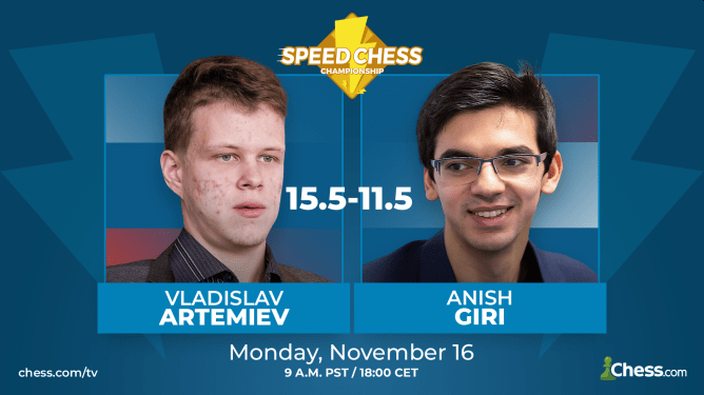
GM Vladislav Artemiev (@Sibelephant) will be GM Magnus Carlsen’s opponent in the quarterfinals of the 2020 Speed Chess Championship Main Event. The Russian grandmaster beat GM Anish Giri (@AnishGiri) 15.5-11.5. Based on his online experience and the Chess.com ratings, Artemiev was the slight favorite and he lived up to the expectations. Playing just a little bit faster than his opponent and with great tactical vision, the Russian player deservedly won this match. It was a result even Giri himself had expected. In fact, he moved up to a shared 12th place in the standings of our Fantasy competition (yep, he plays!) as he accurately predicted the four-point margin with which he’d lose to Artemiev. The match started quite even and was still tied after four games. Artemiev had won a nice, smooth first game and after a draw, Giri won his first. That was one of the rare moments in the match where Artemiev stumbled in a winning position. Usually, it was the other way around, with Artemiev being the one throwing in little tactical tricks here and there that were often completely missed by the commentators and sometimes by Giri as well. Artemiev won game five in a technical endgame and then also game eight, this time again with a small tactical shot. The score at the end of the five-minute segment was 5.5-3.5 and never in the match could Giri level the score again. Occasionally, Giri got the chance to show what he’s worth. That was the case in the second 3+1 game. Afterward, he revealed that he hadn’t prepared much, but that he did look at the Neo-Veresov (GM Baadur Jobava‘s 2.Nc3 and 3.Bf4) because he “always loses against that system in bullet.” The Dutchman got a great position out of the opening and finished it off in style. Giri held on and even ended up winning the three-minute segment with a one-point margin. He got a little help in one of the games as Artemiev briefly had issues with his internet and flagged in a drawn position, shortly after missing a win. With 9-8 for Artemiev, the players started the bullet segment and in that phase, more than before, the Russian player was faster and more accurate. The impression was that Giri didn’t make the most out of his promising positions. In the post-match interview, he didn’t agree he was doing so well in the openings: “Maybe the computer will say I had 0.40 here or there but it was not like there was anything I was thrilled about and he was pretty familiar with the positions and I think he was doing OK. I think too often I was down on the clock and I had not a great position but otherwise, in terms of time scrambles, I think I played OK.” Giri won $851.85 based on win percentage; Artemiev won $2,000 for the victory plus $1,148.15 on percentage, totaling $3,148.15. He moves on to the quarterfinals, where he will play GM Magnus Carlsen. “It should be a very interesting and also a difficult match for me,” said Artemiev. “It was a good motivation for today because it was clear that the winner of our match would go to Magnus. I’m happy and probably I will prepare, I don’t know, a few hours maybe.” The first quarterfinal has been scheduled and will be played on Thursday, November 19, at 9 a.m. Pacific / 18:00 Central Europe between GM Wesley So and GM Jan-Krzysztof Duda. Text: Peter Doggers Photo: chess.com
Chess.com, FIDE agree to broadcast rights deal for 2021 FIDE World Championship

Chess.com has become the first company to acquire broadcast rights for the 2021 FIDE World Championship Match. The company, based in Palo Alto, California, will be an official broadcast partner for what is set to be the biggest global chess event of recent decades. The groundbreaking agreement between Chess.com and FIDE will bring the world chess championship to a wider audience than ever before. As the world’s biggest online chess platform, Chess.com has been the leading broadcaster of the board game in recent years, in partnership with streaming platform Twitch. Held every two years, the FIDE World Championship Match is by far the most important event for the sport. As the final stage of a long world championship cycle, it is also the most popular: the last title match, held in 2018, was followed by dozens of millions of fans around the globe. “We are truly excited about the prospects of the 2021 World Championship Match, and this agreement is a first step towards making it a great success”, said FIDE President, Arkady Dvorkovich. “The popularity of chess is on the rise: more and more people devote more time to playing the game than ever before. Chess has always been an exciting and popular game, but now it is also much more accessible, and Chess.com contributed a great deal to that, bringing chess to a whole new audience. We are confident that this will be the most followed World Championship match of recent decades.” Chess.com will broadcast its official coverage across multiple platforms in the world’s most popular languages, featuring commentary from some of the biggest names in chess and entertainment. “FIDE has been one of Chess.com’s most important partners during the pandemic, helping to bring millions of new players to chess by working with us on some of the world’s most important events,” said Chess.com’s Director of Business Development, Nick Barton. “Chess is experiencing historic growth and we’ve been humbled by the sheer volume of new players from around the world who are finding joy playing on our site each day. This broadcast partnership provides us the opportunity to continue our mission of making chess fun and accessible for everyone.” With its unofficial coverage of the 2018 world championship, Chess.com reached 3.4 million unique viewers. The record-breaking coverage of this year’s Pogchamps event saw even higher per-day unique viewers. The FIDE World Championship Match is planned to be held in the fall of 2021. It will be played between reigning world champion Magnus Carlsen and the winner of the 2020 Candidates tournament. In addition to the championship, Chess.com has also acquired broadcast rights for the next two Candidates tournaments. The first is scheduled for the spring of 2021 and entails the second half of the 2020 tournament, which was postponed due to the coronavirus pandemic. The next Candidates tournament is scheduled for 2022. Contacts: FIDE – press@fide.comChess.com – press@chess.com
ChessTech Conference 2020 announced

The traditional London Chess Conference moves online, being rebranded as “ChessTech Conference 2020”. It will be held from December 5-6, in parallel with the FIDE Congress. The FIDE President Arkady Dvorkovic will be one of the main speakers. Over the past seven years, the London Chess Conference has grown in importance, establishing itself as a reference in chess and education, and the world’s premier chess-related conference overall. With a particular focus on topics like chess in school programs and chess and female empowerment, the event brings together specialists from all over the world, stimulating the exchange of ideas and experiences. Since its inception in 2013, this conference has been held alongside the London ChessClassic, being initially run by Chess in Schools and Communities (CSC), and in the last few years, by the company ChessPlus. Unfortunately, this year’s edition of the London Chess Classic has been canceled due to the pandemic (it will be back in the summer of 2021), so ChessPlus has moved the whole event online, rebranding it as ChessTech Conference 2020. Accordingly, the event will also see its focus shifting to “chess and technology”, while still maintaining the education connection. No longer under the wing of a world-class tournament, the conference will be this time embedded in a different context, taking place in parallel with the first online edition of the annual FIDE Congress. Delegates, Council, and commission members are encouraged to follow the conference, while Arkady Dvorkovich has been confirmed as one of the main speakers. FIDE has also contributed to the budget through a continental ECU grant, while early commercial sponsors are Tornelo.com and Chess.com. If you are a chess merchant and you want to support this initiative, you can check your options and packages on this document. “We are inviting industry leaders, pioneers, and startups alike. We are expecting 400+ attendees, mostly decision-makers, technologists and multipliers, and 25+ businesses to be present. In 30+ sessions of different formats, the conference will reflect on the fast developments since the start of the pandemic and offer glimpses of what we can expect in the near future,” explain the organizers. A detailed program has been announced on a new website with its usual mix of keynote speeches, workshops, debates, and interviews, which will bring together the world’s leading experts in chess and technology. These are some of the main topics: Playing Platforms Anti-Cheating Chess Streaming Chess Databases Tournament Trackers Tournament Administration Classroom Software Online Training Academies Training Utilities Study Systems Chess Engines “The conference will use a mix of platforms to boost learning, interaction, and networking”, reads the website. “Practitioners, decision-makers, and researchers from around the globe will share their knowledge. Platforms and producers will exhibit their latest developments.” The conference is free to attend, and registration is already other through this link. People representing companies are expected to pay for a professional ticket (£50) or to sponsor the event. This ticket gives access to some extra benefits. Dates: December 5-6 Conference Director: John Foley Contact: info@chessconference.org Website: www.chessconference.org
SCC Round of 16: Duda eliminates Caruana
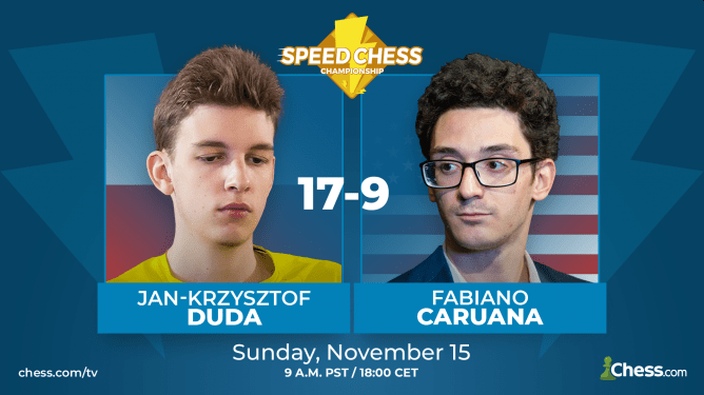
GM Jan-Krzysztof Duda (@Polish_fighter3000) started with three losses but ended up beating GM Fabiano Caruana (@FabianoCaruana) 17-9 in the Roud of 16 of the 2020 Speed Chess Championship Main Event. Remarkably, the players had never played online before. “The shorter the time control is, the bigger are my chances,” said Duda before the match and the course of the encounter proved that he was absolutely right. After two 5+1 and 3+1 sections, the Polish GM edged ahead by one point but dominated the proceedings in the fastest 1+1 part and won the match by a large margin. The 2020 Speed Chess Championship Main Event is a knockout tournament among 16 of the best grandmasters in the world who will play for a $100,000 prize fund, double the amount of last year. The tournament will run November 1-December 13, 2020 on Chess.com. Each individual match will feature 90 minutes of 5+1 blitz, 60 minutes of 3+1 blitz, and 30 minutes of 1+1 bullet chess.
SCC Round of 16: Aronian knocks out Nepomniachtchi
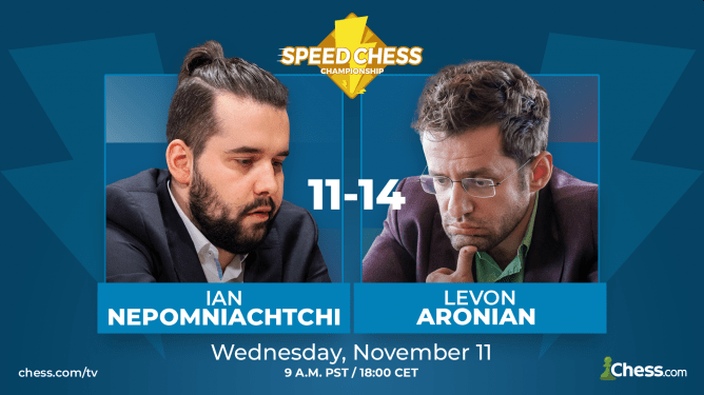
GM Levon Aronian (@LevonAronian) defeated GM Ian Nepomniachtchi (@lachesisQ) 14-11 in the fifth match in the 2020 Speed Chess Championship Main Event. It was an exciting clash of two heavy-weights. Aronian’s win was a small upset victory as Nepomniachtchi was the higher seed in this match based on the FIDE blitz rating list. Also, the Russian grandmaster had won the same matchup, also in the first round, in 2017. Unlike three years ago, Aronian kept up a fairly high level of play all the way into the bullet phase. After a draw in the first game, it was Nepomniachtchi who drew first blood with a nice attack on the king. As Aronian also needed much more time on the clock in those first two games, he definitely seemed under pressure from the start. However, he showed to be tactically sharp as well in the very next game and leveled the score. Aronian won the next game as well and ended up winning the five-minute segment 4.5-3.5. The first 3+1 game clearly showed signs of Nepomniachtchi lacking form. Things seemed to go in Aronian’s direction, but suddenly Nepomniachtchi won two in a row, and all was equal again: 8-8. Aronian recovered with a win in the last three-minute game, so he went into the bullet with a one-point lead. Having been the faster player so far, Nepomniachtchi still seemed to be the slight favorite for those 1+1 games, but Aronian had his own agenda and took a great start in the final portion of the match. With 13-9 on the scoreboard in Levon’s favor and eight minutes and five seconds to go on the match clock, the battle seemed decided. However, a blunder in the next game in a winning position was a blow for Aronian, who would then also lose the next one. With two minutes and 15 seconds left on the clock, Nepomniachtchi needed to win two more games — and the first one in those two minutes. That way he would have kept chances to reach a tiebreak, as we saw in the match between GM Alireza Firouzja and GM Vladimir Fedoseev. Aronian, however, got himself together and ended up winning that last game that went beyond the clock time. Text: Peter Doggers Photo: chess.com
Isle of Man will host the FIDE Grand Swiss and Women’s Grand Swiss 2021
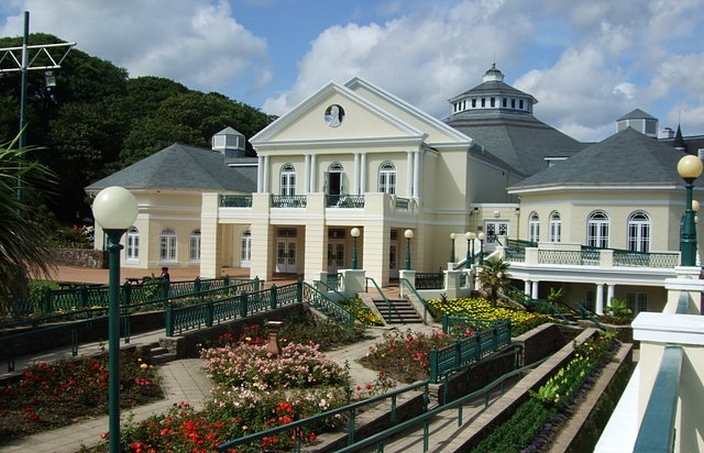
Photo above: Richard Hoare The FIDE Council has approved the bid received from Isle of Man to host the FIDE Grand Swiss 2021, scheduled to take place from Monday, October 25 to Monday, November 8, 2021. With 164 players in total and a combined prize fund of USD 550,000, the event is set to be the strongest and highest-budgeted swiss tournament ever registered in history. The FIDE Grand Swiss will be limited to 114 participants and it is expected to feature the world’s top-100 players, invited by ranking order. Together with nine other FIDE nominees and five wildcards granted by the organizer, they will compete for a prize fund of USD 425,000. In addition to that, the inaugural edition of the FIDE Women’s Grand Swiss will be held concurrently, with invitations to the world’s top-40 players. They will be joined by seven other FIDE nominees, plus three organizer’s wildcards. At stake, USD 125,000 in prize money. Just as important as the extraordinary prize fund is the fact that both events will be part of the race for the World Championship title, producing the “Candidates” for the next cycle. In the case of the Grand Swiss, the winner and the runner-up will advance directly to the Candidates tournament, while the Women’s Grand Swiss will produce one qualifier for the Women’s Candidates tournament. This structure gives continuity to the plan initiated in 2019 when FIDE incorporated a large Swiss tournament as one of the means to qualify for the Candidates and makes it extensive to the women’s cycle as well. The strategic idea behind this reform was to provide more opportunities for a larger number of players, with the participation of all the continents in both open and women. This makes the qualifying cycle more democratic and more exciting, diversifying the paths through which a person can enter the Candidates. Photo: Fiona Steil-Antoni All players will get their travel and lodging expenses covered. The organizing committee has proposed the Royal Hall of the Villa Marina in Douglas, Isle of Man, as the venue for the event. This stunning concert hall, with a capacity for 1500 people, has hosted five Isle of Man Internationals, from 2014 to 2018. The event is, of course, subject to the lifting of COVID-19 restrictions by mid-2021. At present, Isle of Man’s borders are closed, while local tournaments are being played without restrictions. The full regulations will be published at the end of November.
Friendship Team Tournament starts on November 21

The Belarusian Chess Federation and FIDE Chess Academy in Belarus supported by FIDE joined efforts to organize the International Online Friendship Chess Team Tournament. The 7-round Swiss Team event with the time control of 10 minutes + 5 seconds will be held on the Tornelo online platform from 21st to 22nd of November 2020. The International Online Friendship Chess Team Tournament is open for youth teams from all the countries. Each country can register one team of 6 players (two players aged under 12, two players aged under 10, and two players aged under 8) and a captain/representative. This person is responsible for all communication and represents his or her team at the technical meeting. Registration can be made by filling a registration form which should be sent at blr_chess@tut.by by November 17, 2020. The tournament will not be included in for FIDE rapid or any other kind of rating. Schedule: November 20th Technical meeting 18:00 CET November 21st Opening Ceremony 13:30 CET November 21st Rounds 1-4 14:00 – 16:30 CET November 22nd Rounds 5-7 14:00 – 16:00 CET Prizes: The teams taking 1st, 2nd, and 3rd places will be awarded a free online lecture with top Grandmasters: Boris Gelfand – World Championship challenger (2012) Ruslan Ponomariov – FIDE World Champion (FIDE World Chess Championship 2002) Antoaneta Stefanova – Women’s World Champion (2004-2006) All players will receive electronic certificates. International Online Friendship Chess Team Tournament regulations (pdf) Contacts: Tournament DirectorNadezhda KravchukCellphone: + 375 (29) 2030906E-mail: blr_chess@tut.by
Emil Sutovsky on Mikhail Tal
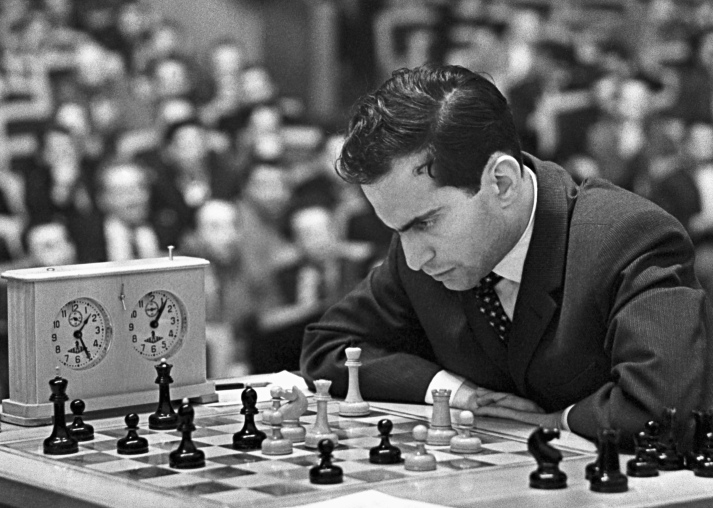
November 9 was the birthday of Mikhail Nekhemevich Tal. Magical, unearthly, amazing. His family name, which means “dew” in Hebrew in many ways reveals the essence of the fresh, fragile, and short-lived genius from Riga. He was like a dewy bead – appearing out of nowhere in that symbolic 1956, Tal became a whiff of fresh air in his first USSR Championship. Four years of incredible success followed. He played different chess seemingly flouting all the existing rules. A very young Misha, with an incredible energy and almost mystical appearance, soared to the very top. He was cocky, devilishly dodgy, and divinely beautiful while battling with the best players of the older generation, and even Botvinnik himself had to lay down his arms. Tal became the world champion. He was admired by the audience and the gentle sex – open, wanton, very young, “du soleil plein la tête”. But then began a long black streak. Misha – as he was called until the last years of his life, despite any age gap – had serious health problems. This affected his preparation for the rematch against Botvinnik, and Tal was crushed by his 50-year-old namesake. Nevertheless, Tal cheerfully remarked that he was now the youngest ex-world-champion ever. Oh, his amazing sense of humor. No world champion delivered so many memorable phrases, remarks, comments, and puns as Tal did, and that sums up Tal for me. His cheery disposition must have helped him survive his numerous health problems. He could have just sunk into a depression and never returned to the game. He cast his magic, played chess, and lived for it – tournaments, simuls, publications, endless blitz games. How about working on his chess or attending some training camps? Nope – at some point, Misha’s long-term mentor and coach Alexander Koblenz just stopped trying to change anything. Photo: Harry Pot But there was no room left for daily routine and domestic life. Tal was absolutely indifferent to these matters and simply sidelined them. Organizational and monetary issues only distracted him. The young Tal could walk around in two different shoes for several days, be regularly late for flights; later in his life Misha could forget about a prize of many thousands or just lose a large sum of money. As for all these Soviet realities – they just hindered him. Just like that pawn from a dialogue with Botvinnik during one of the Olympiads: “Misha, why did you give up a pawn? – It disturbed me.” Tal was in no way anti-Soviet, he did not even notice the system’s shortcomings – all he needed was not to be distracted from his calling. But he was distracted a lot and first of all by his numerous diseases. In 1962, he took part in the Candidates Tournament, hoping to qualify for the championship match again. Dream on! Having spent three-quarters of the tournament on pills, Tal ended up in a hospital. A sick kidney – that’s where young Misha’s troubles began, and thirty years later there would not be a single normally functioning organ in his body. Always with a cigarette – he chain-smoked two packs a day, not a stranger to alcohol, and absolutely disinclined to practice any sport, he burned himself out, but it is simply impossible to imagine him otherwise. Back in the 1960s his young body recovered, and in 1964 the magician from Riga was back on track – he tied for first in the Interzonal (scoring +11 without a single loss), then consecutively beat Portis and Larsen only to lose in the final Candidates match to Spassky, formally becoming the third-ranked player on the planet. The Olympiad in Havana (1966) nearly ended tragically for Tal. A bottle hit his head in a bar – either thrown by mistake or out of jealousy – and sent Tal back to a hospital cot. As Petrosian ironically put it “only Tal with his cast-iron health could come round so quickly” – in a few days Tal was back steamrolling his opponents. Here I would like to elaborate a little bit. Tal was incredibly good against players, albeit strong, but inferior to him. Using psychology brilliantly he would get his opponents to question themselves, fall into time trouble, and make mistakes. However, facing players of his own caliber – world champions, as well as good counterpunchers like Korchnoi, Polugayevsky, Stein – he had a hard time. His creativity lifted him high but harsh reality often brought him back, a few pawns, and sometimes pieces down. When Tal was in normal physical condition, such a style worked even against the best of the best – healthy Tal, healthy spirit, healthy game – but when he wasn’t optimal, it ended not with a bang but with a whimper. During the late sixties, his health failed him more and more often. Major newspapers even prepared obituaries, although Misha was only about thirty. In 1968, he crashed out of the next cycle world championship cycle, losing the match to Kortchnoi. A prolonged crisis ensued: Tal did not make it to the Olympic team, and in Lugano (1968)he was replaced just a day before the departure as if being ostentatiously discarded. The authorities preferred older Smyslov, who did not have a good ground to be a part of the team but was on good terms with Soviet officials. By the way, it also makes Tal very special. Botvinnik, Petrosyan, Smyslov, Karpov – all of them, although to a different extent, were authorities’ darlings. Tal was not. Neither was Spassky. But Spassky was a rebel and did not want to keep his mouth shut. As for Tal, he was alien to all these considerations. Photo: Ron Kroon / Anefo The late sixties and early seventies was not a joyous time for Tal. He tried to change his game style, knowing that his signature squares f5 and d5 were now securely covered, but these attempts did not yield results. He wasn’t even allowed to play in the USSR Championship in 1970, which was held in his native Riga. He
SCC Round of 16: So beats Abdusattorov
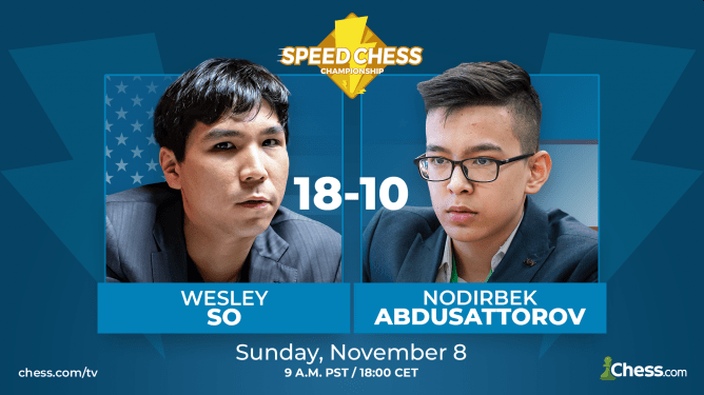
In the fourth match of the 2020 Speed Chess Championship Main Event, GM Wesley So (@GMWSO) defeated GM Nodirbek Abdusattorov (@ChessWarrior7197) 18-10. Except for a brief comeback from Abdusattorov at the end of the five-minute portion, So dominated the match from start to finish. He brought his great play at the American championship into his next tournament while the Uzbek youngster couldn’t find his best form. So played the match from his home in Minnetonka, Minnesota; Abdusattorov played from Tashkent, Uzbekistan. The players in this competition play with two cameras (for fair play reasons). Since both of them had no problem with Chess.com showing the cameras in the broadcast, the fans had the opportunity to see their setup: So, who played with a relatively small board in the corner of a big computer screen, started with three wins—all three scored in endgames. His opponent was fairly close to a draw in game two but couldn’t hold it in the end. After a draw, So won a quick game in a Two Knights Defense that gave him a four-point lead. Abdusattorov referred to this game afterward: “His opening preparation was amazing. [In this game] he just crushed me.” In game six, Abdusattorov finally got his first win. “I said to myself, OK, I need to play faster and my best. And then it became very close,” he said afterward. The next game ended in a draw, but then the Uzbek GM won two more. Suddenly he was just one point behind. So later admitted that this was the first of two times in the match that he “tilted.” The five-minute portion ended with one more draw, which meant the score was 5.5-4.5 with So leading. The American player started the three-minute segment with a win but then blundered again. Those who hoped to see a close battle at this point got disappointed as So won five games in a row to take a commanding six-point lead. That blow Abdusattorov couldn’t recover from. Wesley could even have entered the bullet portion with a slightly bigger lead as he missed a win in a pawn ending in game 19. By winning the first three bullet games, So made it clear that he wasn’t going to allow another comeback. The second moment Wesley went on “tilt” was at the very end. Leading 18-8, he lost the last two bullet games that gave Abdusattorov both a more decent-looking final score and some extra prize money. So said he got “a bit careless” halfway in the five-minute segment: “Actually, I was quite angry with myself because first of all, I lost on time in two or three games. That’s frustrating. After the first four wins, I thought the match would be comfortable, but then Nodirbek played very well today. He is always looking for a fight. He gets fighting positions with both white and black, so it’s hard for me to consolidate.” Abdusattorov won $714.29 based on win percentage; So won $2,000 for the victory plus $1,285.71 on percentage, totaling $3,285.71. He moves on to the quarterfinals, where he will play the winner of GMs Fabiano Caruana and Jan-Krzysztof Duda. The 2020 Speed Chess Championship Main Event is a knockout tournament among 16 of the best grandmasters in the world who will play for a $100,000 prize fund, double the amount of last year. The tournament will run November 1-December 13, 2020 on Chess.com. Each individual match will feature 90 minutes of 5+1 blitz, 60 minutes of 3+1 blitz, and 30 minutes of 1+1 bullet chess. Text: Peter Doggers Photo: chess.com
61 teams register for the Online Olympiad for People with Disabilities

The first FIDE Online Chess Olympiad for People with Disabilities is set for a great start, with 61 registered teams from 45 different countries. The event will take place from November 20 to December 3, and will consist of two stages. The first one is a 7 round Swiss System, from which the best 4 teams will qualify to play a double-round semifinal (November 29-30). The two best teams will advance to the finals, while the two others will compete for third prize. The final has been purposely scheduled for December 3, the date of significant importance: in 1992, it was established by the United Nations as the “International Day of Persons with Disabilities” (IDPWD). The time control in all stages is 25 minutes + 10 seconds, and for the first time, a FIDE event will be held on Tornelo, a web-based tournament management software. FIDE Online Chess Olympiad for People with Disabilities will count on the support of Gazprom as a General Partner. The charity foundation Sozidanie and the Pengcheng Chess Club will also be sponsors for the competition. In total, and including reserve players, the competition will gather almost 400 participants. The event will be as global as expected from an Online Olympiad, with 21 teams from Asia, 20 from Europe, 13 from the Americas, and 7 from Africa. Poland, Germany, the Philippines, Israel, and Cuba are the favorites according to the initial rating, followed by other traditional “chess superpowers” like Russia and Ukraine. The complete list can be found at Chess-Results. The field includes two Grandmasters (Marcin Tabir, from Poland, and Yaacov Silberman, from Israel) as well as 12 International Masters. Nguyen Tran (USA), born in 2011, will be the youngest participant, while Aldric Gomez (FRA) will be the oldest, at 79 years old: in total, seven decades of difference. Official website: https://dis.fide.com