

#18
61 teams registered for the Online Olympiad for People with Disabilities Corporate Social Responsibility Real Madrid Foundation charity event How many Grandmasters are there? Upcoming FIDE Seminars Asian Chess Federation celebrates its 30th anniversary Anniversaries READ NEWSLETTER
FIDE approves electoral regulations for the Athletes Commission
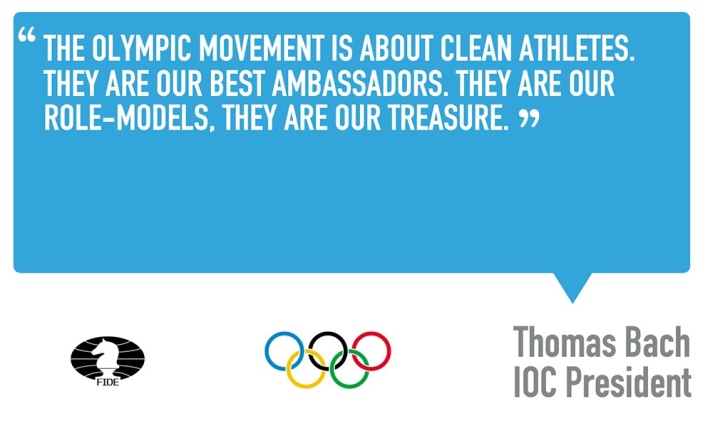
Last May, FIDE announced the creation of the Athletes Commission. The Internal rules and electoral regulations have now been approved by the FIDE Council, and the first Athletes Commission elections are to be held from 9 am CET December 11th to 9 am CET December 18th, 2020. Voting will be conducted by email. This electoral procedure will determine 10 of the 15 members of the ATH Commission, with the remaining 5 being appointed by the FIDE Council. The term of election and appointment of all 15 members is 4 years, but exceptionally, the first term is limited to two years: until the 2022 FIDE Congress. Every candidate for election to the Athletes’ Commission must be at least 18 years old, be endorsed by their National Federation, and he/she must have competed in at least one of the last three FIDE World Championship Cycles, open or Women’s (World Cup, Grand Prix Series, Candidates Tournament), or have qualified for the next cycle. Candidates should also have a reasonable command of English and not have been sanctioned by the FIDE Ethics and Disciplinary Commission in the past 5 years. The electorate will be composed of all holders of GM/WGM titles, as well as any players who have competed in at least one of the last three FIDE World Championship Cycles, (open or Women’s), or have qualified for the next cycle. The Candidature Nomination Form must be completed, signed by the candidate, and received by the FIDE Secretariat (office@fide.com) by November 20th (23:59 CET). You can read the complete regulations here, and the nomination form is available at this link. The purpose of the Athletes Commission (ATH) is to enable the players’ voices and experiences to be heard and used for the improvement of chess as a sport. Involving athletes in the decision-making process is a core component of good governance within sports organizations, allowing them to provide early feedback on potential decisions that will affect them. This peer-to-peer cooperation helps to safeguard the credibility of the sport. Likewise, this body will actively promote and support the establishment of Athletes’ Commissions in Area Associations and Member Federations. The figure of an Athletes Commission is common among members and stakeholders of the Olympic movement, like other International Federations (IFs), National Olympic Committees (NOCs), the World Anti-Doping Agency (WADA), or the Organizing Committees of the Olympic Games (COCGs).
Fedoseev eliminates Firouzja in Round of 16
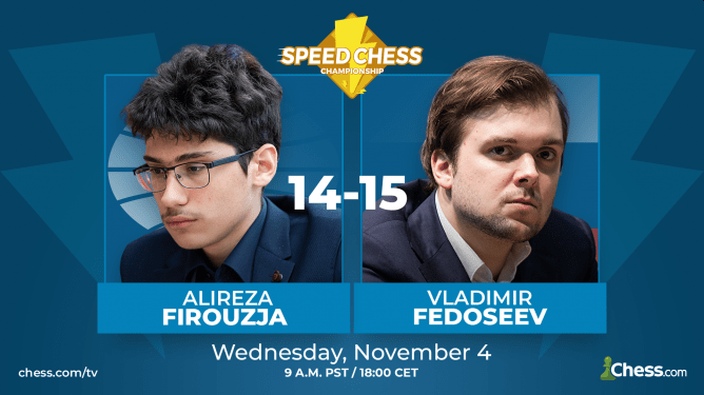
In the third match of the 2020 Speed Chess Championship Main Event the Russian GM Vladimir Fedoseev (@Bigfish1995) scored an upset victory against Iranian-born teenage star GM Alireza Firouzja (@Firouzja2003). Fedoseev ended up winning the match in overtime. There have been quite a few epic matches in the history of the Speed Chess Championship but the Firouzja-Fedoseev match was something special. Co-commentator GM Anish Giri couldn’t hide his excitement and even admiration for his fellow St. Petersburg-born grandmaster Fedoseev. It was a clash between two of the most active online players these days. “I was playing online from eight years old. I guess I’m just a little addicted, I think, and I am good at it,” said Firouzja. Fedoseev: “I play a lot of online blitz because I see it as good practice. You can play a lot of good players and spend a good time.” The first upset result of the championship was a combination of Firouzja not finding his top form and Fedoseev playing some very impressive chess, even when under huge psychological pressure during the playoff as he failed to decide matters earlier. The match saw a shocking start as Alireza lost three of the first four games, with one draw. Especially the second game strongly suggested that the Iranian-born prodigy did not come to the battle in his best form – Firouzja simply overlooked the opponent’s obvious threat. It took seven games and more than an hour of play before Firouzja finally scored his first win. Two draws followed and so it was Fedoseev who was leading by a two-point margin going into the three-minute segment. Except for a draw in the first, all three-minute games ended decisively. Alireza won that segment 4.5-3.5 to narrow the deficit to just one point before the bullet. Firouzja missed a golden opportunity to level the score right away in the first bullet game as he spoiled a winning position. This was one of the key games of the match because a few moves before the draw would be sealed, he dropped a full knight and was down by two points instead. This was a tough blow, and you could see it from Firouzja’s body language. Not only was the one-second increment working against him (he is used to playing 1+0 or even 30-second chess), but he just wasn’t sharp enough. But he was given another chance. In game 23, with Fedoseev still two up (12-10), the players reached a completely drawn, pawnless queen endgame. With four minutes left on the match clock, commentator Giri expected Vladimir to play on for a while to gain time and make it impossible timewise for his opponent to come back on the scoreboard. Instead, Fedoseev showed sportsmanship by agreeing to the draw right away. And he had to deal with the consequences very soon. With 3:54 on the match clock, the 24th game started. Firouzja needed to win this one and then also the next, to force a playoff. It was Fedoseev who stole the show with a rook sacrifice on f7 that reached a dream attacking position for a bullet game. It wasn’t winning, but Firouzja soon blundered — and then it was. Fedoseev then missed a direct win as he continued on a sacrificial path that forced the black king to walk to the center of the board. It was still equal but there didn’t seem to be a clear perpetual check and eventually, Fedoseev blundered his queen. Here resigned with 20 seconds left on the match clock. The most epic game of the match was over, and Firouzja was still alive. Somewhat of expectedly, Firouzja managed to win the next game on-demand as well. Fedoseev was just not ready yet to deal with that disappointing end of the previous encounter. Four more bullet games followed, as the first playoff. After a win for each player and one draw, it was Fedoseev who turned out to have the strongest nerves after all. Vladimir won the last bullet game, his second as Black, and this exciting match by a score of 15-14. Text: Peter Doggers Photo: chess.com
Vachier-Lagrave and Carlsen advance to quarterfinals
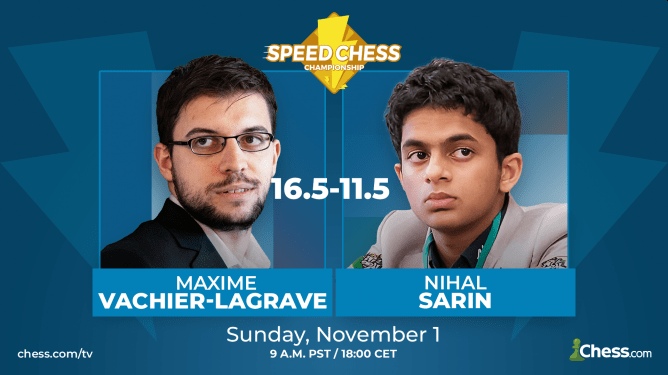
GM Maxime Vachier-Lagrave (@Lyonbeast) defeated GM Nihal Sarin (@NihalSarin) 16.5-11.5 in the first match of the 2020 Speed Chess Championship Main Event. Winning the Junior Speed Chess Championship was a fine achievement by Sarin, but on Sunday he had to admit that the Speed Chess Main Event is a whole other ball game. World number-three in blitz, Vachier-Lagrave won in all three time-controls, while Sarin put up a great fight that included some fine tactical shots. Sarin could keep the pace for four games when the match was still tied. Vachier-Lagrave then won game five and, after two draws, also games eight and nine to finish the five-minute segment with a three-point lead. That became four points after the second three-minute game as MVL successfully tried a knight sacrifice that is almost certainly stored in Sarin’s laptop, but the young Indian GM forgot about how to draw against it. The match seemed over. However, with two fine wins in a row, Sarin was back. However, Vachier-Lagrave won the next two games to restore the four-point margin, and Sarin never got close again. Like in the three-minute portion, the French GM won the bullet segment with a one-point difference. Sarin earned $821.43 based on win percentage; MVL won $2,000 for the victory plus $1,178.57 on percentage, totaling $3,178.57. He moves on to the quarterfinals, where he will play the winner of GM Levon Aronian vs. GM Ian Nepomniachtchi. One of the issues for Sarin was that he was getting low on time in many games early in the match. “I did spend a bit too much time,” he said. “It was mainly that Maxime was playing very strong moves very fast, and I was sort of forced to think.” GM Magnus Carlsen (@MagnusCarlsen) returned to Chess.com with a crushing 24-5 win over GM Parham Maghsoodloo (@Parhamov). If Carlsen wanted to make a statement in his first match of the championship, that certainly worked. He was the big favorite to win against Maghsoodloo but to do it with a 19-point margin was beyond the expectations of most fans. Part of this was the result of Maghsoodloo clearly “tilting” at some point. The score was still tied 2.5-2.5 after five games when Carlsen won an incredible 11 games in a row. Maghsoodloo did quite well early in the match. In fact, Carlsen felt his opponent was more in control: “I would say I didn’t play so well at the start. He was sort of dictating those games. I haven’t really played so much blitz online in a long time so I needed some time to get going.” One reason for Maghsoodloo’s troubles was his indecisiveness; he repeatedly got in time trouble and in several games, he seemed to just forget about the clock. Also, dropping a full knight like in game 12 didn’t help. After a few wins in a row for Carlsen, the crowd in the stadium started shouting “10! 10!” The world champion delivered and even won 11 straight before Maghsoodloo could get a draw in game 17. The first draw Maghsoodloo got, after getting punched so many times, came in a funny way. At first, there was nothing to laugh about for the Iranian as he spoiled a winning position but it was rather entertaining when Carlsen voluntarily went into a pawn ending being a pawn down to demonstrate his knowledge of distant opposition. This was exactly where the other Iranian grandmaster Alireza Firouzja had messed up last month at Norway Chess. As Carlsen got the draw, both he and his opponent were laughing on camera. After the match, Carlsen said: “Frankly I didn’t feel that I ever found much of a rhythm; it was just a bunch of chaotic games that were somehow going my way.” “I think this match format is very difficult to handle because once it starts going south then it’s all psychological. At some point, if you stopped and played a different opponent the result might be very different but since you continue to play the same guy and you suffer against them, everything becomes a lot more difficult.” Maghsoodloo: “I had so many good positions which were close to a win but I spoiled them very badly; I didn’t make a draw but I lost them. When you do this for a lot of positions you completely lose control of the match.” Maghsoodloo won $344.83 based on win percentage; Carlsen won $2,000 for the victory plus $1,655.17 on percentage, totaling $3,655.17. He moves on to the quarterfinals, where he will play the winner of GM Anish Giri and GM Vladislav Artemiev. Asked for his favorite next opponent, Carlsen replied: “I’d rather play Artemiev, I think he’s by far the strongest blitz player of those two.” The 2020 Speed Chess Championship Main Event is a knockout tournament among 16 of the best grandmasters in the world who will play for a $100,000 prize fund, double the amount of last year. The tournament will run November 1-December 13, 2020 on Chess.com. Each individual match will feature 90 minutes of 5+1 blitz, 60 minutes of 3+1 blitz, and 30 minutes of 1+1 bullet chess. Text: Peter Doggers Photo: chess.com
Resolution of FIDE Council regarding the rating list

The lack of rated events due to the coronavirus pandemic could have led, under the existing regulations, to many players being considered as “inactive”. As such, they could have been removed from the rating list. In order to prevent that, the Qualification Commission has made the recommendation to temporarily extend the period required to be considered “inactive” from 12 to 24 months. The exceptional measure, approved by the FIDE Council, has already been applied to November’s rating list. This modification will be reverted once the chess activity goes back to pre-pandemic levels of activity and competitions. You can read the full text of the FIDE Council resolution here: “WHEREAS, since the onset of the Covid-19 pandemic, it has been possible for only a reduced number of FIDE rated tournaments to take place. As a result, it is likely that many players who would under normal conditions be playing rated games will find that they are unable to do so and will therefore be marked as inactive. The FIDE Council has considered this problem and has decided on the advice of the Qualification Commission (QC) that, from the November 2020 list UNTIL FURTHER NOTICE, the period specified in the definition of inactivity will be increased from 12 months to 24 months.”
Nigel Short to visit Tonga in 2021
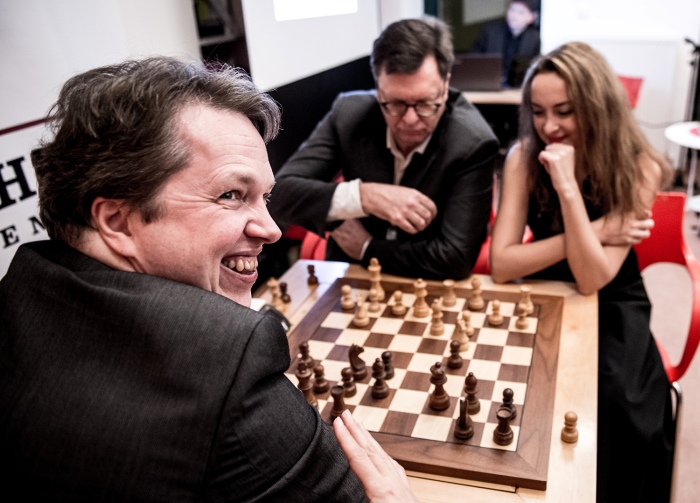
Have you ever dreamed of playing chess face to face against a Grandmaster? Nigel Short, the best British chess player of all time, is visiting Tonga in 2021 (exact dates to be confirmed), as part of a wider tour to promote chess in Polynesia. Twenty chess fans from the island will have the unique opportunity to play against him. Nigel will take on all opponents at once, board to board, move by move, in what is called “a simul exhibition”. This event is sponsored by the International Chess Federation (FIDE), and participation is completely FREE. The seats will be assigned by strict order of registration. If you want to take part, just send us an email to office@fide.com with the word “TONGA” in the subject line. Please tell us in the email what is your full name, age, and sex, since there is a minimum of seats reserved for juniors and girls. It is convenient if you also include a phone number, so we can reach out to you once the exact dates and venue are confirmed. Nigel Short is a Vice-President of FIDE. A former chess prodigy, he was ranked third in the world, and in 1993 he defeated Anatoly Karpov to become the first English player to play a World Chess Championship match. He was defeated by Garry Kasparov in the final. During his stay in Tonga Nigel will also host a roundtable where he will answer questions from the media and local chess fans. This is your chance to ask a Grandmaster how does it feel to play for the world championship title in chess, one of the longest and most prestigious traditions in the world of sports.
China takes 2020 FISU World University Mind Sports

Team China 1 became the 2020 FISU World University Mind Sports Online Champion, the event that brought together 551 student-players from four continents and 40 countries. The champions won all the matches in both the qualification stage and play-offs losing just a single individual game. In the semifinals, China 1 routed the top-seed Armenia 3.5-0.5, whereas Ukraine beat Belarus 3-1. After three games in the final were drawn the captain of team China Lei Tingije (silver medalist of the World Rapid Chess Championship) defeated a member of the Ukrainian Olympic Team, Iulija Osmak, and secured gold for her squad. In the match for third place Armenia prevailed over Belarus thanks to a nice victory by Shant Sargsyan over IM Mihail Nikitienko and took home bronze. Few minutes before the final FIDE Vice President Lukasz Turlej paid a visit to the virtual studio and spoke about the importance of chess in schools and universities. As chess supervisor of the event, Mr. Turlej said it was a big success and praised FISU and Polish University Sports Federation for organizing the Mind Sports Online. He also expressed confidence that chess is getting stronger and stronger in the family of university sport.
Wesley So wins 2020 U.S. Chess Championship

With an incredible run, GM Wesley So became the 2020 U.S. Chess Champion, scoring a fantastic 9.0/11 after finishing the day with two draws to win his second national title. “Winning a second title is really big for me. I’m really happy to have won it, this title is really prestigious.” said the champion. Displaying an amazing performance as well, GM Jeffery Xiong finished in clear 2nd with 8.5/11, while GM Ray Robson took 3rd with 7.5/11. In the final round, Wesley secured the title after making a quick draw with Hikaru Nakamura with white. This meant that the fight was now for second place, with both Jeffery Xiong and Ray Robson tied going into the last round with 7.5 points. Alex Lenderman played one of his best games of the event and managed to defeat Robson in an Exchange King’s Indian endgame. Meanwhile, Xiong was also in trouble against GM Alejandro Ramirez but managed to equalize and eventually capitalize on a late-game blunder. Final standings: Text: IM Kostya Kavutskiy Photo: Official website Official site: USChessChamps.com
First ever ISF World Schools Championship Online Chess goes big

The ISF World Schools Championship Online Chess 2020 was an online event, held on the virtual competition platform Premium Chess throughout October 2020. Young players from all over the world displayed a high-level performance in both age categories, U14 and U17. The final stage of the event, the finals in the U17 category (2003-2004-2005), took place over the last weekend, on October 24 and 25, 2020. Young players from Armenia (boys) and Georgia (girls) took the titles in these categories. Albert Gevorgyan (Armenia) came first in the open category, and Ekaterine Pipia (Georgia) won the gold in the girl category. Both players qualified for the ISF Gymnasiade Jinjiang 2020 (which will be held in China from 16th to 23rd of October 2021). The finals were broadcasted on 1 Play Sports social media channels and moderated by Soumya Swaminathan, former FIDE World Junior Girls champion. Full results and archive of the live stream:https://www.isfsports.org/isf-world-schools-championship-online-chess-2020
#17
FIDE news Chess in Schools Survey Australia takes the Asian Online Nations Cup Your chess club needs you! Joel Benjamin and Irina Krush add to their legend Brief news from National Federations Sports and business Anniversaries READ NEWSLETTER