

FIDE Online Olympiad: India and Russia meet in the final
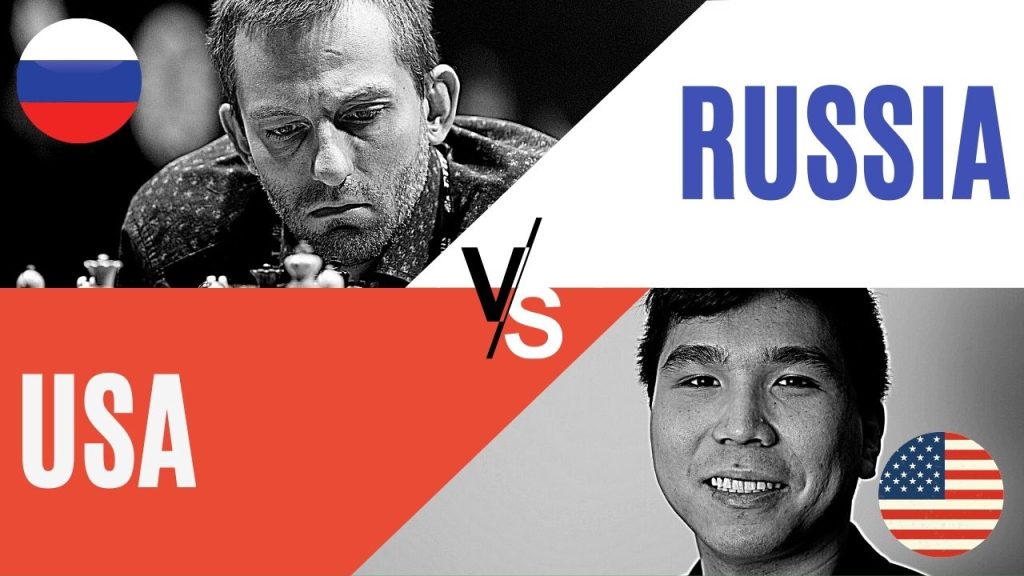
Russia beats the USA, moves into the final India is the last obstacle between Russia and the gold medal. Russia has not won a Chess Olympiad since 2002. The final will take place tomorrow Sunday, August 30, at 11:00 UTC (14:00 in Moscow, 16:30 in Delhi). Russia moves into the final of the first Online Chess Olympiad, after a very tight match against the USA. The Russian team won the first round by minimal margin (3½-2½), then drew the second match (3-3) to seal their pass to the final. In general, Russia seemed to have the match situation under control for most of the time, but both matches could have gone either way in the time scrambles, as the narrow score shows. The first match was decided by the results among the female players, where all three games reached a decisive outcome. Aleksandra Goryachkina played aggressively with White against Anna Zatonskih, castling long and launching a pawn onslaught on the kingside. At the right moment, the young Russian star traded her initiative for an extra pawn in a rook ending, that she converted flawlessly. Alexandra Kosteniuk outplayed Tatev Abrahamyan in a very fine attacking game with Black. Annie Wang scored the only victory for the American team, as she inflicted Polina Shuvalova her first defeat in the event: Wang came out of the opening with better development and the pair of bishops, and soon she was one pawn up. The game between Alexander Grischuk and Wesley So was a very solid and almost irrelevant affair, and in the two other games, both teams made important concessions: Esipenko was much better against Xiong, but 29.Kf1 was an inaccuracy that blew away his advantage, and he had to settle for a draw. On the other hand, Sam Shankland played a fantastic game against Daniil Dubov and transposed into a winning endgame, but blundered when he was already very close to promoting his passed c-pawn. Somehow, Samuel missed an easy move, 62.Bf4+, that would have won on the spot. Russia’s second board, Ian Nepomniachtchi. PHOTO: David Llada The second match was a fight to the death, where not a single draw was signed, and yet it ended in a tie as both teams scored three victories each. In a do-or-die situation, Wesley So showed his A-game and defeated Alexander Grischuk in a very interesting battle, imbalanced in terms of structure and material. Shankland, with Black, played and ambitious and risky move, 13…Ke7, leaving his King in the center. Black looked just fine, but Ian Nepomniachtchi maneuvered to open some files for his heavy pieces, and when he finally did the relatively exposed Black King fell in a deadly trap. Goaryachkina opted for the Caro–Kann with Black, but the resulting position was as sharp as if she had played a Sicilian. It was a double-edged game with plenty of complications, but White had the upper hand and, when the dust settled, Carissa Yip emerged two pawns up in a simple endgame. On the sixth board, Polina Shuvalova was slightly worse in her game against Annie Wang, but the American player suddenly collapsed and allowed the white knight to came out from the corner and destroy Black’s position. Andrey Esipenko achieved a clear advantage (almost decisive at some point), but probably he should have solved his back rank problems with 29…Re8 first, before going for the kill. He didn’t do so and, as a result, Jeffery Xiong found some ingenious tricks that not only allowed him to save the game but gave him the full point. Alexandra Kosteniuk won the decisive game against the USA. PHOTO: David Llada The hero of the day for the Russian team was Alexandra Kosteniuk. The Queen of Russian Chess scored her second win of the day, and both victories were decisive: the first one allowed Russia to win the match, and the second one secured the draw that promoted Russia into the Final against India. Match 1: Russia – USA 3½:2½ Grischuk ½-½ SoDubov ½-½ ShanklandGoryachkina 1-0 ZatonskihKosteniuk 1-0 AbrahamyanEsipenko ½-½ XiongShuvalova 0-1 Wang Match 2: USA – Russia 3:3 So 1-0 GrischukShankland 0-1 NepomniachtchiYip 1-0 GoryachkinaZatonskih 0-1 KosteniukXiong 1-0 EsipenkoWang 0-1 Shuvalova India beats Poland to become the first finalist of the Online Chess Olympiad. India’s rival will come out of the clash between Russia and the USA. It wasn’t an easy match for the winners, who had to come from behind after losing 4-2 in the first round. Jan-Krzysztof Duda managed to out-prepare Vishy Anand on the black side of a Sicilian and came out of the opening with a solid positional advantage that he didn’t fail to convert. Vidit played very aggressively with black, resolutely advancing his h-pawn all the way to h3 and creating some problems to Radek Wojtaszek. However, after the Indian missed an interesting tactical solution (21…Rxe3) White contained the attack, the advanced pawn was captured, and the Polish GM took the whole point. India seemed to have good chances of tying the match thanks to their last two boards, where both Nihal Sarin and Divya Desmukh had better positions. But only Sarin managed to win his game, while Deshmukh fell into time trouble, ruined her little advantage and lost. It is not easy to bounce back right after a defeat, but that’s exactly what India did in the second round of the day, winning on-demand to level the match. Poland decided to replace Wojtaszek for the second round, maybe with the hope to surprise the Indians and avoid Vidit’s preparation, so it was Grzegorz Gajewski who played on board two. Out of the opening, the position was about equal, but the black king was more exposed and that tends to be an important factor in rapid chess. Vidit played 18.f4, went for the kill, and scored the whole point. Humpy Koneru completely outplayed Monika Socko, and Harika Dronavalli managed to defeat Karina Cyfka in an endgame where her Bishop was stronger than Black’s knight. Vishy Anand took his revenge against Duda although by this time the match was already decided in India’s favor. The final score was 4½-1½ for India. Koneru Humpy won the decisive Armageddon game against Poland Photo: David Llada The match came down to the Armageddon tie-break where, like in the last of the quarterfinals played yesterday, Monika Socko had to represent the whole Polish team, fighting against Humpy Koneru for the spot in the finals. It was a fantastic clash between two experienced players and probably
India, Russia, USA and Poland advance to semifinals
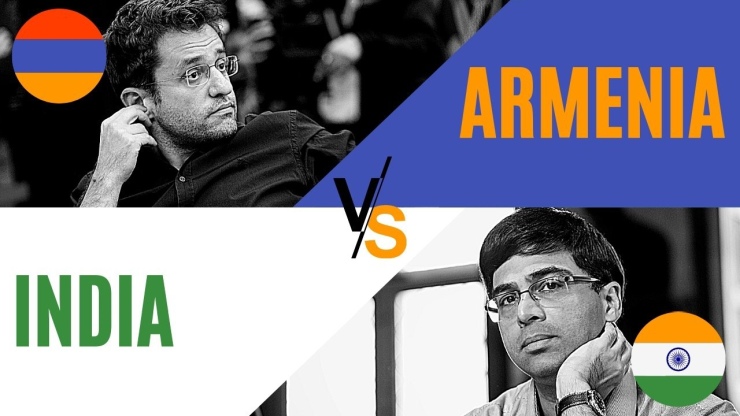
Match 1: 3½-2½Match 2: India wins by default The first match of the day turned out to be a very eventful one, with a very unfortunate outcome. The first game to come to an end was the clash of the giants – Vishy Anand and Levon Aronian They played until only the bare kings where left on the board and split a point. Humpy Koneru pressed too hard in an equal endgame and lost, while Lilit Mkrtchian fell for a little tactical trick and lost to Harika Dronavalli. It was in this moment when, in barely five minutes, a lot of unexpected things happened: Vankita Agrawal overlooked a double-check which cost her a rook, Gabriel Sargissian blundered his Queen in the most spectacular fashion, and in the decisive moment, Haik Martirosyan got disconnected when he only had 53 seconds left on his clock, losing on time. This left the final score at 3½-2½ for the Indian team. Following the disconnection of Haik Martirosyan, the Armenian team filed an official appeal that was rejected by the Appeals Committee, formed by the FIDE President Arkady Dvorkovich, Michael Khodarkovsky, and Sava Stoisavljevic. Not satisfied with this decision, Armenia defaulted the second match, and as a result, India is through to the semifinals. You can read the Appeals Committee resolution here. Match 1: 5-1Match 2: 3-3 Russia was just too strong for Hungary in their first match, winning by a convincing score: 5-1. Viktor Erdos made a fatal mistake against an attacking player like Ian Nepomniachtchi: playing Black, he didn’t castle on time. As soon as Ian got the chance (16…Nh5?) broke through in the center, launched a smashing attack, and quickly scored a victory. Dubov and Esipenko drew their games, but the Russian ladies did the rest of the work to round up the result: Goryachkina, Kosteniuk, and Shuvalova took home three points. The second match was kind of a moral victory for Hungary, which proved to be a very worthy quarter-finalist. The Hungarians say goodbye to the Online Olympiad after a 3-3 draw against Russia. Nepomiachtich won again, this time with the black pieces and against a different rival: Tamas Banusz instead of Viktor Erdos. On the sixth board, Polina Shuvalova demonstrated one more time that there are not many girls in her age group who can play at her level. Polina was the 2019 World Girls U-20 Champion, as well as the World Girl’s U18 Champion in 2018 and 2019, and her results in the Online Olympiad show why. However, for the second match, the Russian team decided to field Lagno and Gunina instead of Kosteniuk and Goryachkina, and these substitutions didn’t work quite well. Both Russian stars lost to Petra Papp and Ticia Gara, who turned in an excellent performance. Match 1: 4½-1½Match 2: 4-2 Vassily Ivanchuk is always unpredictable, and today it wasn’t one of his good days. He went for a French defense against Wesley So, came out of the opening with a worse position, and then simply lost on time on move 27. The game between Anton Korobov and Sam Shankland was a spectacular battle, but it ended in a draw. Carissa Yip and Annie Wang sealed the result in favor of the American team, beating Julia Osmak and Mariia Berdnyk, respectively. The second match didn’t go much better for the Ukrainians. This time they decided to play without Ivanchuk, but nevertheless the lost on the first board, where Wesley So proved to be stronger than Anton Korobov, despite playing with Black. The game between Shankland and Shtembuliak looked balanced, but as soon as the complications arose, Samuel showed his class and outplayed his young opponent. Annie Wang scored another decisive point for her team, against Nadiia Shpanko. For the second time in a row, Kirill Shevchenko drew against Jeffery Xiong, but the way he did it, with a very beautiful resource (31.Bg7!), only reinforces his candidacy as the most valuable player of the Online Olympiad 2020. Match 1: 4-2Match 2: 1½-4½(Poland wins the tie-break) Very much like it happened yesterday in preliminary round Poland was unstoppable in the top two boards. Jan-Krzysztof Duda extended his streak to a sensational 10/11, beating Shakhriyar Mamedyarov in a very fine game with the black pieces. His level of play and accuracy could be comparable to what you would expect from a game played under classical time control. Wojtaszek – Mamedov was a great fight, where the Azerbaijani player had an absolutely winning position at some point (apparently Radoslaw overlooked 29…Rxf3), but then lost the thread of the game and missed not only a win but even a draw. Gulnar Mammadova went all-in to the attack against Karina Cyfka, correctly sacrificing a knight to leave the white King naked and exposed but was not precise enough – Karina consolidated her position and forced a Queen exchange: with this, the game and the first match was over, but the quarterfinals – not yet! Azerbaijan added some drama to the last clash of the day, striking back in the second match, which they won by a wide margin: 4½-1½. To begin with, this time Radjabov played on the first board, and that helped to hold the unstoppable Duda to a draw. On the rest of the boards, Azerbaijan scored one point after another: Radek Wojtaszek, Monika Socko, Karina Cyfka, and Szymon Gumularz, they all lost. It was the young Alicja Sliwicka the only player to score a full point for the Polish team: her first victory in the event so far. The Armageddon game was a face-off between the two top women of both teams, Monika Socko and Gunay Mammadzada, with the 7-time Polish champion playing White. As it is expected under the circumstances, Monika played very aggressively, and we could say that Black came out of the opening slightly better, but White succeeded in creating some complications. In the end, the opponents reached a balanced endgame, but somehow Gunay missed some obvious moves and got entangled in a basic mating net. With just a couple second left on her clock, Monika checkmated her opponent and Poland got the ticket to the semifinals.
LIVE: FIDE Online Olympiad Quarterfinals
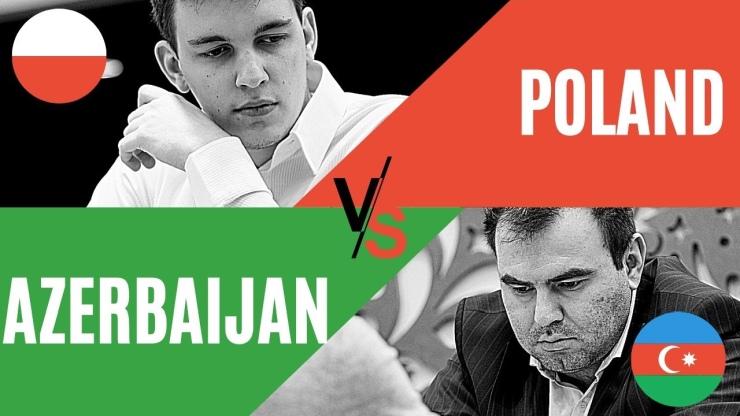
Match 1: Azerbaijan – Poland 2:4 Mamedyarov 0-1 DudaMamedov 0-1 WojtaszekMammadzada ½-½ SockoMammadova 0-1 CyfkaAsadli ½-½ GumularzBalajayeva 1-0 Sliwicka Match 2: Poland – Azerbaijan 2:4 Duda ½-½ RadjabovWojtaszek 0-1 MamedovSocko 0-1 MammadzadaCyfka 0-1 FataliyevaGumularz 0-1 AsadliSliwicka 1-0 Balajayeva After Azerbaijan stuck back and won the second match it came down to the Armageddon decider on the women’s board. Monica Socko downed Gunay Mammadzada in a nail-biter riddled with mutual mistakes and pulled Poland through to the semifinals. Match 1: USA – Ukraine 4½:1½ So 1-0 IvanchukShankland ½-½ KorobovYip 1-0 OsmakZatonskih ½-½ ZhukovaXiong ½-½ ShevchenkoWang 1-0 Berdnyk Match 2: Ukraine – USA 2:4 Korobov 0-1 SoShtembuliak 0-1 ShanklandOsmak ½-½ ZatonskihGaponenko 1-0 AbrahamyanShevchenko ½-½ XiongShpanko 0-1 Wang Team USA won both matches against Ukraine and went through to meet Russia in the semifinals. Russia prevails over Hungary to progress to semifinals Match 1: Russia – Hungary 5:1 Nepomniachtchi 1-0 Erdos Dubov ½-½ Gledura Goryachkina 1-0 HoangKosteniuk 1-0 GaraEsipenko ½-½ KozakShuvalova 1-0 Gaal Match 1: Hungary – Russa 3:3 Banusz 0-1 NepomniachtchiGledura ½-½ ArtemievPapp 1-0 LagnoGara 1-0 GuninaKozak ½-½ SaranaDemeter 0-1 Shuvalova As a winner of the first match, Russia advanced to the semis. India defeats Armenia and advances to semifinals Match 1 – India- Armenia 3½:2½ Anand – Aronian½-½Vidit – Sargissian 1-0Koneru – Danielian 0-1Harika – Mkrtchian 1-0Sarin – Martirosyan 1-0Vantika – Sargsyan 0-1 Following the disconnection of Haik Martirosyan in Match 1 of the Quarterfinal against India, Armenia filed an official appeal that was rejected by the Appeals Committee. Armenia defaulted Match 2. As a result, India is through to the semifinals.
FIDE announces Online Olympiad for People with Disabilities

The International Chess Federation is pleased to announce the FIDE Online Olympiad for People with disabilities, to be held between November 20 and December 3, 2020. This is a team competition, played on four boards, where at least one of the players has to be a woman. The event will consist of two stages. The first one is a 7 round Swiss System, from which the best 4 teams will qualify to play a double-round semifinal (November 29-30). The two best teams will advance to the finals, while the two others will compete for third prize. The time control in all stages is 25 minutes + 10 seconds. Each member Federation is entitled to register between one and four teams, depending on the number of players with disabilities that are members of that federation. Please note that all participants have to be previously registered in the directory of players with disabilities at the DIS website. Up to 50 players: 1 team Between 50 and 75 players: 2 teams Between 76 and 100 players: 3 teams 101 or more players: 4 teams Registration should be done by October 20, 2020, using the online form at the website of the FIDE Commission for the Disabled: dis.fide.com Tournament regulations (pdf) Complete schedule: October 10-15 Zoom meeting with Captains by Chief Arbiter and OC November 10-15 Zoom meeting with Captains by Chief Arbiter and OC CET 15:00 Opening Ceremony CET 15:00 Round 1 November 22 CET 15:00 Round 2 November 23 CET 15:00 Round 3 November 24 CET 15:00 Round 4 November 25 CET 15:00 Round 5 November 26 CET 15:00 Round 6 November 27 CET 15:00 Round 7 REST DAY November 29 CET 15:00 Round 1 Semi-final November 30 CET 15:00 Round 2 Semi-final November 30 Tie-Break (if necessary) CET 15:00 Round 1 Final and for 3 places December 2 CET 15:00 Round 2 Final and for 3 places December 2 Tie-Break (if necessary) CET 15:00 Closing Ceremony
Alexander Zubov wins Ukraine Independence Day Schweppes

Thanks to the cooperation agreement between FIDE and Coca-Cola, Schweppes became the main sponsor of the chess festival that was held in Ukraine. The event included an online tournament, combined with simul exhibitions in the five largest cities in the country. Five 20-board simul exhibitions took place in Kyiv, Dnipro, Kharkiv, Odessa and Lviv featuring some of the most prominent Ukrainian players. Chess fans had a chance to qualify for one of the simuls by taking part in the online tournament. The Ukraine Independence Day Schweppes 2020, a 10-round online Swiss tournament, assembled an extremely strong lineup with 65 titled players taking part including 16 GMs. After ten rounds of fierce battles GM Alexander Zubov, one of the best Ukrainian rapid and blitz players, emerged as a winner with an excellent score of 9/10 (8 wins, 2 draws). Egor Bogdanov and Vladimir Onischuk finished a half-point behind the winner and tied for the second with the former taking silver thanks to better tiebreaks. Final standings: 1. Alexander Zubov – 9/102. Egor Bogdanov – 8.5/103. Vladimir Onischuk – 8.5/104. Konstantin Tarlev – 8/105. Anton Sitnikov – 8/106. Dmitry Mischuk – 8/107. Pavlo Kruglyakov – 8/108. Li Min Peng – 8/109. Mikhail Simantsev – 8/1010. Mike Safronov – 8/10 Three women’s prizes set in the event were taken by Natalia Zhukova (1st), Nastya Rakhmangulova (2nd), and Evgeniya Doluhanova (3rd). Best veterans (three prizes were set) 1. Victor Yanov – 7/102. Valery Neverov – 7/103. Mikhail Golubev – 6.5/9
FIDE Online Olympiad: Quarterfinals are set
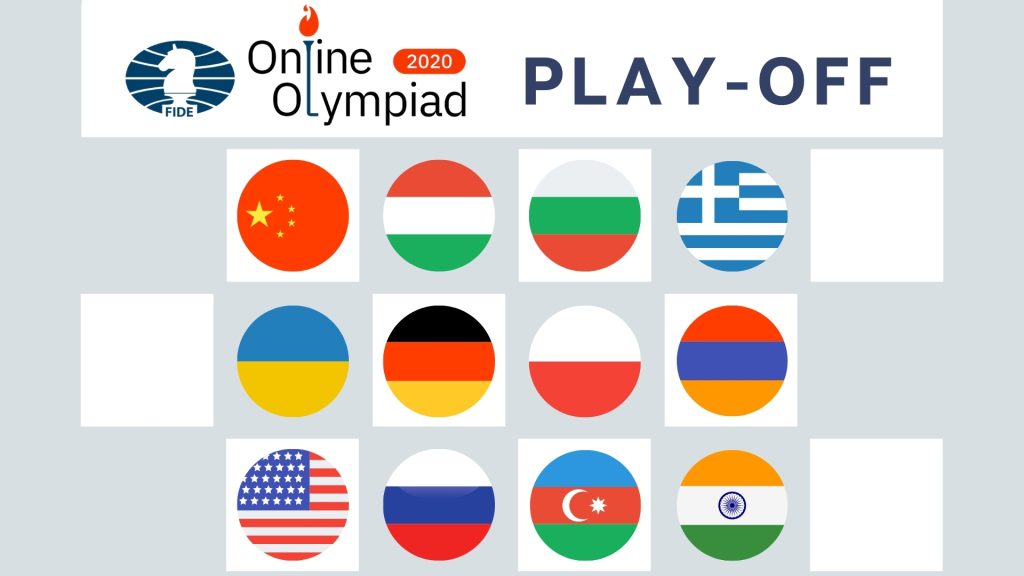
Poland defeats Bulgaria to advance to quarters No prisoners were taken in the match between Poland and Bulgaria, where all the games in both rounds reached a decisive result. All except one, which ended in a draw by accident: Viktoria Radeva was a piece up in the first round encounter, but she inadvertently repeated the same position three times against Alicja Sliwicka, who couldn’t hide her joy in front of the webcam. This half a point was decisive, as it allowed Poland scrape out a victory by a minimal margin (3½ – 2½) in a match that would have been a draw otherwise. Poland’s second board Radoslaw Wojtaszek Poland’s top players proved to be stronger than their Bulgarian counterparts, and both Duda and Wojtaszek made a clean sweep in their games against Delchev and Enchev respectively. On the other hand, Bulgaria dominated the female boards: Salimova defeated Karina Cyfka in both rounds, while Radeva took her little revenge winning her second game against Sliwicka. Socko lost to the former Women’s World Champion Antoaneta Stefanova in the first game, but then won the second, and this was one of the results that tipped the balance towards a more comfortable victory (4-2) for the Polish team. Match 1 Bulgaria 2½ : 3½ Poland Delchev 0 : 1 Duda Enchev 0 : 1 Wojtaszek Stefanova 1 : 0 Socko Salimova 1 : 0 Cyfka Petrov 0 : 1 Gumularz Radeva ½ : ½ Sliwicka Match 2 Poland 4 – 2 Bulgaria Duda 1 : 0 Delchev Wojtaszek 1 : 0 Enchev Socko 1 : 0 Stefanova Cyfka 0 : 1 Salimova Gumularz 1 : 0 Petrov Sliwicka 0 : 1 Radeva It was a busy day at the office for most of the Polish players, since these days they are also playing the national clubs competition: the super-strong Ekstraliga. Many of them had to play an over-the-board classical game starting at 1 pm, and then run to their hotel rooms in Katowice to play the Online Olympiad game at 6 pm. Poland takes on Azerbaijan in Quarter-Finals, which will take place tomorrow, August 28. The other QF duels are India – Armenia, Russia – Hungary, and USA – Ukraine. Armenia will be the rival of India in Quarter-Finals Greece has become one of the revelations of the first Online Olympiad, thanks, among other reasons, to the star performance by the young talent Stavroula Tsolakidou. However, their run in the FIDE Online Olympiad came to an end today, after the clash with a superior Armenian team. Despite Stavroula winning again both her games, Armenia outclassed the Greeks by 4½ – 1½ in the first round and won again by 3½ – 2½ in the second. Armenia’s top player Levon Aronian The pillars of the Armenian team were a veteran, Levon Aronian, and a relative newcomer, Anna Sargsyan. Aronian won both his games with relative ease, first against Dimitrios Mastrovasilis, and then against Hristos Banikas. Sargsyan defeated Anastasia Avramidou with both colors. This is not the first great performance by Anna with the national team, since she already won a bronze medal on the 4th board at the last European Teams Championship in Batumi last year, where she also achieved WGM and IM norms. Meanwhile, Woman Grandmaster Stavroula Tsolakidou (Greece), now a freshman at Saint Louis Chess University, took her overall score to an impressive 14.5 points out of 19 games. The Greek star IM Stavroula Tsolakidou The Armenians advance to Quarter-Finals, where they will face India (Friday, August 28). Match 1 Greece 1½ : 4½ Armenia Mastrovasilis 0 : 1 Aronian Halkias 0 : 1 Sargissian Tsolakidou 1 : 0 Danielian Botsari 0 : 1 Mkrtchian Theodoru ½ : ½ Martirosyan Avramidou 0 : 1 Sargsyan Match 2 Armenia 3½ : 2½ Greece Aronian 1 : 0 Banikas Sargissian ½ : ½ Halkias Danielian 1 : 0 Tsolakidou Mkrtchian ½ : ½ Botsari Martirosyan ½ : ½ Theodoru Sargsyan 0 : 1 Avramido Ukraine knocks down China, advances to Quarter-Finals Ukraine and China were the top seeds in their respective groups at the top division, but both failed to claim the first place and, as a result, they had to battle each other for a spot in Quarter-Finals against the USA. The clash between these two chess giants came down to an Armageddon game after the two regular matches reached a 3-3 result. In the first round, Ukraine was temporary two points down, because the Chinese victories came early in the match. But despite these early setbacks, Ukraine was actually very close to winning. Vassily Ivanchuk lost to Ding Liren with Black, while Shevchenko and Berdnyk took the whole point. Both Irina Gaponenko and Natalia Zhukova had much better positions against Hou Yifan and Ju Wenjun respectively. However, Gaponenko lost the thread of the game and lost, while Zhukova missed a forced checkmate and agreed to a draw. The resulting 3-3 tasted like a lucky save by the Chinese team. GM Vassily Ivanchuk, the leader of team Ukraine The second match was also very balanced, but again the chances of Ukraine looked a bit better. Four of the six games ended in a draw, while Julia Osmak took down a very dangerous rival in rapid chess: Tan Zhongyi. Meanwhile, Zhu Jiner leveled the score by defeating Mariia Berdnyk. This is where 17-year-old Kirill Shevchenko decided to spice things up adding some drama to the clash. The young prodigy, who had won all his 7 games so far in this competition, conceded his first draw in this round, after failing to find a decisive blow that could have given him the whole point – and a team victory. However, Kirill was given an immediate opportunity to make things right, since it was decided that the Armageddon game for this duel between Ukraine and China would be a clash between the two junior boards. For the third time in the day, Shevchenko and Liu Yan crossed swords – the Ukrainian rising star demonstrated stamina and nerves of steel and, in a favorable endgame, he created enough problems for his opponent to make him forfeit on time. The Quarter-Finals clash between Ukraine and the United States will take place
FIDE Council postpones World Amateur Chess Championships
The FIDE Council has approved the postponement of the World Amateur Chess Championships (Greece). This measure was suggested by the organizer in view of the current pandemic situation, and the Management Board made a recommendation to the FIDE Council to postpone the event to 2021. These are all the FIDE competitions that have been postponed to 2021: World Junior and Girls U20 Championships (India) World Amateur Chess Championships (Greece) World Youth U14, U16, U18 Rapid & Blitz Chess Championships (Greece) World Cadet U8, U10, U12 Rapid & Blitz Chess Championships (Greece) World School Individual Championships (Panama) World Youth U14, U16, U18 Championships (Romania) World Olympiad U-16 (Azerbaijan) World Cadet U8, U10, U12 Championships (Georgia) World Senior Championship (Italy)
German Masters caps off German Championship Summit
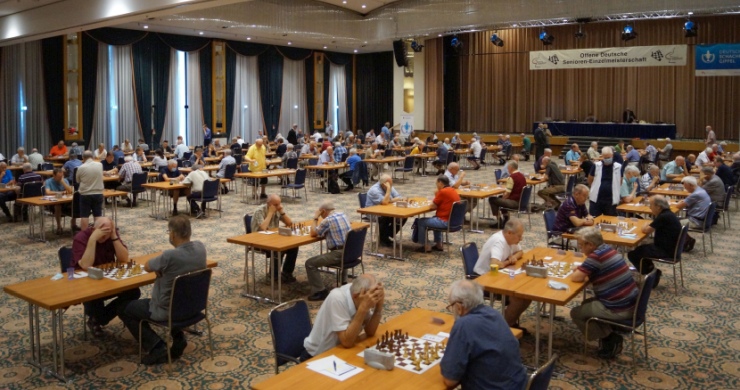
It was the first big chess event in Germany since the beginning of the Corona pandemic: the German Chess Championship Summit took place in Magdeburg from August 14th to 22nd and brought together amateurs, professionals, and officials in one place – of course with extensive safety and precaution measures. The highlight of the event, which was organized in 2019 for the first time, was the German Masters held in two sections: open and women’s tournaments. In each event, the eight strongest German players competed in a round-robin format for an unofficial title of the best chess player in the country. At the same time, the champions of the various German state associations also determined the German Champion and the German Women’s Champion who, in addition to the players seeded by rating, qualified for the Masters in the following year. GM Matthias Blübaum won the German Masters and became a new German number one in the Live Elo rating. WIM Fiona Sieber triumphed in the women’s event, despite being ranked the last on the starting list. The new champion overtook the bronze-winner of the Women’s European Championship 2019 and a former top-ten player IM Elisabeth Pähtz. The second youngest German Grandmaster Luis Engel qualified for the Masters 2021 after taking German Championship title and turning in an impressive performance of 2729. In total 10 tournaments took place at the summit this year: German Masters Women’s German Masters German Championship Women’s German Championship German Lightning Championship Women’s German Blitz Championship German Cup German Seniors Championship German Seniors Lightning Championship German Seniors Rapid Championship Besides, the German national team, which is currently competing at the FIDE Chess Olympiad, played their matches together during this summer forum. The summit was initially planned for May but had to be postponed due to Covid-19. The event became possible thanks to a safety concept found in cooperation with the city of Magdeburg. This included wearing a mask after leaving the board, regular airing, disinfection. No spectators were allowed to the playing venue.
FIDE on Chess ID Game Viewer Call for Offers Procedure
August 25, 2020 As per the timeline established by the Chess ID Game Viewer Call for Offers Procedure, the offer opening meeting took place at FIDE Headquarters in Lausanne, Switzerland. The offer opening panel included Mr. Willy Iclicki, FIDE Chief Operating Officer, Ms. Sava Stoisavljevic, Assistant to the FIDE COO, and Mr. Marco Verdoia, FIDE Marketing Director. FIDE thanks everyone who took interest in the Call for Offers. We will now proceed with further steps as scheduled. Offer Evaluation Committee
Online Olympiad: Top Division Round-up
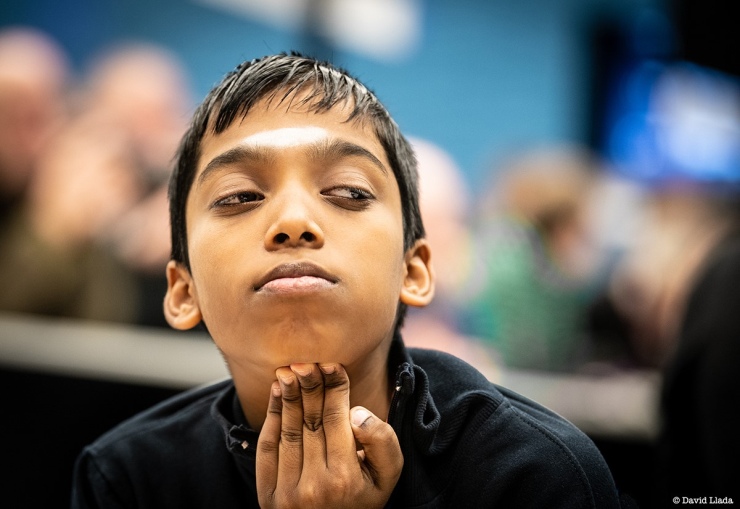
India overthrows China in Group A As it was expected, the top place in Group A of the Chess Olympiad would only be decided in the very last round, when China and India were scheduled to face each other. India beat China by 4-2 in the direct encounter, and thanks to this result India is the first team to qualify directly for the quarter-finals. China advances to the play-off stage. The four games on the top four boards ended in a draw, but India proved to be stronger on the under-20 boards, were Praggnanandhaa (pictured above) won against Yan Liu and Deshmukh Divya outplayed Jiner Zhu. Some of the youngest and more promising Grandmasters in the world are from India, and this enormous potential is already starting to show in international competitions. The Indian players were especially spurred after the technical difficulties that some of them experienced yesterday when Vidit and Humpy lost their games due to a power failure. This incident deprived the Indian team of a certain victory in a crucial match against Mongolia that could have cost them dearly. But the Indians didn’t lose heart and reacted in the best possible way, turning frustration into motivation. Before the decisive victory against China, India had also defeated another two strong opponents: Georgia (4-2) and Germany (4½-1½). Germany claimed third place and advanced to the play-off stage, despite collapsing in the last two rounds losing to India and Uzbekistan. Considering that the team could not count on some of its strongest players, making it into the playoff stage in this event is no mean achievement. Azerbaijan, Hungary, and Ukraine advance to the play-offs The most hard-fought and balanced group of the top division was decided by tie-breaks, as the top half of the table ended very tightly packed with five teams within 1-point of the leader. Azerbaijan, with 14 points, took the first place thanks to a strong performance on the final day and impressive total 37 board points out of 54 games. Hungary (14) and Ukraine (13) claimed second and third place respectively, and they advance to the playoff, while top-placed Azerbaijan is seeded directly into Quarter-finals. GM Teymour Radjabov (Azerbaijan) Kazakhstan and Spain, also with 13 points, had a worse tie-break than Ukraine, so they are out of the Olympiad. Sadly, the event says goodbye to Alexei Shirov, who emerged as one of the stars of the competition scoring 13/15 and exhibiting his characteristic fire-on-board style. With such a close finish, exciting was there until the very last minute. But actually, the key clashes happened in the first round of the day, when the top teams had to face each other: Azerbaijan defeated Spain (4-2), Ukraine won against the Netherlands (4½-1½) and Hungary prevailed over Kazakhstan (3½-2½). In the end, these three teams would be the ones to advance to the next stage. Ukraine was the top-seeded team in this group, despite the absence of Eljanov and the Muzychuk sisters, but they struggled a little and a last-round defeat against Kazakhstan was not the best possible ending. Ivanchuk did not play for the team in any of the day 3 matches, and it is not known whether he will be part of the line-up for the play-offs. Russia enters the quarter-finals Rampant Russia took clear first place in Group B of the Chess Olympiad, five points ahead of second-placed Bulgaria, after winning all nine matches. Team Russia played the most difficult match in Round 8 against the always-dangerous Armenia. In this decisive clash, all games ended in a draw except on board 5, where Alexey Sarana defeated Haik Martirosyan to tip the balance in favor of the Russians. So far, no other team in all the pools has been as effective and ruthless as Russia. Out of 54 individual games played, they have nicked 43.5 board points, with 37 victories, 13 draws and losing only four games. Bulgaria’s third board, Antoaneta Stefanova Bulgaria earned a surprising second place, despite being #7 in the initial rankings. The Bulgarians had a tough start suffering a severe defeat in Round 1 against Russia (4½-1½), but they bounced back right after their defeat, beating Armenia in Round 2 and did not look back after that. The team rounded up its solid performance by winning 5-1 against England in the last round. Armenia qualified for the play-offs finishing in third place, narrowly edging Romania on tie-break: both teams had 12 match points, but the Armenian players accumulated 37.5 “board points” against 33 by the Romanians. It is a bit surprising that one of the most successful nations in chess Olympiads found itself struggling to advance to the next stage. Armenia had finished Saturday’s session in second place, and today the team featured its main star Levon Aronian in all three matches, so everything seemed to be on track for them. However, they started the day with a shocking defeat against England (2½:3½), and in the next round bit the dust against Russia, so the situation got a bit worrisome. A 5-1 victory against Egypt in the last round saved the day for the Armenians. Romania played a good tournament, but they knew they had to face the “final boss” in the last round, and that’s where the team cracked and lost 1½ -4½ despite having winning positions on three boards. As for Croatia, they ended up in 5th place – winning all their three matches today did not help the team after a disastrous second day. USA progresses into quarterfinals, Greece and Poland advance to play-offs One could say there are no big surprises in Pool D of the Online Chess Olympiad, as three of the top five teams according to the initial ranking took the top three spots: USA, Greece, and Poland. However, the way things unfolded was a bit unexpected. The USA won its first six matches in succession, but the third day of play turned out to be much more difficult for them. First, the team lost to Poland in Round 8 then drew against Peru in Round 9. It was