

Steinitz Memorial: Carlsen and Kosteniuk lead after six rounds

Magnus means business Magnus Carlsen burst out of the blocks to grab the lead in a fiery Day 1 of the super-strong FIDE Steinitz Online Memorial. The Norwegian bullied his way to the top of the standings after six rounds of blitz as the tournament celebrating Wilhelm Steinitz, the first undisputed World Chess Champion, got under-way. Having goaded Peter Svidler on Twitter before the event started, Carlsen’s Round 1 encounter with the Russian ended in a draw – but only after a thrilling topsy-turvy game. Svidler could have won but missed a forced mate on move 37. Carlsen then made a shocking error of his own by missing a winning knight fork on 49.Nc2. But that draw just sparked Carlsen into life. The Norwegian made up for his blunder in the next game with a trademark grind to dispose of Le Quang Liem and take the lead. GM Peter Leko, commentating live on chess24, said: “I think in the last three years Magnus has made incredible steps forward in his preparation.” Round 3 saw a rejuvenated Carlsen going for a London System “beauty prize” against Mamedyarov after the Azerbaijani got into trouble early. Although Carlsen wobbled before he could pull off a quick win, he went on to secure victory and stay ahead of the pack. Meanwhile, 19-year-old Jeffery Xiong, playing on his first online super-tournament, also had a big win in Round 3 against Alexander Grischuk. Disaster then struck for Carlsen in Round 4 as the World Champion played a howler against Anton Korobov that left him with a hopeless task. “It does happen, it does happen to the very best as well. This is blitz,” said Leko. With four rounds gone, Korobov, Xiong and former World Rapid Champion Daniil Dubov caught up with Carlsen at the top on 2.5/4. Carlsen, however, wasn’t phased as he bounced back immediately with a smooth win over the Spaniard David Anton. Round 5 saw Dubov, the young Russian, dispatch fellow countryman Grischuk to keep the pressure on at the top. Xiong fell back with a tricky draw against Xiangzhi Bu and Korobov lost to drop out of the race. Then in the final round, Dubov’s unbeaten streak ended as he collapsed against Xiangzhi while Carlsen played out a draw against Grischuk to move into the lead. Carlsen goes into Day 2 a half-point ahead of the chasing pack. Kosteniuk dominates the women’s section Alexandra Kosteniuk, of Russia, was in blistering form as the FIDE Online Steinitz Memorial tournament kicked off with a series of hyper-aggressive games. The former World Women’s Champion went on a hot streak of five straight blitz wins as she demolished the field in the Women’s section. However, in a dramatic final game, Kosteniuk was pegged back to a draw by the promising 23-year-old Chinese Grandmaster Tingjie Lei. “It was a very high-quality game,” enthused GM Peter Leko, after the first of three days of blitz sessions. Kosteniuk leads a point and a half clear at the top of the table with Zhongyi Tan second on 4. The tournament is broadcast with commentary in multiple languages at www.Chess24.com/watch Schedule (all times are CEST): Friday, May 15th Saturday, May 16th Sunday, May 17th Rounds 1-6 Women:15:00 – 18:15 Rounds 7-12 Women:15:00 – 18:15 Rounds 13-18 Women:15:00 – 18:15 Rounds 1-6 Open:18:30 – 21:30 Rounds 7-12 Open:18:30 – 21:30 Rounds 13-18 Open18:30 – 21:30 More information at Chess24.com: FIDE Women’s Steinitz MemorialFIDE Open Steinitz Memorial
Rating analytics: Born in the same year – five-player teams
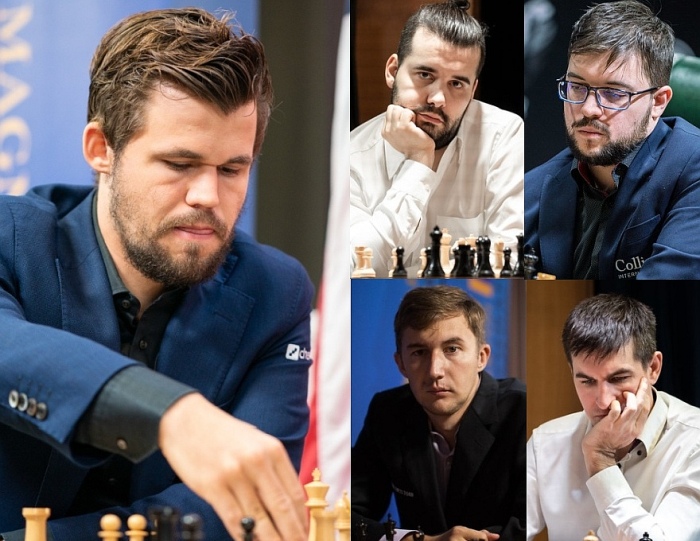
Kaspars Migla is the creator and founder of a chess website chessratings.top. In his column, he analyzes FIDE standard rating changes, career-highs, rating distribution by country, continent, region, and other rating-related statistics. In this edition, he focuses on the particular years that produced the greatest number of chess talents. More than ten years have passed since Magnus Carlsen topped the world rating. When looking at the list, we see not only the World Champion’s actual rating but also the year he was born – 1990. The portal chessratings.top made an attempt to find out whether this year is a special one and focused on the results of other highest-rated players born in 1990. In this research, we took five active players born in the same year and formed hypothetical teams by analogy with Chess Olympiads. We also compared 1990 with other years (both open and women sections) to see how players born earlier have been performing. Are there any other strong players born in 1990 apart from Magnus Carlsen? The answer is a definite yes! We are saying it with confidence because an average rating of the top-5 active players born in 1990 is whopping 2780.6. It means that a hypothetical “team 1990” has the highest rating compared to any other team consisting of players born in the same year. Below you can see the top-5 of teams comprising five players born in the same year (the first figure is the current ranking): Team 19901. Carlsen, Magnus (NOR) 28634. Nepomniachtchi, Ian (RUS) 27845. Vachier-Lagrave, Maxime (FRA) 277817. Karjakin, Sergey (RUS) 275222. Andreikin, Dmitry (RUS) 2726Average rating: 2780.6 Team 19879. Radjabov, Teimour (AZE) 276518. Nakamura, Hikaru (USA) 273625. Vitiugov, Nikita (RUS) 272228. Wojtaszek, Radoslaw (POL) 271934. Tomashevsky, Evgeny (RUS) 2706Average rating: 2728.6 Team 19836. Grischuk, Alexander (RUS) 277714. Dominguez Perez, Leinier (USA) 275847. Jakovenko, Dmitry (RUS) 268453. Sargissian, Gabriel (ARM) 268264. Bacrot, Etienne (FRA) 2673Average rating: 2714.8 Team 199410. Giri, Anish (NED, 2764)23. Vidit, Santosh Gujrathi (IND, 2726)33. Yu, Yangyi (CHN, 2709)48. Predke, Alexandr (RUS, 2684)65. Robson, Ray (USA, 2673)Average rating: 2711.2 Team 19922. Caruana, Fabiano (USA) 28353. Ding, Liren (CHN) 279182. Adhiban, B. (IND) 2659136. Heimann, Andreas (GER) 2633143. Yilmaz, Mustafa (TUR) 2630Average rating: 2709.6 Since the players born in 1990 reached an optimal “chess age” (30), many may take team 1990’s leading position for granted. That is not the case though. In reality the year 1990 was simply rich in chess talents. The same applies to 1983 and 1987. Looking at the same list but as of May 2010, we see the same teams in top-3 but in a different order: 1. Team 1983 2. Team 1987 3. Team 1990. Check out the leader as of May 1, 2010. Team 1983 7. Grischuk, Alexander (RUS) 27609. Eljanov, Pavel (UKR) 275118. Ponomariov, Ruslan (UKR) 273321. Jakovenko, Dmitry (RUS) 272526. Jobava, Baadur (GEO) 2715Average rating: 2736.8 Let’s rewind nine more years – Team 1969 was the best squad as of April 2001 (the ratings were not calculated in May): 3. Anand, Viswanathan (IND) 27947. Ivanchuk, Vassily (UKR) 273118. Dreev, Alexey (RUS) 268556. Piket, Jeroen (NED) 2628165. Korneev, Oleg (RUS) 2572Average rating: 2682 Garry Kasparov (born in 1963) was the rating leader back then (2822), but “his” team 1963 stood only third, trailing team 1975 (lead by Vladimir Kramnik and Veselin Topalov) and team 1971 (headed by Michael Adams). In the crosstable below, you can see the top teams year by year from 2001 to 2020 with their average rating and age. Carlsen’s team 1990 has been dominating since 2013, whereas team-leaders’ average rating increased by almost 100 points, from 2688.6 to 2780.6. It is also worth mentioning that nine years ago, in 2011 the chess elite was the youngest ever! Year Top team year Av.rating Av.age 2001 1969 2688.6 32 2002 1975 2682.6 27 2003 1969 2683 34 2004 1975 2679.4 29 2005 1969 2692.8 36 2006 1983 2701 23 2007 1983 2707.4 24 2008 1983 2711 25 2009 1983 2735.8 26 2010 1983 2736.8 27 2011 1990 2744 21 2012 1987 2743.4 25 2013 1990 2757.4 23 2014 1990 2773.4 24 2015 1990 2766.8 25 2016 1990 2771.4 26 2017 1990 2776.8 27 2018 1990 2773.4 28 2019 1990 2777.6 29 2020 1990 2780.6 30 When it comes to women there is no such a gap between the youngest age group and all the others. Interestingly enough, the team of the current rating leader Hou Yifan (CHN, 2658), who was born in 1994, did not “qualify” for the top-3. Team 19914. Ju, Wenjun (CHN) 25609. Harika, Dronavalli (IND) 251510. Tan, Zhongyi (CHN) 251021. Girya, Olga (RUS) 246942. Ding, Yixin (CHN) 2422Average rating: 2495.2 Team 19872. Koneru, Humpy (IND) 25868. Dzagnidze, Nana (GEO) 252426. Batsiashvili, Nino (GEO) 245738. Munguntuul, Batkhuyag (MGL) 242847. Zawadzka, Jolanta (POL) 2419Average rating: 2482.8 Team 198515. Zhao, Xue (CHN) 248618. Pogonina, Natalija (RUS) 247519. Paehtz, Elisabeth (GER) 247350. Ushenina, Anna (UKR) 2416117. Lujan, Carolina (ARG) 2346Average rating: 2439.2 In May 2010, when legendary Judit Polgar was still active, two teams (see below) had an average rating of 2500+. None of the current team-leaders managed to climb that high. Team 19761. Polgar, Judit (HUN) 268222. Xu, Yuhua (CHN) 248427. Zhu, Chen (QAT) 247635. Gaponenko, Inna (UKR) 246536. Skripchenko, Almira (FRA) 2464Average rating: 2514.2 Team 19855. Kosintseva, Nadezhda (RUS) 255314. Pogonina, Natalija (RUS) 250117. Zhao, Xue (CHN) 249320. Paehtz, Elisabeth (GER) 248532. Ushenina, Anna (UKR) 2468Average rating: 2500 Team 1976 was the best in 2001 with an average rating exceeding a 2500 mark: 1. Polgar, Judit (HUN) 26764. Zhu, Chen (CHN) 25387. Xu, Yuhua (CHN) 250124. Skripchenko, Almira (MDA) 244161. Gaponenko, Inna (UKR) 2373Average rating: 2505.8. It is time to apply the same principle to various countries. Probably chess historians know whether there was a team at Chess Olympiad with all players born in the same year. It is highly unlikely but not impossible, at least theoretically. Moreover, one such hypothetical team would have a chance to be in a contest for medals. We are talking about the country replete with talented players born in 1990, namely, Russia. Russia 1990Nepomniachtchi, Ian (RUS) 2784Karjakin, Sergey (RUS) 2752Andreikin, Dmitry (RUS) 2726Popov, Ivan (RUS) 2636Lintchevski, Daniil
FIDE announces Checkmate Coronavirus project

The Coronavirus pandemic has caused an unprecedented global crisis. In support of efforts of national governments and people around the world, the International Chess Federation, FIDE, has decided to promote an online international chess initiative supporting spending long hours at home. The goal of the initiative is also to promote the ideals of unity and solidarity, which must be manifested in such challenging times. From May 18 until June 16, FIDE will join forces with major internet chess platforms in organizing more than 2,000 online tournaments. “Checkmate Coronavirus” tournaments will be played at lichess.org, chess.com, chess24.com, and FIDE Online Arena. There will be almost 80 tournaments a day aimed at all chess players, regardless of age, country, or level of play. There will also be a prize draw with 1,500 special prizes. Inspired by the Olympic motto (not to win but to take part), we want to give a winning chance to everyone and to reward involvement and participation. The major prize will consist of at least 64 one-week invitations to the 2021 Chess Olympiad in Moscow with flight and lodging expenses fully covered. Other prizes include souvenirs, tickets to chess workshops, and mini-matches with grandmasters. On our website (www.checkmatecoronavirus.com) you can find a full schedule where you can choose the tournament type and preferred platform. On www.checkmatecoronavirus.com you can also check out if you have won any of our special prizes. Remember, the more tournaments you play – the bigger your chances to win! Join this worldwide chess initiative! Take part in the biggest official event in terms of participation and non-stop games running, by any sports federation, ever! And remember – you can play any time on any platform. Your results do not matter, you can win great prizes anyway! Stay safe and play chess online! Let’s checkmate coronavirus!
$1 million Magnus Carlsen Tour: A new era in chess

World Champion Magnus Carlsen revealed his $1 million vision for a new online chess tour designed to cement the game’s future in the public eye. Four super-tournaments culminating in a Grand Final in August will become the new “majors” for online chess, the Magnus Carlsen Chess Tour. It follows the breakthrough success of the Magnus Carlsen Invitational which shattered all records for online viewership and now serves as the first leg of the Tour. Carlsen believes carrying the momentum into an online Tour presents the opportunity to establish chess permanently as a mass media sport. The World Champion said: “The Invitational was a lot of fun and we heard great feedback from the players, our broadcast partners, and the viewers. While physical chess tournaments and sports are still either canceled or postponed, bringing an entire chess tour online is what I feel is right for chess now.” The Invitational was the first online chess tournament to be broadcast on TV. It went out on Spanish, German, Russian, and Czech TV and was covered live on Norway’s biggest commercial channel. The Tour will continue to bring exciting chess entertainment to viewers via TV, streaming services, and on www.chess24.com throughout the summer. Tour Schedule Magnus Carlsen Invitational: Apr 18 – May 3 Lindores Abbey Rapid Challenge: May 19 – June 3 Online Chess Masters: June 20 – July 5 Legends of Chess: July 21 – August 5 Tour Final: August 9 – August 20 The top four players of each tournament are guaranteed a place in the following one. The Grand Final will be played among the winners of the individual tournaments. The combined prize fund is $1 million, the highest ever in online chess. The next tournament, the Lindores Abbey Rapid Challenge, starts on May 19. The name builds on the heritage of the Lindores Abbey Chess Stars, a Scottish super-tournament held for the first time last year with Magnus Carlsen, Vishy Anand, Sergey Karjakin, and Ding Liren taking part. This physical tournament has now moved online to join the Magnus Carlsen Chess Tour and is associated with the Lindores Abbey Heritage Society, which maintains the historic site. Under the tournament’s social media hashtag #HeritageChess, fans can learn more about every participating player and his country’s chess history. It is an effort to show the rich heritage of chess on which the players’ careers have been built. The Lindores Abbey Rapid Challenge will feature four returning players from the Magnus Carlsen Invitational: Magnus Carlsen, Hikaru Nakamura, Ding Liren, and Alireza Firouzja. Eight new players will be introduced: Wesley So, Alexander Grischuk, Sergey Karjakin, Levon Aronian, Wei Yi, Daniil Dubov, Jan-Krzysztof Duda, and Yu Yangyi. Chess24 will cover every tournament in nine languages, with commentary beginning at 3 PM CEST each tournament day. The official home of the Magnus Carlsen Chess Tour is chess24.com/tour. FOR MORE INFORMATION:Leon Watsonleon@chessable.com+447786 078770
Alexander Grischuk wins Play for Russia charity tournament
The Play for Russia Charity Tournament played on lichess.org, ended on May 14, with a determined Alexander Grischuk overcoming first Vladimir Kramnik and then Evgeny Tomashevsky to win the event. Facing Vladimir Kramnik, Grischuk seemed to have his work cut out for him when he lost the first semi-final game with the white pieces. In a must-win situation, Alexander scored an extremely important victory in the second game with Black – ensuring the two played an Armageddon decider. Kramnik chose to play with black pieces, needing just a draw to secure his slot in the final. Facing a must-win situation once again Grischuk played valiantly, and after obtaining a better position he finished things off with winning tactics. A distraught Kramnik had to step away from the computer briefly, before conceding defeat. When talking with GM Evgenij Miroschnichenko and WIM Fiona Steil-Antoni on the Lichess stream later, Alexander remarked that he felt these two games against Kramnik were the “cleanest” and “most beautiful” games he played in the entire event. Photo: Theo Heinze With Kramnik eliminated, on the other side of the draw the two-time Russian champion, Evgeny Tomashevsky, faced off against eight-time Russian champion, Peter Svidler. Playing precise and positional chess, Tomashevsky secured a convincing win in his first game and then drew the second – guaranteeing his place in the final with Grischuk. The final match took only three games instead of four, with Grischuk emerging victorious in each encounter. After a fiercely contested battle in the first game in which Tomashevsky at some point had an upper hand, Grischuk came out with a victory – following up quickly on his success in the second encounter. Evgeny had better chances in the third game but mishandled his position in the time scramble and eventually lost. Alexander Grischuk: “All three final games turned out to be very complex. Evgeny had an advantage both in the first and third games, and the second one was more or less equal. I was lucky to win. But the most important thing was that this event took place in general. The struggle was very exciting in all its stages. I’d like to thank the participants, everyone involved, everybody who gave donations and, of course, Vladimir Kramnik as he was the main initiator of the event.” Photo: Maria Emelianova By the end of the event, a massive 24,670,000 roubles ($335,000) was raised as donations for Russian charities, in the battle against COVID-19. Grischuk shared that the impact homeless are feeling right now was an issue close to his heart – and that he had chosen a nationwide Russian charity to receive the part of the prize fund he represented. The prize fund, raised by the participants was distributed equally among the charities of their choice regardless of the final standings. Whilst the event and the excitement of top-level chess is now over, donations will still be accepted by the Russian Chess Federation until the end of the week. Further information on how to donate and the biggest sponsors are available on the Russian Chess Federation’s website. A massive thank you to all sponsors, players, organizers, and chess fans who made this amazing and worthwhile event a true success. The tournament was initiated by the participants and organized with the support of the Chess Federation of Russia, the Ministry of Sports of the Russian Federation, the Timchenko Foundation, the Ramax group of companies, and Gazprombank (Switzerland). Match TV, a media partner of the tournament, provided the coverage and live broadcast. Text: lichess.org
Kramnik, Svidler, Tomashevsky and Grischuk through to semifinals
The Chess Federation of Russia and the Ministry of Sports of the Russian Federation combined efforts to support the first charity online tournament initiated by Russian chess players. The event is being played on lichess.org in a 5+2 blitz format and features the country’s strongest grandmasters. The entire prize pool ($330,000 already raised so far) will be donated to regional hospitals and health workers fighting the COVID-19 pandemic. The participants will determine the recipients of the donations beforehand, depending on the needs of a particular institution. The entire prize fund is distributed equally among the regions, regardless of the final standings. More details and how to donate can be found on the Russian Chess Federation’s website (EN). The first day of the Play for Russia charity event left chess fans spoilt for choice, with firework matches like Grischuk vs Riazantsev, to classic match-ups like Kramnik vs Svidler. Alexander Grischuk, the three-time World Blitz Champion, was undefeated on day 1, with wins against Riazantsev, Svidler, Karjakin, and Kramnik – and draws against the rest of the field. Such a commanding performance gave Grischuk the lead on the first day, with 5.5/7. Despite retiring from professional chess in 2019, Vladimir Kramnik, the three-time World Champion, was hot on Grischuk’s heels, with four wins (including victories against podium-placer Tomashevsky, and one of the favorites, Ian Nepomniachtchi) and two draws. Kramnik drew laughs and smiles after announcing chess is “only a hobby” for him these days – with an excellent performance of 5/7 showing the truth of “once a World Champion, always a World Champion”. Two-time Russian champion, Evgeny Tomashevsky, finished the first day on third position (4/7) with victories over Ian Nepomniachtchi and Ernesto Inarkiev and the only loss to Kramnik. Sergey Karjakin, Ian Nepomniachtchi, and Peter Svidler (3/7 each) remained in contention and even Ernesto Inarkiev and Alexander Riazantsev (scoring 2.5/7 and 2/7 respectively) still had a chance to qualify for the semifinals. The second day of the event was even more eventful as Vladimir Kramnik overtook Alexander Grischuk to win the double round-robin overall with a dominating 10.5/14. Peter Svidler had a great second day as he scored six points in seven rounds and found himself in the second position of the final standings. After a great start, Alexander Grischuk slowed down drastically but still made it to the next stage although in the semifinal he is up against the most dangerous opponent Vladimir Kramnik. Evgeny Tomashevsky turned in an equally solid performance as on the first day and edged ahead of Grischuk thanks to better Sonneborn-Berger. Today, the four best performers from the double round-robin will play semi-finals and finals to determine Play for Russia Champion. Just like on the first two days WIM Fiona Steil-Antoni and GM Evgenij Miroschnichenko will be providing English commentary of the games on the Lichess Twitch and YouTube for Day 3. Russian commentary will be available on MatchTV (Russian TV-channel). Semifinal and final matches – 14 May 2020: 12:00 GMT:Vladimir Kramnik v Alexander Grischuk Alexander Grischuk v Vladimir Kramnik 13:00 GMT:Peter Svidler v Evgeny TomashevskyEvgeny Tomashevsky v Peter Svidler 14:00 GMT:Finalist 1 v Finalist 2Finalist 2 v Finalist 1Finalist 1 v Finalist 2Finalist 2 v Finalist 1 If scores are equal, an Armageddon round will be played. Standings after 14 rounds: Position Participant Points / 14 1. Vladimir Kramnik 10.5 2. Peter Svidler 9 3. Evgeny Tomashevsky* 8 4. Alexander Grischuk* 8 5. Sergey Karjakin 7.5 6. Ernesto Inarkiev 5.5 7. Ian Nepomniachtchi 5 8. Alexander Riazantsev 2.5 * Sonneborn-Berger was used Text: lichess.org
#05
China wins the FIDE Chess.com Online Nations Cup Carlsen and Lagno to star in FIDE Steinitz Memorial Upcoming FIDE Trainer Seminars Announcing the FIDE Online Cup for Players with Disabilities Success story: US Chess Women & “Isolated Queens” Anniversaires READ NEWSLETTER
China clinches title at the FIDE Chess.com Online Nations Cup

China held the USA to a 2-2 draw in the superfinal match, a result that was enough to secure the title thanks to its superior performance in the round-robin stage: having won the first part of the competition by a four points margin, China had draw odds in its favor. Team USA was forced to win the match, but after Hikaru Nakamura drew against Ding Liren, Yu Yangyi scored the decisive victory by beating Wesley So in a very impressive style. Irina Krush, playing with the white pieces, was never in trouble against the world’s best woman chess player Hou Yifan, but she didn’t have the chance to press for a victory either. Fabiano Caruana scored the only victory for team USA, but by the time he finished his game the title had already been decided in China’s favor. Yu Yangyi, China’s third board, turned in a very strong performance, scoring a total of 7½ points out of 10 games (six victories, three draws, one loss). However, the symbolic “most valuable player” title goes to Fabiano Caruana of the USA. Playing on board two, Caruana went through the event undefeated and scored six wins and three draws. The tournament took place May 5-10, 2020. The group stage run May 5-9, with two rounds per day, while the Superfinal was played today, May 10. The event was broadcast live across multiple outlets including FIDE’s and Chess.com’s own channels across Twitch, YouTube, Mixer, Twitter, and other international streaming platforms. With an estimated audience of several million worldwide, commentary by chess experts was conducted in multiple languages, including English, Spanish, Russian, Mandarin, French, German, Portuguese, Italian, Turkish and Polish. More information in our initial press release about the event. FIDEwww.fide.comDavid Lladapress@fide.com+34 623 021 120 CHESS.comwww.chess.comNick Bartonnick@chess.com
FIDE Chess.com Online Nations Cup: Schedule and Results

The Superfinal match China – USA ended in a draw 2-2 but it was enough for China as the team won the round-robin stage. Congratulations! Ding Liren ½ – ½ Hikaru NakamuraWei Yi 0-1 Fabiano CaruanaYu Yangyi 1-0 Wesley SoHou Yifan ½ – ½ Irina Krush The tournament takes place May 5-11, 2020. The group stage runs May 5-9, with two rounds per day. The Superfinal is played on May 10. The games start 15:00 CEST / 9 a.m. Eastern / 6 a.m. Pacific. China and the USA qualified for the Superfinal. FIDE Chess.com Online Nations Cup pairings and results: May 05, 2020 Round 01 Round 02 May 06, 2020 Round 03 Round 04 May 07, 2020 Round 05 Round 06 May 08, 2020 Round 07 Round 08 May 09, 2020 Round 09 Round 10 Teams China, with an average rating of 2717, is followed in the initial ranking by Europe (2687), Russia (2662), USA (2641), India (2605), and the “Rest of the World” team (2597). The Chinese team is headed by Ding Liren and Wang Hao, the world’s numbers three and twelve respectively. They are two of the eight players who are currently a part of the Candidates tournament – the final stage which decides who will be the finalist in the World Championship Match. But the main news is the return of Hou Yifan to the Chinese national team. The four-time World Champion is a former prodigy and the youngest female player ever to achieve the Grandmaster title. Two years ago Hou won the prestigious Rhodes Scholarship to study at Oxford University and put her career on hold, but she is still the highest-ranked female player in ranking. Hou Yifan’s temporary return to the board might imply that the reigning Women’s World Champion, Ju Wenjun, is sent to the bench. CHINA Captain: Ye Jiangchuan Std. Rpd. Ding Liren 2791 2836 Wang Hao 2763 2750 Wei Yi 2732 2752 Hou Yifan 2658 2621 Yu Yangyi 2709 2738 Ju Wenjun 2560 2610 2.702,17 2.717,83 Maxime Vachier-Lagrave, from France, will be leading a super-strong European team that also includes Levon Aronian, Anish Giri, and Anna Muzychuk, with Jan-Krzysztof Duda and Nana Dzagnidze as reserve players. But even the best players of the moment are slightly overshadowed when the team captain is a living legend like Garry Kasparov. The multiple-time world champion, who ruled the world of chess for two decades, put an end to his career in 2005 and has barely taken part in any competitive chess activity ever since. His presence in this event, even if only as a team captain, has been a pleasant surprise to chess fans all over the world. EUROPE Captain: Garry Kasparov Std. Rpd. Maxime Vachier-Lagrave 2778 2860 Levon Aronian 2773 2778 Anish Giri 2764 2731 Anna Muzychuk 2535 2533 Jan-Krzysztof Duda 2753 2774 Nana Dzagnidze 2524 2447 2.687,83 2.687,17 Russia no longer dominates the chess world as it once did, but even with the absence of some important players – like Alexander Grischuk and Kateryna Largo – the Russian team cannot be ruled out as a possible winner. Ian Nepomniachtchi has proven to be in great shape recently, and he will be defending the first board, along with Vladislav Artemiev, Sergey Karjakin, and Aleksandra Goryachkina. With Dmitry Andreikin and Olga Girya as reserve players, Russian is still a formidable rival, with great team spirit. RUSSIA Captain: Alexander Motylev Std. Rpd. Ian Nepomniachtchi 2784 2778 Vladislav Artemiev 2716 2769 Sergey Karjakin 2752 2709 Aleksandra Goryachkina 2582 2502 Dmitry Andreikin 2726 2740 Olga Girya 2469 2471 2.671,50 2.661,50 The USA, winners of the 2016 Olympiad, brings to the competition all their top guns, starting with the world’s number two Fabiano Caruana. With him, Hikaru Nakamura, who is considered one of the biggest specialists in fast time controls, and the Fischer Random World Champion Wesley So. The team is completed by two experienced female players – Irina Krush and Anna Zatonskih, plus the Cuban-born Leinier Dominguez, who has represented the US Chess Federation since 2018. USA Captain: John Donaldson Std. Rpd. Fabiano Caruana 2835 2773 Hikaru Nakamura 2736 2829 Wesley So 2770 2741 Irina Krush 2429 2392 Leinier Dominguez Perez 2758 2786 Anna Zatonskih 2420 2327 2.658,00 2.641,33 India will be led one more time by the legendary Viswanathan Anand who, despite having reached the age of 50 in November, is still one among the top 15 players in the world – and remains as dangerous as ever when it comes to rapid play. It is a bit paradoxical that the average age of this team is the highest in the event when India is producing more young chess prodigies than any other country in the world. But the young Indian cubs are not ready yet to make it into the national team: the generational changeover will have to wait a bit more. INDIA Adviser to the team:Vladimir Kramnik Std. Rpd. Viswanathan Anand 2753 2751 Vidit Gujrathi 2726 2636 Pentala Harikrishna 2719 2690 Humpy Koneru 2586 2483 Adhiban Baskaran 2659 2624 Harika Dronavalli 2515 2450 2.659,67 2.605,67 The “Rest of the World Team” is, as it would be expected, the most colorful one, including players from Azerbaijan, Iran, Egypt, Peru, Ukraine, and Kazakhstan. On top of the list, the winner of the 2019 FIDE World Cup, Teimour Radjabov. With him, one of the main attractions of the event, the 16-year-old prodigy from Iran, Alireza Firouzja. The teenager is developing a rivalry with the World Champion Magnus Carlsen that is becoming more and more serious by the day, and probably all eyes will be on him, as he will be taking on some of the very top players in the world during this event. The team also features the best African player of all times, Bassem Amin, one of the biggest talents from South America, Jorge Cori, a former Women’s World Champion, Mariya Muzychuk, and the Kazakhstani star Dinara Saduakassova. The FIDE President, Arkady Dvorkovich, will be acting as a captain for this team. REST OF THE WORLD Captain: Arkady Dvorkovich Std. Rpd. Teimour Radjabov 2765 2758 Alireza Firouzja 2728 2703 Bassem Amin 2686 2608 Mariya Muzychuk 2544 2506 Jorge Cori 2652 2599 Dinara Saduakassova 2500 2412 2.645,83 2.597,67 The tournament will be broadcast live across multiple outlets including FIDE’s and Chess.com’s own channels
FIDE Chess.com Online Nations Cup: China and USA meet in Superfinal
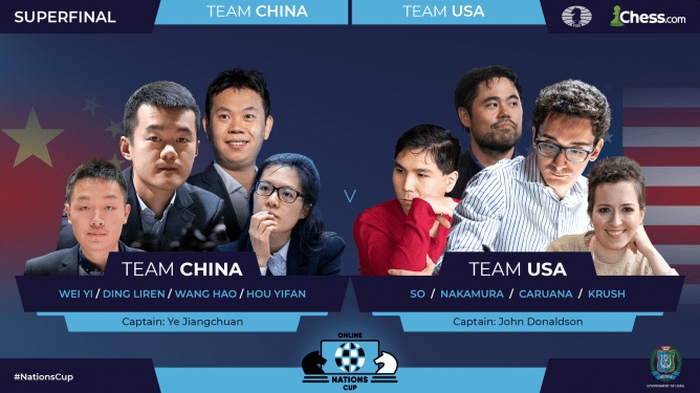
China and the USA are the teams that will face each other in Sunday’s Superfinal of the FIDE Chess.com Online Nations Cup. In a dramatic turn of events, the USA lost in the 9th round against its direct rival, Europe, but then defeated China in the 10th and final round to get their ticket to the final. Despite beating the USA in both their direct encounters, Europe lost its chance of reaching the final by drawing against the “Rest of the World” team in the very last round. FIDE Chess.com Online Nations Cup final standings: Round 9 The big clash between the USA and Europe was likely going to decide the fight for second place, considering the pairings for the final round where the USA would face the leader China, while Europe would play the Rest of the World. After three tense games on the top three boards, where Maxime Vachier-Lagrave was closest to a win vs. Hikaru Nakamura, it was the ladies’ board where this key match was decided. Nana Dzagnidze always had a slight edge and eventually outplayed Irina Krush in a rook endgame. With no chance for qualifying for the final, team captain Vishy Anand and player Vishy Anand must have agreed that he could take the day of. Meanwhile, Yu Yangyi was the absolute star player of this event, at least for nine rounds. He improved his score even further to 6.5/8 with another excellent win, this time against Baskaran Adhiban. In a match that was only played for the history books, Sergey Karjakin learned the hard way how fast Alireza Firouzja has improved lately, as he was completely outplayed and then beaten in a kingside attack. Round 10 Europe was going into the final round a match point ahead of the USA, and as said, with a much better pairing. But the unthinkable happened. While Europe couldn’t win their match, the USA did manage. After the team exchanged blows on first and second boards, Wesley So became the first player to beat Yu in this tournament, and with that win, he secured two match points for the USA. Where did it go wrong for Europe? As always, it’s a team effort but the one board that went lost was Levon Aronian‘s game with Firouzja. Unfortunately, for Aronian and his team, the Iranian star had his best day of the event as he scored 2/2 with two fine games. In another match where not much was at stake, Vladislav Artemiev stole the show with a flashy attack on Vidit Gujrathi’s king: 22. Rxa7+! Kxa7 23. Qa3+ Kb6 24. Qb4+ Kc6 25. Qb7+ Kxc5 26. Bb4# 1-0 Tomorrow’s Superfinal will start an hour later, so 7:00 a.m. Pacific / 10 a.m. Eastern / 16:00 CEST. China will have white on boards one and three. As the winner of the round-robin, China got to choose and also has draw odds in the one match that is the final. In other words, the USA needs to do again what no other team managed: beat China. Again. The tournament is being broadcast live across multiple outlets including FIDE’s and Chess.com’s own channels across Twitch, YouTube, Mixer, Twitter, and other international streaming platforms. With an estimated audience of several million worldwide, commentary by chess experts will be conducted in multiple languages, including English, Spanish, Russian, Mandarin, French, German, Portuguese, Italian, Turkish, and Polish. You can watch live broadcasts and replays on FIDE YouTube channel: https://www.youtube.com/watch?v=hmDtpw5HJEQ Text: Peter Doggers (chess.com) FIDEwww.fide.comDavid Lladapress@fide.com+34 623 021 120 CHESS.comwww.chess.comNick Bartonnick@chess.com