

Rating analytics: Top 10 in the retrospect 2001-2020 Part 2
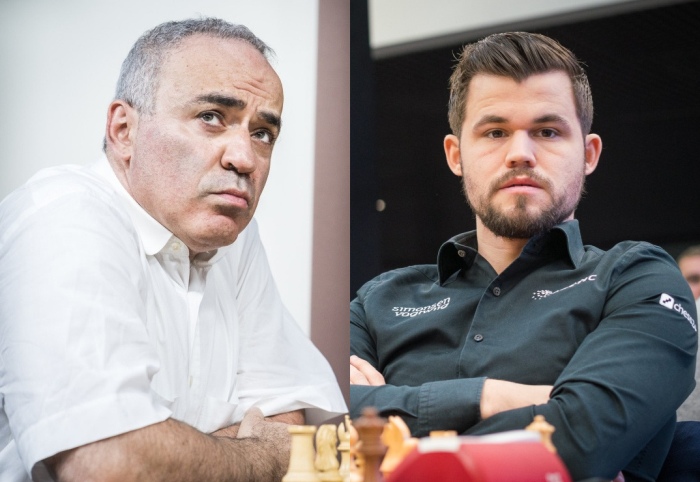
Kaspars Migla is the creator and founder of a chess website chessratings.top. In his column, he analyzes FIDE standard rating changes, career-highs, rating distribution by country, continent, region, and other rating-related statistics. In the first part of his historical research, he analyzed at the Top 10 of both Open and Women ratings over the 19-year period. In the second part, he looks at the countries delegating most players into the Top 10 as well as the leaders of the rating over 19 years. The number of countries delegating players to the Top 10 Open and Top 10 Women since 2001 is similar – 18 countries and 38 representatives (open) and 17 counties and 43 representatives (women). Number of players in the Top 10 by country since 2001 Open Russia 10Ukraine 3Azerbaijan 3China 3USA 3India 2Netherlands 2France 2Bulgaria 1England 1Hungary 1Israel 1Spain 1Armenia 1Norway 1Slovakia 1Italy 1Cuba 1 Women China 12Russia 8Georgia 5Ukraine 3India 2USA 2Hungary 1Sweden 1Moldova 1Bulgaria 1Romania 1France 1Armenia 1Slovenia 1Lithuania 1Germany 1Kazakhstan 1 As you can see Russia dominates the open section delegating into the Top 10 more than three times as many players as its closest rivals tied for the second place (Ukraine, China, Azerbaijan, and the USA). On the women’s side, the situation is not so lopsided – the first three positions are occupied by China, Russia, and Georgia. Interestingly enough, the players who represented Cuba and Italy when making it into the Top 10 of the Open rating currently play under the US banner: back in 2012 Fabiano Caruana (Italy) made his debut in the Top 10; in 2014 Leinier Dominguez Perez (Cuba) did the same. Which country will be next on the list? Poland looks like a very strong candidate as Jan-Krzysztof Duda (#16 in the world) is rapidly climbing the ratings ladder. On the women’s side, two countries from the bottom joined the list not long ago. Elizabeth Paehtz broke into the Top 10 two years ago, whereas Dinara Saduakassova joined the elite club this year. The next reasonable country-candidate is Iran with Sarasadat Khademalsharieh being #14 in the Women’s rating. Let’s check out what GMs have appeared in the Top 10 most often since 2001. Naturally, young players have an advantage here because monthly rating lists have been published since June 2012. It makes little sense analyzing calendar periods, because if a player falls out from the Top 10, then gets back, then drops out again and returns, then he or she is not on the list for the entire period. With this in mind, we will focus on the number of times a particular player was in the Top 10 (the players from the current top 10 are marked with an asterisk) Open Viswanathan Anand (IND, 2753) 130Vladimir Kramnik (RUS, 2753) 129Magnus Carlsen (NOR, 2863) 117*Levon Aronian (ARM, 2773) 114*Fabiano Caruana (ITA/USA, 2835) 94*Veselin Topalov (BUL, 2735) 90Hikaru Nakamura (USA, 2736) 79Alexander Grischuk (RUS, 2777) 70*Shakhriyar Mamedyarov (AZE, 2764) 64*Wesley So (USA, 2770) 57*Maxime Vachier-Lagrave (FRA, 2778) 57*Sergey Karjakin (RUS, 2752) 57 Women Humpy Koneru (IND, 2586) 126*Yifan Hou (CHN, 2658) 123*Anna Muzychuk (SLO/UKR, 2535) 114*Kateryna Lagno (UKR/RUS, 2546) 110*Judit Polgar (HUN, 2675) 90Nana Dzagnidze (GEO, 2524) 90*Alexandra Kosteniuk (RUS, 2471) 90Wenjun Ju (CHN, 2560) 88*Viktorija Cmilyte (LTU, 2538) 68Mariya Muzychuk (UKR, 2544) 62* No less important is how many times in a row a particular player has held his position in the Top 10. Open: Magnus Carlsen (NOR, 2863) 117*Viswanathan Anand (IND, 2753) 96Fabiano Caruana (ITA/USA, 2835) 85*Vladimir Kramnik (RUS, 2753) 79Hikaru Nakamura (USA, 2736) 68Levon Aronian (ARM, 2773) 56*Maxime Vachier-Lagrave (FRA, 2778) 52*Veselin Topalov (BUL, 2735) 44Wesley So (USA, 2770) 38*Peter Leko (HUN, 2663) 37 Women: Yifan Hou (CHN, 2658) 122*Anna Muzychuk (SLO/UKR, 2535) 114*Humpy Koneru (IND, 2586) 104*Judit Polgar (HUN, 2675) 90Wenjun Ju (CHN, 2560) 75*Mariya Muzychuk (UKR, 2544) 56*Nana Dzagnidze (GEO, 2524) 54*Kateryna Lagno (UKR/RUS, 2546) 53*Alexandra Kosteniuk (RUS, 2471) 48Viktorija Cmilyte (LTU, 2538) 40 It is time to say a couple of words about the leaders. Magnus Carlsen has topped the list for ten years. He passed Topalov in January 2010 and never looked back. The only question that matters, how big his margin from the second place has been. It looks highly unlikely that anyone will be able to outperform the current leader in the nearest future. Just a quick reminder to younger generations… Between two eras of Kasparov and Carlsen, three players, namely Anand, Topalov, and Kramnik also climbed to the very top. That makes five people, but in women’s chess situation is quite different as we see only two names at the top spot over the last 20 years. The transition happened in March of 2015 when Judit Polgar (with rating 2675) passed on the baton to Hou Yifan (with rating 2686). Ironically, it has been Hou’s highest career rating so far. Carlsen became the leader of the open rating aged 19, Hou Yifan did it on the women’s side when she was 21. Who will be next? Photo: Lennart Ootes
Carlsen and Nakamura square off in MCI Final

Hikaru Nakamura and Magnus Carlsen are through to the Magnus Carlsen Invitational final after winning incredibly tense battles against Fabiano Caruana and Ding Liren respectively. On Sunday the event ends with a $115,000 final ($70,000 for the winner, $45,000 for the runner-up), where Magnus takes on perhaps his greatest historic rival in speed chess. Hikaru Nakamura – Fabiano Caruana: 4-2 The day started slowly but suddenly became epic in the 4th game when Fabiano managed to win on demand to force playoffs. Hikaru was distraught and admitted, “everything was starting to spiral out of control”, but a blunder by Caruana in the first blitz game was the boost he needed. It was no surprise that the first games were cautiously played. Hikaru Nakamura later said that he’s used to being tested with the black pieces against Fabiano Caruana, but not today: “it felt to me that in this match he wasn’t putting pressure on me with White, and because of that I felt much more comfortable than I usually do against him”. In the first game, Fabiano got nothing with White, and in fact, it was Hikaru who could dream of more before the game fizzled out into a draw. The second game was also quiet, but the commentators felt that Nakamura got an almost dream version of the Exchange Slav. It was all about the weak b5-pawn until Hikaru finally grabbed it with 51.Qxb5?, seemingly overlooking the simple fork. He managed to gather himself again and after 51…Na3 52.Qb3 Nxb1 it turned out that the zwischenzug 53.exf5! (53.Qxb1? h4! and Black wins) gave him just enough counterplay against the black king to go on to force a draw by perpetual check. The third game was another Giuoco Piano, but it ended up being anything but quiet. Magnus later explained that although computers always give White some kind of edge, “these are the kinds of position which aren’t easy to play for White”. If Fabiano had played 26.Be6 we might have got a quick draw by repetition. He preferred a much more ambitious continuation 26.Qc2 but after 26…Nh4! (the move Nakamura assumed his opponent missed) Black was suddenly much better, and in a few moves, White was dead lost. “It’s inexplicable… he just didn’t sense the moment,” Magnus commented, as Fabiano found himself a point down before having the black pieces in the 4th game. The fourth rapid game, a must-win encounter for Caruana, turned into an epic. Peter Svidler described it as “unbelievably tense” and Magnus Carlsen ultimately summed up, “that was amazing!” Fabiano Caruana played a version of the King’s Indian that was a feared weapon of choice for the young Nakamura, and the position he got was the kind Hikaru used to relish. Black began to punch holes in the white position, though it was too close to call until Caruana finally began to demolish the white kingside: 48…Bxh4! 49.gxh4 was the brutal force required, but what really impressed were the “quiet” follow-up moves: 49…Qf6! 50.Kg1 Qxh4 51.Qd2 Kg6! and soon things were falling apart for Nakamura. That meant that for the first time in the Magnus Carlsen Invitational we were going to blitz playoffs since up to two pairs of 5+3 blitz games would be played before Armageddon. The players had little time to cool down, and Hikaru admitted he hadn’t got his nerves under control. He nevertheless seized control again with Black, but he lamented that 33…d4? 34.Bd2! (the move he’d missed) spoilt his position. The climax of the whole match came twelve moves down the road when Fabiano was down to under 30 seconds on his clock. The commentators and Hikaru spotted the option of 46.Nf6+, which Hikaru thought was simply winning. In fact after 46…Nxf6 47.Rh8+ Kxh8 48.Qxg6 there’s no need whatsoever to resign. Instead, Fabiano played 46.Rc8, a move that may objectively be stronger, but it seems he missed the point of 46…Nf8: 47.Rxc6?? was just a blunder, since after 47…Qxc6 there’s no mate with 48.Nf6+ because the f8-knight is covering the h7-square. Fabi played 48.Ng5+ but resigned shortly afterward. That meant Caruana needed to win on demand again with the black pieces, and at some point, it looked as though he might. “Even though it’s fine objectively… it’s just so stupid”, said Hikaru of his 16.Bc6!?, but although the game was tense Fabiano never really got any control, and when he tried to force something in a drawn ending it led only to defeat. The world no. 2 summed up afterward in his Twitter: “Tough final (for me) match. Almost mounted a comeback but couldn’t recover from that awful blunder in game 5. Still, it was a thoroughly enjoyable event. Congrats to Hikaru and good luck in the final.” Magnus Carlsen – Ding Liren: 2½ – 1/½ The World Champion blundered horribly in Game 2 and was in huge trouble in Game 3 until Ding returned the favor by stumbling into checkmate. Both players rejected chances to draw in Game 4 before Magnus emerged victorious, later commenting, “I haven’t felt this kind of tension in a long while – this was real!” It had seemed as though the drama of the Caruana – Nakamura semi-final the day before would be impossible to beat, but in the end, Ding Liren-Carlsen was every bit as exciting. Both matches got off to quiet starts, and there were none of the outrageous opening choices we’d seen Magnus make when he played Ding in the largely meaningless last round of the preliminary stage. “You see how seriously Magnus is playing when it’s a real match,” commented Alexander Grischuk. In the first game Magnus had White and built up a powerful looking attack on the kingside, but Ding Liren held with an extremely accurate defense until they reached a position where there was no way to break through. Magnus had carefully equalized with Black in Game 2 and was hunting for more, when after 31.Qd3 he sank into thought: Black has just picked up an extra pawn, but the position is dynamically balanced, with lots of options. 31…Rd4 was a move our commentators pointed out almost draws on the spot, while other possibilities include 31…Rc3 or 31…Rc1 – even 31…Nxe4 doesn’t lose. Instead,
FIDE Chess.com Online Nations Cup Rosters: Team India
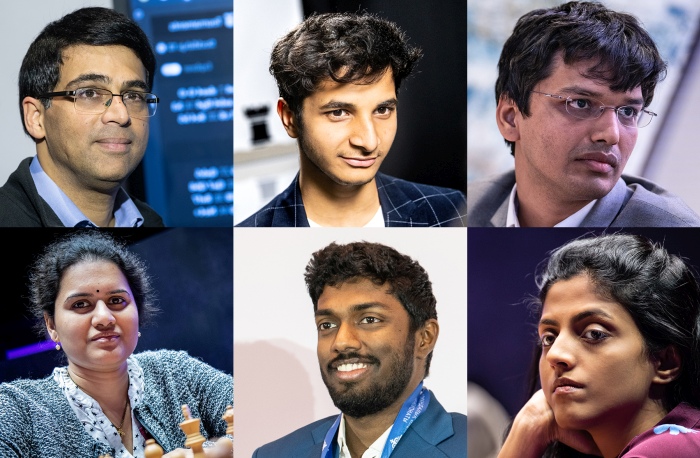
It is a bit paradoxical that the average age of this team is the highest in the event when India is producing more young chess prodigies than any other country in the world. But the young Indian cubs are not ready yet to make it into the national team: the generational changeover will have to wait a bit more. Adviser to the team: Vladimir Kramnik The World Champion from 2000 to 2007 and the winner of numerous tournaments (including 10 titles in Dortmund), in 1996 Vladimir Kramnik became the youngest world #1 player in history, the record broken by Magnus Carlsen 14 years later. Playing for the Russian team in Chess Olympiads since 1992, he won three gold medals. In January 2019 Vladimir Kramnik announced his retirement from professional chess but expressed intention to focus on chess-related projects. Viswanathan Anand (Std. 2753 Rpd. 2751) The first grandmaster from India (1988), a five-time World Champion, Viswanathan Anand became one of a few players to surpass a 2800 rating mark (in 2006). Throughout his long and prolific chess career, he acquired a legendary status not only in his native India but also all around the world. Considered by many to be the greatest rapid player of his generation he won the World Rapid Chess Championship in 2003 and 2017, the World Blitz Cup in 2000, and numerous other top-level rapid and blitz events. Vidit Gujrathi (Std. 2726 Rpd. 2636) The fourth Indian ever to surpass a 2700 mark, Vidit Gujrathi is the second-highest rated player in his home country after Anand. The winner of the Biel Chess Festival Grand Master (2019) and the runner-up in the Prague Chess Festival Masters (2020), he is currently ranked 23rd in the world. Pentala Harikrishna (Std. 2719 Rpd. 2690) The youngest Indian grandmaster back in 2001, the former World Junior Champion (2004) and Asian Individual Champion (2011), Pentala Harikrishna made it into the top 10 in November of 2016. The Commonwealth Champion (2011), he represented India in numerous Olympiads, World Team Championships, and Asian Championships. Harikrishna is currently ranked 26th in the world. Humpy Koneru (Std. 2586 Rpd. 2483) The reigning World Women’s Rapid Chess Champion (2019), Humpy Koneru became the youngest woman ever to earn the title of grandmaster (this record was later broken by Hou Yifan). A semi-finalist of the Women’s World Championship in 2004, 2008 and 2010, she became a challenger in 2011 but lost the title match to Hou Yifan. The runner up in the FIDE Women’s Grand Prix 2011–12, 2013–14 and 2015–16 Humpy holds second position in the 2019-2020 edition of the series after playing just two tournaments. Koneru is currently ranked second in the world. Adhiban Baskaran (Std. 2659 Rpd. 2624) The former World Under-16 Champion (2008) and Indian champion (2009), Adhiban Baskaran was a member of the Indian bronze medal team at the 41st Olympiad in Tromso (2014) and Solvay, the winner of the Spanishi League (2015). His chess resume includes victories Sants Open Barcelona (2013), Masters Open in Biel (2014), and Reykjavic Open (2018). Adhiban is currently ranked 82nd in the world. Harika Dronavalli (Std. 2515 Rpd. 2450) Three-time bronze medalist in the Women’s World Chess Championship (2012, 2015, and 2017), Harika Dronavalli is the second-highest rated Indian woman after Humpy Koneru. She reached her career-high #5 in the world back in 2016 after winning the FIDE Women’s Grand Prix event at Chengdu. Currently ranked ninth in the world, Harika is tied for 5th position in the Grand Prix 2019-2020 after three tournaments.
FIDE Chess.com Online Nations Cup Rosters: Team Russia
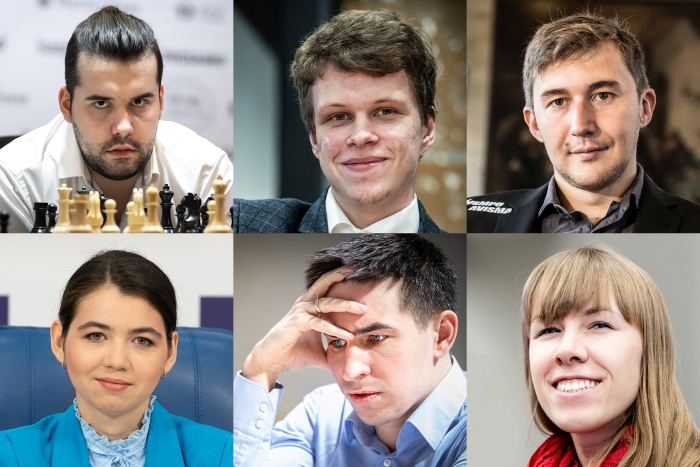
Russia no longer dominates the chess world as it once did but even with the absence of some important players – like Alexander Grischuk and Kateryna Lagno – the team cannot be ruled out as a possible winner. Captain: Alexander Motylev (Std. 2641 Rpd. 2700) The winner of the Russian Champinship (2001) and the European Championship (2014), Alexander Motylev is known not only as a strong GM but also as a great opening analyst, sparring partner, and second. Throughout his career, he worked with Peter Svidler, Vladimir Kramnik, Sergey Karjakin, Aleksander Goryachkina, and Judit Polgar. Ian Nepomniachtchi (Std. 2784 Rpd. 2778) One of the leaders of the suspended Candidates Tournament 2020, Ian Nepomniachtchi won the World Chess Championships as a member of the Russian team in Antalya (2013) and Astana (2019). The winner of Aeroflot Open (2008, 2015), Tal Memorial (2016), Dortmund (2018), and two FIDE Grand Prix events (Moscow 2019 and Jerusalem 2019) he is currently ranked 4th in the world. Vladislav Artemiev (Std. 2716 Rpd. 2769) One of the most talented young players, the current European Champion (2019), Vladislav Artemiev played for the Russian golden team in the World Team Chess Championship (Astana, 2019). The winner of the Agzamov Memorial (2015) and Gibraltar Masters (2019), he is currently ranked 29th in the world. Sergey Karjakin (Std. 2752 Rpd. 2709) The world’s youngest grandmaster ever (earned the title at the age of 12 years and seven months), the winner of the FIDE World Cup 2015, and the Candidates Tournament 2016, Sergey Karjakin faced Magnus Carlsen in the World Championship match (2016) but lost in the rapid tiebreak. Sergey represented Russia at five Olympiads and was a member of the Russian golden team at the World Team Chess Championships in Antalya (2013) and Astana (2019). Aleksandra Goryachkina (Std. 2582 Rpd. 2502) A two-time Russian Champion, Aleksandra Goryachkina won the Women’s Candidates Tournament in 2019 and qualified for the Women’s World Championship match with Ju Wenjun which she lost in the rapid tiebreak. A permanent member of the Russian national team since 2015 and the leader of the FIDE Women Grand Prix after three tournaments played, she is currently ranked third in the world. Dmitry Andreikin (Std. 2726 Rpd. 2740) A two-time Russian Champion (2012, 2018) and the former World Junior Chess Champion (2010), Dmitry Andreikin achieved his major success in Chess World Cup 2013 (lost to Vladimir Kramnik in the final) and in the second leg of the FIDE Grand Prix in Tashkent 2014, which he won finishing ahead of many elite players. Dmitry is currently rated 22nd in the world. Olga Girya (Std. 2469 Rpd. 2471) The reigning Russian Champion (2019), Olga Girya was a member of the Russian gold-winning team at the Women’s Chess Olympiad 2014 and the Women’s Team World Championship 2017. A participant of four Women’s Chess Championships she is currently ranked 22nd in the world.
Nakamura, Ding, Carlsen and Caruana in MCI Final 4
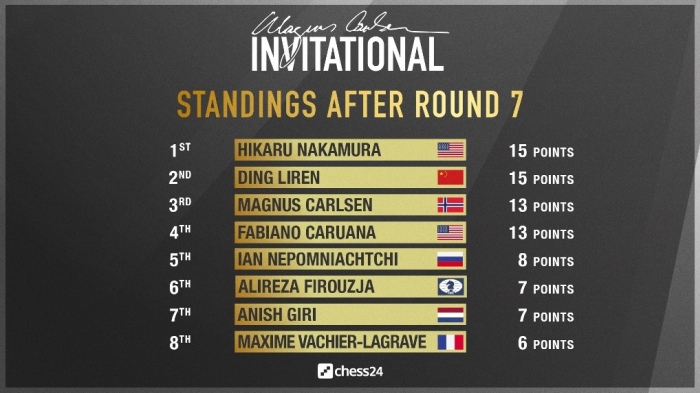
The preliminary stage of the Magnus Carlsen Invitational, an online tournament with an impressive prize fund of $250,000, is in the books. At this stage, the players earned 3 points for a win in the rapid games, while when a match went to Armageddon the winner got 2 points and the loser just 1. After 7 rounds and 13 days of play Hikaru Nakamura, Ding Liren, Magnus Carlsen, and Fabiano Caruana qualified for the semis, whereas Ian Nepomniachtchi, Alireza Firouzja, Anish Giri and Maxime Vachier-Lagrave are out of the competition but may find solace in handsome paychecks. The semifinal quartet was formed in the penultimate round after Fabiano Caruana beat Maxime Vachier-Lagrave, and by doing so left him no chance to catch up. Nevertheless, intrigue remained even in the final round as it decided who would face Magnus Carlsen in the semifinals. Most likely, Ding Liren was far from all these scenarios as he beat the World Champion, while Hikaru Nakamura bested Maxime Vachier-Lagrave in Armageddon while Fabiano Caruana somewhat unexpectedly lost to Anish Giri. As a result, in today’s semis Nakamura takes on Caruana while Ding Liren is facing Carlsen once again. Magnus got probably the least desirable out of three possible opponents, the player who had beaten him not only yesterday but also on tie-break of Sinquefield Cup 2019. The second semifinal is a tough call as at the preliminary stage the Americans went all the way to Armageddon in which Fabiano prevailed with white pieces. Ding Liren and Hikaru Nakamura played four Armageddon encounters each at the preliminary stage – more than any other player did. Both won just two of them but their overall strong performance secured them the coveted spots in the semifinals. Interestingly enough, Ding’s most impressive and quick victory came in Armageddon vs. Maxime Vachier-Lagrave. Ding Liren – Vachier-Lagrave 14.Ne5! the only winning move 14…b5 15.Qa5+ Ke8 16.Qc7! 1-0 Hikaru Nakamura had a tough start as he lost Armageddon to Magnus Carlsen after leveling score twice. Nevertheless, this outcome was an indication of Hikaru’s great form and he proved it in the course of the event. Nakamura made probably the most spectacular and deadly move in the event so far: Nakamura – Firouzja 14.Nxf7! 1-0 Magnus Carlsen entered the competition as a clear favorite and made it to the semis, despite losing two matches. Occasionally the World Champion seemed out of sorts, but in the semifinal we will sure see Magnus with all guns blazing. Although Fabiano Caruana stated in his interview after the first round that “the quality online is much lower than over the board” he managed to maintain good enough level to tie for third place with Magnus. Other participants had their good moments but did not demonstrate stability and consistency so much needed in such a strong field. Arguably, Ian Nepomniachtchi fell the victim of his speed – on several occasions he blitzed into losing positions having more time on the clock than before the start of the game and fell into deep thought when it was too late. Alireza Firoujza flunked the start of the event but collected himself and by winning two matches finished the event on a positive note. Despite losing the match vs. Carlsen, in the second game he pulled off a “fantastic swindle” (as GM Grischuk put it) that is worth demonstrating: Firouzja – Carlsen Magnus just played 39… Rd2?? and after 40.Rb8+! Kh7 41.Qg4! there is no reasonable way to prevent Qg6+ with checkmate 41…Qf1+ 42.Rg2 Qxg2 43.Kxg2 1-0 Anish Giri was unable to score a single victory for a while but in the match with Ding Liren the Dutchman finally got the ball rolling and the next day he took down Magnus Carlsen himself. In the final round, Anish got another scalp, this time defeating Caruana, which definitely lifted his spirits. Maxime Vachier-Lagrave was in the contest for a spot in the semis almost until the very end but a disastrous finish relegated him to the bottom of the standings. Photo: chess24.com
FIDE Chess.com Online Nations Cup Rosters: Team USA
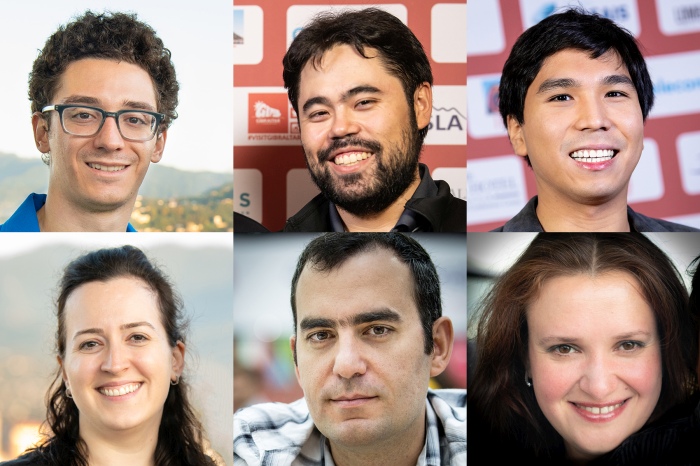
The USA, winners of the 2016 Olympiad, brings to the competition all their top guns: Captain: John Donaldson Willaim John Donaldson was the captain of the US team at numerous chess Olympiads, including the golden team of 2016. A world-renowned expert in chess history and the author of more than 30 books, in 2018 John Donaldson won the Mikhail Botvinnik Award for the best trainer of men or a team in an open event. Fabiano Caruana (Std. 2835 Rpd. 2773) One of the youngest grandmasters in history Fabiano Caruana became the third-highest rated player ever (2844) after winning the 2014 Sinquefield Cup. He participated in three Candidates Tournaments and in 2018 became the first American challenger since Robert Fischer. The winner of numerous international events, Fabiano played on the first board for the US golden team in 2016. He is currently ranked second in the world, right behind Magnus Carlsen. Hikaru Nakamura (Std. 2736 Rpd. 2829) A five-time US Champion and a member of the US Golden team 2016 Hikaru Nakamura reached his peak rating in 2015, which made him second in the world at the time. A recognized expert in rapid chess formats (particularly in bullet) he is currently #1 in the blitz rating. Wesley So (Std. 2770 Rpd. 2741) The first official Fischer Random World Champion and the 2017 US Champion Wesley So is the fifth-highest rated player in the history of chess. In 2016, he played for the US on the third board at the Chess Olympiad 2016 and won team and individual gold. Irina Krush (Std. 2429 Rpd. 2392) A seven-time and the youngest ever US Women’s chess champion Irina Krush was awarded the title of Grandmaster in 2013. A permanent member of the US team at Chess Olympiads, she won silver in Calvia (2004) and bronze in Drezden (2008). Leinier Dominguez Perez (Std. 2758 Rpd. 2786) A five-time Cuban champion and Blitz World Champion (2008), Leinier Domínguez Perez achieved his best career result in the 2013 FIDE Grand Prix event in Thessaloniki (2013) where he finished clear first ahead of many elite players. He also can boast of the individual silver medal won the Chess Olympiad 2016 in Baku. In 2018 he changed federation and currently represents the USA. Anna Zatonskih (Std. 2420 Rpd. 2327) Born in Ukraine, Anna Zatonskih has represented the US since 2003. A four-time US women’s champion, she played for her new home country in eight Olympiads since 2004. Her resume includes silver in Calvia (2004) and bronze in Drezden (2008).
Chess community supports charity initiatives
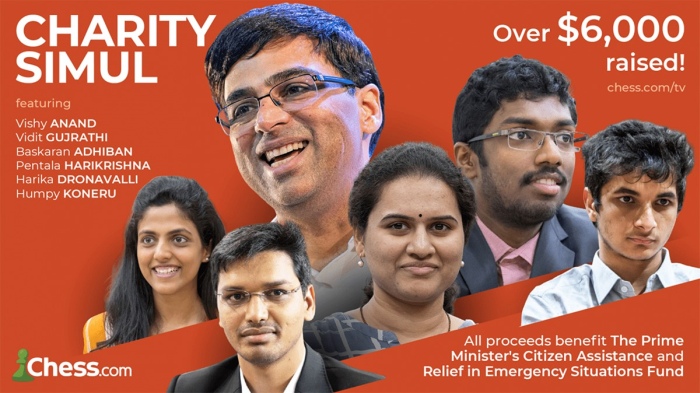
This week FIDE Newsletter latest edition (#004) focused on a very important issue. The coronavirus pandemic goes well beyond a health crisis: the economic consequences are also catastrophic, and many families and health organizations are struggling. We are very proud of the response of the chess community, from chess celebrities to the not-so-famous: a lot of fund-raising initiatives have been launched over the past week. Viswanathan Anand, stranded in Germany after his return flight to India was canceled, has been especially active in this regard. Along with GMs Pentala Harikrishna, Vidit Gujrathi, Adhiban Baskaran, Humpy Koneru, and Harika Dronavalli, Anand took part in a charity simul held on Chess.com on April 16. “Team India” raised more than $6000 for India’s Prime Minister’s Citizen Assistance and Relief in Emergency Situations Fund. On Saturday, April 25, Vishy teamed up with Vidit Gujrathi, Nihal Sarin, Tania Sachdev, and the popular YouTuber Antonio Radic, to play against a team of stand-up comedians in an online charity match. Also in India, the Kerala Chess Association and Chessbase India have put together a very interesting online tournament, to be played on May 2 on Playchess. The Grandmasters Alain Pichot (ARG, 2630), our very own FIDE Vice-President Nigel Short (ENG, 2626), Sunilduth Narayanan (IND, 2618) and Dommaraju Gukesh (IND, 2563) will be the top seeds, with all proceedings going again to the Chief Minister’s Distress Relief Fund. The French Chess Federation has liaised with the Fondation de France, which fights against the coronavirus. A 24 hours chess marathon will be held, starting from May 2 at 15:00, in cooperation with Lichess, Blitzstream, Europe-Echecs, Chess24, Variantes, and Appredre-les-Echecs. The initiative will be supported by the most popular streamers in the country, who will try to mobilize the French-speaking chess community towards making online donations to the “Tous unis contre le virus” campaign run by the Fondation de France. The time control is blitz (5+2) and you can already register through this link to Lichess.org. As schools remain closed all across the United Kingdom, the charity Chess in Schools and Communities partnered with ChessKid, the world’s biggest online children’s chess platform, to offer one million free subscriptions to schools. The goal, as described in their press release, is to “make Britain smarter”. Every primary school in the UK can get involved by applying for up to 1,000 of the one million free ChessKid Gold subscriptions – giving unlimited access to the programme’s online lessons. By providing these, the organizations seek to add an extra-curricular dimension to every school’s remote teaching programme while children remain at home. Chess in Schools and Communities (CSC) is a UK charity founded in 2009, whose mission is to improve children’s educational outcomes and social development by introducing them to the game of chess. They currently teach in over 300 schools and support 500 more nationwide. SUBSCRIBE YOURSELF FOR FIDE NEWSLETTER HERE
#04
FIDE Chess.com Online Nations Cup FIDE Seminars FIDE Candidates’ Countries Youth Tournament The chess community takes a step forward to support charity events “One Million ChessKids” project launched in the UK. Leela Zero defeats Stockfish at the TCEC Superfinal Donald Schultz (1936-2020) Anniversaries READ NEWSLETTER
Strongest Russian grandmasters in a charity tournament to benefit health workers
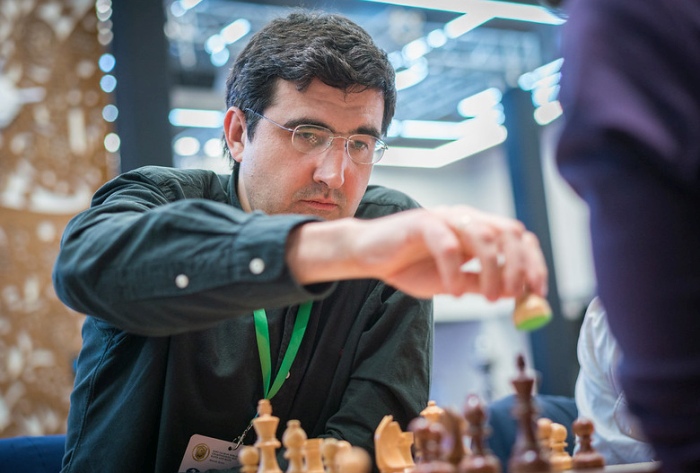
As the world goes through a global health crisis, chess stands out as a unique sport that has successfully resurfaced online to bring together professionals, amateurs, and fans around the world. Besides, chess can serve as an excellent platform for charity and collaboration. The Chess Federation of Russia and the Ministry of Sports of the Russian Federation will combine efforts to support the first charity online tournament, initiated by Russian chess players. The event, scheduled for May 12-14 will feature the country’s strongest grandmasters. The entire prize pool will be donated to regional hospitals and health workers fighting the COVID-19 pandemic. The participants will determine the recipients of the donations beforehand, depending on the needs of a particular institution. The entire prize fund is distributed equally among the regions, regardless of the final standings. The charity tournament features a stellar lineup: Vladimir KramnikIan Nepomniachtchi Alexander Grischuk Sergey Karjakin Peter Svidler Evgeny Tomashevsky Ernesto Inarkiev Alexander Riazantsev It will be a double round-robin blitz event with time control 5 minutes plus a 2-second increment per move. GMs will first play a double round-robin part to determine the best four to qualify for a knockout play-off. Tournament Schedule: May 12 – first half (7 rounds)May 13 – second half (7 rounds)May 14 – semifinals and a final. All the rounds start at 3 p.m. Moscow time. The tournament is supported by the Ramax group of companies. Match TV, a media partner of the tournament, will provide the coverage and live broadcast. The tournament will be played on Lichess.org, one of the most popular online chess platforms. The amount raised so far: 2,505,000 rubles As the world goes through a global health crisis, chess stands out as a unique sport that has successfully resurfaced online to bring together professionals, amateurs, and fans around the world. Besides, chess can serve as an excellent platform for charity and collaboration. We invite all chess lovers to support this event! Official information and details for bank transfers The 14th world champion Vladimir Kramnik gave an interview to Alexey Dospekhov, an observer of the Kommersant newspaper: “Of course, we’ve discussed the current situation with fellow chess players and decided to organize a charity event. For well-known reasons, there are no sports competitions at the moment. Chess is one of the few sports, which can exist even in the present circumstances. There are a lot of online tournaments going on. But we wanted to organize not a commercial but a purely charitable competition. Our country is big and it is difficult to help everybody. Nevertheless, we want to do all we can. We see that large cities and regional centers are doing more or less OK. But the situation in the outlying regions is often much worse. In general, we want to help hospitals and doctors with protective suits, equipment, pharmaceuticals, and so on. This is how this tournament came into being.” Vladimir Kramnik’s interview to Kommersant (in Russian) CFR President Andrey Filatov: “Cooperation and help are very important in these times. I am very glad that the Russian chess players came up with such a wonderful initiative and will practically support the doctors, who are working in an emergency mode and fighting the virus on the frontline. This tournament will not only become an interesting event for chess fans, but also an important social activity. I wish the best of luck to our grandmasters!” Official website of the Chess Federation of Russia Photo: Lennart Ootes Contact information: Eteri Kublashvili, Press service of the Chess Federation of Russia
ChessAgainstCovid Singapore charity raises over 30,000 SGD for families in need
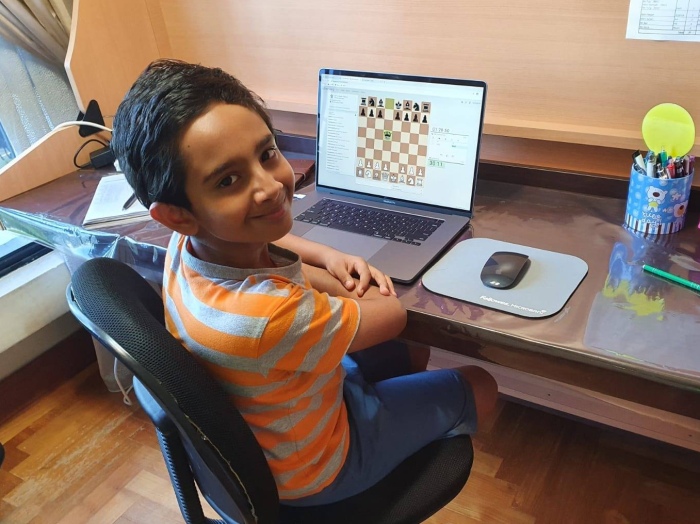
The social aspect has always been one of the strong sides of chess and it is especially noticeable during the challenging times of the coronavirus pandemic. Chess community does not want to stay aside and idle. Many players and clubs around the world do their best to change the situation for the better by holding online tournaments, offering free workshops and lessons, and starting charity initiatives. Kevin Goh is a GM from Singapore who humbly calls himself an “amateur chess player”. He’s the man behind the #ChessAgainstCovid charity – an initiative that raises money to help families badly affected by the coronavirus pandemic. It started with a target of 10,000 SGD and quickly turned to a more ambitious aim of collecting 100,000 SGD (about 70,000 USD). “The drive has raised over 31,000 in just a week since it began on April 11,” writes the “The Straits Times”, the biggest newspaper in the country, one of the mainstream media that featured #ChessAgainstCovid initiative. The movement raises money through a series of online events such as simultaneous exhibitions, team competitions, and “banter blitz” style matches. GM Andrey Kvon who has worked in Singapore for many years, South East Asian Games gold medalist WGM Gong Qianyun, the current national champion IM Tin Jingyao came forward to help the families in need. Many of Singapore’s best young players and volunteers have also contributed their time in many ways to drive this initiative forward. The first week of the campaign was concluded with an online simultaneous exhibition by a Uzbekistani GM Andrey Kvon held on April 19. He took on 16 youngsters, most of them placing within the top 10 in their age groups and even three national champions. The grandmaster fought well, eventually winning 13 games and losing just three: to Ethan Sim, Elliott Wong, and the 2019 National U-15 champion Goh Sean Christian who was the strongest player of the simul. You can check the games and results here. Two more simuls take place on the weekend of 25-26 April as Singapore IMs Hsu Li Yang and Ravindran Shanmugam join the movement. The participation in the simuls is free, but everyone can consider a donation to the charity. Besides, the series of “Young Masters” simuls with young Singaporean titled players taking on juniors has already seen five editions in just two weeks. Under the umbrella of the charity, an international friendly match between 20 of the best young players from Singapore and Kazakhstan will be held on the Lichess website on May 3. Kazakhstani superstar GM Rinat Jumabayev and GM Kevin Goh will be providing live commentary on Twitch. The International Chess Federation welcomes such noble initiatives contributing to a great cause and wishes all the best to all players and organizers.