

FIDE Chess.com Online Nations Cup Rosters: Team China
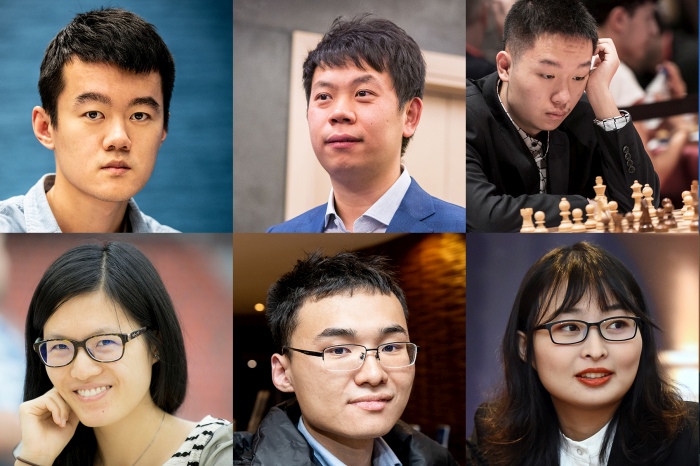
The Chinese team, winner of a historic double gold in the last Chess Olympiad, will be the top-seed at the FIDE Chess.com Online Nations Cup, which will take place May 5-10. Captain: Ye Jiangchuan The second Chinese grandmaster Ye Jiangchuan became the first representative of his country to surpass the 2600 rating mark. His record includes participation in numerous Olympiads and Asian Team Championships two FIDE World Cups and the World Championship (2001). In 2000 Ye Jiangchuan became the chief coach of both national teams – the position he has held ever since. Ding Liren (Std. 2791 Rpd. 2836) The highest-rated Chinese player in history Ding Liren reached the final of the FIDE World Cup twice but lost on both occasions. Currently ranked 3d in the world, he took part in two Candidates Tournaments. In his stellar year 2019, Ding Liren won Sinquefield Cup after beating the World Champion in a tiebreaker and the Grand Chess Tour final. Wang Hao (Std. 2763 Rpd. 2750) In early 2010s Wang Hao overcame the 2750 rating mark, scoring victories against all elite players, including two last World Champions Vishy Anand and Magnus Carlsen. His chess career got a second wind in 2019 – after winning a very prestigious Grand Swiss tournament the Chinese GM qualified for the Candidates Tournament 2020. Wei Yi (Std. 2732 Rpd. 2752) The fifth-youngest GM in the history of chess, Wei Yi became the youngest player ever to reach a 2700 rating mark. Considered by many to be one of the most talented players of his generation, the Chinese GM is currently ranked 20th in the world. His chess resume includes the victory in the 8th Danzhou Super-GM tournament (2017) and the final of the FIDE Grand Prix Jerusalem (2019). Hou Yifan (Std. 2658 Rpd. 2621) The youngest female player ever to achieve the grandmaster title Hou Yifan is the four-time World Champion. After winning the prestigious Rhodes Scholarship to study at Oxford University she put her career on hold. A temporary return of the #1 of the women’s rating strengthened team China before the event. Yu Yangyi (Std. 2709 Rpd. 2738) One of the youngest GMs ever, Yu Yangyi was a member of the gold medal-winning Chinese team at the Chess Olympiad (2014) and the World Team Chess Championship (2015). The winner of the first Qatar Open he had a very good run in the FIDE World Cup 2019 in which he reached semifinals. The Chinese GM is currently ranked 33d in the world. Ju Wenjun (Std. 2560 Rpd. 2610) The reigning Women World Chess Champion, Ju Wenjun is one of few women to cross a 2600 rating barrier. A member of the gold-winning Chinese team at two Olympiads (2016 and 2018) she has successfully defended her World Champion title twice (2018 and 2020).
Ratings analytics: Top 10 in the retrospect 2001-2020 Part 1

Kaspars Migla is the creator and founder of a chess website chessratings.top. In his column, he analyzes FIDE standard rating changes, career-highs, rating distribution by country, continent, region, and other rating-related statistics. In the first part of his historical research, he looks at the Top 10 for both Open and Women ratings over the 19-year period. Almost 20 years ago, on January 1, 2001, the International Chess Federation (FIDE) published the first downloadable rating list. From this moment on any person has had an opportunity to delve into deep analysis of chess ratings by sorting out and breaking down this data. Up to 2009 rating lists were published every four months; from January 2010 to June 2012 – quarterly; from July 2012 rating lists have been updated monthly. 146 downloadable lists published so far provide a fertile ground for various types of statistical analysis. In this edition, Chessratings.top looks at chess elite – the Top 10 active players with classical time control (both open and women). Here is the Top 10 Open January 01, 2001: 1. Garry Kasparov (RUS) 2849, Age 382. Viswanathan Anand (IND) 2790, Age 323. Vladimir Kramnik (RUS, 2772, Age 264. Michael Adams (ENG) 2746, Age 305. Alexander Morozevich (RUS) 2745, Age 246. Peter Leko (HUN) 2745, Age 227. Alexei Shirov (ESP) 2718, Age 298. Veselin Topalov (BUL) 2718, Age 269. Vassily Ivanchuk (UKR) 2717, Age 3210. Boris Gelfand (ISR) 2712, Age 33 The average age (how old a player became in a particular year) was 29,2 years, whereas an average rating – 2751. Only 12 players had rating 2700+ back then, i.e. the TOP 10 plus Evgeny Bareev (RUS, 2709) and Loek Van Wely (NED, 2700). Photo: Lennart Ootes Although active professional life in chess lasts longer compared to other sports, none of the players from this top appeared on the same list on April 1, 2020. Top 10 Open April 1, 2020 1. Magnus Carlsen (NOR) 2863, Age 302. Fabiano Caruana (USA) 2835, Age 283. Liren Ding (CHN) 2791, Age 284. Ian Nepomniachtchi (RUS) 2784, Age 305. Maxime Vachier-Lagrave (FRA) 2778, Age 306. Alexander Grischuk (RUS) 2777, Age 377. Levon Aronian (ARM) 2773, Age 388. Wesley So (USA) 2770, Age 279. Teimour Radjabov (AZE) 2765, Age 3310. Shakhriyar Mamedyarov (AZE) 2764, Age 3510. Anish Giri (NED) 2764, Age 26 Photo: Maria Emelianova At present, the average rating is 2788 which is 37 points higher than 20 years ago. The percentage difference is small (only 1,3%) especially considering the inflation of ratings. Moreover, three people from the 2001 list would be in the current top with Kasparov comfortably sitting on the second position. Despite the persistent feeling of young stars breaking into the chess elite, the average age in the current top 10 is 31.1 years – almost two years higher than in 2001. Why is that? You will find out a little bit later. Top 10 Women January 1, 2001 1. Judit Polgar (HUN) 2676, Age 252. Jun Xie (CHN) 2557, Age 313. Alisa Galliamova (RUS) 2554, Age 294. Chen Zhu (CHN) 2538, Age 255. Maia Chiburdanidze (GEO) 2525, Age 406. Pin Wang (CHN) 2506, Age 277. Yuhua Xu (CHN) 2500, Age 258. Nana Ioseliani (GEO) 2499, Age 399. Pia Cramling (SWE) 2492, Age 3810. Kanying Qin (CHN) 2489, Age 27 Average age – 30.6 years. Average rating – 2533. Photo: Chessvibes We see the same picture on the women’s side – no player from the Top 10 of January 2001 made her way into the current Top 10. Top 10 Women April 1, 2020 1. Yifan Hou (CHN) 2658, Age 262. Humpy Koneru (IND) 2586, Age 333. Aleksandra Goryachkina (RUS) 2582, Age 224. Wenjun Ju (CHN) 2560, Age 295. Kateryna Lagno (RUS) 2546, Age 316. Mariya Muzychuk (UKR) 2544, Age 287. Anna Muzychuk (UKR) 2535, Age 308. Nana Dzagnidze (GEO) 2524, Age 339. Dronavalli Harika (IND) 2515, Age 2910. Zhongyi Tan (CHN) 2510, Age 29 Average age – 29.0 years, average rating – 2556. Photo: Frans Peeters Comparing to the year 2001, the average rating increased by 23 points or 0.9%. Since this gain is smaller than in the open category, whole 5 players from the “old” list would have qualified for the new one. Eight players out of the Top 10 Open of 2001 are still active. All of them with just one exception are in the current Top 100, whereas Anand and Topalov are not far away from the Top 10. On the women’s side, only two players from the Top 10 of 2001 are still active. Here are these eight players mentioned above: 16. Viswanathan Anand (IND) 275319. Veselin Topalov (BUL) 273537. Michael Adams (ENG) 270158. Vassily Ivanchuk (UKR) 267862. Boris Gelfand (ISR) 267677. Peter Leko (HUN) 266383. Alexander Morozevich (RUS) 2659104. Alexei Shirov (ESP) 2647 Since the oldest in this group is Boris Gelfand (born in 1968), maybe even ten years down the road all of them will be among active players. Only two World Champions Garry Kasparov and Vladimir Kramnik are missing. Kasparov played his last tournament game back in 2005, whereas Kramnik retired from professional chess at the beginning of the last year. Photo: Niki Riga Here are two still active players from the Top 10 Women 2001: 22. Pia Cramling (SWE) 246433. Alisa Galliamova (RUS) 2438 It is just another evidence of a shorter and less intense period of activity in women’s chess. However, Pia Cramling (born in 1963) has been doing a great job undermining this doctrine. Last year the GM from Sweden became the most active player in the Top 100 Women playing 133 games! Photo: David Llada Let’s have a look at the players who made their way into the Top 10 Open after January 1, 2001 – particularly at the age they first did it, the countries they represented back then and the rating they had at that moment. The player from the current Top 10 Open and Women are marked with an asterisk. Open: 1. Evgeny Bareev (RUS) 2709, Age 35, 20012. Loek Van Wely (NED) 2714, Age 29, 20013. Ruslan Ponomariov (UKR) 2727, Age 19, 20024. Alexander Grischuk (RUS) 2712, Age 20, 2003*5. Peter Svidler
Rosters revealed for the FIDE Chess.com Online Nations Cup

The Chinese team, winner of a historic double gold in the last Chess Olympiad, will be the top-seed at the FIDE Chess.com Online Nations Cup, which will take place May 5-10. The field for the event includes six players who have held the title of World Chess Champion, plus twelve others who have been Candidates to the throne at some point. China, with an average rating of 2717, is followed in the initial ranking by Europe (2687), Russia (2662), USA (2641), India (2605), and the “Rest of the World” team (2597). The Chinese team is headed by Ding Liren and Wang Hao, the world’s numbers three and twelve respectively. They are two of the eight players who are currently a part of the Candidates tournament – the final stage which decides who will be the finalist in the World Championship Match. But the main news is the return of Hou Yifan to the Chinese national team. The four-time World Champion is a former prodigy and the youngest female player ever to achieve the Grandmaster title. Two years ago Hou won the prestigious Rhodes Scholarship to study at Oxford University and put her career on hold, but she is still the highest-ranked female player in ranking. Hou Yifan’s temporary return to the board might imply that the reigning Women’s World Champion, Ju Wenjun, is sent to the bench. CHINA Captain: Ye Jiangchuan Std. Rpd. Ding Liren 2791 2836 Wang Hao 2763 2750 Wei Yi 2732 2752 Hou Yifan 2658 2621 Yu Yangyi 2709 2738 Ju Wenjun 2560 2610 2.702,17 2.717,83 Maxime Vachier-Lagrave, from France, will be leading a super-strong European team that also includes Levon Aronian, Anish Giri, and Anna Muzychuk, with Jan-Krzysztof Duda and Nana Dzagnidze as reserve players. But even the best players of the moment are slightly overshadowed when the team captain is a living legend like Garry Kasparov. The multiple-time world champion, who ruled the world of chess for two decades, put an end to his career in 2005 and has barely taken part in any competitive chess activity ever since. His presence in this event, even if only as a team captain, has been a pleasant surprise to chess fans all over the world. EUROPE Captain: Garry Kasparov Std. Rpd. Maxime Vachier-Lagrave 2778 2860 Levon Aronian 2773 2778 Anish Giri 2764 2731 Anna Muzychuk 2535 2533 Jan-Krzysztof Duda 2753 2774 Nana Dzagnidze 2524 2447 2.687,83 2.687,17 Russia no longer dominates the chess world as it once did, but even with the absence of some important players – like Alexander Grischuk and Kateryna Largo – the Russian team cannot be ruled out as a possible winner. Ian Nepomniachtchi has proven to be in great shape recently, and he will be defending the first board, along with Vladislav Artemiev, Sergey Karjakin, and Aleksandra Goryachkina. With Dmitry Andreikin and Olga Girya as reserve players, Russian is still a formidable rival, with great team spirit. RUSSIA Captain: Alexander Motylev Std. Rpd. Ian Nepomniachtchi 2784 2778 Vladislav Artemiev 2716 2769 Sergey Karjakin 2752 2709 Aleksandra Goryachkina 2582 2502 Dmitry Andreikin 2726 2740 Olga Girya 2469 2471 2.671,50 2.661,50 The USA, winners of the 2016 Olympiad, brings to the competition all their top guns, starting with the world’s number two Fabiano Caruana. With him, Hikaru Nakamura, who is considered one of the biggest specialists in fast time controls, and the Fischer Random World Champion Wesley So. The team is completed by two experienced female players – Irina Krush and Anna Zatonskih, plus the Cuban-born Leinier Dominguez, who has represented the US Chess Federation since 2018. USA Captain: John Donaldson Std. Rpd. Fabiano Caruana 2835 2773 Hikaru Nakamura 2736 2829 Wesley So 2770 2741 Irina Krush 2429 2392 Leinier Dominguez Perez 2758 2786 Anna Zatonskih 2420 2327 2.658,00 2.641,33 India will be led one more time by the legendary Viswanathan Anand who, despite having reached the age of 50 in November, is still one among the top 15 players in the world – and remains as dangerous as ever when it comes to rapid play. It is a bit paradoxical that the average age of this team is the highest in the event when India is producing more young chess prodigies than any other country in the world. But the young Indian cubs are not ready yet to make it into the national team: the generational changeover will have to wait a bit more. INDIA Adviser to the team:Vladimir Kramnik Std. Rpd. Viswanathan Anand 2753 2751 Vidit Gujrathi 2726 2636 Pentala Harikrishna 2719 2690 Humpy Koneru 2586 2483 Adhiban Baskaran 2659 2624 Harika Dronavalli 2515 2450 2.659,67 2.605,67 The “Rest of the World Team” is, as it would be expected, the most colorful one, including players from Azerbaijan, Iran, Egypt, Peru, Ukraine, and Kazakhstan. On top of the list, the winner of the 2019 FIDE World Cup, Teimour Radjabov. With him, one of the main attractions of the event, the 16-year-old prodigy from Iran, Alireza Firouzja. The teenager is developing a rivalry with the World Champion Magnus Carlsen that is becoming more and more serious by the day, and probably all eyes will be on him, as he will be taking on some of the very top players in the world during this event. The team also features the best African player of all times, Bassem Amin, one of the biggest talents from South America, Jorge Cori, a former Women’s World Champion, Mariya Muzychuk, and the Kazakhstani star Dinara Saduakassova. The FIDE President, Arkady Dvorkovich, will be acting as a captain for this team. REST OF THE WORLD Captain: Arkady Dvorkovich Std. Rpd. Teimour Radjabov 2765 2758 Alireza Firouzja 2728 2703 Bassem Amin 2686 2608 Mariya Muzychuk 2544 2506 Jorge Cori 2652 2599 Dinara Saduakassova 2500 2412 2.645,83 2.597,67 The tournament will be broadcast live across multiple outlets including FIDE’s and Chess.com’s own channels across Twitch, YouTube, Mixer, Twitter, and other international streaming platforms. With an estimated audience of several million worldwide, commentary by chess experts will be conducted in multiple languages, including English, Spanish, Russian, Mandarin, French, German, Portuguese, Italian, Turkish, and Polish. More information in our initial press release about the event. FIDEwww.fide.comDavid Lladapress@fide.com+34 623 021 120 CHESS.comwww.chess.comNick Bartonnick@chess.com
FIDE Chess.com Online Nations Cup Rosters: Team Europe
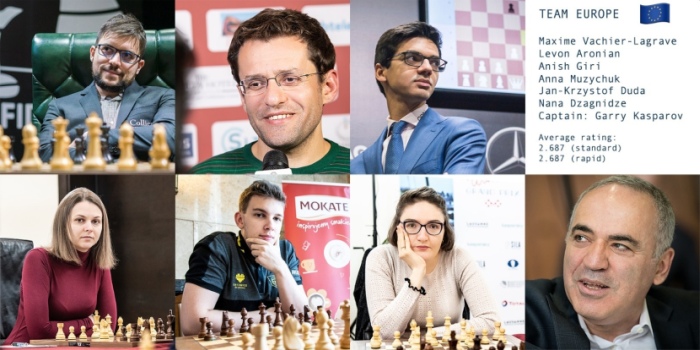
Team Europe for the FIDE Chess.com Online Nations Cup is confirmed: Captain: Garry Kasparov The 13th World Champion, Garry Kasparov is considered by many to be the greatest player of all time. During his career, Kasparov was ranked #1 for 255 months. His highest rating of 2851(achieved in 1999) was surpassed only by Magnus Carlsen in 2013. He also holds the record for the consecutive tournament victories and number of Chess Oscars. Maxim Vachier-Lagrave (France Std. 2778 Rpd. 2860) The highest-rated French player, the five-time winner of the Biel Grandmaster Tournament and one of the leaders of the Candidates Tournament 2020, Maxime Vachier-Lagrave is currently ranked #5 in the world. He reached his peak rating (2819) in August 2016. Levon Aronian (Armenia Std. 2773 Rpd. 2778) The fourth highest-ranked player in the history of chess, a true celebrity in Armenia, Levon Aronian won FIDE World Cup in 2005 and 2017. Levon led the national team to the gold medals in three Olympiads in 2006, 2008, and 2012. Aronian is currently ranked #7 in the world. Anish Giri (Netherlands Std. 2764 Rpd. 2731) A four-time Dutch champion, the winner of several prestigious tournaments Anish Kumar Giri is currently ranked #10 in the world. He reached his peak rating (2798) in January 2016. Fluent in Russian, English, and Dutch, Giri has qualified for the Candidates Tournament twice (2016 and 2020). Anna Muzychuk (Ukraine Std. 2535 Rpd. 2533) The winner of Women’s World Rapid Chess Championship (2016) and the Women’s World Blitz Chess Championship (2014 and 2016) Anna Muzychuk became the fourth woman to cross a 2600 rating mark in classical chess. The participant of the FIDE Women’s Grand Prix, she is currently ranked #7 in the world. Jan-Krzysztof Duda (Poland Std. 2753 Rpd. 2774) One of the most promising and talented young players Jan-Krzysztof Duda is already ranked #16 in the world. He achieved the title of Grandmaster at the age of 15. The winner of the Polish championship (2018), last November Duda reached the final in the FIDE Grand Prix (Hamburg 2019) facing a very strong competition. Nana Dzagnidze (Georgia Std. 2524 Rpd. 2447) A member of the gold medal-winning Georgia team at the Women’s Olympiad (2008) and the winner of the Women’s Blitz Championship (2017) Nana Dzagnidze currently occupies 8th position in the women’s rating list. This March the mother of two reached a milestone in her career after winning FIDE Women’s Grand Prix Lausanne. The Online Nations Cup is a team competition that will be held on May 5-10 with teams Russia, USA, Europe, China, India & the Rest of the World taking part.
Don Schultz (1936 – 2020)
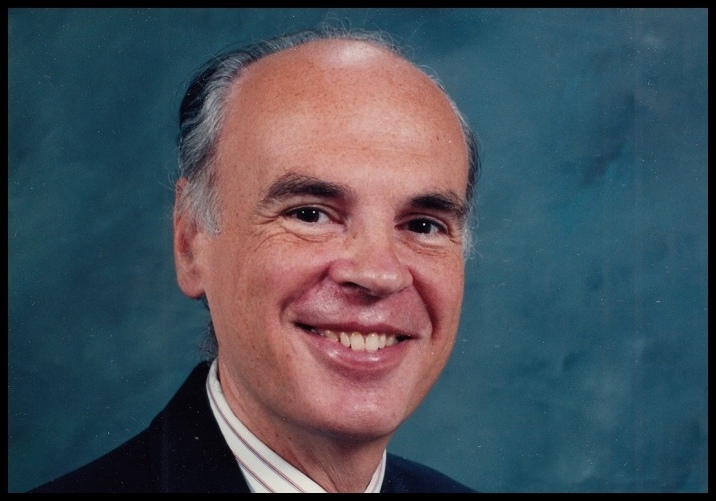
This week brought the sad news of the passing of Don Schultz, a former member of the FIDE Executive Board (1982-1990), and US Chess President (1996-1999). He was 83. Don worked full time for IBM, so he was never able to devote himself entirely to chess – and yet his contributions to promoting the game in the US were remarkable. His “day job” had him move to different states across the US (and even abroad), so he ended up being President of the NYS Chess Association, the North Carolina Chess Association, the Georgia Chess Association, and the Florida Chess Association. One of the first events he organized was the 1963 New York State Open, which Bobby Fischer won with a perfect score. It was there that Bobby played 9.Nh3 against Bisguier in a game that found its way into “My 60 Memorable Games”. He also organized the 1990 World Youth Championship in Fond du Lac (Wisconsin) where Judit Polgar won the Boys (!) Under 14 World Championship. Schultz was also a well-known chess journalist, and the author of two chess books: “ChessDon” (1999) and “Fischer, Kasparov and the others” (2005). A close friend of Fischer, Schultz accidentally became one of the three members of his delegation during the 1972 match, an event that he was only planning to attend as a mere supporter. From then on, he would get involved in international chess affairs. He represented our institution as co-chair of the FIDE-UNESCO Commission during the years 1981-82, and he was a member of the FIDE Executive Board between 1982 and 1990. In total, he attended no less than 21 FIDE Congresses, in different capacities, between 1972 and 2005. FIDE extends its condolences to the US chess family, and most of all, to Don’s family and loved ones.
FIDE and Chess.com announce Online Nations Cup
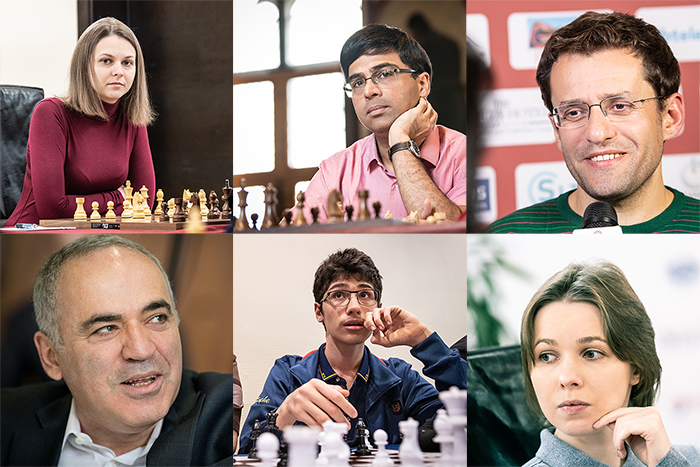
The International Chess Federation and Chess.com announce the Online Nations Cup, a team competition held May 5-10, 2020. Six teams are due to take part in this competition: Russia, USA, Europe, China, India, plus a team representing the “Rest of the World.” This epoch-making battle draws some similarities with golf’s Ryder Cup, or with the 1970 “USSR vs. Rest of the World” chess match-up that made headlines in Bobby Fischer’s heyday. But the new “match of the century” will be more global, entirely online, and also gender-inclusive, since the team line-ups must include at least one female player. A retired legend, Garry Kasparov, will be the captain for the European team, while his former world championship rival, Vishwanathan Anand, will defend the first board of the Indian team. The Online Nations Cup is a team championship showdown, where six teams of four players each will fight under a rapid play format, for a prize fund of USD 180.000. The event, co-organized by the International Chess Federation and the leading chess-playing platform Chess.com, is expected to feature nearly all the top players on the planet, representing China, India, Russia, the USA, Europe, and “Rest of the World”. The first stage, a double round-robin with the six teams, will take place on May 5-9. The top two teams will then play in a Superfinal on Sunday, May 10, to determine the FIDE Chess.com Online Nations Cup champion. The games will be played in a rapid format, where each player begins the game with 25 minutes on their clock, plus 10 seconds of extra time added after each move. The exact composition of the teams will be confirmed tomorrow (April 22). The preliminary entry list includes three generations of the best players: from 50-year-old Viswanathan Anand (multiple-time World Champion and still in the world’s top-20) to the newest chess phenomenon, the 16-year-old Iranian Alireza Firouzja. The regulations stipulate that in every match the line-up of the teams must include at least one female player, and the best women’s players in the world have already expressed their readiness to take part in the tournament. In order to guarantee fair play in an entirely online event, during their games, players will be observed by FIDE-affiliated international arbiters via a video conference call. To ensure that the participants don’t receive any kind of external help from a computer, their webcam, computer screen and the room in which they are playing will be under supervision. The tournament will be broadcast live across multiple outlets including FIDE’s and Chess.com’s own channels across Twitch, YouTube, Mixer, Twitter, and other international streaming platforms. With an estimated audience of several million worldwide, commentary by chess experts will be conducted in multiple languages, including English, Spanish, Russian, Mandarin, French, German, Portuguese, Italian, Turkish and Polish. “This is a unique event that will combine competitive chess at the highest level, with a top-notch online spectacle”, says Arkady Dvorkovich, President of the International Chess Federation. “The reasons why an official tournament like this has to be conducted online are very unfortunate – but we are happy to see that chess is providing solace to millions of people who are under a home lockdown: they can play themselves, and they can also enjoy the thrill of a first-class sporting event”. The move represents the latest initiative by FIDE to shift its activities to the online arena. Like every other sport, the International Chess Federation has seen its activities disrupted amid the coronavirus shutdown: one of its flagship events, the Candidates Tournament, had to be halted midway, while the Chess Olympiad, which was supposed to take place in Russia this summer, had to be postponed to 2021. However, chess has an advantage over other sports: fully competitive chess can be played online, with no compromise on quality. And in fact, this sport is experiencing a boom when it comes to casual players: chess clubs online have witnessed a record number of games being played. An estimated 16 million games are being played online every day since the lockdown began – 9 million of them on Chess.com alone. “We are currently experiencing significant accelerated growth”, says Nick Barton, Director of Business Development for Chess.com. “While we wish the unfortunate circumstances surrounding this groundbreaking event were different, we are pleased to be working with FIDE in bringing a major championship to the online landscape for fans around the world.” The FIDE Chess.com Online Nations Cup is the first in a series of competitive online events to be organized by FIDE in cooperation with various partners. The governing body of Chess has also launched a number of online workshops and lectures for its members and affiliates. 1.Regulations for the FIDE Chess.com Online Nations Cup (pdf). Annex 1. Player Requirements. Annex 2. Captain Requirements. Annex 3. Officials for the FIDE Chess.com Online Nations Cup More information: FIDEwww.fide.comDavid Lladapress@fide.com+34 623 021 120 CHESS.comwww.chess.comNick Bartonnick@chess.com
Team FIDE wins FIDE Candidates Countries Youth Tournament
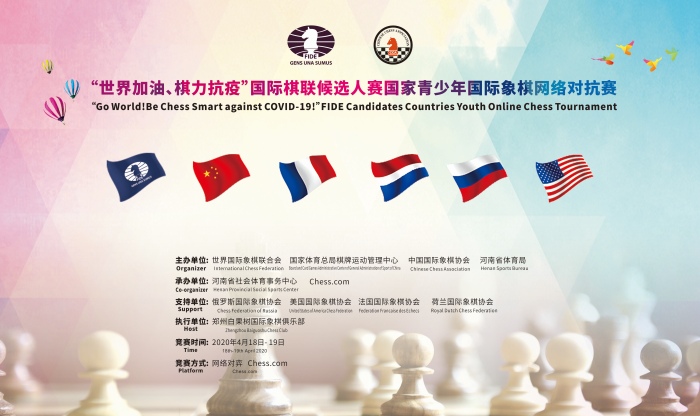
On April 18-19, the Chinese Chess Association organized an online competition – FIDE Candidates Countries Youth Online Chess Tournament. The motto of the event, held on Chess.com, was “Go World! Be Chess Smart against COVID-19!” The tournament was broadcasted live on China Leisure Sports TV Network with GMs Hou Yifan (#1 in women’s rating list) and Peng Zhaoqin commentating on proceedings. It reached more than 10,000 views, even though the show was in the late evening in China. This youth competition was inspired by the Candidates Tournament 2020 with five teams representing China, USA, France, Russia, and the Netherlands taking part. Each team consisted of 5 young players under 16 each (3 boys and 2 girls). To make the number of participant teams even, a sixth team was added, playing under the FIDE flag and comprising five players from Cuba, Germany, Kazakhstan, Uzbekistan, and India. The tournament started on April 18, 22:00 Beijing time. The highest ever rated woman-player Judit Polgar and the former women’s World Champion Zhu Chen recorded videos of making the first symbolic moves in the event. The organizers showed these videos before the start of the tournament. To ensure fair game, the arbiter group supervised all games via Zoom. All the teams were required to enter a Zoom room with one arbiter inside. During the game, every player set up a smartphone or same function device in the right (or left) corner to let the camera show the screen and the player. Besides the measure taken, all captains as members of the appeal committee have discussed and signed a guarantee letter, promising fair play. Team FIDE headed by GMs Nihal Sarin (2620) and Noribek Abdusattorov (2627) entered the competition as prohibitive rating favorites but in Round 1 it suffered a defeat at hands of the Chinese squad. Meanwhile, Russia was held to a draw by a lower-rated USA. Somewhat surprisingly, in Round 2 Russia dismantled China 4:1 and took the joint lead with the USA which beat France with the same score. In Round 3 team FIDE stopped Russia (3:2), but the USA won its match against France and preserved one-point distance from the closest pursuers. In Round 4, which became decisive one, team FIDE whitewashed the leader 5:0; China and Russia also scored victories. In the final round, team FIDE made a short work of France, but China convincingly outplayed the USA. As a result, the teams FIDE and China tied for first place with the former claiming the title by the total number of game points. Russia finished 3rd, USA 4th, whereas France and Netherlands shared 5-6 places. 16-year-old Bibisara Assaubayeva from the FIDE team showed the best individual result in the event with 4 wins and 1 draw. GMs Nihal Sarin (FIDE) and Huang Renjie (China) were the best on board 1, scoring 4 points each.
90th FIDE Congress: 2020 FIDE Extraordinary General Assembly Minutes and Annexes

FIDE publishes the Minutes of 2020 FIDE Extraordinary General Assembly which was held in Abu Dhabi, UAE on February 28th. Download 2020 Extraordinary General Assembly Minutes (pdf) Annex 1.1 Admission of new federations Annex 1.2 Admission of new affiliated members Annex 2.1 Change of FIDE Statutes: new FIDE Charter Annex 3.1 New Financial Regulations
90th FIDE Congress: 2020 FIDE Executive Board Minutes and Annexes
FIDE publishes the Minutes of 2020 Executive Board meeting which was held in Abu Dhabi, UAE on February 29th. Download 2020 FIDE Executive Board minutes (pdf) Annex 3.1 Report of the FIDE Treasurer Annex 3.2 FIDE Financial Statements for 2018 Annex 3.3 Verification Commission report Annex 3.5 Budget 2020 Annex 4.1 Report of Continental Association for Europe Annex 4.2 Report of Continental Association for Americas Annex 4.4 Report of Continental Association for Africa Annex 5.2 Arbiters’ Commission report (ARB) Annex 5.3 Chess in Education Commission report (EDU) Annex 5.4 Commission for the Disabled report (DIS) Annex 5.5 Commission for Women’s Chess report (WOM) Annex 5.7 Ethics Commission report (ETH) Annex 5.8 Events Commission report (EVE) Annex 5.8.3 Bids for World Senior Team Championship 50+ and 65+ 2021 (Italy and Russia) Annex 5.8.4 Bids for World Senior Championships 2021 (Malta and Russia) Annex 5.8.5 Bids for World Amateur Championship 2021 (Italy and Malta)Annex 5.8.6 Bid for World Junior and Girls U-20 Championship 2021 (Italy) Annex 5.8.7 Bids for World Youth Championships U-14, U-16, U-18 2021 (Italy and Russia) Annex 5.8.8 Bid for World Cadet Championship U-8, U-10, U-12 2021 (Egypt) Annex 5.8.9 Bids for World Cadet & Youth Rapid and Blitz Championships U-8,10,12 2021 (Croatia and Georgia) Annex 5.9 Fair Play Commission report (FPL) Annex 5.10 Global Strategy Commission report (GSC) Annex 5.11 Medical Commission report (MED) Annex 5.12 Online Commission report (OLC) Annex 5.13 Planning and Development Commission report (PDC) Annex 5.14 Qualification Commission report (QC) Annex 5.15 Rules Commission report (RC) Annex 5.17 Systems of Pairings and Programs report (SPP) Annex 5.18 Technical Commission report (TEC) Annex 5.19 Trainers’ Commission report (TRG) Annex 5.20 Data protection GDPR Annex 8.1 Chess ID Annex 8.3 Fischer Random Chess Annex 8.4 Athletes Commission
Arkady Dvorkovich: FIDE is moving online
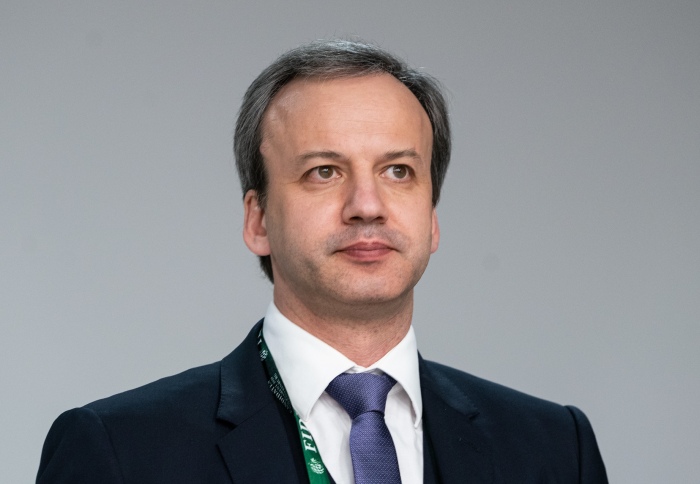
FIDE President Arkady Dvorkovich gave a big interview to a popular Russian newspaper Kommersant. The first part was published on the official FIDE site website three days ago. This is the second part of this interview. When announcing the suspension of the Candidates Tournament you told that FIDE would try to make smart use of this period of self-isolation to search for new ideas. What is the International Chess Federation doing right now? Arkady Dvorkovich: We are moving many of our activities online, to digital platforms. There have been already several unofficial competitions on different websites. We carefully reviewed this experience and worked out our own strategy. First of all, we are going to organize team events for the leading chess countries including a “digital copy” of the Chess Olympiad that was scheduled for August. Now we are planning to hold it in the online format. That is a big project. We are also considering the formats involving competitions among schools, universities, corporations, and cities. The rapid chess championships are also on the menu. I think we will organize one massive tournament with a wide range of players taking part. Are regional federations active as well? A.D.: They are. The European Chess Union (ECU) has planned the European Championship for May. Magnus Carlsen with his team announced Magnus Invitational tournament with all the top players participating. The event starts on April 18. Many of our activities also go digital – seminars for trainers and arbiters, tournaments organizers and chess players. We will be very active in these spheres for the next several months. Currently, the lectors are intensively preparing for the planned seminars. All these measures will help people all around the world to be part of the chess life even in this difficult period. Am I right that this crisis in a way gave chess some boost? A.D.: There is one problem with that – in addition to an emotional aspect – after all chess players prefer to get together in clubs, to socialize and play live (most of them enjoy it much more than online). I am talking about cheating. Unfortunately, no one can be trusted, except maybe for the top-players for whom their reputation is the key asset. On lower levels, anti-cheating is highly relevant. We are working together with chess platforms and cybersecurity companies on the solutions to these problems. It is too early to summarize the results of the World Championship cycle which coincided with you taking the office. Maybe you can specify some trends? Has the popularity of chess increased? A.D.: All that we have done over the last two years, was done on a higher level than previously. I am referring to both marketing efforts and engaging leading companies into chess. I am talking about such companies as Coca-Cola, Total, RZD, Rosseti, Gazprom. The same applies to the coverage of the tournaments. For example, we provided coverage for the Women’s World Championship match and the Candidates tournament in several languages (Russian, English, and Chinese), whereas our partner Chess24 added several extra languages to the broadcast. This is a great improvement of the situation as language diversity attracts extra users to the World Championship cycle. Plus, the look of the chess broadcasts is much more professional now. I hope that it will measure up to the highest standards to be broadcasted on TV. Is the chess audience growing? A.D.: We saw an exponential viewership growth in women’s chess. The size of the audience is still not that great in absolute numbers but we are talking about tens of thousands of people following the games. As far as the open category is concerned, we expanded our audience by hundreds of thousands of people by involving Chinese viewers. FIDE made an experiment by making the Grand Swiss a part of the World Championship cycle. It was a Swiss-tournament, the format that often produces unexpected results. Are you happy with this event? A.D.: This tournament on the Isle of Man brought together the participants from different rating categories. It was different from the elite Grand Prix in which only the best compete in a playoff format. I would compare Grand Swiss with the FIDE World Cup, but unlike the latter, it attracted virtually all the best players. This is a more democratic format that gives a chance to the maximum number of players to distinguish themselves. We saw two biggest sensations of this cycle come out of Grand Swiss. Thanks to this event, not only the top players qualified for the Candidates, but also two “dark horses” – Wang Hao (China) and Kirill Alekseenko (Russia). Summing up, we are quite happy with this tournament and hope to continue. Some advocates of chess traditions argue that two random players qualified for the Candidates in Yekaterinburg but their level is below the rest of the field. A.D.: Going by this logic we should hold no qualifying events, just take eight best players by rating and that’s it. All in all, we think that the qualifying process has to be as open and democratic as possible. Have you planned any experiments in the new cycle? A.D.: We would like to stick to the principles of the current cycle. Maybe we will make some changes in the qualifying for the Candidates. First of all, it is about determining the best-rated player who gets his spot in the Candidates. The current system has drawn a fair amount of criticism because from a mathematical standpoint the rating points earned several months ago are more valuable than those picked up right before the Candidates. We are working with the experts in math and statistics on possible corrections of the current system. One of the solutions might be using so-called performance, i.e. how good a particular player was in the period right before the Candidates. Many of my friends play online either rapid or blitz. Don’t you think that these formats are not represented enough at the highest level? A.D.: I don’t think so. All top players constantly participate in various online rapid and blitz tournaments. The Rapid and Blitz World Championship is