

Arkady Dvorkovich: “We are ensuring the safe return of players to their homes”
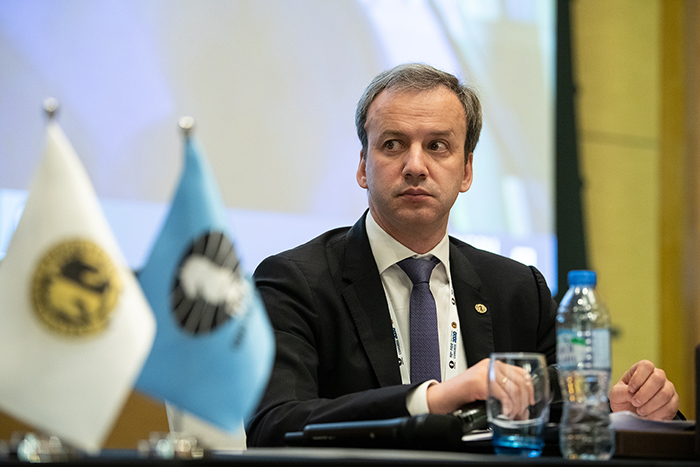
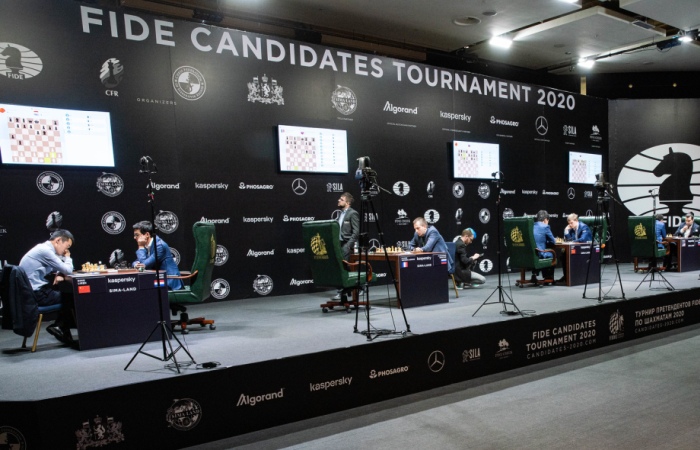
Following the announcement of the government of the Russian Federation about suspending all flights to and from the country as of March 27, the International Chess Federation (FIDE) has decided to halt the 2020 Candidates Tournament which was taking place in Yekaterinburg. In an interview for the Russian news agency TASS, FIDE President explained his decision. Q: Has FIDE discussed this decision to stop the event with the players, what do they think? Arkady Dvorkovich: We have been in touch with the players every day during the event and we were weighing all the risks all the time. FIDE believes that this is the best course of action under these circumstances. We remain committed to popularising chess and raising the spirits at this grave time, but we have always said that people’s lives and health are a priority for us. Q: Air traffic with other countries has been suspended by Russia. Won’t it be a problem for all the chess players to go home? Arkady Dvorkovich: This unique situation transpired suddenly. We are doing everything we can to provide the necessary support to everyone and get them home safely. Tickets for all the players and most other people involved in the tournament have already been purchased, and we are organizing all necessary logistics. FIDE is organizing and paying for all the travel costs and is working closely with everyone to ensure all is done safely and efficiently. Q: In your opinion, will the tournament be finished this year or when? Will Yekaterinburg remain the host? Arkady Dvorkovich: We will do our best for everything to be sorted out as soon as possible, following regulations and protecting the safety and interests of all involved. We remain confident that the event will be completed this year, in cooperation with our main partner – SIMA-land. The issue of exact dates and locations will be resolved in the near future, as soon as the global situation stabilizes. Q: Why did you decide to start the tournament when the virus was already spreading strongly around the world? Arkady Dvorkovich: This is a very important event for the players and the chess world. The situation in Russia was different at the beginning. We looked at different trajectories of the situation, including potential cancellations. At the same time, in terms of the medical safety measures, the Candidates Tournament was well prepared. All the players, arbiters and staff had medical checkups twice a day, tests for the detection of COVID-19 have been done and all came back as negative. Also, the spectators have been banned from the venue and the interaction between the players and the media has been put to a minimum. However, we concluded that the flight ban announced this morning would put too much pressure on the players and participants in terms of how and when they will be able to return home. Unfortunately, the situation with the pandemic is developing in the most negative scenario. We, therefore, believe that our decision to suspend the Tournament at this moment was correct. Again, we are doing everything we can to ensure the safe and secure return of everyone to their homes. Q: Is there a significant financial loss for FIDE due to the transfer? Arkady Dvorkovich: Our priority was and remains to make sure that everyone involved is safe and returns to their home. Losses are minimal and definitely not a factor in making this decision. We have a mutual understanding with our partners and sponsors, and we are grateful for their support. Q: In general, what is your view of what is happening in the spirting word and how things will develop? Arkady Dvorkovich: It is difficult to give estimates – no one knows for how long the acute phase of the crisis caused by the coronavirus will last. There are different opinions about how long the events should be postponed – 2-3 months or six months to a year. I believe that with the joint efforts of all countries and tough measures, we will be able to defeat the pandemic. Of course, it will be a slightly different world afterwards, but we will be stronger. The coming period will be used by FIDE to search for and find new ways and ideas, expand links between national federations, strengthen partnerships and share experiences. Nowadays we must use all the latest online formats to communicate with current and potential chess fans. We will, therefore, step up our online activities and do more to attract chess audiences to our online services and platforms through training, tournaments, and conferences. These are challenging times, but we see this as an opportunity and want to do our best to help the chess community and promote the game. Q: And an important question about the match for the title of World Champion. Is the match also being postponed? Arkady Dvorkovich: The match for the chess crown is due to take place at the end of the year. There is no question of changing dates.
Regulations of the Eighth FIDE World Cup in Composing 2020 published

REGULATIONS on holding the Eighth FIDE World Cup in Composing 2020: 1. TASKS AND OBJECTIVES The Eighth FIDE World Cup in Composing is held with the aim to: – develop and promote chess; – develop and promote chess composition as a constituent of chess culture; – expand the geography of participants; – decide the winners. 2. ORGANIZERS The organizers are the International Chess Federation (www.fide.com), with the participation of the World Federation for Chess Composition (www.wfcc.ch). The holding of the tournament is the direct responsibility of the Director and the Panel of Judges: The Director of the tournament is Alexander Bulavka (Belarus). A. Two-movers – Judge: Dragan Stojnic (Serbia) B. Three-movers – Judge: Miodrag Mladenovic (Serbia) C. Moremovers – Judge: Mikhail Marandyuk (Ukraine) D. Endgame studies – Judge: Yochanan Afek (Netherlands) E. Helpmates – Judge: Mikhal Dragoun (Czech Republic) F. Selfmates – Judge: Alexander Azhusin (Russia) G. Fairies – Judge: Vlaicu Crisan (Romania) H. Retros and Proofgames – Judge: Nikolas Dupont (France) 3. THE TIME FRAME OF THE EVENT The tournament will be conducted from April 1 to October 10, 2020. The closing date for submitting the entries is May 15, 2020. The director will send all compositions to the judges on uniform and anonymous diagrams by June 1, 2020. All judges are to submit their awards by August 1, 2020. 4. PARTICIPANTS Anyone wishing to take part in the tournament can do so. 5. PROCEDURE FOR PARTICIPATION In each section, only one composition by each author is acceptable and joint compositions are not allowed. The theme is free in all sections. In the fairies section (G), there is no restriction on stipulations, conditions, the use of fairy pieces, or the number of moves. In the selfmate section (F) and fairies section (G), only computer-tested problems (using Alybadix, Popeye, or WinChloe) are allowed; the participants should specify the version of the program they used to test their entry. Entries must be sent on diagrams with complete solutions and any comments by e-mail only to the Director’s address: tischka@tut.by. Participants should mention their postal address in the email. 6. TOURNAMENT AWARD After receiving the entries in anonymous form from the Director, the judges consider the submitted compositions, determine their originality, difficulty, esthetic appeal, search for possible anticipations, and decide their ranking in the tournament. In each section, compositions in first, second, and third places must be determined, as well as entries receiving honorary mentions and commendations. It is also possible to specify prize-winning compositions (no more than three per section). After ranking the entries, the judges are to send, within the preset period, their award, with the indication of numbers of the compositions in the award and related comments, to the Director of the tournament. After receiving the awards from the judges, the Director is to enter the names of the authors and provide the preliminary results for publication on the websites of FIDE and WFCC before August 15, 2020. During one month after the publication of the preliminary results, claims of defects and anticipations can be sent to the Director, who will accumulate and forward them to the judges. After receiving the claims, the judges will make the final decision on the results of the World Cup and send the final award to the Director. 7. PUBLICATION OF RESULTS The final results of this competition will be published on the FIDE and WFCC websites no later than Oсtober 1, 2020. 8. PRIZE-GIVING In each section, the Cup winner will be entitled to a money prize of 500 Euro, a Cup, a medal, and a certificate. Composers in 2nd and 3rd places will be awarded medals and respective certificates. The certificates for 1st-3rd places will be signed by the President of FIDE. The prizes and other distinctions are to be presented to the laureates on October 9, 2020, at the closing ceremony of the World Chess Composition Congress in Rodos (Greece) 9. ORGANIZATIONAL ISSUES These Regulations shall constitute an official invitation to the tournament.
2020 Executive Board Minutes
FIDE publishes the Minutes of 2020 Executive Board meeting which was held in Abu Dhabi, UAE on February 29th. Download 2020 FIDE Executive Board minutes (pdf)
FIDE stops the Candidates Tournament

Today, the government of the Russian Federation announced that starting March 27, 2020, Russia interrupts air traffic with other countries without indicating any time frames. FIDE can not continue the tournament without guarantees for the players’ and officials’ safe and timely return home. In this situation and on the basis of clause 1.5. Rules of Candidates Tournament, the FIDE President decided to stop the tournament. It will be continued later, with the exact dates to be announced as soon, as the global situation related to the COVID-19 pandemic will allow. As it was stipulated by the special rules agreed with the players before the start of the event, the results of the 7 rounds played remain valid, and the tournament will be resumed in the same composition starting with the games of the 8th round. FIDE is grateful to the players, officials, volunteers and the entire team of organizers, including the Chess Federation of Russia and the main partner of the tournament – SIMA-Land. Sincerely,Arkady Dvorkovich,FIDE President
Statement by the FIDE Council regarding the Chess Olympiad

Dear members of the chess community, As you know, the Chess Olympiad is the most popular FIDE event, attended by thousands of people, including players, coaches, officials, and spectators. The mission of Chess Olympiads is not only to determine the sportive results but also to popularize our game and unite chess lovers around the world in this truly global sports festival. At the same time, FIDE is deeply concerned about the growing COVID-19 pandemic and its impact on people’s lives. Taking into account the reports from the World Health Organisation (WHO) indicating the constant increase in the number of cases worldwide, and given today’s IOC statement regarding the Tokyo 2020 Olympic games, FIDE has decided to postpone the 44th Chess Olympiad (including the competition for players with disabilities) and the FIDE Congress. These events, to be held in Moscow and Khanty-Mansiysk during the summer of 2020, are rescheduled to the summer of 2021 at the same locations. FIDE will continue to work hard in order to support various chess activities, at the same time caring first and foremost about the health and well-being of the entire chess community. FIDE CouncilMarch 24, 2020
Vachier-Lagrave catches up with Nepomniachtchi
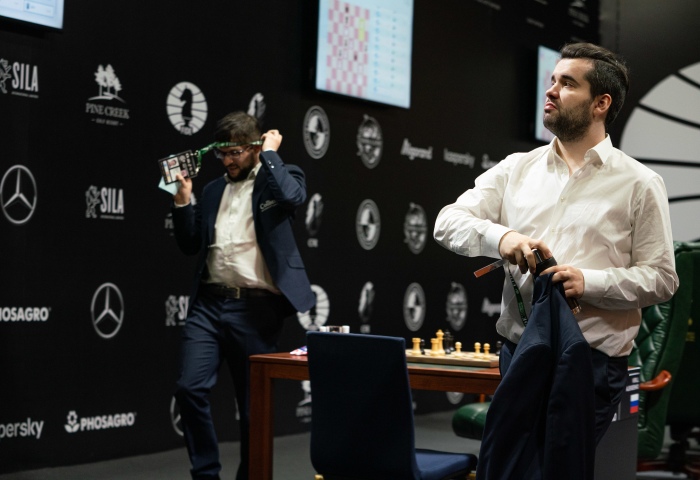
Halfway through the 2020 Candidates, there has been a change at the top as France’s Maxime Vachier-Lagrave defeated the leader after Round 6 Ian Nepomniachtchi in a duel for first place. Both players are now tied for the lead with 4.5 each. A group of four players is a full point behind them. The race is now wide open again as at least six players have a chance for first place. The game between Maxime Vachier-Lagrave (France) and Ian Nepomniachtchi (Russia) was a centerpiece of the day. The Russian started Round 7 with a whole point ahead of his closest rival and was hoping to keep his leading position. Before this round, the two met 13 times and the score is clearly in favor of the Frenchman: seven draws, one loss and five victories. However, Nepomniachtchi won their last game before the Candidates (Jerusalem 2019) in which the place in the Candidates 2020 was at stake. The position was sharp from the very opening, with Nepomniachtchi opting for the French Defence for the second time in this event. Commenting on the game, British Grandmaster Daniel King pointed out that the line, which Black chose to play, was very sharp, suggesting it was a very brave but risky decision of Nepomniachtchi. It seemed it was more the latter than the former as the Russian gradually got into time trouble under White’s pressure. First, the Frenchman started active operations on the queenside, since Black’s rook got stuck at the opposite flank, then he foiled Ian’s attempts to block the position and finally launched an attack in the center and the kingside. Black’s defense collapsed and Ian signed his capitulation just two moves after reaching the time control. Nepomniachtchi now might be regretting his opening choice of a very sharp line. Luck favors the brave, but not always. After the game, Vachier-Lagrave said that he was satisfied with how the tournament was going for him. “Apart from the game with Wang Hao, I played reasonably well [at the tournament]. I hope to continue this trend and to be able to stay on this journey”, the Frenchman said. After this victory, Maxime Vachier-Lagrave joined Nepomniachtchi at the top of the standings as both players now have 4.5 points out of seven games. Despite the two having the same amount of points, Vachier-Lagrave has better tiebreaks thanks to winning their direct encounter. Both Fabiano Caruana (USA) and Wang Hao (China) were on 50% before this round. Caruana, the winner of the 2018 Candidates had to pick up speed if he wanted to be in the race for the first place. However, he was facing Wang Hao, a dangerous and uneasy opponent who already had a good record against the World #2 – five victories, four draws, and no defeats. Still, the majority of the games were played seven or more years ago. Since 2013, the two faced each other just once, in the Isle of Man Grand Swiss in October 2019 (the game was drawn). After Caruana opened with 1.e2-e4 Wang Hao responded with his trusted Petrov Defence. The opponents castled on the opposite sides, presumably signaling a sharp game ahead, but on move 13 the queens left the board. Fabiano launched his g-pawn towards the Black king’s fortress, but this aggression was met with a classical counterattack in the center. The position quickly transpired into an endgame (as Caruana said in the post-game interview, he could not remember all the lines so opted to simplify). Black was slightly better but not enough to convert this tiny advantage into more than a half-point. The two agreed on a draw on move 41. With 3.5 points out of seven games, both players are still in the race for the top spot and hoping to kick into high gear in the second part of the tournament. Alexander Grischuk (Russia) continues to be the king of draws at the 2020 Candidates. The Russian split a point in all his games, including the Round 7 encounter with Anish Giri (The Netherlands). The two have played 14 times before this game with Giri leading by 2:1 (plus 11 draws). The game saw a relatively rare line of the English Opening bearing the name of Paul Keres. As in all previous games, Grischuk spent a lot of time in the opening but for a good reason, as he obtained quite a comfortable position. Like in Caruana – Wang Hao game the opponents castled on opposite sides, but after White’s breakthrough in the center and massive exchanges on d5-square, the game steered into an equal endgame in which the conflict was quickly exhausted. The opponents shook hands in a drawing endgame right after reaching the time control. In the post mortem, Giri said that Grischuk played well and managed to find the most sophisticated moves in the opening, holding the position. The Dutchman confessed to an unusual conflict of interest in this game, saying that although he “obviously wanted to win” he also wanted a series of draws by his opponent to continue. Both players have chances to fight for the first place as they are just one point behind the leaders (on 3.5 points after seven games). Ding Liren (China) drew as White with Kirill Alekseenko (Russia). Both players were on two points after six rounds and were at the bottom of the board before Round Seven. This was a duel between the Chinese pre-start favorite and the Russian wild-card. The two played twice before and both games ended in a draw. A popular Russian comedian Andrey Rozhkov, Yekaterinburg’s native, made the first ceremonial move in the game and seemingly raised players’ spirits. Black quickly managed to equalize in the Catalan Opening and got a flexible position. Ding Liren was not at his best in the middle game as at some point Alekseenko’s ambitions might have gone farther than just making a draw with Black. However, the Chinese never crossed the line in this game and the opponents sealed a draw by repetition in a rook ending. Both players were not enthusiastic about the outcome in
Candidates 2020: In-form Nepomniachtchi stretches the lead
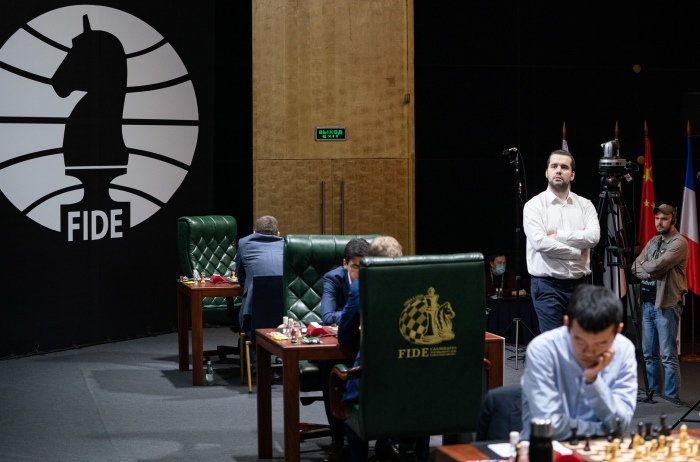
Russia’s Ian Nepomniachtchi increased his lead at the 2020 Candidates to a whole point after defeating China’s Ding Liren. The 29-year-old goes into the rest day with 4.5 points after the first six rounds (+3) and is now a very strong favorite to become the challenger to Magnus Carlsen for the title of the World Champion. Behind him, on 3.5/6 is Maxime Vachier-Lagrave, followed by a pack of four players with three points each. Round 6 saw the longest game of the tournament so far: after an epic seven-hour battle and 98 moves, Anish Giri defeated the Russian wild-card Kirill Alekseenko in a tense and draining endgame. It was a day of long and double-edged play in Round 6 of the 2020 chess Candidates in Yekaterinburg. 1.e2-e4 was played on three out of four boards with the Black responding with solid 1…e7-e5. As a result, two Ruy Lopez and one Italian appeared on the boards. Only China’s Wang Hao opened with 1.d2-d4 and tested his opponent in the Gruenfeld Defense. The game between Ian Nepomniachtchi (Russia) and Ding Liren (China) was a battle between the tournament leader (Nepomniachtchi) and one of the favorites before the event (Ding Liren). Prior to this game, the two played each other nine times, winning one game each and drawing seven. The last decisive outcome between the two was last year, at the Zagreb Grand Chess Tour (Ding Liren won). The leader of the tournament demonstrated an excellent opening preparation as White. The grandmasters commenting on the game pointed out that Ding Liren was repeating lines he previously had played, suggesting that he is open to a risk of walking into his opponents’ preparation.n. It seems that this is what happened in this game as Ding Liren spent considerably more time in the opening. After exchanges in the center, White created a passer on the b-file and quickly advanced it towards the promotion-line. Ding Liren responded with engineering some counterplay on the kingside creating potential mating threats. It was a double-edged game, but it seemed that Nepomniachtchi had better control over the proceedings. The key moment came on move 33 – first Ian made a natural move 33. Qc6 (an in-between 33.f3 was much better) allowing Black escape with a brilliant 33…Rxb6!!, but the Chinese missed this golden opportunity. After the Russian mercilessly put his queen behind Black’s lines Ding Liren gave up a piece and put an end to his suffering on move 40. After this game two things are clear: Ian Nepomniachtchi has positioned himself as a very strong favorite to challenge Magnus Carlsen for the world chess crown, while the pre-event favorite, Ding Liren, seems to be giving up on his hopes as he is on the bottom of the scoreboard with 2/6. Nepomniachtchi did not beat about the bush in the post-game interview: “In this tournament, only the result counts, nothing else”. With 4.5/6, he made his point clear. The game between the Russian wild-card Kirill Alekseenko and Anish Giri (The Netherlands) was the longest of the day and the tournament so far. After more than seven hours of play and 98 moves, the Dutchman forced the Russian to resign. Previously, the two met once, in 2008 – when both were kids – and it was Giri who came victorious. Alekseenko opted for the Italian game where both sides usually develop slowly without many exchanges. Giri was showing more confidence and better preparation as he spent less time but obtained a quite comfortable even a slightly better position with Black. After several exchanges in the center, the game transpired to a queen and knight endgame where Black had a better pawn structure. White pressed on, understanding that if he wishes to stay in the game he cannot afford to be passive. Giri responded with careful, preventive moves but maybe proceeded too cautiously. Kirill broke through in the center and was very close to reaching complete equality but played unthinkable 38.Qd7 instead of a more than natural 38.Qxb7. Eventually Black managed to get hold of an extra pawn, but his 2:1 pawn majority on the queenside transformed into a 3:2 pawn advantage on the kingside in a knight endgame. Commentators noted that the position on the board was similar to a 2019 game where World Champion Magnus Carlsen managed to convert an extra pawn against Visvanathan Anand. Alekseenko was doing his best, carefully maneuvering his knight and king thwarting Black’s attempts for quite a long time but got cracked on move 89 after playing 89.Nd3? instead of 89.Nh1+. Ten moves down the road Alekseenko threw in the towel. After this victory, Anish Giri got back on 50% and joined the pack of three other players with 3/6. This defeat left Kirill Alekseenko on 2/6 – he is sharing the last place with Ding Liren. Alexander Grischuk (Russia), the most experienced player of the event, was late for his game against Fabiano Caruana (USA). This has become something of a tradition in the Candidates as the Russian was late for every single game so far. Somehow, it seems that this goes hand in hand with his time troubles, which Grischuk is known for. The game saw an aggressive, double-edged Archangelsk variation of the Ruy Lopez. While Caruana was blitzing out his moves (suggesting good opening preparation), Grischuk was somewhat struggling: on move 13 he spent nearly 15 minutes pondering on what to chose. Caruana offered a repetition early on but after a further half-hour of thinking, Grischuk decided to continue the battle. Eventually, the Russian sacrificed a pawn but got full compensation in a dynamic position. Then it was Caruana’s turn to make an offering as he left his knight up for grabs on a7. Grischuk thought another 13 minutes and refused the poisonous gift. The position was tense and required a lot of precise and detailed calculations, which demanded time. This is exactly what Grishuk did not have as he was down to two and a half minutes for eight moves to reach the first time control. Grischuk managed to do it regaining a pawn along the way. He is
Candidates 2020: Nepomniachtchi emerges as a clear leader
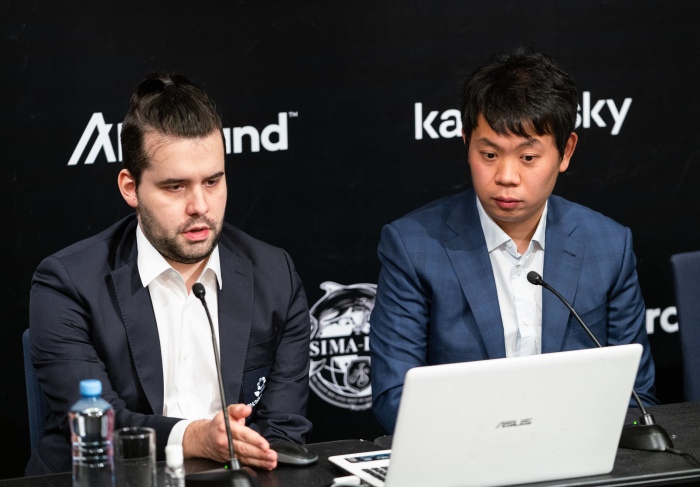
After five rounds of play, Russia’s Ian Nepomniachtchi emerged as a clear leader in the 8-player 2020 Candidates, having defeated Wang Hao of China. With 3.5/5, he is half a point ahead of second-placed Maxime Vachier-Lagrave who drew with Russian wild-card Kirill Alekseenko. On other boards, American Fabiano Caruana was lucky to escape with a draw against Anish Giri, while the game between Grischuk and Ding Liren finished last with the two splitting a point after a long battle. After a day of draws (Round 4) came a day of sharp lines and edgy play at the 2020 Candidates. Finally, one player managed to rise above the rest – Ian Nepomniachtchi, as he defeated Wang Hao of China. This was a battle between two leaders (Nepomniachtchi, Wang Hao and Vachier-Lagrave were tied for the first place after four rounds). Before this game, the two met four times and the score was even: one win each and two draws. The last time they faced each other in a game with classical time control was at the Danzhou super tournament in 2016. That encounter ended in a draw. Not this time, however! After 1.e4 Wang Hao opted for the Petrov Defence as Black. White quickly started pushing his h-pawn towards the black king’s fortress. The move is considered a novelty and became a cause for Black to go into deep calculations. Commentators – including world champion Magnus Carlsen – noted that pushing the h-pawn has become more common at the top level as a clear sign of how AlphaZero (the powerful chess computer, which patented the idea behind the move) was influencing the game. Both players demonstrated a high level of preparation and the position was mostly balanced. Although Ian was persistently looking for opportunities, a draw remained the most likely outcome. However, Wang Hao first allowed Ian’s queen to infiltrate into his camp and then committed a fatal error with 32…Qd7? (a bold 32…Nxd4 with the idea of launching a counterattack on the light squares was sufficient for a draw). Nepomniachtchi was quick to capitalize on the opponent’s misstep and after a forced sequence Black had to give up a piece and resigned immediately. The complexity of the game was shown later in the post-mortem – both players spent well over 10 minutes in live commentary analyzing the lines suggested by chess engines. Wang Hao did not seem disappointed after the game, while Nepomniachtchi (currently ranked as the fifth strongest player in the world and the only one at the top to have a better score against world champion Magnus Carlsen), was very calm and reserved about his lead, saying it’s still early days. One of the favorites Fabiano Caruana is counting his lucky stars after he managed to escape with half a point in the game with Anish Giri. From the very opening, Anish Giri (who played as White) pushed and came down hard on his opponent. The American later confessed that he didn’t remember the right line after Giri surprised him in the opening and was forced to improvise. The improvisation, however, led to Giri’s achieving a dominating position, making Black feel quite uncomfortable (“I was borderline lost”, said Caruana after the game). However, it is the resilience and the will to ‘bugger on’ at even the toughest of times that sets the best from the rest. Caruana kept defending well and hoping for his luck to turn. Then came a turning point in the game: despite obtaining a better position – deemed by some as almost winning – Anish Giri made several substandard moves and let his advantage disappear. After Caruana managed to reach the time control and equalized position a draw was called. This was not the first lucky escape the American had facing Anish Giri: the Dutchman was completely winning with White vs. Caruana in Candidates 2016 in Moscow, but – as now in Yekaterinburg – Giri missed his chances in a sharp position and then tried to break through for 96 moves to no avail. In the interview after the game, Anish Giri gave the following assessment of the outcome: “I was better, but… I cannot say I saw a win but there were options there”. This game leaves one of the top favorites to win the event – Fabiano Caruana – “only” on 50 percent after a third of the games played! In one of the most exciting duels of the day between Kirill Alekseenko (Russia) and Maxime Vachier-Lagrave (France), a double-edged Najdorf Sicilian was played. For quite a long time the opponents followed the footsteps of Magnus Carlsen and Vachier-Lagrave himself (the game was played in London back in 2019) and diverted only on 16th move when Black introduced a very important novelty 16…g6. Then the game reached its crescendo when White (Alekseenko) sacrificed a rook for a pawn on the kingside, which was immediately met by Black’s sacrificing an exchange on c3. Both players were very well prepared, but the number of tactical lines available forced less experienced Alekseenko to spend an hour more than his opponent did. Interestingly, this was the second time in this tournament that Vachier-Lagrave experienced his opponent spending almost an hour on a single move (in the fourth round Grischuk spent almost an hour for an obvious move). The Frenchmen later commented that if this happens to him again, that he will ask the Chief Arbiter “to bring some board games out” so he could amuse himself. However, in the game between Kirill Alekseenko and Vachier-Lagrave – all the excitement was there at the board as both needed to make sure not just that they calculate correctly but also, not to forget any of the relevant lines that were possible. This put higher pressure on the Russian wild-card Alekseenko who was in serious time trouble. To his credit, the Russian managed to find the right moves just in time and the two agreed on a draw. In the interview which followed, both players noted that sharp positions demand that the players remember the lines clearly. “I try to remember the main
Candidates 2020: A day of draws in Yekaterinburg
There has been no breakthrough at the 2020 Candidates Tournament as all four games of Round Four ended in a draw. Maxime Vachier-Lagrave of France was closest to scoring a full point but he missed his chances against Alexander Grischuk, despite the Russian being in severe time trouble. The longest game of the day was between American Fabiano Caruana and Russian Ian Nepomniachtchi which also ended in a draw. Altogether, there is no clear leader at the 2020 Candidates, as three players have 2.5/4 – Ian Nepomniachtchi, Maxime Vachier-Lagrave and Wang Hao Round 4 started – and finished – with the Candidates tournament being wide open. Thanks to Ding Liren’s comeback in Round 3, when he delivered a blow to Fabiano Caruana, all players entered the fourth round with a chance to make a significant step forward. The round started with ceremonial moves made on all four boards. In the Game Caruana – Nepomniachtchi, the first move was made by Nikolay Karpol – legendary women’s volleyball coach and President and Head coach of the VC Uralochka-NTMK Yekaterinburg. Andrey Simanovsky, President of the Chess Federation of the Sverdlovsk region opened the game Wang Hao – Kirill Alekseenko. Viktor Shepty, First Deputy Chairperson of the Legislative Assembly of the Sverdlovsk region, did the honors in the encounter Maxime Vachier-Lagrave – Alexander Grischuk. Finally, Albert Stepanyan, Executive Director of the Chess Federation of the Sverdlovsk region made the first ceremonial move in the game between Ding Liren and Anish Giri. The most exciting game of the day was between Maxime Vachier-Lagrave and Alexander Grischuk (the only player to draw all his encounters). The Frenchmen opened with 1.e4 and Grischuk responded with the Berlin Defence in the Ruy Lopez. The game progressed quickly until one point: Grischuk spent 53 minutes on his 19th move before deciding to put his knight to e7. This was unusual, as the move seemed natural and had been played before (between Maxime Vachier-Lagrave and Hikaru Nakamura). On move 20, the Frenchmen sacrificed his c3-pawn and put some pressure on Black’s position. After 24 moves, White had the initiative as Black’s king got stuck in the center and his a8 rook was cut-off from the action. The computer said the position was equal, however – Grischuk had under 10 minutes on his clock which suggested serious time trouble. By move 26, Grischuk had just two and a half minutes to make 14 moves! Then, unsurprisingly, Alexander made a serious mistake by taking White’s pawn on a4, offered by Vachier-Lagrave. However, instead of 30.Re4 with the decisive advantage for White, the Frenchmen rushed with 30.Ba3+. (In an interview after the game, Maxime said he forgot about the 30.Re4 move. Even the greatest players make errors). The game then transposed into a four-rook ending in which White had an advanced pawn on e6 and more active rooks. Nevertheless, after surviving major scare on 30th move, Grischuk safely reached the time control break and then confidently made a draw. In an interview after the game, Alexander said that he “made a very stupid thing” by spending an hour thinking about an obvious move. Talking about the endgame, Grischuk said: “The position was extremely tactical despite it being an endgame. It could have gone either way.” This was a fourth consecutive draw for Grischuk in the 2020 Candidates. The game between Fabiano Caruana (white) and Ian Nepomniachtchi (black) developed quickly. After 1.d4 Nepomniachtchi went for Gruenfeld defense, his main weapon with Black. Caruana was blitzing his moves, launching his h-pawn towards the black king’s fortress. The American secured his control over the center and advanced his pawn further to h6 hampering Black. Commenting on the game, Magnus Carlsen suggested that Nepomniachtchi is taking many risks. After exchanges in the center, Nepomniachtchi then offered to trade queens on move 26 but Caruana preferred to continue with the most powerful pieces on the board. The American pinned his hopes on his d5-passer but Nepomniachtchi was defending accurately and patiently. Still White had some pressure but Fabiano made an inaccuracy with 31.Qf3, apparently overlooking the sequence 31…Qe1+ and 32…f5 after which Black was out of any danger, to say the least. After the exchange of queens, Ian tried to find some chances in the bishop endgame but Caruana did not give him any – a draw was called on move 55, after five hours of play. In their first duel ever, Wang Hao and Kirill Alekseenko agreed to split a point. Alekseenko obtained a solid position with Black and reached equality. Although Alekseenko was playing very carefully making sure he prevents White from activating his play – Peter Svidler, Alekseenko’s second – noticed that his compatriot tends to overthink his positions sometimes thus creating needless complications. This was the case when Kirill played 13…Ra6 and found himself in an inferior position. In the following tense game with a lot of fine maneuvering, Alekseenko was defending with great accuracy and neutralized all White’s active ideas. The opponents sealed a draw on 41st move. Ding Liren – who got back into the tournament after defeating Fabiano Caruana in Round 3 – drew as White against Anish Giri. Both had a slow start to the tournament, with one point out of three. The opponents had a discussion in the Catalan Opening. White got a slight edge but there was no real way to make progress without serious missteps from Black’s part. Naturally, Anish refused to cooperate – he demonstrated a very interesting idea of pushing his h-pawn and solved all his little problems. After massive exchanges, the game steered into an equal rook and bishop vs rook and bishop endgame in which a draw was a natural outcome. Judit Polgar on the 2020 Candidates: An extraordinary situation but a great opportunity for chess Joining the official commentary today (via Skype) was Judit Polgar – the strongest female chess player of all time. She reflected on the circumstances in which this tournament is being played: “This is an extraordinary situation for the players. It is psychologically very tough. There are a lot of strange things happening. In the games, you could see
Call for submissions: FIDE launches veterans support program
The International Chess Federation is pleased to announce the continuation of its support to chess veterans. A number of stipends for a total amount of 20,000 Euro will be awarded next month to distinguished players and trainers aged 65+. Anyone over this age, who has contributed to the development of chess and who is in an unstable financial situation, is eligible to receive this support. We invite federations, clubs, and players themselves to send their applications, including a CV of the nominee, to the FIDE Secretariat: office@fide.com. The deadline for submissions is April 5, 2020.