

Nepomniachtchi and Wang Hao early leaders at the 2020 Candidates
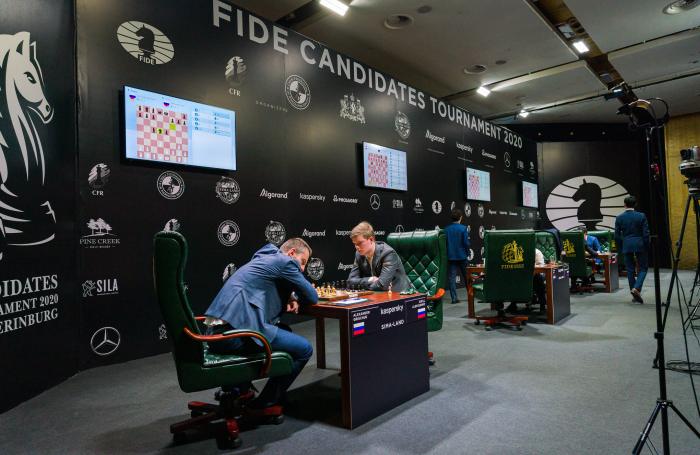
Round one of the 2020 Candidates Tournament opened with a Chinese upset as the underdog Wang Hao, playing with black pieces, defeated his compatriot – and one of the favorites of the tournament – Ding Liren. The second decisive outcome was produced in the game between Anish Giri and Ian Nepomniachtchi in which the local player prevailed. After the first round, Ian Nepomniachtchi (Russia) and Wang Hao (China) lead the field, with four players on half a point and two on zero. The 2020 Candidates Tournament is probably the only high-profile sporting event taking place in the world. In light of the concerns regarding the coronavirus, various measures have been put into place. Players and arbiters are supplied with masks, sanitizers, and the audience is not allowed in the playing venue. In chess terms, this event is unique given that it has the highest prize fund ever for a Candidates Tournament (500,000), and that for half of the players (Maxime Vachier-Lagrave, Ian Nepomniachtchi, Kirill Alekseenko, and Wang Hao) this is their debut at the event. Traditionally, the opening round started with the first-move ceremony. FIDE President Arkady Dvorkovich made the first move in the game Ding Liren – Wang Hao, Russian football star Dmitri Bulykin made the first move in the game between Vachier-Lagrave and Caruana, the head of Yekaterinburg City Chess Federation Mikhail Vakhrushev did the honors in the Russian duel between Alexander Grischuk and Kirill Alekseenko and the 12th World Champion Anatoly Karpov opened the game between Anish Giri and Ian Nepomniachtchi. Interestingly, while Giri did shake hands with Karpov, Nepomniachtchi refused, in light of the concerns about the global coronavirus pandemic. The biggest upset of the day came in the Chinese duel where Wang Hao (who is playing his first Candidates event) defeated Ding Liren (who finished the 2018 Candidates without a single loss!). For the first time in the Candidates, two Chinese players were playing each other. Following the English Opening, the compatriots ended in a seemingly peaceful position in the midgame, with the queens exchanged. White (Ding Liren) had a tiny advantage – a strong knight on c4 and good control of the flow of the game, while Black had a passive bishop on c7. The position was, however, roughly equal. White then decided to open the position with 30.f4, but it allowed Black’s pieces to spring to life. Wang Hao got a chance to take the initiative, and several moves down the road he was dominating on the kingside, while at the same time blocking any chances for White. Facing an imminent collapse of his position Ding Liren decided to resign. Ding Liren did not appear at the press conference after the game. In his analysis of the position, Wang Hao highlighted 30.f4 as a bad move, pointing out that White had some advantage before that. This game was interesting for one other reason: over a million people tuned in from China to watch the live broadcast on the official website. The Chinese commentary being provided by non-other than the highest-rated female player in the world Hou Yifan, and three-time champion of China and 14-time champion of the Netherlands, Peng Zhaoqing. The first game to finish was the one between Maxime Vachier-Lagrave (who got a place in the event after Teimour Radjabov decided to withdraw) and Fabiano Caruana (the #2 in the world and the winner of the 2018 Candidates). The opponents had a discussion in the sharp Arkhangelsk variation of the Ruy Lopez. As Caruana commented after the game: “it was one of the most double-edged lines in the opening, and it’s a double-edged opening in general”. The opening did not go as planned for Maxime Vachier-Lagrave and, in his own words, “the position was very unpleasant”. In a tactically challenging battle, it seemed that Caruana was better prepared and had a more solid knowledge of the lines. However, the Frenchmen played patiently and managed to find the right moves to maintain the balance in a sharp position. The most critical moment of the game came on move 32 when White played 32.Qd3 after 23 minutes of thinking! This move seemed very dangerous for White, but there was still no sign of a distinct advantage for Black: “I looked at a number of options without finding anything with a clear cut. I didn’t see anything I liked so much. After that it was a clean draw”, said Caruana in an interview after the game. The opponents sealed a draw after 45 moves in an ending with rooks and opposite-colored bishops. The Russian duel between Alexander Grischuk and Kirill Alekseenko started with a handshake and ended in a draw. There was a technical issue at the beginning when Grischuk asked for his chair to be replaced, as he found it uncomfortable. The same opening was played as in the game between Ding Liren and Wang Hao. However, by move eight the game transpired into a position that has never been played before. After a slow but pressuring play in the center and the kingside White (Grischuk) managed to create a strong formation, towering over the central squares. Despite White’s building a secure and powerful structure in the center, Black (Alekseenko) had sufficient firepower (combining the queen and the bishop) and enough open diagonals to engineer some counterplay and threaten the white king. The duel ended in a perpetual check, confirming an even outcome. While the engines and chess pundits gave many opinions about this game and others from Round 1, Grischuk – in his style – gave a sweeping blunt summary of the first day: “Everyone played horrible today, except maybe Ian [Nepomniachtchi]”. Grichuk had a point in praising Ian Nepomniachtchi’s play as the latter managed to defeat Anish Giri with Black pieces. This was the longest game of the First Round, lasting over five hours. In yet another English opening, the players went for a very sharp line. As the game was developing, commentators around the globe – from Danil Dubov and Evgenij Miroshnichenko in Yekaterinburg (who are doing the English commentary for the event) to Viswanathan Anand in India and Hikaru Nakamura in the States – were guessing how far did Giri’s preparation go. It was noticeable that the Dutchman spent quite a lot of time before
FIDE enhances protection measures in the Candidates Tournament

Due to the current epidemiological situation, protection measures have been enhanced in the FIDE Candidates Tournament. No spectators will be allowed to the playing venue at the Hyatt Regency Yekaterinburg hotel. The accredited persons, including media, are admitted into the playing area only for the first 5 minutes after the start of the round. Photo and video shooting are allowed only from a distance of at least 6 meters from the players. Spectators can follow the games on the official website, FIDE website, and the FIDE Youtube channel A popular Grandmaster and coach Sergey Shipov will lead the Russian commentary. The World Rapid Champion-2018 Daniil Dubov and Grandmaster Evgeny Miroshnichenko will provide the English coverage. The Chinese commentators will be the highest-rated female player in the world Hou Yifan and three-time champion of China and 14-time champion of the Netherlands, Peng Zhaoqing.
The 2020 Candidates Tournament officially opened in Yekaterinburg
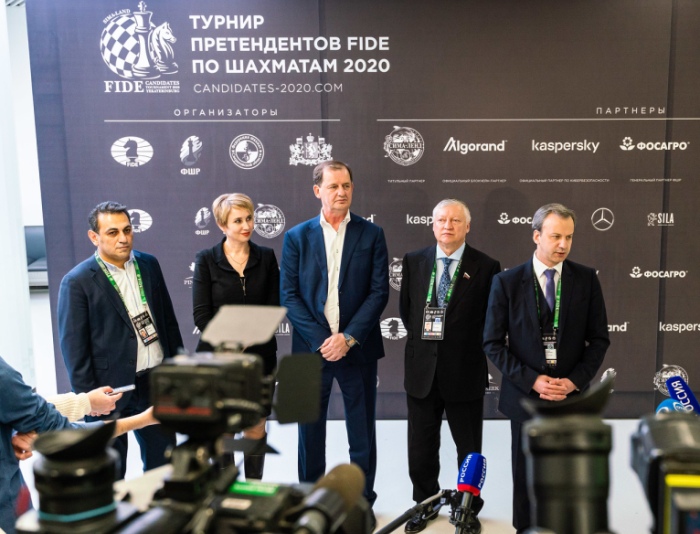
The International Chess Federation (FIDE) is pleased to announce the opening of the 2020 Candidates Tournament, which is taking place in Yekaterinburg (Russia) The eight-player Candidates tournament is one of the most prestigious global chess events, held every two years. The event will determine who will challenge the defender Magnus Carlsen for the title of the World Chess Champion. This year’s event has a prize fund of 500,000 Euros, which is the highest ever in the history of the Candidates tournaments. The players taking part in the Candidates are Fabiano Caruana (USA), Ding Liren (China), Alexander Grischuk (Russia), Ian Nepomniachtchi (Russia), Maxime Vachier-Lagrave (France), Anish Giri (The Netherlands), Wang Hao (China) and Kirill Alekseenko (Russia). The opening ceremony took place at the “Ekaterinburg Expo” congress center. Speakers at the Opening Ceremony were Evgeny Kuyvashev (Governor of the Sverdlovsk Oblast (Region)), FIDE President Arkady Dvorkovich, former World Champion Anatoly Karpov, the President of the Sverdlovsk Chess Federation Andrey Simanovsky as well as the Regional Corporate Sales Head at Kaspersky Marina Usova. Evgeny Kuyvashev, the Governor of the Sverdlovsk Oblast (Region) said that it is the first time this region is hosting a FIDE Candidates tournament and added: “Our region considers itself one of the leaders of the home [Russian] chess movement and the center for the development of “the chess thought”. Today some 20,000 people professionally play chess in the Sverdlovsk Region, including 2.500 children and teenagers. We are proud of our chess masters and our young chess talents”. Congratulating the players and chess fans across the world on the start of the FIDE Candidates Tournament in Yekaterinburg, FIDE President Arkady Dvorkovich pointed to this event being the most important stage in the qualifying cycle for the World Chess Championship, as it will determine the opponent of the current world champion Magnus Carlsen. “In the coming weeks, we will witness epic battles between eight world’s leading chess players. They went through the toughest selection process in the previous few months to compete for the right to challenge for the world chess crown in Yekaterinburg”. FIDE president also reflected on the fact that the Tournament is held in the environment of an alarming situation with the spread of COVID-19. “I would like to note that in terms of medical safety measures, the Tournament organizing Committee fully follows the recommendations of the World Health Organization, the IOC and Rospotrebnadzor and fulfills all the prescribed requirements. We also ask for maximum support from the chess community, the media, and all of you”. “Once again, I would like to welcome the participants of the FIDE Candidates Tournament and wish them memorable combinations and spectacular victories. And let the Tournament bring only joy and new positive emotions to all the fans”, Dvorkovich concluded. The mayor of Yekaterinburg, Alexander Vysokinsky highlighted the importance of this event for the local community, adding “we will try to do everything in our power so that this event is held according to highest standards, so everyone could enjoy!” One of the speakers at the ceremony was Grandmaster Anatoly Karpov, the 12th World Champion in chess, who himself comes from the Ural region. Karpov emphasized the uniqueness of the tournament for the region and spoke about efforts made to develop chess education, including at the Ural Federal University. The President of the Sverdlovsk Chess Federation Andrey Simanovsky, as well as the Regional Corporate Sales Head at Kaspersky Marina Usova joined the speakers in wishing the players good luck in the tournament. This year’s Candidates Tournament is held from March 16 to April 3. The First Round starts on March 17 at 4 PM local time (noon CET; 11 AM GMT). The pairings for the First Round: Maxime Vachier-Lagrave (France) – Fabiano Caruana (USA)Ding Liren (China) – Wang Hao (China)Anish Giri (The Netherlands) – Ian Nepomniachtchi (Russia)Alexander Grischuk (Russia) – Kirill Alekseenko (Russia) More information about the event can be found here. The Partners: Sima Land – the title sponsor of the FIDE Candidates TournamentAlgorand – official blockchain partnerKaspersky – official cybersecurity partnerPJSC PhosAgro – General partner of the CFRMercedes-Benz Russia – Official car partnerPine Creek Golf Resort and SILA International Lawyers – partners Relevant links and contacts: Official website: https://en.candidates-2020.com/ FIDE website: https://www.fide.com Chess Federation of the Sverdlovsk Region: http://www.ural-chess.com Information about the partners: https://en.candidates-2020.com/partners Press inquiries: press@fide.com
Arkady Dvorkovich: Safety is our priority

A pre-press event for the 2020 Candidates took place earlier today at the Sverdlovsk Journalists’ Union, where the organisers, local officials, the public and Russian media were introduced to the programme and the organisation of the upcoming tournament. Present at the conference were the Sverdlovsk Region Deputy Governor Alexey Orlov, the president of the International Chess Federation Arkady Dvorkovich, the former World Champion Anatoly Karpov and the President of the Chess Federation of the Sverdlovsk Region Andrey Simanovsky. They were joined by the Regional Corporate Sales Head at Kaspersky Marina Usova, as well as one of the participants of the Candidates, Russian GM Kirill Alekseenko. Speaking on behalf of the regional authorities, Deputy Governor Alexey Orlov said that it is a “great honour for Sverdlovsk to be hosting the Candidates Tournament”. He added that the Sverdlovsk Region has “thoroughly prepared for the event” and that they are “putting a lot of effort into ensuring that all competitive events are organised to the highest safety standards necessary today”. FIDE President Arkady Dvorkovich thanked the regional government as well as the Chess Federation of Russia on organising the tournament: “This is a big event not just for the chess world but, possibly, for the whole sporting community since almost all international competitions have been cancelled due to the spread of the coronavirus”. Dvorkovich added that the International Chess Federation put special emphasis on minimising all health risks for the participants and everyone involved in the event: “We cleared all the health safety issues including medical screenings and tests with the Federal Service for Oversight of Consumer Protection and Welfare (Rospotrebnadzor), and the Ministry of Public Health. We took precautionary measures, following recommendations by WHO, IOC, and Rospotrebnadzor. The participants, media, organizers, and spectators will be separated, and the latter will not be permitted to enter the playing hall. We expect these measures to be sufficient for the players’ safety, bearing in mind that this is not a mass event.” Dvorkovich added that, due to the concerns, all additional mass events (tournaments, simuls) planned for the Candidates have been cancelled. Despite the spectators not being able to attend the playing hall, Dvorkovich pointed out that there will be live commentary, in English, Russian and Chinese, which will be streamed online. Andrey Simanovsky, who heads the Chess Federation of the Sverdlovsk Region, emphasized there has never been an event of such magnitude in Yekaterinburg, adding that this will be “a good impulse to promoting chess in the region”. “I became a president of the regional chess federation rather recently, but already I recognize how exciting the chess world is, and how many extraordinary people are here. In my opinion, chess is the most peaceful, intelligent, and prestigious sport”, he added. Afterwards, Simanovsky showed medals which will be awarded to the top three players of the Candidates Tournament. Cybersecurity and chess The official cyber-security partner of the Candidates Tournament is Kaspersky. Marina Usova, Head of Corporate Sales at Kaspersky, has said that her company is “happy to be involved in a mind sport like chess, which cannot be imagined without the use of computer algorithms”. She drew on similarities between chess and the IT security industry: “There are constant challenges and they require strategic thinking. In cybersecurity, the ability to defend is crucial, as every detail matters. In chess – also. One wrong move can change the course of the game.” W. Sean Ford, COO of Algorand, another sponsor of the event, sent the following message to the participants: “As one of the leading blockchain organizations, we are honoured to join a lineup of other industry-leading partners in supporting chess. We look forward to being a part of the Candidates Tournament in Russia, where chess has been a longstanding tradition and produced some of the most skilled chess players in the world.” Anatoly Karpov: “Energy, health and calm nerves” The 12th World Champion and one of the key people in the Sverdlovsk chess federation, Anatoly Karpov also took spoke at the pre-press event. He shared his thoughts and advice to the players: “In order to win such tournament, one needs energy, health, and steady nerves. Tournament-specific preparation and general opening knowledge as well. The participants of this event won many tournaments during their careers – they are truly cream of the chess world.” Karpov also reflected on the history of chess development in the Urals. “We have never had such a high-level competition in Sverdlovsk Region or in Yekaterinburg. However, the Ural chess school has been developing rapidly in recent years, and the Chess Federation of the Sverdlovsk Region is now one of the most active in Russia. I believe this tournament will be held at the highest level. The players have ideal conditions and they will live and play in the same hotel”. One of the Candidates, Kirill Alekseenko: Playing for a win Kirill Alekseenko, the wild-card participant of the Candidates, was also present at the pre-press event. He expressed his gratitude for being invited, adding: “Naturally, I will be playing for a win, as only the first place gives a chance to challenge Magnus Carlsen.” The official Opening Ceremony of the Yekaterinburg 2020 Candidates Tournament will take place at 7 PM local time on March 16 at the Congress Centre – Ekaterinburg Expo. First games are played on March 17.
Introducing Candidates: Fabiano Caruana
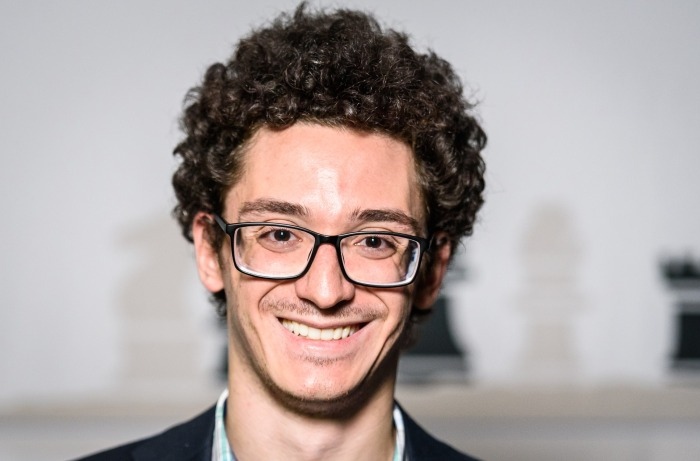
Fabiano Caruana (USA)Born: June 30, 1992 (27 years old)Rating: 2842Qualified as the Challenger in the World Championship match 2018 The third child in a large Italian family, Fabiano Caruana was born in Miami and spent his childhood in the US. Fabiano’s remarkable chess abilities became evident from an early age, and his father, a club-level player, dedicated his life to his son and made everything possible to realize his potential. In America, Fabiano was trained by Miron Sher. At the age of 12, the young chess player, together with his parents, moved to Europe. First, they settled in Spain, where Fabiano was trained by Boris Zlotnik for several years. Then, Caruana’s family put down their roots in Budapest, so that Fabiano could work with Alexander Chernin. The young chess player wasn’t even 15 when he became a grandmaster. Fabiano changed his federation to Italian and started steadily improving his tournament record, participating in numerous events (Biel, in New Delhi, Reykjavik, Dortmund, Zurich, and Wijk aan Zee). A new partnership with Vladimir Chuchelov proved to be very fruitful as the Italian grandmaster advanced rapidly. He firmly established himself in the top 10 players in the world and after a victory in Dortmund (2014), surpassed the 2800 rating mark. Fabiano did not stop there. Playing the Sinquefield Cup, an event featuring six of the world’s top-10 players, Caruana turned in a phenomenal result – he scored 8.5 points out of 10 and overtook the second-place finisher, the World Champion, Magnus Carlsen, by three points, adding 30 rating points along the way with a first-place finish. In 2015, Caruana returned under the American banner and qualified for the Candidates Tournament held in Moscow in March 2016. Fabiano was in contention for first place until the final round in which he lost the winner-takes-all game to Sergey Karjakin. The same year he won the Olympiad (Baku 2016) with his new team playing on the first board. Caruana is a very versatile chess player equally good in openings, positional maneuvering, and endgames. His distinguishing feature is unparalleled concentration over the board. Fabiano’s second attempt to qualify for the match with the World Champion was successful – after winning the Candidates tournament in Berlin (2018) Caruana crossed swords with Magnus Carlsen. The World Championship match in London was a very close one: after all 12 games with classical time control were drawn, the Word Champion prevailed only in a tiebreak. At the beginning of this year, Fabiano reached a new high after delivering an extraordinary performance in the Tata Steel Masters 2020. Caruana finished a clear first, two points ahead of Magnus Carlsen. The American enters the Candidates Tournament as the rating favorite. Will he succeed one more time? We will find out in three weeks. Caruana – Ponomariov (Dortmund 2014) 39. Re7! Qxe7 40. Ba6! Kxa6 41. Qa8# (“One of the mostsatisfying combinations I have ever played!” – Fabiano Caruana)
#01
FIDE Candidates Tournament opens today in Yekaterinburg Dzagnidze clinches victory in Lausanne New FIDE Charter approved USA (+50) and Russia (+65) win gold at the World Senior Team Championship Mercedes-Benz is the official auto partner of the Candidates Tournament READ NEWSLETTER
Health and safety measures at the FIDE Candidates Tournament
Update, 12.03.2020: Due to health concerns, the organizers have decided that spectators will not have access to the playing area. Other preventive measures may be put in place, depending on requirements. Press Release: March 6 2020, FIDE The outbreak of the Coronavirus (Covid-19), which has affected events globally, has led to concerns and questions whether the FIDE Candidates Tournament – due to take place between March 15 and April 5 in Yekaterinburg, Russia – should be postponed. The postponement of the tournament, however, is not legally and practically feasible. Without the introduction of an official ban by the state authorities of the Russian Federation, a unilateral transfer or postponement by FIDE is not possible. However, FIDE is closely following the developments regarding the Coronavirus as well as the situation in Russia and the steps taken by Russian authorities. It also should be noted that contrary to other large chess opens that have been canceled over the past few days, the Candidates Tournament is not a mass event. Being an elite, 8-player tournament, the reduced number of participants allows us to monitor their personal circumstances, health status, and provide them personal attention. In light of the concerns which have been raised, FIDE would like to inform all the participants of the upcoming Tournament as well as the public about the health and safety measures which will be in force: 1. A check-point with a qualified nurse will be created for all participants of the tournament, and officials and visitors in the auditorium. At this point, visitors will be checked for symptoms of Covid-19 before entering the game room, including checking their body temperature. 2. Alcohol-based hand sanitizers will be available at all times. 3. N95 face-masks will always be available in the required quantity. Depending on the assessment of the situation, the wearing of masks may become mandatory for visitors in the auditorium. 4. The distance between the first rows of spectators and players will be at least 15 meters. 5. Handshakes before and after the game are optional. 6. Preventive measures (masks, disinfectants) must also be provided in all hotel rooms where participants and officials will be staying, as well as in all vehicles used for the tournament. FIDE is closely following the developments on the ground and steps taken by Russian authorities. We will do everything in our power to ensure the safety of participants and spectators at the event.
Nana Dzagnidze clinches victory in Lausanne
The third leg of the FIDE Women’s Grand Prix unfolded from March 1 to 13 in Lausanne. The opening ceremony took place at the Olympic Museum in the presence of Lausanne Mayor Grégoire Junod, and the FIDE President Arkady Dvorkovich. This museum was the venue of the World Championship match between Anatoly Karpov and Viswanathan Anand in 1998. The field underwent a last-minute change, since Zhao Xue had to be replaced by Zhansaya Abdumalik due to increasing travel restrictions from Asia. The other Chinese participant, the World Champion Ju Wenjun, was not affected by this situation, as she had been in the US since January. With her and Aleksandra Goryachkina, both world championship finalists would meet again after their recent match for the world crown. The young Russian took a solid early lead in the event by winning her white games in rounds two and four against Alexandra Kosteniuk and Antoaneta Stefanova. Some players, at times, shared the temporary first place with her, but without the same consistency. Harika Dronavalli also reached 3 out of 4 but then lost against Alexandra Kosteniuk. The third Russian participant in Lausanne, Alina Kashlinskaya, had a strong first half. She beat Alexandra Kosteniuk and Marie Sebag to reach 4 out of 6 but later lost to Ju Wenjun due to a dramatic mistake that changed the course of the tournament. Because of a loss with white in round 4 to Dronavalli, few imagined that Nana Dzagnidze would take part in the race for the tournament victory. Yet, this is exactly what she achieved thanks to her powerful play and fighting spirit. The Georgian had already beaten Zhansaya Abdumalik in the second round, but the turning point for her came in round 5 when she managed to extricate herself from a difficult position and win against Anna Muzychuk. After further victories over Marie Sebag and Ju Wenjun, she emerged as the leader with 6 out of 9. Aleksandra Goryachkina reacted immediately in the 10th round with a nice win against Ju Wenjun. The luck of pairings pitted both leaders against each other in the last round. Aware of her tie-break advantage, Nana Dzagnidze took no risk and secured the draw. The mother of two declared afterward that she was delighted with this victory, as it came totally unexpectedly. “I haven’t been very successful in the past few years and was already thinking of quitting chess and raising my children”. Third place was surprisingly clinched by the youngest participant, the 20-year old Zhansaya Abdumalik, who scored 6.5 points. The Kazakhstani, the highest-ranked Junior player among women, beautifully recovered from her early loss and won a total of three games. The reigning World Champion Ju Wenjun was totally out of form. She finished at 4.5 points with a single victory and three losses. Alexandra Kosteniuk, winner of the second Grand Prix leg in Monaco, was also out of shape and finished joined last. Having competed in all three events, the Russian will not be able to qualify for the Candidates through the Grand Prix Series. Indeed, the overall standings before the last leg show that Humpy Koneru clearly holds the best cards in her hands. Only a disaster in the final tournament could prevent her from going through. The second qualification spot will be hard-fought between Nana Dzagnidze, Kateryna Lagno, and Anna Muzychuk, while some other players keep theoretical chances to create an upset. Side events also contributed to the social activity of the Grand Prix. Two rapid tournaments were staged on the weekend of March 7 and 8. Both took place in the House of International Sport, where FIDE has its office since May 2019. This “1st FIDE rapid open of the Olympic Capital”, as well as the rapid tournament for girls under 18 years old, were organized in partnership with the Swiss Chess Federation and helpers from different local chess clubs. The rapid open on March 7 was won by Russian GM Pavel Tregubov on tie-break, ahead of GM Vasquez-Schroeder from Chile and local FM Aurelio Colmenares, who all scored 6 points out of 7. The girls’ event was dominated by the French champion among university students Estée Aubert. Several prestigious guests visited the event, such as Lausanne Mayor Grégoire Junod, Councillor of State Philippe Leuba or the General Director of Athletissima Jacky Delapierre. At the closing ceremony, FIDE Vice-President Lukasz Turlej thanked all sponsors and partners which contributed to the making and the success of this event. In particular Total, Kaspersky, Sila Lawyers, the Swiss Chess Federation and the Olympic City of Lausanne. He added that the live broadcast had attracted a record number of viewers for a women tournament. The exposure of the Women’s Grand Prix was significant in the Swiss press as well. A recap with interviews appeared on primetime news of the national French-speaking RTS on March 12, something which had not happened since World Champion Magnus Carlsen played in Biel in 2018. The event was also presented live on national radio on the morning of the last round. Besides that, several main newspapers mandated journalists to write exclusive articles about the tournament. No doubt, FIDE has succeeded in promoting its first event in Lausanne, since they settled in the Olympic Capital in May 2019. Final standings of the Lausanne Grand Prix: 1-2. Nana Dzagnidze (GEO) and Aleksandra Goryachkina (RUS) – 7 points3. Zhansaya Abdumalik (KAZ) – 6½4-5. Alina Kashlinskaya (RUS) et Anna Muzychuk (UKR) – 66-8. Harika Dronavalli (IND), Mariya Muzychuk (UKR) and Antoaneta Stefanova (BUL) – 5½9-10. Pia Cramling (SWE) and Ju Wenjun (CHN) – 4½11-12. Marie Sebag (FRA) and Alexandra Kosteniuk (RUS) – 4 Current standings of the Grand Prix Series 2019 – 2020 before the last event: 1. Aleksandra Goryachkina, Russia, 398 (3 tournaments)2. Humpy Koneru, India, 293 (2)3. Alexandra Kosteniuk, Russia, 193 (3)4. Nana Dzagnidze, Georgia, 180 (2)5. Kateryna Lagno, Russia, 180 (2)6. Harika Dronavalli, India 180 (3)7. Anna Muzychuk, Ukraine, 165 (2)8. Ju Wenjun, China, 155 (2)9. Alina Kashlinskaya, Russia, 130 (2)10. Mariya Muzychuk, Ukraine, 120 (2)11. Zhansaya Abdumalik, Kazakhstan, 110 (1)12. Pia Cramling, Sweden, 105 (3)13. Elisabeth Paehtz, Germany, 95 (2)14. Valentina Gunina, Russia, 85 (2)15. Antoaneta Stefanova,
The new FIDE Charter: What is it?
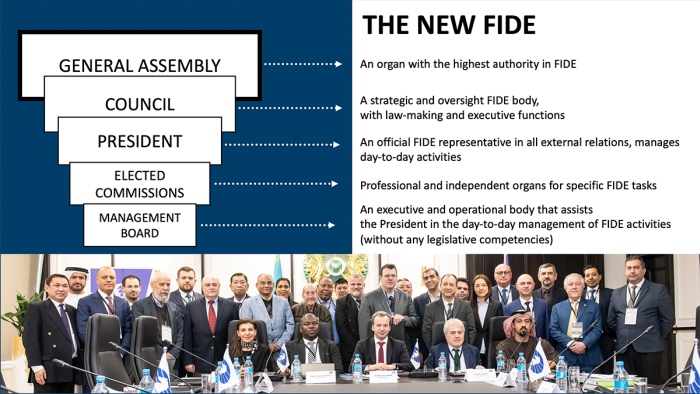
One of the main decisions at the recent 90th Extraordinary General Assembly was the approval of the new FIDE Charter, that replaces the old FIDE Statutes and came into force on March 1, 2020. But what does this change implies, and why it was required? This reform was needed because the previous FIDE Statutes were severely outdated. There was a pressing need to renew them in order to turn FIDE into a more modern, transparent, democratic and efficient institution, in full compliance with International Olympic Committee stands. The main rules of our organization have a fundamental role in making this possible, clarifying the system of FIDE rules and regulations, defining the principles of FIDE, establishing clear management structures, improving the role of the independent Elected Commissions, and updating the role of Zonal Presidents. One of the main changes is that the “Presidential Board” is now replaced by the “FIDE Council”, a strategic and oversight body with law-making and executive functions. Its number of members was reduced to 15 members, to facilitate the efficient work process. In the former statutes, less than half of the Presidential Board members were elected independently of the President, while in the new Charter more than half of them are elected independently of the President. Votes on elections for the members of the FIDE Council must be made by secret ballot. The role of the FIDE President is now defined as “representing the institution in all external relations, managing day-to-day activities, signing contracts, maintaining good relations between FIDE and the Federations, and fostering a positive image of FIDE”. The new Charter also introduces term limits: a person cannot serve as President for more than two terms (including the current term). The President is assisted by the management board, an operational body with executive, operational and administrative functions, but without any legislative competencies. This body manages ordinary activities and resources, coordinates current activities of officials, commissions, FIDE offices and employees, and implements decisions and attains objectives set by the President and the Council. In the new Charter, the General Assembly is reinforced as the organ with the highest authority in FIDE, getting more powers: it becomes the main body dealing with all major issues, including FIDE elections, budget approval, and votes of no confidence. It acts as an internal appellate organ for all decisions taken by the Council and the President. To improve transparency, the new FIDE charter also introduces “a vote of no confidence”: The General Assembly may dismiss elected officials (including the President of the entire Council), with a majority of two-thirds of valid votes. Motions of no confidence can be debated following a proposal supported by a minimum of 65 member federations, or by 7 members of the council. The elected commissions, like the Ethics Commission or the Disciplinary Commission, remain as professional and independent organs for specific FIDE tasks. As it would be expected, such a profound reform initially raised many questions from the members of the chess community. The comments and suggestions gathered during months of open dialogue often turned in improvements that were introduced in the draft, producing, as a result, a more robust FIDE Charter that, on its final form, was approved with wide support: 112 votes in favor, 1 abstention, and 1 vote against. LINKS: The attendants to the General Assembly were shown the following presentation, which contains more details about this reform FIDE Charter (complete)
FIDE Qualification Commission: Coronavirus Announcement

The Qualification Commission has received a large amount of correspondence about the consequences with regard to FIDE-rated chess tournaments during the last week. The Qualification Commission’s approach will be to be as helpful as possible to national federations in assisting them to submit tournaments for rating with minimum difficulty, and National Rating Officers are welcome to contact us with any specific queries. It is not the responsibility of FIDE to cancel FIDE-rated tournaments in any given Federation. Each Federation may take their own decisions in accordance with their own constitution and statutes regarding FIDE-rated chess within their Federation. Registration of Tournaments It is expected that a number of tournaments that were registered will now be cancelled. In this case, Rating Officers should submit a deletion request for the tournament. There are no fees levied for this. If a tournament is postponed until another date, then Rating Officers are instructed to change their dates. These changes will be approved by the Qualification Commission. This includes any “long” events, such as a National League run over a season-long basis. Cancelled Tournaments while they are in Progress A number of tournaments have been cancelled by the local or national government while they were in progress; including the recent World Senior Team Championships in Prague. For the avoidance of doubt, rating files with fewer than the registered number of rounds will be permitted for FIDE rating. National Leagues A number of season-long national leagues have either had weekends postponed until later in 2020, or the rest of the season cancelled entirely. Title norms that have been achieved over the shorter seasons will be considered provided that at least 9 rounds have been played by the player. In addition, the terms of 1.41c of the Title Regulations will apply to National Leagues that have been postponed or cancelled after 8 of the scheduled rounds. Long Events Some events which last up to 90 days are rated in one rating file, rather than a separate rating file for each month. The end of these tournaments may now be postponed for several weeks. In this case, National Rating Officers are instructed to modify the tournament to a “long” tournament and submit a rating file of the games of the tournament played so far. The rest of the tournament can be registered as a continuation of the long tournament once its conclusion is rearranged. If you have any further questions, please contact QC. Alex Holowczakalexholowczak@gmail.comQualification Commission Secretary14th March, 2020