

90th FIDE Congress: Final List of Delegates

FIDE is publishing the final list of the delegates for 90th FIDE Congress. FINAL LIST OF DELEGATES (pdf)
Gibraltar Masters 2020: Esipenko leads halfway through

One of the best open tournaments in the world, Gibraltar International Chess Festival is underway in the British Overseas Territory. The festival includes several tournaments in three sections, running January 22-30: Masters, Challengers and Amateurs. More than 500 players are taking part this year. In the Masters tournament, Andrey Esipenko (Russia, #6 in the juniors rating list) emerged as the sole leader with an excellent score 5½ out of 6 points after beating Ivan Cheparinov (Bulgaria) with black pieces on the first board in Round 6. Mikhail Antipov (Russia), Wang Hao (China), Parham Maghsoodloo (Iran, #3 in the juniors rating list), David Paravyan (Russia), Mikhail Kobalia (Russia), Indian wunderkind Praggnanandhaa R (who knocked over Veselin Topalov in Round 6) and Alan Pichot (Argentina) are trailing by a half-point. A large group of players, that includes Maxime Vachier-Lagrave (France), Michael Adams (England), Krishnan Sasikiran and Kirill Alekseenko (Russia) among others is on 4½. GM Bela Khotenashvili (Georgia) who also belongs to this large group mentioned above is leading the women’s field. With 4 out of 6 points Nataliya Buksa (Ukraine), Zhansaya Abdumalik (Kazakhstan), Anna Muzychuk (Ukraine) and Natalija Pogonina (Russia) are also in the contest for the top women’s prize (£20,000). With four rounds to go, the event is still wide open. As it is often the case in Gibraltar, most likely the winner will be determined in the last round. Official site: https://www.gibchess.com/Photo: John Saunders and Niki Riga Top 10 after 6 rounds: 1. Andrey Esipenko – 5½ 2. Mikhail Antipov – 5 3. Wang Hao – 54. Parham Maghsoodloo – 55. David Paravyan – 56. Mikhail Kobalia – 57. Praggnanandhaa R – 58. Alan Pichot – 59. Jose Carlos Ibarra Jerez – 4½10. Ivan Cheparinov – 4½
Marking the centennial of Lim Kok Ann’s birth
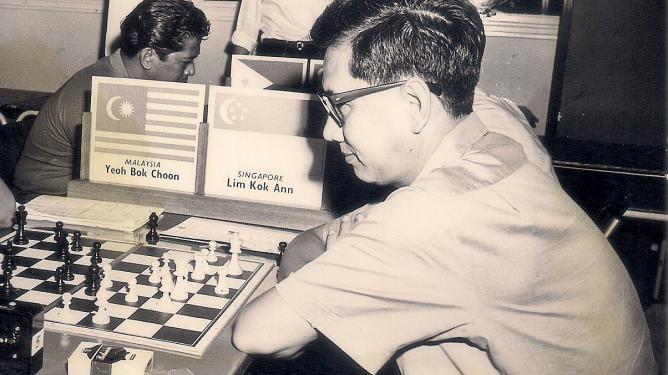
(Photo: Singapore Chess: A History 1945-1990) On January 27, 2020, Lim Kok Ann, a chess player from Singapore, the General Secretary of FIDE from 1982 untill 1988 would have celebrated his 100 anniversary. Lim Kok Ann is called one of the “Fathers of Asian chess” and rightly so. For more than 50 years Lim Kok Ann relentlessly promoted chess in his native Singapore and the entire Asian continent. Having started with organizing the first chess championship in the history of Singapore back in 1949, he was gradually fulfilling his dream which he formulated as “a chessboard in every Singapore house”. When more than forty years later Singapore team debuted at Chess Olympiad, it had three IMs in its line-up. Lim Kok Ann won the first Singapore championship and then took the title two more times in 1960 and 1968. (Photo: https://qcdchess.com) Lim Kok Ann‘s achievements did not go unnoticed in the chess community – as a result, Florencio Compamanes appointed him the General Secretary of FIDE in 1982. Lim Kok Ann served in this position for six years, till 1988. None other than Lim Kok Ann created and published FIDE Handbook (you can find the current version on our site), which became his most important work. One of the areas the professor focused on was a well-known fifty-move rule. Despite his advanced age and status, Lim Kok Ann was no alien to spontaneous decisions sometimes – having made his mind to move to Switzerland to work for FIDE he simply asked his wife to pack their bags. Not many people in the world of chess know about another side of Lim Kok Ann’s life. He was awarded the title of professor for his achievements in medicine. Back in 1957, a talented scientist, he revealed and isolated the virus which causes Asian flu. He has worked beside future Nobel prize winners in the research laboratories all around the world, and later on, became the Dean of the Medical School of the University of Singapore. There is one medical achievement Lim Kok Ann was particularly proud of: when working at the Houston headquarters of the World Health Organization in 1959 he devised and implemented a new diagnostic procedure that simplified the identification of enteroviruses – viruses which cause enteritis. (Photo: http://www.chesshistory.com) In later life, Lim Kok Ann returned to Methodist faith, from which he distanced at some point, but continued to officiate at major chess events as Chief Arbiter. On March 8, 2003, Lim Kok Ann died of a heart attack; ironically, shortly after the infamous SARS epidemic broke out, one of the deceases the professor was fighting against his entire life. When asked what chess had taught him in an interview in 1995, the professor said, “People compare chess with life. You prepare your forces, make split-second decisions, take risks and learn from defeat. All these are valuable lessons in life”.
International Arbiter Training Seminar held in Moscow
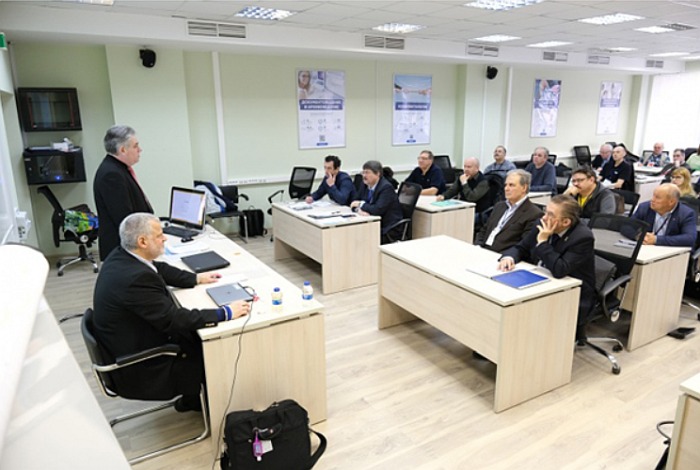
The International Arbiter Training Seminar, the fifth event in the FIDE & CFR Pilot Project for Training and Certification of the International Arbiters for the 2020 World Chess Olympiad, took place at the Russian State Social University in Moscow on January 24-27, 2020. Held in Russian and English, this IA Training Seminar was a flagship event in the business program of the XVI Moscow Open International RSSU Chess Cup. The number and geography of participants grow with every subsequent Training Seminar. The Moscow event featured 35 International Arbiters representing five national federations: Russia, Azerbaijan, Bosnia and Herzegovina, Kazakhstan, and Ukraine. Despite different origins, citizenships, and ages, the attendees shared a common language and were brought up in the cherished traditions of the renowned Soviet school of chess arbitering that was established by such luminaries as Lev Abramov, Vladimir Dvorkovich, and Yuri Averbakh. This shared background allowed them to work out common interpretations of the finer points in the Laws of Chess and to agree on the best processes and practices to be used in the upcoming competitions. The Pilot Project’s objective is to train and to certify a cadre of IAs, especially female arbiters, who are on top of all recent changes in the Laws of Chess and the FIDE Competition Rules, plus are able to communicate in English efficiently and to be integrated into multinational arbiter teams at the top-level FIDE events, culminating in the Chess Olympiads 2020 and 2022. The specific task is to build an expanded list of arbiters who will serve in various capacities at the 44th World Chess Olympiad in Moscow and the 1st World Chess Paralympiad in Khanty-Mansiysk. The unique innovative approach by the Chess Federation of Russia offered the leading International Arbiters of the partner countries both an intensive refreshment course on the most difficult areas of high-level arbitering and a chance to practice and to apply new skills during the 2020 Moscow Open, the largest chess festival in this country, where many of the workshop attendees are serving in senior roles. The Principal Lecturer, IA/IO/FL Alexander Tkachev (Russia), the CFR Technical Director, generalized the lessons learned from previous Pilot Project events in Moscow, Tashkent, Baku, and Sochi, as well as shared first-hand experience of the challenging situations that occurred during the recently completed World Rapid & Blitz Championships in Moscow and the World Women’s Championship Match in Vladivostok. In his responses to multiple questions from the audience, Mr. Tkachev described in detail the criteria that arbiters shall meet in order to be nominated for the World Chess Olympiad in Moscow and the 1st Chess Paralympiad in Khanty-Mansiysk. The Guest Lecturer, IA/IO Vadim Tsypin (Canada) presented a refresher on the FIDE Competition (Tournament) Rules for team competitions and led a group discussion that focused on the officials’ interactions with team captains. The workshop attendees used this topic as a springboard to share their opinions on a wide range of chess life issues. Mr. Tsypin directed participants through problem-solving sessions that had them practice using English in real-life chess game situations that sharpened the attendees’ analysis and communication skills. IA/IO Vladimir Makhnev shared his experience of leading an anti-cheating team during the 2019 WRBC. A lively discussion on the priority of the host nation’s laws followed. For the second time in the pilot project, an examination test featured an equal number of questions in Russian and English, including several open-ended questions. A post mortem discussion allowed participants to see their marked tests, to review difficult questions with the Lecturers, and to provide feedback on the Workshop. Several IAs asked to extend such events to at least one more working day and to expand them faster to other countries with experienced Russian-speaking arbiters who would be an asset to the 2020 Olympiad. Photo galleryPhoto: Galina Popova
Tata Steel Masters 2020: Rich Man, Poor Man
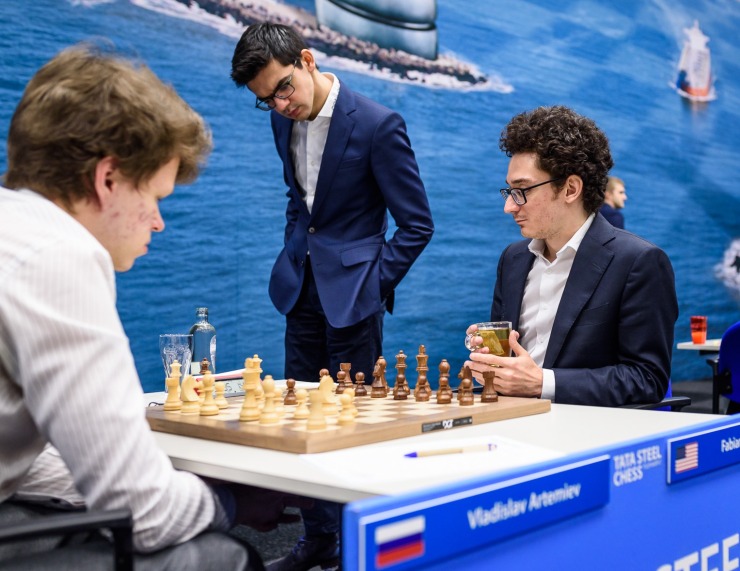
Fabiano Caruana finished Masters event in Wijk aan Zee in style winning his last game against Vladislav Artemiev in the longest and the most interesting encounter of the round. All the other games were drawn. FIDE.com summarizes the results of the first super tournament of 2020. Fabiano Caruana guaranteed himself a tournament win after Round 12, but he still wasn’t in a hurry to get a bowl of traditional pea soup. He easily equalized after highly unorthodox 1.Nf3 d5 2.g3 Nd7!? and then secured a clear advantage after Artemiev ran in circles for a while in the middlegame. All games were over long ago, but Caruana kept looking for a win. The Russian GM found an interesting opportunity to escape by sacrificing his knight to activate the queen and deliver a perpetual. Unfortunately for him, he chose the wrong “checking route” – 49.Qd7+ would have saved the game as after 49…Rf7 50.Qd4+ Kf8 there is a key check from d8. After 49.Qe7+ Artemiev was doomed as Caruana’s king ran away and found a safe haven in White’s camp. 4 out of 6 other games were not exciting at all as in So – Carlsen, Duda – Anand, Firouzja – Dubov, and Kovalev – Vitiugov duels both participants had nothing against a peaceful outcome. On the contrary, Anish Giri badly wanted to beat Jorden van Foreest and to surpass him in the tournament standings – he had a clear advantage at some moment after van Foreest didn’t dare take a pawn on b4, but even White’s extra pawn in the rook endgame wasn’t enough for a win. Yu Yangyi had a chance to shut the tournament door with a bang as he was up an exchange against Jeffery Xiong, but suddenly the Chinese GM just offered a draw in a position where he could have pushed for a win for a long stretch of time. Tata Steel Masters 2020 will be remembered for Fabiano Caruana’s outstanding performance. He finished with a remarkable score of 10 out of 13 (7 wins with no losses) two points ahead of Magnus Carlsen. It’s his best tournament performance since Sinquefield Cup 2014 when he won 7 games in a row at the start. Here, in Wijk aan Zee he won the last 4 games. Twice, against van Foreest and against Anand he was on the brink of defeat but managed to escape both times – in the game with the Dutchman by simply offering a draw. Caruana’s live rating is up to 2842 after the event, only 20 points behind Magnus Carlsen. Magnus Carlsen was out of form at the beginning of the tournament but still finished in clear second place with a respectable 8/13 keeping his unbeaten streak alive. His most important achievement is undoubtedly a victory over Firouzja with Black – a prelude for their long upcoming battle. Wesley So finished third with 7.5 points and also undefeated. He started the event with two victories and was even leading for a short moment, but his energy level was seemingly not high enough as he went on nine game drawing streak. Jorden van Foreest turned in by far the best tournament in his life. He managed not only to finish with +1 score (three wins and two losses) but played some fighting, spirited chess throughout the event and showed absolutely no fear in mixing up with the “big boys”. The lowest-rated participant tied for the 4th place with Daniil Dubov who was actually 3rd lowest-rated player in the tournament. It’s also a pretty good result for Dubov who is almost back into “2700 class” with live rating of 2699. Meanwhile, Jorden will increase his rating by 23 points and enter the top 100 (Open) for the first time in his life. Alireza Firouzja once again became the main magnet to spectators’ attention in Wijk aan Zee. The 16-year-old prodigy from Iran, now living in France and playing under FIDE flag, was sensationally leading the tournament until Round 9. He played some amazing games (his wins against Artemiev and Xiong were especially good) and went for the big battles against the world’s best – he suffered three losses in a row in these clashes, but definitely can be really proud of how he handled himself in his first classical chess super tournament. 50-year-old Vishwanathan Anand also played a nice tournament. His two wins – against the two youngest opponents, Firouzja and Xiong – were almost perfect, and his two losses were dramatic: he could have forced a draw after very deep combo versus So and was clearly winning against future tournament winner Caruana. All other players were not at their best in Wijk aan Zee, but still contributed into a tournament that was a real joy for all the chess fans around the globe. FIDE.com team and the whole chess community are already waiting for Tata Steel 2021. One participant is already known – David Anton Guijarro won the Challengers event and according to a long-standing tradition will play Masters next year. Official site: https://www.tatasteelchess.com/Photo: Alina l’Ami Tata Steel Masters 2020 Final Standings: 1. Caruana – 10;2. Carlsen – 8;3. So – 7½;4-5. Van Foreest, Dubov – 7;6-9. Firouzja, Duda, Giri, Anand – 6½;10-11. Artemiev, Xiong – 6;12. Vitiugov – 5;13. Yu Yangyi – 4½;14. Kovalev – 4
Tata Steel Masters 2020: Caruana wins it all
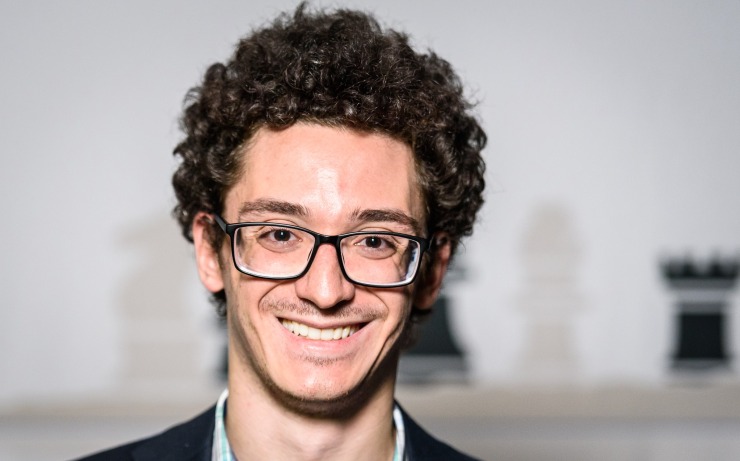
Fabiano Caruana played one of the best tournaments of his outstanding career and by beating Jan-Krzystof Duda in Round 12 he secured first place and is 1.5 (!) ahead of Magnus Carlsen going into the last round. Duda had some opening problems at the beginning of the event, but since that he has been quite comfortable in most of his games and actually was one of the 4 players (together with Caruana, Carlsen and So) without a single loss. It all changed after Round 12. Once again, he got into big trouble right after the opening, and Caruana actually considered his position winning until Duda came up with 18…Rb8 idea. After that Fabiano didn’t see a forced win (engines suggest 20.Bd2! and it’s interesting why Caruana thought it was not enough) and accepted just a better position. He didn’t know if his advantage was enough for a win until Duda moved his knight to f8 on move 29. It was an easy sail for the tournament winner after that as he quickly got an extra pawn and completely dominating position. With this win, Caruana secured a clear tournament victory, as his only real competitor Magnus Carlsen couldn’t break Vladislav Artemiev‘s defense. World Champion decided against testing Artemiev’s Caro-Cann and chose a calmer line against Gruenfeld (11.d5 instead of 11.Be2 is the most principled continuation). The 21-year-old Russian chose a way to defense introduced by his elder compatriot Peter Svidler which is always a good path in Gruenfeld and held his own in the endgame. Carlsen won a pawn, but the rook ending was completely drawn. Daniil Dubov somewhat easily crushed Yu Yangiy and moved into the top 5. The Chinese GM has a disastrous tournament and seems completely out of his game. He went for a very passive set-up only playing for a draw and then blundered with 16…Ra7 as according to Dubov he missed 18.Qb4 completely. White penetrated into Black’s camp immediately and it looks like 21.Qb8! was winning on the spot. Dubov missed it and went for a more positional approach, but Black’s position was so ugly that it collapsed soon anyway. The young Russian was happy to have this win as historically he has had very poor results against players from China. Jorden van Foreest had his fair share of crazy games in this event and is probably very happy his position in the tournament standings. That must be the reason why he went for a classical line in the Scotch against Weslley So – White was not taking any risks, but to win against super-solid So playing this way is just impossible. Kovalev surprised Anand with a very rare 3…Nd4 in Ruy Lopez and Anand refused a big battle – a draw was agreed on move 20. Nikita Vitiugov was clearly better against Alireza Firouzja after the opening, but he is probably just waiting for this tournament to be over as on several occasions he chose to simplify the position instead of playing for a full point. Anish Giri and Jeffery Xiong played an exciting match in the third round of the World Cup 2019 that finally went Xiong’s way and today Giri was looking for revenge. He was playing Black but soon got a slightly better position. He probably missed a small chance to get a real edge around move 23, and when he won a pawn after the first time control the queen endgame was very drawish as White was checking black king non-stop. Nevertheless, Giri tortured his opponent for quite a while trying everything but with no real progress. Finally, he settled for a draw on move 107 but definitely with a heavy heart. In the last round, Caruana will play a “no-pressure” game versus Artemiev, and Carlsen has Black against So, and it is hard to expect a big fight in those games. While Masters’ winner is already known, there was a sudden twist in the Challengers event. David Anton who was crushing the field played a very weird game against the tournament outsider Max Warmerdam and lost with White after making several terrible mistakes. Now he is only half a point ahead of the group of his chasers that includes 15-year-old Nodirbek Abdusattorov. The winner of the Challengers event will play Masters next year. Official site: https://www.tatasteelchess.com/Photo: Alina l’Ami Tata Steel Masters 2020 Standings after Round 12: 1. Caruana – 9;2. Carlsen – 7½;3. So – 7;4-5. Van Foreest, Dubov – 6½;6-10. Firouzja, Duda, Giri, Artemiev, Anand – 6;11. Xiong – 5½;12. Vitiugov – 4½;13. Yu Yangyi – 4;14. Kovalev – 3½
Former FIDE President Fridrik Olafsson turns 85
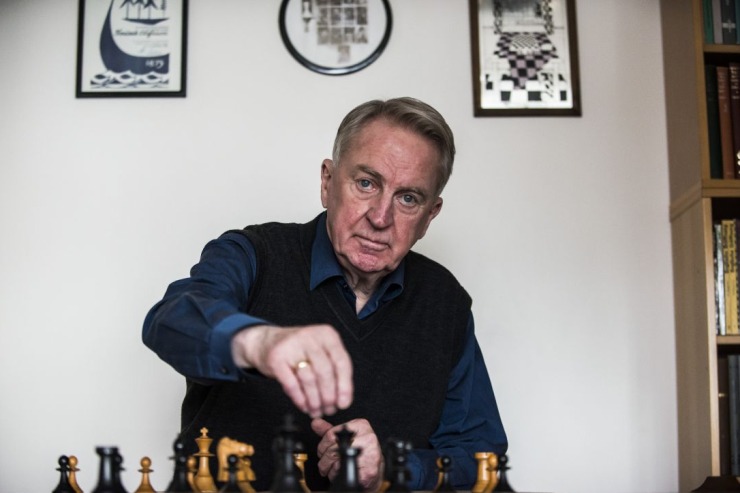
Photo: https://reykjavik.is/ The fourth FIDE President, Fridrik Olafsson, was born on this day in 1935. He served a single term —succeeding Max Euwe in 1978 and being followed by Florencio Campomanes in 1982— but he left an indelible mark in the history of this organization. His brief period leading FIDE was only the culmination of a brilliant career – and a life devoted to chess. It was Olafsson who put Iceland on the world chess map, long before the Fisher – Spassky match was even conceived. You have probably heard this fun fact before: Iceland is the country with more Grandmasters per capita in the world, with 13 GMs on the island of approximately 325,000. Fridrik Olafsson was the first one of them, being awarded the title in 1958. Photo: http://gahetna.nl And he was not an ordinary Grandmaster, but a world-class one, who can boast victories over Bobby Fischer, Tigran Petrosian, and Mikhail Tal. He defeated these legendary world champions, not once, but twice each! He added another illustrious scalp to his collection later on, when he defeated Anatoly Karpov under the most original circumstances. To begin with, Fridrik was already 45 years old, and his best days as a player were already behind him. Secondly, the year was 1980, and he was in the middle of his term as FIDE President. Nevertheless, he was invited to take part in the “Clarin Tournament” organized by the largest Argentinian newspaper in Buenos Aires, with the strongest possible field: the World Champion, as well as Larsen, Timman, Ljubojevic, Najdorf, and other stars. Olafsson picked up the gauntlet and accepted to play. He achieved a very decent overall result with 6 points out of 13 games, but the highlight of the event was probably his victory over Anatoly Karpov. For the first and only time in history, the reigning President of the International Chess Federation crossed swords against the reigning World Champion in an official game – and the functionary won! With this victory, Olafsson also joined what is called “the Mikhail Chigorin Club”: those players who can boast a victory over a reigning world champion, without having been world champions themselves. Photo: https://lifdununa.is/ Fridrik’s successful career had taken off in 1952 when he became Icelandic Champion at the age of 17. This would be the first of a total of six victories he would achieve in this competition. It was also a golden ticket to travel abroad and compete in international competitions, where very soon he had the chance to prove his value. In 1953 he became Scandinavian Champion, and he also achieved a bronze medal in the World Junior Championship. His first international success was the Hastings International tournament in England, played during New Year’s 1955-1956. He started on the wrong foot because, having arrived in Hastings late, no hotel room could be found for him. The improvised solution was offered by a police officer, who kindly invited him to spend the night in a cell at the Hastings police station. This unusual experience left no traumas on him and he would go on to win the tournament, sharing first with Viktor Kortchnoi. Olafsson took part in the World Championship cycle, finishing 5th/6th at the 1958 Interzonal tournament in Portoroz. This result gave him the Grandmaster title, as well as a spot in the 1959 Candidates Tournament played in Yugoslavia. These are the two events in which he scored his two victories over Bobby Fischer. Photo: http://skaksogufelagid.is But probably his most memorable victory in the Candidates was the one against Tigran Petrosian. His game had been adjourned, and when it was resumed, they played on a balcony overlooking Zagreb’s Republic Square. According to the historian Golombek, “A giant demonstration board had been erected, and a crowd of 5,000 assembled to watch. Olafsson won, to great acclaim. When he tried to go back to the hotel the crowd insisted on carrying him on their shoulders”. Despite these great results, for most of his life, Olafsson juggled his chess career with a regular job, having worked as a lawyer at the Icelandic Ministry of Justice until 1974. Shortly after he lost the 1982 FIDE elections, he was appointed as the highest-ranking employee at the Icelandic Parliament: Secretary-General. And yet, his contribution to the game has been extremely valuable, earning him a very special place in the history of chess. We rejoice with Fridrik Olafsson as he celebrates his 85 birthday today, and we wish him good health and happiness in life! David Llada(Chief Marketing and Communications Officer)
Tata Steel Masters 2020: Caruana pulls away
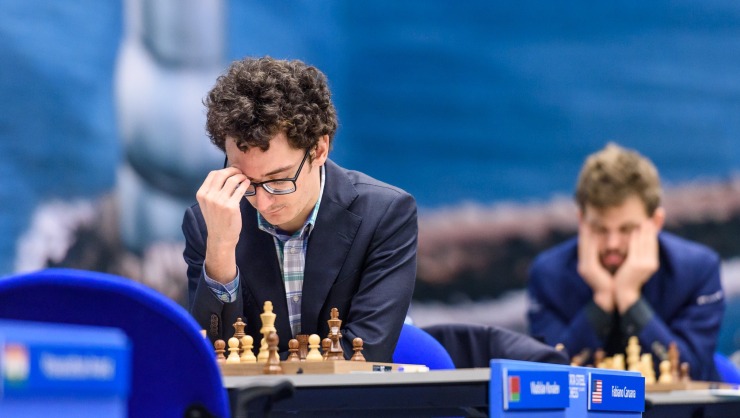
Black finally had their first “winning day” in Round 11 of Tata Steel Masters, but Fabiano Caruana’s win that almost guaranteed him a tournament victory is a fact of much greater importance. Alireza Firouzja suffered his third defeat in a row after Vishwanathan Anand demonstrated an impeccable endgame technique and created a positional masterpiece. Caruana had Black against tournament outsider Vladislav Kovalev and was planning to take an opportunity to play for a win if he had a chance. An opportunity presented itself quite soon as Kovalev, who has two major problems in this event – opening preparation and permanent time trouble – mixed up the lines once again in a sharp variation of Ruy Lopez. He played 15.f4 almost instantly while 15.Kh1 is proved to be the best option; in the game, he retreated with his king to h1 two moves later and soon realized that something went wrong. Kovalev started to hesitate and after he didn’t return his knight to b5 on move 21 his center just collapsed. In-form Caruana easily finished White’s king off, comfortably attacking with an extra pawn. Magnus Carlsen could not keep up with Caruana and was quite disappointed after drawing his game with Jan-Krzystof Duda. The World Champion thought that Duda’s early attack on the kingside was premature, although engines actually approve it and give White advantage after possible 21.h4. Duda played 21.g4 instead and Carlsen was doing fine until he missed an exchanging combination. White was slightly better once again, but then according to Magnus himself, something weird happened – Polish GM continued to look for drawing opportunities instead of playing optimally. It was definitely not the perfect way to handle the situation, and in the final position Magnus was even a pawn up, but White’s strong pair of bishops made it impossible for Black to play for a win anyway. Game of the day was played by Anand; it’s only his second win in the tournament, but both of them are worth analyzing. The former World Champion admitted that he was a bit nervous before the game despite Firouzja’s losing streak as he knew that Alireza would play very aggressively. Anand was expecting the line with 4.f3 in Nimzo-Indian and opted for a rare line with 7…c5 (he played only 7…e5 before). Firouzja’s reply was probably a novelty and the game immediately transposed into a complex endgame with a highly unorthodox pawn structure. Anand just understood the essence of the endgame much better and gradually outplayed his young opponent. It’s difficult to point out when exactly things went astray for Firouzja – it looks like 21.Nd6+ was premature and 25.Kd2 allowing Black to fix white’s weak pawn on f3 was definitely a mistake. After that Vishwanathan was at his best skillfully outplaying his opponent in a position that still looked unclear for an untrained eye. Three games in a row against the game greatest was a real test for 16-year-old talent who is now living in France. One can say that he didn’t pass the test as he lost all three games. On the other hand, he can only blame himself for the game versus Carlsen; in two other encounters his opponents were simply at their best and this level is just out of reach at the age of 16. Jorden van Foreest – another hero of the early stages of the event – also bit the dust today. His early aggression on the kingside was met with a counterpunch in the center by Vladislav Artemiev and White forced into a better endgame. Soon Artemiev won a pawn and eventually the game. It is a third win for the Russian with White, but he had too many problems with Black to call this tournament a success. In the three other games, Anish Giri was unable to break through Yu Yangyi‘s favorite Petroff’s fortifications, Nikita Vitiugov went for a drawing opening line against Daniil Dubov, and Wesley So just forced a draw on move 11 versus Jeffery Xiong which is somewhat strange as he still had chances to win the whole thing. Talking to a tournament press officer after the game Carlsen quipped that the tournament win was out of sight for him after today’s round, but he would still try his best in the last two rounds. Caruana understandably is not willing to discuss these issues at the moment. In Round 11 he is playing Duda with White while Carlsen will probably test Artemiev’s Caro-Cann which definitely does not look unbreakable in this event. In the Challengers event David Anton Guijarro who was a clear favorite before the event, especially after his amazing score in the Grand Swiss, finally took the sole lead after Round 10 when he won a crucial game against Pavel Eljanov. In Round 11 he moved further ahead beating Anton Smirnov. 15-year-old Nodirbek Abdusattorov, who held Carlsen for a draw in World Blitz Championship on December 29, won three games in a row and now is sharing the second place with Erwin L’Ami. Official site: https://www.tatasteelchess.com/Photo: Alina l’Ami Tata Steel Masters 2020 Standings after Round 11: 1. Caruana – 8;2. Carlsen – 7;3. So – 6½;4-5. Van Foreest, Duda – 6;6-10. Firouzja, Dubov, Giri, Artemiev, Anand – 5½;11. Xiong – 5;12-13. Vitiugov, Yu Yangyi – 4;14. Kovalev – 3.
Ju Wenjun wins Women’s World Championship match
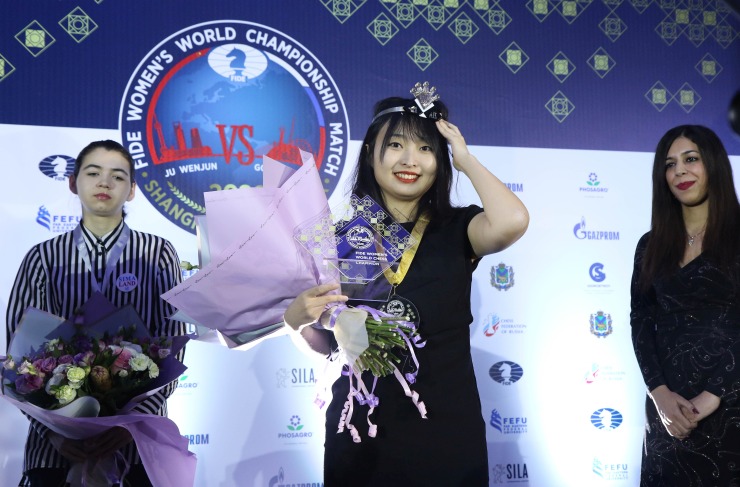
Ju Wenjun retains her Women’s World Chess Champion title after winning the playoff against the challenger Aleksandra Goryachkina. After battling during two weeks in a match split between Shanghai and Vladivostok, the classical part of the competition ended in a tie (6-6), with three victories each and six draws. The playoff, played today in the Blue Hall amphitheater of the Far Eastern University in Vladivostok, consisted of four 25-minute rapid games. Goryachkina was very close to the victory in the first game, and she also dominated the second, but the challenger failed to convert her advantage on both occasions. On the third assault, Ju Wenjun followed the same opening as in the first game, but she introduced an improvement that allowed her a more aggressive approach. The Chinese Champion achieved a victory that put her ahead in the scoreboard for the third time in this match. In the final game, Goryachkina, with the white pieces, was in a must-win situation, but this time she failed to pull out a miraculous win. The challenger played an audacious line that implied sacrificing a pawn in exchange for activity, and she managed to get the initiative. But the World Champion returned the material and managed to keep the balance, taking the game to a draw that was good enough to retain her crown. The final score of the match is 6-6 in classical chess and 2.5-1.5 in rapid games in favor of Ju Wenjun. She becomes Women’s World Chess Champion for the third time. Official website: https://wwcm2020.fide.com Photos: Eteri Kublashvili & Michael Friedman Contact: press@fide.com Photos in high resolution are available for the press at our official Flickr account.
The Women’s World Chess Championship will be decided by tie-break

ANATOMY OF A MUST-WIN “The person that said winning isn’t everything, never won anything” —Mia Hamm Take your opponent out of their comfort zone Aleksandra Goryachkina‘s (playing white) choice to open the game with 1.d4 d5. 2.Nc3 was strategically brilliant. In just two moves, she managed to completely take the World Champion Ju Wenjun out of her preparation. Ju spent 17 minutes contemplating her reply. At the same time, Goryachkina knew that she is likely to get the type of position that favored her style — positional and strategic, proving that one doesn’t have to go for hand-to-hand combat in a must-win. In fact, black spent about 40 minutes on her first 10 moves. Goryachkina’s ability to make her opponent work this much just out of the gate proved critical later in the game. Be yourself While Ju was spending time and energy figuring out what to do in an opening she has not played before, Goryachkina kept her cool. She was not precise, but she did not need to be. Ju’s quasi-aggressive 10..Ne4 and 11..f5 could have been refuted by Goryachkina with more precise play. It was not, and by move 20 white’s advantage appeared to have evaporated. Pundits were down on Goryachkina’s chances to exert any kind of pressure. Despite being low on time, it looked as if Ju’s upcoming moves would be more straightforward and logical: Being short on time would not be a factor. Anxiety Attack Despite objective equality on the board, Ju’s nervous play appeared to catch up to her. She seemed adrift, not being sure what to do with her pieces. Black’s sequence Qh5, Qg6, Qe4, h6 and Qh7 allowed White to consolidate and begin to probe Ju’s position with 27.e4! Once again, White did not need to be precise, as Black continued to drift with 28…Rc8 and 30..e3. It is worth noting that by move 28, both players were down to 12 minutes left until the time control, but their body language and play could not have been more different. It became clear that the next ten moves will decide the game. Make time control and convert Ju looked exhausted and was not putting up much resistance. Black allowed exchanging all minor pieces, leaving Ju in a completely lost passive end game. Goryachkina converted with trademark calm and efficiency. Tie-break and stray observations: – Given today’s performance, one wonders if Ju regrets not pushing harder with white in game 11. – Ju has the 2nd highest rapid rating in the world. Goryachkina’s rating is quite low, but she hasn’t played rapid in a while. – Having defeated the World Champion three times in twelve games, Goryachkina will not lack confidence in tie-breaks. – Six decisive outcomes in a twelve game match have to be a record of some kind for the modern era. Official website: https://wwcm2020.fide.com Text: Michael Friedman Photos: Eteri Kublashvili & Michael Friedman Contact: press@fide.com Photos in high resolution are available for the press at our official Flickr account.