

Former FIDE President Fridrik Olafsson turns 85
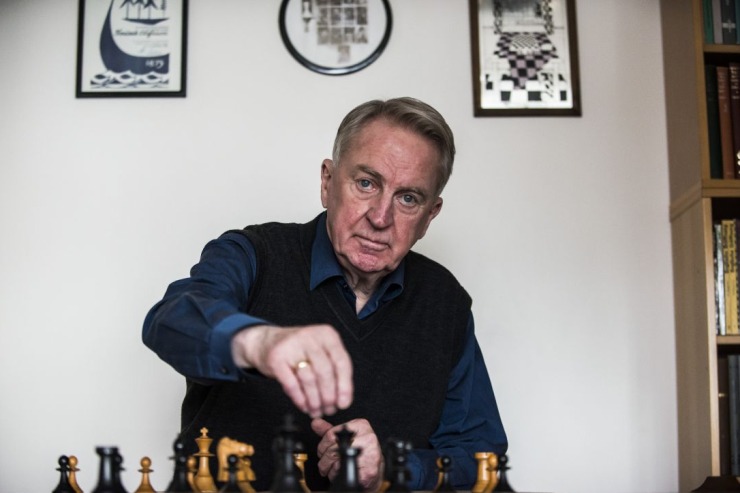
Photo: https://reykjavik.is/ The fourth FIDE President, Fridrik Olafsson, was born on this day in 1935. He served a single term —succeeding Max Euwe in 1978 and being followed by Florencio Campomanes in 1982— but he left an indelible mark in the history of this organization. His brief period leading FIDE was only the culmination of a brilliant career – and a life devoted to chess. It was Olafsson who put Iceland on the world chess map, long before the Fisher – Spassky match was even conceived. You have probably heard this fun fact before: Iceland is the country with more Grandmasters per capita in the world, with 13 GMs on the island of approximately 325,000. Fridrik Olafsson was the first one of them, being awarded the title in 1958. Photo: http://gahetna.nl And he was not an ordinary Grandmaster, but a world-class one, who can boast victories over Bobby Fischer, Tigran Petrosian, and Mikhail Tal. He defeated these legendary world champions, not once, but twice each! He added another illustrious scalp to his collection later on, when he defeated Anatoly Karpov under the most original circumstances. To begin with, Fridrik was already 45 years old, and his best days as a player were already behind him. Secondly, the year was 1980, and he was in the middle of his term as FIDE President. Nevertheless, he was invited to take part in the “Clarin Tournament” organized by the largest Argentinian newspaper in Buenos Aires, with the strongest possible field: the World Champion, as well as Larsen, Timman, Ljubojevic, Najdorf, and other stars. Olafsson picked up the gauntlet and accepted to play. He achieved a very decent overall result with 6 points out of 13 games, but the highlight of the event was probably his victory over Anatoly Karpov. For the first and only time in history, the reigning President of the International Chess Federation crossed swords against the reigning World Champion in an official game – and the functionary won! With this victory, Olafsson also joined what is called “the Mikhail Chigorin Club”: those players who can boast a victory over a reigning world champion, without having been world champions themselves. Photo: https://lifdununa.is/ Fridrik’s successful career had taken off in 1952 when he became Icelandic Champion at the age of 17. This would be the first of a total of six victories he would achieve in this competition. It was also a golden ticket to travel abroad and compete in international competitions, where very soon he had the chance to prove his value. In 1953 he became Scandinavian Champion, and he also achieved a bronze medal in the World Junior Championship. His first international success was the Hastings International tournament in England, played during New Year’s 1955-1956. He started on the wrong foot because, having arrived in Hastings late, no hotel room could be found for him. The improvised solution was offered by a police officer, who kindly invited him to spend the night in a cell at the Hastings police station. This unusual experience left no traumas on him and he would go on to win the tournament, sharing first with Viktor Kortchnoi. Olafsson took part in the World Championship cycle, finishing 5th/6th at the 1958 Interzonal tournament in Portoroz. This result gave him the Grandmaster title, as well as a spot in the 1959 Candidates Tournament played in Yugoslavia. These are the two events in which he scored his two victories over Bobby Fischer. Photo: http://skaksogufelagid.is But probably his most memorable victory in the Candidates was the one against Tigran Petrosian. His game had been adjourned, and when it was resumed, they played on a balcony overlooking Zagreb’s Republic Square. According to the historian Golombek, “A giant demonstration board had been erected, and a crowd of 5,000 assembled to watch. Olafsson won, to great acclaim. When he tried to go back to the hotel the crowd insisted on carrying him on their shoulders”. Despite these great results, for most of his life, Olafsson juggled his chess career with a regular job, having worked as a lawyer at the Icelandic Ministry of Justice until 1974. Shortly after he lost the 1982 FIDE elections, he was appointed as the highest-ranking employee at the Icelandic Parliament: Secretary-General. And yet, his contribution to the game has been extremely valuable, earning him a very special place in the history of chess. We rejoice with Fridrik Olafsson as he celebrates his 85 birthday today, and we wish him good health and happiness in life! David Llada(Chief Marketing and Communications Officer)
Tata Steel Masters 2020: Caruana pulls away
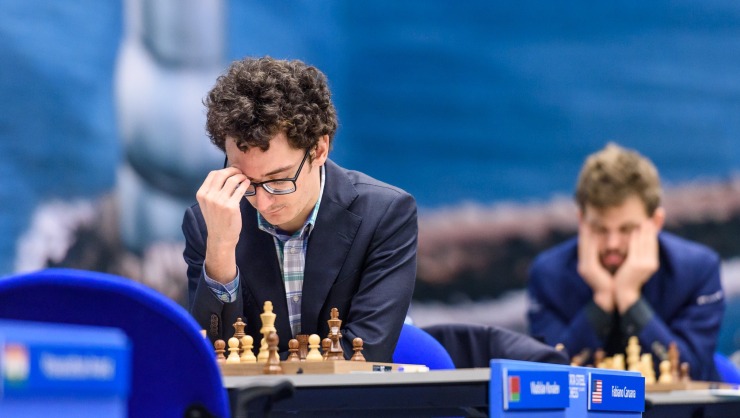
Black finally had their first “winning day” in Round 11 of Tata Steel Masters, but Fabiano Caruana’s win that almost guaranteed him a tournament victory is a fact of much greater importance. Alireza Firouzja suffered his third defeat in a row after Vishwanathan Anand demonstrated an impeccable endgame technique and created a positional masterpiece. Caruana had Black against tournament outsider Vladislav Kovalev and was planning to take an opportunity to play for a win if he had a chance. An opportunity presented itself quite soon as Kovalev, who has two major problems in this event – opening preparation and permanent time trouble – mixed up the lines once again in a sharp variation of Ruy Lopez. He played 15.f4 almost instantly while 15.Kh1 is proved to be the best option; in the game, he retreated with his king to h1 two moves later and soon realized that something went wrong. Kovalev started to hesitate and after he didn’t return his knight to b5 on move 21 his center just collapsed. In-form Caruana easily finished White’s king off, comfortably attacking with an extra pawn. Magnus Carlsen could not keep up with Caruana and was quite disappointed after drawing his game with Jan-Krzystof Duda. The World Champion thought that Duda’s early attack on the kingside was premature, although engines actually approve it and give White advantage after possible 21.h4. Duda played 21.g4 instead and Carlsen was doing fine until he missed an exchanging combination. White was slightly better once again, but then according to Magnus himself, something weird happened – Polish GM continued to look for drawing opportunities instead of playing optimally. It was definitely not the perfect way to handle the situation, and in the final position Magnus was even a pawn up, but White’s strong pair of bishops made it impossible for Black to play for a win anyway. Game of the day was played by Anand; it’s only his second win in the tournament, but both of them are worth analyzing. The former World Champion admitted that he was a bit nervous before the game despite Firouzja’s losing streak as he knew that Alireza would play very aggressively. Anand was expecting the line with 4.f3 in Nimzo-Indian and opted for a rare line with 7…c5 (he played only 7…e5 before). Firouzja’s reply was probably a novelty and the game immediately transposed into a complex endgame with a highly unorthodox pawn structure. Anand just understood the essence of the endgame much better and gradually outplayed his young opponent. It’s difficult to point out when exactly things went astray for Firouzja – it looks like 21.Nd6+ was premature and 25.Kd2 allowing Black to fix white’s weak pawn on f3 was definitely a mistake. After that Vishwanathan was at his best skillfully outplaying his opponent in a position that still looked unclear for an untrained eye. Three games in a row against the game greatest was a real test for 16-year-old talent who is now living in France. One can say that he didn’t pass the test as he lost all three games. On the other hand, he can only blame himself for the game versus Carlsen; in two other encounters his opponents were simply at their best and this level is just out of reach at the age of 16. Jorden van Foreest – another hero of the early stages of the event – also bit the dust today. His early aggression on the kingside was met with a counterpunch in the center by Vladislav Artemiev and White forced into a better endgame. Soon Artemiev won a pawn and eventually the game. It is a third win for the Russian with White, but he had too many problems with Black to call this tournament a success. In the three other games, Anish Giri was unable to break through Yu Yangyi‘s favorite Petroff’s fortifications, Nikita Vitiugov went for a drawing opening line against Daniil Dubov, and Wesley So just forced a draw on move 11 versus Jeffery Xiong which is somewhat strange as he still had chances to win the whole thing. Talking to a tournament press officer after the game Carlsen quipped that the tournament win was out of sight for him after today’s round, but he would still try his best in the last two rounds. Caruana understandably is not willing to discuss these issues at the moment. In Round 11 he is playing Duda with White while Carlsen will probably test Artemiev’s Caro-Cann which definitely does not look unbreakable in this event. In the Challengers event David Anton Guijarro who was a clear favorite before the event, especially after his amazing score in the Grand Swiss, finally took the sole lead after Round 10 when he won a crucial game against Pavel Eljanov. In Round 11 he moved further ahead beating Anton Smirnov. 15-year-old Nodirbek Abdusattorov, who held Carlsen for a draw in World Blitz Championship on December 29, won three games in a row and now is sharing the second place with Erwin L’Ami. Official site: https://www.tatasteelchess.com/Photo: Alina l’Ami Tata Steel Masters 2020 Standings after Round 11: 1. Caruana – 8;2. Carlsen – 7;3. So – 6½;4-5. Van Foreest, Duda – 6;6-10. Firouzja, Dubov, Giri, Artemiev, Anand – 5½;11. Xiong – 5;12-13. Vitiugov, Yu Yangyi – 4;14. Kovalev – 3.
Ju Wenjun wins Women’s World Championship match

Ju Wenjun retains her Women’s World Chess Champion title after winning the playoff against the challenger Aleksandra Goryachkina. After battling during two weeks in a match split between Shanghai and Vladivostok, the classical part of the competition ended in a tie (6-6), with three victories each and six draws. The playoff, played today in the Blue Hall amphitheater of the Far Eastern University in Vladivostok, consisted of four 25-minute rapid games. Goryachkina was very close to the victory in the first game, and she also dominated the second, but the challenger failed to convert her advantage on both occasions. On the third assault, Ju Wenjun followed the same opening as in the first game, but she introduced an improvement that allowed her a more aggressive approach. The Chinese Champion achieved a victory that put her ahead in the scoreboard for the third time in this match. In the final game, Goryachkina, with the white pieces, was in a must-win situation, but this time she failed to pull out a miraculous win. The challenger played an audacious line that implied sacrificing a pawn in exchange for activity, and she managed to get the initiative. But the World Champion returned the material and managed to keep the balance, taking the game to a draw that was good enough to retain her crown. The final score of the match is 6-6 in classical chess and 2.5-1.5 in rapid games in favor of Ju Wenjun. She becomes Women’s World Chess Champion for the third time. Official website: https://wwcm2020.fide.com Photos: Eteri Kublashvili & Michael Friedman Contact: press@fide.com Photos in high resolution are available for the press at our official Flickr account.
The Women’s World Chess Championship will be decided by tie-break

ANATOMY OF A MUST-WIN “The person that said winning isn’t everything, never won anything” —Mia Hamm Take your opponent out of their comfort zone Aleksandra Goryachkina‘s (playing white) choice to open the game with 1.d4 d5. 2.Nc3 was strategically brilliant. In just two moves, she managed to completely take the World Champion Ju Wenjun out of her preparation. Ju spent 17 minutes contemplating her reply. At the same time, Goryachkina knew that she is likely to get the type of position that favored her style — positional and strategic, proving that one doesn’t have to go for hand-to-hand combat in a must-win. In fact, black spent about 40 minutes on her first 10 moves. Goryachkina’s ability to make her opponent work this much just out of the gate proved critical later in the game. Be yourself While Ju was spending time and energy figuring out what to do in an opening she has not played before, Goryachkina kept her cool. She was not precise, but she did not need to be. Ju’s quasi-aggressive 10..Ne4 and 11..f5 could have been refuted by Goryachkina with more precise play. It was not, and by move 20 white’s advantage appeared to have evaporated. Pundits were down on Goryachkina’s chances to exert any kind of pressure. Despite being low on time, it looked as if Ju’s upcoming moves would be more straightforward and logical: Being short on time would not be a factor. Anxiety Attack Despite objective equality on the board, Ju’s nervous play appeared to catch up to her. She seemed adrift, not being sure what to do with her pieces. Black’s sequence Qh5, Qg6, Qe4, h6 and Qh7 allowed White to consolidate and begin to probe Ju’s position with 27.e4! Once again, White did not need to be precise, as Black continued to drift with 28…Rc8 and 30..e3. It is worth noting that by move 28, both players were down to 12 minutes left until the time control, but their body language and play could not have been more different. It became clear that the next ten moves will decide the game. Make time control and convert Ju looked exhausted and was not putting up much resistance. Black allowed exchanging all minor pieces, leaving Ju in a completely lost passive end game. Goryachkina converted with trademark calm and efficiency. Tie-break and stray observations: – Given today’s performance, one wonders if Ju regrets not pushing harder with white in game 11. – Ju has the 2nd highest rapid rating in the world. Goryachkina’s rating is quite low, but she hasn’t played rapid in a while. – Having defeated the World Champion three times in twelve games, Goryachkina will not lack confidence in tie-breaks. – Six decisive outcomes in a twelve game match have to be a record of some kind for the modern era. Official website: https://wwcm2020.fide.com Text: Michael Friedman Photos: Eteri Kublashvili & Michael Friedman Contact: press@fide.com Photos in high resolution are available for the press at our official Flickr account.
Rating analytics: Do ratings help to predict future champions?
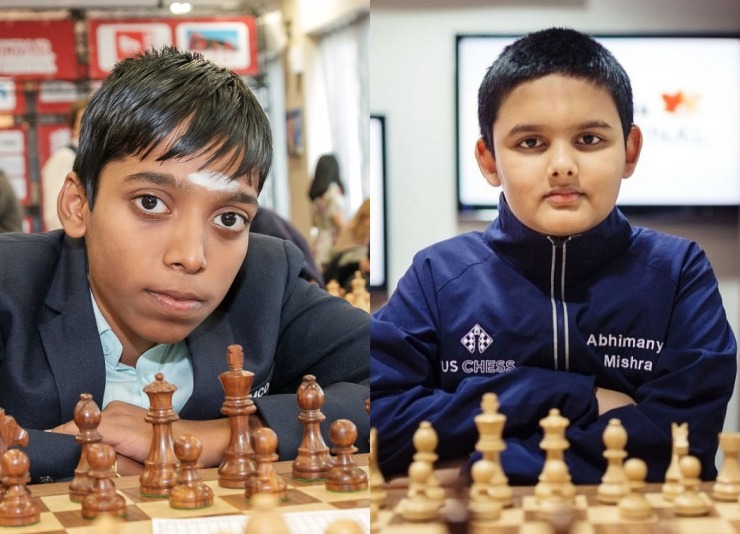
Kaspars Migla is the creator and founder of chessratings.top. In his column, he analyzes monthly FIDE standard rating changes, career-high ratings, rating distribution by country, continent, region, and other rating-related statistics. In this edition, he tries to establish a correlation between the rating of juniors with their future achievements. In chess, the title of World Champion is contested by the strongest challengers determined by objective criteria known as rating. The career of the reigning World Champion Magnus Carlsen illustrates the point. He became #1 in the rating list on January 1, 2010, succeeding Veselin Topalov on the top and three years later in 2013 won the World Champion title. Since then Magnus has been not only an uncontested chess leader but also a role model and a man to beat and surpass. In order to figure out his competitors in the near future, a special option of rating comparison was designed at chessratings.top. Any player can be compared against another rating-wise at a particular age (which is calculated not by the exact day of birth but simply a year when a player reached a particular age). This information is more than enough to identify several up-and-coming young talents whose ratings are higher than that of Carlsen at the same age. Among those who are running ahead of Carlsen’s rating schedule, Alireza Firouzja is the most prominent one. On January 1, 2020, his rating reached 2723 points, whereas Carlsen at the same age had 2690. You can check out the comparison of these players here. Photo: John Saunders Figouzja stands alone in the U-18 category but when it comes to the U-16 group, there are three players outperforming the World Champion – Nodirbek Abdusattorov (Uzbekistan, 2635), Nihal Sarin (India, 2618) and Praggnanandhaa R (India, 2602). All these teenagers reached chess maturity, i.e. became grandmasters. Several youngsters from the U-12 category, namely CM Abhimanyu Mishra (USA, 2397), FM Marco Materia, (France, 2320), FM Liran Zhou (USA,2307) and FM Aldiyar Ansat (Kazakhstan, 2263) also stack up well against Carlsen at their age – all these boys have higher ratings. Abhimanyu Mishra really stands out in this group with rating of more than 300 points higher than that of Carlsen at the age of 11. Magnus got his first rating (2064) in April 2001. He was in the U-12 which is very late by modern standards. Checking out the rating list of April 2001 in the U-12 category we see that the current World Champion was sitting at 61st position, 200 points behind the future Challenger Sergey Karjakin (2262). Interestingly, there were 9 (!) Chinese players in the top 13. We won’t analyze the categories U-8 and U-10 for at least two reasons. Firstly, many boys and girls just start learning chess at this age; secondly, we can’t compare their ratings with that of Carlsen (Magnus got his first rating being in the U-12 category). Photo: Andreas Kontokanis In women’s chess Hou Yifan (China, 2664), the #1 among active players, holds all “youngest-ever” records (rating, titles, various achievements) and is head and shoulders above her closest competitors. It is up to our readers what type of conclusions to draw from these statistics. It is clear that rating is a good indicator of chess strength, but in order to become the best not only among juniors but also in open competitive chess mere raw talent is not enough. In order to make progress, one has to constantly work on his or her chess development. Only this approach guarantees good results in the future. Kaspars Migla, https://www.chessratings.top/
WWCC Game 11: Calm before the storm

Game 11 of the Women’s World Championship Match ends in a draw after 40 moves. Defending champion Ju Wenjun is leading 6-5. In the final game on Jan 23, the challenger Aleksandra Goryachkina has White in a must-win situation. With just two games remaining in the match, World Champion Ju Wenjun (playing white) today had a decision to make. Go for everything and finish Aleksandra Goryachkina off, or save some much-needed energy, and play calm, solid, risk-off chess. Goryachkina, who prior to losing Games 9 and 10, had not lost consecutive games in nearly two years, was not sure what her opponent would do either. All of these questions were very quickly resolved. By move 20, the only mystery left in the game was how quickly will the players reach the obligatory 40 moves. They managed to achieve this in just over an hour — by far the quickest game of this match. The first 10 games averaged 67 moves and nearly all were well into the fifth hour of play. After the game, Goryachkina said that the rest day helped her to restore some much-needed equilibrium. Game 12 Notes: – Playing white, Goryachkina needs a win to force tie-breaks. – Ju has had major problems with black the whole match. If this pattern continues, Goryachkina should be able to have serious chances to equalize. – Last game heroics aren’t new to World Championship Matches. In modern history, Kramnik vs. Leko (2004), and more famously Kasparov vs. Karpov (1987) both ended in dramatic decisive games. Official website: https://wwcm2020.fide.com Text: Michael Friedman Photos: Eteri Kublashvili Contact: press@fide.com Photos in high resolution are available for the press at our official Flickr account.
FIDE Congress and Extraordinary General Assembly 2020 in Abu Dhabi

FIDE is pleased to communicate the following information regarding the FIDE Congress and Extraordinary General Assembly 2020 in Abu Dhabi: DATES: The dates of the Congress are 26 February (arrival) – 1 March (departure) 2020. This is the provisional schedule (subject to adjustments): February 26 – Arrivals.February 27 – FIDE Commission meetings (Constitutional, Ethics, Planning and Development and Verification).Seminar on Chess Federation Management for Development Levels 3-5, facilitated by FIDE Planning and Development Commission.February 28 – FIDE Extraordinary General AssemblyZonal and/or Continental Meetings.February 29 – FIDE Executive Board.Additional meetings (if necessary), Seminar on Chess Federation Management Levels 3-5 by FIDE Planning and Development Commission (if necessary).March 1 – Departures We would also like to draw your attention to the fact that all FIDE meetings, including the EGA, will be based on electronic desktop documentation. Therefore, we advise you to make your own arrangements, should you prefer having printed documents. VENUE: The venue of the FIDE Congress and Official hotel is Dusit Thani Abu Dhabi 5*. The cost of the rooms in Dusit Thani per night with full board is: Single room – 160 USD Double room – 100 USD per person VISA More than 70 different countries are eligible for a 30-day or 60-day UAE visa on arrival. You can check the complete list and requirements in the following link by Emirates. In case you require a visa, the cost is $50 per person. For visa application and hotel bookings, please send the following documents to Mr. Casto Abundo at casto.abundo@gmail.com with cc to office@asianchess.com – Digital scanned color passport copy. – Passport size color photo in .jpg format. – Flight details. – UAE FIDE Congress registration form (download) The documents should be submitted by the deadline of 30th January to confirm hotel booking and visa purposes. TRANSFER FROM/TO AIRPORTS The fee of $100 covers registration and transportation back and forth from Abu Dhabi Airport. For those arriving at Dubai and Sharjah airports, fee is $160 for registration and transportation from Dubai and Sharjah airports, pick up and drop off. All payments should be done to the ACF bank account (Please state your name when making the transfer): Account Name: Asian Chess FederationUS Dollar Account Number: 11381190Bank: Abu Dhabi Islamic BankAddress: Al Murabba Branch, Al-Ain, United Arab Emirates P.O.Box: 68739SWIFT Code: abdiaeadIBAN: AE640500000000011381190
Tata Steel Masters 2020: Caruana and Carlsen top the leaderboard
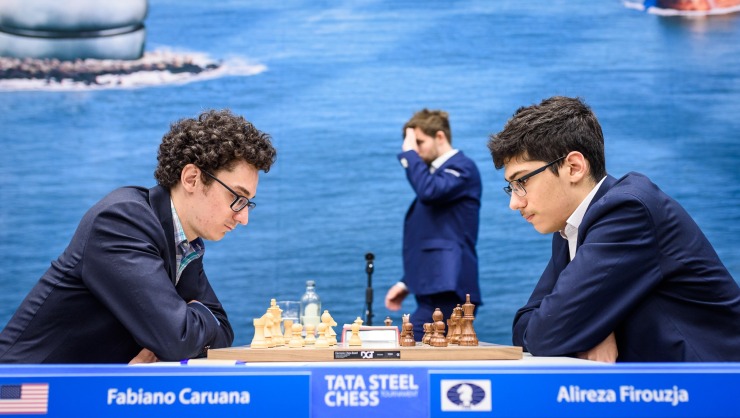
Magnus Carlsen and Fabiano Caruana are the two best players in classical chess. They have been at the top of the FIDE rating list for the last few years, taking first prizes most of classical chess tournaments in recent history and faced each other in the last World Championship match. In Round 10 of Tata Steel Masters Magnus and Fabiano proved their toughness winning key games and forging into the lead in Wijk aan Zee. Caruana had White against a tournament sensation Alireza Firouzja right after the latter lost his game versus Carlsen – the tournament schedule wasn’t kind to the youngster. Firouzja didn’t seem to be shaken though – he surprised Caruana twice, first time with a double-edged King’s Indian and then with a very rare move 6…Nc6. Fabiano was out of the book quickly and felt a bit worried as his opponent kept blitzing moves. It looks like only 11…b6 was a novelty, and the key moment occurred on move 14 when Caruana boldly played 14.g5 provoking a tempting piece sacrifice by Black. Engines approve on this and agree with Caruana who felt that he was at least not worse in the arising position with a bishop against 4 pawns. American GM puzzled out the secret of the position – Black’s pawn on d6 was a clog for his rooks, and it was very important not to take it with the queen. Caruana also was right that Black’s advancing his pawn army would expose the king. This exact scenario happened in the game and White’s attack was short and convincing. Firouzja probably could have played better around move 30 (30…h5! preventing h3-h4 was worth considering), but in general, he has nothing to blame himself for. He gambled a bit, and Caruana was just a better player tonight. Magnus Carlsen had a much easier task today as he was practically winning against Vladislav Kovalev right after the opening. Spectators and opponents started to forget how dangerous the World Champion could be after the first 7 games/draws, but the lion is back now. 13…a6 was definitely too slow, and after that Carlsen was unstoppable. When he broke through in the center with 18.e4! we could start writing this part of the report as the World #1 is ruthless in these positions. After 10 rounds the order is restored in the chess kingdom. Caruana is leading with 7 points – actually, it’s already his best score in Wijk aan Zee, and there are still three rounds to go. Carlsen is in clear second and only half a point behind. There is practically no doubt that one of them will lift the trophy on Sunday when the event is over. Apart from two Big C’s, Jeffery Xiong was the only winner today as he kind of recovered after his mid-tournament troubles. He got a classical endgame advantage against Vladislav Artemiev as his rook was much more active – his opponent from Russia sacrificed a pawn to activate his rook, but White managed to get connected passed pawns on “a” and “b” files and the game got beyond the point of no return for Black. In a few drawn games today the curtain fell a bit too early. Daniil Dubov was slightly better against Anish Giri and could have tortured him for a while without any risk but decided against testing the Dutchman’s legendary defensive technique. Nikita Vitiugov is probably very disappointed with his performance in Tata Steel as he missed several very good opportunities and made a horrible blunder against van Foreest – that is the reason he probably didn’t believe himself when he got a clear edge playing with Black against Vishwanathan Anand. He got an extra pawn with no compensation for White in sight, but just forced a draw by repetition. Yu Yangyi also had an extra pawn for the biggest part of the game against Wesley So and tried everything to get his first tournament win but Wesley So is just too good of a defender to let this happen. As always, Jorden van Foreest played one of the most entertaining games of the round – this time with a clear help of his adversary, Jan-Krzystof Duda. The Dutchman played 2.c3 against the Sicilian, but Duda had no troubles equalizing and then securing some advantage thanks to the pair of bishops. Feeling that something went wrong van Foreest sacrificed a pawn with 27.b4!? but if Duda had reacted with 30…a5 the 20-year-old from Utrecht would still have had serious problems. 30…Kh7 allowed White to escape with a nice queen sacrifice that lead to a perpetual check. Thursday will be the last day off; the tournament will continue on Friday. Both leaders will have Black – Caruana versus Kovalev and Carlsen is facing Duda. Official site: https://www.tatasteelchess.com/ Photo: Alina l’Ami Tata Steel Masters 2020 Standings after Round 10: 1. Caruana – 7; 2. Carlsen – 6.5; 3-4. Van Foreest, So – 6; 5-6. Duda, Firouzja – 5.5; 7-8. Dubov, Giri – 5; 9-11. Artemiev, Anand, Xiong – 4.5; 12-13. Vitiugov, Yu Yangyi – 3.5; 14. Kovalev – 3
Regulations for Chess Olympiad 2020, Competition for disabled
FIDE publishes the Regulations for Chess Olympiad 2020, Competition for disabled. FIDE is happy to announce that the first Chess Olympiad 2020, Competition for disabled will take place from July 28th till August 5th, 2020 in Khanty Mansiysk, Russia. Please check the Chess Olympiad 2020, Competition for disabled in the FIDE Calendar 2020. All FIDE National Federations are requested to provide FIDE with the list of the disabled chess players of their respective federations. The selection of teams for the 1st World Chess Paralympiad will be made based on the rating system (See Point 2 of the Regulations). A federation with higher rated players has more chances to participate in the Chess Olympiad 2020, Competition for disabled. FIDE has already received disabled players’ lists from most of the federations. Please check the lists here: http://dis.fide.com/. Should you have additional players, please fill in the Disabled Players’ Form and send it to the FIDE Vice President Akaki Iashvili at iashvili.fide@gmail.com. Before sending the Form, please make sure that your disabled players have FIDE IDs. The deadline for receipt of Disabled Player’s Form is February 10th, 2020. Looking forward to your participation.
Fier and Ter-Sahakyan win national championships
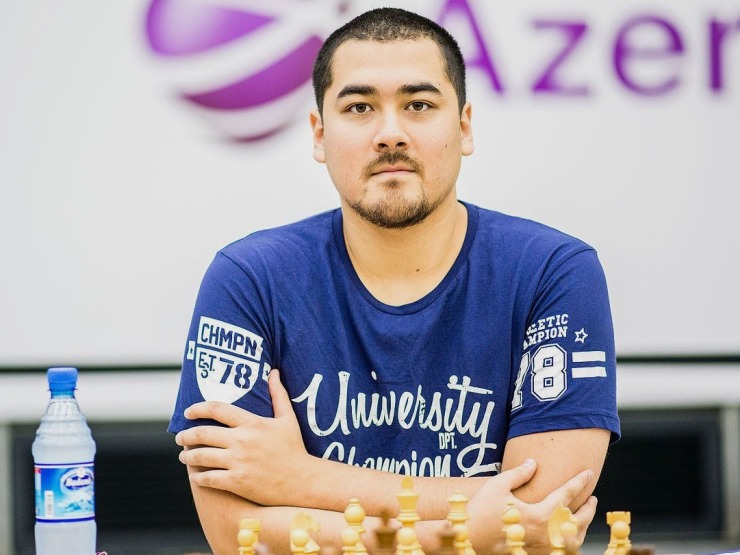
Photo: Andreas Kontokanis Two national championships ended almost simultaneously on the opposite sides of the Earth. The Brazilian absolute championship brought together 16 players contesting for the title in playoff format. The event, held in Hotel Othon Suites in Natal, did not attract all the best – only four out of nine 2500+ Brazilain players participated. The final saw the battle between GMs Alexandr Fier and Andre Diamant who beat Luis Paulo Supi and Darcy Lima respectively in very close semifinal matches. It suffices to say that Alexandr and Luis Paulo had to play seven games to determine the winner. The first two games of the final were drawn but then it was all Fier who won two encounters in a row and deservedly took the title of Brazilan Champion, third in his career. Photo: www.thinkingsquares.com In the women’s section, WIM Juliana Terao won her sixth title. From January 12 to January 20 the capital of Armenia Yerevan hosted the national championship, a 10-player round-robin tournament. No one was able to able to avoid a defeat, including the eventual winner Samvel Ter-Sahakyan who overcompensated his only loss with four victories. Samvel Martirosyan and Robert Hovhannisyan finished a half-point behind the champion with former taking silver thanks to better tiebreaks (Sonnebor-Berger). Maria Gevorgyan scored impressive 8 out of 9 in the women’s event became the champion of Armenia for the fourth time in her career. Photo: Mediamax Final standings: 1. Samvel Ter-Sahakyan – 6 2. Samvel Martirosyan – 5½3. Robert Hovhannisyan – 5½4. Arman Pashikian – 55. Mamikon Gharibyan – 4½6. Aram Hakobyan – 4½7. Zaven Andriasian – 4½8. Shant Sargsyan – 49. Mikaelyan Arman – 3½10. Gabuzyan Hovhannes – 2