

Chess and Female Empowerment conference concluded in London

London Chess Conference 2019, focusing on the ground-breaking theme “Chess and Female Empowerment” took place on November 30 and December 1, 2019, in the Irish Cultural Centre, Hammersmith. For the last four years the event has been supported by the European Chess Union, and this year additionally through the FIDE Development Fund. The conference opened with the welcome speech by Mr. Malcolm Pein who has been supporting the event from the very first year as a part of the London Chess Classic. After the welcome speech, Chairman of ECU Education Commission Mr. Jesper Hall presented the agenda of the conference and the work in progress by the ECU EDU commission. The conference examined the involvement of women and girls in chess and provided insights into how to improve gender balance. Primary and secondary school teachers had a chance to learn how to make chess a more engaging activity through its social and collaborative modes. With many workshops, presentations, debates, round tables and demonstrations in the program, the Conference provided ideas and initiatives for those striving to improve the engagement of women in science, technology, engineering, and mathematics. The conference was also dedicated to the recent study developed by ECU EDU Commission and Survey on Women’s Chess in Europe. Analyzing the results of the Survey, Ms. Alice O’Gorman, a member of the ECU Women’s Commission presented the current state of women’s chess throughout European countries and Chess Federations. A study conducted through the US Chess Federation provided qualitative insights into chess and gender issues, while an analysis of online play in the Netherlands revealed details of how boys and girls compare. The US Chess Federation has shared a short video by Jenny Schweitzer, a New York-based director. In this inspiring film, young female chess players explain the emotional and intellectual impact of chess on their lives and the challenges they have faced in the game. After receiving an award in Monaco at the Golden Pawn Ceremony legendary Judit Polgar flew to London to share her valuable experiences on women’s chess during the 7th London Chess Conference. Among more than 40 speakers from around 30 countries of the Conference were also the Chairman of the FIDE Chess in Education Commission Mr. Smbat Lputian and the Secretary Mr. Kevin O’Connell who actively participated in the sessions and debates. Text: Dr. Uvencio Blanco HernándezPhoto: John Saunders
GCT London Finals: Vachier-Lagrave miraculously escapes
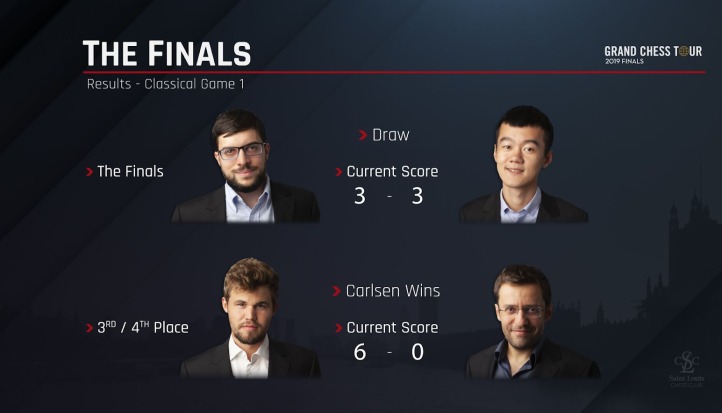
The players returned to the board after spending their day off at the Pro Biz Cup raising money for the UK charity Chess in Schools and Communities. After the opening phase, the commentators expected to see two victories. While Carlsen was able to put away his opponent, Vachier-Lagrave escaped by the skin of his teeth thanks to his resilient and resourceful defense. Aronian will have the white pieces tomorrow to try to overcome the 6 point deficit. The games will resume tomorrow 2 hours earlier, at 2 PM GMT/8 AM CST. Results after first classical games Maxime Vachier-Lagrave vs Ding Liren: ½ – ½ Vachier-Lagrave miraculously weathered the storm in what looked like a completely lost position. Ding repeated the same line against the Ruy Lopez that he had played against Carlsen in 2017. The Frenchman misplayed the middlegame and found himself in an unpleasant position, with a bad knight against a superior bishop in a queen endgame. Vachier-Lagrave decided to give up a pawn in order to trade the minor pieces, but inadvertently entered a lost endgame where his opponent’s passed c-pawn was unstoppable. Ding’s king ran across the board in order to hide from his opponent’s checks and to support his passed pawn. The situation looked hopeless for the Frenchman, but at the critical moment on move 66, the Chinese star made the grave error of allowing his opponent to promote to a queen as well, thinking that he had a forced win. The unusual endgame with four queens on the board went on for 32 moves until Ding had to accept that the victory had slipped out of his hands, eventually settling for a perpetual. Vachier-Lagrave was very critical of his performace, calling it unworthy of a final match. Ding was disappointed but found some solace in his high-quality middlegame play. Magnus Carlsen vs Levon Aronian: 1-0 Carlsen returned to the board eager to recover from his loss against Vachier-Lagrave. The main culprit of Aronian’s downfall was his poor time management throughout the game. The World Champion maintained a small edge after getting the bishop pair but Aronian was in the game. The position blew up on move 32 when the Armenian sacrificed a pawn in order to activate his pieces. Unfortunately, he was already low on time and missed a key resource to fully equalize. After a few more inaccuracies by both sides, the players ended up in an opposite-colored bishop endgame where Aronian was down a pawn and already relying heavily on increment, making it practically impossible to hold. He conceded defeat after it became clear that another one of his pawns would inevitably fall. Photo: Grand Chess Tour Official site
Humpy Koneru earns a draw and keeps the lead
Another exciting day at the Yacht Club with four decisive results. The veteran Pia Cramling, the oldest participant in the event and a member of the Cercle d’Echecs de Montecarlo since 2007, climbs to the second position. The Grand Prix had the honor to welcome the Honorary Consul General of Russia in Monaco, Mrs. Ekaterina Semenikhin, to launch the fourth round. The diplomat played a symbolic first move in the encounter between former World Champions Alexandra Kosteniuk and Mariya Muzychuk. In an interview given afterward, Mrs. Semenikhin revealed that she had played a part in the organization since she had suggested holding the event at the Yacht Club de Monaco. “As one of the most beautiful buildings in Monaco, symbolizing the modern style and modern life, this is a perfect place for the Grand Prix”, she added. For the record, the game between Alexandra Kosteniuk and Mariya Muzychuk finished rather early with a draw by repetition. The only other encounter where the point was split witnessed a tense battle. Nana Dzagnidze tried hard to beat Humpy Koneru with the white pieces, as this would enable her to overtake her opponent, who has been leading the tournament since day one. The Georgian got a definite edge from the opening and pushed until the very end. It did not work out as Koneru’s defensive skills and resilience proved sufficient. In the remaining four games one part came out victorious and surprisingly only once it was White. Valentina Gunina misplayed her Bogo-Indian opening and soon ended up in a critical position against Zhao Xue. The Chinese produced a good game and did not let this chance slip away. Aleksandra Goryachkina fully recovered from her loss in round two and scored her second consecutive win against Harika Dronavalli. This game seemed to be heading toward a quiet draw, but the World Championship challenger found a way to obtain an edge in the endgame. The Indian did not defend too well, which allowed Goryachkina to display an excellent technique and score a full point. Pia Cramling is having a great event so far. The Swedish legend, the lowest-rated participant in Monaco, is giving a hard time to her younger competitors. After three initial draws, where she actually missed some chances, Pia overcame the resistance of Elisabeth Paehtz. The German is visibly out of shape, as she inexplicably forgot to exchange queens with 27.Qc8. Cramling managed to put pressure on her opponent after that and won a pawn. The fight ended abruptly with a terrible blunder by Paehtz, although most likely she would have lost anyway. Kateryna Lagno and Anna Muzychuk played the longest game of the day. Black refrained from castling, which possibly provoked her opponent into an attacking attempt with 14.Ng5. But eventually, this knight ended up being cut off from its own camp. In order to avoid losing this piece, Lagno had to take some drastic measures, which gave Black wonderful play. The Ukrainian won a pawn and converted it convincingly. Humpy Koneru keeps the lead with three points but is now trailed by four players. Results of Round 4:Nana Dzagnidze (Geo) – Humpy Koneru (Ind): ½ – ½Alexandra Kosteniuk (Rus) – Anna Muzychuk (Ukr): ½ – ½Kateryna Lagno (Rus) – Mariya Muzychuk (Ukr): 0-1Zhao Xue (China) – Valentina Gunina (Rus): 1-0Harika Dronavalli (Ind) – Aleksandra Goryachkina (Rus): 0-1Elisabeth Paehtz (Ger) – Pia Cramling (Swe): 0-1 Standings after Round 4:1. Humpy Koneru – 32-5. Nana Dzagnidze, Aleksandra Goryachkina, Anna Muzychuk and Pia Cramling – 2½6-9. Harika Dronavalli, Zhao Xue, Mariya Muzychuk and Alexandra Kosteniuk – 210. Kateryna Lagno – 1½11. Valentina Gunina – 112. Elisabeth Paehtz – ½ Round 5, 7 December at 3 pm:Pia Cramling (Swe) – Nana Dzagnidze (Geo)Anna Muzychuk (Ukr) – Alexandra Kosteniuk (Rus)Mariya Muzychuk (Ukr) – Zhao Xue (China)Valentina Gunina (Rus) – Harika Dronavalli (Ind)Aleksandra Goryachkina (Rus) – Elisabeth Paehtz (Ger)Humpy Koneru (Ind) – Kateryna Lagno (Rus) Official website with live games and commentary by WGM Keti Tsatsalashvili, GM Josif Dorfman and GM Bartlomiej Heberla: https://wgp2019.fide.comPictures are available in this Dropbox folder. Text: Yannick PelletierPictures: Karol Bartnik
FIDE Women’s Grand Prix reaches cruising speed
Four wins and two draws in an exciting third round at the Yacht Club de Monaco. Humpy Koneru keeps the lead. The second leg of the Women’s Grand Prix seems to run like a clockwork. Like on the previous day, the round ended with four victories and two draws. The game between Mariya Muzychuk and Kateryna Lagno was a real roller coaster. Lagno’s opening choice clearly backfired, as she quickly found herself in a critical position. But the King’s Indian would not be the King’s Indian if Black was unable to fish in muddy waters by launching a desperate attack. The value of every move is very high and any mistake by White may turn the tables. Muzychuk wasted part of her advantage with 30.Bb6 and even gave Black a winning attack by playing 31.fxe4. But the position was so unusual and complex that both grandmasters squandered their chances. After Lagno missed a forced mate by 33…Qf4+ (33…Qg5+ instead was winning on the spot), Muzychuk emerged from the time trouble with a winning position and eventually won the game. In fact, Mariya Muzychuk was not the only player to bounce back from a defeat in round two, as both Valentina Gunina and Aleksandra Goryachkina accomplished the same feet. This proved particularly important for Gunina who had suffered two initial losses. Valentina actually won a very nice game against her compatriot Alexandra Kosteniuk, reminding everybody how dangerous an attacking player she can be. In her post-game commentary, Goryachkina felt that her win had been rather smooth after her opponent Zhao Xue made a few inaccuracies in the early middle-game. Indeed, she won a pawn with 23.Bxd5, and converted it confidently in the endgame. Nana Dzagnidze handled the middlegame much better against Elisabeth Paehtz and inflicted a second consecutive defeat to the German. The Georgian gradually increased her advantage and obtained an endgame with a rook and a knight each, where her pieces were much more active. The leader Humpy Koneru somewhat carelessly allowed Anna Muzychuk to grab a pawn on a7. Humpy admitted afterwards that had hoped to trap this adventurous Bishop, but timely realized that she actually had to be careful and seek for equality. Koneru was up to the task as she managed a draw by repetition. Harika Dronavalli and Pia Cramling exchanged queens very early on. The symmetrical structure presaged a quiet game that indeed ended in a draw after 31 moves. Koneru remains the sole leader but faces one of her pursuers in the next round. With the white pieces, Dzagnidze will certainly try to overtake the Indian. Results of Round 3:Elisabeth Paehtz (Ger) – Nana Dzagnidze (Geo): 0-1Pia Cramling (Swe) – Harika Dronavalli (Ind): ½ – ½Aleksandra Goryachkina (Rus) – Zhao Xue (China): 1-0Valentina Gunina (Rus) – Alexandra Kosteniuk (Rus): 1-0Mariya Muzychuk (Ukr) – Kateryna Lagno (Rus): 1-0Anna Muzychuk (Ukr) – Humpy Koneru (Ind): ½ – ½ Standings after Round 3: 1. Humpy Koneru – 2½ points2-3. Nana Dzagnidze and Harika Dronavalli – 24-9. Mariya Muzychuk, Alexandra Kosteniuk, Kateryna Lagno, Aleksandra Goryachkina, Anna Muzychuk, and Pia Cramling – 1½10-11. Zhao Xue and Valentina Gunina – 112. Elisabeth Paehtz – ½ Round 4, 6 December at 3 pm:Nana Dzagnidze (Geo) – Humpy Koneru (Ind)Alexandra Kosteniuk (Rus) – Anna Muzychuk (Ukr)Kateryna Lagno (Rus) – Mariya Muzychuk (Ukr)Zhao Xue (China) – Valentina Gunina (Rus)Harika Dronavalli (Ind) – Aleksandra Goryachkina (Rus)Elisabeth Paehtz (Ger) – Pia Cramling (Swe) Official website with live games and commentary by WGM Keti Tsatsalashvili, GM Josif Dorfman and GM Bartlomiej Heberla: https://wgp2019.fide.com Pictures are available in this Dropbox folder.
Wang Hao and Andreikin join the Jerusalem Grand Prix
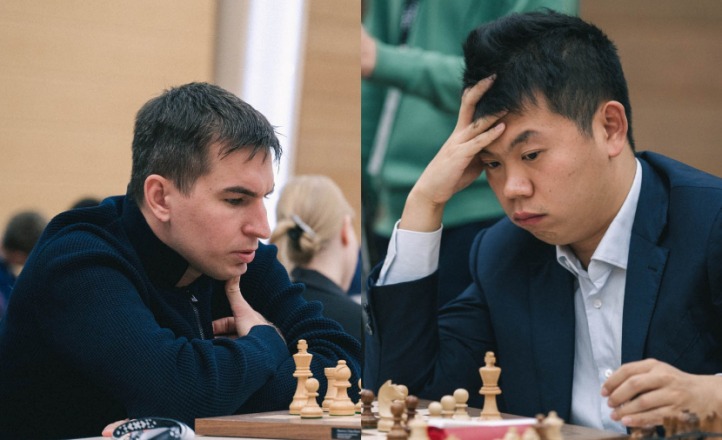
Following the withdrawal Teymour Radjabov and Levon Aronian for medical reasons, the field for the Jerusalem Grand Prix has been completed with the inclusion of Wang Hao (CHN, 2756) and Dmitry Andreikin (RUS, 2724). Wang Hao is the first player from the list of reserve players published in February who was available and ready to take part in the tournament. As for Andreikin, he is the strongest player who was available following the rating list. 1 – Maxime Vachier-Lagrave (FRA, 2780)2 – Shakriyar Mamedyarov (AZE, 2772)3 – Anish Giri (NED, 2769)4 – Ian Nepomniachtchi (RUS, 2767)5 – Wesley So (USA, 2760)6 – Wang Hao (CHN, 2756)7 – Sergey Karjakin (2754)8 – Yu Yangyi (CHN, 2738)9 – Veselin Topalov (BUL, 2737)10 – Radoslav Wojtaszek (POL, 2725)11 – Wei Yi (CHN, 2725)12 – Pentala Harikrishna (IND, 2724)13 – Dmitry Andreikin (RUS, 2724)14 – David Navara (CZH, 2707)15 – Dmitry Jakovenko (RUS, 2698)16 – Boris Gelfand (2684) This is the official website to the FIDE Grand Prix in Jerusalem organized by World Chess: https://worldchess.com/news/guide-to-jerusalem-grand-prix-2019
Call for Bids: FIDE World School Chess Championship 2020

FIDE Presidential Board decided to transfer Peru’s right to organize the World School Chess Championships from 2020 to 2022 due to the unstable situation in the leadership of Peruvian Chess Federation. Peru’s right to organize the 2022 World School Chess Championships comes into force if, no later than March 10, 2020, the Peruvian Federation presents guarantees of state support for the World School Chess Championships 2022 and the Presidential Board recognizes them as satisfactory at 1st quarter 2020 meeting. Presidential Board also decided to re-open bidding procedure for the World School Chess Championships 2020 with the bidding deadline no later than December 13, 2019. Call for Bid World School Championships 2020 reopened again with the deadline 13th December 2019. · A bid for any FIDE Competitions onwards shall include the name of a FIDE licensed International Organizer. · All bids should be submitted by the due date in sealed envelope or scanned documents to the FIDE Secretariat, postal address: Avenue de Rhodanie 54, 1007 Lausanne, Switzerland, Tel: + (41) 21 6010039, email office@fide.com by 13th December 2019, 16:00 local time · Each bid should be accompanied with a bid fee 500 euro · Bid Fees are not refundable. Bid fees should be paid the latest by 20th December 2019 to the FIDE bank account (free of charges) or to be enclosed in the bid envelope. · All bidders must fill the bid form and the new bid from annex completely. · Price of hotels, details about the accommodation and tournament hall must be written in the bid. · FIDE EVE will make first bid inspections and send his report together with a bid evaluation form. There will be a second inspection prior 2 to 4 months to awarded organization. Accommodation costs of the inspections must be paid by organizers. · FIDE Officials – Appeals Committee, Chief Arbiter, Deputy Arbiter(s) – will be decided and appointed by FIDE by taking proposal of organizers. The bid form and new added annex can be downloaded here. BID FORM BID FORM ANNEX
FIDE Ethics Commission announces the sanctions against Igor Rausis
Lausanne, December 5, 2019 The FIDE Ethics Commission (ETH), composed of Yolander Persaud, Ravindra Dongre, Rajesh Hari Joshi, and Francois Strydom as a Chairman, held a meeting in Lausanne, Switzerland, during November 23-24. During this meeting, among other matters, the ETH Commission studied the allegations of cheating against GM Igor Rausis at the 2019 Strasbourg tournament, and various other tournaments in the period 2015-2019. An oral hearing was held at which were present, apart from the ETH members, the respondent Igor Rausis, Mr. Yuri Garrett of the FIDE Fair Play Commission, and Prof. Kenneth Regan. Mr Rausis confessed to cheating on four different occasions, in three instances by using his mobile phone and in the other instance by pre-arranging the result of a game, and was found guilty as such on the basis of his own version. Taking into account Mr Rausis’ acknowledgment of guilt, his co-operation at the hearing and remorse displayed, as well as his personal circumstances, but keeping in mind the precedent established by the ETH’s decision in case no. 7/2015, the ETH unanimously decided to sanction Mr. Igor Rausis with a worldwide ban of 6 (six) years to take effect from 31 July 2019 and to end on 30 July 2025. During this period Mr. Rausis is prohibited from participating as a player in any FIDE rated over-the-board chess competition (whether classical, rapid, blitz or Fischer-random chess), and from any chess-related activity as an arbiter, organizer or representative of a chess federation. In addition, Mr. Rausis’ grandmaster title is revoked effective from the date of publishing this decision. For the sake of clarity, the sanction does not seek to prevent Mr. Rausis’ participation in FIDE correspondence or online chess games, or to restrain Mr. Rausis from earning income during the period of the ban as a private chess trainer, teacher or coach, provided that he shall not act as captain or assist any player or team during any official FIDE event or Continental championship at the physical site of the tournament. Remote coaching is permitted. The ETH decision does not affect Mr. Rausis’ rating or any other titles he holds, such as FIDE International Master, FIDE Trainer, and National Arbiter. This decision was communicated this morning to Mr. Igor Rausis, the European Chess Union, the Czech and Latvian Chess Federations, the Fair Play Commission and the Investigatory Chamber (per IA Klaus Deventer). Full decision (PDF) [All the other decisions recently taken by the ETH will be published on the Ethics Commission Website in approximately two weeks]
GCT Finals: Ding Liren and Vachier-Lagrave meet in the final
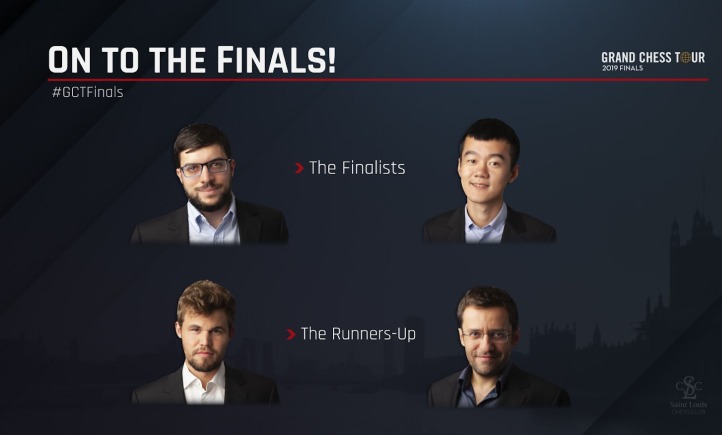
Maxime Vachier-Lagrave and Ding Liren will meet in the finals after defeating Magnus Carlsen and Levon Aronian respectively. While Ding was dominant in his match, Vachier-Lagrave had to go all the way to tiebreaks to secure his spot. Ding and Vachier-Lagrave will be competing for the $150,000 first-place prize and the title of Grand Chess Tour Champion, while Carlsen and Aronian will battle it out for the third-place qualifying spot to the 2020 GCT in addition to a $60,000 prize. Tomorrow the players will take a break from the action to partake in the corporate day, where they will be paired with entrepreneurs in friendly games to raise money for the UK charity Chess in Schools and Communities. Action will resume on December 6. Ding Liren vs Levon Aronian The Chinese player was completely dominant in his match, advancing to the finals with three blitz games to spare. Aronian was unable to deal with the complications arising from his opponent’s piece sacrifices in both rapid games, collapsing at the crucial moments. The two wins in the rapid gave Ding a 6 point lead, and he only needed 1 draw in the remaining 4 blitz games. He secured his spot in the finals by locking up the position in the first blitz game, forcing a draw and reaching 15 points. Aronian suffered two more losses but did manage to end the day with a win. The Armenian star felt “ashamed” about his play today, whereas Ding felt lucky to win the first game. Maxime Vachier-Lagrave vs Magnus Carlsen Unlike the smooth sailing by Ding, the match between Carlsen and Vachier-Lagrave was a complete roller coaster ride and was decided on the tiebreak. Carlsen later explained to Maurice that he felt sluggish and “not good enough in the critical moments.” After two tame rapid games, the World Champion escaped unscathed in the first blitz game only to go on to lose the next one. In his typical fashion, he bounced back immediately in the very next game with a win in a rook endgame. After a draw in the final blitz game, the match moved on to tiebreaks. The first tiebreak game was a wild affair with the evaluation of the position changing drastically several times. Carlsen had a crushing attack, but let the advantage slip with inaccurate play. After another blunder, he found himself in a difficult position, then ultimately in a lost knight endgame, which Vachier-Lagrave converted masterfully with seconds on his clock. The Frenchman sealed the deal with a draw in the second game. This marks the World Champion’s second tiebreak loss this year, a blemish on his otherwise flawless tiebreak record. Photo: Grand Chess Tour Official site
Competition heats up at the Women Grand Prix in Monaco
All games of the second round of the Women’s FIDE Grand Prix were hard-fought and exciting. Humpy Koneru leads with a perfect score. After a rather uneventful first round on Tuesday, where five our of six games ended in a draw, all the players arrived today to the Yacht Club de Monaco in a very fighting mood. Indeed, four encounters were decided in favor of the white pieces. Thanks to a flawless technical performance, Humpy Koneru clinched her second victory in this event. She chose a rather aggressive line against Mariya Muzychuk’s Grunfeld, to which the Ukrainian did not react accurately. A key concept in this opening consists in not being scared of sacrificing material for the sake of activity. With this in mind, Black should have refrained from the passive move 23…Ra8, going instead for 23…Ne7 24.Qxa6 Nd5. After being given this opportunity the Indian exerted relentless pressure on Black’s position until she reached a favorable endgame before the first time control, which she converted confidently. The other Indian representative Harika Dronavalli was equally successful, as she outplayed Elisabeth Paehtz in the Slav Defense. The German chose a timid 5…Nbd7 and ended up in the kind of passive position on the queenside which Black usually tries to avoid in this variation. Paehtz tried to get counter-play on the other side with 18…g5, but Dronavalli reacted perfectly by allowing the exchange of her Bishop on g3. She even got attacking chances against the open black king, but when given a chance, she opted for converting her positional advantage in an endgame. The four Russian players were pitted against each other on this second day. Alexandra Kosteniuk achieved what White dreams of in this line of the Caro-Kann: a long-lasting edge thanks to the pair of Bishops. On move 20, her opponent Aleksandra Goryachkina strangely decided to bring her strong Nb4 all the way back to e8, instead of developing her rook to d8. Kosteniuk later managed to break through with the thematic 30.d5. She won a pawn and reached a highly favorable endgame. However, Kosteniuk criticized her own technique in the post-game interview: she indeed allowed her opponent to escape towards the end. But the future challenger for the World Championship missed the saving move 61…Kg6 and lost. The other Russian duel was very lively. Valentina Gunina took a lot of time in her Berlin opening and decided to offer a pawn with 15…Be6. Kateryna Lagno accepted the gift and got a clearly better position plus a 1-hour advantage on the clock. Down to her last minutes around move 20, Gunina started playing as actively as possible and managed to confuse her opponent. Lagno missed several ways to consolidate her advantage and eventually had to settle for a drawish endgame despite an extra pawn. But Gunina, who is suffering from a cold, did not have the energy to hold it. Her final mistake came when she decided to reject the prospect of defending the famous endgame a rook and bishop against a rook. Both draws of this round were very interesting games as well. Nana Dzagnidze could have obtained an opening advantage with 12.Bd6 but took the poisoned pawn on c6 instead. She admitted that she underestimated Anna Muzychuk’s reply 13…Qc8, after which she already had to be very careful. After 19…Qc4, it became clear that Black would not let her opponent castle. Being low on time, the Ukrainian erred with 21…Rc8 though. She refrained from the correct 21…Rad8 because of 22.Rd4, but the simple exchange on d4 would have given her a winning position. 23.cxd4 is met with Rc8, while after 23.exd4 Qd3 Black is crushing too. In the game, Dzagnidze eventually managed to simplify and achieve a draw. Pia Cramling played almost a perfect game against Zhao Xue’s English Opening. As she explained afterward, she felt that Black had to play actively in order to avoid getting slightly worse in the long run. Her moves 15…b5 and 16…d5 were brilliant and gave her the initiative. The Swedish legend is known to be a very restrained and modest person. She probably did not fully believe that she had so skilfully outplayed her opponent and repeated moves to seal a draw. She actually missed two consecutive opportunities to win, namely 25…Nb4 and 26…Nc4. The leader of the Grand Prix race Koneru is the only player with two out of two in Monaco. She is followed by her compatriot Dronavalli and two Russians Kosteniuk and Lagno who are a half-point behind. Results of Round 2: Nana Dzagnidze (Geo) – Anna Muzychuk (Ukr): ½-½Humpy Koneru (Ind) – Mariya Muzychuk (Ukr): 1-0Kateryna Lagno (Rus) – Valentina Gunina (Rus): 1-0Alexandra Kosteniuk (Rus) – Aleksandra Goryachkina (Rus): 1-0Zhao Xue (China) – Pia Cramling (Swe): ½-½Dronavalli Harika (Ind) – Elisabeth Paehtz (Ger): 1-0 Standings after round 2 :1. Humpy Koneru – 2 points2-4. Harika Dronavalli , Alexandra Kosteniuk, Kateryna Lagno – 1½5-8. Nana Dzagnidze, Anna Muzychuk, Zhao Xue, Pia Cramling – 19-11. Aleksandra Goryachkina, Elisabeth Paehtz, Mariya Muzychuk – ½12. Valentina Gunina – 0 Round 3, 5 December at 3 pm:Elisabeth Paehtz (Ger) – Nana Dzagnidze (Geo)Pia Cramling (Swe) – Dronavalli Harika (Ind)Aleksandra Goryachkina (Rus) – Zhao Xue (China)Valentina Gunina (Rus) – Alexandra Kosteniuk (Rus)Mariya Muzychuk (Ukr) – Kateryna Lagno (Rus)Anna Muzychuk (Ukr) – Humpy Koneru (Ind) Official website with live games and commentary by WGM Keti Tsatsalashvili, GM Josif Dorfman and GM Bartlomiej Heberla: https://wgp2019.fide.com. Pictures are available on this Dropbox folder Text: Yannick PelletierPictures: Karol Bartnik
John Fawole Chess Awards 2019: Full list of winners

The John Fawole Chess Awards 2019 has come and gone with loads of surprises, fun, games, drama, and laughs. In course of the ceremony, held at Chevron Recreation Club, Gbagada, Lagos Nigeria, the awards were given to the most deserving chess players, chess contributors, organizers, and arbiters. Established back in 2016, the John Fawole Chess Awards also known as Nigeria Chess Awards is Nigeria’s most prestigious and anticipated chess awards. The key goal of the award is to celebrate excellence for chess players who have contributed immensely to the development of chess in Nigeria, either through an excellent representation of the country in chess events or via a deliberate and charitable promotion of chess among the citizens of Nigeria. The organizers and panel of judges announced the full list of awardees for the year 2018. The list below is what the panel of judges decided after votes were cast online: 1. Most outstanding chess player award (Male): Abdulrahman Abduraheem Akintoye2. Most outstanding chess player (Female): Perpetual Ogbiyoyo3. Arbiter of the year (Male): Olawale Peter Oyeleye4. Best organized chess tournament of the year: MGI5. Tournament director of the year: Olawale Peter Oyeleye6. Most outstanding senior award: Erhabor David7. Award of recognition for most outstanding in WAUG: Daniel Anwuli8. Award of Recognition for most outstanding in WAUG: Perpetual Ogbiyoyo9. Promoter of the year award: Salem Fly10. Award of recognition for the most outstanding grassroots development project – Chess in the slum: Tunde Onakoya11. Personality of the year award: Tajudeen Oyeneyin12. Award of recognition for the most outstanding all-time tournament director: Rotimi Dasaolu13. Team leader of the year: Ayokanmi Ajayi14. Most Outstanding u-10 player award (Male): Osadebe Emmanuel15. Most Outstanding u-10 player award (Female): Oluyisola Abiola Diamond16. Most outstanding u-20 player (Male): Kikosem Igwubor17. Most outstanding u-20 player (Female): Akintoye Deborah18. Most consistent online player award: Aikhoje Odion19. Best online tournament award: chess online Nigeria (CNO)20. Arbiter of the Year (Female): Alhaji Tayo Amisu 23 Awards of Recognition for people who have contributed immensely to the development of chess in Nigeria: 1. Bimbo Fajemirokun2. Ayo Tuase3. Nnamdi Nwoye4. Robert Asibor5. George Lolomari6. Femi Adebajo7. Lekan Adeyemi8. Rotimi Odunaiya9. Adewole Adeyinka10. DIG Rtd. Sani. Mohammed11. Ajibola Olanrewaju12. Rachael Dappa13. Aisha Jimoh Ibrahim14. Rabiu Olabisi15. Magnus Epkiken16. Bode Durotoye17. Dasaolu Rotimi18. Tolu Ogunwobi19. Kenneth Odeh20. Bayo Babalola21. Niyi Oriolowo22. Ikechukwu Igwunze23. The Executives – Chevron Recreation Club, Gbagada Lagos.