

Superbet Rapid & Blitz: Giri forges ahead
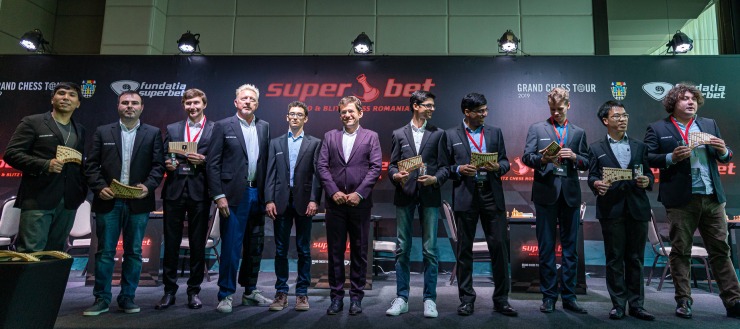
The penultimate leg of the 2019 Grand Chess Tour kicked off yesterday in Bucharest, Romania with an exciting opening ceremony. The event featured special guest and former world number one tennis player, Boris Becker. Additionally, former Romanian basketball player and captain of the national team Virgil Stănescu made the ceremonial first move in Caruana – Aronian game of round 1. After an eventful first day, Anish Giri is leading the tournament by a full point ahead of the field. Round 1 In the central game of Round 1, Fabiano Caruana played with Levon Aronian. Having White pieces, World #2 went for an ambitious piece sacrifice right after the opening & seemed to have sufficient compensation. Aronian defended really well and then sacrificed an exchange to grab the initiative. After Fabiano let the black knight occupy e3 square White seemed doomed. Aronian converted his advantage in mutual time trouble and scored a very important victory. Vlad Artemiev from Russia started the year 2019 really well but it looks like he has been out of form for the last few months. In the first round, he had White against Vishy Anand. Anand sacrificed an exchange but he had two bishops and a dangerous pawn center. Objectively Artemiev was still holding his own but he carelessly let the ex-World Champion from India break his pawn structure on the kingside and launch a murderous attack. Anish Giri proved his impeccable technique once again. Many amateur players have problems with Black in these seemingly equal Catalan endgames, and even Fischer Random World Champion Wesley So repeated their fate in his Round 1 game against the Dutch GM. Move after move Giri was increasing his advantage and by the move 39 So found himself in a complete zugzwang. He blundered there but his position was lost anyway. Two other games were drawn. Sergey Karjakin couldn’t convert his extra passed pawn versus Anton Korobov, whereas Shakhriyar Mamedyarov played to bare kings against Le Quang Liem, but never had a real chance to score a full point. Round 2 Round 2 of the Superbet Rapid & Blitz was as close to classical chess as a rapid event can be. Players with White pieces were pressing in all five games, had some chances here and there, but Black defended successfully. As a result, all five games were drawn. Aronian got absolutely nothing from the opening against Karjakin, and though later in the game he was pushing for a win, opposite-colored bishops were a key factor. So chose a very interesting line in Reti Opening against Anand and had some initiative on the kingside but the Indian GM responded with a pawn sacrifice to create some threats on the long diagonal. So found nothing better than to force further exchanges which resulted in a drawn endgame. Giri was trying his best to outplay Caruana and grab a sole lead. Since a weakness on b6 was a constant headache for the American, he finally had to give it up a pawn on the move 36. In the endgame, Caruana resourcefully created a very serious counterplay against the white king, and Giri had to give up an exchange. He never was in danger of losing though as his passed pawn on the a-file was too strong. The central game of the round ended in a perpetual. Mamedyarov – Artemiev & Korobov – Le Quang Liem were pretty comfortable draws for Black. Aronian, Anand & Giri were in the lead with 3 points out of 4 each. Round 3 Anish Giri seems to be on fire in Bucharest. He won a second game in three rounds and moved to a sole lead. Karjakin was too slow in a calm line of Najdorf and Giri came up with a brilliant maneuver Be7-d8-a5 getting a clear advantage. Classical Sicilian pressure on the “c” file was too much for Karjakin to endure and he quickly lost several pawns and the game. Anand was also very close to winning his second game of the day. He got a better position after the opening against Mamedyarov and could have gone for the checkmate but preferred to exchange queens to reach much better endgame where Black bishops didn’t compensate for multiple weak pawns. Anand was at his best until he hastily grabbed an a5-pawn – the white rook got trapped on this square and disappointed Anand had to accept a draw. Fabiano Caruana had his first win in the tournament in the encounter with Wesley So. He sacrificed a pawn in the Gioco Piano, but So defended really well and timely returned his extra material to almost achieve equality. Unfortunately, you can never be safe playing against such a player as Caruana. Somehow Fabiano engineered a menacing attack even without queens on board. In a difficult position So blundered a piece and resigned immediately. Artemiev’s troubles continued as he lost an equal endgame playing White versus Korobov. Le Quang Liem – Aronian was a very solid draw. Standings after Round 3: 1. Giri, Anish 5/62-4. Aronian, Levon 4/62-4. Anand, Viswanathan 4/62-4. Korobov, Anton 4/65-7. Caruana, Fabiano 3/65-7. Mamedyarov, Shakhriyar 3/65-7. Le, Quang Liem 3/68. Karjakin, Sergey 2/69-10. So, Wesley 1/69-10. Artemiev, Vladislav 1/6 Official site Livestream:GrandChessTour.org Photos:Courtesy of Grand Chess Tour and Spectrum StudiosCredits available on Flickr.
World Youth U-16 Chess Olympiad: Azerbaijan takes gold
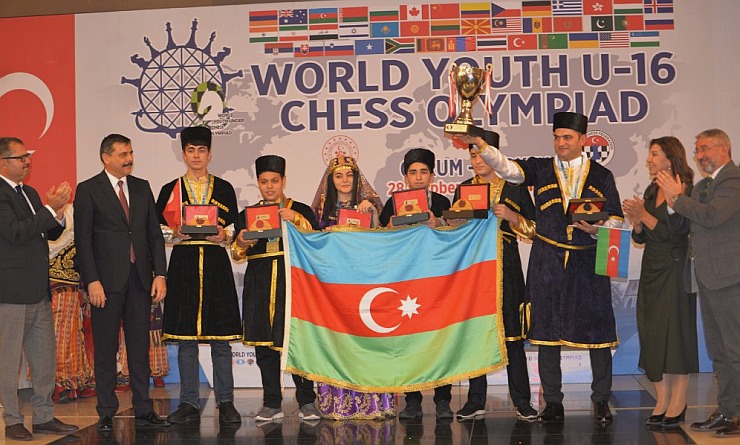
FIDE World Youth U-16 Chess Olympiad 2019 is concluded in an ancient Turkish city Çorum. From October 20 to November 5 forty-eight teams from all around the world were fighting for medals. Each squad consisted of five players, including one girl. The event was held in the playing hall of the five-star Anitta hotel, which offered accommodation to all participants. Azerbaijan, Russia, and Ukraine entered the tournament as favorites but only the first one lived up to its promise. The contest turned into an exciting race of Azerbaijan, Uzbekistan, Belarus, and Kazakhstan. Belarus was in front until Round 5 in which the team lost to Kazakhstan. As a result, Azerbaijan, Uzbekistan, and Kazakhstan tied for the lead but after round 6 the trio became a duo – Azerbaijan won a key match over Kazakhstan. The ex-leader did not give up and beat Uzbekistan in the next round, but Azerbaijan won its match as well, shot ahead and preserved its top-position to the very end. Final standings: 1. AZERBAIJAN – 162. UZBEKISTAN – 153. BELARUS – 144. KAZAKHSTAN – 135. ISRAEL – 126. UKRAINE – 127. INDIA – 128. MONGOLIA – 129. GREECE – 1110. RUSSIA – 11
FIDE Grand Prix Hamburg: Four winners in the first round
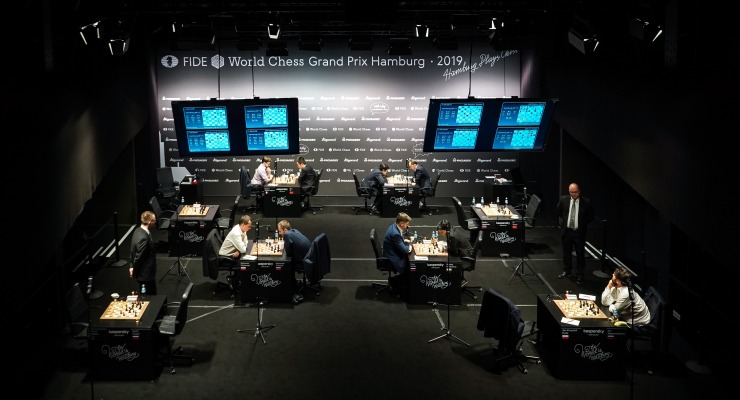
The first day of the FIDE Grand Prix in Hamburg attracted many spectators until the organizers announced: “sold out”. The German chess fans didn’t regret coming as they witnessed many dramatic battles and four victories. The president of the German Chess Federation, Ulrich Krause, symbolically opened the 1st round of the FIDE Grand Prix in Hamburg by playing 1. e2-e4 on the board of Maxime Vachier-Lagrave and Wei Yi. “It was a pleasure,” he said afterward and added: “It is an honor for me to be the chairman of the appeals committee during the next two weeks. At the same time, I expect not to be active in this role.” Superb technique by Maxime Vachier-Lagrave One of the favorites of the FIDE Grand Prix in Hamburg got off to a great start. Maxime Vachier-Lagrave outplayed his opponent Wei Yi from the very beginning to the end. The Chinese grandmaster boldly chose the Najdorf Variation of the Sicilian Defense with the black pieces against the world’s leading expert of this opening. Vachier-Lagrave reacted with a rare idea on move seven. After the exchange of queens on move 19, he got a better ending and was gradually improving his position. On the move 29 Vachier-Lagrave won the crucial a-pawn, which proved to be decisive. A blunder by Ian Nepomniachtchi Jan-Krzysztof Duda opened his duel against Ian Nepomniachtchi by pushing his pawn to c4. “I just wanted a random game and to avoid any theoretical battle in the Grunfeld or Najdorf”, he stated afterward. It was an equal fight until the Russian grandmaster played 23.e5-e4. “I couldn’t believe my eyes when I saw this move,” said Duda. It was just a terrible blunder. The Polish GM was not only a pawn up, but also had the bishop pair and the center. Nepomniachtchi tried to complicate things by sacrificing an exchange, but the outcome of the game was never in doubt. Peter Svidler thanked his compatriot Kirill Alekseenko for showing him the line he used today to beat Pentala Harikrishna. In the second Italian Game of the day, Black seemed to have some initiative on the kingside, but Svidler parried all threats with precise counters and reached a favorable ending. White’s advantage increased when the Russian grandmaster infiltrated the 7th rank with one of his rooks on move 29. Harikrishna sacrificed an exchange and tried to create some counterplay with his passed pawn on the a-file, but Svidler was always in command and seamlessly converted his advantage into a full point. Radoslaw Wojtaszek and Alexander Grischuk split the point after an intense and open battle in a variation of the Catalan Opening. “We are both happy and unhappy”, said Grischuk, meaning that both players missed their chances. In a highly complex middlegame, Black got the upper hand around move 30 when the white pieces were clumsily flocked up on the kingside. The Polish grandmaster nevertheless was able to turn the tables by giving some material for the black queen and forcing Grischuk’s majesty to leave the corner and run to the center. He chased the black king over half of the board, but the position promised nothing more than a perpetual check, which he delivered after the first time control. In a battle lasting nearly five hours, Hikaru Nakamura and Veselin Topalov played the longest game of the day, which ended in favor of the Bulgarian grandmaster. “I used a line, which Anand played against me once”, Topalov explained. His decision was justified as he started a vicious attack against the white king right after the opening. Even if Topalov missed a win by force, the position on the board never raised serious doubts about the outcome. David Navara and Nikita Vitiugov tested their theoretical knowledge in a deeply analyzed line of the Marshall Attack. The Czech grandmaster followed in the footsteps of Teimour Radjabov, who beat Ding Liren in the final of the World Cup. Vitiugov deviated on move 17 by putting the bishop on f5 instead of the queen. He sacrificed a pawn, but soon afterward Navara gave the pawn back and forced the draw after 25 moves. “This is modern chess”, said Vitiugov later and added that Black has typical compensation in this position, which often leads to a draw. The first game to end in the starting round was the one between Teimour Radjabov and Daniil Dubov. It was only twelve moves long and it concluded in less than an hour. In an Italian Game, the Russian grandmaster gave up castling short but advanced his pawns on the kingside. Just when the battle began to heat up, Radjabov offered a draw, which Dubov accepted. Dmitry Jakovenko and Yu Yangyi shook hands shortly afterward. In a line of the rock-solid Petroff, Jakovenko decided to call it a day after 17 moves in a symmetrical and balanced position. The opponents will face each other on November 6 at 3 pm (CET) with colors reversed. The games are broadcasted live via the official website, www.worldchess.com. Round 1 first games results: Maxime Vachier-Lagrave – Wei Yi: 1-0Hikaru Nakamura – Veselin Topalov: 0-1David Navara – Nikita Vitiugov: 1/2-1/2Radoslaw Wojtaszek – Alexander Grischuk: 1/2-1/2Teimour Radjabov – Daniil Dubov: 1/2-1/2Peter Svidler – Pentala Harikrishna: 1-0Dmitry Jakovenko – Yu Yangyi: 1/2-1/2Jan-Krzysztof Duda – Ian Nepomniachtchi: 1-0 Schedule FIDE Grand Prix Hamburg Nov. 5 14:00 Round 1 game 1Nov. 6 14:00 Round 1 game 2Nov. 7 14:00 TiebreakNov. 8 14:00 Round 2 game 1Nov. 9 14:00 Round 2 game 2Nov. 10 14:00 TiebreakNov. 11 14:00 Round 3 game 1Nov. 12 14:00 Round 3 game 2Nov. 13 14:00 TiebreakNov. 14 Rest dayNov. 15 14:00 Round 4 game 1Nov. 16 14:00 Round 4 game 2Nov. 17 14:00 Tiebreak FIDE Press officer for the event: Georgios Souleidis Official Photographer: Valeria Gordienko World Chess contact: media@worldchess.com Photos are available for the press from the following link to Dropbox. The list of key partners supporting the FIDE World Chess Grand Prix Series 2019 includes: Algorand as the Exclusive Blockchain PartnerPhosAgro as the Official Strategic PartnerKaspersky as the Official Cybersecurity PartnerPella Sietas Shipyard as Official PartnerPrytek as the Technology Transfer Partner
Third leg of the FIDE Grand Prix takes off in Hamburg

After 54 years, Hamburg is hosting a high-class chess event again. In 1965, the Soviet Union won the gold medal at the European Team Championship held in this city. In the year 2019, sixteen of the world’s best grandmasters fight at the FIDE Grand Prix for two spots at the next Candidates tournament. The President of the International Chess Federation (FIDE), Arkady Dvorkovich, ceremoniously opened the third leg of the FIDE Grand Prix 2019 at the Curio-Haus, the same venue where the world champions Tigran Petrosian, Mikhail Botvinnik, and Vassily Smyslov lead their team to victory. During his speech, Mr. Dvorkovich announced that FIDE had received two bids for the next World Championship match. The United Arab Emirates and Argentina are interested in hosting the most important chess event in the second half of the year 2020. FIDE will take a decision within the next few days. The speeches by the authorities were followed by the drawing of lots. The 16 grandmasters took the stage, where the main arbiter, Mr. Jens Wolter, announced the pairings for the 1st round: Maxime Vachier-Lagrave – Wei YiHikaru Nakamura – Veselin Topalov David Navara – Nikita VitiugovRadoslaw Wojtaszek – Alexander GrischukTeimour Radjabov – Daniil DubovPeter Svidler – Pentala HarikrishnaDmitry Jakovenko – Yu YangyiJan-Krzysztof Duda – Ian Nepomniachtchi Can the nominal favorite Maxime Vachier-Lagrave make a further step towards the Candidates? The number four in the world is one of the elite players to be permanently on duty. During the first press conference in Hamburg, he was asked about the number of games he has played this year. The 29-year-old grandmaster took a guess something around 100, but he wasn’t even close: adding blitz and rapid games, the number is 280! Consequently, it was essential for the Frenchman to take a well-deserved rest after the World Cup in Khanty Mansiysk at the beginning of October, where he finished third. In the first round of the FIDE Grand Prix in Hamburg Vachier-Lagrave faces Wei Yi. The Chinese grandmaster collected only two points at the FIDE Grand Prix in Moscow and needs to finish strong in Hamburg and Jerusalem to keep his hopes alive to qualify for the Candidates. In one of the other eight duels, it will be interesting to see if the winner of the World Cup, Teimour Radjabov, can tame the resourceful and creative play of Daniil Dubov. Alexander Grischuk, who is leading the FIDE Grand Prix along with Shakhriyar Mamedyarov with 10 points, is facing the Polish grandmaster Radoslaw Wojtaszek. Grischuk needs a perfect result in Hamburg to stay in the game for the Candidates spot, as this is his last tournament within the Grand Prix series. Ian Nepomniachtchi of Russia is another firm candidate to claim the spot to the Candidates. “Nepo” tested his creativity last week at the first official Fischer Random Worldchampionship in Oslo. In Hamburg, he has to adjust again to the more classical play against the young Polish super-grandmaster Jan-Krzysztof Duda. All the action starts on November 5 at 3 pm (CET). The games are broadcasted live via the official website, www.worldchess.com. Schedule FIDE Grand Prix Hamburg Nov. 5 14:00 Round 1 game 1Nov. 6 14:00 Round 1 game 2Nov. 7 14:00 TiebreakNov. 8 14:00 Round 2 game 1Nov. 9 14:00 Round 2 game 2Nov. 10 14:00 TiebreakNov. 11 14:00 Round 3 game 1Nov. 12 14:00 Round 3 game 2Nov. 13 14:00 TiebreakNov. 14 Rest dayNov. 15 14:00 Round 4 game 1Nov. 16 14:00 Round 4 game 2Nov. 17 14:00 Tiebreak Format: The Grand Prix is a knockout (KO) tournament. In each round, two games are played with contestants receiving 90 minutes for the first 40 moves plus 30 seconds bonus per move. If there is a draw, then it continues with further two-game matches with shorter time control. Official website: https://worldchess.com FIDE Press officer for the event: Georgios Souleidis Official Photographer: Valeria Gordienko World Chess contact: media@worldchess.com Photos are available for the press from the following link to Dropbox. Leading partners supporting the FIDE World Chess Grand Prix Series 2019 include: Algorand as the Exclusive Blockchain PartnerPhosAgro as the Official Strategic PartnerKaspersky as the Official Cybersecurity PartnerPella Sietas Shipyard as Official PartnerPrytek as the Technology Transfer Partner
Third leg of FIDE Grand Prix starts in Hamburg on November 5
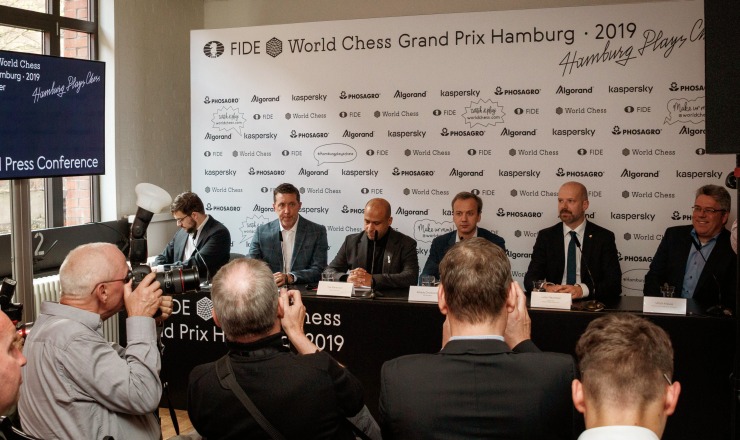
Hamburg, November 4, 2019 – Hamburg welcomes the third leg of the FIDE Grand Prix Series organized by WorldChess. There hasn’t been a top chess tournament for 54 years, since the European Team Championship in 1965 in the Curio-Haus. From 5 to 17 November Hamburg will become a centerpiece for all chess enthusiasts. 16 of the world’s top chess players will take part in the FIDE Grand Prix Hamburg 2019. The third leg of the Grand Prix series opened with a press conference today at the Theater Kehrwieder, featuring Arkady Dvorkovich, the president of FIDE; Ilya Merenzon, CEO of World Chess, the organizer of the Grand Prix; Ulrich Krause, German Chess Federation President, W. Sean Ford, Chief Operating Officer, Algorand; as well as Peter Neumeier, Head of Channel Germany, Kaspersky. Speakers thanked the city authorities for their help in organizing the tournament, invited all chess fans to the event and explained the new system of the Grand Prix. Arkady Dvorkovich, FIDE President, said: «We are officially opening the third leg of the FIDE Grand Prix Series, organized by World Chess. This time we are running the tournament in Hamburg, a city known for its chess culture. We are grateful to our Hamburg colleagues for their hospitality and help. We hope that the games will please all chess enthusiasts.» Ilya Merenzon, CEO of World Chess, said: «We are very pleased that the third leg of the Grand Prix is taking place in Hamburg, one of the most chess friendly cities. We hope chess fans from all over Germany will join us in following the live games of the greatest grandmasters.» Andreу Guryev, CEO of PhosAgro, Vice President of the Russian Chess Federation: «We believe that Russian grandmasters have all the chances to enter the Candidates tournament! We will be watching the games of the third leg of the Grand Prix with great interest. Hoping for the success of our players, PhosAgro, as a strategic partner of FIDE, promises to sign a sponsorship contract with those Russian chess players who will win the Grand Prix series and enter the Candidates tournament. We believe that in Hamburg, one of the most chess-intensive cities in Europe, an exciting and non-compromising battle awaits us!» “We are honored to support the most played sport in the world and inspired by the World Chess’ focus on bringing innovation and technology to the forefront of the game,” said W. Sean Ford, COO of Algorand. “We look forward to collaborating on next generation blockchain solutions for our joint communities of blockchain adopters, computer scientists and chess enthusiasts in the coming months.” Peter Neumeier, Head of Channel Germany, Kaspersky: «We’re proud to be – for several years already – the official cybersecurity partner of the FIDE World Championship series. Chess requires a sharp mind and a high level of strategic thinking. These are essentials traits also for our work at Kaspersky. Our mission to build a safer world depends on the commitment, creativity, and skills of our experts around the world.» The four-tournament series, which is running throughout the year, features 22 of the world’s best Grandmasters fighting for two spots in next year’s Candidates Tournament to select a challenger for the World Championship title. The players are also competing for a total of €800,000 in prizes, with €130,000 in each Grand Prix and an additional €280,000 for the overall performance in the whole series. To make the series even more exciting, each tournament has a knock-out format, starting with 16 players. To win a Grand Prix, a player has to survive four rounds. Each round consists of two classical games, followed by rapid tie-breaker games if necessary. The FIDE Grand Prix Hamburg will be held in the Theater Kehrwieder (Kehrwieder 6, 20457 Hamburg) from November 5-17. All guests and spectators will be able to enjoy games as well as the outstanding architecture of the historical buildings and Elbphilarmonie – the most recognizable landmark of the city. The rounds start at 3 PM Hamburg time. Chess fans will be able to enter the playing venue starting from 2 PM. The organizers will provide on-site commentary. The games will be broadcast live at worldchess.com, the official FIDE broadcasting platform. First round parings: Maxime Vachier-Lagrave – Wei Yi Hikaru Nakamura – Veselin Topalov David Navara – Nikita Vitiugov Radoslaw Wojtaszek – Alexander Grischuk Teimour Radjabov – Daniil Dubov Peter Svidler – Pentala Harikrishna Dmitry Jakovenko – Yu Yangyi Jan-Krzysztof Duda – Ian Nepomniachtchi Leading partners supporting the FIDE Grand Prix Series 2019 include: Algorand as the Exclusive Blockchain Partner PhosAgro as the Official Strategic Partner Kaspersky as the Official Cybersecurity Partner Pella Sietas Shipyard as the Official Partner PRYTEK as the Technology Transfer Partner For further questions, please contact: media@worldchess.com. Guide to FIDE Grand Prix Hamburg for Press Official FIDE Grand Prix Hamburg Press Kit About FIDE The World Chess Federation or Fédération Internationale des Echecs, (FIDE), is recognized by its members and the International Olympic Committee as the international federation in the domain of chess, the supreme body responsible for the sport of chess and its Championships. FIDE has the exclusive rights to organize the World Chess Championships and the Chess Olympiads. www.fide.com About World Chess World Chess is a London-based media company. It’s the official broadcaster of the World Chess Federation events and a commercial partner of the World Chess Federation (FIDE). World Chess organized the World Championship Matches in Russia, the USA, and the UK. It revolutionized chess by signing the biggest media partnerships in the history of chess. World Chess is also developing Armageddon, the chess league designed for television. It operates worldchess.com. About Algorand Based in Boston and founded by cryptography pioneer and Turing award winner Silvio Micali, Algorand is an open-source software company building technical innovation for the borderless economy with a platform that delivers decentralization, scalability, and security. Algorand’s first-of-its-kind, permissionless, pure proof-of-stake protocol supports the scale, open participation, and transaction finality needed by users to build opportunity and fulfill the promise of blockchain technology. For more information, visit https://www.algorand.com. About Kaspersky Kaspersky is a global cybersecurity company founded in 1997. Kaspersky’s deep threat intelligence and security expertise is constantly transforming into innovative security solutions and services
Russia scoops at European Team Championship
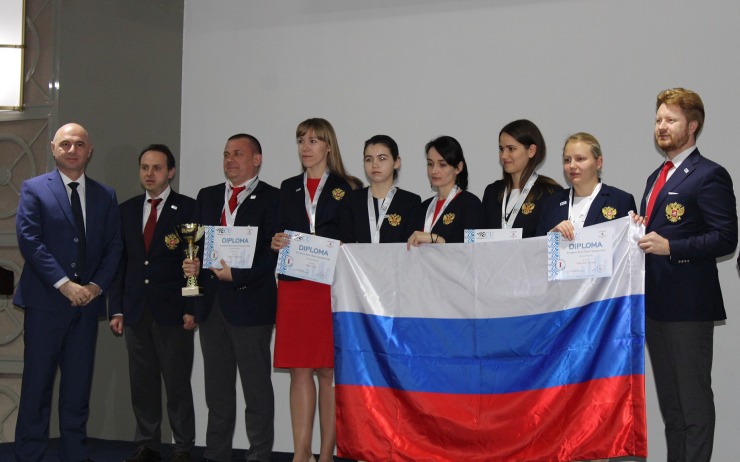
The European Team Championship in Batumi ended with the Russian teams’ claiming gold in both open and women’s sections. One may think that in the women’s tournament Russia smoothly sailed to the victory – after all the team was leading throughout the tournament distance and finished a point ahead of the silver medalists, but in reality, it was not that easy. In the sixth round, Russia drew with Azerbaijan, whereas in the eighth round the team was teetering on the brink of defeat in the match with Armenia. Hadn’t Kateryna Lagno outfoxed her opponent in a theoretically drawing rook-and-bishop-vs-rook endgame the team would have lost two matchpoints and let Georgia catch up. Lagno became the main point-winner in the team – after sweeping three final games Kateryna ended up with 6.5 out of 8. The Challenger of the upcoming Women’s World Championship match Alexandre Goryachkina sealed off the first board (6 out 9); the champion of Russia Olga Girya earned several important victories (5.5 out of 7). Both Valentina Gunina and Alina Kashlinskaya were far from their best but scored +2. The Georgian team came second. After losing the key match to Russia in the fourth round the home-squad won all others save for a draw with Azerbaijan in round 7. On the first board, a participant of the Candidates Tournament Nana Dzagnidze netted 7 out 9; Meri Arabidze also turned in a fine performance (she suffered her only defeat in the match with Russia). The managers decided to put Nino Batsiashvili at the helm of the Georgia-2 team – one may wonder how it would have played out if she had been a member of the main team. Azerbaijan deservedly took bronze. Young Azerbaijan players drew the matches with both gold and silver medalists and lost just one at the start of the tournament. IM Gulnar Mammadova delivered the best performance (6.5 out of 8). It was much more close contest in the open section where, in accordance with unspoken rules of team competitions, the winner was determined in the very last minutes of the final round. After Ivan Saric managed to build a fortress in the game with Vassily Ivanchuk, Russia finished one point ahead of Ukraine and England. As we mentioned in our half-way review, the key match between the favorites was played in the sixth round, right after the day off. Russia pulled out a victory – Dmitry Andreikin outplayed Vassily Ivanchuk in the Najdorf Variation of Sicilian defense on the top board and brought his team a decisive point. However, right after that Russia faltered, drawing two matches with Germany and England. In the first one, the future champion barely escaped thanks to a sparkling although not error-free play by Daniil Dubov in the game with Rasmus Svane. The final combination of this highly entertaining encounter was immediately tweeted all around the chess world: 36.Bb3! (the only move) Bd7 37.Qc1+ Kxb3 38.Qc2 Ka3 39.Qa2# As a result, before the final round, Urkaine stood alongside Russia but had better tiebreaks. However, Ukraine failed to break down Croatia’s resistance, whereas Russia prevailed over a strong Polish team thanks to Kirill Alekseenko’s victory on the third board. Daniil Dubov, who asked to call him “Joker” after the tournament, put in the best performance in the team-champion (5.5 out 7). The team leader Dmitry Andreikin scored the same amount of points but in eight games. The fatigue accumulated after Grand Swiss Isle of Man had an impact on three other Russian players, but their high level coupled with a little luck helped the team to snatch gold. Ukraine tied with England for the second place but was awarded silver due to better tiebreaks. Legendary Vassily Ivanchuk did not spoil the party, scoring 5.5 out 9 on the first board. Vladimir Onischuk (formally a reserve player) notched 6 points in 8 games, although sometimes his positions made his teammates sweat. Unfortunately, a tight tournament schedule also took its toll on the Ukranian team – Alexander Moiseenko played way below his abilities. Third place by England is in line with pre-tournament expectations – the team had second rating after Russia. It is important to note, that England has played the second team championship in a row virtually without substitutes. Given that McShane, Howell, and Jones were among the participants in Grand Swiss Isle of Man, it was particularly difficult for them to pace up. Curiously enough, the leaders of Ukraine and England Vassily Ivanchuk and Michael Adams won their first European Team Championship medals in 1992 in Debrecen. Ironically, the first three lines in the final standings back then were taken by Russia, Ukraine, and England. Most likely Armenia (4th place) and the defending champion Azerbaijan (6th place) had set more ambitious goals before the tournament. The Armenian team suffered from insufficient roster depth, whereas, in the case of Azerbaijan, its leaders Shakhryar Mamediarov and Arkadij Naiditsch were out of shape. On the other hand, Croatia emerged as a real breakthrough of the event. The Croatian squad finished fifth even though two of its members did not win a single game. This is just another evidence of a very close contest in the tournament. FIDE.com congratulates all the winners and thanks ECU for organizing the championship.
Wesley So is the first Fischer Random World Champion
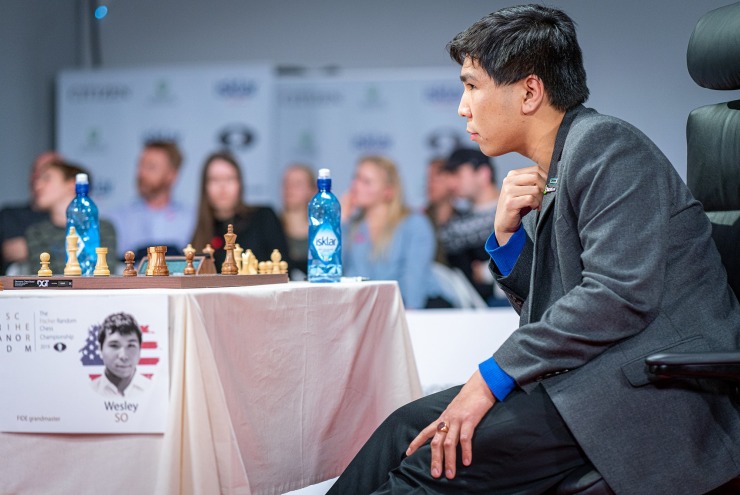
America’s third-ranked player wins the first official world championship for this variant over classical world champion Magnus Carlsen of Norway. 2-11-2019, OSLO, NORWAY: Wesley So took down Magnus Carlsen by 13,5 to 2,5. The final, played in Oslo, was a historical event in which for the first time the International Chess Federation recognized a new variety of chess. At the Henie Onstad Kunstsenter art museum located close to Oslo, Norway, GM Wesley So became the first World Champion in Fischer Random Chess. So defeated GM Magnus Carlsen by the dominant score of 13.5 to 2.5 in the event that started on October 27 and ended on November 2. Wesley’s victory, with four wins and only two draws, was so crushing that he clinched the title with six rounds to spare. In fact, the American cruised through the whole final stage of the event without suffering a single loss, showing his supremacy in this recently developed chess variant. The match’s fate was decided after Wesley won the second through fourth games. Magnus Carlsen, who hasn’t lost a game of classical chess since July 2018 and accumulates a streak of 101 games unbeaten, bit the dust three times in a row before his home crowd, who gathered in big numbers at the Henie Onstad Art Center in Bærum, Norway. The Norwegian has been the classical world champion since 2013 and the world-number-one since 2011 and has also been considered the unofficial Fischer Random champion, having won a match in 2018 against GM Hikaru Nakamura. “I just want to congratulate Wesley So, he played a lot better than me,” said the champion after his defeat. Wesley So, who reached the number two spot in the FIDE world ranking back in 2017, achieves his first official world title in individual competition—filling a hole in an already brilliant career, with numerous victories in top-level events. The event was organized by Dund AS, with Chess.com as a technological partner. “With FIDE’s support for Fischer Radom Chess, we are happy to invite you to join the quest to become the first, ever, FIDE World Fischer Random Chess Champion,” said Arne Horvei, Founding Partner in Dund AS. “Anyone can participate online, and we are excited to see if there are any diamonds in the ruff out there that could excel in this format of chess”. “From the moment we were presented with the vision for this incredible event many months ago, we immediately recognized the potential milestone that an official World Fischer Random Chess Championship would represent for the chess world. Chess.com is proud to have organized the first truly open online qualification process which saw over 10,000 games played and became the foundation for crowning a worthy champion like Wesley So. We believe this is a first step on the path towards a prosperous and exciting future for chess through online and over-the-board harmonization.” Chess, rebooted There have been many proposals over the long history of chess to revolutionize the game by introducing new pieces or changing the initial arrangement of these. However, none of these attempts succeeded until the former World Champion Bobby Fischer came up with his own idea. The American genius suggested that the pieces should be shuffled, but only following certain restrictions: the bishops must be placed on opposite-color squares, and the king must be placed on a square between the rooks. The result is a modality in which we have 960 unique possible starting positions, but the rules of chess remain the same. Thus, the tactics, and for the most part, the principles and basic strategies of the game, are still valid. The fact that both players keep the right to castle also contributed to the starting positions having some kind of “harmony” and balance, characteristical of standard chess. Fischer Random tackles a problem in modern chess: since the starting position was always the same, the possibilities in the “opening” phase of the game has been methodically analyzed. Even the beginners have their favorite opening lines – the systems that they employ to start the game, develop their pieces, and place them in the most favorable positions. At the top level, and since the irruption of the computers in the game towards the end of the nineties, chess openings have been exhaustively analyzed. Top players spend most of their time analyzing the lines used by their opponent and improving their own arsenal – the best way to respond to their opponent’s usual defenses. This implies memorizing an enormous amount of information. As a result, standard chess games between elite players often follow a line that has been played before, and a “novelty”, or a move that has never been used before, doesn’t show up on the board until as late as the 20th or 25th move. Many games are not decided by a move found over the board, but early on, during the preparation for the game. The random setup that Fischer Random implies makes gaining an advantage through the memorization of openings impracticable. Instead, players must rely on their skill, talent, and creativity, facing a completely fresh position over the board. All the opening theory that they have learned so far becomes useless – it is like rebooting chess, and giving it a fresh start. “It is probably for this reason that Fischer Random chess has won the favor of the chess community, including the top players and the World Champion himself”, stated the FIDE President Arkady Dvorkovich earlier this year. “We couldn’t be oblivious to that: it was time to embrace and incorporate this modality of chess.” Who is Wesley So? Wesley Barbasa So was born on October 9, 1993, in Bacoor (Philippines). He learned chess at the age of 7 or 8 on the streets of Cavite, a suburb in the outskirts of Manila: “Chess is very popular in the Philippines because in third-world countries, chess is the poor man’s game. Rich people play tennis, polo, and golf, while poor people play chess because you don’t need anything – no uniform, no field or courts”, explained Wesley in an interview with David Cox of Chess.com. Wesley was nine years old
FIDE presents chess at ODECABE General Assembly in Panama
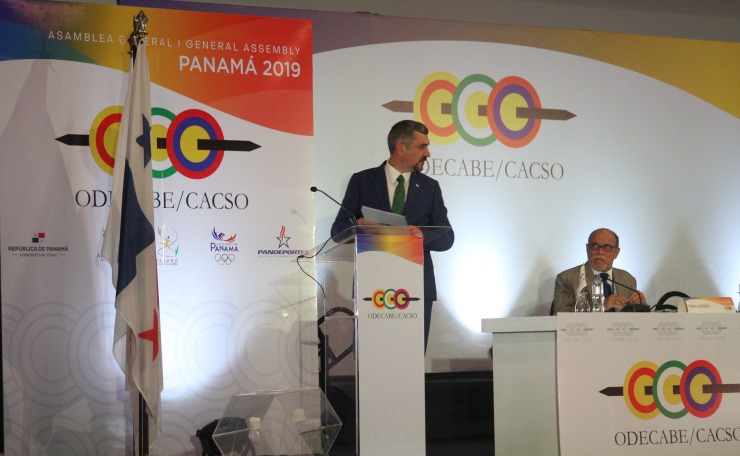
On October 31st ODECABE General Assembly of National Olympics Committees (Central America and Caribe Countries Games) took place in the Wyndham Albrook Hotel in Panama City Panama. FIDE Executive Director Victor Bologan made a presentation and elaborated on the benefits of including chess into the 2022 Central America and Caribe Games (CACG) which will be held in Panamá City, Panamá. The presentation had great success with very positive comments from some NOC Presidents in particular from Venezuela and Costa Rica about chess as a serious sport. Now ODECABE will present the chess proposal to the Technical Committee which is to make the decision on the inclusion of chess into CACG. The Panama Chess Federation together with the NCF Presidents of Venezuela and Mexico Fidel Gonzalez and Mario Ramirez made a considerable contribution to the organization of presentation. A special chess exhibition outside the Assembly Hall was staged so the delegates could familiarize themselves with the game.
Women’s Grand Prix Monaco: Pairings announced
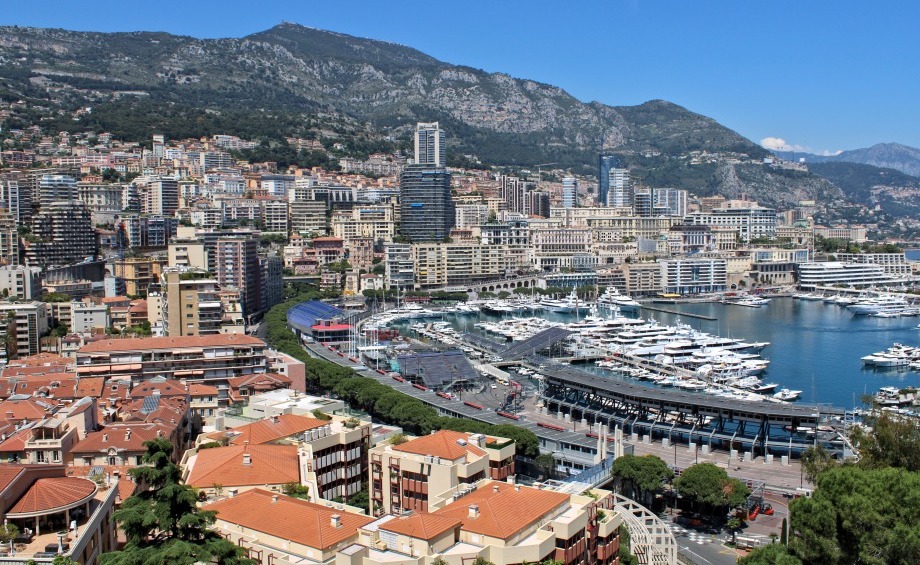
The pairings for every round of the upcoming Women’s Grand Prix Monaco are announced. The second leg of Women’s Grand Prix will take place in the Mediterranean principality from 2 to 15 of December. Twelve players will compete in a round-robin event. The participants got the following starting numbers: 1. Harika Dronavalli (India), 2. Elisabeth Paehtz (Germany), 3. Pia Cramling (Sweden), 4. Aleksandra Goryachkina (Russia), 5. Valentina Gunina (Russia), 6. Mariya Muzychuk (Ukraine), 7. Anna Muzychuk, 8. Humpy Koneru (India), 9. Kateryna Lagno (Russia), 10. Alexandra Kosteniuk (Russia), 11. Zhao Xue (China), 12. Nana Dzagnidze (Georgia) In the first round, the leader in the overall standings Humpy Konery takes on Valentina Gunina, whereas her closest competitor Alexandra Goryachkina will face Kateryna Lagno. The World Champion Ju Wenjun, who is tied for second place with Goryachkina, opted to skip this event. Full pairings Women’s FIDE Grand Prix Series 2019-2020 consist of four Women’ Grand Prix tournaments (hereinafter referred to as WGP tournaments) held over two years (2019-20): 1st – Skolkovo, September 10th – 23rd, 2019;2nd – Monaco, December 2nd – 15th, 2019;3rd – Lausanne, between March 1st and 20th, 2020;4th – Sardinia, between May 20th and June 10th, 2020. Sixteen players compete in four WGP tournaments. Each of the sixteen players participates in three out of four WGP tournaments. Each WGP tournament is played in a round-robin format with twelve participants. In each WGP tournament, every player scores WGP points according to her position in the final standings; the winner of WGP Series is a player who scores the greatest number of cumulative points earned in all three WGP tournaments she participated. The two players who score the most number of cumulative points in the WGP Series qualify for the FIDE Women Candidates Tournament to be held in the first half of 2021. Overall standings after the first leg in Skolkovo: 1. Humpy Koneru (160 points)2. Ju Wenjun (120 points) 3. Aleksandra Goryachkina (120 points) 4. Kateryna Lagno (90 points) 5. Elisabeth Paehtz (75 points) 6. Valentina Gunina (75 points) 7. Harika Dronavalli (60 points) 8. Alexandra Kosteniuk (45 points) 9. Alina Kashlinskaya (45 points) 10. Antoaneta Stefanova (25 points) 11. Marie Sebag (25 points) 12. Pia Cramling (10 points)
Alekseenko rockets up in the November rating list
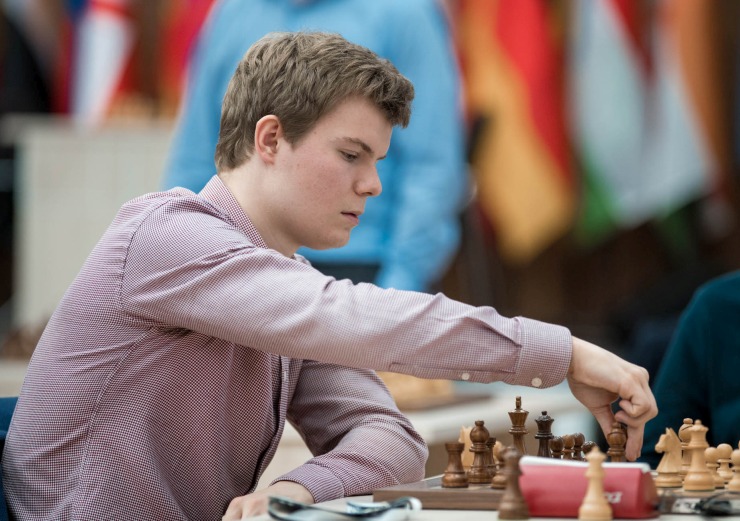
(Photo: Kirill Merkuryev) FIDE November 1 rating listAll Top-100 listsAll rating lists – download October of 2019 was dominated by the FIDE World Cup and Grand Swiss Isle of Man, the tournaments causing major shifts in the November rating list. It is no coincidence that those who performed well in these massive events made the biggest progress in the rankings. Top-10 November rating list 1. Carlsen, Magnus (2870; -6)2. Caruana, Fabiano (2822; +10) 3. Ding, Liren (2801; -10)4. Vachier-Lagrave, Maxime (2777; +3)5. Giri, Anish (2776; -4)6. Nepomniachtchi, Ian (2773; -3)7. Aronian, Levon (2772; +14)8. Mamedyarov, Shakhriyar (2772; +5)9. Radjabov, Teimour (2767; +9)10. Grischuk, Alexander (2764; +5) The most noticeable change, when it comes to top-10, is the resurgence of Teimour Radjabov. After his triumph at the FIDE World Cup, the GM from Azerbaijan reappeared in the elite group for the first time since April 2013. Despite making it to the final, Ding Liren lost 10 rating points but preserved his third position on the list. Fabiano Caruana, who tied for the first in the Isle of Man, picked up 10 rating points and broke away from the Chinese GM, whereas Levon Aronian returned to the top-10 following his strong showing in the same tournament. Alexander Grischuk most likely hoped for more, but his results in two key October events allowed him to get back to the top-10. (Photo: Kirill Merkuryev) Biggest gains 1. Alekseenko, Kirill (2715; +41) 2. Wang, Hao (2752; +26)3. Najer, Evgeniy (2661; +26)4. Abasov, Nijat (2655; +23)5. Maghsoodloo, Parham (2684; +20)6. Vitiugov, Nikita (2751; +19)7. Predke, Alexandr (2676; +19)8. Firouzja, Alireza (2720; +18)9-11. Duda, Jan-Krzysztof (2748; +14)9-11. Aronian, Levon (2772; +14)9-11. Kryvoruchko, Yuriy (2683; +14) Kirill Alekseenko made a real splash at the World Cup, reaching the round of 16, but a couple a weeks later did even better in the Grand Swiss Isle of Man where he came third. As a result, the young GM from St-Petersburg soared up in the rating list and became the biggest gainer of October (41 points). The winner of the Grand Swiss Wang Hao understandably netted quite a lot of rating points and tied for the second in this nomination. Another Russian GM Evgeniy Najer also earned 26 rating points thanks to his solid performance in the above-mentioned tournaments (plus a couple of victories in the Czech League) and climbed 62 positions up. The same but to a slightly lesser extent applies to a young Azerbaijani GM Nijat Abasov who is making his debut in the top-100. Other top players from our list (except for Alexander Predke, who mainly accumulated his points in Spanish Team Championship in Linares) also distinguished themselves in one or both important October events. Welcome to top-100 78. Najer, Evgeniy (2661)79. Melkumyan, Hrant (2661)84. Swiercz, Dariusz (2659)87. Lupulescu, Constantin (2657)92. Abasov, Nijat (2655)96. Adhiban, B. (2654)98. Kuzubov, Yuriy (2652) We have seven newcomers in the top-100 and again, the majority of them improved their rating in two flagship October tournaments. Since there were not many women’s tournaments in October, the top-10 remains virtually intact. Nevertheless, two women, namely Harika Dronavalli and Dinara Saduakassova made a difference. Playing in the open section of the Grand Swiss Isle of Man they scored 5.5 each and became best performing women in the tournament. Needless to say, both substantially increased their rating by 23 and 24 points respectively. (Photo: John Saunders) In the juniors’ list Alireza Firouzja, Jeffery Xiong and Parham Maghsoodloo got closer to Wei Yi who is still reigning on the top, whereas Nodirbek Abdusattorov made it to the top-10 for the first time in his career. In the girls’ list, Zhansaya Abdumalik overtook Zhu Jiner and became a new #1, whereas Polina Shuvalova, the winner of both U-18 and U-20 championships took a giant leap and broke into the top-3.