

FIDE Trainer Awards 2018: Winners announced

Lausanne, October 18, 2019 The FIDE Trainers’ Commission (TRG) is pleased to announce the Trainer Awards results for the best achievements in 2018. The Mikhail Botvinnik Award, for best trainer of men or a team in an open event, goes to William John Donaldson. William John Donaldson (born in Los Angeles, 1958) has been the Captain of the US Open team for most of the Olympiads since 1986 – which equals to say, for most of his adult life. He retired from his job at San Francisco Mechanics’ Institute earlier in the year, but hopefully not from the US team. In the last two Olympiads, the US took Gold and Silver, with an identical lineup after paper-thin tie-break finishes. The Vakhtang Karseladze Award, for best trainer of women or a team in a women’s event, goes to Yu Shaoteng (余少腾). Yu Shaoteng (Guangzhou, 1979) became China’s 17th Grandmaster at the age of 25. As a coach, he has five World Championships under his belt as a coach: two with Hou Yifan, one with Tan Zhongyi, and two with Ju Wenjun. He is also the coach of the Chinese Women’s team that triumphed at the Batumi Chess Olympiad. Since Ju Wenjun won, not just one but two World Championship titles in 2018, Shaoteng was a clear favorite to win this award. The Mark Dvoretsky Award, for best trainer of juniors or a team in a juniors event, goes to Ramesh RB. Ramachandran Ramesh (born in Chennai, 1976) has coached a total of 39 Gold winners at Junior, Youth and Cadet World Championships, starting with Aarthie Ramesh in 1999, and lately the 14-year-old prodigy Praggnanandhaa, who just won the 2019 World Championship for players U18, and is now among the leaders in the World Junior Championship (U20). The Tigran Petrosian Award, for special achievements, goes to Michal Konopka. Michal Konopka (born in Prague, 1966) has been the captain of the Czech Men National Team, and since 2013 he has been the manager of both Men and Women National teams. Over the past decades, he has coached at many World and European Youth Championships, where his students won several medals. He has also been a second for elite players like David Navara and Viktor Laznicka. The Yuri Razuvaev Award, for Contributions to Trainers Education, goes to Adrian Mikhalchishin. Adrian Bohdanovych Mikhalchishin (born in Lviv, 1954) was the TRG chairman for a decade after the death of his mentor and predecessor, GM Yuri Razuvaev. With lots of hard and passionate work, Adrian’s dream of increasing the prestige of chess trainers is quickly becoming a reality. The Awards will be presented on five different dates and locations, according to the wishes of the winners. All the awardees will receive the trophy “The Tree of Chess”, designed by the famous Ukrainian sculptor Volodymyr Odrehivskyj. The final results were voted by the most qualified and diverse panel of judges ever, consisting of both experienced players and trainers. All continents were represented in a gender-balanced jury, which includes four world champions: Word Champion Vladimir KramnikWorld Champion & FIDE Senior Trainer Susan PolgarWorld Champion Zhu ChenWorld Champion & FIDE Senior Trainer Antoaneta StefanovaGM & FIDE Senior Trainer Eugene TorreGM & FIDE Senior Trainer Alonso ZapataGM & FIDE Senior Trainer Slim Bouaziz The Averbakh/Boleslavsky Award for Book of the Year is judged separately. This award has three judges: Nigel Short, Artur Yusupov, and the World’s oldest living grandmaster, Yuri Averbakh. The shortlist is expected out in early November, and the winner will be declared some weeks thereafter. The deadline for submission for the 2019 Awards will be Friday 3rd April 2020. The categories are likely to be slightly altered to reflect new priorities. Eligible to nominate are any FIDE Office Bearers, Continental Chess Federations, National Chess Federations, TRG Commission Members, and FIDE Endorsed Academies. Eligible are all FIDE trainers with a valid license for 2018 and 2019, except for the TRG Chairman (Jacob Aagaard) and Secretary (Peter Long). The same person can not be nominated in more than one category by the same eligible body. The 2020 Awards will be presented at the Olympiad in Khanty-Mansiysk. Official site
Grand Swiss: Levon Aronian breaks through to the top
The seventh day of the Isle of Man Grand Swiss tournament was a Day of draws. On the top 20 boards, only four games ended with a decisive outcome (and in all four cases, White was victorious). One of them was particularly important – Levon Aronian defeated the leader of the tournament, Wang Hao of China and has now emerged at the top! The second leader – Fabiano Caruana – drew with black pieces against Alexander Grischuk in a very time-challenging game for both players. There are now two leaders at the top and they will face each other in round eight: World No 2, Fabiano Caruana, and Armenian Levon Aronian, for whom this tournament is likely the last chance to get on the Candidates’ boat and fight for the opportunity to become World Champion. A large number of draws in round seven made things more complicated in the upper ranks as those players who scored a victory managed to climb up the ladder and add to the pressure on the rest. On board one, it was a chance for another Russian, Alexander Grischuk, to try and bring down Fabiano Caruana from the top board, after Fedoseev failed in round six. Time seemed to be the key factor of the game as first Grischuk got into serious trouble only to be joined by Caruana at the end. In the English opening, White (Grischuk) played a system for which Caruana later said he wasn’t fully prepared. The Russian, however, quickly got into time trouble: after two and a half hours and just 17 moves played, Grischuk had less than 20 minutes on his clock. The situation looked pretty dangerous for the Russian GM. Things then got crazy on the board, with Grischuk pushing forward the g-pawn in front of his king, launching an attack on the Black’s monarch. With good control in the center and two bishops well aligned to support the advancement, it seemed that Caruana was in real trouble. The World No 2 however was defending well, snatched a pawn while preparing a counterattack. Grischuk – a pawn down and weaker on time – had to switch to defense. After the exchange of queens, Fabiano Caruana pushed his opponent towards a complicated endgame. Interestingly, Magnus Carlsen came over several times to check what’s going on. Grischuk had under 30 seconds on his clock when the game was on move 29 (!) but thanks to the 30-second increment per move, he managed to hold the balance and even forced Caruana to spend more time. Eventually, both players found themselves in time trouble. Just a few moves before the 40-move watermark, opponents had under a minute on their clock. At one point, Caruana had even less time than Grischuk! Some were wondering, could Grischuk – the three-times Blitz world champion – outplay the World No 2 in a blitz endgame? But Caruana held his nerve and played it steady. With 35 seconds on his clock, Girschuk made it to the 40th move and reached the first time control. At that point, he got up from the board for the first time. The game was, however, to last for just further two moves – Grischuk went for a repetition of checks and the two agreed to a draw. (Photo: David Llada) Aronian breaks through the hurdle On the second board, Levon Aronian, as white, was facing one of the leaders after round six, Wang Hao of China. After white secured better control in the center, Black tried to counter it by sacrificing a pawn to activate his queenside pieces. Aronian saw through black’s plans and by move 23 the extra pawn transformed into a passer on the a-file for White. Wang then pushed for the exchange of queens which Aronian eventually had to accept, leading into a four-rook endgame with an extra pawn for White. The computer was showing that the position is likely a draw. Aronian, however, pushed forward. By move 42 Levon’s a-pawn fell, but his king infiltrated to h6, endangering black’s pawns. By move 46, one set of rooks was exchanged, with White pressing black from the back-ranks. Wang was in time trouble and that was an important factor for Aronian who kept the pressure up. Wang Hao was down to 1 minute and – according to the computer – there was only one(!) move held the position – 56…Rd3. After the Chinese GM played 53…Ra3 instead, it was all over for him. Just two moves down the road Wang Hao resigned. (Photo: Maria Emelianova) Like after Round six, there are now two players at the top (with 5.5 points) with the other seven (now on five points) on their heels: Wang, Alekseenko, Grischuk, Maghsoodloo, Guijarro, the World Champion Carlsen, and Vitiugov. Aronian will be facing the World No 2, Fabiano Caruana, the central encounter of the round eight and probably one of the most important games in the tournament for the Armenian. In an interview with chess.com after the game, when asked about the forthcoming game against Caruana, Aronian said: “It is always good to play somebody you respect – somebody who forces you to respect him!” (Photo: Maria Emelianova) Alekseenko withstands Carlsen’s pressure On board three, Kirill Alekseenko (who, as of last round, joined the 2700-club) was playing as white against Magnus Carlsen. The position was even throughout the game, but it seemed that white had more opportunities for active play. The best chance Carlsen had was in creating a passed pawn on the a-file but white was able to control that. In a double-rook endgame, being a pawn down and having to play precisely to maintain balance, the World Champion pushed his pieces forward hoping for an offensive. It seems that Carlsen wasn’t happy with a draw, despite the position suggesting it, and he went on testing his luck and that of his opponent. The World Champion ended up with an extra pawn in a rook endgame but the evaluating of the position as drawish did not change. Nevertheless, Magnus declined a draw offered by
London will host the 2019 Grand Chess Tour Finals
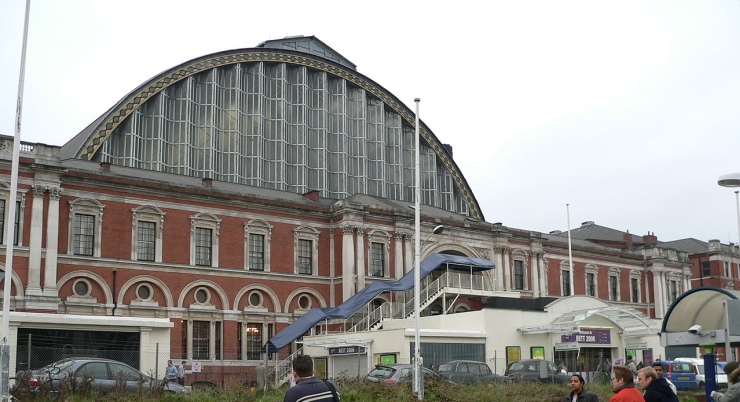
The fifth edition of the Grand Chess Tour (GCT) will culminate at the beginning of December in Olympia Conference Centre in Kensington, London. The Tour Finals will be the part of the 11th London Chess Classic (November 29 – December 8) alongside the other festival events. The schedule of the GCT fifth season includes two classical (Zagreb and Sinquefield Cup) and five rapid and blitz tournaments. Twelve GCT-2019 participants play in both classical events and in three of the five rapid and blitz tournaments. The four top-scoring players will square off in London in two semi-finals and the final/3rd place play-off matches. Each match will consist of classical, rapid and blitz games and will see the players competing for an enhanced prize fund which totals USD 350,000 this year. The prize fund will be split amongst the four finalists as follows: 1st Place: USD 150,0002nd Place: USD 100,0003rd Place: USD 60,0004th Place: USD 40,000Total Prize Fund: USD 350,000 With two rapid and blitz tournaments to go (Bucharest, November 4-11 and Kolkata, November 20-27) World Champion Magnus Carlsen (54.5 points) leads the 2019 Grand Chess Tour standings and has already qualified for the Tour Finals. Ding Liren (37.8 points), who is currently second, has very good chances of making a trip to London. Most likely, the Chinese GM will improve his tally picking up some points in one of two remaining tournaments. Maxime Vachier-Lagrave (36.8 points) occupies the third position the standings, but it is his final score after five events. In a large group of other potential semi-finalists Levon Aronian (25.5 points), Vishy Anand (24 points) and Wesley So (23.5 points) stand out from competitors as they have two more tournaments to play. (Image: Grand Chess Tour) The schedule for the GCT Finals:Dec 2: Semi-Final – Classical Game 1Dec 3: Semi-Final – Classical Game 2Dec 4: Semi-Final – Rapid & Blitz GamesDec 5: Corporate Day – Pro-Biz CupDec 6: Finals and match for 3rd place – Classical Game 1Dec 7: Finals and match for 3rd place – Classical Game 2Dec 8: Finals and match for 3rd place – Rapid & Blitz GamesDec 9: Prize Giving and Charity Dinner for Chess in Schools & Communities Charity Each match will consist of 2 classical games, 2 rapid games and 4 blitz games with points allocated to each game within the respective matches as follows: 6 points for a win, 3 points for a draw and 0 points for a loss in the 2 Classic games.4 points for a win, 2 points for a draw and 0 points for a loss in the 2 Rapid games; and2 point for a win, 1 point for a draw and 0 points for a loss in the 4 Blitz games. If tie-breaks are required, they will be contested over two rapid games followed by an Armageddon game if required.
Arkady Dvorkovich: “The real evaluation shall be made by the chess world”
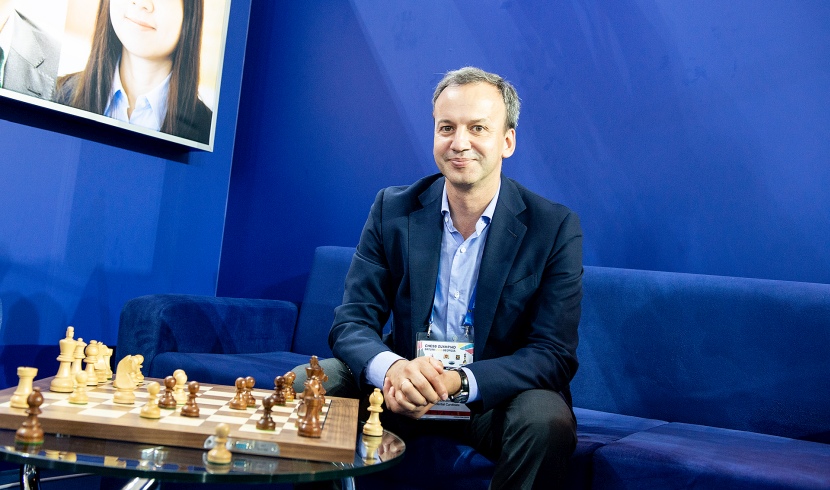
During the first week of October, on the occasion of the first anniversary of Arkady Dvorkovich as FIDE President, we invited some representatives of the media to send questions to him. The result of this joint-interview offers some insight into the work of the new FIDE management along the past 365 days. Q: At the end of the first year of your work, which of your achievements would you list among the most important ones? I would say that the main achievement is the obvious change of attitude from the chess community, professionals and federations towards FIDE and our activities. This can be sensed from the meetings, the responses, the many suggestions we receive… This trust in FIDE management shall be used wisely for the benefit of chess. In particular, I would like to point out the following: – The successful organization of the top-level tournaments during this year: The World Rapid and Blitz, the World Cup, the Women’s Candidates tournament, several stages of the Grand Prix… We also reinstated the Women’s Grand Prix, and the first leg, played in Skolkovo, was a great success. The Grand Swiss is in full swing on the Isle of Man, and since we know the work done in previous editions by the organizers, we are sure it will be a fantastic event as well [this interview was conducted right before the start of this event]. – We regained rights over our flagship events, the FIDE World Championship cycle. This is of paramount importance in order to attract sponsors and to showcase the game of chess in the eyes of a global audience. – We implemented massive programs for chess development. About 50% of national Federations are developing such programs with our assistance, and the volume of this support has increased several-fold compared to previous years. – The internal FIDE organization. We built a new team with dozens of members, including full time, temporary employees, and volunteers. Of course, for this staff to perform like clockwork will still need some more time, but the team is already showing its determination and efficiency. Some other challenges, like agreements with sponsors and partners, are long term goals, but we have already taken some promising steps. We commissioned global marketing research to Nielsen, and the results of this research have us now in a position to talk to sponsors with a clear focus. We have established positive cooperation with the giant, Coca-Cola, and that speaks volumes. Many potential partners have started a dialogue with us, and we are now fully immersed in the sponsorship recruitment phase. Q: Which of your campaign promises would you consider fulfilled? The reform of the Women’s World Championship cycle, which has been unified similarly to that of men. It is a consistent system that includes World Cup, Grand Prix, Candidate’s tournament and the title match. The prize fund has also been increased significantly. I believe it is important that the Grand Prix system is now back; its absence in recent years felt like an omission. By the way, should be there more women’s round-robin tournaments in the future calendar, the system might be replaced by knockout competitions, following men’s pattern. We don’t have Women Grand Swiss currently, but we are working on it and I hope that we will be able to add it to the calendar. The agenda of the General Assembly to be held in December includes a suggestion to make a major reduction of the FIDE fees. This one may have come later than we expected but it has been done finally. The packages are aimed at all countries and various social groups. FIDE veterans’ fees have been cancelled already, while we also allocated an additional €50.000 to support senior chess players [€20.000 as stipends, and €30.000 to reinforce the prize structure of the Senior World Championships]. Veterans, kids, and developing countries benefit the most from these decisions. Q: What were the mistakes made during this year? There are always certain mistakes in organizing tournaments and hosting events. We are putting in place a reporting system after each event, as a routine, in order to make sure that these mistakes are not repeated. It is really important for us to listen to criticism and we are doing our best to address all concerns. The World Fischer Random Chess Championship deserved somewhat more attention probably. On the whole, and speaking in chess terms, I would say that all mistakes were about tactics, not strategy. Q: How would you rate yourself after this first year? Would you like to specifically praise anybody based on his/her performance? I’d prefer not to praise anyone in particular because this is teamwork, and every member who has contributed to the implementation of our projects has my gratitude. As for my own self-evaluation, I have certainly made one, but rather for myself – not for public consumption. The real evaluation shall be made by the chess world and FIDE stakeholders. If the delegates support my suggestions regarding the new FIDE Charter, the budget and fees reduction at the General Assembly, then I would rate my activity as successful. Q: One of the first sports executives who congratulated you for your election in Batumi was Gianni Infantino, president of FIFA. Do you think that chess can experience in the next decades a boom comparable to that of football in the 20th century? I do not think that our beloved game of chess should be compared with the beautiful game of football. Our world needs both. To make chess a really universal game, FIDE should focus on two priorities: bringing chess to schools as one of the best possible tools to improve the intellectual capabilities of our kids, and expanding online chess playing and training. On top of that, finding ways to make chess interesting to watch is critical for success. And I am sure that new technologies would allow us to do so. Q: Before you got elected you promised strong cooperation with FIFA. What has materialized out of this in the first year? Any material collaboration requires proper preparation. While I am confident that
Grand Swiss: Favorites dominate Round 6
There were no quick draws in the sixth round of the Isle of Man Grand Swiss, as things got heated on the leading boards. With very sharp positions being played, there were several games in which top GMs played either with one or even two pieces down. This was also the day when the best of the best – the top world elite, made up of Carlsen, Caruana, Aronian, Nakamura, Anand – have not only won their games, but crushed their opponents. When the dust settled, there were two players in the lead: Wang Hao of China and World No 2, Fabiano Caruana, of the U.S, who are both on five points out of six. The World Champion, Magnus Carlsen, scored another victory and is trailing the top players by half a point, joined by six more players. With the key five rounds left to play and a rest day ahead, the scene is set for a ferocious battle at the top in what is one of the strongest chess tournaments in history. On the top board, Fabiano Caruana was playing as white against the Russian star Vladimir Fedoseev. Black played the Sicilian Defence which was met by the Rosollimo Attack. Fedoseev did not seem to be well prepared for the line played, choosing to castle his king earlier than he should have. Caruana managed to put enormous pressure on the queenside and pushed his pawn down to b6, pinning down Fedoseev’s pieces. Trying to break out, Fedoseev first gave up an exchange and then, in a desperate attempt to stop the advance of white’s dangerous b-pawn, had to make another sacrifice and ended up a full rook down. Vladimir continued, clinging to his last bit of hope – a pawn on d3. Any chance of the pawn progressing was efficiently stifled by Caruana who left his opponent no other options but to contemplate when to resign in the final moves of the game. [Photo: David Llada/FIDE] On board two, the Junior World Champion (2018) Parham Maghsoodloo had white pieces against Alexander Grischuk of Russia. The opponents played Rui Lopez and after what was a pretty sharp set of moves the position became even. The game ended in a draw on move 24, after repetition. A solid outcome for both players who, having finished within two hours and having secured a spot among the leaders of the tournament, also gained more time to relax and prepare for the decisive showdown which follows after the rest day. On the third board, Wang Hao was facing Luke McShane, who found himself in a difficult position by the middlegame. Englishman who was stripped of victory by Fabiano Caruana the day before, after almost seven hours of play, had another tough opponent. Wang dominated throughout, putting Luke in a psychologically challenging situation. After the exchange of queens and further simplifications, they reached the endgame which seemed less difficult for Black, but still problematic: white was a pawn up and after further exchanges, he ended up with the knight, bishop and an extra pawn in the center, against black’s two knights. Wang pushed forward with his king and coordinated the pieces in such a way that there was no counterplay for McShane. With this victory, Wang Hao joined Fabiano Caruana on the top position after the first part of the tournament. Glorious sacrifices and smoke and mirrors After obtaining a solid position as white on board five, Sergey Karjakin got into trouble with Yuriy Kryvoruchko who took the initiative from move 20. By move 26, Karjakin was in dire straights: with five minutes on his clock, he needed to quickly make 14 moves in order to reach the first time control. Further problems followed before move 40, as Black launched an onslaught on White’s position, eventually collecting his castle-pawns and dangerously exposing Karjaking’s king. Just as the opponents reached the first time control, on move 40, Kryvoruchko had a queen and four pawns against Sergey’s queen and a knight. However, Yuriy’s king was also exposed. Eventually, Yuriy emerged two pawns up in the queens ending but luckily for Karjakin, Black’s king was unable to escape a perpetual check. On the sixth board, Levon Aronian was playing Aleksey Dreev in what was an unusual game. The opponents had a discussion in a very sharp line, with threats from both sides. The critical moment of the game came when Aronian moved his pawn from f2 to f4, exposing his king on f1. Black decided to castle and allowed his bishop to be trapped and later taken. Dreev was counting on a sharp attack and sacrificed another piece to create some threats which turned out to be nothing but smoke and mirrors. With two pieces down and with no more checks to give, Dreev resigned, putting Aronian on 4.5/6. [Photo: John Saunders] One of the most exciting games of the day was played on board seven, between the Russian Nikita Vitiugov and Matthias Bluebaum of Germany. In an even position, after an ordinary 16…c6 move, White came up with an inspiring bishop sacrifice on f7, removing a pawn off black’s castle and exposing his monarch. Once Black missed the best defensive move which would have assured the security of his position he was immediately lost. Threatening checkmate, White got into black’s back ranks (where undeveloped pieces on the queenside laid exposed) and secured a winning endgame. Carlsen ‘catching fire’ as he scores his seventh victory over Shirov Board four saw a duel between World Champion Magnus Carlsen and the World No2 from 25 years ago, Alexei Shirov. The two played each other 16 times in classical games, from 2005 to 2011 (with Carlsen winning six, losing two and drawing eight). Carlsen had a good score even before he reached his prime, but the duel on the Isle of Man was their first encounter in 8 years! The World Champion outmaneuvered Shirov by the middlegame, timely sacrificed an exchange and zeroed in on a dangerously exposed opponent’s king. Alexei had just over five minutes to make 12 moves and was – by all means – lost, having to return material (Carlsen had a dangerous bishop for
World Junior Championship 2019 kicks off in New Delhi
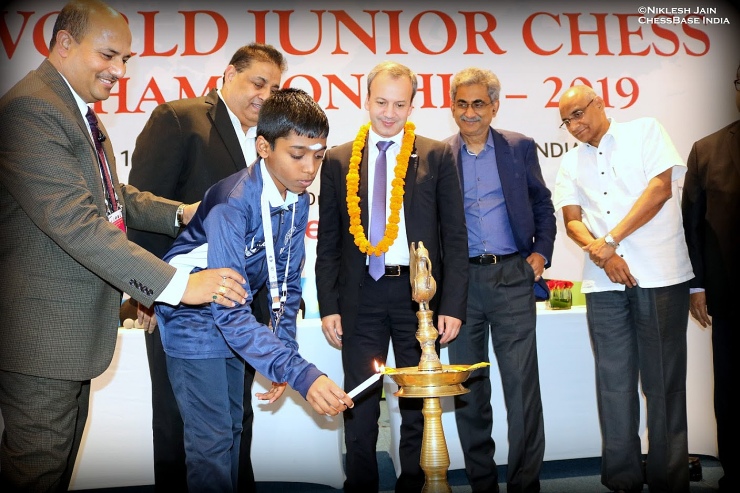
FIDE World Junior Chess Championship (U20) 2019 started in the Indian capital New Delhi. The open section of the tournament brought together 94 players, including 15 grandmasters. The girls’ section attracted 95 participants. Amin Tabatabaei (2642) and Zhu Jiner (2507, top-rated U20 women player in the world, featured at ratings.fide.com frontpage) entered the competition as the rating favorites in the respective sections. The newly-minted World Youth Chess Championship winners U18 Open and Girls category 14-year old Praggnanandhaa and Polina Shuvalova came to New Delhi and will try to repeat their Mumbai success. The participants will play 11 rounds (Swiss system); the champions will be crowned on October 25. FIDE President Arkady Dvorkovich took part in the opening ceremony. In his eloquent speech, FIDE President congratulated the Indian Chess Federation on the successful organization of the recently completed World Youth Championship and stressed the importance of youth and junior chess. Official site Photo: Niklesh Jain ChessBase India
Workshop for International Arbiters concluded in Sochi
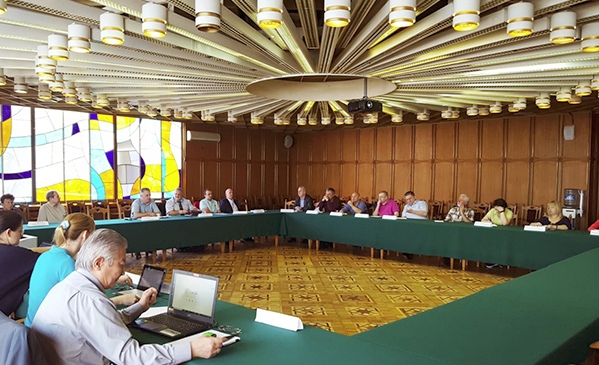
А Workshop for International Arbiters, the fourth event in the FIDE & CFR Pilot Project for Training and Certification of the International Arbiters for the 2020 World Chess Olympiad, took place in Sochi, October 11-14. The Project’s objective is to train and to certify a cadre of IAs, especially female arbiters, who are on top of all recent changes in the Laws of Chess and the FIDE Competition Rules and able able to communicate in English efficiently to be integrated into multinational arbiter teams at the top-level FIDE events, culminating in the Chess Olympiads 2020 and 2022. The Principal Lecturer, IA/IO/FL Alexander Tkachev (RUS), the CFR Technical Director, opened the Workshop by summarizing lessons learned from previous Pilot Project events in Moscow, Tashkent, and Baku. Mr. Tkachev proceeded with a refresher on Anti-Cheating Guidelines, then IA Vladimir Makhnev gave a crash course on the use of a modern metal detector. During a group discussion on the FIDE Competition (Tournament) Rules, the workshop attendees shared their opinions on a wide range of issues that challenges of modern life bring into the chess world. Pharmacology’s impact on chess competitions, anti-doping measures, use of metal detectors on players with pacemakers or artificial limbs, dress code limitations, upcoming brain prosthetics, general standards for electronics used in tournaments, the priority of the host nation’s laws were discussed. The Guest Lecturer, IA/IO Vadim Tsypin (CAN) gave a refresher on the chess terms glossary in English, then led the participants in a practice of using English in typical tournament situations. On the second day, Mr. Tsypin proceeded by presenting real-life chess game situations that sharpened the attendees’ analysis and communication skills. IA Elena Polovina and IA Vera Penzina helped to animate a group discussion. For the first time in history, an examination test featured an equal number of questions in Russian and English. An experienced IA/FL Alexander Shaab obtained the best exam score. A post mortem discussion allowed participants to see their marked tests, to review difficult questions with the Lecturers, and to provide feedback on the Workshop. Several IAs asked to extend such events to three full working days. The next Pilot Project IA Workshop in the Russian Federation will be held in Moscow in January 2020. Please, check for updates.
Grand Swiss: Fabiano Caruana’s miracle
Day five of the Isle of Man Grand Swiss saw World No 2 Fabiano Caruana barely avoiding a loss at the hands of the Englishman Luke McShane in a spectacular game which lasted for over six and a half hours. On the second board, China’s Wang Hao split a point with the Junior World Champion Parham Maghsoodloo in a game full of twists and turns. On board 11, World Champion Magnus Carlsen scored a confident victory, getting back to the top pack. Candidate hopeful Alexander Grischuk won against Ivan Cheparinov. Aronian and Nakamura drew their games while World No 8, Wesley So, scored his first victory of the tournament. After five rounds, seven players are sharing the first place, with four points each: Wang Hao, Caruana, McShane, Fedoseev, Grischuk, Shirov and Maghsoodloo On board one, England’s Luke McShane was playing against Fabiano Caruana. The Englishman had a great start to the tournament, scoring three consecutive wins after a draw in the first round. On day five, it was Caruana’s turn to ‘do a Carlsen’ from round four, and pull off the impossible. For the second game in a row, McShane played with white pieces. After Caruana weakened his king’s castle with h6, McShane moved his king to h1 (a novelty) and started preparing the advance of his g-pawn directly at the black king’s defence. Caruana quickly responded by throwing his c8-bishop into the game and including the queenside rook, launching a counter-attack. McShane had two knights (one of them back on d1) against two bishops. Caruana managed to create a slightly better position, with more time on the clock. After black’s imprecision on move 21 (according to the computer), Luke McShane launched his g-line attack, but also managed to secure an extra pawn along the way (which later grew to two pawn advantage), and activating his pieces. McShane was, however, lagging on time: he had just under eight minutes for 13 moves, while Caruana was on 30 minutes. The Englishman, however, pulled it off: by move 40, Caruana was in a considerably weaker position. McShane pushed 41.d6, which was an introduction to a dominating advantage in which his queen and knight were setting up a clean kill. Then, an unbelievable thing happened: after the exchanges of pieces, the position unravelled into a rook vs bishop ending with White having a more active king. It still seemed like a clear victory for white, but the World No 2 put on an incredible defence and managed to prevent McShane from getting into a simple winning position. By move 74 – with the computer showing that White is winning – McShane was on three and a half minutes while Caruana had 10 minutes more. McShane then went for an exchange of pawns, but with black having an active g-pawn he was out of trouble. After six and hours and 40 minutes of play and 85 moves, the game ended in a draw. Hao and Maghsoodloo draw in a game full of twists and turns The game on board two, between China’s Wang Hao and the World Junior Champion, 19-year-old Parham Maghsoodloo, was full of turns. In the earlier stages of the game, Wang Hao sacrificed a pawn but pushed Black’s pieces to the back-lines. However, this situation should have been approached with caution: in many of Maghsoodloo’s games, he plays a lot from the back-ranks ready to counterattack. One thing played into the hands of the Iranian – he was consistently better on time. The game took an interesting turn in move 23 when, instead of accepting an exchange of queens, Wang Hao sacrificed an exchange to exploit black’s weak squares around his king. Maghsoodloo broke out with a brave march of his f-pawn and in a tense fight between time, tactics and material, the Iranian seemed to have managed to erase the compensational advantage the Chinese player had for his sacrifice. What followed was a dynamic tussle between a marvellous attacker (Hao) and an excellent defender (Maghsoodloo). At one point Maghsoodloo blundered – on move 45 he moved his king to g7, exposing the black monarch to a lethal check. Then, however, Hao returned the favour and missed an opportunity. After several turns and chances being on both sides, the game ended in a draw. Grischuk, Fedoseev and Shirov push forward Boards three to ten were reserved for 14 players who, after four rounds, had three points each. Former contender for the title of World Champion, Sergey Karjakin played as black against David Anton Guijarro of Spain. In the neo-Catalan accepted variant of the English opening, White managed to push his pawn to e5, pinning the centre and pressing Black. The position was playable, but the Spaniard offered a draw which was accepted. Both players are on 3.5 out of five which still gives them solid chances. Alexander Grischuk is one of the players hoping to secure a spot at the Candidates’. He achieved a slightly better position as white against Ivan Cheparinov on board three but was constantly behind on time. The opening led to a King’s Indian reverse, where black was two tempi down. By move 20, Cheparinov had weak pawns on a7 and c5. Grischuk went on to win the pawn on h6 and then transformed the game to a rook endgame where he was significantly stronger and forced Cheparinov to capitulate. Grischuk is now on four points. Vladimir Fedoseev last year’s Isle of Man winner, Radoslaw Wojtaszek played a sharp line in Nimzo-Indian. It looked like White was in danger as Fedoseev’s king got stuck in the center while Black seemed much better developed. However, other positional factors proved to be much more important. Gradually it became clear that Russian GM was outplaying his dangerous opponent. Wojtaczek tried to complicate the issue by sacrificing two pawns, but Fedoseev seemed unfazed and took every pawn and piece that was offered to him. Polish GM resigned on move 47 allowing Fedoseev to catch up with the leaders. On board five, Levon Aronian (who made a statement with his red shirt and red shoes) squared off against Ukrainian GM Yuriy Kryvoruchko. Aronian played one of his favourites, the Marshal Gambit, and
Grand Swiss: Four take the lead as Carlsen barely escapes defeat
The fourth round of the Isle of Man Grand Swiss almost brought a shock: the World Champion, Magnus Carlsen, was facing an imminent defeat (after 438 days of not losing a game), only to be saved by his opponent’s time trouble. The board-one clash between the World No 2, Fabiano Caruana, and China’s Wang Hao ended in a draw. The two have been joined at the top by the World Junior Champion Parham Maghsoodloo and England’s Luke McShane. Round four also saw an upset: the experienced GM Sergei Movsesian lost on board 70 to 21-year-old Antenaina Rakotomaharo Fy, an IM from Madagascar. Kovalev vs Carlsen: Saved in the nick of time Among the top boards of the Grand Swiss, the most dramatic game of the day was that between Magnus Carlsen and Vladislav Kovalev of Belarus. The World Champion was lucky to escape with half a point after his opponent (who is 215-points lower-rated!) got into serious time trouble and missed several winning moves. Kovalev, who played as White, took the initiative early on. After 20 moves, he pushed his pawn to d6 and dominated in the centre with the queen and knight. With all of his pieces activated and well-positioned and a completely safe king, it seemed there was no hope for Magnus Carlsen. By move 26 the World Champion was completely lost. The expression on Carlsen’s face reflected the gloomy atmosphere of what was mostly a rainy day on the Isle of Man. The scene was set for a dramatic event: the World Champion Magnus Carlsen was at the brink of losing and ending his streak of 93 games and 438 days without a loss. Carlsen had only one thing going for him: Kovalev was in serious time trouble – he had under two minutes to make 14 moves to reach the first time control. Still, World Champions are great not just because they are good at winning but, also, because they are skilled at defending. Appearing completely calm, Carlsen played the most precise moves which his position required. The tension was high and a large number of GM spectators further electrified the intense atmosphere on the board. At one point, Azeri GM Rauf Mamedov passed by, looked at the position and the clock and disapprovingly shook his head and mumbled something. The 25-year-old Vladislav Kovalev (who won the strong Aeroflot open in 2018 and this January scored 10/13 in the Tata Steel B-tournament), was starting to panic: his look frantically shifting between the clock and the board. The Belarusian was down to his final seconds. His feet dug into the carpet, leaning on the side of the table trying to keep his legs still, but his body was shaking. Carlsen then offered a repetition of moves, but Kovalev wanted to go for the win. In the next couple of moves, however, he missed everything he could. He did reach the time control but at the price of losing his pawn on d7 and exchanging the queens, which led to a drawish rook ending. After this, Carlsen got up for a good walk. When he came back, his opponent was still shaking his head in disbelief, trying to come to terms with a lost opportunity. Kovalev still had a passed pawn on the a-file, but the position was not winning anymore. The players agreed to draw. This was the closest the World Champion came to defeat for a long time. The Carlsen’s unbeaten run continues and is now on 94 games and 439 days. The World Champion is struggling, but he is still just one point away from contending the top place. A very instructive interesting comment about this game was published by GM and FIDE Director-General, Emil Sutovsky on his Facebook page: “Once Yussupov taught us, the young students of Polugaevsky chess school: when you are clearly winning – pick one move, focus on it and calculate till the end. Do not compare. But to Magnus’ luck, Kovalev did not attend that lesson… Carlsen escapes, though he is yet to find his play.” The Russian Game in an American – Chinese showdown While the drama between Carlsen and Kovalev was unfolding, on the top board Fabiano Caruana was leading white pieces against Wang Hao. By the beginning of day four, the two were the only players out of 154 to have a maximum score after three rounds. Petrov’s Defence (also called The Russian Game) was played. Caruana secured a small advantage after the opening, having a 2:1 pawn advantage on the queenside. After a lot of strategical manoeuvring, Caruana started to push his pieces forward. Black’s coordinated his knights to create a solid defence, supported by rooks, with the a-rook equally active in defending and also threatening white with back-rank intrusions. Caruana couldn’t find a way forward and, eventually, offered a draw which was accepted. Four players in the lead The Russian duel on board two ended in a draw where Alexander Grischuk (as black) had to sacrifice a whole rook to get a perpetual check against Kiril Alekseenko and both are now on three points. Board three saw an interesting clash between Ivan Cheparinov (as white) and Nikita Vitiugov. The game took a wild turn at move 17 when black’s king set off on a walk. Cheparinov attacked, but the Black king quickly reached safety. Moreover, a few moves down the road, Vitiugov managed to align his pieces for an attacking formation. After a tactical struggle, the Black emerged completely winning but missed 32…Qh6, mating black in a few moves. Cheparinov found a way to escape and then transposed into an endgame with opposite-coloured bishops. The game ended in a draw. On board four, reigning World Junior Champion, Parham Maghsoodloo of Iran defeated India’s Santosh Gujrathi Vidit. After a miscalculation in the middlegame, black ended up in a worse position, with weak pawns. Maghsoodloo then pushed his king forward to help block black’s pieces. White, however, needed to play precisely until the end as Black skilfully freed his king. A pawn race to the final line was launched by both sides, but White had a clear advantage. In desperation, Vidit sacrificed a
Happy Anniversary, Nana Alexandria!
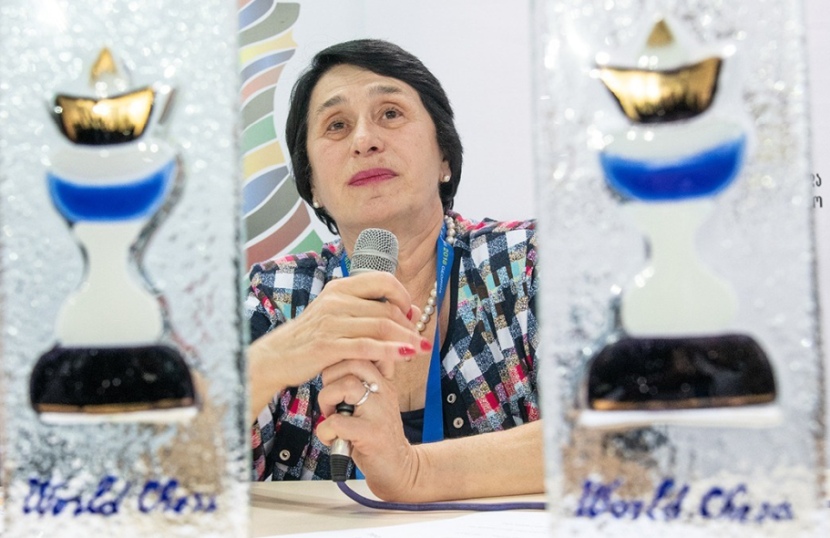
Times flies, they say – Nana Alexandria celebrates her 70th birthday. Born in Poti, Georgia, she learned chess at the age of four and six years later became the champion of Tbilisi among girls. Her rise to fame was meteoric: by the age of 20, she won three USSR Women’s Championships titles (1966, 1967 and 1969) and established herself as a frontrunner for the women’s champion crown. In 1973-1975 Nana went through all the stages of the World Championship cycle and challenged the reigning champion Nona Gaprindashvili. Despite suffering a painful defeat in the Women’s World Championship match (+3 =1 −8), Alexandria managed to regroup and made all the way up again. In 1981 she became much closer to the coveted title but drew the World Championship match with Maia Chiburdanidze (+4 =8 −4), with the champion retaining her title. As a member of the Soviet Union squad, Alexandria participated in six Chess Olympiads (1969, 1974, 1978, 1980, 1982 and 1986) making significant contributions in the team’s winning gold every time. From 1986 to 2001 Alexandria was the chairperson of the FIDE Women’s Commission. The winner of 20 international tournaments, a talented journalist, one of the most determined advocates of women’s chess and bewitchingly charming person, Nana enjoys a great deal of respect in the chess world. It is no coincidence that Alexandria was appointed deputy arbiter at the Carlsen – Caruana match (2018). On the occasion of her 70th birthday, we congratulate Nana Alexandria and wish her the finest things in professional and personal life.