

WGP: Ju Wenjun catches up with Gunina
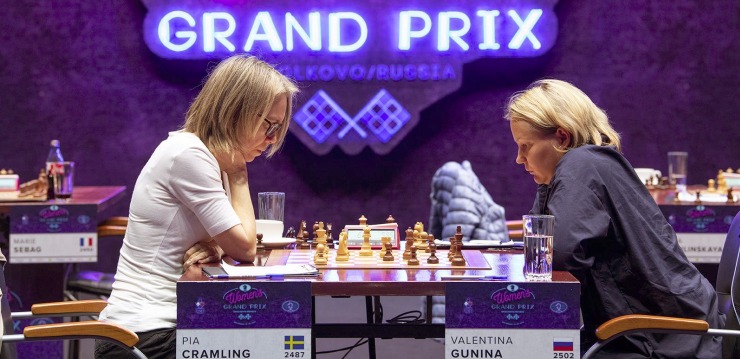
The tournament leader Valentina Gunina (2502) was very close to a setback in her game against the veteran Pia Cramling (2487). Loyal to her style, the Russian jumped into some sharp tactical skirmishes as soon as she had the chance, but the complications didn’t yield her any gain. Quite the opposite, when the dust settled it was the Swede who had a clear advantage, and she appeared headed for her first victory in the tournament. However, short of time, Cramling didn’t manage to crack Black defense and, when the time trouble got serious, decided to go for a threefold repetition to secure a half-point. A Modern variation of the Slav Defence was played in the game between Ju Wenjun (2576) and Marie Sebag (2450). Sebag lost the thread right after the opening, allowing Ju Wenjun’s cavalry to infiltrate her position. By move 20, the position of the French Grandmaster was already very delicate, and the World Champion gave her no chance. This victory allows the Chinese to catch up with Gunina, with 3/4. The second decisive game of the round was the fantastic victory of Alina Kashlinskaya (2487) over Harika Dronavalli (2503). In a Pirc Defence, white quickly traded the queens, dominated the centre, and formed a strong battery on the “h” file, which left black without counter-play. After gaining the initiative, Kashlinskaya showed excellent technique and converted her advantage into a flawless victory, her first one at the Women’s Grand Prix. It was a tough round for the Indian players since Humpy Koneru (2560) was also on the brink defeat. Alexandra Kosteniuk (2495) came out of the opening with a more dynamic position, an advantage that she later converted into a rook endgame with two pawns up. However, Humpy found some creative ways to defend her position – pulling up a final trick, with a stalemate setup, that allowed her to get away with a draw. In the duel between Antoaneta Stefanova (2491) and Elisabeth Paethz (2479) a well-known line in the sharp Najdorf Variation of Sicilian Defense was played. Even though the White pieces looked very menacing, Black’s King was never really at risk. As soon as Paehtz was given a chance, she launched a counterattack that led to a perpetual check, reaching a draw after 25 moves. The Russian derby Goryachkina (2564) – Lagno (2545) ended in a draw. Goryachkina followed a modern idea in the Moscow variation, but Lagno managed to come out of the opening in full control of the position. However, the position was quite symmetrical, with only one open file, and after exchanging rooks the game came down to an opposite-colored bishops endgame. Standings after 4 rounds:1-2. Ju Wenjun and Valentina Gunina – 3; 3-4. Alexandra Goryachkina and Humpy Koneru – 2.5; 5-7. Elisabeth Paethz, Harika Dronavalli and Kateryna Lagno – 2; 8-11. Antoaneta Stefanova, Alina Kashlinskaya and Alexandra Kosteniuk, Pia Cramling – 1.5; 11. Marie Sebag – 1.
World Cup: Seventeen players advanced to the third round
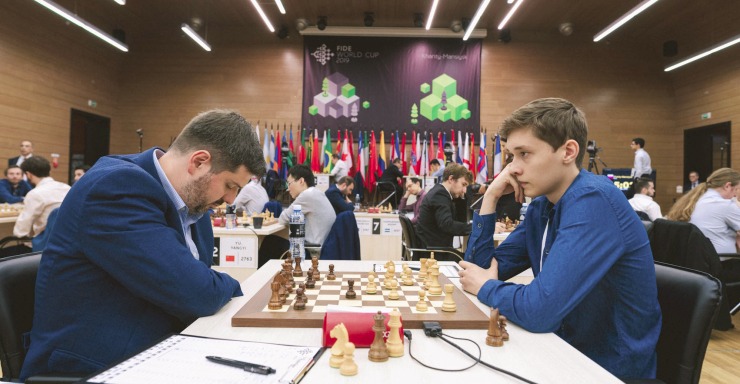
The second games of the Second Round of the World Cup were played on September 14 in Khanty-Mansiysk. Three players – Sergey Karjakin (Russia), Jan-Krzysztof Duda (Poland), and Maxime Vachier-Lagrave (France) – whitewashed their opponents. It is worth mentioning that the Frenchmen have not conceded to his rivals even a half-point so far. Many matches ended with a popular 1.5-0.5 score. In arguably the most sensational one, Liviu-Dieter Nisipeanu (Germany) made a draw from the position of strength with Hikaru Nakamura (USA) and advanced to the third round. Ian Nepomniachtchi (Russia) won his match against his compatriot Alexandr Predke (at some point Ian was three pawns down, snatched the victory), Dmitry Andreikin (Russia) defeated Rinat Jumabayev (Kazakhstan), Levon Aronian (Armenia) was stronger than Parham Maghsoodloo (Iran), Shakhriyar Mamedyarov (Azerbaijan) beat Rustam Kasimdzhanov (Uzbekistan), Xu Xiangyu (China) got the better of Ernesto Inarkiev (Russia), Wesley So (USA) bested Anton Demchenko (Russia), Pentala Harikrishna (India) passed though Vladimir Fedoseev (Russia), Wang Hao (China) defeated Maxim Rodshtein (Israel), Vladislav Artemiev (Russia) won against Ivan Cheparinov (Georgia), Evgeny Tomashevsky (Russia) knocked out Chitambaram Aravindth (India), Anton Korobov (Ukraine) lost to Le Quang Liem (Vietnam), Aleksandr Rakhmanov (Russia) gave way to Santosh Vidit (India), and Daniil Dubov (Russia) had to capitulate in a clash with Alireza Firouzja (Iran). Quite a few matches will once again be decided on tie-breaks. Only two players managed to come back after losing the first game: Eltaj Safarli defeated Nihal Sarin thanks to a terrible blunder from his opponent (Nihal just left his bishop unprotected), whereas Wei Yi from China took revenge with black pieces against the Spaniard David Anton Guijarro . The following matches moved on to tie-breaks after two draws: Ding Liren -Movsesian, Christiansen – Alekseenko, Svidler – Esipenko, Jakovenko – Jones, Giri -Najer, Tabatabaei – Xiong, McShane –Y uffa, Dominguez – Abasov, Grischuk – Bok, Sjugirov – Radjabov, Gelfand – Matlakov, Adhiban – Yu Yangyi, and Vitiugov – Huschenbeth. The tie-breaks will be played on September 15. Official website: https://khantymansiysk2019.fide.com/en/ General partner – Gazpromneft-Khantos LCC.Official airline – Utair.Official partners of the competition: OJSC Rostelecom, Ugra Chess Academy, Russian Chess Federation, AB InBev Efes and PJSC Rosneft.FIDE official partner – JSCo “RZD”.General media partner – News Agency TASS.Media partners – Match TV, World of Chess social network, OTRC “Ugra”, Ugra-news.ru News of Ugra regional newspaper, AIF-Ugra newspaper.
Champions Crowned in World Youth Rapid and Blitz
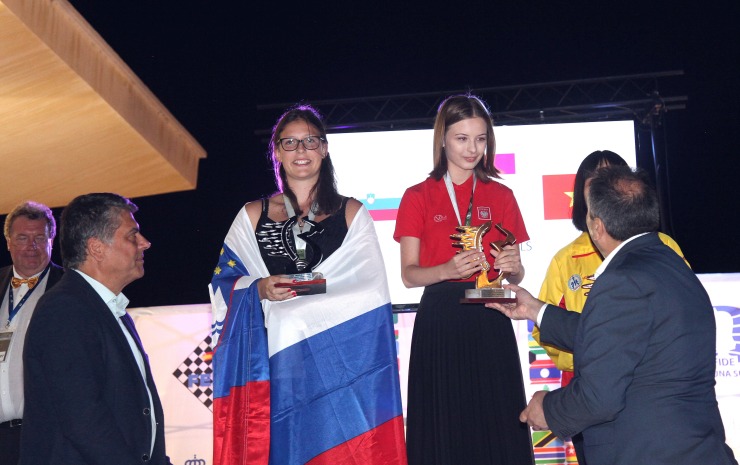
FIDE World Youth Rapid and Blitz Championships (under 14, 16 and 18 years old categories) finished in Salobrena, Spain. 178 players from 22 countries, including 1 GM, 5 IMs, 12 FMs, 1 WIM, 12 WFMs participated in the chess forum in Granada. After three days of intense battles, we have all twelve champions. Final results of the World Junior rapid championships in Salobrena (11 – 12 September 2019): Winner U-14 Girls: Thien Ngan Nguyen (Vietnam) Winner U-14 Open: Aspet Tadevosyan (Spain) Winner U-16 Open: Pedro Antonio Gines Esteo (Spain) Winner U-16 Girls: Cecilia Guillo Longares (Spain) Winner U-18 Open: Lucas Van Foreest (Netherlands) Winner U-18 Girls: Honorata Kucharska (Poland) Final results of the World Junior blitz championships in Salobrena (13 September 2019) Winner U-14 Open: Pham Thien Phuc Vo (Vietnam) Winner U-14 Girls: Thien Ngan Nguyen (Vietnam) Winner U-16 Open: Dominik Horvath (Austria) Winner U-16 Girls: Ngoc Thuy Duong Bach (Vietnam) Winner U-18 Open: Lucas Van Foreest (Netherlands) Winner U-18 Girls: Kamila Hryshchenko (Ukraine) 18-years-old Dutch grandmaster Lucas van Foreest celebrates double success winning both rapid and blitz world championships under 18. He comes from the famous Van Foreest chess family: his brother Jorden won the 2016 Dutch Championship, and both his great-great-grandfather Arnold and great-great-granduncle Dirk were three-time Dutch Champions. It has been a very good year for Lukas so far – earlier in July he won the national championship and is now a part of the Dutch national team together with such grandmasters as Anish Giri and Erwin L’Ami. We will see him in action at the European Team Championship in Georgia in October. “I feel quite relieved, happy. I played such tournaments for the first time in my life. I came here to win,” said Lucas in an interview given to his compatriot Sergey Tiviakov. The closing ceremony included speeches delivered by FIDE Deputy President GM Bachar Kouatly and President of the Spanish Chess Federation Javier Ochoa, vibrant Flamenco dances by local artists and presentation of awards to all the winners.
2019 3rd Quarter FIDE Presidential Board Meeting
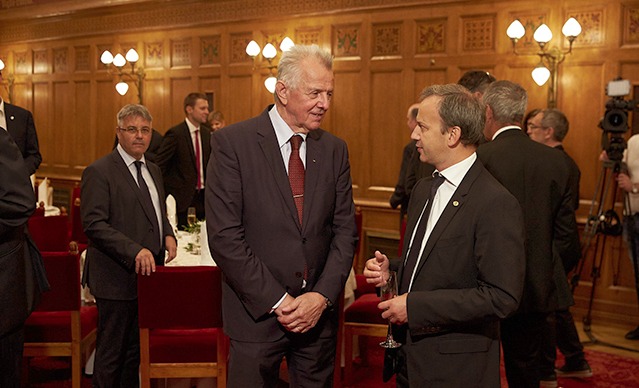
The new FIDE Charter was the main point in the agenda of the 2019 third quarter Presidential Board meeting, held in Budapest last weekend. During the gala dinner, the Hungarian Chess Federation took the opportunity to express their will to bid to organize the Chess Olympiad in 2024. The Presidential Board meeting opened with the report from the FIDE President Arkady Dvorkovich, who informed the attendants about his recent trips to South America and Morocco. The main outcome from these trips has been a firm commitment from political authorities in the visited countries to support chess and to organize some top events in the near future. The President also briefed the Board about the incoming events (World Cup and Women’s Grand Prix), and about the new FIDE website that is about to be launched. On behalf of the Global Strategy Commission, Emil Sutovsky reported on the progress regarding FIDE’s flag-ship competitions. The Candidates tournament 2020 is confirmed to take place in Ekaterinburg during the second half of March (exact dates will be confirmed soon). As for the World Championship, there are three cities interested in hosting the match, but since the three of them requested some extra time, the bidding deadline has been postponed to November 1st. The chapter about the Chess Olympiad sparked an interesting debate regarding the role of captains. Should they be allowed to talk to their players during the games? In many cases, a strong Grandmaster is acting as a captain for a team where the average rating is 2300. Is it fair in a case like this that the captain can instruct a player to accept or offer a draw? Different views were exchanged on this topic, with the general conclusion that the matter deserves a longer discussion in the near future. Another important point that was unanimously approved was the fees reduction. FIDE will cut or waive fees at youth events by 120,000 euros annually, starting in January 2020. This will mean an approximate 40% cut in that concept. A small panel (for more agility) will be created to finalize the details on how this reduction will come into force. Viktor Bologan was in charge of reporting about the Planning and Development Commission and he presented very detailed figures about how the Development Fund has been used so far to support and develop federations to the members of the board. Some members of the board took the chance to exchange views on the best ways to promote chess. Bachar Kouatly strongly suggested investing in formation, rather than in events, while Judit Polgar offered her views and experience on how to use online tools for chess promotion. In general, the consensus was that FIDE should shift a little from supporting events, to support activities that imply grassroots promotion and growth. The most important point of this Presidential Board meeting was probably the reform of the FIDE Statutes. Roberto Rivello was given the task to chair a group of experts charged to prepare a proposal of full reform of the current Statutes, drafting a juridically correct and comprehensive text that the Constitutional Commission proposed to call “FIDE Charter”. “FIDE needs this reform, not only because the current FIDE Statutes were written many decades ago and the role of international sports federations is completely different today, as it is our society. But mainly because we need to move in the direction of a more modern, transparent, democratic and efficient institution, and the main rules of our organization have a fundamental role to play in making this possible.”, explained Roberto, who received warm applause when he finished his presentation. The members of the Presidential Board were invited to a gala dinner at the Hungarian Parliament. Pál Schmitt, former Hungarian Olympic fencer, member of the IOC and politician who served as President of Hungary from 2010 to 2012, gave the opening speech before the dinner. Mr Schmitt told the attendants how he uses to play chess online for more than an hour a day and expressed his firm support to the recognition of chess as a sport by the IOC. State secretary Tamás Menczer emphasized that the Hungarians are famous for being good organizers, with great experience in organizing major international sports events, and the country has a sports-friendly government that supports the efforts of the Hungarian Chess Association. But the biggest announcement came from László Szabó, recently elected as the new President of the Hungarian Chess Association (MSSZ). After stressing the close links between chess and some of the biggest personalities in the history of the country, on behalf of the Hungarian Chess Federation he expressed their will to bid to host the 2024 Chess Olympiad.
WGP: Gunina still ahead
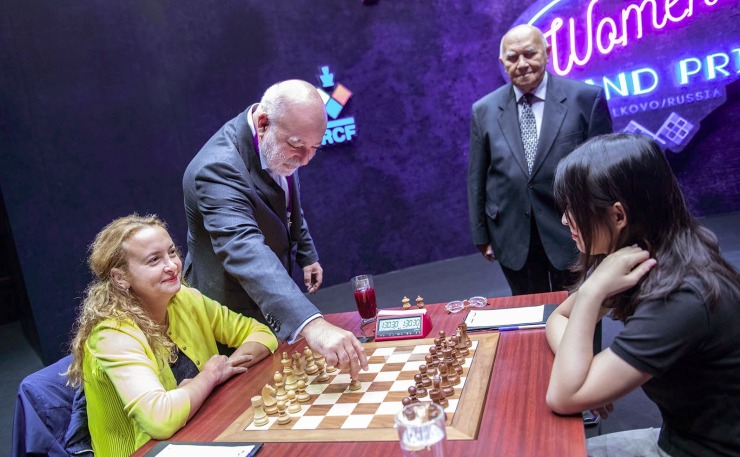
After three rounds, Valentina Gunina is leading the FIDE Women’s Grand Prix with 2.5 points; followed by Harika Dronavalli, Ju Wenjun, Humpy Koneru, and Aleksandra Goryachkina with 2 points; Elisabeth Paethz and Kateryna Lagno are still in the 50% zone – 1.5 each; Antoaneta Stefanova, Alexandra Kosteniuk, Pia Cramling and Marie Sebag – 1 point; Alina Kashlinskaya – 0.5 point. The sole leader of the Skolkovo Women’s Grand Prix Valentina Gunina drew against the second-seeded player Aleksandra Goryachkina and kept her lead with 2.5 points. The Queen’s Gambit was played, where black managed to trade both bishops and held the draw in the endgame. In her game with Humpy Konery Alina Kashlinskaya apparently overlooked the move 18.Neg5! (the exchange 17… Bxe4 was called for) after which it was all over for black. The shortest game of the round lasted just 20 moves. Another Indian participant, GM Harika Dronavalli, celebrated a victory against French GM Marie Sebag. Harika decided to play a very unusual first move – f4, known as the Bird’s Opening (Dutch Defense with reversed colors). Harika gained initiative in the middlegame, snatched a pawn and confidently converted her material advantage in a rook endgame. The Rubinstein variation of four knights opening was played in the game between GM Kateryna Lagno and GM Aleksandra Kosteniuk. The opponents reconstructed a long theoretical line in which Black reached a safe heaven with a perpetual check. The clash between the former World Champion, Antoaneta Stefanova and the current World Champion, Ju Wenjun also resulted in a draw. In the Petrov’s Defence, black managed to get a slightly better position, but it was not enough for something more substantial than a half-point. The evaluation of position in the game Elisabeth Paethz and Pia Cramling hardly deviated from equality, so the draw was a logical outcome. The guest of honor during the third round was Victor Vekselberg, Chairman of the Board of Skolkovo Foundation, who made the first move on the first board. Among the side activities, Grandmaster Sergey Zagrebelny offered a simul exhibition against the students of the Botvinnik Chess School. The four-round games will be played at 3 pm local time (GMT +3) on September 14. Spectators can follow the games with English and Russian commentaries: https://www.youtube.com/fidechannel Official website: https://wgp2019.fide.com
World Cup: Second round started in Khanty-Mansiysk
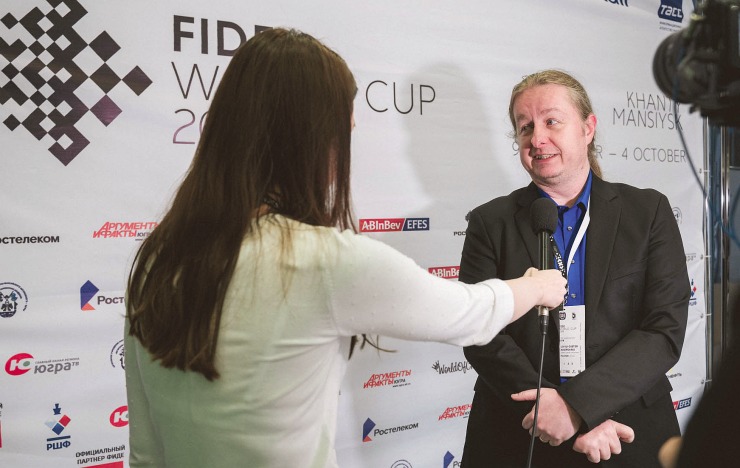
The first games of the Second Round of the FIDE World Cup were played on September 13 in Ugra Chess Academy. Hikaru Nakamura’s loss to Liviu-Dieter Nisipeanu was one of the main headlines of the day. The grandmaster from Germany, playing Black, employed an interesting queen sacrifice and took the upper hand in a complicated game that followed. Nisipeanu had some concerns during the game, though. “I remembered that I looked at it but I could not remember the conclusions. This is always a problem when you’re not repeating the line before the game which I haven’t done. I was quite nervous” – confessed the winner. Despite this convincing victory, Liviu-Dieter is far from complacency: “I expect to face a beast [tomorrow]. I know what’s coming. I hope to survive but obviously, it will be extremely tough!” Another unexpected result occurred in Wei Yi – AntonGuijarro: the Spanish grandmaster won as black against a much higher rated opponent. Shakhriyar Mamedyarov (Azerbaijan) won against Rustam Kasimdzhanov (Uzbekistan), Maxime Vachier-Lagrave (France) defeated Igor Kovalenko (Latvia), Nihal Sarin (India) convincingly outplayed Eltaj Safarli (Azerbaijan), Jan-Krzysztof Duda (Poland) was stronger than Tamir Nabaty (Israel), Evgeny Tomashevsky (Russia) downed Chithambaram Aravindh (India), Vladimir Fedoseev (Russia) lost to Pentala Harikrishna (India), Levon Aronian (Armenia) trounced Parham Maghsoodloo (Iran), Vladislav Artemiev (Russia) got the best of Ivan Cheparinov (Georgia), and Sergey Karjakin (Russia) prevailed in the encounter with Samuel Sevian (USA). All other games, namely Abasov-Dominguez, Andreikin-Jumbayev, Sjugirov-Radjabov, Inarkiev-Xu Xiangyu, Demchenko-So, Huschenbeth-Vitiugov, Nepomniachtchi-Predke, Adhiban-Yu Yangyi, Jones-Jakovenko, Vidit-Rakhmanov, Grischuk-Bok, Ding Liren-Movsenian, Najer-Giri, Dubov-Firouzja, Matlakov-Gelfand, Wang Hao-Rodshtein, Svidler-Esipenko, Alekseenko-Christiansen, Korobov-Le Quang Liem, Xiong-Tabatabaei, and Yuffa – McShane were drawn. The last encounter came down to a rare position two bishops vs. knight (no pawns). According to 5-piece Nalimov database white wins in 68 moves, but the Russian GM failed to find the correct algorithm and the game was drawn on the move 132. The second games of the matches with the colors reversed will be played on September 14. Official website: https://khantymansiysk2019.fide.com/en/ General partner – Gazpromneft-Khantos LCC.Official airline – Utair.Official partners of the competition: OJSC Rostelecom, Ugra Chess Academy, Russian Chess Federation, AB InBev Efes and PJSC Rosneft.FIDE official partner – JSCo “RZD”.General media partner – News Agency TASS.Media partners – Match TV, World of Chess social network, OTRC “Ugra”, Ugra-news.ru News of Ugra regional newspaper, AIF-Ugra newspaper.
WGP: Gunina emerges as the sole leader
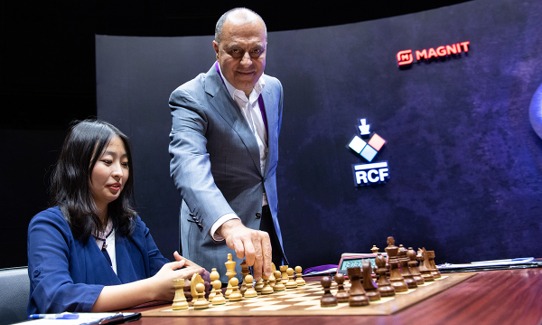
FIDE Vice-President and a great supporter of chess Mahir Mammedov paid a visit at the Skolkovo Women’s Grand Prix and made the first move in the game between World Champion Ju Wenjun and Indian top-seeded player Harika Dronavalli. Mr Mahir brought equal luck to the opponents and the game ended up in a drawish rook-endgame. Valentina Gunina managed to beat her countryman Alexandra Kosteniuk with black pieces. After Alexandra refused to go for the principal continuation and then missed the winning move g5 twice, she ended up blundering an exchange. Rapid activation of the black pieces brought the whole point and sole lead to Gunina. Later, at the press conference, Valentina admitted that she disliked her position at the beginning, but later on she declined a three-time repetition. She added that having Women Grand Prix next to her home brings her great benefits. Valentina also shared her secret of alleviating stress – she does it with a little help from her lovely pets (a cat and a dog). A spectacular game was played in another Russian derby, in which Alina Kashlinskaya’s king was under heavy fire from Katerina Lagno, who obtained a significant advantage after her aggressive advances on the kingside. However, at the key moment of the game, Katerina did not demonstrate the necessary accuracy. Alina sacrificed one of her rooks and forced a perpetual check. Aleksandra Goryachkina went to the Slav Defense Exchange Variation in her game with Elisabeth Paethz. Black managed to mobilize her pieces and equalized position, but on the move 21 Paethz captured automatically on c6 with a queen and found herself in a quandary. To her credit, Elizabeth put up a stubborn resistance and held her unpleasant position. Pia Cramling and Antoaneta Stefanova also played a very entertaining game. The Swedish GM obtained a decisive advantage but missed the precise way 27.c4 Rb3 28. Bc5 +- to win some material. The game between French GM Marie Sebag and Indian number one female player Koneru Humpy was the most peaceful encounter of the second round. The players shook hands on the move 26. The third-round games will be played on September 13, at 3 pm local time (GMT +3). Spectators can follow the games with English and Russian commentaries: https://www.youtube.com/fidechannel Official website: https://wgp2019.fide.com
Round 1 of FIDE World Cup is in the books
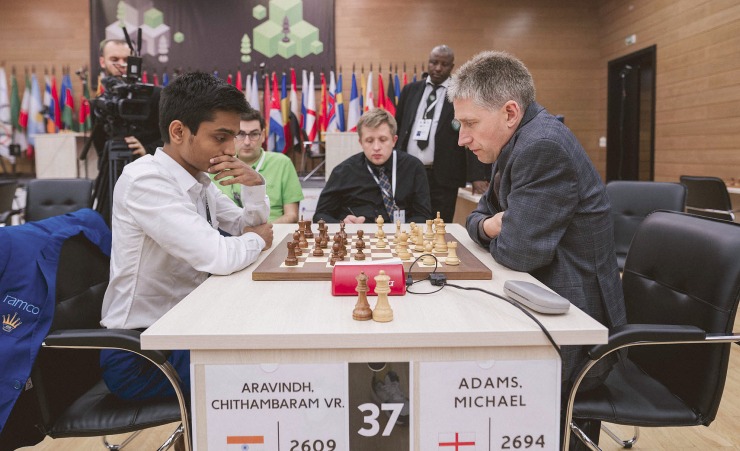
The tie-breaks of the First Round of the FIDE World Cup were played on September 12. A large group of participants secured the overall victory already in rapid chess: Hikaru Nakamura (USA), Evgeny Tomashevsky, Dmitry Andreikin, Maxim Matlakov, Sanan Sjugirov, Alexandr Predke (all from Russia), Benjamin Bok (Netherlands), David Anton Guijarro (Spain), Tamir Nabaty (Israel), Luke McShane (England), Igor Kovalenko (Latvia), Liviu-Dieter Nisipeanu (Germany), Le Quang Liem (Vietnam), and Mohammad Amin Tabatabaei (Iran). Vladimir Fedoseev (Russia), Yu Yangyi, Wang Hao (both from China), Boris Gelfand (Israel), Anton Korobov (Ukraine), and Eltaj Safarli (Azerbaijan) were more successful than their rivals in 10-minute games and also advanced to the second round. An amazing instance of “chess blindness was evidenced in the Shankland – Safarli match. Sam had to win the 2nd 10-min rapid game at any cost but blundered a bishop in a slightly better endgame. Somehow Safarli missed this opportunity and then Shankland decided to continue his bluff leaving the bishop under attack for one more move. Safarli missed a clear win once again, but still managed to secure a draw that punched his ticket into the second round. Bu Xiangzhi (China) suffered a rather surprising loss to his compatriot Xu Xiangyu in this stage. Young Chithambaram Aravindh (India) defeated the experienced Michael Adams (England): after seven draws in a row, the Indian grandmaster managed to win in a second blitz game. The dramatic match between Kacper Piorun (Poland) and Nijat Abasov (Azerbaijan) also reached the blitz stage. The players exchanged blows in rapid and 10-minute games, but Abasov proved stronger in blitz. The competition is organized by the Government of Khanty-Mansiysk Autonomous Okrug – Ugra, International Chess Federation (FIDE), Ugra Chess Federation, and Ministry of Sports of the Russian Federation. Round 2, Game 1 pairings Videos Official website: https://khantymansiysk2019.fide.com/en/ General partner – Gazpromneft-Khantos LCC.Official airline – Utair.Official partners of the competition: OJSC Rostelecom, Ugra Chess Academy, Russian Chess Federation, AB InBev Efes and PJSC Rosneft.FIDE official partner – JSCo “RZD”.General media partner – News Agency TASS.Media partners – Match TV, World of Chess social network, OTRC “Ugra”, Ugra-news.ru News of Ugra regional newspaper, AIF-Ugra newspaper.
WGP Skolkovo: Ju Wenjun, Goryachkina and Gunina take the lead
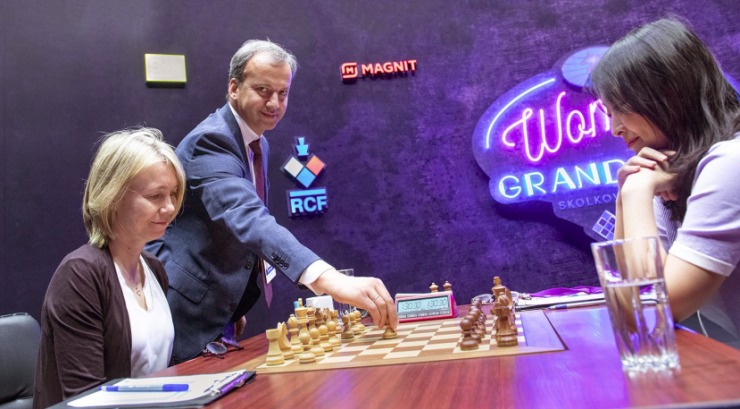
The participants of the FIDE Women’s Grand Prix hit the ground running: the current world women’s champion Ju Wenjun and the Challenger Aleksandra Goryachkina won the first-round games with black pieces. FIDE President Arkady Dvorkovich made the first move in the game GM Cramling Pia (2487) – GM Ju Wenjun (2576). In the game mentioned above, the position went into an early endgame where black got a pair of bishops. The Chinese GM managed to turn this slight positional edge into material advantage which she gradually converted. The game of former World women’s champion GM Antoaneta Stefanova (2491) and GM Aleksandra Goryachkina (2564) ended dramatically. Having an enormous amount of time on the clock Stefanova eventually found herself in a time trouble and made a fatal blunder on then move 31st. Indian derby GM Koneru Humpy (2560) – GM Harika Dronavalli (2503) ended up in drawish rook endgame, although the former had a significant advantage throughout the game. Unfortunately for Hampy, time pressure did not allow her to achieve more than a half-point. Another sharp position arose in the game of IM Elisabeth Paehtz (2479) and the 14th world women’s champion GM Alexandra Kosteniuk (2495). With 22.Bg5 white sacrificed a piece for two pawns in return for a sharp attack on the kingside. Kosteniuk found the most precise way to defend the position and the game ended up with a perpetual check. Valentina Gunina (2502) sacrificed two pawns in order to gain the initiative in her encounter with Alina Kashlinskaya (2487). Alina was holding tight but eventually buckled under pressure making a deadly mistake on the move 30. The game between GM Kateryna Lagno (2545) – GM Marie Sebag (2450) was rather peaceful. Players agreed on draw on the move 34th. The second-round games start on September 12, at 3 pm (GMT +3). Spectators can follow the games with English and Russian commentaries: https://www.youtube.com/fidechannel Official site: https://wgp2019.fide.com
World Cup: 41 Players through to the second round
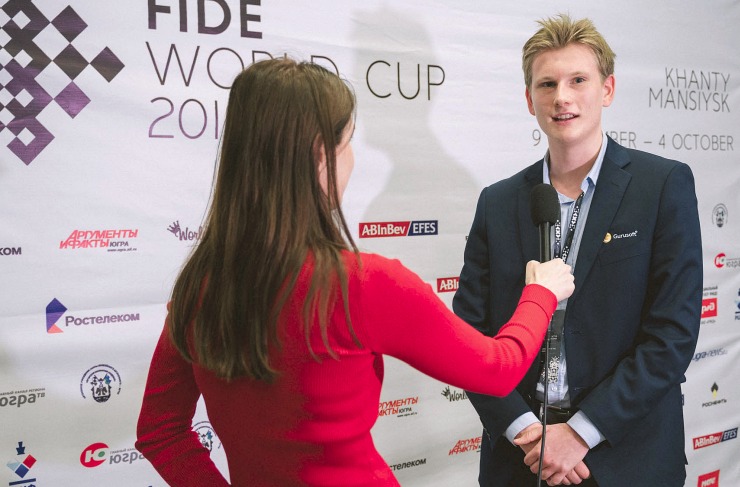
Second games of the FIDE World Cup’s first round were played on September 11 in Khanty-Mansiysk. The World Cup newcomer Johan-Sebastian Christiansen from Norway (pictured above) delivered a major sensation by knocking out one of the rating favorites, Radoslaw Wojtaszek (Poland). The Norwegian won both games of the match. Another unexpected result was observed in a match between Daniil Yuffa (Russia) and David Navara (Czech Republic): the Russian checkmated his experienced opponent and won the match 1.5-0.5. Ding Liren (China), Anish Giri (Netherlands), Maxime Vachier-Lagrave (France), Ian Nepomniachtchi, Alexander Grischuk, Dmitry Jakovenko (all from Russia), Shakhriyar Mamedyarov (Azerbaijan), Wesley So, Lenier Dominguez, Jeffrey Xiong (all from USA), Pentala Harikrishna, Nihal Sarin (both from India), Niclas Huschenbeth (Germany), and Parham Maghsoodloo (Iran) advanced to the second round upon winning both games in their matches. The following players advanced with a win and a draw: the Russians Sergey Karjakin, Peter Svidler, Vladislav Artemiev, Daniil Dubov, Nikita Vitiugov, Ernesto Inarkiev, Evgeniy Najer, Anton Demchenko, Kirill Alekseenko, Alexandr Rakhmanov, Andrey Esipenko (he defeated the former World Champion Ruslan Ponomariov), Levon Aronian, Sergei Movsesian (both from Armenia), Teimour Radjabov (Azerbaijan), Santosh Vidit, Baskaran Adhiban (both from India), Jan-Krzysztof Duda (Poland), Maxim Rodshtein (Israel), Samuel Sevian (USA), Wei Yi (China), Rustam Kasimdzhanov (Uzbekistan), Gawain Jones (England), Rinat Jumbayev (Kazakhstan), Ivan Cheparinov (Georgia), and Alireza Firouzja (Iran). S.P. Sethuraman (India) managed to come back in a match with Tamir Nabaty (Israel). Constantin Lupulescu also managed to level the score after losing the first game to Igor Kovalenko (Latvia). Vladimir Fedoseev (Russia) lost the second game to Surya Ganguly (India), allowing the opponent to tie the match. S.L. Narayanan (India) also came back against David Anton Guijarro (Spain). In the longest game of the day, the Iranian Ehsan Ghaem Maghami defeated Yu Yangyi (China). All these players will continue on tie-break tomorrow. In the matches Gelfand-Lu Shanglei, Nakamura-Bellahcene, Piorun-Abasov, Sarana-Predke, Safarli-Shankland, McShane-Delgado Ramirez, Adams-Aravindh, Amin-Tabatabaei, Bu Xiangzhi-Xu Xiangyu, Tomashevsky-Petrov, Wang Hao-Pridorozhni, Bok-Saric, Andreikin-Mekhitarian, Mareco-Sjugirov, Parligras-Nisipeanu, Matlakov-Abdusattorov, Le Quang Liem-Alexandrov, and Gupta-Korobov both game were drawn. The first round tie-break with 23 matches scheduled will be played on Thursday, September 12. Tie-break Pairings Official website